Documentation – a picture’s worth a thousand words

Doctors believe what they see.The training they get and the laws they must follow all reinforce that. If they see it themselves, then it’s real; if they only hear about it, it’s hearsay, which is much less believable.

This is why it’s hard for us, as chronic pain patients with all sorts of hidden issues, not to come off as shrill and demanding: we expect them to believe what we say, and they find that outstandingly hard. It goes against everything they really know.

Therefore, show them. Put it in pictures, put it in print, and watch their expressions change before your very eyes.

sketch of excessively happy doctor running with a hypodermic needle
They should always move with such alacrity and glee 🙂

This is the first in a series of posts about the documentation that I’ve used over the years. I’m starting with the time I got tired of pointing to my arm and saying, “Well, it was like this (gestures) last week and it’s like this (different gestures) most of the time this week. It’s only blue because of the cold.” And then he couldn’t remember what I said it looked like a week ago.

No help at all.

So I went home, put my hand and forearm on a piece of paper, and drew an outline around it. I came up with a set of symbols to show what I needed to track, and marked up the outline accordingly.

As my situation changed from week to week and month to month, I grabbed paper, put my arm on it, drew another outline (I really should have made blank copies), and filled it in with the current state of my arm.

Lo and behold, I hardly had to say a thing. One doctor looked over my stack of images and said, “Wow. They really tell the whole story, don’t they? I hardly need to look at the medical record.” He did anyway, but was pretty quick.

My office visits were a lot more productive after I started keeping those pictures. I called them “snapshots” and collected quite a few of them before the case became too complex and moved into different territory. (More on that later.)

Here’s the key I came up with to explain the symbols I used for the symptoms I had at the time:
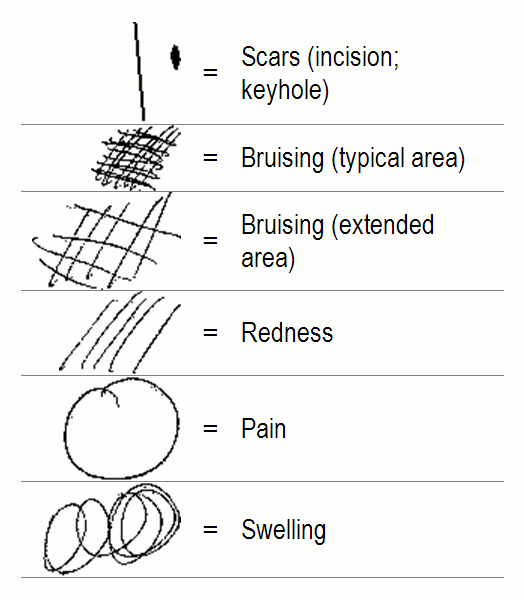
6 different scribbles to show 6 different signs and symptoms
key to snapshot scribbles

As you can see, I just scribbled patterns which I found easy to remember. Nothing fancy.

Each sign is distinct from the others, except for the two strengths of “bruising” (I now know that that was CRPS discoloration), which are the same symbol at different densities. Makes sense, right?

Here are the first 3 images, and what made the difference between them:

Baseline, after working as best I could with the injuries:
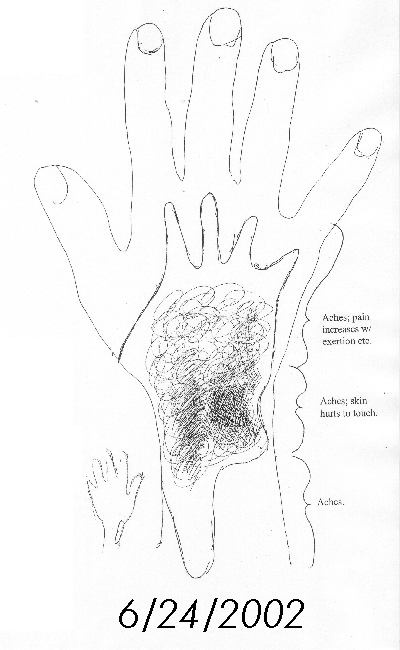
sketch of hand that shows extensive pain and bruising.
My first stab at this. What can I say? I was a writer and musician, so I took my hands very seriously.

After about 4 weeks off duty, resting and recuperating:
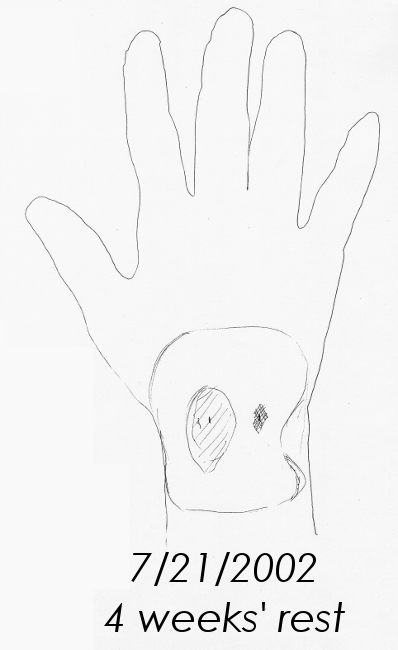
sketch of hand showing very little pain or discoloration.
It took 2 weeks just to relax, but I succeeded.

After 1 single week back at work on restricted duty:
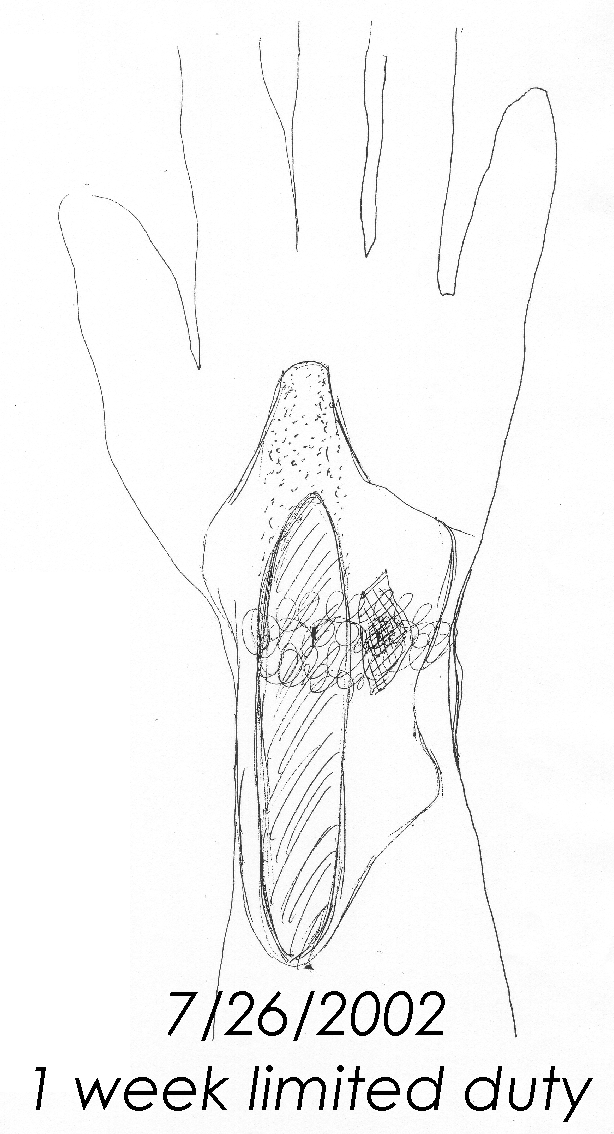
sketch of hand showing pain and discoloration going further up the forearm than ever before
Yeah. Sucks, huh?

That doctor was right. They really do tell the whole story.

See how easy that was? 🙂 All it took was a pen, paper, and a few notes.

Here are some tips:

  • Put the date and your name on every single one, always.
  • Be consistent about how you label things. They don’t need to learn different labeling systems, they need to learn your case’s course over time.
  • This is a good place to note your pain ratings.I annotated my snapshots with current pain range (at rest and on exertion), bullet points and narrative notes, but it took awhile to learn to keep those annotations very short and to the point.

I scanned all the snapshots into my hard drive, so I can recreate these at any time. I find it very useful when breaking in a new team, because the story told by my first few years of pictures really does tell the key parts of those first few years. They “hardly have to look at the medical record” to understand — and remember! — what happened.

Plus, you clearly don’t have to be an artist to make these pictures accurate and useful 🙂 If tracing around your own limb is too painful or awkward, there’s no reason not to ask someone else to do theirs. Alternatively, you could take a photograph and use image-editing software (available with your camera, or for free or cheap online) to mark the image with your signs and symptoms.

There are lots of ways to get these images going, with any set of tools. And boy, are they ever worth it.

As a point of interest, the freeware I use for editing images is called Gimp. Perfect tool-name for someone like me, eh?

Expletives can be good

I’ve always been a wee bit daffy, so the additional daffiness of pain-brain, combined with the clumsiness of my brain’s shoddy un-mapping, re-mapping, or possibly dis-mapping of my body and physical environment, leaves my daily life simply packed with faux pas and prat-falls of one kind or another.

Mr. Keaton, clearly making a decision in a moment of pain-brain.

These used to upset me considerably, and I’d try to re-normalize the situation as fast as possible out of the combined distress of embarrassment and fear about the brain-invading nature of this disease.

This morning, I turned away from the counter too fast and knocked over the oil-filled heater. Instead of dissolving in humiliation and anxiety, I pursed my lips, finished what I was doing, and pulled up the heater when I had a hand free.

My sweetie J, as usual, said (without the asterisks), “You f***ed up,” with a unique combination of resignation and relish. (Nobody says, “You f***ed up,” like he does. It’s a gift.)

The more trivial the faux pas or prat-fall, the more pronounced those syllables are. “You f***ed up” becomes more emphatic, the more meaningless the mistake.

It never fails to put things in perspective.

Something I’m going to write about, once I figure out how, is The Flinch — the way that years of isolation, vulnerability, and abuse left me twitching in fear with the least expression of displeasure or annoyance in those around me.

Last summer, my excellent hostess L, who has a magical combination of boundless compassion and ‘no b.s. thank you’, was the first to let me know that I’d become a nervous nellie extraordinaire, and helped me start to retrain myself.

When I moved in with J in October, he let me know, after a couple of weeks of me jumping and flinching and asking permission to use my own damn home, that The Flinch was back and needed to take a lo-o-o-ong vacation.

“You f****ed up” is part of his droll approach to that inescapable fact of life, frustration. It’s part of his gift for surviving with his golden personality intact. He says things like that to defuse feelings before they even start to pile up.

I grew up in New England. Do I need to say more? We don’t defuse … what, feelings? We are very intellectual in the way we admit that we even have any. The first few times he told me, “You f****ed up,” I stared at him in shock.
me, looking absurdly shocked
I’m used to it now. I laugh, or agree “I f****ed up,” or turn it around and say, “Yeah, you sure did.”

I can’t do any of that and flinch.

Long ago, I observed that a good partner was one who handed you the way back to yourself when you got lost in the confusion of life. Simply telling me it’s no big deal is not that helpful — I know in my head that it’s no big deal, but the feelings in this over-torqued, dis-mapped brain all charge ahead nevertheless.

J’s way of showing me, by making the bigness of the deal ridiculous, stops that routine in its tracks.

I f***ed up. So what? I’ve got a fresh pot of tea waiting on the other side of that radiator. And that’s what matters! 🙂
teapot-eaglehaslanded

On sleeping despite all this

This is a brain-dump from a recent social-media post. Since the same question was asked 3 times in one day on my groups, I figured I might as well put it all right here and link …

Stylized image of woman asleep with enormous red and black dress billowing around and supporting her. White snow falls from a deep blue sky

I used to be a night shift nurse and a home care nurse. Boy, do I have advice about helping your body sleep. Pick and choose what to start with and try as many of these ideas as you want, until it starts coming together and working well for you:

* Positioning. (Old nurses and physical therapists can be really good at this — we don’t get to write prescriptions, so we have to go with what really works and has no side effects. Oops, did I say that out loud?) Invest in enough pillows that you can, as needed, elevate appropriate limbs; support your neck; cradle your head; support your back and hips; pad your knees; get your upper body at a good enough angle so your blood doesn’t pool too much in your head; if you’re a tummy-sleeper, this can be really interesting because you need to slant your whole body from the knees up. Positioning, and the pillows/towels/blankets that requires, is generally the first thing to address.

* Have a regular bedtime routine. This gives your body and brain a consistent, reliable set of cues that it’s getting towards That Time. Our too-plastic brains need to be constantly retrained. Mine starts about an hour and a half before bedtime; I would do well to move it up to 2 hours,, as my descent into sleep is iffy.

* Turn off electronics (TV, phone, interwebby stuff) 1.5-3 hours before bed. There are several reasons for this: multisensory stimulation, EM activation, input from the outside world beyond your control, input you need to react to or decide not to react to (all of which suck up neurotransmitters.) All of this cranks up the primitive brain. Mine goes off around 8-8:30 pm.

* Listen to soothing, calming music for an hour or two before bed. I love classical chamber music, especially Mozart, Bach, Schubert, Rachmaninov, Pachelbel – elegant but not too emotional. Soft jazz or soft rock are also good for those who don’t care for classical. The brain patterns readily to music, so this is like free help.

* Speaking as a night shift nurse, I have to say that chamomile tea is the best, bar none, the BEST way to get the squirrels off the wheel. It doesn’t make you feel as “different” as sleeping pills do, so many people under-rate it dramatically. I noticed that most of my patients couldn’t even get halfway down the mug before they passed out completely, so I know it works objectively, even if it isn’t dramatic subjectively.

* Tulsi, or holy basil (Latin name occinum sanctum), is an herb from India that actually lowers cortisol. (It was used to teach novice monks what a calm mind feels like, so they could get it together with their meditation.) If you get that pop-awake in the wee hours, that’s probably cortisol, and tulsi at bedtime can do a lot of good.

* Ashwaganda has similar abilities, but I haven’t used it much so I haven’t studied it. See what you think. Some teas have both.

* All major herbal traditions have herbs that help. Tulsi and chamomile work best for me, but valerian works for others. I find hops stimulating, and wouldn’t go near poppy or belladonna because of my CNS sensitivities. Those with migraines, central nervous system and some vascular issues need to check twice before using some hypnotic herbs… This is well worth discussing with an herbalist, because they can make all the difference if you get the right recipe.

* Melatonin can help, too. There are two ways to use it: at a “metabolic dose”, which means one tablet can last 8 doses, and that’s just to remind your body to do its calming down; or at a pharmaceutic dose, in which case you can experiment with the different dosings available (usually from 1 to 4 mg, I believe.) See which works for you.

* You can also use 5-HTP before bedtime, which is a good serotonin precursor. If you’re on antidepressants, start at low dose and be mindful of its effects; it can potentiate your antidepressants, making them more effective at a lower dose. Being overdosed on serotonin can be counterproductive, as it makes it very hard to wake up completely!

* If nightmares are making it hard to nod off (often the case for me; I can tell I’ve been having nightmares if I can’t make myself calm down for sleep) then lavender oil dabbed onto either side of your pillow can be a real help. Or a lavender pillow, but remember to refresh it as needed. It’s very good for keeping nightmares at bay.

* Get what activity you can, pretty much every day, and stop exercising either before 5 or before 3, depending on your system. Activity helps regulate the autonomic nervous system, especially if you respect the body’s natural diurnal cycle and take enough time to let the neurochemistry slow down at the end of the day.

* Be mindful of your caffeine intake. Caffeine in the morning can be a huge help to keeping the diurnal cycle regulated, but it’s important to lay off it in the later afternoon and evening, because the disruptive effect always lasts longer than the real waking-up effect.

* Be gentle with yourself. Take the time to learn what works best for you. Be considerate of your household regarding lights and noise, so there’s less fallout in the morning. When you’re stuck awake, remember that rest is still restful, even when it isn’t sleep, and do your best with what you can get. If all else fails, make the most of the time, and try again tomorrow night.

Prolly enough to go on with for now… any other thoughts, folks? 🙂

On a lighter note…

toon_dlewis_bedtimeroutine

International group post: Love is portable

The point is this: love is portable. Real, solid love can handle time and distance.

I’ve been saying that for a very long time. I didn’t know, however, that even the formation of love can cover distance. It can cross the globe.

I grew up overseas. Since there wasn’t always a credible, accredited school where we lived, this meant we kids were sometimes away from the family for months at a time. I learned to handle it in a curious way …

I realized, in a deeply personal way, that the same sky covered us all, and the same world held us. If I could see the stars, I felt very strongly that my brothers and parents could see those same stars — if not today because of clouds, then perhaps tomorrow or yesterday — and knowing that we could look at the same stars was a powerful comfort to me.

Beautiful colored view of a star-forming region
Star-forming region in the Magellanic Cloud. Photo from NASA’s Hubble project.

It doesn’t have to make sense, if it works.

As an adult, I got a dreadful disease that requires more research to manage and understand than one person can do in a lifetime. It took me weeks in the Stanford medical library to realize I had something truly rare. Once I was finally diagnosed, it took me months to begin to understand the complexities of what I have.

I also got the internet and a membership in an online pain group … and eventually a blog and social media accounts.

And suddenly, I wasn’t alone.

That first group’s administrator got me through the second major test of survival. (This disease has caused quite a few.) She’s on the other side of the country.

As I’d reached out to her in desperate need, I found someone else reaching out to me in a similar fashion, and she’s a nearly equivalent distance North, in another country.

Then I met the Swede, the Briton, the Belgian, the Icelandic… then Australians, New Zealanders, Chinese, Japanese, more Britons, French, French-Canadian, Dutch, Danish, Mexican, Argentine, and on and on and on. Any country with a health system sophisticated enough to think of, and look for, rare diseases, seems to have people with CRPS.

Let’s think about that for a moment.

OK, that’s long enough. It’s depressing.

The truly international distribution of the disease is almost as penetrating as the international distribution of the internet.
The Earth's winds. Not a bad metaphor. By NASA's Goddard center.
I could go on about the obvious benefits — having someone to chat with at almost any hour is a good one; having such a wealth of perspectives on health, medical delivery, and self-care is another; being able to discuss findings in one country that aren’t yet known in another is a hottie; and, of course, there’s always someone worse off to make me feel humbly grateful for my little all; but these are pretty obvious and probably stated better elsewhere. I’m not doing too well above the neck this week and I have to keep it simple.

This disease has stripped me of many of my friends, my careers (both of them: nursing and software), almost all of my hobbies, most of my strength and stamina, and pretty much every illusion about life and humans that I ever had.

Life can be bleak when it’s this lean. There has to be more to live for than usual, not less, when every day is another stab at the same tedious, repetitious, miserable slog that would make me say to Sysiphus, “Quit your whining, kiddo. Trust me, you’ve got it easy.”
Sysiphus looking miserable as he pushes a rock up hill... with poor body mechanics.
But every connection that I make with my CRPS cohorts makes me stronger. And — how do I say this without sounding mushy or daft — these aren’t superficial connections. I would gladly stop a bullet for my friends, not that that’s likely to happen … but then, it’s easy to find something worth dying for. The trick is finding what, or who, is worth living for.

Any hour of day or night, I can log on and find a soul-sibling somewhere in this world, beyond first-languages and politics, beyond gender and race, beyond anything that might have mattered once.

I don’t have time to ask permission to use names before posting, so my own ethics force me to skip personalization, but the fact is, ladies and gentlemen, you light up my world.
Earth seen from the moon. Earth is gibbous.

When I get discouraged or disgruntled about this tedious, repetitious, miserable slog, and I can’t remember the self-care routines that can help me with it, instead I remember my friends: this one’s Celtic ferocity; that one’s wry wit; the painful eloquence of one; the utter gentle kindness of another; the ghastly spelling over the radiant sweetness of yet another; the shining fragile beauty and boundless courage of, well, all of them …

Every piece I write has to meet multiple tests of integrity before it gets posted: factually accurate, logically defensible, ethically sound, emotionally true (but as the rambling nature of this one indicates, brilliance is NOT a criterion, or I’d be posting a whole lot less.)

That list of criteria has a lot to do with who I think of when I write. It’s this absolutely global, polyglot, brilliant, loving, well and widely informed set of people. Each one of us has our strengths and our weak points, but collectively, we are astounding. Utterly astounding.

I have to live up to that, and be translatable … and it’s an honor and a challenge, every time.

CRPS has taken much, but the internet, mother wit, and a quorum of luck has given me infinitely more. I’m a better being and a better writer because I share the world with people like this … and I’m aware enough to know it.

I have plenty to live for. Screw the slog. Sysiphus, move over and I’ll show you how it’s done.
girl on a flat beach kicking a ball high

Being clear about being grateful

We visited our favorite hot springs last week. There’s a hot pool that’s very hot indeed. When I alternate between that and the cold pool, preferably dipping several times, it becomes quite a fabulous experience.

Stone angel with hands clasped in prayer, standing on a pillar, sun like a glorious halo
Halleluiah!

Whether it’s the lymph getting going properly for a change, or toxins (the few that are left) getting sucked out of my system, or my autonomic system finally getting a clue and just taking a break, or possibly all that and something more, I have no idea. But it can be really good.

gleeful woman grinning, sitting in a sailboat cockpit, sunny water behind her
REALLY good!

I did my dips and bounced gently on the balls of my feet in the hot pool, overflowing with something like gratitude. I’m no fool (I just take an off-road approach to life) … offering gratitude works, even with a conception of spirituality based more on quantum physics than religious dogma.

Things go better when I’m classy enough to express whatever gratitude I feel.

However, it has to be “true enough to write,” my ultimate litmus test of sincerity. (That really is my key phrase when I’m thinking about truth, writing, or both.)

George_Goodwin_Kilburne_Writing_a_letter_home_1875There’s no fooling the All, because I’m part of it and I know the truth, even when I don’t want to.

Letting my head fall back into the welcoming warmth, I thought a moment, letting the feeling swirl through me like water.

Grateful for my life?
I have to be honest (though it may mean I have an inferior soul or something) … I’d love to be. I think that somehow I ought to be. But really, when you get right down to it… too many caveats.

Grateful for this day?
Well, y’know, there was too much of the day left that could go wrong. Experience has been too strong a teacher to make me grateful for something before it’s in the bag.

Grateful for this moment?
Ah yes, there we go.

I felt my spine let go of the last knot.

I could say, without hesitation and with perfect integrity, that I was definitely grateful for this moment. Completely, unwaveringly glad to have it. I was truly thankful for that heavenly bit of space-time I’d found myself in.

Crab_Nebula-crop
Heavenly, beautiful… grateful for it

The moment stretched and smiled and wrapped me in blissful arms. It made me stronger and more content, and I faced the bumps and mild insults of the rest of the day with fairly unruffled peace.

It turned out to be a good day. A day to be grateful for.

Painting my limbic system blue

I’m not used to having TV. I grew up in Egypt, at a time when you only needed to take off one shoe to count all the TV channels in New Jersey. Didn’t even have to put down your real-sugar-sweetened soda to count the channels in Cairo — none of which were in English.

arabic-tv
This delightfully expressive image is from wn.com

J is a more normal American, so between his restoration of normality, and my sense of novelty, we’re delighted to have TV again. His ear for BS is too keen to make sitcoms bearable, so we default to true crime, amateur survivalist, and judge shows, where people really are that idiotic and don’t have to pretend.

A couple of days ago, we stumbled across a show about felons on the lam. I think that was on one channel or another from noon to bedtime, except for the news. It was strangely entertaining, seeing how people fool themselves into believing the false lives they create.

For the past two nights, I’ve woken up in the wee hours from dreams of having done something I knew wasn’t quite right, then it turned out the feds really didn’t like, learning that they were displeased, then discovering they were after me (a mortal issue, since I wouldn’t survive a week in prison), then finding myself hiding and running and trying terribly hard to be clever enough to survive in my decidedly impaired mental state.

This morning, I woke up feeling, quite vividly, as if my limbic system — that set of tiny, nervous parts clustered deep in the primitive brain — was huge, red, and pulsing with overstimulation.
brain_limbicsystem-inflated
I’m no fool. I know how to deal with imaginary brain inflation.

I wrapped a band around it, colored the whole thing a pleasing blue, and gently and persistently cooled and prodded it down to a more reasonable size.
brain_limbicsystem-deflated
I also massaged the point between my eyebrows that my old acupuncturist used to needle when I was too jumpy to let her stick sharp objects into me.
acupuncture-yintang-institutyinyang
When I was calm enough to do my brain exercise that stabilizes my ANS somewhat, I worked it like a plowhorse.

Once I had done that, I was actually capable of noticing how tense my system feels, and could mentally reach the lever that makes that inner spring gently unwind.

Then J brought me a nice fresh cup of hot tea in bed.

mug-drwho-steam
…Oh, heaven!

Then I read this out to him, and he laughed out loud.

Now, it’s a good day.

Isy’s principles of blogging 101

Quite a few people I know are going into blogging. Most of them are CRPSers, all of them are clever and interesting, and I think that is terrific. I couldn’t find a Blogging 101 that wasn’t oriented towards cashcow blogs, so I figured I’d better write one.

Each writer who writes as themselves is unique, and the more of us who write truly about CRPS (or whatever we struggle with), the more others will begin to understand what’s really at stake when we talk about managing and even curing it.

The more, the merrier!

First, let’s knock off some assumptions…

What it isn’t

– A blog post is normally not a chapter in a book, or a news article, or a short story — unless it is. If you’re posting any of the above, it means you’re writing a particular sub-category of blog, which is a good thing to be clear about. (Generallly, a blog is a place to work out ideas which subsueqently turn into books or articles, we’re writing for.)

– It’s not a journal. Generally, it’s creepy people who want to read other people’s journals; most of the rest of us are uncomfortable with that feeling.

– With that in mind, writing a journal entry before writing a blog post can really help deliver a punchy, powerful blog post.

Then let’s talk about the almost unlimited potential…

What it can be or do

– A great place to work out ideas that later go into books, articles, and so on, with more focus and a better understanding of the audience. The interaction and feedback you get on each nugget of thought is a great way to learn how to tune your writing and make your ideas clearer.

– Pre-marketing. When people love your blog, they’re liable to be interested in any work that comes out of it: books, articles, even speaking tours or movies.

– Wonderful way to connect with people in your target group, the group of people you want to explain things to or share things with.

And now some basic guidelines…

What a good blog usually is or does do

– Each post has one or two main points. A post is a limited space, oriented towards people with not a lot of time — either because of work, attention span, or memory issues. Keep each post to the point.

– Short posts get read more. Kinda sad, but true.

– The above is a good reminder to keep the writing “tight”, that is, no needless words, no needless sentences, and no needless paragraphs. (Another reason why journaling is so helpful — we can get the need to gnaw on an idea out of our systems, so we can step back and deliver it more tightly and strongly in less space.)

– Be particular about which posts get long, and keep them engaging to someone outside one’s own head. Extended metaphors or an underlying plot can keep people reading.

– Serious stuff matters. Humor keeps people reading. The two often go together really well, or at least can take turns gracefully.

– Keywords/categories/tags (the terminology depends on the blog host) are important. They help people find your blog online, so choose terms that people are likely to search for.

And finally…

Further tips and suggestions from my experience

– As I have to remind myself now and then — my readers are people outside of my head, not in here with me 🙂 This helps me explain and unpack when my first impulse is to be telegraphic; it also keeps me from belaboring a point that’s bothering me more than it would bother someone else.

– I get a lot out of watching the director commentaries on good/entertaining films, especially if there are director commentaries on the deleted scenes and outtakes. Hearing how they chose to eliminate much-loved or super-cool scenes in service to the overall piece, is like a mini-workshop on creative structure and knowing what your priorities are. Most notably, the concept of eliminating “repeated beats” is key to keeping my blog posts solid. I’ve deleted some great lines, but they aren’t missed. It took awhile to realize that, if they won’t be missed, they aren’t needed.

And now for a practical note…

Choosing a setup for blogging on

If you have access to a server and a web geek, read no further. You’re set. Just do what they advise and ask for any help you need.

If you’re totally new to all this, it’s not crazy to go to http://blogger.com, set up a Google account if you don’t already have one, and go through their step-by-step process for setting up and customizing your blog. The upside is, they really protect you from spam and thin out the hacking issues. The downside is, once you’re hacked, you’re hacked. They don’t seem to have a way of letting you build in extra protections.

If you have some geek skills and can get access to a server or hosting service, you might prefer http://WordPress.com to build your blog site with. It’s highly customizable and you can choose from plenty of forms of protection, which you can alter, tune, and change as you like. Downside: the spam is horrific. Upside: You can always upgrade your hacking protection.

There are a growing number of options, but I’m describing what I know and have worked with myself. Hope it’s helpful.

Happy blogging 🙂

Link list

Predatory mis-links are so common now, I aim to be more diligent about providing lists of the links I actually use in my blogs. That’s not a bad tip, actually, and it was first suggested by one of my readers 🙂

  1. Writing Like Yourself, by yours truly
  2. Blogger.com
  3. WordPress

Getting the important things settled

It took roughly three weeks to recover from the move. For much of that time, everything was bathed in a whitish sheen, and getting more than one coherent sentence out at a time was a crap shoot. I’m learning to relax through these times, knowing they’ll pass, especially since I had someone to keep the place cleanish and make sure food landed on the table once in awhile. You’d be amazed how much energy it frees up, having help with the demands of daily living.

It took about three and a half weeks to get internet going at all, and even then, it’s slow. My original workstation was so astoundingly awkward I had to sit sideways on the settee in order to type while hooked up to the modem. Short surf sessions, needless to say, with frequent breaks. Awful.

Yesterday, I pulled apart all of the — wow — truly excessively complicated hookups laid in by the prior owner. I reran wires, relocated cord-keepers, moved the faceplate from its hidden location in the cupboard to the wall where it can conceal horribly ratty holes including the one that the cable goes through, moved the huge coil of excess cable (15 feet, at a guess, of which 3 were being used) off the TV and strung it along the wall… to where I can now sit up comfortably in my bed, power and modem hooked up to my laptop, and noodle away in perfect peace. I put the remaining cabling — 2 pieces of extra CAT5 cable, triple-wire connector cable, ethernet cable, and a random small piece of 2-wire connector cable — zipped up in a plastic bag and shoved out of sight.

I’d take a picture, but there’s nothing to see. Just a cupboard, with a splitter at one end and a single white cable secured to the underside of the shelf, until it plunges out of sight to head off to its final destination.

There’s a bit of extra cable looped and secured neatly against the back wall. In electronics and electrics alike, if the wire is just the right length, then it’s too short. Give it a foot (not twelve feet) of slack, neatly stowed.

The key to routing wiring of any kind is: it should be as simple as it can be, and no simpler. I kept chanting that in my mind as I pulled things apart.

With that thought, I didn’t have to keep the whole puzzle in my head. There was an intake end and two output ends, and the shape of everything in the middle would be derived from necessary functions and the available space. Not, for crying out loud, from the needlessly complicated cat’s cradle I’d inherited.

When I got started, J stood by quizzically as I pulled out the hefty coil of cable, pointed out the rat’s nest around the splitter, and displayed other bits of insulated-wire macrame, each time snorting in gleeful derision and saying, “Amateurs!”

Finally, after he dodged the shrapnel from my 3rd dive into the tool drawer, he got that look that says, “time to get out of the danger zone,” and took off to run errands.

I’m not as fast as I used to be, so it took from noon until sunset to get it all done and neatly stowed. J wandered back as I was finishing up, and was more flatteringly impressed than I’d dared to hope — really wowed. He wasn’t sure why I’d gone to all that trouble to clear cupboard space (which was one nice side-effect, in this limited space), but when he saw the cable over by my new workstation, which is about the most comfortable place there is to sit, it made more sense.

He should be able to watch TV at the same time that I’m working online. To us, this is sybaritic paradise. Bring it on.

Tech note: My internet has to be hardwired, because the radiation from being near wifi consistently makes me sick. The nausea, weakness and racing heartbeat are unmistakeable.

I keep the wires off my arms with pillows, so that, even though the wires originate behind me, they don’t come within a foot of me until they’re almost at the laptop. This is about as good as it can be here. After sitting here for most of an hour, I’m fine. Just fine.

Persistence, chronic illness, mortality, and other perky subjects

I’m recovering from packing and moving to my homestead. [I’m sorry to say that I don’t have internet yet, and the library’s uplink is slo-o-o-o-ow. Images will be filled in once that’s corrected. In the meantime, you get to see how I flag where the images will go.]
[img]
The cat is ecstatic. He’s getting muscular, too. He’s bigger than most of the cats I’ve ever had, and he’s only 8 or 9 months old. J is falling in love with his saucy sweetness — they’re a well-matched pair.

It took a week just to be able to think in a straight line again. I’m still very slow, but improving. Breakfast is my best meal, so I try to make it a good one — my stomach is not nearly as happy as the cat about all this.

Yesterday, as an aid to recovery, J and I went to the nearby hot springs for steaming and soaking.
[img]
We usually get nicely parboiled in a couple of hours, but I got horrifically dizzy going from the hot pool to the cold. Usually it feels terrific (one reason I keep going back) but I think I stayed in too long — 2 whole minutes… When I was able to see, I noticed that my skin was bright red; I touched it, and it was as hot as if I had a fever.

That’s the hyper-reactive response we get with a twitchy autonomic nervous system (ANS.) This is why we don’t ice our injuries with most forms of CRPS.

All my skin’s blood vessels spasmed with the cold, then the spasming set off an alarm in my wackadoodle ANS, and my ANS ordered all those peripheral vessels to open wa-a-a-y up.

What does that do? Sucks all the blood out of my brain and out into my skin, that’s what. Result: dizziness to a frightening degree. J helped me get out of the pool without drowning, and got me safely benched.
[img]
I realize I tend to overestimate my capacities, but that really was a first for me.

Periodically — and with increasing frequency — I get FED the heck UP with having these diseases — CRPS, FM, MCS, POTS, GERD … I’d have to be a British peer with medals and degrees to have that many letters after my name, in any other context.

These diseases are not recreational. They don’t just pop in, have a good time, and then take off.

They’ve moved in. They’re here for the long haul, or at least that’s what they seem to think. They take the concept of “persistence” to a whole new level.

It reminds me of something… H’mm. Oh yes.

In February 1999, I got a phone call at 4:10 am from my stepmother, telling me my father was dead. I still remember the way the word “no” kept echoing off the walls, until I realized it was me who had cried it out. I won’t describe the next few weeks, except that there was a lot to do (he had died in Egypt) and I learned a lot about the people in my family (interesting, not worrisome.)

After a few months, when the acute grieving was more or less behind me and I could drive safely and notice the birds and sunshine in a more normal way, I found myself unconsciously expecting him to be alive again. As if dying of a double heart attack face down in the water was like a curable cancer, horrific but eventually over. Then I’d catch myself, and that awful “no” would stab through me again.

There was a part of me that just could not get the permanence of death.

I haven’t spoken to anyone who has had this same experience. It may be so peculiarly daft that it could only happen to a wing-nut like me.

Death, take a holiday? Only in a Terry Pratchett novel.
[img]
Over the next couple of years, I had plenty of opportunity to come to terms with the persistence of death, as I was bereaved of friends and extended family about once every other month. None of them came back.

I don’t recommend it.

And this is where Walt and Pogo come stumbling in from the past:
[IMG: “don’t take life so serious, son, it ain’t nohow permanent.”]

It’s impossible to have a rotten, devastating condition and not face my own mortality once in awhile, if only because the blank spot that bereavement leaves in the world sometimes seems better than this mess. And it’s a persistent mess, too.

The real question is, is it just as persistent as death? Will there really be no end to this? The poetic injustice is, that question might not be answered until my ashes melt into the sea.

There are good times and strong times and, of course, I’m almost constantly panning for those nuggets of gold, so don’t worry.

It’s just that anyone vile enough to stick a gun in my ribs and say, “Your money or your life,” is going to have to hold me up with both arms, I’ll be laughing so hard.

Nice work, Clint, but I think me and my cohorts could top this delivery…

Rock stars

As many physicians have noted, treating chronic pain is peculiarly frustrating. Therefore, treating a pain condition as subtle, complex and intransigent as CRPS must be heartbreaking — though it’s never as bad as having it.

Don’t get me wrong
If you say hello and I take a ride
Upon a sea where the mystic moon
Is playing havoc with the tide

Most of us live in countries where there are practical limits on who we can see for care. Since there are few CRPS experts to start with, this tends to put us in tight spots.

So, meeting a new doctor, as many of us have said privately, is a bit like being a bride in an arranged marriage in a backward society*: you have no idea how you’ll get along, but this person is not only going to have a significant role in defining your life for the foreseeable future, but can torture and even kill you without any fear of the law.

14 year old bride with lowered head and sad, helpless expression, standing next to an elderly man who peers at her as if she were a new car he was looking over.

It sounds dramatic, but that’s the bottom line. Think about it for a minute…

For one thing, nobody likes being in so vulnerable a position. For another, we’ve all paid the price for some practitioner’s ignorance or intransigence, somewhere along the way. The fears are not theoretical; they’re real and appropriate.

Suddenly the thunder showers everywhere
Who can explain the thunder and rain
But there’s something in the air

Add to that the fact that chronic CRPS tends to hot-wire the fight-or-flight mechanism, and you have to realize that the doctor is facing a situation that requires about a million times more tact and respect than they ever learned in medical school.

Don’t get me wrong
If I’m acting so distracted

And then there’s me.

I used to be an RN, so I can use med-speak fluently and, more to the point, I’ve got the background to understand the scientific material I read when it’s time to explore a new facet of this condition.

I was dealing with a full-bore case of ADD due to the mechanical and chemical damage of chronic CRPS. At the time, I wasn’t sure what to make of my psychiatrist, Dr. Todd Hutton. He’s so quiet that I simply couldn’t get a bead on how much attention he was really paying to what I was saying.

I was beginning to suspect that he was at least awake, which is a huge bonus in my book… But I had to have my duckies in a row, just in case.

Don’t get me wrong
If I split like light refracted
I’m only off to wander
Across a moonlit mile

Everything about CRPS goes off in different directions, so studying it is like working with refractions.

I studied up on the nature of the brain oddities that characterize ADD.
candleburn-1
Figured out where they overlap with the brain damage caused by chronic CRPS.
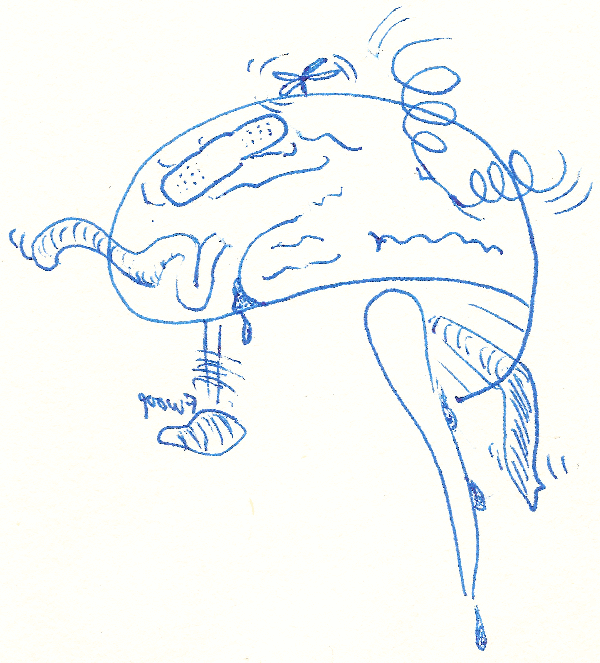
Sketch of brain, with bits falling off and popping out, and a bandaid over the worst
Then it was the neurochemistry.

candleburn-2

I have the neurochemistry of CRPS pretty well nailed, and found that, again, the overlaps with ADD were astounding.

How much of that awful, crippling fog we call “pain brain” is a treatable form of acquired ADD?

Do we really have to live like that?

I might be great tomorrow
But hopeless yesterday

I’m not so sure any more.

Then I looked at treatment modalities for ADD.

candleburn-3

The cognitive-behavioral stuff — like structuring your day, having contingency plans, staying in charge of your emotions, and creating ways to check yourself and to take care of yourself when things go wahooni-shaped — are pretty much identical, though CRPS adds a lot of material about pacing, communicating about functional and pain levels, and managing physical limits.

The pharmaceutical stuff has some interesting overlaps, too.

candleburn-4

Aside from narcotic pain control (which isn’t much good to many of us), treatment for CRPS neurochemistry tends to focus on serotonin, norepinephrine (noradrenaline), and dopamine; treatment for ADD neurochemistry tends to focus on epinephrine (adrenaline) and dopamine.

More overlap, or is that just a coincidence? Hah! No such thing, when we’re treating the brain.

So, after traversing my “moonlit (or candlelit) mile” of research, I showed up at the psychiatrist’s office with the following info:

  •  It’s probably related to the CRPS. (Nod.)
  •  It’s probably treatable. (Slightly qualified nod.)
  •  I can’t have Adderall, et alia, because my heart is dicky enough as it is. (Firm nod.)
  •  I could face Ritalin, et alia, but I’m already on Savella, which also boosts dopamine. (He shrugged and said, “Same molecule, different location.”)

After a bit more backing and forthing, he said, “How about Provigil?”

I’d seen a friend get hooked on it, so I didn’t leap out of my seat, but we talked it over. His reasoning was faultless. (Something I almost never say.)

More than awake, he was really engaged with my case. So I took the leap of faith and said I’d try it.

Trapeze_artists_trimmed

He said he’d supply me with samples of Nuvigil (a longer-acting form) since the maker no longer supplies samples of Provigil. (Pharma companies only provide samples of what they still have under patent. They’re in it for the money, remember…)

Don’t get me wrong

If I come and go like fashion

I had the singular pleasure of going in for my follow-up, dressed professionally for a change, and reporting that:

+ I had enough energy to get outside and move around nearly every day. This means laundry gets done, there’s proper food in the house, and I can get some of that so-necessary exercise.

+ I had enough focus to put together a settlement offer, which the insurance company accepted. (WOOT!)

+ I could change focus at need.

+ I was driving better, thinking strategically and more able to pay attention to what was going on around me at high speed.

+ I could sleep better, because I’d been properly awake and engaged during the day. (OMG!)

– My anxiety was no worse, but when it did kick in, it was harder to get it to chill. That was one drawback, but not a major one.

– Nuvigil tends to build up in my system, until suddenly I can’t sleep at all. It took about 5 days to clear it after that. So now I take half a tablet (that is, about 75 mg) every other day. That works quite well.

+ It’s not perfect — it’s not like being well — but I’m so much closer to being myself that I can actually think about what to wear again. (I used to be kind of a fashion plate, in the intersection of classic, practical, and colorful, with a dash of steampunk.)


I told him, “Love and the relationships I have make life bearable. But being able to think, and be productive, and learn things, and get some work done, THAT’s what makes my life worth living. This is giving me my life back. I’m really grateful.”

If I hadn’t grown up in New England (land of the unspoken), I might have missed the slight lengthening of his spine, the slight lifting of his head, the slight brightening of his face, the tiniest lift of a smile.

For once in my life, a doctor of mine got to feel like a rock star.

It might be unbelievable
But let’s not say so long
It might just be fantastic

I got into the car and drove away on a shiny September afternoon in Pasadena.

On the radio, Chrissie Hynde was belting out,

Don’t get me wrong
If I’m looking kind of dazzled

And it put the seal on everything.

For a moment, I tried to stifle the beaming joy that shot through me. Then sanity intervened.

What I wanted to do was pull over, slap on a headset, and dance on the glittering lawn in front of City Hall, arms wide and the sun sparkling through my starry lashes.

I wasn’t sure the police would understand, though.

Instead, I danced in my car, grinning fit to split my head, bouncing my red SUV to the Pretenders.

Drawing smiles even in LA traffic.

Sometimes, the only right thing to do is dance.

Big grinning woman in spectacular Hawaiian ceremonial dress dancing with her arms
Photo: Joanna Poe in Honolulu

Here’s the whole song. At first, I thought the visual story, with its false leads, dead ends, and triumphant ending, was distracting — then I thought about it for a second… 🙂

* Common sense note: obviously, not all societies that practice arranged marriage are backward. I know too many couples who have an excellent partnership and tons of love between them, who were picked out for each other by their nearest and dearest. It’s not arranged marriage that’s the problem, but those situations where there’s a lack of choice and utter helplessness on one side. That’s what’s backward!