Central (brain & spine) windup, from inside

People with pain windup, prepare to feel validated.

My life is Tetris. Logistically, medically, attentionally, and furniturely — it’s all Tetris.

Keep an eye on the last word in that series.

There’s a tall metal piece of furniture that’s supremely helpful for drying sheets on, and if you lower it to earth it becomes a water-resist rowing machine. Excellent piece. I recently put colorful tape on the bottom end because it had to be moved 2 inches out from its old position.

Tetris.

While speaking over my shoulder, I slammed my foot into it.

Despite having 2 people to mask for, I didn’t mask so much as lean over so they couldn’t see my face. I pounded the doorframe a bit (this rower is right by a door).  There was silence from the other room.

So much for the immediate reaction. I hobbled to my bedside where all my gear is. I slathered it with magnesium oil (magnesium blocks a chunk of pain transmission) and then, when I could touch it, emu oil (which is a carrier oil that pushes stuff into the tissues).

I put sturdy shoes on, not because it felt great but because my feet needed to feel protected.

I swung my foot up onto a couple of pillows on the couch. Felt the shimmering signal of windup — where pain gets worse and more extensive after a blow, rather than easing off — go up my leg and through my hips, lighting up my piriformis, which has always been a bit of a diva. Spasms crept up my legs and flickered in my arms.

The active CRPS patches in my hands, wrists, and shins all pitched in, singing the song of their people.

I think of significant pains as having singing voices, and sometimes their singing drowns out other sounds. More often, it’s just a descant to whatever is going on; sometimes it’s a baseline running below everything else. Occasionally, it just shouts.

And now the muscle failure is creeping in, so I have to put down my phone and just listen to something loud enough to drown out this chorus. The fever-like prickling on my forehead and the comprehensive exhaustion are par for the course.

I just stubbed my foot. Nothing is broken. Were I healthy, I’d have saken it off in 10 minutes. This has trashed my day. This is a reality check, not an argument… this is what it’s like with longstanding CRPS.

This is the second or third “what it’s like” post, so I’ve made a new category for that. Not everyone wants to read it, and nor should they. Some people want to know exactly this, and this is for them.

I’ve put a lot of work into becoming more aware of my body because it’s easier to get leverage against faulty neurochemistry that way. Sadly, of course, dissociation happens for a reason and it gets hard to stay checked in — but I’m going to work on it.

Later.

I think today is for movies & grocery delivery rather than what I intended. I need a little constructive dissociation.

And that, ladies and gentlebeings, is windup, at least in me. It’s nuancedly different in everyone, but this is fairly standard — for this very nonstandard way of experiencing a normally trivial event.

Playing with my food

For audio version, tap PlayingWithMyFood below:

It’s almost impossible not to start this article with, “I used to…” So I’ll skip that and jump right in.

The first time I had swordfish, we were on vacation and the little restaurant was a rickety shack with a cockeyed roof and rickety grape arbors failing to hold their load up. It was on top of a cliff overlooking a bay of beautiful blue. (This was in the late 1970s. Water really was bluer then.)

The air blew soft in my face, because I was facing the sea. I’d teased my Dad about keeping his back straight even when he was slouching over soup. Everyone was pleased and peaceful. And I took my first bite.

I could tell, just by tasting it, that that fish had been swimming around early that morning. It didn’t taste like anything I could remember having before.

It was an amazing multisensory experience. It made me a foodie forever.

However, 4 years in the more environmentally challenging processes of Egypt followed that. The food filled a wider scale: the packaged white bread tasted like the feet of the men who kneaded the huge vat of dough the old-fashioned way with their shoes off, and the roadside falafel sandwiches on chewy baladi bread fresh from the oven behind the sweet-faced woman selling it at the roadside tasted like joy and love and home. With yogurt and tahini, please, thank you. (Not tomatoes, because hepatitis was in the water.)

Then there was the trip down to Upper Egypt on the train, almost 4 years later. By then, I was used to checking my soda for bugs and broken glass, and never bought candy with a damaged wrapper. (Well… hardly ever.) A certain appropriate skepticism had crept into my gleeful charging-in to the task of eating. I thought things through reflexively. That’s not an oxymoron.

The train went overnight from Cairo to Luxor. We woke in the morning ready for a good breakfast.

Egyptian eggs were small with shells so hard you could break something by throwing them. They had very yellow yolks as a rule, and I remember them as being delicious. I asked for a 3-egg omelet (which we used to spell omelette) with grated cheese. (“What kind of cheese do you have?” Shrug, “Just cheese.”)

I got all that, and a little bit more: a little cockroach cooked right in, a browny-black plaque on the surface facing me. The waiter put the plate down with one quick glance and no actual hesitation.

What good would screaming do? Honestly. I had 2 brothers and I had learned to save screaming for genuine emergencies.

I poked around while I thought this over. The egg had clearly, by its texture and color, been subjected to a good amount of heat; that roach was fried to a crisp, and I know that because I used my otherwise useless knife to check.

I mulled the level of certainty I could possibly have that another plate of eggs wouldn’t have a roach in it, only next time, concealed and not as close to the heat. Nope, anything could be in the next one, at this rate: tails, fewmets, broken glass… I mean, that waiter showed no shame. Not a good sign.

I poked around the omelette to see if there were any other surprises, other than a few scallions. Nope.

Decision: made. Elapsed time: two breaths.

I cut around the cockroach, moved it to the edge of my plate, turned my plate so the other side faced me, and dug right in.

It was good and I was fine.

I think I won the family award for aplomb that year. That was cool.

2026, with the G.I. doctor

I had a nice, relaxing meltdown with my g.i. specialist 2 days ago. My weight is almost as high as it’s ever been — not that I mind attracting small objects into my orbit or knocking over unstable furniture; that’s kind of fun.

As I told her, it’s the side effects. My right knee has developed new spasms and my low back doesn’t bear thinking about. I told her, “With CRPS we get bone pain, and the bones in my legs I’m going to cry about if I talk about them.” The added bust size is a disaster, and my postural muscles are fighting it out between stabilizing my hips and holding up my trunk; there isn’t enough to do both.

Multiple food sensitivities (try crossing FODMAP foods with gastroparesis diet with cardiac diet with mast cell/low-histamine diet, and see what’s left), a few outright allergies including gluten (which is rare), and gastroparesis complicating things have given me lots to learn about. I ranted about it, but I was really doing a sanity-check:

  • People with CRPS and fibromyalgia don’t get much muscle-wasting when we’re bedbound, unlike healthy people who get bedbound. What we do get is very few red muscle cells (the oxygen-dependent endurance muscle cells), and lots & lots of white muscle cells, depending on anaerobic respiration. (This has to do with how our circulatory nerves mess up circulation and the oxygen-driven muscle cells just go away and get replaced by anaerobic muscle.) This explains why I have not been able to get anywhere with cardio exercise at this point. Beating my head against a brick wall.
  • GLP-1s: contraindicated in med-reactive gastroparesis. I need my guts to move.
  • Metformin: attractive for its mast-cell stabilizing effects, but then it would be “bye bye, remaining red muscle cells”, because Metformin blocks their benefit from exercise.
  • The surgeries available for dealing with any of this are contraindicated because of CRPS, with its vascular and neurological complications.

It was a relief just to be heard.

And another thing: The CRPS Primer

I stumbled on this 10 dayd ago and I want to buy the maker dinner. I wanted to do this for 20 years and just haven’t been able to. This person has a kind of neurotwitchy that makes it possible to complete such a complex and challenging task, despite having this wretched condition.

The CRPS Primer is available from crpscontender.com. Buy them a coffee if you can afford it.

I plonked the whole thing into Word so I could highlight and annotate it for my own purposes. Highly recommend this as a learning tool. It’s good to think and add and argue with the writer at times, even when they turn out to be right. The references are extensive, though the gutting of the US Federal science library has affected some of the links. Check the Internet Archive’s Wayback Machine if you need to.

I won’t share that, or any other derivations, without clearing it with CRPScontender first, and that’s likely to take time. Nevertheless, they are serious about keeping it freely available to everyone at all times, so go get your own copy and play with it. It’s brilliant.

Not recommended – a poem

Tap here for the audio version.

This one is probably just for fellow painees. Others are welcome, but be aware it might be hard going.

How I got to now

Sunday: 2 hours of unexpected VOC exposure.

Monday: massive (for me) radiation exposure, over 1 h.

Tuesday (today): trigger point injections, 3rd or 4th I’ve had. Each is more painful than the last. This one was epic, and there’s nothing I can do about it cuz mast cell dysfunction and cytochrome (genetic) variants mean that pain meds give me all of the side effects and none of the benefits.

This isn’t about whining. It’s about naming a very bad day. Then, one breath or minute or hour at a time, moving on.

This poem fell out of my keyboard today in a comment on socials:

High on pain. Not recommended. 

Of all the highs that touch the skies,
Most humans choose from chemical vibes:
From mickey to fin, from plants to sin,
Delight is the evanescing disguise

That covers the deep unknowable scars
We tend to bear, when off to the stars
We go, and throw our pain in the bin
For respite or maybe transcendence– too wise
To hope for remission, that damnable prize
Of luckier chemistry, luckier lives;

Decades in,
Pain is untreatable, sometimes unbeatable,
And all I can do is rise… and rise…
And not give in.


Copyright me, 2026, the year Hell opened its maw for us all.

P. S. ~25 years in, I’ve tried everything and some days are like that. Heigh ho. Moving along…

Communication: How showers can suck

We get a lot of disbelief from normos who can’t imagine why we don’t spend more time in the shower. This is what you show them, to reduce the explanation time and shorten the period of disbelief. We have really good reasons, a whole variety of them. (Mom, this explains why I always look for a bathtub to use instead, but you can  give it a miss.)

I’ve talked over The Shower Issue with many people.

Keep in mind that I remember when showers felt wholesome and refreshing. I know what people mean when they say, “Have a Nice Shower — you’ll feel better.”

I have to make Nice Shower a proper noun to distinguish it from other showers. Nice Shower abandoned me long ago. We hardly ever meet each other now… maybe once a year or so.

They’re still dead wrong. I don’t get Nice Showers, though I sometimes get bearable ones.

Some people find each moment of preparation, ambulation, ablution, and drying off to be exhausting beyond belief. Taking a shower consumes most of the day.

Some people have ferocious blood-pooling and dysautonomia from their reaction to standing upright while being covered in water that’s running down — like their battery. Bloodpooling feels awful, and the stubborn dizziness can be nauseating.

Some people can’t articulate why it’s so awful because the English language is not good at describing unpleasant states or experiences. If it’s not bleeding, breaking, crushing, or falling, our language runs out.

For me, it’s several things, and it varies widely from time to time. Here are some of the options in play for me…

Every drop running down me might as well have a hook in its head and be pulling the life-force from me. That’s a real drag when it happens. Literally, ha ha.

The tactile experience of being jabbed, tapped, and scraped by a thousand little nails or pins (different sized shower sprays just mean different sized nasty objects) is, frankly, appalling. 0/10 do not recommend.

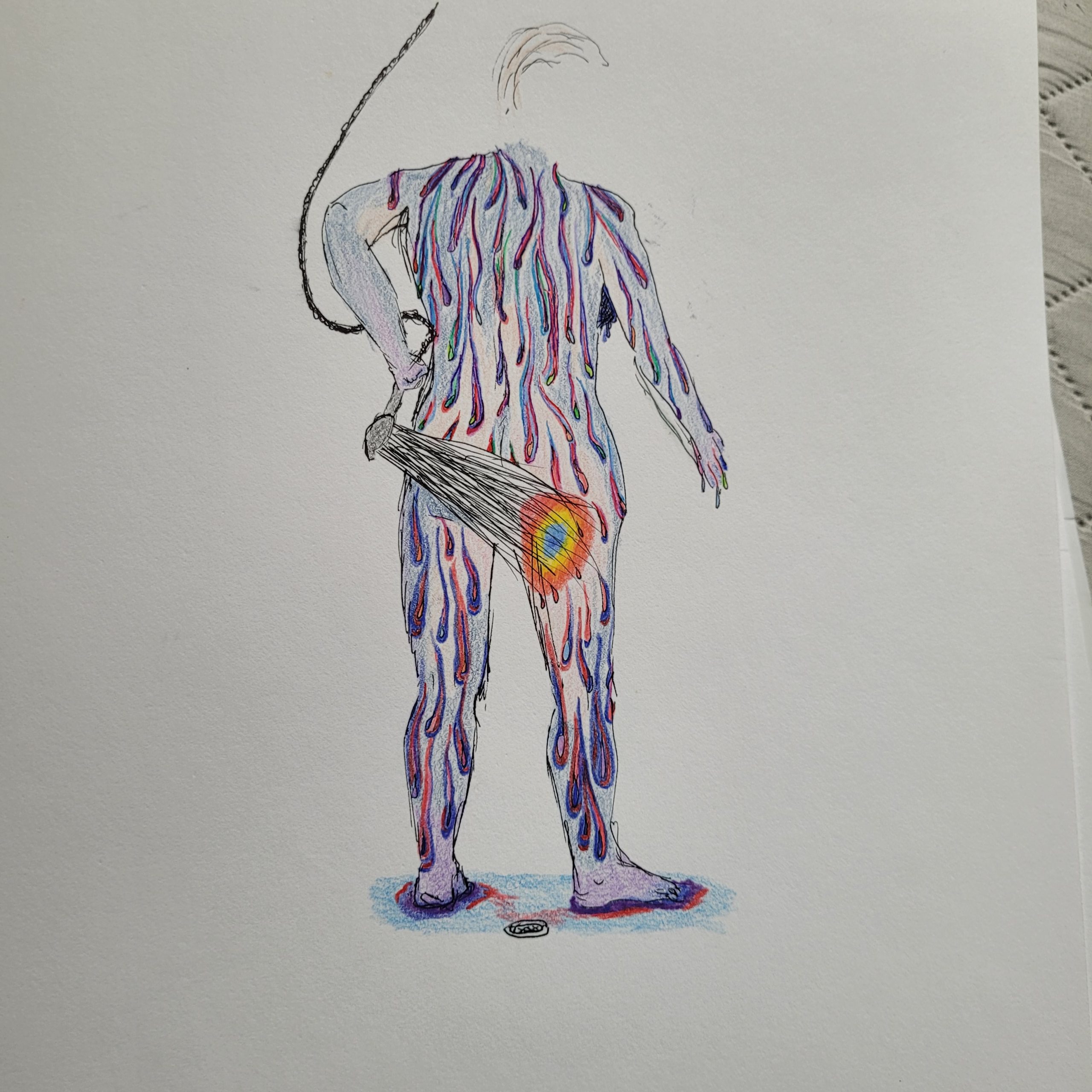
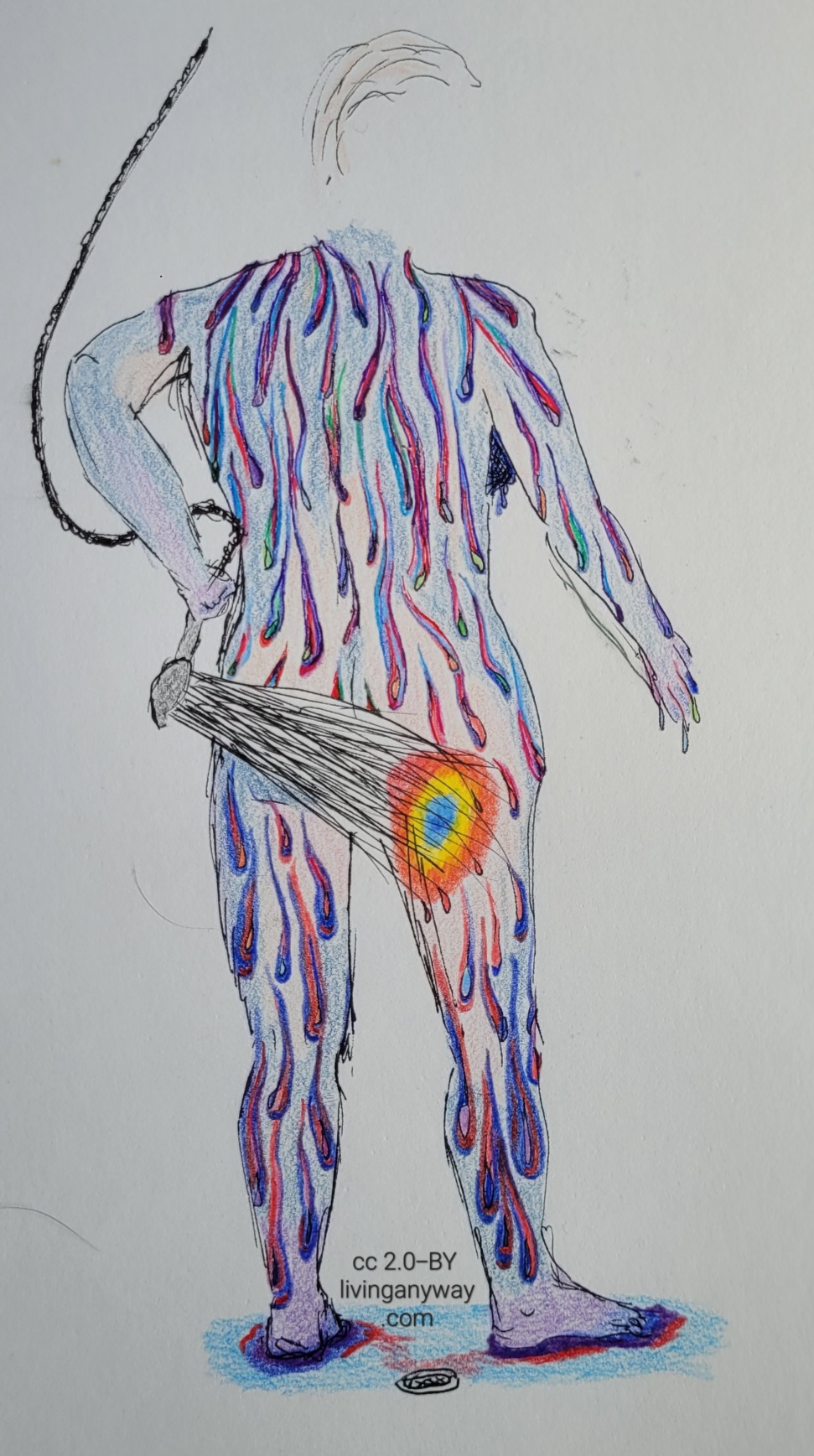
And then there’s the temperature issue. In me, CRPS hot-wires my perception of temperature on my skin far beyond what’s reasonable, including my perception of temperature changes. The micro-changes, on days like today, are no fun at all. Imagine something feeling like a stream of hot coals when it first lands, then like a band of ice next to it, repeating that pattern — until the next droplet. The water in the basin, regardless of its actual temperature, feels freezing, with a runnel of boiling-hot swirling through it. I came up with an image for it, which even shows the nicer temperatures, though not how quickly it all changes again.

It’s a bit oversimplified, scaled for Web-based use, but it gives an idea of what the temp-two-step is like:

Too bad it doesn’t actually show. That’d be awesome!

Anyway… when people say that showers are horrible, it’s fine to just believe them, even when your own experience is quite different.

Quickies: Stubborn CRPS sores? TCM burn cream

New series: Quickies. Short, practical notes, mostly about things to try for problems with CRPS, dysautonomia, mast cell & histamine disorders, etc.

Problem

I get what my grandmother would have called chilblains: cracks in the calluses around my feet and sometimes on my fingers. Nasty, uncomfortable, and — because they’re surrounded with thick walls — hard to heal.

Option

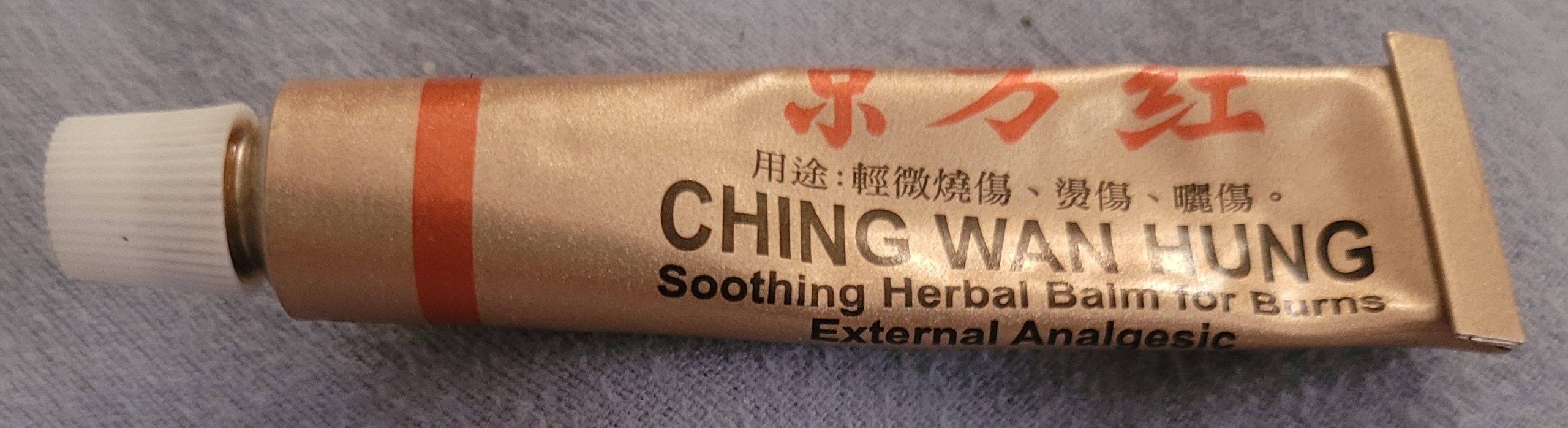
I’m an old nurse. I know a lot about healing wounds of all kinds. Nothing worked, at all …until I tried Ching Wan Hung, in the copper-colored packaging.

Ching Wan Hung:
Different manufacturers but similar copper packaging

It’s a traditional herbal product with Chinese cinnamon, which smells a whole lot different from the tropical stuff we eat. It also has menthol, which I can’t tolerate normally, but is no problem for me here. I can scarcely smell it, so maybe it’s a dosing or production issue. Most herbal salves bring on menthol like a battering ram.

Usage

I squish it right into the cracks and holes of the sores, rub it in well, then put a dark sock over it for an hour. (It stains light colors.) Then I get on with my nap, or my task, or whatever. I put it on twice a day, before getting out of bed and at bedtime. I should probably use it more often for faster results, but I’m not very good at that.

It doesn’t work for everyone, just as everything else I tried, that did work for other CRPSers, didn’t work for me. It’s another option.

Sourcing

I’ve found it online at the usual places and at my local Asian/ international market, usually in little copper-colored tubes, which is more hygeinic than the larger tub you have to stick fingers into. It’s cheap for what it is, too.

You can ask for “Chinese burn cream” if you can’t remember the name.


Caveats

Use common sense (all my readers are extremely sensible, so of course you will).

If it brings up a rash or makes you wheeze, wash it off well and never use it again. Not for wounds that bleed readily or might be infected. Never use on bites, because mouths are utterly filthy and bite wounds need different care. If you can’t feel the tissues where your chilblains or non-healing sores are, see a doctor about them and follow their advice over mine. And so on.

Pulling the masks off in pieces

Having crashed and burned in a (for me) spectacular manner, I’m being (ahem) encouraged by many of my nearest and dearest to stop pretending I’m so much healthier and stronger and more multi-systemically resilient than I am.

My underlying state of health is not good, and I hate discussing it. It’s tiresome and depressing. That said, ignoring it obviously doesn’t work for long. Need a 3rd way.

I’m pushing 60. Time to stop pretending I’m 34… which was my last year of what I still reflexively consider my normal health & athleticism, and it was also when this pain syndrome was laying down its first tracks. Between multiple bereavements, recurring respiratory infections, and repeated courses of megadeath antibiotics, my nervous system was primed for disruption.

As one friend said, “We habitually present a version of our pre-CRPS selves” and, outside my 4 walls and the privacy within, I don’t seem to have anyone else to be yet. How can I exist without coming off as hardy and buoyant? I don’t know what that could even look like.

I go out and do things in public view, then crawl home (nope still no car, yes it’s been all of 2025, yes I’m struggling more all the time, don’t ask) to recover in private. Those are my 2 gears. I’ve recently developed a half-gear of being in my garden plot, but that now requires a lift because the bus is too brutal – although I love that it’s currently free!

It feels like I’m waiting for the world to allow me to heal. If that sounds self-pitying, you’re probably right. I’m new to un-masking, and it’ll take practice to get the tone right – un-self-pitying, but fully honest for a change.

Showing showering

I’ve been drawing cartoons of lives like mine for years. I was waiting to put them into a book, but they’re doing no good in my folio and some have been there for way too long. I’ve also drawn communication tools. It didn’t seem time to share them before, but it sure does now.

First up…

Taking a shower on a bad day:

When I’m rash enough to shower on a bad day, it feels kinda like this.

This picture isn’t finished, but it’s good enough. You can enlarge it to see the way the (to my senses) appalling changes of temperature wrap around every individual drop’s path all the way into the drain.

I couldn’t find a way to draw the way each drop feels like there’s a hook in its head, physically latching onto and dragging energy out of my body. That doesn’t hurt (unlike the hot/cold nonsense) but boy, is it exhausting!

So, when you can tell (pew!) that I haven’t had a proper shower or even gotten wet recently, you’ll be able to surmise that the pain has been higher than my ability to cope with the intensity of the experience.

For the record – I gritted my teeth and showered & washed my hair yesterday morning! I’m taking a bow, frankly. I had a familiar audiobook to listen to, which sometimes can keep my attention off those hot/cold and dragging sensations.

Keep in mind that everyone’s pain is their own. CRPSers don’t all have the same experience in the shower, because, for some, it’s awful in some other way. Not all days are this bad, even 24 years in. Nuance is key. Also, boundaries.

My pain isn’t yours, and nor should it be.

The idea here is to give you a chance to look on, without looking for anything more than your witness. That right there is a powerful thing: just being seen.

Don’t take it on.  Just adjust your expectations, maybe, as I’m learning to do myself.

If you’re a bio-nerd, read up on how humans go from mad mitosis to having skin and organs. It is absolutely fascinating – and explains a lot about neurological variations!

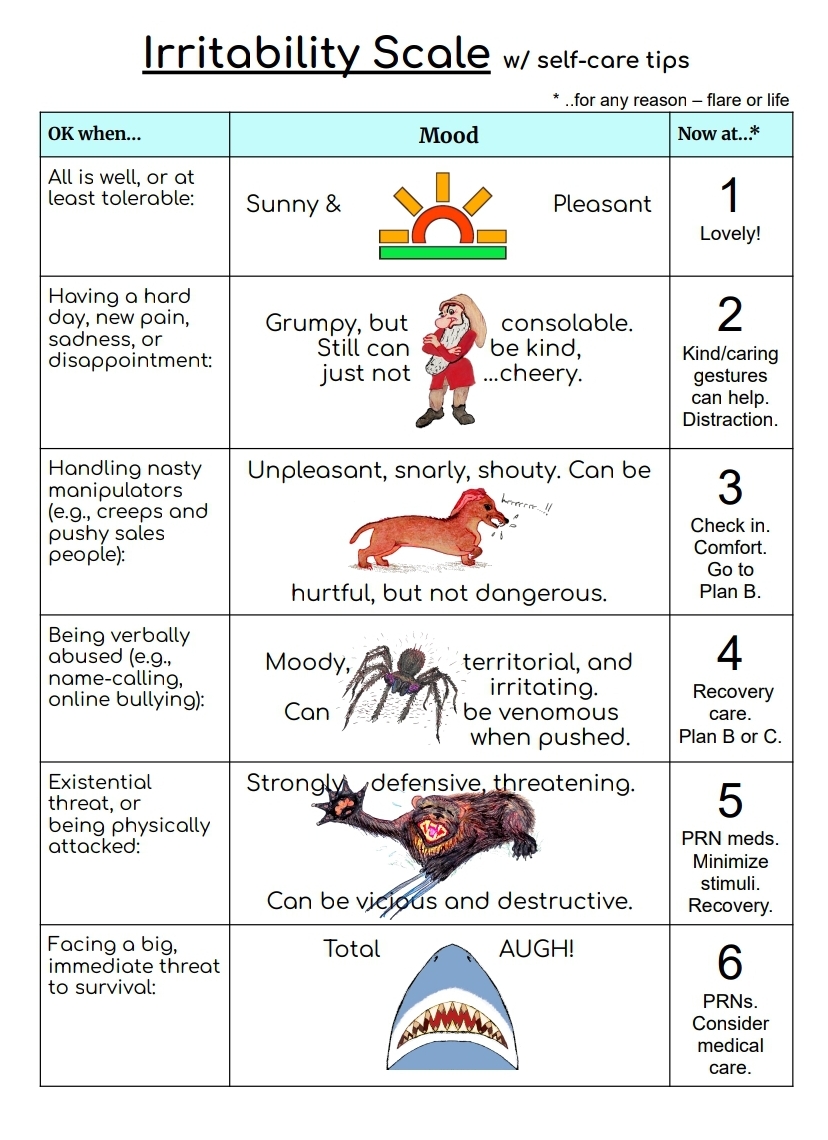
Communication tool: moods & self-care

I’ve also got a delightful communication tool to share.

As we all now know, my mood may not reflect the outward, apparent situation. There can be stuff burbling away that affects me in ways I might not realize, but others can.

I came up with a rough drawing of a rating scale for my housemates to use (when I had some) and it was a huge help to get that objective feedback – without anyone being defensive! I’d sometimes find the magnet moved to a different number, then go away and take care of myself until I was pretty sure it could move back up. Usually, though, they felt free to call me over and show me where my behavior was, and I loved their honesty. Did me a lot of good.

Click here for the full-sized PDF: Irritability Scale

I particularly like how it indicates when a level of irritation is appropriate. That was a mind- blower for me, as I’d been telling myself that it was always bad to be unpleasant. Nope! Sometimes it’s perfectly appropriate!

I think, and hope, that sharing these images and tools will:

A. Be useful, and

B. Get it right through the concrete (taps own head) that I need to come up with ways to live and engage with the world that are congruent with this reality.

My inner Cleopatra, queen of de Nile, needs to get back to Egypt.

Cheers and virtual hugs are most welcome! I’m daunted by this job. I mean… I value honesty enormously… just not about my weaknesses and disabilities 🤣

The Beast

One of the characteristics of CRPS and some other longstanding brain-driven pain conditions is the occasional personality transplants which, especially combined with memory-holes and perceptual shifts, can really do a number on relationships. This situation is called the Beast. Medically, it’s considered part of the territory.

I’ve been absolutely smug about my aability to stay away from the Beast. Since regular psychotherapy is part of the gold standard of treatment for CRPS, I’ve prioritized psych care — from professionals who have a good understanding of trauma and PTSD, since actual specialists in central pain are so rare, and trauma/PTSD is a good model to start from. That care hasn’t been possible for most of the past 5 months, and I’m taking stock of how much I’ve lost in that time, now that I’m back on the schedule.

I can count on 3 fingers (now 4) the times I’ve been the Beast in ~21 years. (I’m fuzzy on my first ~4 years of illness. It was a blur.) The most recent of those times was due to a neurotoxic exposure. One was when I lived in a mold infestation I hadn’t mitigated yet. One was during a particularly hectic trauma period. The current one was after I decided to make an extended, extravagant physical effort in not-very-safe air. I really thought I could pull it off, and just rest afterwards.

But these are reasons, not excuses. I hurt people who didn’t have it coming at all. I injured relationships I care about deeply and intend to protect. Today’s event cuts particularly deep.

“Why would you do that?” is an unanswerable question. If you don’t have this shit disease, it can’t be explained. All I know is that I felt myself being pulled under, not recognizing fractured memory and wacked perceptions. I grabbed for a rope. Didn’t think what it was attached to, because I thought I was drowning.

Mind you (adds that inveterate shit, Sarcastic Sister), my feelings are such that I’d rather be dead than hurt my loved ones. But this is not the time to say that, because it makes no sense from the outside, in light of what they just experienced from me.

Need a moment to process this.

So… diligent psychoemotional tune-ups, reasonable pacing of activity, and a safe environment are not at all optional. That rubric is my best insurance against the Beast. What I know from seeing my long-term survivor cohort is that there’s no guarantee I’ll be able to avoid the Beast forever. So, I’m wrestling with this reality and not really wanting to be here for my life. (“I’d rather be dead than feel this way” was a state my late BiL and I could bond over.) Many of my fellow CRPSers know the feeling, and it eases my soul ever so slightly to know it’s part of this disease experience, and not because I’ve actually become evil.

I’ve done what I can for now. I’m off home for meditation time, if I can, and a familiar show if I can’t. I have to remember how to rest and how to push myself no harder than is good for me. I have to take recuperation very seriously and basically expect nothing from myself for a week. I have to manage this terrible storm of feelings in the absence of a stable central nervous/ endocrine system. I hope to have the chance to rebuild a couple of relationships. We’ll see if that’s do-able. Fun times.

I’m looking for some more positive message to turn towards or even something to lighten this a little, since the point of this blog is “living anyway” in spite of what this craptastic disease does to people. The only thing I’ve got to offer right now is the passage of time and the hope of some recovery… within the context of this horror-show snowballing around me, around us all.

Care of Spines & CRPS

This is about the messy intersection of CRPS & the mechanical aspects of central nervous system dysfunction, and dealing with those effects.

I’m writing through the waunnng, waunnng, waunnng of a ringing headache. I’m hoping that if I hydrate, urinate, and (carefully) ambulate enough, it’ll pass faster. We shall see. Meantime, I’ll do my best to pass on some useful info.

The brain and spine are supposed to float in cerebrospinal fluid. We are supposed to stay hydrated enough to keep those sensitive tissues from grounding out.

We have 2 kidneys – each one capable of filtering twice the water we actually need – as a practical accommodation for the fact that, throughout history, most water was filthy and needed lots of filtering.

We have 4 times the kidney power we need for a busy, messy lifetime. We’re supposed to use them! The more we use them, the healthier they can stay. They love to do their job.

When we’re properly hydrated, our brains and spines can float comfortably in their spaces. When they float comfortably, they have plenty of shock absorption protecting them.

Spinal care

Dr Faye Weinstein taught me an important part of brain & spine care.

I had too little cartilage in my knees, so I had developed the habit of dropping into chairs instead of using my legs to lower myself neatly.

She hated that. She visibly flinched, and one day she finally cried out in audible distress, “Stop doing that!”

I stopped doing that.

Just as she had predicted, my baseline level of misery became less.

Once I was out of the habit of dropping into chairs, then, when I did it again, it caused headaches and sometimes back pain (depending on my hydration, of course). I was no longer used to enduring this as part of my daily quorum of yuk.

That was (checks watch) over 10 years ago. My brain and spine, oddly enough, haven’t gotten any younger since then.

Yesterday (after a couple of days of being “too busy” to hydrate properly), while I was turning to admire something across the street (a boat or a building; I forget which)… I stepped off a step I hadn’t noticed. One step down, caught myself, barely stumbled, no harm done. Massaged my neck a bit, to ease the slight jamming on one side. In my formerly healthy system, that would have been that. Probably would have forgotten about it instantly.

But now is different.

It took 10 minutes for the icky feeling to set in at my low back and back of head. It took a little over 2 hours for the whole brain-fog and uncontrolled body pain to take hold. Chronic CRPS really is wired into the whole neurological system, and one of the hallmarks is how the spine takes on an anti-life of its own in the face of any signs of disrespect.

Clearly, my spine felt seriously disrespected.

Content warning – skip this description if you’re squeamish about pain:

We know that I have no effective pain control left to me, with genetic tweaks making narcotics disgusting (they make the pain worse, cause untreatable nausea, and trigger horrific mood swings), and mast-cell activation making NSAIDS unbearable (they cause a soft-tissue-wide inflammatory pain, making it feel like shards of hot glass are hammered into all my cells).

So, how to approach this?

There’s a super-concentrated lemon balm extract that helps calm down inflamed nerves. Lemon balm has been used to calm nerve inflammation & pain for, approximate thousands of years.

Since all the nerves coming out of my spine are feeling very hot right now, I’m taking that about every 8 hours.

Note: check this against your meds, especially with GABAnergics. Ask your pharmacist to check their standard herb-drug interaction charts.

Pain salve on my spine and up my neck before bed, and also on arms/ shoulders and hips once I tried to sleep, helped noticeably.

It was a rocky night, but I’ve been getting as much water down as my tummy will tolerate and, now that my kidneys have been flushed 3 times, the headache is noticeably easing.

Conclusion

We can’t be alert every second. Our senses are so distracting at the best of times. Finding ways to manage these impacts is unspeakably important.

Long-term pain patients tend to get self-concerned to a degree that could be obnoxious normally, but it’s a legitimate self-care attribute in a life where one wrong move or one wrong exposure can destroy weeks or months of work.

Mouse brain neurons, two pairs, stained flame yellow against red background
Image by neurollero on flickr, CC share-alike attribution license.

One benefit of this self-attention is learning how to manage and mitigate the problems that arise by catching them early, and sharing the info in the hope that it’ll do some other painee or their caretakers some good. We have to learn from each other. Nobody else is as qualified.

With a pet & chronic illness

This is a long one. Grab something to drink and put your feet up, if you want to…

In the wildly unlikely event that, say, a vulnerable American citizen felt moved to respect the anti-immigration feeling and return to the lands that, say, my ancestors left in the 1600s and 1700s… how would that work?

It helps if you already have a passport. This is important. Go here:

https://travel.state.gov/content/travel/en/passports.html

and follow the instructions there – whenever you land on it. Passports are issued by the State Department, and the State Department is currently being defunded and depopulated, so their processes may change.

This hypothetical traveler – let’s call her Max Peregrine – and why not? – is female, disabled, poor, and has very short hair. This puts her in several categories of risk in the US in 2025, and she’d like to know what other options there are for someone like her. Her service animal, a minature goldendoodle, has to go with her.

This is important.

Max has learned that a pet leaving the US has to get a certificate from a vet specifically qualified to issue international pet health certificates. She asked her usual vet, who referred her to the USDA web site to find one.

The USDA has been running increasingly lean for years, and has recently been gutted by the incoming president and his team, so the list of vets qualified to give this pet health certificate is out of date.

Max has been disabled a long time and is used to this kind of disappointment, so, after an Epsom salt bath and a TV break, she called down the list of veterinarians in the area until she found one who can (theoretically) give this certificate.

It took the one vet she found 3 weeks to research whether this is even possible. The USDA (which supervises animal health certificates for travel) is running out of staff, after all, and every country people want to bring their animals to has its own peculiarities over what is required to clear a pet for arrival, so it gets very complicated very quickly.

Sadly, the information that non-vets like Max find about import requirements is less than half the story.

Also, the US export process is complex in itself, and requires a 3-hour minimum turnaround between the vet and the USDA for the form to be submitted, reviewed, inspected, corrected, approved, and printed out. That is, if nothing goes wrong.

This vet certificate has to be issued within 10 days of departure (in some cases, 3 days, depending on the country the traveler is going to) so it’s good to start this process well in advance, and be willing to stay flexible.

If, like Max, your pet had an uncertain history or belongs to someone with limited mobility, it’s possible you’ll hit a snag: if the initial rabies series was not done exactly right, you might have to start the series over, do a blood test in 3 weeks, and be sure to get the next one inside of a year.

If you travel to Europe, you’re in luck: go to a certified vet there and get your pet an EU Pet Passport. It’ll make everything a lot easier as it’s widely accepted.

It’s important to remember that Max belongs to a category of people who can’t afford a package trip, nor a concierge trip. She has to do all the planning and reservations herself, and track all that info if, for instance, her pet’s initial rabies vaccination did not happen exactly as intended, and every leg of her trip has to be adjusted, by herself, one piece at a time.

Every transport company has their own pet policies, so she also has to call every single carrier in the chain of the journey to make sure her pet reservation has followed her.

It’s fortunate for Max that her executive function happens to have extra bandwidth for travel planning. It’s in her DNA. Her ancestors have been traveling for at least 350 years.

Since Max’s mini goldendoodle, a girl named Sam, is a Service Animal, there’s no question of that pet being refused. She has to fly with her person.

However, her paperwork still has to be in order!

So, having rectified the rabies shot situation, changed the entire trip to 2 weeks later to make sure her dog can come, and found half a dozen places to get food that matched her dietary requirements in each place she planned to stay in, Max was smart enough to know she could not possibly relax until she actually had her toes in the sand and her dog in her arms at the same time. The preparation for this trip had only just started.

Max is probably a bit overwhelmed, but can get good advice and good tools. She got Smart Tags for her luggage, found friends willing to be phone buddies to use Find My Phone to watch her progress, set an alarm to remind her to turn on Location and 5G at every transfer to give Find My Phone a signal, and then returns to low-rad mode so she’s not battling cyclical vomiting syndrome (which is what happens when she’s around too much signal too close to her body) while conducting a long trirp.

Cyclical vomiting is never fun, but it’s worse all around when you’re packed into Economy class.

Max, who hates travel surprises and likes to be organized, has also prepared a travel folder with pockets and tabs:

  • Complete itinerary in the inside pocket in front.
  • First tab: Check in information for each stage of the trip. This also proves that she plans to return in less than 90 days, because that’s important in an increasingly immigrant-hostile world.
  • 2nd tab: Visa related info: trip insurance coverage, with the coverages page copied and stapled to the front for easy reference.
  • 3rd tab, more visa related info: Lodging reservations, printed in every language she’ll be travelling through, so each border can conduct its own checks. Arriving with nowhere to stay is a big no-no these days; no more turning up and finding the nearest hostel.
  • Health tab: vaccination info. A lot of places really care about this, so get your shots if you want to travel, and get printouts from your provider. If you can afford it, you can have a travel specialist doctor make a yellow International Certificate of Vaccination, which is accepted everywhere – like the best credit cards.
  • Emergency: this tab is particular because Max has underlying medical conditions. There’s a MOLST form, which providees instructions for when someone is unconscious and can’t tell you if they want CPR or oxygen. It should also have copies of prescriptions, which you can get by calling your pharmacist and asking them to print them out. (Some countries require prescriptions hand-signed from the doctor’s office, but electronics are making their way into this process more over time.)
  • The pet, naturally, has her own tab. Her health certification, rabies documentation, and whatever else is needed, go here. This includes her microchip number, because pets require a chip for travel.

At the back of the folder, Max has left space to keep brochures and flyers for things she most wants – from safe places to get food, to inexpensive trips, free/cheap sights, and bus schedules. Max looks forward to filling that up, but knows she has to be careful with money because she’s still poor … she’s just staying somewhere a lot cheaper than her home at the moment, somewhere the government is not (yet) committing very messy self-merc.

And then there’s packing. Max has to bring her own self-care mechanisms, which involve a lot of pillows and some extra gear. Being disabled is a lot of work and there’s just no getting around that. Everything that’s most necessary for that work has to come with, or be bought there, and she’s on a tight budget.

Happily, sunshine is free!

Max is an expert at enjoying the little beauties and making the most of whatever blessings come her way. She’s going to have a fabulous time, and so is her service animal.

I’m a little envious, but I’ll be sticking around for the foreseeable. I helped Max with some of her research, though, so there’s likely to be more to come…

Foggy… and formats

There’s been a lot going on, but I’m not up to discussing it for lots of reasons, but mostly, TBH, because I’m foggy.

I’m thinking about how to put my work together differently. Like, make it easy to focus on overarching topics – traveling with illness and pain; navigating relationships; communicating with loved ones; getting your message through to doctors; handling flares; laughing at the absurdities of this life; being a smart-aleck when appropriate; coping when it’s hard to keep going… these are specific subjects, and it’s not good to hit an unsuspecting system with a surprise ttopic.i don’t think category tags are sufficient warning. We should be able to choose our topics upfront.

So, I’m mulling Patreon or books or some other way of putting out my work so it gets organized into logical groups. You should still be able to find the most recent if you want to, and go in reverse chronological order; it’s just that that should not be forced on the reader the way a normal blog organization does it.

Not sure I’m explaining myself well. Like I said… foggy.

What do you think? Is there a subset or grouping you’d like to see? There are a lot of ways I could organize it – do you have a favorite format?

I’d love to hear what you think! Feel free to comment or whatever.