Seeking Diagnosis if you don’t fit the Standard Medical Model

Today’s post is a copy/paste from an answer I wrote in my socials. This is real life, not polemic.

“I’m a woman trying to get a diagnosis for my pain. I can’t understand the doctors, or they don’t understand me. Do I need to take someone in with me? I need the dr to take me seriously.”

Hoo boy, is this in my wheelhouse. Longtime (>25 yrs) pain patient, retired RN, ongoing patient advocate & educator.

You’re right: the pain of women (cis & trans) and people of color is dismissed, misunderstood, and under-treated horrifically. Know that this is unconscious reflex. It can’t be corrected by us, but it usually can be hacked.

How?

By presenting it as non-personally as possible. In other words, use:

A. Data & images to describe your pain & its effects,

B. Journalistic documentation for your experience with it, and

C. Others’ voices to support your words as you communicate it.

First, though, two key points:

Pro tip 1: Keep in mind “an averagely bad day”. We cannot plan for anything better.

When we’re describing how our pain affects us, we have to stick, not to our best or worst day (because they’re irrelevant; they’re exceptions) nor to an average day (because that’s out of reach without effective diagnosis, treatment, support, accommodation, nourishment, and rest), but to an averagely bad day.

This is our reality, and it’s what they need to know in order to plan appropriately and understand our needs.

If you describe any worse, you’re assumed to be faking it. The lack of conviction will show.

Any better, you’re actually faking it, but in the other direction.

“Averagely bad day” is the functional standard.

Pro tip 2: Recuperation and recovery is not calculated into pain description, unless you put it there. For instance, an activity that wipes you out for 3 days is different from an activity that knocks you back for a couple of hours, even if the reported level of pain is similar. Eff that tish!!

Calculate & document recuperation time.

For each thing that makes it worse, or each flare, document how long it takes to get back to your baseline. This is key to getting remission or even disease recovery.

A. Pictures & numbers

There are not enough words for pain in the English language. Also, as we know, they’re somehow just noise when coming from a woman, a “weirdo” (fill in any pejorative term), or a person of color. It’s wild, but there it is. We have to work around that.

Most of my tools are about getting their attention off of me and onto the pure information about my condition.

Which is interesting to them.

I’m not, and I handle things accordingly.

There are many ways to document the location, character, and intensity of your pain:

– Take pictures and mark them up in your photo editor.

– Fill out those “standard body” outlines.

– Draw your own outline of body or body parts and use that.

– Whatever works for you — just visualize it.

Make them look at the image, not you. Then they’re processing info, rather than being triggered by “woman reporting pain — must pretend it isn’t happening”.

We were all brought into the world by a way that typically causes a heck of a lot of pain to those giving birth, and sometimes I wonder if that primal event is what the denial relates to.

Functionality is the bottom line for any chronic condition.

The more you can put numbers to your levels of capacity at different times, the better. “Can carry 2 grocery bags 30 ft to the door today after meds, but yesterday I could only carry 1 without meds.” That’s an incredibly boring task, but it’s also an incredibly important indicator of function. It’s pure gold for the doctor’s notes.

I’ve got posts about doctor visit updates and timelines that demonstrate these tools in real life. For more info, go to the search bar or word cloud and search “documentation”. The site is a bit chaotic, but it’s all there.

B. Journalistic notes

Journalism answers “who, what, when, where, how, why”.

Who:

You’re the “who” who’s in pain.

Who sees, or is impacted by the effects of, your pain? Kids, colleagues, etc.

Who gave you a diagnosis, if any? Mention doctors by name and specialty.

What:

What hurts?

What makes it worse?

What makes it better, and is it significant or not?

What have you tried but had no benefit?

What’s affected? (Work, walking/standing, using the bathroom, carrying things like equipment or groceries, sleep, food prep & eating are the usual biggies.)

When:

When & where did it start?

When does it get worse? Better?

Does it have a diurnal pattern, meaning a consistent rise or fall through the day & night?

Where:

– Where, and how, does it hurt? Pictures are your friend. See A.

– Where do you go that makes it worse or better? Parks, forests, or print shops & other VOC sources can have an impact.

How:

– Describe the character of the pain: piercing, squeezing, burning, tingling, nauseating, etc etc.

– How does it limit you? Be specific. It helps to know that a gallon of water weighs 8 pounds, a bag of groceries about 10-12, a can of beans about a pound.

Whether you can lift without symptoms, how far you can carry, and whether you can manage stairs with those loads, are all good data!

How much you can do *safely and without needing recovery* is key.

– How long does it take to get back to your baseline after something happens? Calculate & document recuperation time. More on this later.

Why:

– If you have any thoughts about why it happened, mention them.

– If you have health-related gene scans or DNA analysis, it can strengthen the case for paying attention to you.

DNA rarely provides diagnoses, but clarifies ways you’re susceptible to types of illnesses, including pain diseases.

– If you have found any scientific articles, bring copies or send links.

C. Others’ voices

Others’ voices (especially deep voices from tall men) are more credible, somehow, and that’s messed up. Our lone voices should be heard! We are the experts in our own experience! But, well, here we are.

– If you don’t have a male friend or relation who is willing to be your “stunt man” and sit there exuding man-itude and occasionally repeating what you say, then there are other hacks.

A 3rd person in the room is key.

– A woman is excellent! She can sit there and quietly back you up, which is the baseline. She can ask if you feel like your questions were fully answered. She can ask if you understood what the doc just said, if it sounded like blah blah blah. She can ask her own questions, if you’re both OK with that. It’s your appointment after all; you can bring your own help.

You might (!!) see the doctor jump when she speaks, if they’ve forgotten she’s in the room. (It’s good for them.)

Pro tip: You’re a patient. Pride is irrelevant. It’s OK to seem goofy (though neat & well dressed,  if possible), as long as your needs are met and your care is appropriate and effective.

– It’s the law that you’re allowed to have a chaperone (yes, they use that word!) from the office in the appointment with you. Insist sweetly that you know it’s your right to have a chaperone with you, you want one, and you’re here a little early (be 15 min early) to allow them to find one for you.

You don’t owe any further explanation, though you can assure them the dr is fine, you want a chaperone anyway. (They’ll just have to work short-staffed until you’re done.)

Corner case: There’s an outside chance they’ll send in a security guard, which is inappropriate (they don’t have medical training and aren’t as trained in HIPAA) but it can work in your favor because, hey, usually someone tall & deeper-voiced. Greet them sweetly and thank them for being your chaperone — they need to know you’re to be protected, in their mental framework.

– You can ask about recording the visit, but be prepared for shock & horror. Being recorded is poison in some facilities because of legalities and liability concerns — and the way words can get twisted in court. If your doctor is fine with it, great! You can review it with your notebook and Merck Manual Consumer Edition.

There you have it.

Blessing by the seat of her pantaloons

My cat blesses things by sitting on them. She thinks that’s perfectly appropriate, and doesn’t seem to care if there are other feelings on the subject.

She generates a fair bit of brain juice for me. That said, normally, having my center of attention occluded by a messy floof with gemlike eyes has not been high on my list of useful experiences.

Today, for a change, I worked around it. As soon as I really needed her out of the way, she moved off my notes and let me turn the page.

She must be feeling merciful.

Now she’s draping her tail over my notebook. I think this is the equivalent of a benediction.

I think cats are here to teach us to communicate. She has been communicating blessings & benedictions all this time, and I thought she was just getting in the way.

Like a missionistic preacher, she doesn’t always realize that her blessings and benedictions might be poorly timed, or even unwelcome.

She’s working on her timing. There is no power in heaven or earth that can persuade her she’s ever unwelcome.

I’m OK with that.

Quickie: Managing expectations?

Today, I learned (or re-learned) how much louder clothing speaks than my expression or manner.

I went out in my “hippie” disguise — a change from my usual “preppie on her way to a parent-teacher conference” disguise.

I like turtlenecks in winter. Anyway.

Today, in my shaggy green sweater with the red-and-purple geometric designs, people are *smiling back* and giving me extra time when my fingers don’t work.

I love my neat, clean, long-lasting basic wardrobe. (A bit boring, but well-kempt, smart, and will stick around forever. Kind of like my ideal partner.) However, I feel Indian cotton and flowy accessories in my future. I need to be responded to, more than I need to be respected — and possibly slightly annoying…

Documentation: logs and tracking

Cards on the table: I like to write. Maybe a little too much.

It’s inconvenient to have crapped-out wrists that limit typing severely and a voice just weird enough in accent & vocal fry to make dictation software stare back at me, blinking blankly, instead of capturing the marvelous flow of inspiration…

Yeah. To heck with that. I have to make it simpler.

I have a bunch of self-documentation templates and techniques which I’ve been meaning to write about, because we know how important providing evidence of your own experience can be and because… I like to write.

Sigh.

I’m not trying to make them pretty and I’m certainly not taking the time to make them generic or pare out the details of what I’ve tried and used over the years. I like doing that, but wanting to do that is what has kept from getting this stuff up… for years.

I’m just going to throw them at you instead. You’re all smart enough to take what you like and leave the rest. Have fun!

Note: All of my Self-Documentation by LivingAnyway.com is marked CC0 1.0. To view a copy of this mark, visit https://creativecommons.org/publicdomain/zero/1.0/

TL;DR – it’s a formal way of making this work Public Domain. Go wild. It’s yours now.

Pro Tip: There are good health tracker apps now, and one or two are very good. If they work for you, that’s good enough!

If, like me, screens hurt your eyes and tapping hurts your hands, you might want to consider the ol’ pen-and-paper method here.

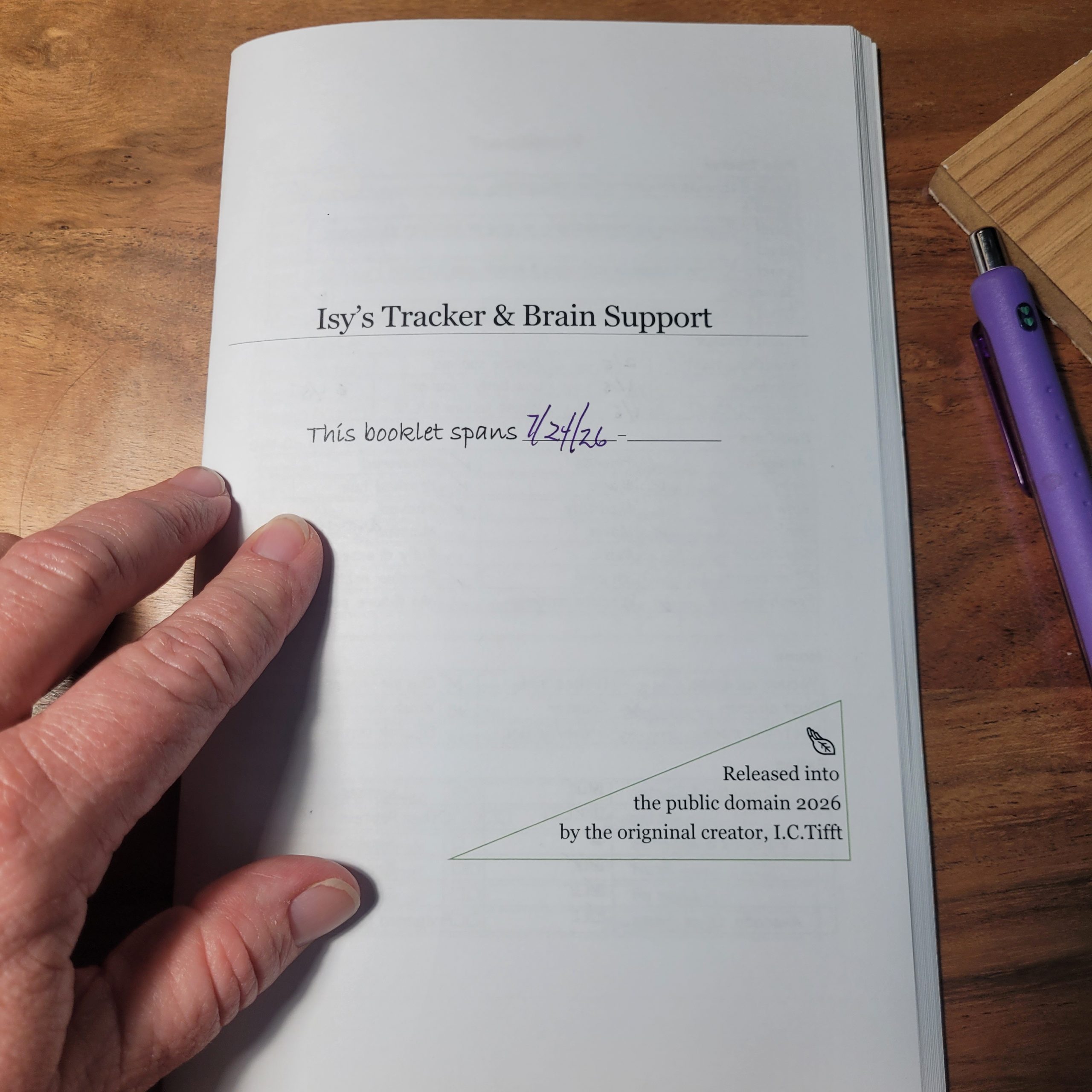
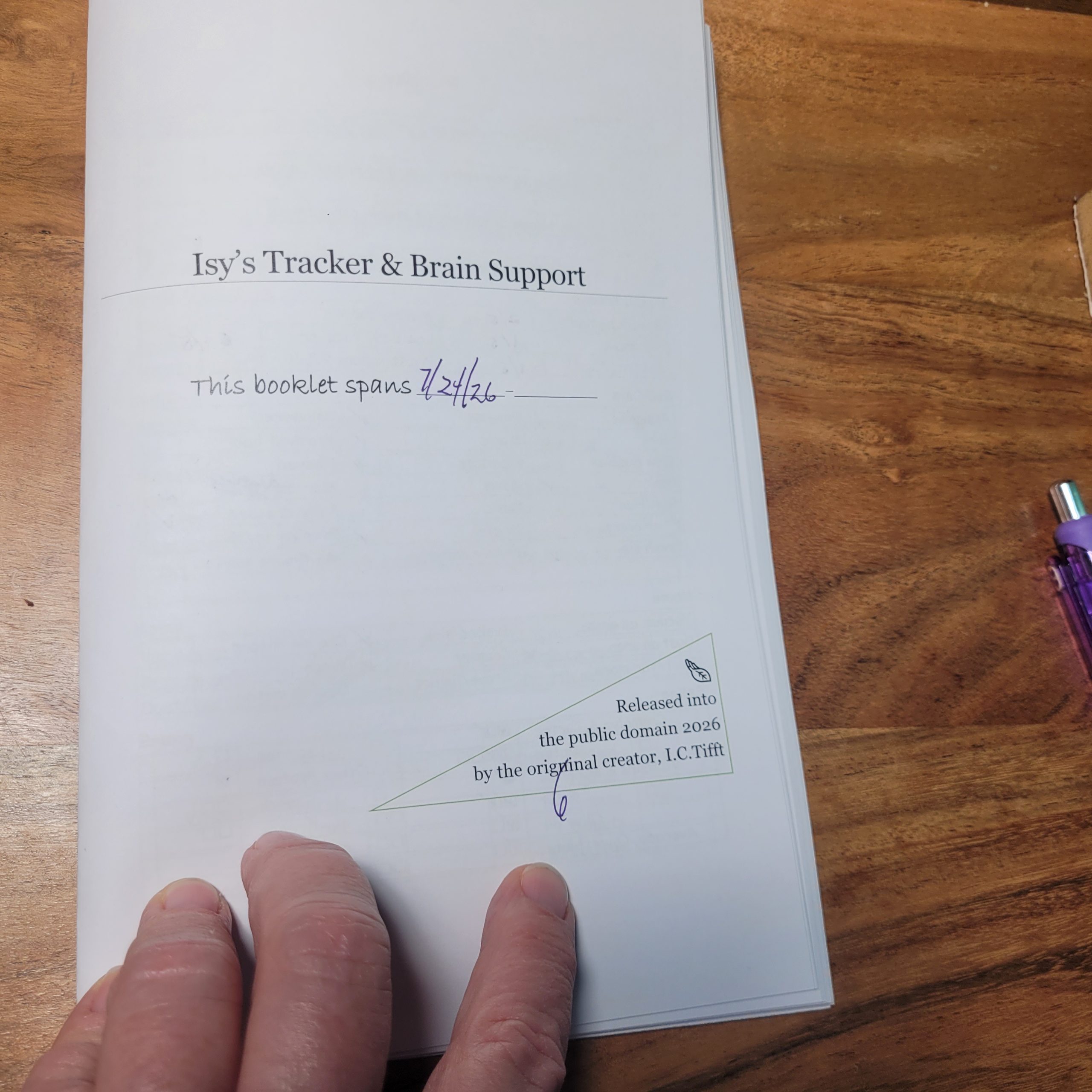
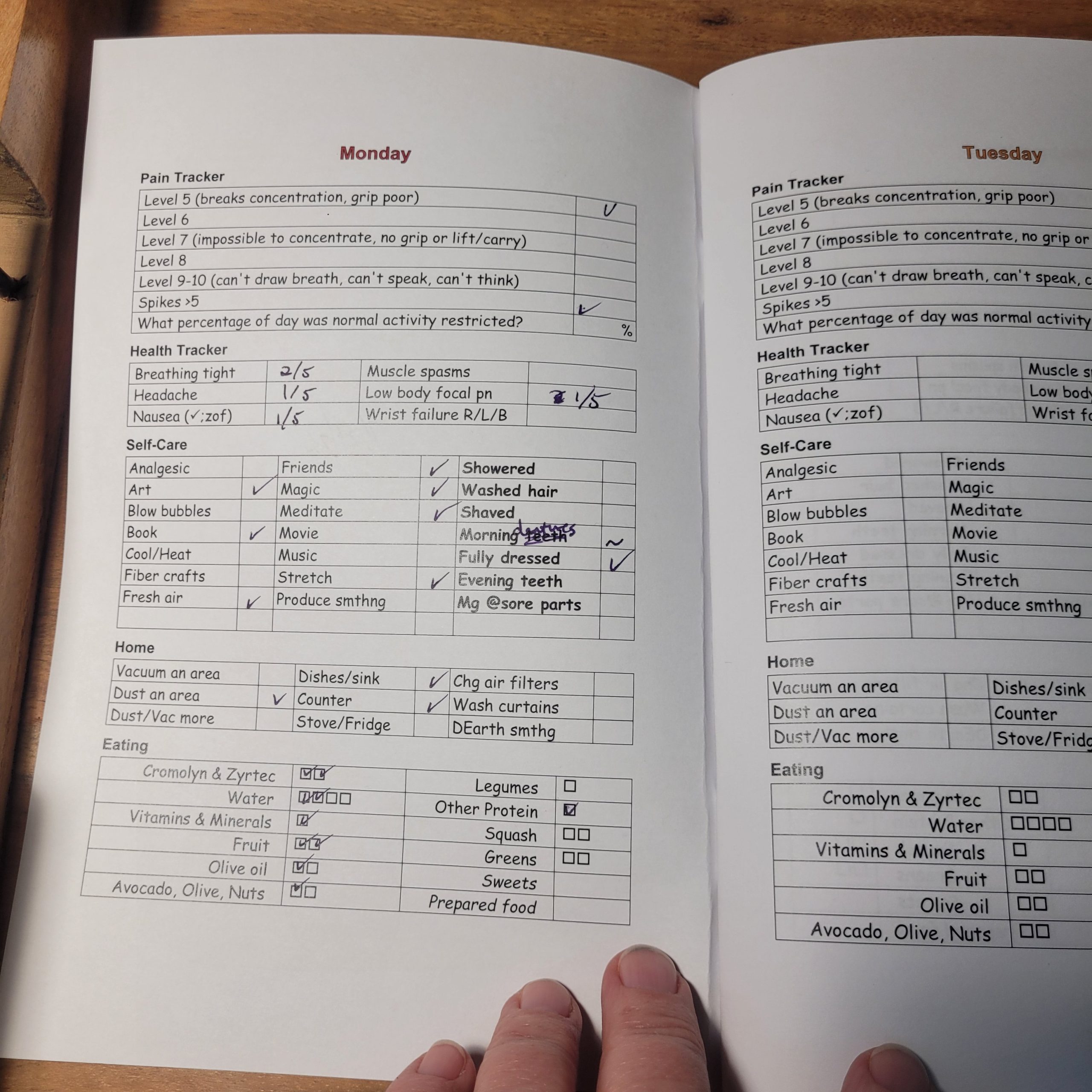
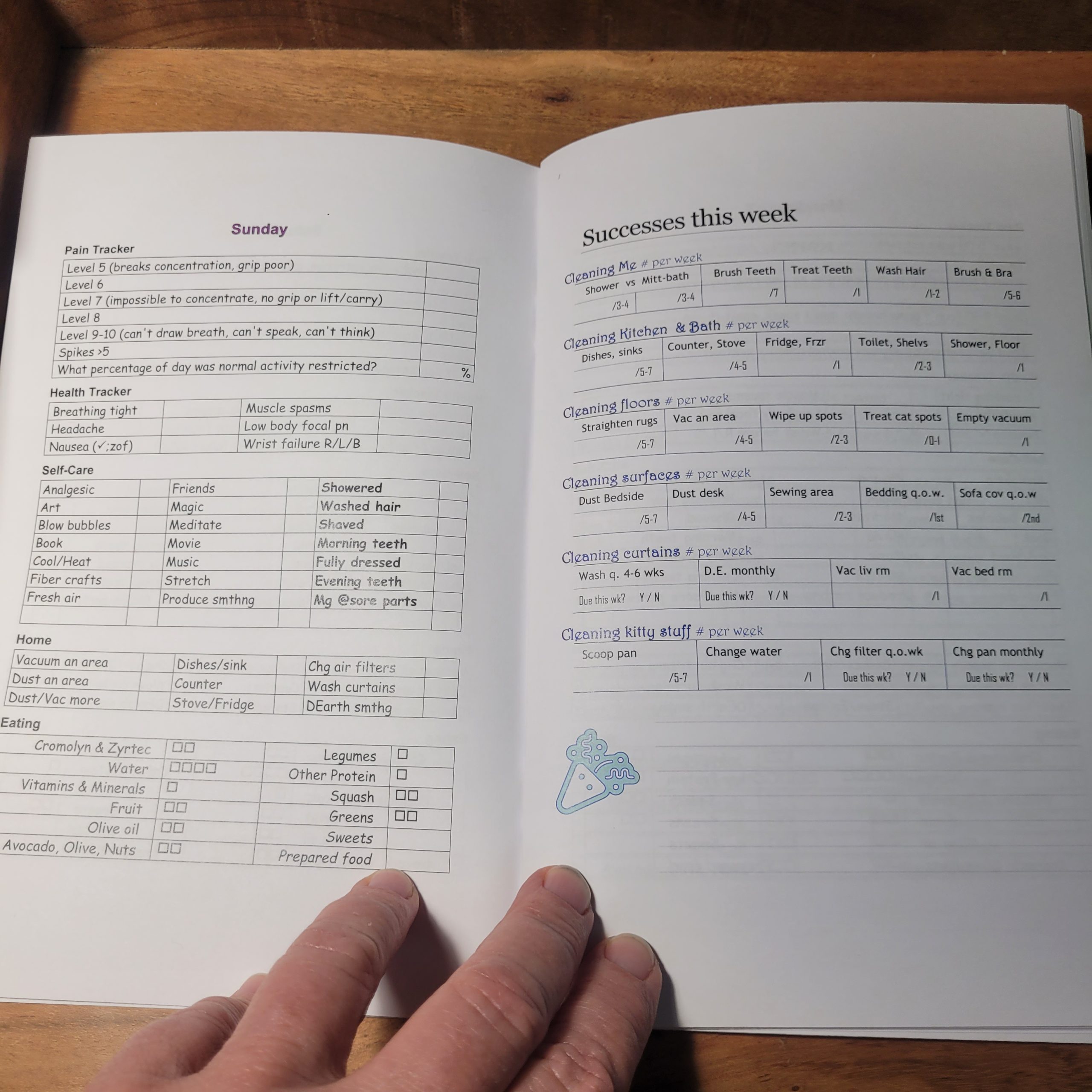
We’ve got logs in color. We’ve got ’em in black and white. We’ve got half sheets, whole sheets. We’ve got tables, checkboxes, body maps… anything I could think of to make using these a low-cognition task:

You can see how my tracking changed depending on just how sick I was vs. how much activity I could (or, more often, wanted to) expect from myself. They show how my priorities and needs shifted, what worked for me well enough to track, and so on. Don’t worry that it seems rather personal – it’s all information; information is a good thing; good things should be shared. You might find a relevant format to start your own tracker from.

They’re in PDF format, for technical reasons. Conversion tools and PDF editing tools are available, some of them for free. Have fun, and come back here to re-download if you mess something up. This is a no-shame zone.


Pulling the masks off in pieces

Having crashed and burned in a (for me) spectacular manner, I’m being (ahem) encouraged by many of my nearest and dearest to stop pretending I’m so much healthier and stronger and more multi-systemically resilient than I am.

My underlying state of health is not good, and I hate discussing it. It’s tiresome and depressing. That said, ignoring it obviously doesn’t work for long. Need a 3rd way.

I’m pushing 60. Time to stop pretending I’m 34… which was my last year of what I still reflexively consider my normal health & athleticism, and it was also when this pain syndrome was laying down its first tracks. Between multiple bereavements, recurring respiratory infections, and repeated courses of megadeath antibiotics, my nervous system was primed for disruption.

As one friend said, “We habitually present a version of our pre-CRPS selves” and, outside my 4 walls and the privacy within, I don’t seem to have anyone else to be yet. How can I exist without coming off as hardy and buoyant? I don’t know what that could even look like.

I go out and do things in public view, then crawl home (nope still no car, yes it’s been all of 2025, yes I’m struggling more all the time, don’t ask) to recover in private. Those are my 2 gears. I’ve recently developed a half-gear of being in my garden plot, but that now requires a lift because the bus is too brutal – although I love that it’s currently free!

It feels like I’m waiting for the world to allow me to heal. If that sounds self-pitying, you’re probably right. I’m new to un-masking, and it’ll take practice to get the tone right – un-self-pitying, but fully honest for a change.

Showing showering

I’ve been drawing cartoons of lives like mine for years. I was waiting to put them into a book, but they’re doing no good in my folio and some have been there for way too long. I’ve also drawn communication tools. It didn’t seem time to share them before, but it sure does now.

First up…

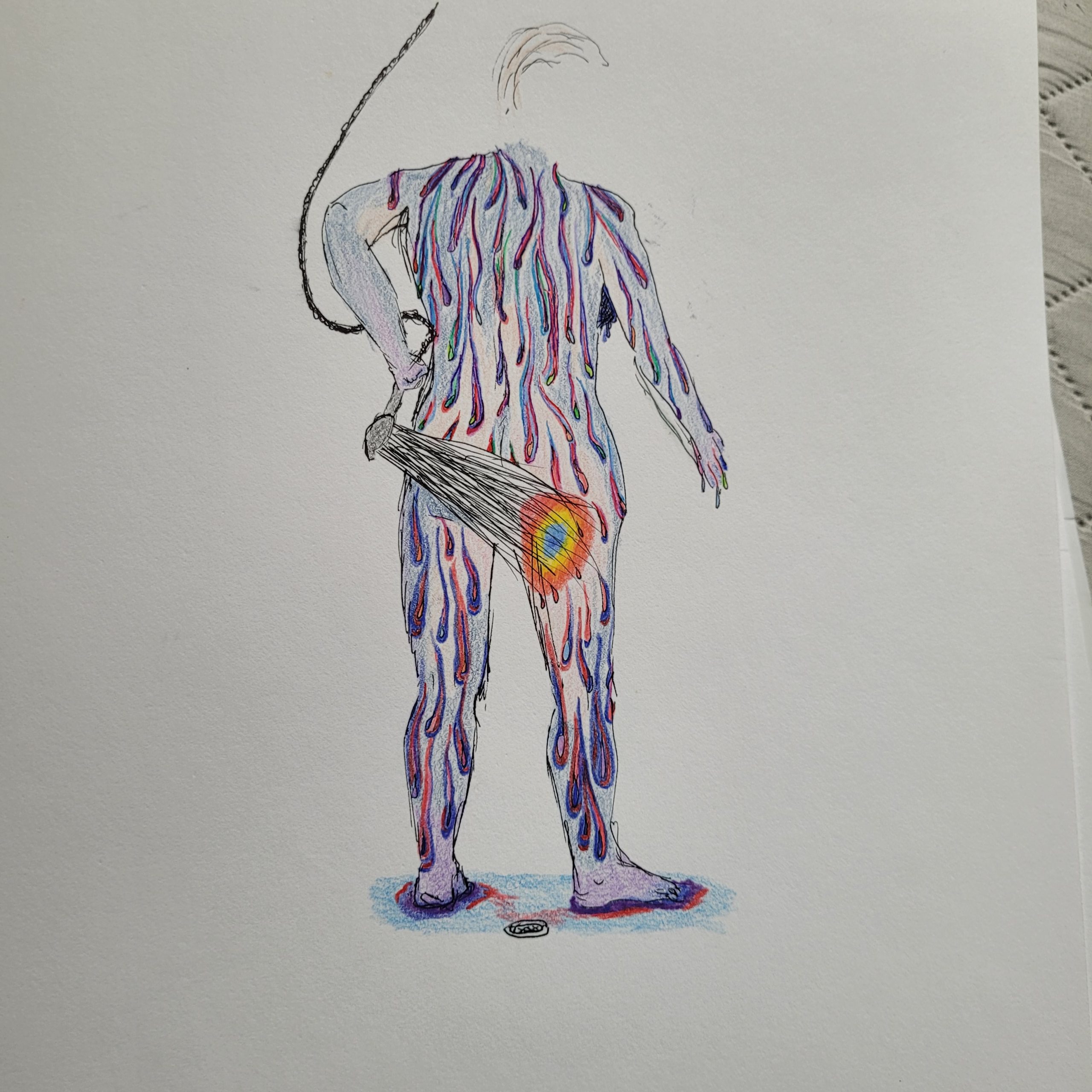
Taking a shower on a bad day:

When I’m rash enough to shower on a bad day, it feels kinda like this.

This picture isn’t finished, but it’s good enough. You can enlarge it to see the way the (to my senses) appalling changes of temperature wrap around every individual drop’s path all the way into the drain.

I couldn’t find a way to draw the way each drop feels like there’s a hook in its head, physically latching onto and dragging energy out of my body. That doesn’t hurt (unlike the hot/cold nonsense) but boy, is it exhausting!

So, when you can tell (pew!) that I haven’t had a proper shower or even gotten wet recently, you’ll be able to surmise that the pain has been higher than my ability to cope with the intensity of the experience.

For the record – I gritted my teeth and showered & washed my hair yesterday morning! I’m taking a bow, frankly. I had a familiar audiobook to listen to, which sometimes can keep my attention off those hot/cold and dragging sensations.

Keep in mind that everyone’s pain is their own. CRPSers don’t all have the same experience in the shower, because, for some, it’s awful in some other way. Not all days are this bad, even 24 years in. Nuance is key. Also, boundaries.

My pain isn’t yours, and nor should it be.

The idea here is to give you a chance to look on, without looking for anything more than your witness. That right there is a powerful thing: just being seen.

Don’t take it on.  Just adjust your expectations, maybe, as I’m learning to do myself.

If you’re a bio-nerd, read up on how humans go from mad mitosis to having skin and organs. It is absolutely fascinating – and explains a lot about neurological variations!

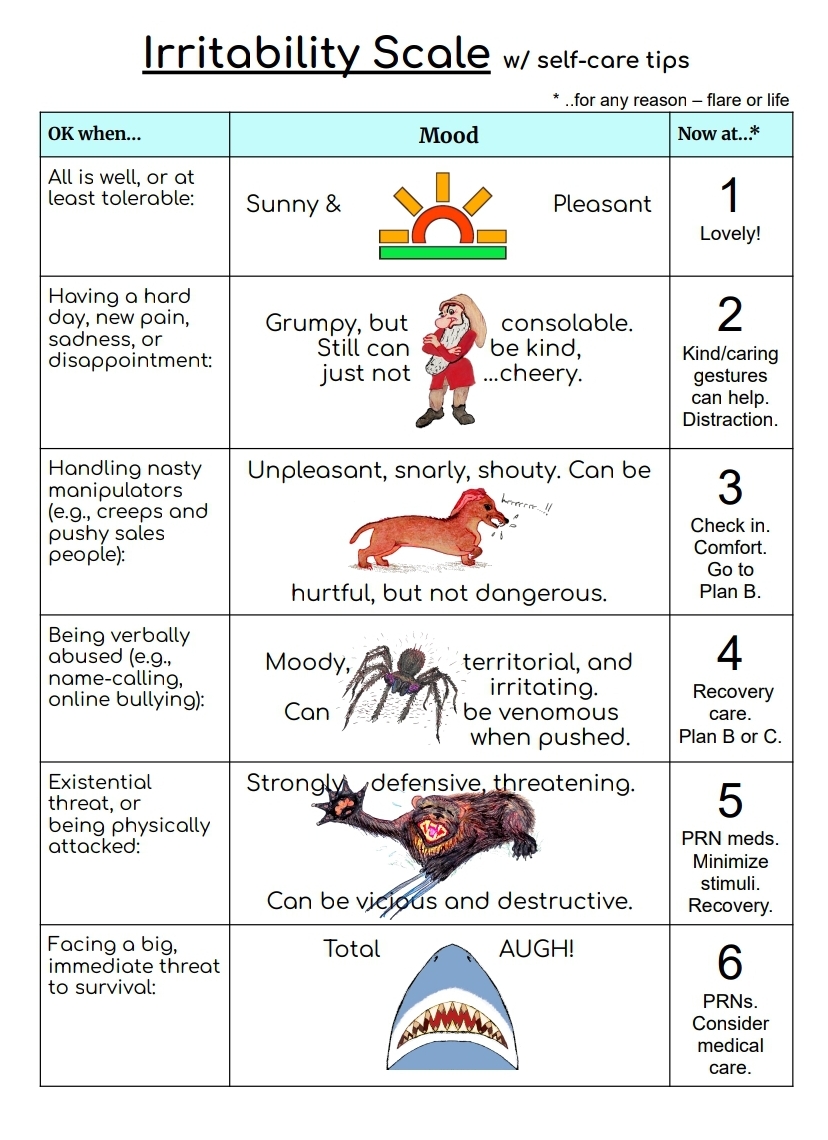
Communication tool: moods & self-care

I’ve also got a delightful communication tool to share.

As we all now know, my mood may not reflect the outward, apparent situation. There can be stuff burbling away that affects me in ways I might not realize, but others can.

I came up with a rough drawing of a rating scale for my housemates to use (when I had some) and it was a huge help to get that objective feedback – without anyone being defensive! I’d sometimes find the magnet moved to a different number, then go away and take care of myself until I was pretty sure it could move back up. Usually, though, they felt free to call me over and show me where my behavior was, and I loved their honesty. Did me a lot of good.

Click here for the full-sized PDF: Irritability Scale

I particularly like how it indicates when a level of irritation is appropriate. That was a mind- blower for me, as I’d been telling myself that it was always bad to be unpleasant. Nope! Sometimes it’s perfectly appropriate!

I think, and hope, that sharing these images and tools will:

A. Be useful, and

B. Get it right through the concrete (taps own head) that I need to come up with ways to live and engage with the world that are congruent with this reality.

My inner Cleopatra, queen of de Nile, needs to get back to Egypt.

Cheers and virtual hugs are most welcome! I’m daunted by this job. I mean… I value honesty enormously… just not about my weaknesses and disabilities 🤣