Today I Learned.. about how cashier’s checks work

If you’re chronically ill to the point of being disabled, you’re probably the sort of person that things happen to. This is something that insurance companies used to have data for, so nobody can tell me this category doesn’t exist. Besides, I think I am one!

Long story short…

Cashier’s checks can disappear into the void, but — if you know a little terminology — it’s possible to get them out again.

Note: this is based on the US system. The concepts broadly apply, but tend to be implemented differently elsewhere.

Lingo and key points are in bold.

When you get a cashier’s check, the money is taken out of your account and put into the bank’s GL, or General Ledger.

The GL is a kind of “sandbox” that they can use to move money through in a way that protects the cashflow, regardless of what else happens in your account. It’s strictly temporary and has to be zero’d out at the end of each day.

Whatever else you do, check 2 things on that cashier’s check:

  1. Who it’s made out to (get them to read it to you if necessary).
  2. How much it’s for.

If either is wrong, push it back across the counter and make them redo it immediately.

The cashier’s check is drawn on the bank’s own account. This is why the account number on the check is not one of yours. It’s also why they’re considered more usable than personal checks: banks are guaranteed to have that money in hand.

If you take that check to another bank to deposit it, hopefully it’ll be credited directly to your account.

If not, here are some clues to follow.

I’ve spoken to 8 or 10 bankers in the past 2 weeks, 4 of them managers/assistant managers. (I don’t know exactly how many people were in a couple of those rooms.) Only one of them could explain this to me. So, might want to take notes or print this out.

If a cashier’s check is negotiated (in this case, that means “marked up and legally received”) by a bank, and subsequently denied for any reason, it goes into a magical 3rd space that few people even know exists. This is where things get interesting.

If anyone tells you — as people have told me — that a problematic cashier’s check simply vanishes and you lose that money, they’re wrong. Don’t put up with that.

1. If the check was negotiated by the receiving (2nd) bank before being denied (this is rare, and requires at least three people to be asleep at the time!), then call the issuing (1st) bank and ask if it shows up in their system as having been cleared.

But wait! There’s more.

2. If it has been cleared, then next, the bankers need to look for what’s called a Fed adjustment. Naturally, the Feds keep a hand on the tiller of bank transactions. When a balance sheet is not right, they make a Fed adjustment — which does not show up in the usual account information, as seen by the front-line staff! — and gets parked in the 1st bank’s own accounts somewhere else.

PRO TIP: Try to get a trace number, or else (like someone sitting in my seat right now), you might wind up waiting still more days to track that money down definitively.

Information about a Fed adjustment is not available to the usual banking staff. Access to that info is available only to specialists, and it’s often contracted to a specialist 3rd party.

The bank’s Accounting department might have access if they know they’re looking for a Fed adjustment. The Operations department (if they have one) will have access, because they have to handle policies and procedures and stay legal & proper.

The 2nd bank’s 3rd party specialists can access that info and tell you where it is. The 1st bank’s specialists may not see it without a trace number.

It exists and it’s their job to find it.

Once you’ve established whether the check has been cleared by the 1st bank, and you have found the right person who can look up Fed adjustments, then you’ll know where the money exists: either in the 1st bank (most likely) or possibly in the 2nd bank. But now you know.

Remember.. It won’t be in any of your accounts, it’ll be in the bank’s own area. They have to look for it differently.

4. Next step is to notify the bank/branch manager where the money is, and ask them to credit that money back to your account.

If that doesn’t go well, play Duelling Bank Managers: go to the bank that doesn’t have the money and, from the manager’s office, call up the one that does; the manager you’re with can ask them sweetly & precisely how to find it and get the money back to you.

This is one of the things that speakerphone was made for. Wonderful way to clear the path.

5. This is the worst part: the Fed adjustment may not land back in your bank (let alone your account) for 30 days. Then you can do whatever you like with it.

My 1st bank, now that they know where the money is and are sure of receiving it in time, are giving me a free loan on that basis, so the money is in my account now and I can go get it at last.

I’m gasping. Absolutely breathless.

Warning: verbatim quote — “the squeaky wheel gets the grease”… so if you’re working with a bank that isn’t culturally meticulous, be prepared to do a lot of squeaking.

I’m hoping the car dealerships will take cash, because I have jumped through enough hoops in the past 2 weeks, and I do need my own transportation.

Pulling the masks off in pieces

Having crashed and burned in a (for me) spectacular manner, I’m being (ahem) encouraged by many of my nearest and dearest to stop pretending I’m so much healthier and stronger and more multi-systemically resilient than I am.

My underlying state of health is not good, and I hate discussing it. It’s tiresome and depressing. That said, ignoring it obviously doesn’t work for long. Need a 3rd way.

I’m pushing 60. Time to stop pretending I’m 34… which was my last year of what I still reflexively consider my normal health & athleticism, and it was also when this pain syndrome was laying down its first tracks. Between multiple bereavements, recurring respiratory infections, and repeated courses of megadeath antibiotics, my nervous system was primed for disruption.

As one friend said, “We habitually present a version of our pre-CRPS selves” and, outside my 4 walls and the privacy within, I don’t seem to have anyone else to be yet. How can I exist without coming off as hardy and buoyant? I don’t know what that could even look like.

I go out and do things in public view, then crawl home (nope still no car, yes it’s been all of 2025, yes I’m struggling more all the time, don’t ask) to recover in private. Those are my 2 gears. I’ve recently developed a half-gear of being in my garden plot, but that now requires a lift because the bus is too brutal – although I love that it’s currently free!

It feels like I’m waiting for the world to allow me to heal. If that sounds self-pitying, you’re probably right. I’m new to un-masking, and it’ll take practice to get the tone right – un-self-pitying, but fully honest for a change.

Showing showering

I’ve been drawing cartoons of lives like mine for years. I was waiting to put them into a book, but they’re doing no good in my folio and some have been there for way too long. I’ve also drawn communication tools. It didn’t seem time to share them before, but it sure does now.

First up…

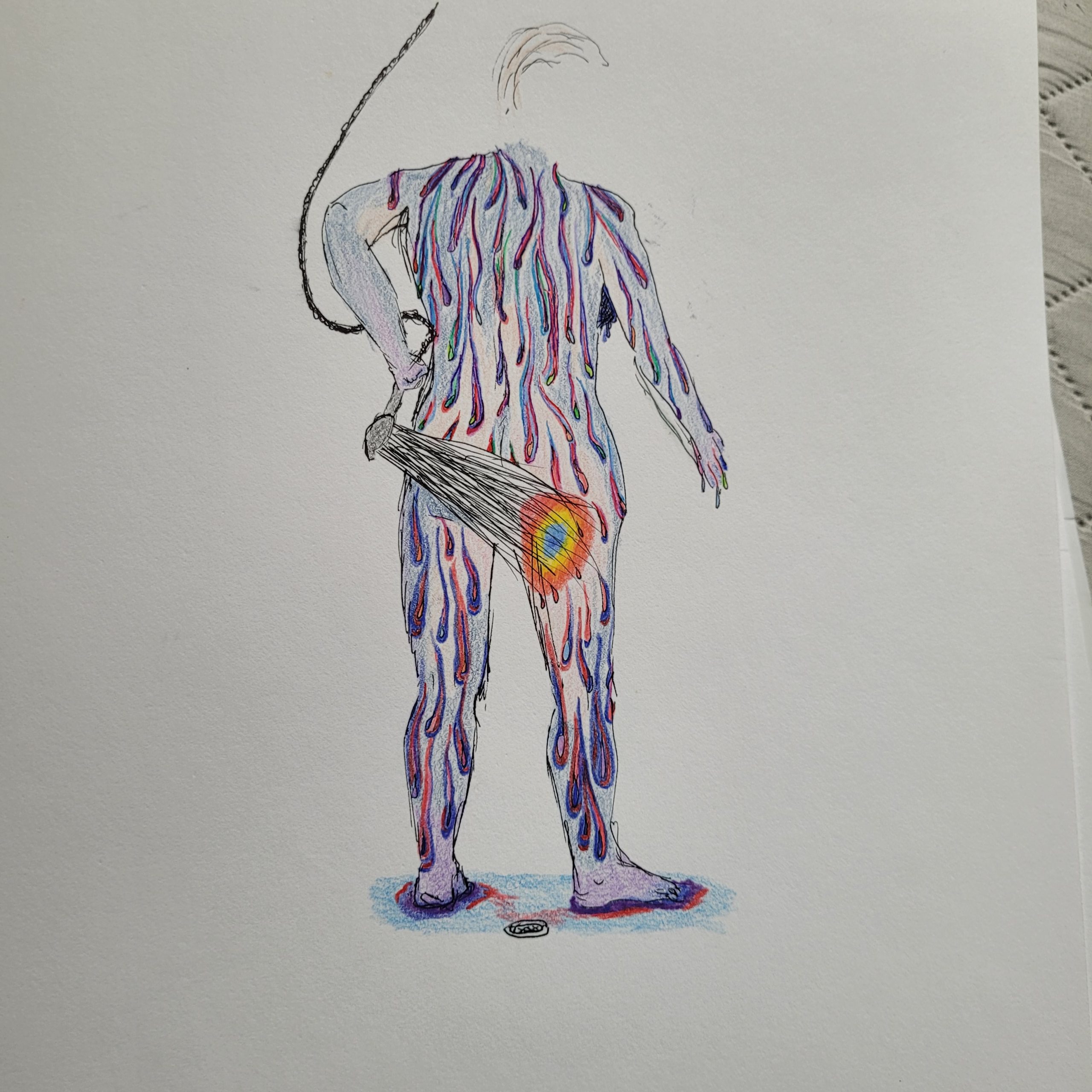
Taking a shower on a bad day:

When I’m rash enough to shower on a bad day, it feels kinda like this.

This picture isn’t finished, but it’s good enough. You can enlarge it to see the way the (to my senses) appalling changes of temperature wrap around every individual drop’s path all the way into the drain.

I couldn’t find a way to draw the way each drop feels like there’s a hook in its head, physically latching onto and dragging energy out of my body. That doesn’t hurt (unlike the hot/cold nonsense) but boy, is it exhausting!

So, when you can tell (pew!) that I haven’t had a proper shower or even gotten wet recently, you’ll be able to surmise that the pain has been higher than my ability to cope with the intensity of the experience.

For the record – I gritted my teeth and showered & washed my hair yesterday morning! I’m taking a bow, frankly. I had a familiar audiobook to listen to, which sometimes can keep my attention off those hot/cold and dragging sensations.

Keep in mind that everyone’s pain is their own. CRPSers don’t all have the same experience in the shower, because, for some, it’s awful in some other way. Not all days are this bad, even 24 years in. Nuance is key. Also, boundaries.

My pain isn’t yours, and nor should it be.

The idea here is to give you a chance to look on, without looking for anything more than your witness. That right there is a powerful thing: just being seen.

Don’t take it on.  Just adjust your expectations, maybe, as I’m learning to do myself.

If you’re a bio-nerd, read up on how humans go from mad mitosis to having skin and organs. It is absolutely fascinating – and explains a lot about neurological variations!

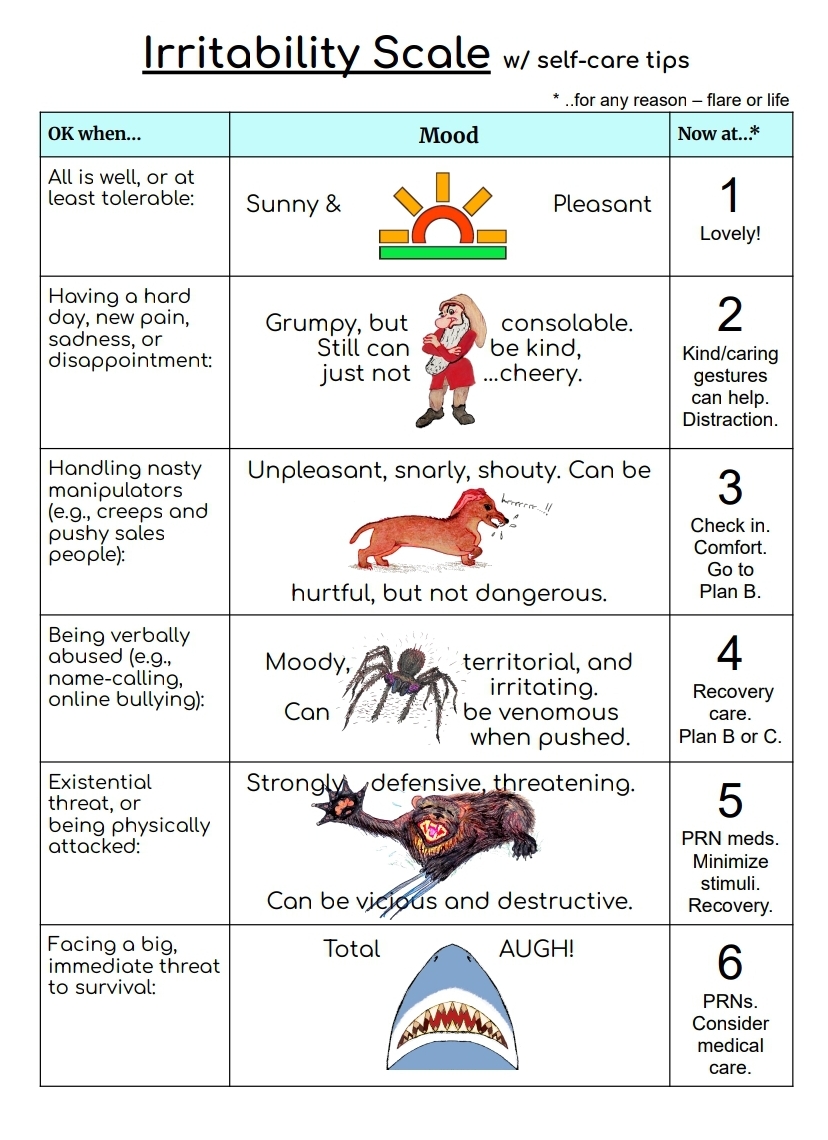
Communication tool: moods & self-care

I’ve also got a delightful communication tool to share.

As we all now know, my mood may not reflect the outward, apparent situation. There can be stuff burbling away that affects me in ways I might not realize, but others can.

I came up with a rough drawing of a rating scale for my housemates to use (when I had some) and it was a huge help to get that objective feedback – without anyone being defensive! I’d sometimes find the magnet moved to a different number, then go away and take care of myself until I was pretty sure it could move back up. Usually, though, they felt free to call me over and show me where my behavior was, and I loved their honesty. Did me a lot of good.

Click here for the full-sized PDF: Irritability Scale

I particularly like how it indicates when a level of irritation is appropriate. That was a mind- blower for me, as I’d been telling myself that it was always bad to be unpleasant. Nope! Sometimes it’s perfectly appropriate!

I think, and hope, that sharing these images and tools will:

A. Be useful, and

B. Get it right through the concrete (taps own head) that I need to come up with ways to live and engage with the world that are congruent with this reality.

My inner Cleopatra, queen of de Nile, needs to get back to Egypt.

Cheers and virtual hugs are most welcome! I’m daunted by this job. I mean… I value honesty enormously… just not about my weaknesses and disabilities 🤣

The Beast

One of the characteristics of CRPS and some other longstanding brain-driven pain conditions is the occasional personality transplants which, especially combined with memory-holes and perceptual shifts, can really do a number on relationships. This situation is called the Beast. Medically, it’s considered part of the territory.

I’ve been absolutely smug about my aability to stay away from the Beast. Since regular psychotherapy is part of the gold standard of treatment for CRPS, I’ve prioritized psych care — from professionals who have a good understanding of trauma and PTSD, since actual specialists in central pain are so rare, and trauma/PTSD is a good model to start from. That care hasn’t been possible for most of the past 5 months, and I’m taking stock of how much I’ve lost in that time, now that I’m back on the schedule.

I can count on 3 fingers (now 4) the times I’ve been the Beast in ~21 years. (I’m fuzzy on my first ~4 years of illness. It was a blur.) The most recent of those times was due to a neurotoxic exposure. One was when I lived in a mold infestation I hadn’t mitigated yet. One was during a particularly hectic trauma period. The current one was after I decided to make an extended, extravagant physical effort in not-very-safe air. I really thought I could pull it off, and just rest afterwards.

But these are reasons, not excuses. I hurt people who didn’t have it coming at all. I injured relationships I care about deeply and intend to protect. Today’s event cuts particularly deep.

“Why would you do that?” is an unanswerable question. If you don’t have this shit disease, it can’t be explained. All I know is that I felt myself being pulled under, not recognizing fractured memory and wacked perceptions. I grabbed for a rope. Didn’t think what it was attached to, because I thought I was drowning.

Mind you (adds that inveterate shit, Sarcastic Sister), my feelings are such that I’d rather be dead than hurt my loved ones. But this is not the time to say that, because it makes no sense from the outside, in light of what they just experienced from me.

Need a moment to process this.

So… diligent psychoemotional tune-ups, reasonable pacing of activity, and a safe environment are not at all optional. That rubric is my best insurance against the Beast. What I know from seeing my long-term survivor cohort is that there’s no guarantee I’ll be able to avoid the Beast forever. So, I’m wrestling with this reality and not really wanting to be here for my life. (“I’d rather be dead than feel this way” was a state my late BiL and I could bond over.) Many of my fellow CRPSers know the feeling, and it eases my soul ever so slightly to know it’s part of this disease experience, and not because I’ve actually become evil.

I’ve done what I can for now. I’m off home for meditation time, if I can, and a familiar show if I can’t. I have to remember how to rest and how to push myself no harder than is good for me. I have to take recuperation very seriously and basically expect nothing from myself for a week. I have to manage this terrible storm of feelings in the absence of a stable central nervous/ endocrine system. I hope to have the chance to rebuild a couple of relationships. We’ll see if that’s do-able. Fun times.

I’m looking for some more positive message to turn towards or even something to lighten this a little, since the point of this blog is “living anyway” in spite of what this craptastic disease does to people. The only thing I’ve got to offer right now is the passage of time and the hope of some recovery… within the context of this horror-show snowballing around me, around us all.

It gets weird in here

I was chatting with a close friend about a week ago. He’s placed to be on top of current events with a depth and nuance that my vomit reflex can’t stand. We had an interesting conversation which was mostly me chirping, “But what about…?” And him giving me a really good update on stuff I’d never be able to stay upright long enough to research.

My brain was twinkling away on the incoming tide, sorting the info and soaking it into the correct metaphorical tide-pools and littorals.

I soon realized that, though I was sorting words coming in, I was having a terrible time getting words out. I didn’t realize, until that moment, just how completely that parsing a thought may feel verbal, but might not be.

I thought I was wording just fine as I thought, “okay… this goes here with news ownership; this goes there with political gamesmanship from Brand X; this relates both to Brand Y and legal process” and so on.

On the outward flow, all I could get going was along the lines of, “so, uh, how’s the… thingy… you know, from… what’s-his-name…” and I realized I sounded immeasurably more mentally inept than I felt.

I wanted to say, “look, I’m still in here and I’m taking in everything you say. I just can’t operate the outgoing current right now and my word capturing is going great, but my word finding seems to be underwater.” I could not fund the words, of course.

It’s been grimly fascinating to me to find the many ways a brain can go off-line in bits & pieces, and how my mental activity and neurological activity have these unthinkably complex ways of associating and dis-associating within themselves and between each other.

Everyone’s brain is linked up in completely unique ways. Just imagine what it would be like to work with people who could relate exactly what is and isn’t working and when. It’d set off such an explosion in the advancement of knowledge that.. wow.

A pointless note of wistful longing

It’s a real pity I can’t handle any schooling, let alone medical school, because this is exactly what neurologists need to know about to make their lives – and, boy howdy, ours! – a lot more useful and interesting.

As it is, patients are considered inherently unreliable in the medical mind, and, although that’s extremely insulting, it’s not crazy within physician context: the precision of thought and accuracy of terminology is rarely there, because so much training goes into commanding the information the way a doctor does.

Conversely, it’s adapting through a traumatizing cascade of brutal experiences that creates a skilful and well- informed patient. Training that’s so high-level it amounts to nosebleed seats for one; autodidacticism that makes Richard Francis Burton look like a playboy (oh, wait..) for the other. (When I can find someone who’s as brilliant an autodidact but not a moral negative, I’ll revise that sentence.)

It really is a different language and these two rather fragile mind-sets have trouble reaching across the cultural gap. (Anyone who thinks doctors aren’t fragile should just try correcting a few. It can get rough.)

I think the ratio of truly secure doctors to the rest is about the same as truly adept patients: they are definitely around, but can be hard to identify even when you’ve got one. It takes hard work and a lot of fearless honesty in both cases.

Buckling on my helmet. I’ll get it from both sides now.

The onus winds up being on the traumatized patient, who usually has more clock-time to prepare for the visit. The doctor has to turn around and deal with someone equally intense in 2-7 minutes, so they have to stay mentally free to do so.

Yes, let’s hear it again for corporate medicine and its unholy offspring. So efficient,  such a great use of limited resources… not.

There isn’t (yet) a cultural context in the field for cross-training as a patient and as any sort of licensed practitioner. That’s the key deficit.

Practioners get culturally demoted when they become patients (which is disgusting, but predictable in such a heirarchy) and patients get shoved into a little cultural pocket for things that fall between weird and interesting without fully qualifying as either.

Fun, eh? It’s one stellar example of the waste in the system.

With a pet & chronic illness

This is a long one. Grab something to drink and put your feet up, if you want to…

In the wildly unlikely event that, say, a vulnerable American citizen felt moved to respect the anti-immigration feeling and return to the lands that, say, my ancestors left in the 1600s and 1700s… how would that work?

It helps if you already have a passport. This is important. Go here:

https://travel.state.gov/content/travel/en/passports.html

and follow the instructions there – whenever you land on it. Passports are issued by the State Department, and the State Department is currently being defunded and depopulated, so their processes may change.

This hypothetical traveler – let’s call her Max Peregrine – and why not? – is female, disabled, poor, and has very short hair. This puts her in several categories of risk in the US in 2025, and she’d like to know what other options there are for someone like her. Her service animal, a minature goldendoodle, has to go with her.

This is important.

Max has learned that a pet leaving the US has to get a certificate from a vet specifically qualified to issue international pet health certificates. She asked her usual vet, who referred her to the USDA web site to find one.

The USDA has been running increasingly lean for years, and has recently been gutted by the incoming president and his team, so the list of vets qualified to give this pet health certificate is out of date.

Max has been disabled a long time and is used to this kind of disappointment, so, after an Epsom salt bath and a TV break, she called down the list of veterinarians in the area until she found one who can (theoretically) give this certificate.

It took the one vet she found 3 weeks to research whether this is even possible. The USDA (which supervises animal health certificates for travel) is running out of staff, after all, and every country people want to bring their animals to has its own peculiarities over what is required to clear a pet for arrival, so it gets very complicated very quickly.

Sadly, the information that non-vets like Max find about import requirements is less than half the story.

Also, the US export process is complex in itself, and requires a 3-hour minimum turnaround between the vet and the USDA for the form to be submitted, reviewed, inspected, corrected, approved, and printed out. That is, if nothing goes wrong.

This vet certificate has to be issued within 10 days of departure (in some cases, 3 days, depending on the country the traveler is going to) so it’s good to start this process well in advance, and be willing to stay flexible.

If, like Max, your pet had an uncertain history or belongs to someone with limited mobility, it’s possible you’ll hit a snag: if the initial rabies series was not done exactly right, you might have to start the series over, do a blood test in 3 weeks, and be sure to get the next one inside of a year.

If you travel to Europe, you’re in luck: go to a certified vet there and get your pet an EU Pet Passport. It’ll make everything a lot easier as it’s widely accepted.

It’s important to remember that Max belongs to a category of people who can’t afford a package trip, nor a concierge trip. She has to do all the planning and reservations herself, and track all that info if, for instance, her pet’s initial rabies vaccination did not happen exactly as intended, and every leg of her trip has to be adjusted, by herself, one piece at a time.

Every transport company has their own pet policies, so she also has to call every single carrier in the chain of the journey to make sure her pet reservation has followed her.

It’s fortunate for Max that her executive function happens to have extra bandwidth for travel planning. It’s in her DNA. Her ancestors have been traveling for at least 350 years.

Since Max’s mini goldendoodle, a girl named Sam, is a Service Animal, there’s no question of that pet being refused. She has to fly with her person.

However, her paperwork still has to be in order!

So, having rectified the rabies shot situation, changed the entire trip to 2 weeks later to make sure her dog can come, and found half a dozen places to get food that matched her dietary requirements in each place she planned to stay in, Max was smart enough to know she could not possibly relax until she actually had her toes in the sand and her dog in her arms at the same time. The preparation for this trip had only just started.

Max is probably a bit overwhelmed, but can get good advice and good tools. She got Smart Tags for her luggage, found friends willing to be phone buddies to use Find My Phone to watch her progress, set an alarm to remind her to turn on Location and 5G at every transfer to give Find My Phone a signal, and then returns to low-rad mode so she’s not battling cyclical vomiting syndrome (which is what happens when she’s around too much signal too close to her body) while conducting a long trirp.

Cyclical vomiting is never fun, but it’s worse all around when you’re packed into Economy class.

Max, who hates travel surprises and likes to be organized, has also prepared a travel folder with pockets and tabs:

  • Complete itinerary in the inside pocket in front.
  • First tab: Check in information for each stage of the trip. This also proves that she plans to return in less than 90 days, because that’s important in an increasingly immigrant-hostile world.
  • 2nd tab: Visa related info: trip insurance coverage, with the coverages page copied and stapled to the front for easy reference.
  • 3rd tab, more visa related info: Lodging reservations, printed in every language she’ll be travelling through, so each border can conduct its own checks. Arriving with nowhere to stay is a big no-no these days; no more turning up and finding the nearest hostel.
  • Health tab: vaccination info. A lot of places really care about this, so get your shots if you want to travel, and get printouts from your provider. If you can afford it, you can have a travel specialist doctor make a yellow International Certificate of Vaccination, which is accepted everywhere – like the best credit cards.
  • Emergency: this tab is particular because Max has underlying medical conditions. There’s a MOLST form, which providees instructions for when someone is unconscious and can’t tell you if they want CPR or oxygen. It should also have copies of prescriptions, which you can get by calling your pharmacist and asking them to print them out. (Some countries require prescriptions hand-signed from the doctor’s office, but electronics are making their way into this process more over time.)
  • The pet, naturally, has her own tab. Her health certification, rabies documentation, and whatever else is needed, go here. This includes her microchip number, because pets require a chip for travel.

At the back of the folder, Max has left space to keep brochures and flyers for things she most wants – from safe places to get food, to inexpensive trips, free/cheap sights, and bus schedules. Max looks forward to filling that up, but knows she has to be careful with money because she’s still poor … she’s just staying somewhere a lot cheaper than her home at the moment, somewhere the government is not (yet) committing very messy self-merc.

And then there’s packing. Max has to bring her own self-care mechanisms, which involve a lot of pillows and some extra gear. Being disabled is a lot of work and there’s just no getting around that. Everything that’s most necessary for that work has to come with, or be bought there, and she’s on a tight budget.

Happily, sunshine is free!

Max is an expert at enjoying the little beauties and making the most of whatever blessings come her way. She’s going to have a fabulous time, and so is her service animal.

I’m a little envious, but I’ll be sticking around for the foreseeable. I helped Max with some of her research, though, so there’s likely to be more to come…

Fully-qualified human beings

When I was working in the software industry, the term “fully-qualified” entered my world in a marvelously exact way.

The specific programmatic terminology here is from the Java programming language. Don’t let it bother you – some things are just details.

Java uses an organizing category called “classes” for unique bundles of code that define all the features, characteristics, and actions that this bundle of code needs in order to do what its name says it will do. (Other programming languages may have other terms.)

Each class has to have all the parts it needs to know when it’s wanted, what it needs to look for, what it has to do, when it has to stop, and what (if anything) should happen next.

If a class is completely and properly defined in all these parameters (and sometimes more), then it’s called a “fully-qualified” class. It can be trusted and can be used across multiple regions.

Not all classes are fully-qualified. They’re okay for quick tasks and have a place in the Java ecosystem, but their usefulness is limited. Those classes, those hunks of code, usually have to be filled out to be fully-qualified or else deleted when the time comes to prepare a program for market.

Any robust program needs an awful lot of classes of many different types. It’s inefficient to have too many similar classes — you’ve got to have different classes to do different tasks. All that they have to have in common (besides logical coherence) is that they must be properly constructed so they can do their task — whatever their particular task is.

This diversity of classes is essential to good programming.

You’re starting to see the metaphor here, aren’t you…

Some people view all others as fully-qualified human beings.

Some people do not. Only a few meet their idea of fully-qualified — that is, complete and correct and fully able to function as they should. This, naturally, means that they have specific and limited ideas of what humans need to do.

When people beat on those who diverge from their idea of truly human (those targets are usually women or gender-bending or people with disabilities or people of color or poor people) they’re acting on the fact that they don’t see these other people as fully-qualified human beings.

The people doing the beating-on are hung up on the feeling that these people are not properly “written”, that they’re missing huge hunks of “code” that limits their function — and makes them fair game for being taken out, sidelined or deleted.

We aren’t all the same, and nor should we be. It’d be a terrible program if we were, and would quickly choke on its own redundancy, crashing itself and possibly blue-screening the whole show.

Maybe we should go back to the old CRT colors and make it orange-screening.

What do you think? Too bold?

Neuro reset FTW

I’m working on building up stamina because being a blob doesn’t agree with me.

I had one of our rare, hard-won, absolutely stunning neuro physiotherapy sessions yesterday. It usually takes time (days or even weeks) for my body to embrace the resetting, but this one is showing up fast.

Until last week, walking a bit too far would wipe me out.

When I was well, walking lifted my spirits and calmed my mind, and “too far” had more to do with comfort & convenience than anything more pressing.

For most of my illness, walking helped in the aggregate – if I kept it up, I did better over time. It was good, and I was glad to do it, but…

I’d forgotten, until today, just how lovely it was possible to feel after a good walk.

Yes, I’ve overdone a bit, and I’m open to the idea of staying in tomorrow & taking it easy.

I just… I haven’t had a workout high in… dear heavens, I can’t even remember. Decades, possibly.

Must remember to send this link to my physiotherapist. She’ll be:

A. Over the moon for me.

B. Reminding me to drink a lot of water and put my feet up for a bit.

It’s hard to keep it all in perspective – to celebrate this properly, without falling into the old trap of ignoring all the ongoing work it took to get here; to keep it up & stay honest about the jungle of limits I still have to negotiate.

Good day, though, eh? Really, really good. My heart is as light as the feather of Ma’at…

New times; new topics

For audio version (with extra fun stuff), touch this sentence.

I’m not going to mention current events in my country.

This is a series about traveling…

Traveling in interesting ways.

The ADHD is strong in this one:

If a thing is interesting, it is ever so much more bearable.

If I were to travel, I would like to bring my pet.

I hear some of you shouting, “Why, you insufferable loon? Don’t you have enough to deal with??” (Sorry, Mom.)

For one thing, I like her company; for another, she keeps me on schedule and is really good at “body-doubling”, or hanging around to help me focus on a task. She literally holds the yarn while I crochet, and tracks the loose bits of thread when I’m sewing. Cats are supposed to be interfering, but she’s genuinely helpful.

Also… Traveling with a pet definitely makes this more interesting.

Chapter 1: pet passport

I was going to start with the effort to find a vet to make her travel certification happen. I’m not up to that right now.

Chapter 2: Trip planning

I’ve been reading up on alllllllll the aspects of this trip for a long time. Years, really, but most recently for about 3 weeks. It takes some noodling around just to find out if it’s impossible or just kinda weird.

In case it isn’t obvious, I’m okay with weird. Impossible takes a little longer.

Aspects to understand for planning a trip like this:

– The only way to get to my target continent is by air.

– Some airlines are pet-friendly.

– Some airlines that are pet-friendly for domestic flights somehow refuse to carry animals at all on international flights.

– Some airlines that are willing to carry animals on international flights, don’t allow them in the cabin. From my experiences before, I absolutely, flatly refuse to send a cat in the hold, regardless of the airline’s reputation. Never again.

– Am I overthinking/ over-explaining? I think I am.

Point is, there are all these layers and layers of information to dig through. I had to keep on digging through possibilities, then peel back the incompatible options, until everything finally got very simple.

Cats are not supposed to be in a carrier for more than about 7.5 hours. So, all I really had to do was get her from my airport to an airport less than 8 hours away; 3 to choose from. Flights within that other continent are all within that time frame, so the crossing was all that mattered.

Still with me? Good.

Flying into one of these 3 cities puts me at the heart of the high-speed rail line, something I’ve been coveting a ride on since it was first mooted roughly half a century ago.

At the other end of that high-speed rail line is a ferry ride, a 16-hour journey over one of the most adorable seas in the world, to an island that entrances me.

The total cost of the train and ferry (even with the pet) comes out to less than half the cost of another darned multi-leg plane trip *without* the pet, eating bad food, too far up to enjoy the scenery, and breathing other peoples’ air.

In short, if I were to organize such a trip, we’d have 3 modes of transport over 40 hours, lungfuls of fresh air, and moonlight on the Mediterranean to welcome me home.

I might love it. I might hate it and never want to do any of that again. Doesn’t matter from here… because it’s interesting, it’s affordable, and I want to give it a shot.


Another chance to get it right

I’ve been chewing over something for awhile and recently realized that it might be time to apply that much mercy to myself. It’s a more coherent, whole way of thinking about what I discussed in some panic in my previous post.

Complex chronic spoonies tend to drive ourselves hard because we really have no option (the exhausting, but relevant, internal chorus of “adapt or die, figure it out or eff off, push through or give up, fight or fall” is inescapable) but does it need to be so ubiquitous?

A lot of these posts have been oriented on finding light through the cracks, on putting life itself into center stage somehow. I think I’m cooking up a new way of doing that.

The most basic of basics

Many years ago, when I was working as an emergency nurse, I realized that (despite the hype & excitement) our job was fundamentally simple: give people another chance to get “it” right.

Whether “it” was keeping up with their meds, staying off of whatever was poisoning them, choosing better company, finding the healing path that worked for them – whatever. There are fewer “its” than their are people working on them, which is why we are never the only one with our struggles.

That made more sense inside my head. Sorry.

People wind up in the ER because something bad happened, and usually human ignorance, stupidity, or violence was involved.

That’s not about blame. People don’t always get to choose their company or can’t always bear to be alive without some kind of buffer between them and their situations. Even if they did do something colossally daft (like the rich kids who decided to cut out the middlemen and drive 350 miles to buy their drugs from the distributor; 4 came down, 1 eventually went back), it’s not right to require mistakes to be terminal if they don’t have to be. 

Of course people with heart disease should take their meds even when they feel fine, and get periodic blood tests to show that it’s working. Of course people with diabetes should keep an eye on their blood sugar and stay on their meds. Of course primary care when you first get symptoms is better than going to the ER when you start to fall to pieces… but it’s awfully hard to find a primary doctor these days.

Life is complicated and increasingly expensive. ER work really shows that.

Anyway, I saw our job not as holding back the sea with a broom (as some do), but as giving individual people a chance to figure out how to do things better. Lift properly. Drive sensibly. Stay off the hard stuff. Find an appropriate doctor who’ll listen – and then talk with them.

Nobody likes to be told, so reciting these mantras to them doesn’t often make sense. Oddly enough, it can be a lot more meaningful when you’re meeting their worried gaze as you administer the medication or fit their c-collar or go over the x-rays with them. Or tape and dress the wounds in their wrists.

There is so much we don’t control… sometimes we just have to remember what we could control, and how to put that in reach. It’s not easy, but it’s often very simple. When the universe is dropping its big hammer, where do I need to be when it lands? Under it? Or can I get off to one side? What will I have to let go of in order to get out of the way? Is it worth it?

The answers to this aren’t always obvious, and “worth it” to some is not the same “worth it” as for others.

What that looked like in practice

We had a lot of repeat customers. Some of them I wound up zipping into body bags, because what it took to get out from under the universe’s hammer was either too far out of reach or not ultimately worth the effort of letting go of what they were clinging to. They mostly didn’t want to die, but it wound up being too hard to do what it took to live.

I’ve got to respect that. It’s not for me to judge.

Some of them I saw come back just for ordinary bump-and-owie stuff, showing me the healing scars (inward or outward) of their old struggles. There are no words for the sense of sunrise I felt on seeing them. It made the rest worth doing.

It was all their work… but it was up to us to give them another chance to get it right.

My chance

I absolutely love to work. Being useful and productive is the bomb! If it weren’t so important to me… well, I probably would not have come down with CRPS, which stemmed from relentless overuse injuries in my case. I could not take a break to save my life. Whatever it was, I had to jump in with both feet, arms flailing and shouting “incomiiiiing!”

I imagine I could be pretty tiresome that way. Belated apologies to my friends and colleagues along the way!

I’ve been wrestling – for years (how embarrassing) – with recognizing that having fun… recreating… seeking diversion instead of merely a change of work… I’m not even sure how to put it… but that loose, apparently useless, seemingly non-productive use of my time, is really good for me.

It lowers my stress levels. It reduces my pain. It raises my spirits. I don’t know if it gives me back any of my lost abilities, because I find it incredibly hard to do and have never been able to hang onto the easy-going vibe long enough to find out.

What with one thing and another (I’m an American living stateside in January of 2025; IYKYK) I have a powerful inward pull to go somewhere glorious – and affordable, thank you very much – and simply muck about enjoying the diversions. Play tourist for once in my life. Soak up pretty colors and different sounds. Be warm every single day.

And, if I get bored or don’t like it well enough, simply go somewhere else.

At this point, a lot of places are more affordable than the U.S. (more on that later) and, for all the challenges of travel in this body, I do plan on doing nothing but recover and enjoy myself for a good while afterward.

…It’s a weird idea, honestly.

Good thing I’m used to maintaining and cultivating relationships via the internet, after a quarter century of having to do so. It makes love more portable.

It’s still a weird idea. Wherever I go, I still bring myself along, and I know I’ll have to leave my compulsiveness behind with my snowboots. That’s unnatural, but I’ll learn.

Learning to let go of that deep attachment to being productive and useful is not the same as not being productive and useful – but it could give me time and space to heal my much-clobbered systems.

That might be the point.

Rest and play is widely regarded as essential. I think that’s the “it” that I need to work on getting right. Get out from under the falling hammer of overdriving a broken system.

Still a weird idea! LOL!

The times, they are a-changing

Without descending into the morass of modern U. S. history and politics, let’s just say that I’d like the first months – up to half a year – of the new regime to happen with me being somewhere bearable, where good produce is a lot cheaper and the medical care both stable and affordable.

None of this is likely here, where my food prices rose about 30% during the harvest season and there is much loose talk and planned chaos around Medicare and the dole (which I depend on to stay alive) – not to mention the cost of everything rising by 15-60%.

The pundits and those who follow them tell me not to worry, because there are rules and procedures “they” have to follow.

Given the Mump track records regarding rules and procedures, all I can do is smile sweetly so as not to worry my loved ones, and let my mental gears turn more quietly.

Hot tip #1: a tariff is a tax. These get passed on to the consumers, not sucked up by the companies from countries exporting to us.

Hot tip #2: as we’ve seen so clearly over the past 5 years, industries don’t just raise costs in line with their own expenses, but jack them up to see just how much the market will bear. Given a captive market, this has gotten really ugly. Remember eggs last year? The sub-prime lending fiasco leading to the 2008-9 crash? Yeah, it’s an established pattern.

So anyway… here I am: if I stay in one place, I’ll be wrestling hard with un-meetable expenses (my dietary needs are simple, but not cheap) and a constantly-cycling urge to run away. That’s neither stable, healthy, nor fun. Been there, did that, threw away the t-shirt.

I didn’t grow up in one place, or even one country. I’m not mentally stuck here, and I don’t believe I have to put up with the scrambling anxiety or insufferable expenses to come as the Mump Regime and its trail of chaos gets itself through the initial reality-checks.

I’ve been toying with the idea that it’s healthful and good to be warm, stable, and happy. That takes adjusting to, because so much of what makes me feel anchored to the world is about work. I love to be productive. It makes me feel superbly grounded to be useful/helpful to others. This is very compelling… but as far as my daily choices go, doesn’t have a lot to do with being warm, stable, and happy.

It does have to do with abusing my eyes and attention with falling down back-lit rabbit-holes and trying to turn the swarms of information floating around in my brain into streams of relevant words, pertinent to the question I’ve just read.

But I’ve got serious limits and, as it turns out, I am much more useful and productive after I’ve been taking really good care of myself and playing and recreating and being happy outdoors – a lot.

This doesn’t sound like computer-gazing, which is how most of my work happens.

This focus on making myself happy is a weird concept, and I’m still working out a lot of the details. I mean, not even details – I haven’t settled on where to start; even my departure date is unfixed. Getting the right people in to keep my place clean & warm while I’m gone is kind of a big deal too. I’m not prepared to move and won’t sacrifice my sweet little home – not until I’ve got a much better offer in hand, anyway!

Anything could happen. I’m trying to keep breathing properly as I say that.

Maybe it’s time to take a sabbatical…