I’m profoundly curious. (Take that however you want, LOL)
When I was an inch from dying, around 12-14 years ago, when there was nothing left of anything I thought made up my life… I found, down there at the bottom of everything that had been, this relentless creature who had to know how the story would go. I could not allow death to overtake me because I’d never know. So I lived – on pure willpower for a while, but then things started to change and get better & better.
This came up in my Pain Psychology appointment today, following on from the “new pain doc” appointment I’d had the day before. I’ve had 4 pain specialists in 9 years, and (thanks to extended litigation) around 19 in the past 20. Since much more than my life depends on my pain docs, and I have no control over the situation, this is harrowing, every single time.
My medical PTSD is a main focus of my pain psychology treatment, which is how this came up for discussion.
My curiosity is clearly more fundamental than my reflexes and primal needs, so, “Let’s figure out how to use it to interrupt some primally-driven anxieties.” Today’s quote from Kylie Steinhilber, PhD, my pain psychologist. From this, we discussed 2 further insights:
Being inquisitive is about holding an empty mind/heart in the present: pure now, with an open eye to the unknown future.
Trauma responses are about having emotional context and re-experiencing that history, thinking (“knowing”) it will go this way or that way based on what’s happened before.
I’ve never realized that quite so clearly.
If this had been a rough “new pain doc” visit, I could go to the open & curious state of, “so that’s what’s here/now. I wonder where it will go?” – instead of falling into the misery and grim anxiety of “knowing” what it will be like based on prior experience.
Note to self:
BE CURIOUS about where the story will go! That is rational, even though it doesn’t come with a plan.
Prior experience matters, but it’s a lot better for me to stay open and inquisitive and be with what’s going on now. More options, less antipathy between us, and that opens up communication – which improves outcomes, even in a crap situation.
Serendipity was my brain’s home base pre-injury, & it likely still is. It’s OK to go there and hang on when things get uncertain.
I’m in the 20% of humans who thrive through a serendipitous approach, although it drives more linear people (the 80%) up a tree, because it looks crazy to them & sometimes makes them want to reach for a net – or a straight-jacket.
When I use their (the 80%’s) linear approach (which I’m technically good at; mad skillz), the best I can do is mediocrity, if that. It doesn’t work well, no matter how careful the planning and research I put into it. Makes no sense, but that’s how it goes.
Chaos and WTFery are going to find me. I’m one of those people that things happen to. No, that’s not logical, but accepting it is rational. Interesting distinction between logic and reason there.
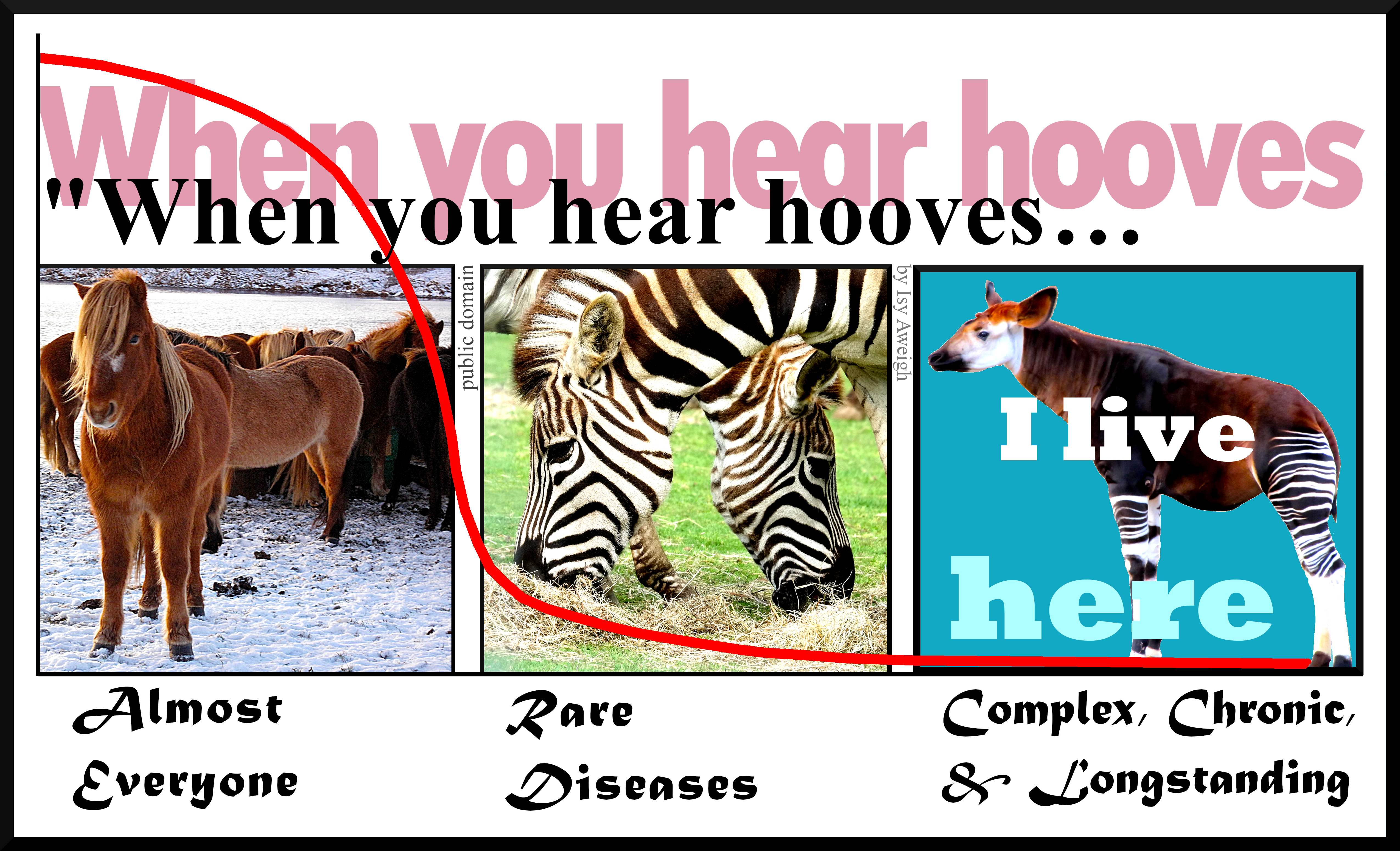
I see my mental job as learning – over & over – how to ride the metaphorical wild horses, not keep trying to dodge their flinty hooves as they run over my well-plotted garden.
20% of humans are like this. We’re not alone, just unusual.
Note to self:
I CAN TRUST MYSELF to know how to go and when to stop. Truly.
Cf. my “15% overdo recovery time” note in my personal pain rating scale. I really do know what it means to overdo by 15%, and why it’s harder to recover from than 10%. *That’s* evidence of a high level of insight & self-management. I can perceive it accurately when I loosen my grip on “tha Plan” and listen to myself.
I said to myself, “Self…
“LET the inner story that ‘everything will go wrong’ BE WRONG.”
Some moments suck anyway, but they pass a whole lot faster when I stay curious and open and let things go differently than expected.
All that said… I am simply over the moon with delight that this “new pain doc” visit was such a good one and that I feel safe at last in that part of the system! That frees up a ton of energy, now and ongoing. The relief is stupendous.
The resident (training) physician remarked, unprompted and naturally, “After all, you are the expert in your own body.”
Hearing that from a doctor is a show-stopper. As one friend & compatriot said, “I’d be less surprised if a unicorn came to your door and told you you’d won the lottery.”
I wrote the start of this for a fellow spoonie today and realized it’s a good starting point for a subject most people find overwhelming: reading medical science when you’re starting off as a non-scientist.
The article I cite first is a good example to start with, because it’s written well and has passages of clear English to work with. So…
I suggest reading the abstract and introduction. After that, just skim the first sentence of each paragraph, since (in science writing) that tells you what the paragraph is about.
If the first sentence makes no sense, skip that paragraph.
If you can figure out the first sentence, glance at the rest of the paragraph to see if there’s any more to glean. If not, move on..
It’s a skill
Reading science is a skill, and skills take time to master. That’s expected! Share what you glean with your doctor and ask them to help you understand it better.
Honestly — this isn’t to puff myself up, it’s just the nature of patients to dis themselves, so hear me out — if you can read my stuff and make out half of it, you are plenty smart and literate enough to start reading science. It’s just work and time, and the time will pass whatever we do, and the work will get easier with time. We just have to take care of ourselves and pick our time, when we’re chronically ill.
Using the right amount of honey
Doctors might give you attitude about comparing your Google search to their medical degree, but that’s not what you’re doing: you’re studying up on your condition, which is wise, and you’re expanding your info base on this thing that has imposed on your life, which is survival.
So, feel free to correct them sweetly, and don’t be afraid to pour some admiration on them if it helps them to re-focus on your information-gap.
The point is not who knows more overall. That’s not in question. When you talk to your doctor, you’re talking to someone who had to memorize, for instance, the Krebs cycle (here’s a partial explanation: https://www.medschoolcoach.com/the-krebs-cycle-mcat-biochemistry/) — so, yes, they have a depth and nuance of knowledge that’s nearly impossible to replicate without going to medical school.
They like having that acknowledged, because they take a lot of painful flak for not knowing everything about everybody’s illnesses all the time, and they need to know that you know what an effort they made to be able to work as a doctor.
So, it’s good to acknowledge that enormous effort.
Then they are usually able to hear you when you clarify that you’re not arguing with them, you’re trying to improve your understanding of this thing that affects you so profoundly. You trust them to help because of their knowledge.
Trust. Help. Knowledge.
These are keywords because they are core professional values for most doctors.
They’re important to acknowledge, and great to invoke and rely on.
That said… if you can’t rely on these characteristics in your doctor, even after you tell them that that’s what you need, then it might be time to find another doctor if you can. These core values are far more important than whether a doctor has good social skills or a good handshake.
When all is said and done, guess who has to live (or not) with the outcomes? It’s you. While the doctor is the subject-matter expert on the medical info around your condition, you are the subject-matter expert on being in your body and dealing with the fallout. There’s a degree of respect that should go both ways, though modern practice makes that hard.
The key to reading science is realizing — or at least, going ahead as if — you’re perfectly capable, and just need to practice. Science is written by humans, and you’re a human too.
1. You are a perfectly sensible person. If you’re reading this, you know how to read (or access translations from) English; also, you have access to a whole world of dictionaries. MedlinePlus is especially helpful in explaining concepts and helping us learn to read medical stuff.
2. Not all scientists can write well in English, and none of them write in English all the time. That’s okay. They went to school for a long time to get extra vocabulary and learn to do what they do; good for them. They’re still people, and they have to write in English at least some of the time. That’s where you can come in.
3. You can read the English just fine. Trust yourself and take time. With practice, you can learn more lingo over time, and get better at reading more science.
Just work from what you can understand now, and let that grow over time. You’ve got this.
Choosing credible sources
While you’re learning to read science, start where you can and work from there. As you get more confident and your understanding grows, you’ll learn to be choosier.
The gold standard for science info
When learning how to assess science, you’ll hear a lot about placebo-controlled, double-blind studies and that method is often important. This method of science gives us more reliable statistical probabilities about whether something will work in a certain situation. The statistical probabilities become reliable when several thousand people (“subjects”) have been tested, probably over many different studies.
With rare diseases, this is obviously pretty unlikely, so we have to work with less scientific certainty. C’est la vie.
Statistical probabilities have more limited value for patients than doctors, because we’re individuals, not pooled data. There used to be a phrase used in medical school: “Statistics mean nothing in the case of the individual.” This has gone by the wayside a bit, but it’s still true.
We may have to cast our nets further afield, because we’re looking for clues that might help us, personally. Be aware when you’re doing that, and put those science reports in your mental “hmm, maybe” folder.
I showed a case study that had a marvelous impact to one of my best doctors. He said to me, “If I could put that effect in a bottle, I would. It worked for that person, and we have no idea why. We do know that it doesn’t work for all these other people. Everybody’s different. Figuring out how to apply one thing to help a lot of people is our holy grail!” Lloyd Saberski, MD.
And that’s why doctors rely on the pooled data gathered from the scientific method. They want to help as many people as possible with each thing they try. Otherwise they fear they’ll spend too much time chasing rainbows.
We patients have to find our own rainbows, just as we have to count on our doctors to keep an eye on what’s statistically worth trying. It really is teamwork, and we both need to do our jobs.
What’s peer review?
Before you give a study to your doctor, it’s worth checking if it’s from a peer-reviewed journal. Don’t expect them to put too much stock in it otherwise.
Peer review means that other people in related fields have checked it over for sanity and validity. This is important for us patients, as well as the doctors who rely on the information.
You can Google whether the journal your article was first published in is a peer-reviewed journal. JAMA, BMJ, and the Lancet are all reliably peer-reviewed.
The value of literature reviews
Then, after a fair amount of studies have been done on a topic, there’s usually a literature review. This is when a qualified scientist takes a close look at all the studies, throws out the ones that were badly designed or poorly run (because bad technique creates bad data. “Garbage in, garbage out”) and writes an overview of what the current good science says.
They also discuss the strengths and weaknesses in the data, and suggest where future science funding could go, in light of the science so far.
Literature reviews are wonderful places to improve your knowledge of your disease/condition, expand your vocabulary, and get a lot better at understanding what goes into the science on your condition in the first place.
For instance, it used to be widely believed that most people with Complex Regional Pain Syndrome had had traumatic childhoods. (“Blame the parents” LOL.) There was a literature review done on about 30 years’ worth of studies, and it turned out that almost all of them were so badly-designed, poorly run, and calculated with so much bias, that nearly all of the studies had to be thrown out!
This taught me very important lessons:
– Just because most people say it, doesn’t mean it’s right, even if they should know better. This is an excellent attitude to have while reading science.
– Methods matter. You’ll learn over time how to sense whether the methods used are appropriate to the topic studied. The wrong method can lead to truly bogus results. The method has to fit the material.
– People lose their minds when they think about pain, as well as when they think about childhood trauma. In practical terms, this means I have to approach all normal (non-CRPS) people’s reasoning about my condition (which is characterized by relentless agony which a non-CRPS’d brain cannot even conceive of) with compassionate criticism. They do not know what it’s like, nor how to live with that pain and still think rationally. They’re not able to know. I don’t want them in a position where they do know, because that’ll mean their lives are as battered as mine is.
Therefore, every word they say has to be filtered through my awareness of how their minds get lit up by unreason, when they think about my pain. This, believe it or not, is perfectly natural. (Look up “amygdala hijack” for background on this mechanism.)
I survive because I’ve learned to substantially displace or ignore one of the most powerful primitive signals in the human body. That isn’t natural, and nor should it be.
These scientists mean well, without question. However, their logic is necessarily fractured when thinking about this, because they lack my tools for facing it. I need to dig into their data and methods before I can buy into their conclusions.
That’s good to know!
The conclusion of that literature review? CRPSers are likely (not guaranteed) to have had relatively eventful lives. Whether the events were traumatic or wonderful wasn’t relevant to our probability of developing CRPS.
In other words, we live in interesting times!
Where to find science to read
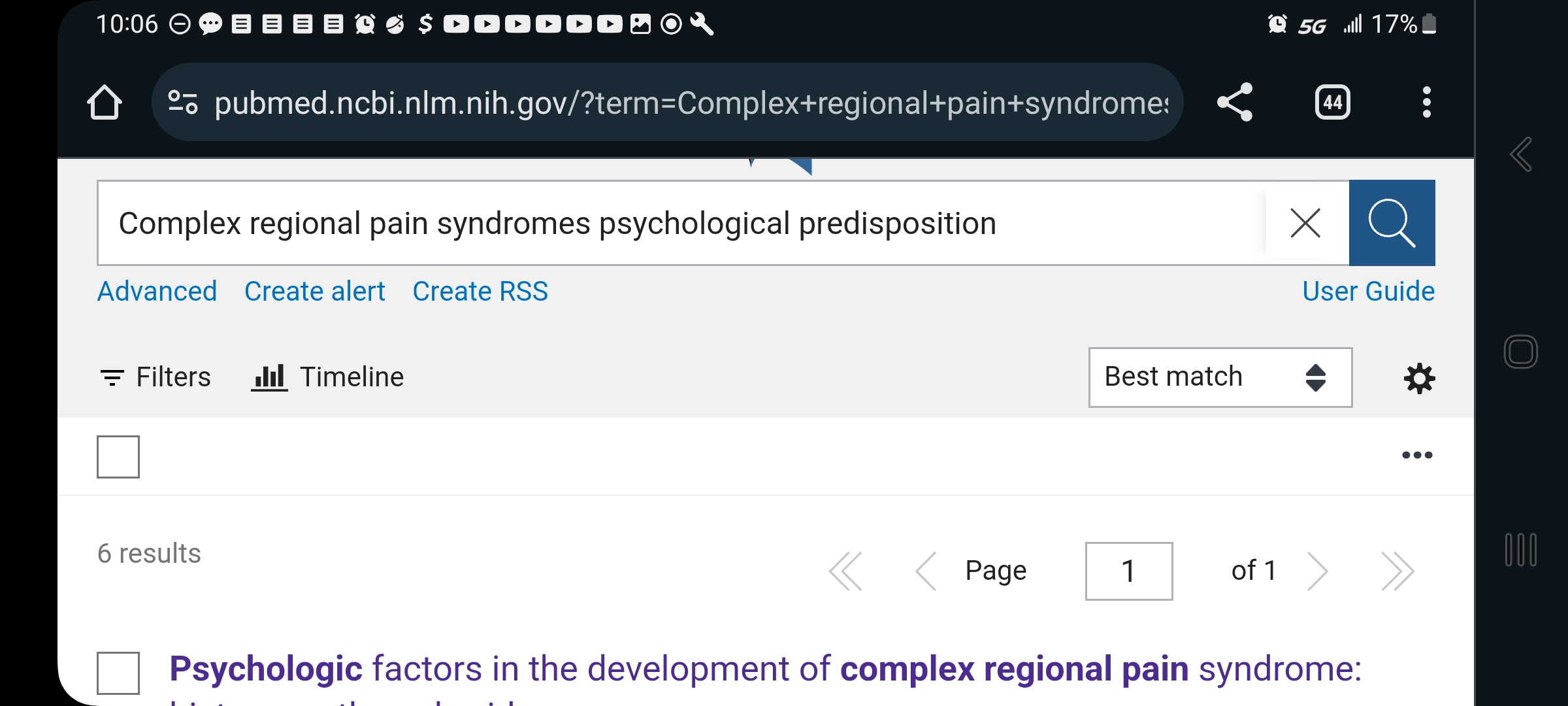
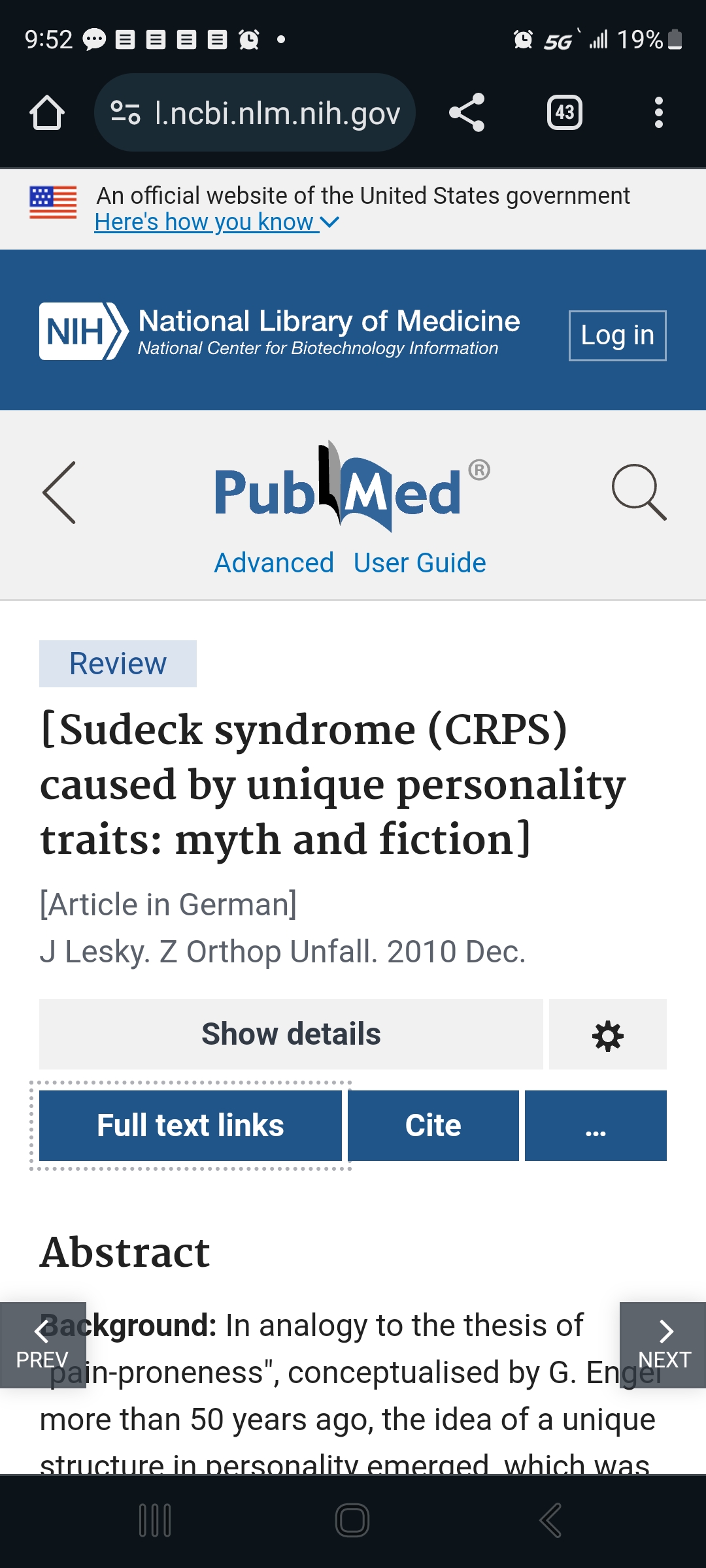
Google pubmed, and you’ll find the National Library of Medicine (NLM) division of the National Institutes of Health (NIH). This is a searchable science library which hosts articles from all around the world, in whatever language they were published in plus English. You can search any valid medical term — for instance, use the full name of your disease rather than its initials, for better results:
Here, you can see that I typed out “complex regional pain syndromes” instead of CRPS.
Some of them have full articles that are free to read (look for “Full Text Link”) …
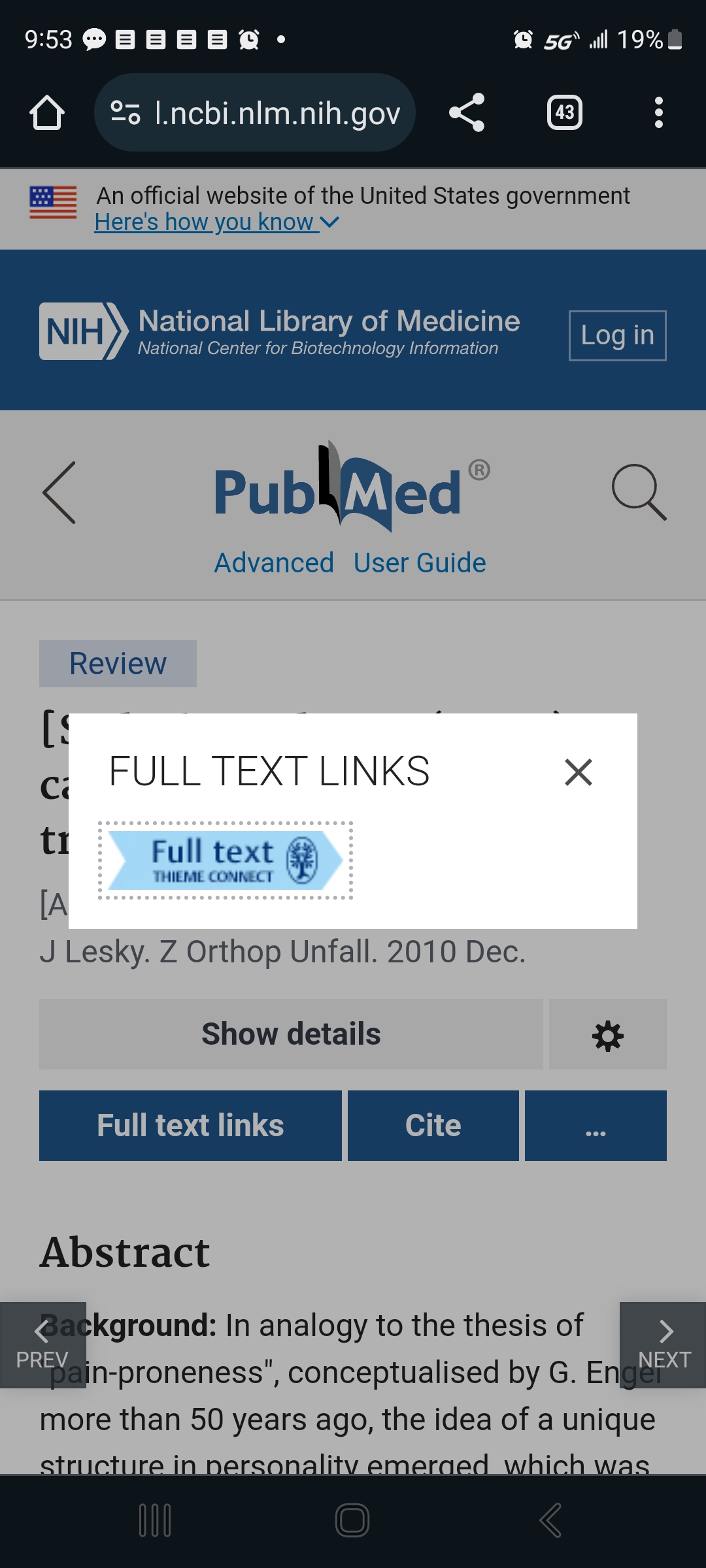
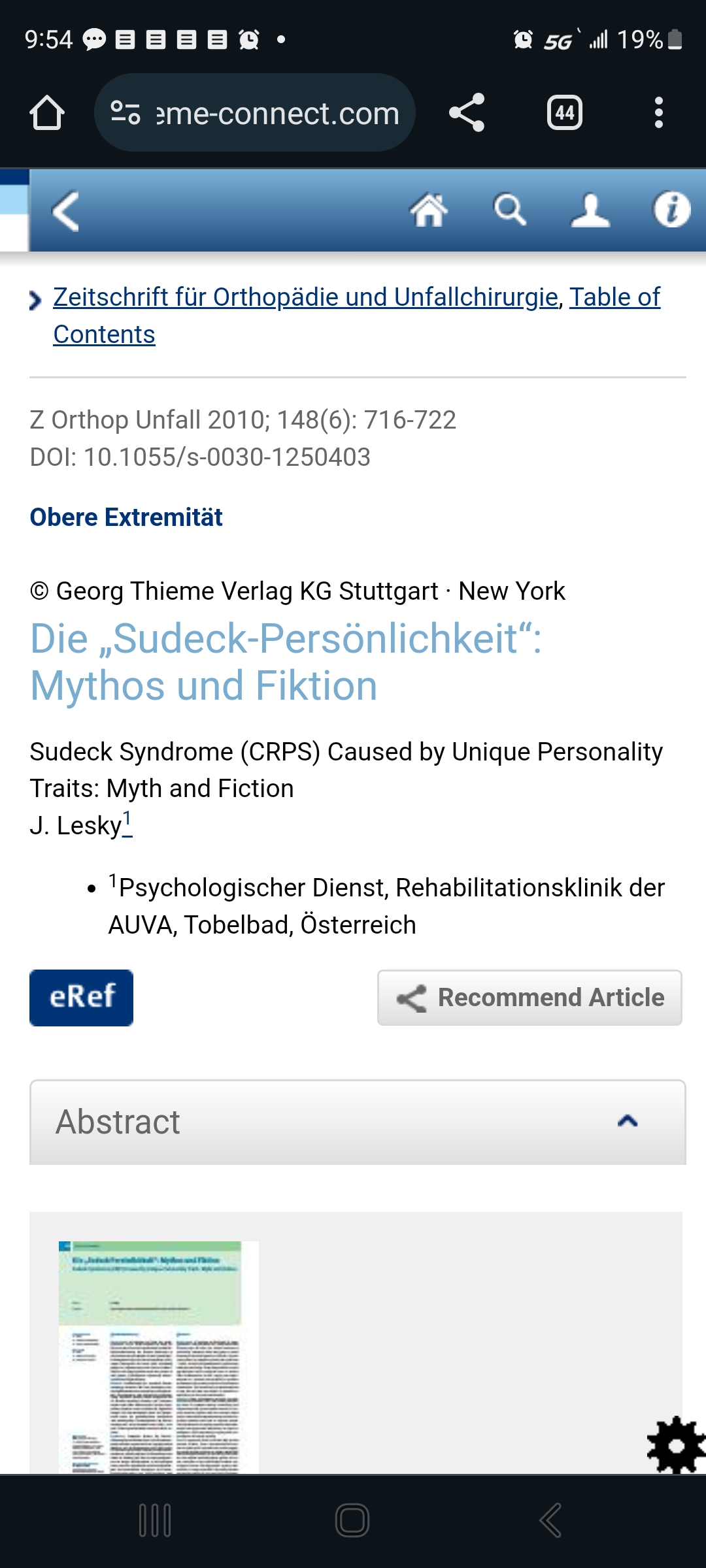
The square brackets around the title tell you it originated in another language. The note under the title tells you which one. Good science is done all over the world. I’m glad we can access so much of it!This image shows what pops up when you touch the Full Text Link button.This is the original site that published this paper. As you can see, it’s in German here, but an English translation is also printed below the German version. For better or worse, English is the world language for science and medicine. I feel lucky being born into an English-speaking family, because it’s tough to learn. All those synonyms… and the crazy spelling!
…But most will show only the abstract, that is, the high-level overview of what the study is about. For our purposes, that’s the most important thing, so it gives you something useful to work with.
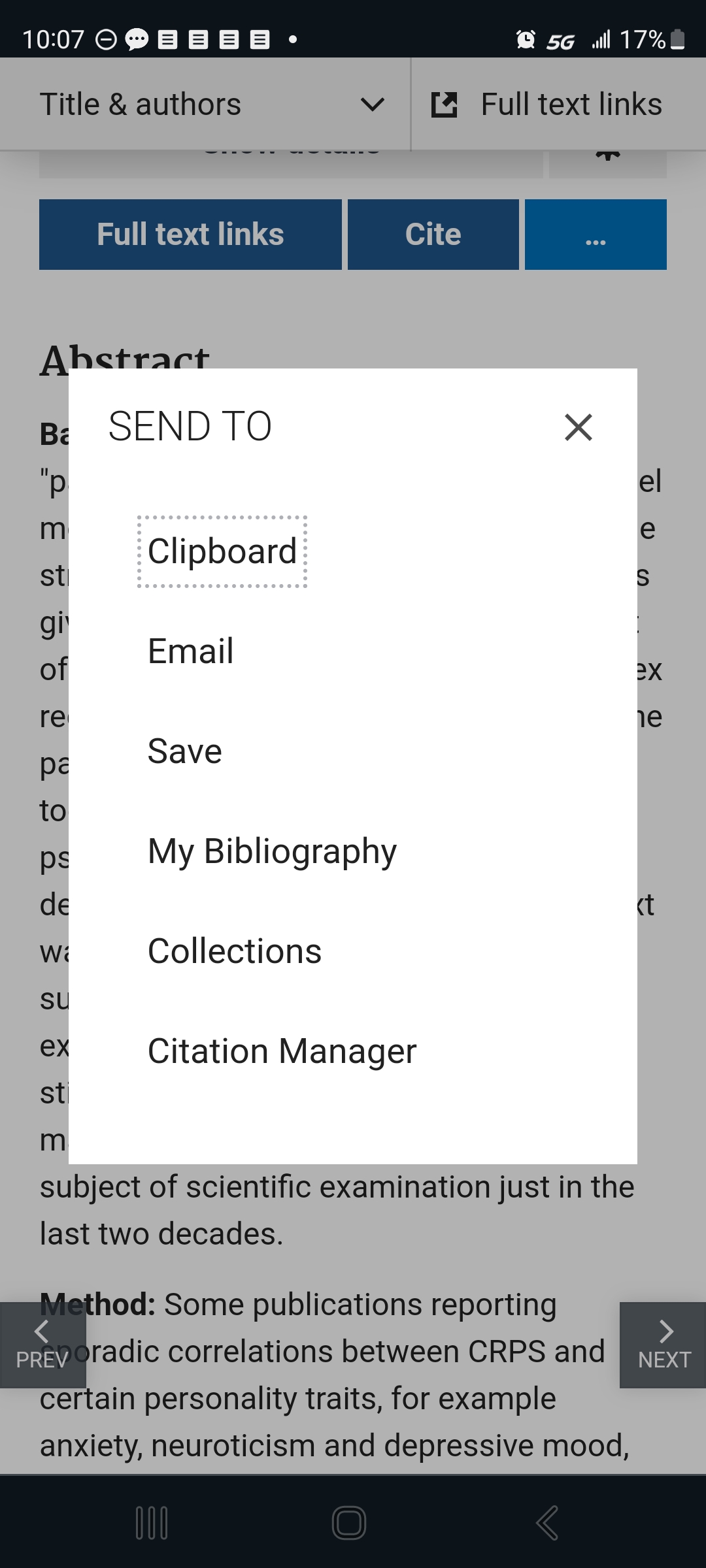
The interface gives you options for saving, sending, and citing the articles.
Touch the “…” button to get this helpful menu. If you get a free account with the NLM, you can use these to help you keep your studies organized and accessible.
To use these, just touch or click the one you want. They do exactly what they say they will.
If you touch one of the menu options that requires them to store the info on their side — like “Collections”, “Bibiography”, or “Citation Manager”– it will give you what you need to sign in (if you already have an account) and, at the very bottom, the option to “Sign up”:
The site is very helpful; just slow down and let yourself look at one thing at a time.
Once you feel more self-assured, try out Google Scholar. It’s smaller in some fields and generally less selective, but that can be good. I suggest saving it for later only because it’s got fewer guard-rails. We’re all different, though, and you might find that easier.
These two libraries aren’t identical. They do overlap.
A word about MeSH terms
MeSH stands for Medical Subject Heading. It’s a curated list of specific terms used in the National Institutes of Health materials. This kind of consistency is necessary when organizing a stupendous medical database like the National Library of Medicine.
MeSH terms are listed at the bottom of each article. If that article was useful, you can click the MeSH terms to have them saved to your PubMed search history:
I’ve circled the heading “MeSH Terms”, where it appears below other back-matter after the article.
Here’s a tip: when using their Search tool, don’t worry about capitalization, but be very particular about spaces and punctuation. Copy them exactly.
Using MeSH terms will improve your future searches, because it makes the most of the databases self-referencing mechanisms.
Trust your eyebrows
Best tool in your mental toolbox: when you’re reading sentences you know you do understand and, yet, you feel your eyebrows moving around on your forehead… that logic is not right.
The scientist might be misinformed, biased, pulling a fast one, or just plain wrong, but it doesn’t really matter which — that logic is not right. The underlying pattern-matching part of your brain can tell. That’s a primitive part of the brain and, when you’re paying attention to it, it’s extremely hard to fool!
Trust your eyebrows. If you want to, save the article and come back to it when you know more, so you can figure out where the problem is. I assure you, there is one. Your eyebrows don’t lie.
Feed your brain
Reading science is hard work and brains are big hungry things at the best of times. Feeding it right can be a huge help.
Meds & caffeine
If you’ve got attention problems, adjust your meds and caffeine to give you some extra focus when you’re reading science. It’s a lot more fun that way!
Smart produce
Green, blue, and purple foods are absolutely marvelous for brains — and pain. They feed the nerves, literally. I know you needed an excuse to eat more blackberries, blueberries, collard greens, and rocket salad, aw shucks.
I also know it’s not the cheapest stuff in the market. Explore your local options for farmer’s markets, roadside stands, produce sales, and organized assistance like EBT/food stamps and healthy-living programs giving more access to produce in the state, like they have in Massachusetts and California and other places.
This is a great opportunity to learn more about your condition and to bring what you’ve learned into your life (more on that later), and the upfront effort pays off so much in the end.
Body-safe phenylalanine
Obviously, if you’re prone to phenylketonuria, skip this part! IYK,YK.
Also, keep in mind that this can have an effect on some meds — sometimes giving them a boost, sometimes making things worse. Be sensible, do your due diligence, and study it up for yourself if you’re interested. Also, use your self-documentation skills: note what you do and what it does to you, change what needs to change, and take responsibility for the results of your choices. We are our own best caregivers.
I’m discussing the physiological activity of this thing with the weird name, and what I’ve found in my life and those closest to me. This isn’t any kind of assurance that it’ll do good for anyone else. Put it no further than “hmm, maybe” in your mental filing system and do your own further research to validate what I say and get an idea how it might work for you, yourself.
Basically, phenylalanine is a precursor to the “up” side of the neurotransmitter suite, dopamine and norepinephrine and even epinephrine (they all transform into each other as needed). These neurotransmitters carry messages among the parts of the brain involved in learning and memory. Taking in phenylalanine can have a truly astonishing effect on attention and memory WHEN you’ve got fundamental deficits, as do people with central and longstanding pain and some other conditions.
TL;DR — If it doesn’t make an obvious difference in less than an hour, you don’t need it.
I’ve trialed using aspartame, which went well for me. (Discussing my results with my doctor paved the way to including SNRIs in my med regime, to my considerable benefit.)
Food sources of phenylalanine
This is where hard cheese and smoked or processed meat shine. They’re rich natural sources of phenylalanine. They also have saturated fats which, in moderate doses, seem to help with pain and brain symptoms.
As a moderate part of a well-balanced diet, folks.
This hasn’t been well-studied; it’s one of those things you pick up after being involved with self-managed patients for over 30 years.
It doesn’t take much. I found that 2 or 3 bites of aged cheddar would absolutely light up my brain for 45 min to an hour and a half, depending on my deficit.
One pal of mine keeps meat jerky sticks on hand for study sessions. Aged cheese works better for me; jerky works better for them.
Now, unfortunately, mast cell activation problems have moved cheese and smoked meat out of my diet. When I need a brain boost, and it feels like cheese might help, I have to use a supplement instead.
Supplementing phenylalanine
It’s more measurable to use a supplement called DLPA, or d,l phenylalanine. It’s a blend of natural and manufactured forms of phenylalanine. One works better for pain and another for depression, but the blend seems well-tolerated and helps both. Phenylalanine suppresses certain inflammatory kinases and may help suppress pain at the spinal root (that is, right where the base of the peripheral nerve path comes out of the spine) as well as helping with mentation and cognition. (Sarcastic Sister notes: The recent science about it magically disappeared in the wake of the “war on pain meds” and I won’t pretend to understand why.)
There is a maximum recommended dose before it gets toxic, but if you’re seriously thinking about that, you’ll want to do your own studying, and might want to talk to your doctor about SNRI meds as a possibility. (The N is for norepinephrine, which phenylalanine supports.)
Why bother with learning how to read science?
Knowledge and understanding are the most powerful tools you can have for dealing with complex chronic health problems. It may or may not change what you have to deal with, but it certainly gives you more and wiser options about how to deal with it.
Even if you aren’t ready to start now, you can circle back around to this whenever you want. It’s attainable; you can do it. It’ll always be there (although individual articles and topics may come and go.)
The patients who learn the most and put that to work in their own lives, are the patients who most consistently beat the odds and have the best quality of life over time.
Therefore, better information leads to better living with complex chronic illness. My HIV patients taught me that 32 years ago at my first nursing job, and it’s truer than ever now.
Note: Nobody here says it’s easy. That said, our complex chronically ill lives are never easy.
Pretending that getting through the day is not, itself, almost a superhuman task is a disservice to our strength, so let’s just start off by recognizing that everything we do is really hard work.
Knowing that, I have found that the effort of learning and applying what we learn pays off a whole lot more than passively waiting to be saved and feeling rotten all the while — and still being wrecked & exhausted.
I can whole-heartedly recommend learning and figuring things out. It’s a winner.
My first nursing job was on an HIV unit in 1991. We were in the 2nd wave of the med mixes, so there were some treatment options. We knew which precautions were necessary, and when.
Those precautions had been newly dubbed, “universal precautions”. HIV was the last global pandemic that had a powerful effect on ordinary patient care, legislation, daily activities, travel, everything. The lessons we learned were rolled so thoroughly into our lives that we no longer think about it.
Anecdote from the front lines..
At that time, it was all rather new. Old nurses were afraid to go near any patients on our unit. We had about 80% novice nurses, an unheard-of proportion on a specialty ward in a nationally-ranked hospital in a major city! We had to pay attention, and we had to learn fast.
Because we weren’t abandoned enough already…
Our rather young nursing preceptor had bone cancer in her knee. She went in for surgery as soon as the last of us (me + 1 other) got signed off on training.
But wait, there’s more: as soon as she came out of surgery, she wrote a message insisting they pull the plug on the machines and let her die. Husband supported that, in tears.
Considering how close to hysterical she’d gotten 3 days earlier, when I tried to dig in my heels and tell her I was not ready to practice autonomously and might need more training after her op; and how strenuously this woman — who’d done little but put me down for weeks and express frustration at how slow I was — now insisted I was ready, really ready; and considering how improbable that post-op scenario is, in so many ways… I think she had planned it well in advance. Most expensive euthanasia ever.
Her 2nd-to-last words to me were: “Change your socks. They should be white. Bright colors are not professionally appropriate.” And gave me a fierce look. She came back for a nice goodbye, telling us we were all “good nurses” despite our occasional touches of color (a laugh and a nudge for the main transgressors, me & a fabulous fellow), before she turned and left the unit for the last time.
She’d been working on me about the sock thing for weeks. Slouchy cotton socks in gem-bright colors were still fashionable; drove her crazy.
She was the only one who hated them. The patients, the other nurses, and my immediate supervisor thought my gaudy ankles were delightful. I was referred to as “the one with the socks” and everyone knew. (I also introduced the fanny pack to nursing life. Nobody had heard of it before I showed up with a white, wipe-clean, bleachable one. You’re welcome.)
It’s possible that I got a packet of white socks, as a gesture of respect to that tough young woman… which quickly got grubby-looking, as white socks always do on me, and thus were eliminated from my wardrobe as not being professionally appropriate.
… That was largely irrelevant, but I’ve stopped suppressing my storytelling urge. There are just too many; they leak.
Back to the job of being a complex chronic patient.
It’s surprisingly logical — it just takes a long time to figure it out. I hope this will shorten that course for whoever reads this! There are 3 key principles to follow, and 3 sets of jobs, one for each kind of person involved in each case.
Three key principles
My patients on that ward taught me a lot about how to navigate hard, complex, intransigent illness. There are 3 key principles:
“Grandma was right” kinds of things: fresh air, activity, nutrition, sincere friends, learning all you can — they make a huge difference.
Find the light, or life, in the cracks. Doing #1 makes that a lot easier.
Communicate with others in the way they need to be communicated with.
That can be a tricky one, but I’ve got a lot of material on it. Some of it is here on this blog. And one day I’m going to complete and organize that collection of communication tools. (Any day now…)
Three different sets of jobs
It’s important to remember that you can’t do everything. I learned that (and keep re-learning it) the hard way.
There are specific realms of responsibilities which the important people in this situation have:
My job.
Significant other’s job.
Provider’s job.
They’re perfectly straightforward.
My (the patient’s) job
A note on terminology: some object to the word “patient” as dehumanizing. I’ll let you mull over what it means to think of someone who needs care as less than human. I don’t.
I’m sticking with the word “patient” here, because it describes a person who has specific, unavoidable experiences with alterations in their bodies, care providers, and whatever health-care system they have access to.
Complex chronic patients have a depth and breadth of experience with these things that most people simply can’t imagine — and nor should they. We wouldn’t wish this on anyone.
So, as a patient, my job boils down to this…
Take care of myself; take care of my responsibilities; take care of my relationships. All this includes having fun and seizing little joys!
Manage my illness. This includes: meds, nutrition, activity, learning about the disease and how to manage it, self-care (whatever that turns out to include, but it always includes pacing: alternating activity and rest.)
Track important signs, symptoms, and changes, and document them meaningfully.
Share this info with providers and significant others when it makes sense to.
Find useful ways to communicate with significant others & care providers about changing needs and abilities.
Make all my appointments on time, every time.
Contact my Dr for anything I need their support with: changes, meds, treatments, info.
Get through the days one at a time. (Thinking of the whole span of my existence is not my job. One day at a time is plenty.)
Find life in the cracks: notice the little beauties, regularly do something I enjoy, stop and smell the flowers.
Make time for fun and happiness. It makes me so much stronger!
Be good to my loved ones, whatever that means and within my limits.
Know that I’m the subject matter expert on my body, and hold myself responsible for managing it accordingly.
Significant other’s job
These two principles can be used by people at work, at home, on the playground, wherever. Very simply, “believe me” and “avoid making this harder, whenever possible”.
Believe me
Nobody — trust me, nobody — can make this stuff up, and there are far too many expensively-educated people working on this for it to be imaginary.
If you can’t believe it, then try pretending you do for awhile, just to test the concept, and see how that works.
Learn about the disease. There’s good info out there and I, or my doctor, can help you find it.
If you’re really important to me, come to an office visit with me and ask the doctor your own questions.
Avoid making this harder
Communicate with me about changing levels of activity and needs. I hate to keep saying how broken I am, so let’s come up with a code to pinpoint the different levels of broken that I could be.
Then, I don’t have to talk about how close I am to puking or crying or passing out, you can know anyway, and we can get on with things appropriately.
That’s what I really want — to be as productive as possible for all the time that I can; to be as good a partner/employee/friend/family member as I can.
Provider’s job
Another note on terminology: I’m old enough to remember when physicians, who were relieved that good schools for PAs, NPs, and APNs were starting to flourish, advocated for the term “provider” as a collective noun, encompassing themselves and the advanced-practice professionals who potentiated their work and multiplied their efforts.
That worm has turned, and now it’s not so popular with physicians.
Please allow this old nurse to use the term with all the respect it originally included, in memory of the brilliant and capable physicians who taught me to use it as the inclusive term of choice.
The provider’s job (as of course you know) is threefold: keeping the larger view, providing appropriate care (of course), and providing info and guidance.
This is sometimes easier said than done, because every time I see you is a rough day. You hold more than the power of life or death over me — you hold the power of tolerability or pure Hell. Thus, it’s natural for me to be a little fragile, possibly overwhelmed, in our conversations.
I do my best to be prepared and “keep it together”. I want to make the best use of our time.
Due to the additional insults of pain and CNS dysfunction, I can be subtly or even grossly impaired when I most need to be responsive, intelligent, and clear.
Given all this, please know that your kindness makes a great difference in my life.
Here is what I hope for, from my providers:
Consider context. Notice where I fall in the statistical ranges and how might this affect my care; help me distinguish between reasonable vs. unreasonable efforts, as well as watchable vs. reportable signs/symptoms; steer me through that intersection created by my medical & physiological peculiarities in one axis, and the statistical probabilities generated by reams of studies and years of clinical practice on the axis which crosses it.
Prescribe appropriate tests, ancillary care (physical therapy, occupational therapy, speech therapy, and so on), and medications.
Respond sensibly and kindly to concerns about meds, therapies, and changes in my illness. (Fragile egg here.)
Let me know what I really need to know about my condition, meds, or treatment, before I leave the room (virtual or 3-D), so I neither ignore something important nor over-study and confuse myself. My responsibility to learn benefits from yours to inform me. Also, it helps me to know the right keywords.
Be the subject matter expert on the scientific and clinical knowledge-base for the illness I see you for, and be willing to figure out relevant context that my other conditions create.
See this article about just how fabulous an experience it is to have a physician who does all that. It’s such a relief and such a joy. Thank you from the bottom of my vital signs for doing what you do.
All 3 working together = best possible situation
When complex chronic patients can monitor and communicate effectively, prioritizing our care while keeping life in center stage most of the time; when our loved ones can coordinate around our limits, allowing us to be at our best, considering; and when doctors apply their staggering breadth of knowledge to our particular situations with attention; we have a fabulous chance of doing as well as possible.
I like doing as well as possible. I have a lot to give and I want to be able to give it — that said, my care comes first, last, and always; it’s the only way!
Thanks to significant help and support, good friends and loving family, and some real rock-stars on my medical team, I’m well set right now. I’m almost afraid to admit it, because I don’t want to rock the boat…
And here we are
There you have it: the 3 key principles and the 3 main jobs of living/working with complex chronic illness.
I know they are that fundamental, because I’ve had a few providers almost plead with me to come and participate in their patient support groups, specifically so I could talk about it with other patients.
Well, here we are, sharing this information all over the world! Send this article wherever you see fit. I’d love to know what your support groups think about it.
Patients, caregivers, loved ones of complex chronic patients, doctors, P.A.s, A.P.N.s and N.P.s… feel free to comment. This is about all of us, after all.
On my 21st birthday, I went out with a bunch of women friends, including 2 couples. All of us health-care workers. Drunk jerk got thrown out of a car right behind is as we stood on the sidewalk deciding where to go next.
He decided that us being out without a man, and clearly happy in our own company, was a terrible transgression. Then he noticed the couple vibes. Then he called us “a bunch of” d-word. Then he tried to kill one of the women in a couple.
Someone else saw him draw a knife. He went to slash her throat. Someone else pulled her back, by her arms unfortunately.
I saw him raising a fist to a defenseless friend, her eyes huge, staring at the fist.
Somehow I levitated between 2 parked cars and a couple meters of pavement in the time it took his hand to move another foot.
I landed in front of him with my arms raised in a blocking stance my Dad taught me at 9 or 10 years old. He said, “I’m teaching you to block with both arms at once, so you don’t get confused in the heat.” That worked!
The attacker looked stunned. Took a step back. I stepped back. He took another, one more, then turned and ran.
I ran back to the bar we’d come out of, passing a couple of delightful young men, shouting a warning: “There’s a man, with a knife, back there.”
I had no idea my left side was covered in blood pouring out of my face.
Those two precious darlings ran. Found out later they ran *towards* the attack, followed my friends’ pointing fingers, and kept him blocked in at the train station, where he had just missed the last train out. Trust me, it takes balls to be a queen.
When the back door of the bar finally opened, the barkeep peeped out and said, “Sorry, we’re clo — oh, dear — somebody get me a towel with ice in it!” He clamped it to my face and that was the moment I realized my left shoe was squishing with the blood in it and I kinda lost my cool.
I hammered on the brick wall with my bare fists, screaming “Never again! Never again!”
I had already been a female for 21 years, which taught me a lot about uninvited violence; had learned about the Stonewall riots; knew the horrific statistics of how often non-heteronormative women are attacked “to teach them a lesson”; and had started getting involved in “let’s all treat each other like frkn human beings & not torture and kill each other like it’s a sport” types of activism.
So. All that was behind that “Never again”. It was too much in my life already, and I was barely an adult.
When the cops brought the attacker in the bulletproof squad car, so I could identify him, I couldn’t see at first because his hand was over his face. Cop went around to the side to ask him to lower his hand. He turned sideways, and I saw the profile that had gone to sink a knife into the throat of a defenseless woman.
It seemed logical at the time that I didn’t want to fight the cops, one on either side of the car. I decided to go through the windshield instead. It was only bulletproof glass; between fingernails and fury, I saw no reason (in my state at the time) not to get through it.
A minute later, with drunk dude stark white and frozen with terror, one of my friends (an ER nurse) pulled me off the hood by the slack of my best black jeans (this was the late 1980s) now smearing blood on the hood of the car.
She and the cop looked at each other and chorused, “I think that’s a positive ID.” ?
While this makes a great story, the memory of it also makes it very, very hard to speak up against microaggressive b.s. because you never know where it will lead. Name calling can go anywhere. Being in a group is some protection but not as much as you might think. If I’d tripped on my gods-assisted leap across that distance, my friend would be dead, and her partner would not have been even acknowledged as a widow, and all of us would have been stuck with that harrowing memory with no tolerable ending.
I now have long hair and am not nearly as fit, so I have the leverage of obvious straight privilege more than I ever did before. (Not that I’m personally wedded to gender or orientation. Binarism is a bit weird to me, but hey, you do you.) My actual sexuality has been all over the map and is currently parked in Neutral: don’t have it, don’t want it. But hey, you do you — that’s the bottom line.
That language changes all the time. When I was an activist, at first “queer” was an all-embracing term, but then the language started moving to an acronym. In the move to acknowledge all the variety, that acronym has gotten unwieldy. The English language being the adaptable thing that it is, another word-based term will emerge to act as the modern umbrella term; that’s still in process.
You don’t have to like LGBTQAI+. If you’d actually read, as I have, holy books in an intellectually responsible translation, you’d find that the major ones are OK with it. God is OK with it, but you do you: just keep your hands to yourself.
You don’t have to support LGBTQAI+ businesses or like having LGBTQAI+ employees. If you check the stats, you’ll find that businesses with strong LGBTQAI+-positive policies and culture get more and better work out of ALL of their employees. A tolerant environment is very freeing to everyone, not just the nominally unusual! But you do you; just keep your hostility to yourself. It’s not OK to be hateful or spiteful at work.
You don’t have to want a LGBTQAI+ family. If you check the records, you’ll find that kids raised in LGBTQAI+ homes are just as smart & just as competent (and generally somewhat more adaptable) as anyone else’s kids. You do you; just keep specific laws off those bodies, because it’s no more your business than your sex, your private parts, your children, and your home life belong in other voter’s hands.
You do you. Let others do them. That’s basic humanity.
It’s not just LGBTQAI+ people who suffer for it. It really is a disservice to everyone.
Let’s get this crapshow turned around, because we really need to get together on issues beyond the personal, if any of our descendants are going to have a bearable future.
Yesterday, it came naturally to be warmly present for V during a big event where I stood in for her, even at a distance of 3,000 miles or so. Gotta love technology for that!
Today, I think of D and the anticipatory grief is like a warm finger of current, pulling at me without tearing at my core or dragging my mind away. He’s here now, and everyone who cares about him is working on a graceful last chapter to his intense, vivid, improbably well-groomed life. (Yes, he’s quite a character!)
This recovery is not all perfect: after yesterday’s 8-hour social endurance event (a physical and physiological experience piled on top of a very neurologically demanding week) I woke up this morning with a pure dys-autonomic experience I haven’t had in a very long time.
On the very cusp of waking, as I first became physically aware of the real world, my body’s temperature-regulation mechanism dropped off the rails.
I suddenly got intensely cold, that bone-deep cold that makes the smallest touch of air feel like knives. Imagine full-body Reynaud’s, with added concertina wire. It’s amazing how cold my skin suddenly gets to the touch when this happens, after feeling just right at the moment I started to wake.
So, I did what I learned to do 10 years ago, when the dysautonomia really kicked in with this: I pulled my down duvet completely over me and tucked in every gap, wrapping it right around my head, and constructed a little tunnel just big enough to breathe fresh air through. (Fresh air seems to speed up the recovery period.)
Nothing I can do after that but wait for it to pass, as my regulatory thingies come to terms with being awake instead of asleep (one autonomic function) and being able to be at the right temperature (another autonomic function.) I know that it will pass, while my system creeps toward wakefulness.
Big shrug. The Nasty Cold Snap hasn’t been part of my day in a very long time, which is good!
This just goes to show that the physical/physiological impact of these flows of stress and anguish isn’t negated. Expecting that would be unrealistic.
They are manageable. That’s the point.
Doing those “brain first aid” things makes handling the weighty, current reality bearable. That means I’m still capable of several important tasks:
I can bring my tips and tricks to bear against the physical effects of this illness.
I can think my way through ordinary (to me) problems.
I can remember that things pass: the Nasty Cold Snap will pass, as the mental shock passed, as even terror passes when it’s allowed to.
I return fairly quickly to my normal frame of mind — which beats trauma-brain all hollow!
There’s still a bit more physical recovery involved, mostly giving my systems a chance to finish returning to their normal function and easing up on the extra weakness, reactivity, and pain.
But, basically, I’m OK. I’m able to show up for myself and my friends. That’s what it’s all about.
My point (and I do have one) is…
The skills I learned in psychotherapy really work when I use them, and I’m so relieved.
I want to make the point that psychotherapy is not “just like talking to a friend”, because our friends don’t need a graduate degree to be our friends. Psychotherapy is a professional-level, highly customized form of care, even if it feels relaxed (creating an environment where you can relax is one of the skills of a good shrink.)
Nor is it a passive process; the skills and concepts only work if you work them. It’s good to be heard; that said, it’s also good to remember that real healing involves relevant changes. The fun (??) part is, in medicine, we may influence the changes but there’s a significant random element involved in them; in psychotherapy, the client steers the whole process. While being an active, involved patient can improve outcomes in medicine, being an active, involved client does improve outcomes in psychotherapy.
So, there’s the core message behind this 2-part series, part of the ongoing “what works” toolkit. Psychotherapy works, when done properly and used diligently. Just like any other kind of care. It’s not magic. It’s skills.
I’m getting an allergy panel in a month or so. This means I have to be off my antihistamine for 5 days before.
THAT means I have to start tapering off ~2 weeks ahead of time; 3 weeks would be safer, but I don’t see how to endure over 3.5 weeks total with that level of obnoxious symptomatology and brittle physical fragility.
That said, I *really* want the data.
You might ask, “Why?” (Or possibly, depending on how familiar you are with the twisted satire that is my health record, “WhyTF?? Are you *crazy*??” As if you didn’t already have a definite opinion about *that*! ?)
Well, here goes…
Flash back to 2013
Years ago, under the tutelage of a late & very lamented friend who Knew Mast Cell Stuff like I know the back of my hands, I finally (in 2013) did my empirical testing around whether mast cell & histamine activation-like signs & symptoms I was struggling with, would respond to treatment.
Step 1: reducing & eliminating competing problems
I had already gotten excellent neurological & biofeedback training, which worked well for many things (Go, Pain Psychologist Dr Faye Weinstein! I got tremendous and lasting benefits from my work with her. Highly recommended. “Stabilize, stabilize, stabilize.”) While I had excellent results from the neuro stabilization, it didn’t make much difference to the allergies, a particular “flavor” of brain fog, food & digestion issues, or the usual allergy circus of itching facial orifices & random urticaria.
The histological issues persisted most obnoxiously. This was 9 years ago when the mast cell activation diagnoses were not as well developed, and at a time that, though I had access to an enormous pool of well trained doctors, I was already up to my hip-waders in the maximum number of appointments I was able to keep.
What do you think? Pursuing testing and inquiry into a set of issues that were still widely considered to be a matter of hysteria? — For a middle-aged woman with pain diseases and 60 extra pounds of weight, do you think *that* would have been a good use of my limited time?
Smh!
So, I went empirical on it.
Two methods of science: “empirical” and “scientific” method
Both methods are scientific, in that they require diligent examination & limiting of variables as well as testing, retesting, and recording results accurately.
(But hey, that nomenclature isn’t confusing, right? <eyeroll>)
It boils down to this:
Empirical method: what works in this case in particular?
Scientific method: what’s generally likely to work in many cases?
The empirical method of science is brilliant on a case-by-case basis, there’s nothing better; but avoid making assumptions beyond that case. The scientific method of science depends on hundreds, ultimately thousands, of cases, and from all those together, it generates statistical probabilities about what’s *likely* to work under certain circumstances as a general rule. It’s much more widely applied, but explicitly *not* individualized.
This is why, as someone dealing with multiple rare issues, I test everything ~3 times on myself before deciding if it’s a good idea for my particular situation.
Now the next section will make more sense.
Right med, right dose, right time
I tried several antihistamines to see which one helped me the most.
Then I experimented with dosing to see how much it took to get me functional most of the time.
Then I experimented further with once-daily dosing, or dividing the dose in two and taking it twice daily. It had better results (and no “oog” feeling) if I took it twice a day.
In the end, I wound up on one of the top 3 meds for mast cell/histamine issues. I also wound up at the common dose for those with a solid case of Mast Cell Activation Disorder. (The twice-daily dosing was my own special twist, but I’ve since learned it’s not that uncommon among “masties”, as people with mast cell dysfunctions refer to themselves.)
Without any further ado, my doctors added MCAD to my list of diagnoses.
(As with every med and supplement, I continued testing it every 6 months or so, backing off the dose and looking for the minimum effective dose, but stopped doing this because of … we’ll get to that.)
But, frankly, a differential diagnosis doesn’t yield enough info to change anything causative. If I can nail specific allergens — or culprits — and receive treatments that can actually reverse this ghastly crap, that would be *great*!
So, I really want the data.
Histamines & tendon problems
I stopped trying to cut down on the antihistamines a couple of years ago, because I couldn’t bear any more injuries that threatened my mobility.
“Mobility? Huh??” I hear you ask.
One of the things the antihistamine helped with was tissue-tearing. I didn’t expect that, but was delighted not to be twisting my ankles on uneven ground or sudden jumps away from traffic, then having to crawl or scoot home because hopping on 1 foot when your tendons don’t work is a terrible idea.
As I thought about it, it made sense though…
Histology review:
Q: What happens when your histamines are active?
A: Among other things, inflammation in and around your cells.
Q: What happens when cells get inflamed?
A: Among other things, cell walls get weak and leaky.
Q: What happens when connective tissue cells get weak?
A: They tear more easily.
Ah hah!
So, yeah, maybe MCAD could weaken my connective tissue after all — especially because, for one thing, I started out hyperflexible, which is a setup for these kinds of problems; and for another thing, the fibrosity of fibromyalgia has made my connective tissue more brittle & easier to tear.
Ducky! Another hat-trick! ??
Back to the testing
This is the test where they put a grid on your back and scratch or inject tiny amounts of different stuff into your skin. In about 20 minutes, whatever you’re going to react to should be a nice hot ruddy lump, technically a “wheal”.
For this to happen, your body has to have nothing interfering with histamine reactions — in other words, no anti-histamines.
Since the antihistamine I wound up on has a long half-life, I have to be off it for 5 full days before testing.
Prepping for the test
Because going from full dose to no dose means I can barely get out of bed safely (see “Histamines & tendon problems” above), I have to taper down. I’ve done this before, usually to eke out my meds when my supply is running late. It’s familiar territory.
Experience tells me that:
I have to taper at a rate of no more than 12.5% of my daily dose at a time.
I’m best off (in this terrible sitiation) stopping for 3 days at each new dose before the next step down.
This means that it would take 20 days to taper off to 0 (shorting the last step to 2 days instead of 3) *and then* 5 more days at 0.
Doing this with tissues crying, “Go on — tear me!” And every bite of food, breath of air, bit of furniture, bump in the sidewalk, or tussock of grass all giggling in evil tones (so to speak), eager to hear my muffled yells.
Yeah. Tasteless spoofing aside, that’s not a great situation to spend 3.5 weeks in.
Then, of course, as soon as I can horse down my meds again, it’ll be several days before I qualify as human.
Then, about another 1 to 3 weeks before I get back up to baseline function.
My Halloween costume will require very little makeup for me to pass as a zombie, so that’s one bonus.
What a month-and-a-half to look forward to!
Is all this really necessary?
Well… I really, *really* want the data. If this is at all reversible, wouldn’t that be worth a few weeks of howl-worthy endurance?
Obviously, yes… but I don’t think I could keep at it for over a month. I’m good at enduring, but I’ve got hard limits.
I really, *really* want the data.
Managing towards the best possible outcome
My doc prescribed me some prednisone to take in order to avoid winding up in the hospital over this. I look at the results of my last round of prednisone — the change in my face and the truly shocking stretch marks (which made my dermatologists blanch and leap back, no kidding) — and I consider this truly last-ditch stuff. Beats nothing, I guess. It might keep me out of our ER.
There are dietary issues to consider. (What follows is a brain-dump from my years of querying doctors and reading, as well as my empirical food testing.)
Food matters: boost the signal
I know that the system being tested (mine) can respond more truthfully if it’s familiar with the molecule being tested. For instance, I haven’t eaten gluten in years, so this test might possibly come up negative to that.
Doesn’t mean that, the next time I walk past a bakery without my mask on, I won’t get an itchy swollen throat and everything won’t turn white for a bit, it just means my body had enough of a break to stand down, and will need to re-arm.
With that in mind, I might grab a couple of saltines before I go in. If I could calm the gluten circus enough to just be safer walking around, that would be awesome.
Food matters: reduce the noise
I’m getting off the aged and fermented food, because that makes such a dramatic difference in my pain and swelling. This includes seafood and beef and anything packaged (look up what creates histamine in food).
Despite that, I’m making exceptions for things which I want to make sure my body has experienced in the month before testing — nuts, bananas, stone fruit, fish, grains in addition to glutinous ones, even beans — although that’ll be a period of gastroparesis hell, but this system must not be “bean-naïve” for the test.
Because I really, *really*, REALLY want the data. This is the kind of info that could change the course of my life for the better.
For that, I can get through some serious struggle.
Ramping down steeper
I’m going to go down 12.5% of my dose every 2 days, instead of 3. This will shorten the ramp-time to 2 weeks. Recovery might be a little longer, but I can maintain attention on what I’m doing this for, for that length of time.
Until then, I’ve got a lot of cooking to do and a freezer to stuff with things that
Won’t hurt me more than absolutely necessary, and
Will include exactly what I think I need to be exposed to, to maximize the value of the test.
If you’re in a similar situation, remember that your mileage may vary. Ask your own docs, and then ask their nurses the same questions.
The differences in the answers tend to reflect the wholism that nurses work with, a nitty-gritty pragmatism that rounds out the more optimistic notional-ness that doctors can succumb to. Both views matter.
For only the second time in my life, I might do actual menu planning. I’m usually more of a “what’s fresh? What’s cheap? What’s safe? What’s appealing? Throw it in the pan” kind of cook, but that takes brain. I’d like to insulate myself from a potentially very brain-free near future and reduce my frustration over the coming month. Having easy-to-grab, safely frozen meals sounds fabulous.
Here’s my plan…
The grocery order just arrived, so if you’ll excuse me…
That last post, about acknowledging the shimmering sense of mortality I’ve lived with for nearly a year? Well, I kept meaning to post an update, but I’ve been having too much fun making progress elsewhere, and simply dropped the ball. I often think, “oh, I should post that on my blog,” and then – pain diseases being what they are – when I shift context to hop online, I’ve forgotten what it was and quickly get sucked into something else.
At the risk of using terms improperly, I found myself explaining this normality of painee existence as a sort of “acquired ADD.” As it happens, our brains get changed in the same places and pathways that ADD brains live in, so that our scans look amazingly similar. Those ADD-like symptoms are definitely not imaginary. I have found myself using adaptations very much like those I’ve read about in some of the terrific books on ADD. I recommend reading up on it. There’s a ton of helpful material on how to manage with and work around these attention issues.
I miss blogging. So, I hope to automate (or at least simplify) moving information here from social media. There are still interesting questions to answer, and I think that useful info we generate in pain groups should find its way to a more stable, searchable medium.
I have been sinking into this life, having acknowledged that inward message about its likely brevity. I’ve been here a year, and love my little flat more and more each day. I’ve been rearranging, creating more usable space within the same square footage. It’s delightful!
I keep the picture that reminds me of those who made this happen over the decorative fireplace, where it looks wonderful, and send grateful thoughts to its source/s – even when reaching out in real life only creates confusion and misunderstanding. We humans generally, and painees particularly, sometimes realize we don’t control how others receive us, but we can steer our own thoughts. So, I maintain this practice of gratitude, because that’s who I am and always have been, and wait for better times.
More health problems? Certainly! I will write about the gastrointestinal circus another time. I’m currently working on digesting a drink of water, and I’d prefer not to think about it until that’s done. This is the big, hairy, stinking follow-up to the first sign of trouble nearly 2 decades ago, which I wrote about (with disgusting toilet humor, inevitably) over at the post Intestinal Fortitude.
Apart from one misunderstanding and that additional body system, this life is amazing. Bit by bit, I’ve been getting a broader pool of professional and personal help and support. Bit by bit, I’ve been coming up with adaptations that bring more art, craft, and productive time into my weeks, although I have to be careful (of course) about changing tasks and changing position and managing time better than I really want to. For instance: “No,” I had to myself yesterday evening; “you don’t get to finish that row of adaptive crochet! I don’t care how pretty this is, or how soft the yarn. These helpful tools only improve my function, they don’t correct the problem! Put. The yarn. Down. Thank you. Now go do something else.”
So I did.
And then I treated my right forearm with everything in my toolkit. And then I made myself promise not to pick up those tools for at least two more days, because that’s what it takes to recover when I’m forgetful enough to do crochet on a couple of consecutive days. Change those tasks! Figuring out a crafty solution is not as important as protecting tomorrow’s ability. Or even tonight’s. I can use myself hard, but I’m not allowed to use myself up. I don’t count on a ton of recovery time.
I’m back to using dictation software, in order to make better use of my arm time. The stylistic difference is clear to me, but it probably doesn’t matter. This is a good compromise to make, although it’s not necessarily an easy one. Dictation is a strange, slow way of speaking, and it forces me to think in chunks rather than in thoughts and words. But hey, it works!
Times are changing. Whether or not the current American president behaves any better, whether or not the next American president has the moral courage for fundamental changes, whatever, times are changing. My own possibilities are opening up, and I’m not holding back. I didn’t even know I was, but boy, things have changed since I stopped trying to eke everything out! I’ve got things to do, and I’m not waiting any longer to do them.
If I were more self-conscious, I’d throw in a bumper sticker-appropriate remark here. I’m out of ideas. I’ve got other things to do now. Maybe next time. Maybe. 🙂
Take care of yourselves. When you can’t, take care of each other. When you can’t do that, take care of your world. It helps.
As regular readers know, I’ve had an eventful life. The past 20 years, particularly, have been a circus of bizarre improbabilities, oxymoronic paradoxes, and irreconcilable conundrums. My life reads like a dystopian comedy, if your sense of humor is sufficiently twisted.
This is why I’ve got the category “imp-possible” going in this blog. It looks merely cute, but it has a lot of layers. Imps could be little devils, or little fairies, or little children. They emphasize the power of the small. It feels like the only power left. “Imp” also suggests the power of the unexpected.
As the current American president’s so-called “tax cut” comes home, the US Disability Income management agency, Social Security, has decided to trim costs in anticipation of their lost income: they’re cutting my pay, on the grounds that the Worker’s Compensation element of US health care paid me off for being hurt. Separately, they handed over a bunch of health insurance money so Medicare wouldn’t have to pay for my work-related treatment.
Social Security confused the two, and then added zeros to the left of the decimal, divided it by 12, multiplied that by the square root of Guatemala (I’m making this up, just like they did), slapped a bonus on it, and decided I make OVER $5,000 PER MONTH and they’re going to count 80% of that and dock my pay by ~$160 per month…
I’m allowed to make over $5,000/month? Where? How? Sign me up! But wait… huh?? You think I actually have $5,000/month???
Yeah, I’m confused too. (The payout was good, but not that good: I got a sturdy, 10-yr-old car and a year’s worth of rent in a clean, dry cottage out of it.)
That $160 is what allows me to keep my pain-cream-making gear & off-season clothes in storage *and* pay for my writing course at the 50% discount I negotiated with the teacher (I’m doing that course instead of buying books & music for a few months.) I’m not sure any of that counts as extra these days.
They said this would be (future conditional tense) reflected in my pay as of December 2019 (whaaaaat???)…
Either they’re as confused as the rest of us, they’re in even harder denial about which year this is, or they’re setting up to make the pay cut retroactive in case they decide that that’s in their best interests. Also, Social Security being who they are and the current US administration being who they are, this feels like the first move against our lifeline, not the only move.
… I’m sitting here speechless again. Happens every time I think about it.
This is on top of the brutal horrors of approaching winter (relentless agony, burning brain, incapacitating fog), no bathtub (CRPS’s disruptive surface effects creep up my legs and over my back and make my shoulders, hips, and right arm into bloated purple sausages wrapped in electrified barbed wire, with no way to push back), encroaching mold (which multiplies everything, including mast-cell hyperreactivity/disabling allergies, heart dysrhythmias, gut problems, and it adds respiratory diseases to the mix), and gastroparesis so bad that every other day I have to do a big ol’ — you don’t want to know. Trust me. Even I can’t make it funny.
My psychotherapist is savvy, sweet, and has that merciless faith in her client that the best of them wield like surgeon’s tools (yes, this is relevant, hang on through the curve)… I fell apart completely in our virtual visit and whispered in stricken tones, “I don’t know if I’ll make it this time.”
After acknowledging the depth and legitimacy of my feelings and recognizing my prior successes against staggering odds (she does know her job!) she encouraged me to see the breadth of creative possibility embedded behind, “I don’t know.”
I blinked, because that sounded pretty darned merciless, even for a top-flight psychotherapist. (Keep in mind that surgeon’s tools include, not just scalpels and silk, but electric saws and the sprung barbs known, deceptively, as towel clips.) She wouldn’t give up, though.
I agreed to accept that as a working hypothesis.
On reflection, that thought began to feel more like pre-2019 Isy, before my heart got ripped out and stomped on a little too hard by a few too many, and my system fell apart so badly in the storm of it. It began to feel more like the Isy who, 13 years ago at the start of the Hell Years, looked around at the absolute rubble & blasted mess of everything I thought defined my life, and realized someone was still there doing the looking, so there was still an “I” and I wasn’t done yet. It felt more like the Isy who made the term “imp-possible” a regular category. I didn’t know where that would lead me, but…
I didn’t know how to finish that sentence yet.
This morning, while listening to an audiobook that’s a romantic comedy about overthinky nerds (still relevant; hang on through one more curve), I used the toilet successfully for the first time in months, without having to resort to the apparatus hanging nearby for the thing I’ve had to do that I won’t tell you about. (It involves soap & warm water, nothing too ghastly.)
I use audiobooks to keep my brain from overheating. It gives me just enough to focus on that I don’t drive my thoughts off a cliff, and it’s not so intrusive or demanding that I can’t do ordinary tasks at the same time.
This one had gotten to a part where the author discusses basic chaos theory: chaotic systems (and I defy any biologist to come up with a more chaotic system than a dysautonomic human body with longstanding central pain syndromes) … where was I? Right. Chaotic systems tend to get more and more chaotic until a sort of tipping-point is reached and they reorganize at a higher level of criticality.
What the heck does that actually mean, anyway?? What do they mean by a higher level of criticality?
Partly, it means that a lower level of energy is required to maintain that state of chaos, even though it’s still a higher level of chaos.
And that (I thought, as I looked up at the equipment I was going without at last) meant that I could do more coping with less effort.
Once you’ve prioritized your needs hard enough and developed your adaptations effectively enough, it gets a whole lot harder to throw you off your game.
I can work with that.
The next level of chaos is here. I have no idea how it’ll unfold. That said, I’ve already reorganized at a higher level of criticality.
I’ll meet it somehow. I don’t know how. I’m still here doing the looking, so I’m not done yet.
Like many, I’ve been watching the extraordinary infinity-ring circus of Covid-19 with rising confusion.
I hate being that confused.
So, I thought about how to cut to the chase. I investigated mortality figures, looking for clarity on the competing narratives about the actual danger posed by Covid-19. (This is aside from the epidemiological information, which is hard work for me and possibly beyond a lot of people. Look into attack rate, latency, and lag if you want to know more about the reasons for its spreadability.)
This boils it down to one simple, definitive marker:
How many die? Because that’s the point.
Comparing mortality numbers
This is all out of a U.S. population (as of 2019) of 328,200,000.
Annual US death rates from various causes in 2019 (or 2018):
36,560 … Highway fatalities (2018.)
5,250 … Fatal workplace injuries (2018.)
48,236 … Adverse medical events ending in death (including surgical problems, allergic responses, medical devices, prescription errors, and fatal drug overdoses.)☆
61,200 … Seasonal flu, 2018-2019 season.
15,820 … Those with HIV, of all known causes (2018.)
Fatalities due to Covid-19 in the US in 2020, only up to Sept 1:
About 180,000
Expected to exceed 200,000 in 2 more weeks.
???
Questioning the data
If this number were as low as 2X the nearest competitors, I’d have dug into the question of just how bad the Covid-19 reportage is.
(Hint: lots of problems, some pushing the numbers up, others pushing the numbers down.)
It’s nearly FOUR TIMES higher than the nearest causes of death. Even I can’t pick a big enough hole in that number to change the outlook!
Bottom line
This final figure is inescapably bigger — in only 8-9 months! — than any other major/relevant cause of mortality in an entire year in the U.S.
So… death by Covid-19 is a real problem. A huge problem.
It’s a real, huge, problem.
Please protect yourself & others: don’t share air or germs.
Self-protection skills
For my fellow chronics, don’t be too worried. Surviving this is a 3-part skill, and you’ve mastered much worse. You can do this.
1. Dilute your air. ?
2. Protect your airway. ?
3. Wash wash wash. ?
Here’s what that means:
1. ? Get as much air as possible around you. Avoid recirculated air. Open windows in closed buildings. Dilute, dilute, dilute your air. Even a little! (Work within your constraints.)
2. ? Cover all your breathing apparatus with something that meets these practical criteria for masks that protect *you* as well as others:
A. Seals: doesn’t gust air out the edges and passes the “doesn’t fog glasses” test.
B. Protects: has enough material/filtration that you can’t see any light specks peeking through, when you hold it up to the light.
C. Doesn’t vent. (Apart from exposing others, venting can also create weird ripples for super-small viruses to ride back in on. Look up “Venturi effect”.)
After reading mask tests until my eyes bubbled, I agree with these guidelines. Plus, no codes to remember!
3. ? Wash, wash, wash your paws & whatever you touch or touch with. Alcohol will do in between times.
Dealing with questionable cleaners
After two painful toxic exposures, I learned that 40 proof in a spritz bottle smells better, is easier & potentially cheaper than the gooey store stuff, and is far safer than methylated or isopropyl.
Alcohol-free folks: look into spritzing 3% hydrogen peroxide, which kills viruses faster than Clorox (watch your clothes, it can bleach too), proven essential oil blends, or even soapy wipes. Read labels for virus killing info.
Summary
THIS IS NOT IMAGINARY.
The death toll from Covid-19 is horrific — no matter how small the comparative R’s are.
It really IS a huge problem, still unfolding.
It’s appropriate to take it very seriously — and intelligently.
You’re not helpless. You really can protect yourself and your loved ones with that simple 3-part skill set:
1. ? Dilute your air.
2. ? Protect your airway.
3. ? Wash wash wash.
Follow these guidelines for the best chance of staying well.
Reflect: “adequate protection” means masks AND 6 feet (“safer six”.) Both masks and “safer six.” Look around and see where that does or doesn’t happen.
Tip: Most eateries do takeout now, and parks are open for meeting in ????.
We all have horrible choices ahead. Hope it helps to have a little coherent, practical, straightforward info. ?⚕️????
Note on, & list of, sources
Sources are all primary data collection organizations within the federal government, which has access to all the original info streams:
– U.S. Census Bureau
– U.S. Bureau of Labor Statistics
– Bureau of Transportation Statistics (a dept. of U.S. DOT)
– The Joint Commission (of AHQS)
– DHHS-NPDB (National Practitioner Data Bank)
– HIV.gov
– CDC.gov
– EPA.gov
☆A statement along the lines of “prescription drug mismanagement results in >2M injuries and 100,000 deaths annually” is cut & pasted into many articles, some going back to 2005, despite the advances in monitoring and treatment in the past 15 years. Therefore, those figures are meaningless.
I wish politicians realized that made-up figures never improve the debate. They’re only bad for everyone’s blood pressure, at the very least.