Documentation: logs and tracking

Cards on the table: I like to write. Maybe a little too much.

It’s inconvenient to have crapped-out wrists that limit typing severely and a voice just weird enough in accent & vocal fry to make dictation software stare back at me, blinking blankly, instead of capturing the marvelous flow of inspiration…

Yeah. To heck with that. I have to make it simpler.

I have a bunch of self-documentation templates and techniques which I’ve been meaning to write about, because we know how important providing evidence of your own experience can be and because… I like to write.

Sigh.

I’m not trying to make them pretty and I’m certainly not taking the time to make them generic or pare out the details of what I’ve tried and used over the years. I like doing that, but wanting to do that is what has kept from getting this stuff up… for years.

I’m just going to throw them at you instead. You’re all smart enough to take what you like and leave the rest. Have fun!

Note: All of my Self-Documentation by LivingAnyway.com is marked CC0 1.0. To view a copy of this mark, visit https://creativecommons.org/publicdomain/zero/1.0/

TL;DR – it’s a formal way of making this work Public Domain. Go wild. It’s yours now.

Pro Tip: There are good health tracker apps now, and one or two are very good. If they work for you, that’s good enough!

If, like me, screens hurt your eyes and tapping hurts your hands, you might want to consider the ol’ pen-and-paper method here.

We’ve got logs in color. We’ve got ’em in black and white. We’ve got half sheets, whole sheets. We’ve got tables, checkboxes, body maps… anything I could think of to make using these a low-cognition task:

You can see how my tracking changed depending on just how sick I was vs. how much activity I could (or, more often, wanted to) expect from myself. They show how my priorities and needs shifted, what worked for me well enough to track, and so on. Don’t worry that it seems rather personal – it’s all information; information is a good thing; good things should be shared. You might find a relevant format to start your own tracker from.

They’re in PDF format, for technical reasons. Conversion tools and PDF editing tools are available, some of them for free. Have fun, and come back here to re-download if you mess something up. This is a no-shame zone.


Pulling the masks off in pieces

Having crashed and burned in a (for me) spectacular manner, I’m being (ahem) encouraged by many of my nearest and dearest to stop pretending I’m so much healthier and stronger and more multi-systemically resilient than I am.

My underlying state of health is not good, and I hate discussing it. It’s tiresome and depressing. That said, ignoring it obviously doesn’t work for long. Need a 3rd way.

I’m pushing 60. Time to stop pretending I’m 34… which was my last year of what I still reflexively consider my normal health & athleticism, and it was also when this pain syndrome was laying down its first tracks. Between multiple bereavements, recurring respiratory infections, and repeated courses of megadeath antibiotics, my nervous system was primed for disruption.

As one friend said, “We habitually present a version of our pre-CRPS selves” and, outside my 4 walls and the privacy within, I don’t seem to have anyone else to be yet. How can I exist without coming off as hardy and buoyant? I don’t know what that could even look like.

I go out and do things in public view, then crawl home (nope still no car, yes it’s been all of 2025, yes I’m struggling more all the time, don’t ask) to recover in private. Those are my 2 gears. I’ve recently developed a half-gear of being in my garden plot, but that now requires a lift because the bus is too brutal – although I love that it’s currently free!

It feels like I’m waiting for the world to allow me to heal. If that sounds self-pitying, you’re probably right. I’m new to un-masking, and it’ll take practice to get the tone right – un-self-pitying, but fully honest for a change.

Showing showering

I’ve been drawing cartoons of lives like mine for years. I was waiting to put them into a book, but they’re doing no good in my folio and some have been there for way too long. I’ve also drawn communication tools. It didn’t seem time to share them before, but it sure does now.

First up…

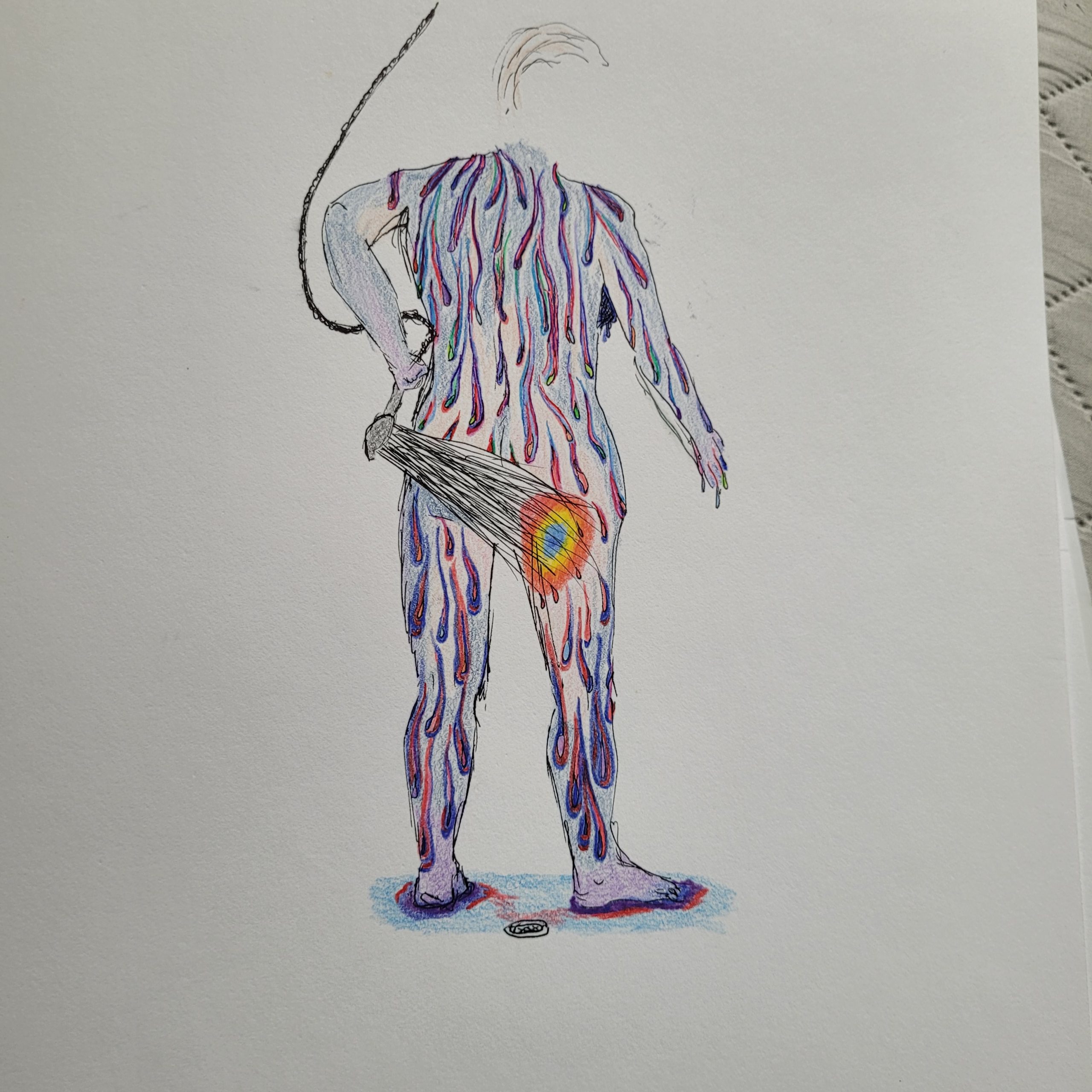
Taking a shower on a bad day:

When I’m rash enough to shower on a bad day, it feels kinda like this.

This picture isn’t finished, but it’s good enough. You can enlarge it to see the way the (to my senses) appalling changes of temperature wrap around every individual drop’s path all the way into the drain.

I couldn’t find a way to draw the way each drop feels like there’s a hook in its head, physically latching onto and dragging energy out of my body. That doesn’t hurt (unlike the hot/cold nonsense) but boy, is it exhausting!

So, when you can tell (pew!) that I haven’t had a proper shower or even gotten wet recently, you’ll be able to surmise that the pain has been higher than my ability to cope with the intensity of the experience.

For the record – I gritted my teeth and showered & washed my hair yesterday morning! I’m taking a bow, frankly. I had a familiar audiobook to listen to, which sometimes can keep my attention off those hot/cold and dragging sensations.

Keep in mind that everyone’s pain is their own. CRPSers don’t all have the same experience in the shower, because, for some, it’s awful in some other way. Not all days are this bad, even 24 years in. Nuance is key. Also, boundaries.

My pain isn’t yours, and nor should it be.

The idea here is to give you a chance to look on, without looking for anything more than your witness. That right there is a powerful thing: just being seen.

Don’t take it on.  Just adjust your expectations, maybe, as I’m learning to do myself.

If you’re a bio-nerd, read up on how humans go from mad mitosis to having skin and organs. It is absolutely fascinating – and explains a lot about neurological variations!

Communication tool: moods & self-care

I’ve also got a delightful communication tool to share.

As we all now know, my mood may not reflect the outward, apparent situation. There can be stuff burbling away that affects me in ways I might not realize, but others can.

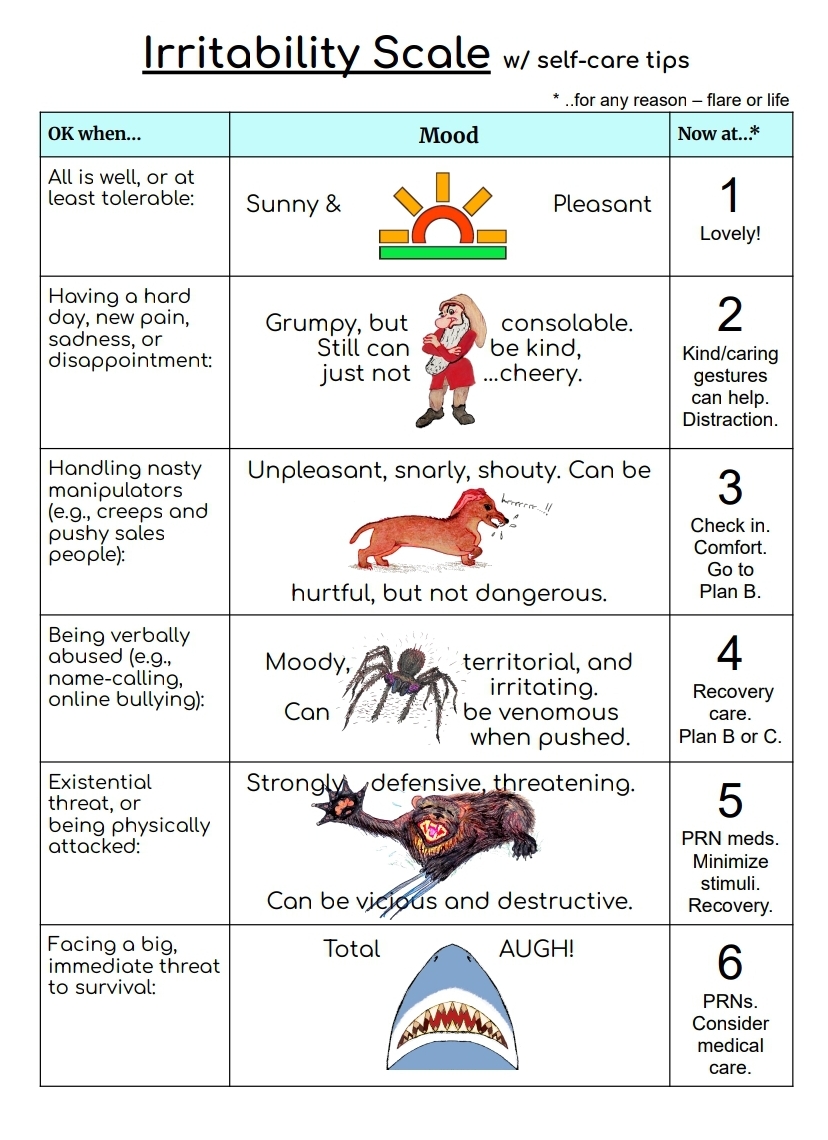
I came up with a rough drawing of a rating scale for my housemates to use (when I had some) and it was a huge help to get that objective feedback – without anyone being defensive! I’d sometimes find the magnet moved to a different number, then go away and take care of myself until I was pretty sure it could move back up. Usually, though, they felt free to call me over and show me where my behavior was, and I loved their honesty. Did me a lot of good.

Click here for the full-sized PDF: Irritability Scale

I particularly like how it indicates when a level of irritation is appropriate. That was a mind- blower for me, as I’d been telling myself that it was always bad to be unpleasant. Nope! Sometimes it’s perfectly appropriate!

I think, and hope, that sharing these images and tools will:

A. Be useful, and

B. Get it right through the concrete (taps own head) that I need to come up with ways to live and engage with the world that are congruent with this reality.

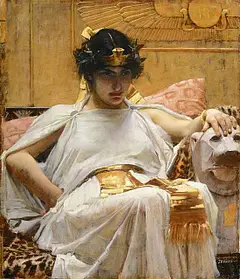
My inner Cleopatra, queen of de Nile, needs to get back to Egypt.

Cheers and virtual hugs are most welcome! I’m daunted by this job. I mean… I value honesty enormously… just not about my weaknesses and disabilities 🤣

It gets weird in here

I was chatting with a close friend about a week ago. He’s placed to be on top of current events with a depth and nuance that my vomit reflex can’t stand. We had an interesting conversation which was mostly me chirping, “But what about…?” And him giving me a really good update on stuff I’d never be able to stay upright long enough to research.

My brain was twinkling away on the incoming tide, sorting the info and soaking it into the correct metaphorical tide-pools and littorals.

I soon realized that, though I was sorting words coming in, I was having a terrible time getting words out. I didn’t realize, until that moment, just how completely that parsing a thought may feel verbal, but might not be.

I thought I was wording just fine as I thought, “okay… this goes here with news ownership; this goes there with political gamesmanship from Brand X; this relates both to Brand Y and legal process” and so on.

On the outward flow, all I could get going was along the lines of, “so, uh, how’s the… thingy… you know, from… what’s-his-name…” and I realized I sounded immeasurably more mentally inept than I felt.

I wanted to say, “look, I’m still in here and I’m taking in everything you say. I just can’t operate the outgoing current right now and my word capturing is going great, but my word finding seems to be underwater.” I could not fund the words, of course.

It’s been grimly fascinating to me to find the many ways a brain can go off-line in bits & pieces, and how my mental activity and neurological activity have these unthinkably complex ways of associating and dis-associating within themselves and between each other.

Everyone’s brain is linked up in completely unique ways. Just imagine what it would be like to work with people who could relate exactly what is and isn’t working and when. It’d set off such an explosion in the advancement of knowledge that.. wow.

A pointless note of wistful longing

It’s a real pity I can’t handle any schooling, let alone medical school, because this is exactly what neurologists need to know about to make their lives – and, boy howdy, ours! – a lot more useful and interesting.

As it is, patients are considered inherently unreliable in the medical mind, and, although that’s extremely insulting, it’s not crazy within physician context: the precision of thought and accuracy of terminology is rarely there, because so much training goes into commanding the information the way a doctor does.

Conversely, it’s adapting through a traumatizing cascade of brutal experiences that creates a skilful and well- informed patient. Training that’s so high-level it amounts to nosebleed seats for one; autodidacticism that makes Richard Francis Burton look like a playboy (oh, wait..) for the other. (When I can find someone who’s as brilliant an autodidact but not a moral negative, I’ll revise that sentence.)

It really is a different language and these two rather fragile mind-sets have trouble reaching across the cultural gap. (Anyone who thinks doctors aren’t fragile should just try correcting a few. It can get rough.)

I think the ratio of truly secure doctors to the rest is about the same as truly adept patients: they are definitely around, but can be hard to identify even when you’ve got one. It takes hard work and a lot of fearless honesty in both cases.

Buckling on my helmet. I’ll get it from both sides now.

The onus winds up being on the traumatized patient, who usually has more clock-time to prepare for the visit. The doctor has to turn around and deal with someone equally intense in 2-7 minutes, so they have to stay mentally free to do so.

Yes, let’s hear it again for corporate medicine and its unholy offspring. So efficient,  such a great use of limited resources… not.

There isn’t (yet) a cultural context in the field for cross-training as a patient and as any sort of licensed practitioner. That’s the key deficit.

Practioners get culturally demoted when they become patients (which is disgusting, but predictable in such a heirarchy) and patients get shoved into a little cultural pocket for things that fall between weird and interesting without fully qualifying as either.

Fun, eh? It’s one stellar example of the waste in the system.

Another chance to get it right

I’ve been chewing over something for awhile and recently realized that it might be time to apply that much mercy to myself. It’s a more coherent, whole way of thinking about what I discussed in some panic in my previous post.

Complex chronic spoonies tend to drive ourselves hard because we really have no option (the exhausting, but relevant, internal chorus of “adapt or die, figure it out or eff off, push through or give up, fight or fall” is inescapable) but does it need to be so ubiquitous?

A lot of these posts have been oriented on finding light through the cracks, on putting life itself into center stage somehow. I think I’m cooking up a new way of doing that.

The most basic of basics

Many years ago, when I was working as an emergency nurse, I realized that (despite the hype & excitement) our job was fundamentally simple: give people another chance to get “it” right.

Whether “it” was keeping up with their meds, staying off of whatever was poisoning them, choosing better company, finding the healing path that worked for them – whatever. There are fewer “its” than their are people working on them, which is why we are never the only one with our struggles.

That made more sense inside my head. Sorry.

People wind up in the ER because something bad happened, and usually human ignorance, stupidity, or violence was involved.

That’s not about blame. People don’t always get to choose their company or can’t always bear to be alive without some kind of buffer between them and their situations. Even if they did do something colossally daft (like the rich kids who decided to cut out the middlemen and drive 350 miles to buy their drugs from the distributor; 4 came down, 1 eventually went back), it’s not right to require mistakes to be terminal if they don’t have to be. 

Of course people with heart disease should take their meds even when they feel fine, and get periodic blood tests to show that it’s working. Of course people with diabetes should keep an eye on their blood sugar and stay on their meds. Of course primary care when you first get symptoms is better than going to the ER when you start to fall to pieces… but it’s awfully hard to find a primary doctor these days.

Life is complicated and increasingly expensive. ER work really shows that.

Anyway, I saw our job not as holding back the sea with a broom (as some do), but as giving individual people a chance to figure out how to do things better. Lift properly. Drive sensibly. Stay off the hard stuff. Find an appropriate doctor who’ll listen – and then talk with them.

Nobody likes to be told, so reciting these mantras to them doesn’t often make sense. Oddly enough, it can be a lot more meaningful when you’re meeting their worried gaze as you administer the medication or fit their c-collar or go over the x-rays with them. Or tape and dress the wounds in their wrists.

There is so much we don’t control… sometimes we just have to remember what we could control, and how to put that in reach. It’s not easy, but it’s often very simple. When the universe is dropping its big hammer, where do I need to be when it lands? Under it? Or can I get off to one side? What will I have to let go of in order to get out of the way? Is it worth it?

The answers to this aren’t always obvious, and “worth it” to some is not the same “worth it” as for others.

What that looked like in practice

We had a lot of repeat customers. Some of them I wound up zipping into body bags, because what it took to get out from under the universe’s hammer was either too far out of reach or not ultimately worth the effort of letting go of what they were clinging to. They mostly didn’t want to die, but it wound up being too hard to do what it took to live.

I’ve got to respect that. It’s not for me to judge.

Some of them I saw come back just for ordinary bump-and-owie stuff, showing me the healing scars (inward or outward) of their old struggles. There are no words for the sense of sunrise I felt on seeing them. It made the rest worth doing.

It was all their work… but it was up to us to give them another chance to get it right.

My chance

I absolutely love to work. Being useful and productive is the bomb! If it weren’t so important to me… well, I probably would not have come down with CRPS, which stemmed from relentless overuse injuries in my case. I could not take a break to save my life. Whatever it was, I had to jump in with both feet, arms flailing and shouting “incomiiiiing!”

I imagine I could be pretty tiresome that way. Belated apologies to my friends and colleagues along the way!

I’ve been wrestling – for years (how embarrassing) – with recognizing that having fun… recreating… seeking diversion instead of merely a change of work… I’m not even sure how to put it… but that loose, apparently useless, seemingly non-productive use of my time, is really good for me.

It lowers my stress levels. It reduces my pain. It raises my spirits. I don’t know if it gives me back any of my lost abilities, because I find it incredibly hard to do and have never been able to hang onto the easy-going vibe long enough to find out.

What with one thing and another (I’m an American living stateside in January of 2025; IYKYK) I have a powerful inward pull to go somewhere glorious – and affordable, thank you very much – and simply muck about enjoying the diversions. Play tourist for once in my life. Soak up pretty colors and different sounds. Be warm every single day.

And, if I get bored or don’t like it well enough, simply go somewhere else.

At this point, a lot of places are more affordable than the U.S. (more on that later) and, for all the challenges of travel in this body, I do plan on doing nothing but recover and enjoy myself for a good while afterward.

…It’s a weird idea, honestly.

Good thing I’m used to maintaining and cultivating relationships via the internet, after a quarter century of having to do so. It makes love more portable.

It’s still a weird idea. Wherever I go, I still bring myself along, and I know I’ll have to leave my compulsiveness behind with my snowboots. That’s unnatural, but I’ll learn.

Learning to let go of that deep attachment to being productive and useful is not the same as not being productive and useful – but it could give me time and space to heal my much-clobbered systems.

That might be the point.

Rest and play is widely regarded as essential. I think that’s the “it” that I need to work on getting right. Get out from under the falling hammer of overdriving a broken system.

Still a weird idea! LOL!

Tough gift, but a good one

American Thanksgiving is the 4th Thursday in November. I had a gift that day – a difficult one, but I’ve been unwrapping it and wondering ever since.

Wide-eyed kitten staring at a roast chicken on table in front of its face

My phone (which has my i.d. and my bank cards in it, and it provides my only internet access) disappeared on Wednesday evening.

While this is momentous for anyone these days, I have a disease-specific reason for being harrowed by it:

  • I listen to audiobooks to drown out my brain’s ongoing response to the ongoing pain, wonky signaling, and that disconcerting imbalance between what I need and what I have or can get to keep my environment safer for my body. To me, it sounds like screaming; I’ve heard others describe it other ways, as crunchiness or a kind of rattling wobble or other experiences entirely. My sensory processing apparatus decided that it’s a constant, ongoing scream from someone too upset to be the least bit self-conscious. Audiobooks and internet rabbit-holes are fantastic ways to manage this, partly by drowning out the internally-generated sound by the external one that I want to hear, and partly with the power of distraction.
  • Pain, reasonable & irreconcilable anxiety about how I’m going to get through anything from this day to the next chapter in my life, and the occasional neurological crumping (when my cognition shuts down and my coordination goes to hell, so I can’t make ideas or hold things) … all of these are best addressed by comfort and distraction. For me, books and memes and contact with absent friends are all good for that.

For Thanksgiving – when everything is shut aaaaaaaall day – I had none of that.

I just need a moment to process this.

It was a sad day. I couldn’t make or receive any of the usual holiday calls with people I love. I couldn’t go out to eat, and the previous evening I’d had to put back all the holiday food I had in my cart and get only what I could pay for in the cash I had on hand.

I had the sweetest visit from 2 friends (I explained why I had nothing to feed them with) who made it their mission to check on me twice daily until I was en-phoned again, and that helped me get through several hours much better.

Apart from that, I had little to do but hear the screaming, and wonder what I would do next year in a country that has voted for unprecedented chaos that, on the showing so far, is liable to shatter a large part of what makes it possible for me to live. The litany starts off like this: “The level of daily chaos to come is unbearable to think about. Every time I read up on the latest plans or appointments, it gets worse.” Not good for dysautonomia, among other things.

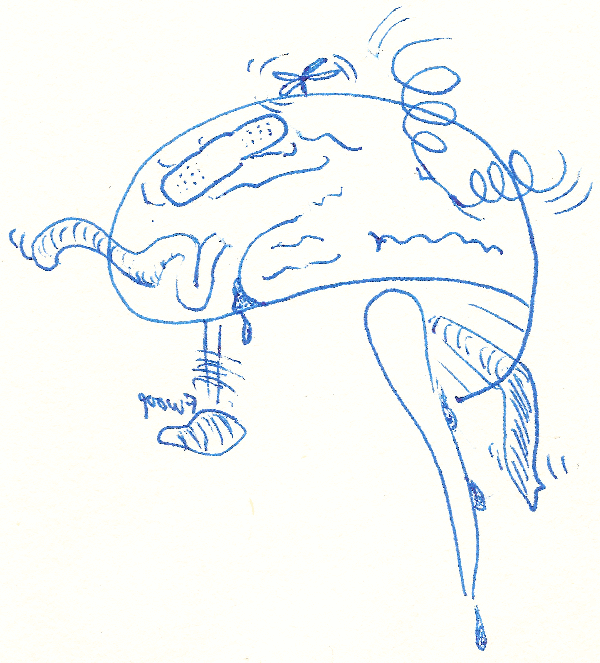
Sketch of brain, with bits falling off and popping out, and a bandaid over the worst

At the end of the day, I began to apply a bit of cognition to this experience (as you do) and realized something important…

The screaming was a whole lot quieter than it used to be; than it was, say, a year ago.

Last year, it was a lot quieter than when I first moved in here, right before the Pandemic. That was a tough time and the screaming was so loud I had to play the audiobooks and dvds at a fairly ridiculous volume to get the benefit. (The neighbor knocked on my wall a couple of times.) That volume might be partly why I now have ongoing tinnitus, a ringing in my ears that’s always at a different pitch and volume from the inward screaming. Clearly, my brain decided not to confuse the two.

Also, I noticed that my mind had actually recovered some ebb and flow!

There were times of day where it was natural to fix things, other times for doing something creative, times to sit and be quiet and times to move around and chat with the cats…

Natural texture and dimension in my mental activity, which the constant audiobooks had smoothed out and neutralized since they came back until that day of enforced quiet.

To the able-bodied and -minded, this is perfectly natural. It didn’t used to be for me. I had 10 or 12 alarms set throughout each day to tell me exactly when to do each kind of activity, because that mental texture had been quite, quite lost.

I got through 2 nights and a day without any alarms. I survived, and I also realized that alarms are jarring.

Who knew??

It turns out that my slowly-healing autonomic system has finally agreed with me that a stable diurnal schedule is a good thing to do, so I wake up within the same half-hour every day, without needing to be kicked awake by a series of 3-4 alarms.

The phone climbed out of its hiding place the next day. (Of course, I had already thoroughly checked there.) I canceled almost all of the alarms, except the one for feeding the cat.

I can make a short list for each day and get through it by riding those mental waves – and being kind if I can’t get them done at the very time that I wish to. It seems that being kind to myself knocks down a number of stress-related barriers.

Horse & woman laughing hysterically

I’m still digesting this new experience of the world. It’ll probably continue evolving over some time to come.

It’s not exactly normal to have such a significant level of recovery when you’re close to pushing 60 and sitting on 25 years of pain-related neurological disruption, including 20 years of dysautonomia.

So yeah, it was a sad day and not an easy one, but what a gift it turned out to contain!

I needed such a gift. My life is about to change drastically, and it’s up to me to work out which path to take through it. None of them are easy, but some could be more rewarding than others.

Can’t wait to see, not only how I’ll screw up, but what I’ll learn from it!

I’m going to try something new, as I navigate this tricky shift in life: asking for input and advice from people outside my head and its rabbit-warrens of associated ideas.

I know, wild idea… and for that reason alone, probably worth trying.


What’s your forward path?

I’ve seen more than the usual amount of material about having hope, lately.

I see why, of course. Many people view hope as an incentive to carry on when things are going badly and they can’t change that.

So, hope serves as a forward path or guiding light, a way to keep going when you’re not sure you’re going to wind up anywhere good.

Speaking as a long-term survivor of a pretty rotten condition, I certainly understand the value of that!

The point, I’d say, is the forward path itself, the guiding light that gives us the idea of having something positive to go for, when the usual ideas and activities don’t work or make things worse.

Hope is one way, but not the only way. Sometimes hope is counterproductive, and if you’re convinced that hope is the only way to keep going, that can be a real downer.

To me, hope is like a pretty lie: I’d like to believe it, but there’s no logical support for the hopeful ideas that, for instance, I could attain full remission and be able to work to support myself again, that the Atlantic circulation will strengthen again and stave off total disaster, or that my country could look forward to a survivably rational government in the new year.

And yet, some people cherish those hopes in themselves, and who am I to persuade them otherwise? Their futures are for them to envision. I’ve got to deal with my own, and that’s plenty!

My own sense of a forward path is something I have a hard time articulating…

It depends partly on the deep sense of history I grew up with, 10,000 years of the ebb and flow of human vanity, decency, terror, greed, and stunning insights.

I’ve read notes and letters from people burying their entire families in the Black Plague… between king and lord of warring states… Spanish merchants discussing trading alliances along the Great Lakes in North America in the mid-1300s, very hush-hush… Gilgamesh and his passionate grief for Enkidu… love songs from every age and between every gender… desperate missives from ancient Romans fleeing the fall of their government to families who never answered them, or told them there simply wasn’t enough to go around and still keep everyone else in their accustomed style and comfort.

Whatever we suffer, we are not alone in it. We are one more part of a very long course of events, and every problem has been faced before. It’s up to us to find the best solution for this particular version at this moment in time – and we have this great depth of information about how it has been faced before.

We are never alone in our terror, betrayal, or pain. Somehow, that helps me.

Another part is that – another lesson from history – there is a future worth having, if you can stay alive long enough and do what it takes to increase your odds.

This alone has gotten me through some things that should have been terminal: I had to see what the future worth getting to would be. So far, it’s been a fantastic outcome, relatively speaking. Well worth getting to!

The last thing, which is the hardest to explain although it’s the easiest to notice, is my stubborn idea that it’s my job to hew my best and truest path through this life – do my best while being honest about my capacity, be guided by my humane ethos, keep the long view, and don’t let the misery of my circumstances decide how I’m going to face them. That job belongs to my will. It has had a lot of practice.

Sounds really noble or something. It sure doesn’t feel noble! It feels messy and rebellious and defiant, most of the time. It requires me to disrupt expectations about how women, who are middle-aged women, who are white middle-aged women, who are white middle-aged women who originated from upper-middle social strata and good education… should behave. In short, people who are supposed to have options and protections and resources that I haven’t even been able to dream of for a very long time.

That’s what I felt I should have been. It’s a useless “should”, but a gluey one.

For all that I’m pretty cheerful (especially with the morning sun on my face, like now), I don’t have much truck with “hope”, because it feels like placing too much weight in an imaginary basket. I can bank on my diligence, curiosity, and determination, though. They aren’t imaginary at all; this blog reminds me of that.

I think that every one of us has to find the forward path or guiding thought that works for us individually in our own ways.

We’ve each got to play to our own strengths, and do our best to keep the deep-dyed “should” phrases in their place.

Sometimes hope is just another “should”, and it’s okay to set it aside for other motivators. You’re still whole without it.

Maybe it helps to know that the Darwinian statement, “survival of the fittest,” does not mean those who have the strongest minds or the healthiest bodies – despite the narrow libertarian/right-wingy assumptions and the hunter-gatherer-based ideas of cost/benefit.

It means “those most able to adapt to fit the new environment” and that, dear reader, means us: the disabled and neurodivergent are the OG adapters to strange environments, the fittest to figure out how to handle the increasingly worrying future.

One way or another, this era in history – with its uncertainties, intensity, and rising waves of change – is ours. Like it or not.

Collectively, we can do this. Individually, as ever, it’s an open question – but let’s find out.

I’m curious how this will go…


Defining my terms: burny brain

Current science states that there are no nerves that convey temperature or pain in the brain.

Well, not a normal brain.

Well… not as far as we know.

Since I’m terribly clear about the fact that my sensory experience of life has been extensively revised over the past quarter century of constant and increasingly centralized (that is, brain- and spine-driven) neurogenic pain, I’m going to sail sweetly right over that assumption and get on with today’s topic.

We live in the messy and extensive reality of the world outside of labs, scientific studies, and academic debates. Don’t worry about them – they’ll catch up eventually, usually in about 10-30 years.

Brain inflammation

Brain inflammation is one of those topics which patients and wholistic or ancillary professionals have been working with & evolving strategies for for years, but many clinical practitioners have trouble working out how it applies in real life, let alone how to work with it given current techniques.

Practical point:

This is not a dis of those practitioners, it reflects their environment of practice. Their training – and liability insurance coverage – focuses on what has been proven through multiple double-blind placebo-controlled studies, preferably on thousands of patients. Those take time, funding, lots of patients (which rare diseases don’t provide anyway), and a crucial position away from interfering with vested interests.

This is why clinical practice lags 10-30 years behind practical patient experience.

Where were we? Oh – brain inflammation.

One of my dear friends has been working specifically on chronic longstanding brain Inflammation, and it’s been validating as heck to see someone so smart, disciplined, and articulate work through that. Burny brain is, in my case, a sign of acute flare-ups, and talking the concepts over has helped me articulate my own situation.

And then there was Election Day and this lifelong historian & longtime spoonie saw my future get thrown on the flames.

NB: I don’t believe ideology or labeling, I believe that past performance is a good indicator of future behavior and, more importantly, that a written plan is a big fat clue about what to expect – and it’s not good for someone in my position.

After days of feeling staggered, my brain caught fire.

Inflamed brain, level 1

When a series of events, or one overwhelming and life-altering event, land in my life and awareness, my brain takes a few days to go into full bonfire mode. But it does:

Managing that

I depend on my well-established habits around self care and communication to mask my real state and continue to function, but it’s not reliable.

I crank up my vitamins, especially B complex, and do what it takes to get enough protein in. This is tricky, because eating is hard work and few things taste ok.

Keeping a stable schedule is important, to avoid feeding into the general autonomic instability.

Stabilize, stabilize, stabilize.

Since I lose track of time constantly in this state, I have to double-check whether I’ve taken my meds on time, and they’re one of the most important ways of stabilizing that there are.

If I had a bathtub, I’d take baths with vitamin C (20 min very warm; lie down on the C-powder as the bath fills) and then Epsom salt (20 min not so warm) then take naps – a fantastic 1-2-3 recovery technique that I really miss having access to. I recommend it highly.

Level 2

Once the flames get lower and my brain feels more like heavy coals, I know I’m making progress, although it doesn’t feel great:

This feeling of roaring combustion comes with big, fragile feelings. I limit contact and focus hard on noticing when & how I’m functioning, and grab tasks off the to-do list that relate to that.

So, laundry was a significant part of my weekend: no brain required, little physical effort, quick reward, and a huge improvement in my life. Now I’m  dressing off the clean laundry pile rather than my drawers & closet, because I can’t focus on folding & putting away, but that’s okay.

More veg today, partly because I was finally hungry for them, and also because protein was too difficult.

All the olive oil all the time.

Level 3

This is how my brain feels today, more or less:
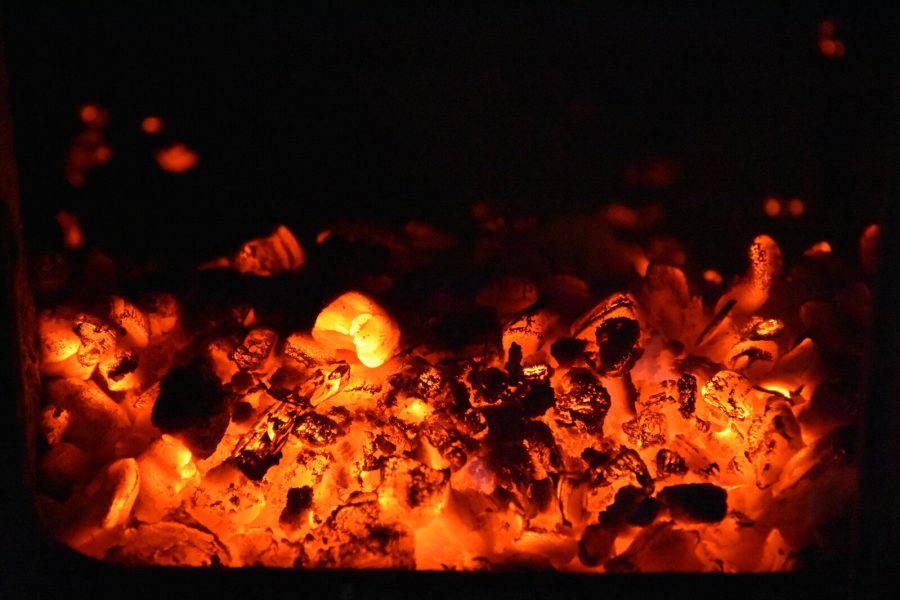
Honestly, this still sucks beyond belief, but it is improvement and improvement is good. I could eat in portions larger than half-cups and palmfuls, finally.

Today, I wanted to make some calls about getting something fixed, but that wasn’t possible – I kept going blank and stumbling into furniture when I tried (burny brain comes with worse coordination).

Instead, I went and got a ball of yarn to finish a project, which felt good and freed up more focus; with that, I dropped in at the law library and learned how best to approach an issue and then did some online research with that in mind. Now, when I do make those calls that i couldnt make today, I’m actually going to be much better prepared. Still not possible, but it will be at some point.

I wanted to make progress on another administrative task (paperwork, urgh) but my friend has taught us that, even though the clock keeps ticking, when the inflamed brain says “no”, it’s useless to argue. Let it go and rest that brain.

So I put on a movie. Then a dear old friend called out of the blue and we enjoyed reconnecting. Very good for the brain!

Level 4

With any luck, tomorrow my brain will feel more like this, still raw and hot, but somewhat contained, and with more cool spots:
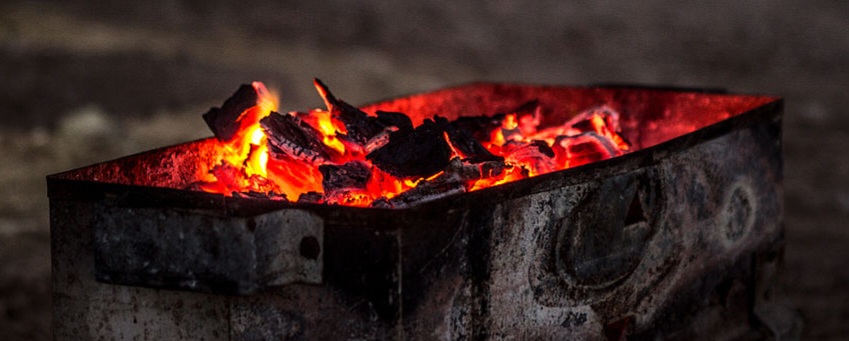
Unless something else happens to shake my foundations. You never know. But still, I hope for continued improvement!

If you’re having trouble understanding brain inflammation as a physiological thing, write a query in the comments and I’ll explain…

Later <grin>


New pain doc & big insights

I’m profoundly curious. (Take that however you want, LOL)

When I was an inch from dying, around 12-14 years ago, when there was nothing left of anything I thought made up my life… I found, down there at the bottom of everything that had been, this relentless creature who had to know how the story would go. I could not allow death to overtake me because I’d never know. So I lived – on pure willpower for a while, but then things started to change and get better & better.

This came up in my Pain Psychology appointment today, following on from the “new pain doc” appointment I’d had the day before. I’ve had 4 pain specialists in 9 years, and (thanks to extended litigation) around 19 in the past 20. Since much more than my life depends on my pain docs, and I have no control over the situation, this is harrowing, every single time.

My medical PTSD is a main focus of my pain psychology treatment, which is how this came up for discussion.

My curiosity is clearly more fundamental than my reflexes and primal needs, so, “Let’s figure out how to use it to interrupt some primally-driven anxieties.” Today’s quote from Kylie Steinhilber, PhD, my pain psychologist. From this, we discussed 2 further insights:

  • Being inquisitive is about holding an empty mind/heart in the present: pure now, with an open eye to the unknown future.
  • Trauma responses are about having emotional context and re-experiencing that history, thinking (“knowing”) it will go this way or that way based on what’s happened before.

I’ve never realized that quite so clearly.

If this had been a rough “new pain doc” visit, I could go to the open & curious state of, “so that’s what’s here/now. I wonder where it will go?” – instead of falling into the misery and grim anxiety of “knowing” what it will be like based on prior experience.

Note to self:

BE CURIOUS about where the story will go! That is rational, even though it doesn’t come with a plan.

Prior experience matters, but it’s a lot better for me to stay open and inquisitive and be with what’s going on now. More options, less antipathy between us, and that opens up communication – which improves outcomes, even in a crap situation.

Serendipity was my brain’s home base pre-injury, & it likely still is. It’s OK to go there and hang on when things get uncertain.

I’m in the 20% of humans who thrive through a serendipitous approach, although it drives more linear people (the 80%) up a tree, because it looks crazy to them & sometimes makes them want to reach for a net – or a straight-jacket.

When I use their (the 80%’s) linear approach (which I’m technically good at; mad skillz), the best I can do is mediocrity, if that. It doesn’t work well, no matter how careful the planning and research I put into it. Makes no sense, but that’s how it goes.

Chaos and WTFery are going to find me. I’m one of those people that things happen to. No, that’s not logical, but accepting it is rational. Interesting distinction between logic and reason there.

I see my mental job as learning – over & over – how to ride the metaphorical wild horses, not keep trying to dodge their flinty hooves as they run over my well-plotted garden.

20% of humans are like this. We’re not alone, just unusual.

Note to self:

I CAN TRUST MYSELF to know how to go and when to stop. Truly.

Cf. my “15% overdo recovery time” note in my personal pain rating scale. I really do know what it means to overdo by 15%, and why it’s harder to recover from than 10%. *That’s* evidence of a high level of insight & self-management. I can perceive it accurately when I loosen my grip on “tha Plan” and listen to myself.

I said to myself, “Self…

“LET the inner story that ‘everything will go wrong’ BE WRONG.”

Some moments suck anyway, but they pass a whole lot faster when I stay curious and open and let things go differently than expected.

All that said… I am simply over the moon with delight that this “new pain doc” visit was such a good one and that I feel safe at last in that part of the system! That frees up a ton of energy, now and ongoing. The relief is stupendous.

The resident (training) physician remarked, unprompted and naturally, “After all, you are the expert in your own body.”

Hearing that from a doctor is a show-stopper. As one friend & compatriot said, “I’d be less surprised if a unicorn came to your door and told you you’d won the lottery.”

It feels a bit like that..

Petroglyphs & the Permian

Poems don’t need me to write them, but sometimes I need to write something that sure isn’t prose. This is today’s poetical offering on the altar of, “it wasn’t ever in the script, but this is life, and it’s kinda cool.”

Odd legacies

Dinosaur footprints & petroglyphs..
Ancient cousins were marveling,
And it took ’til now to find their signs!

Some legacies don’t appear for
Eeeeeee
          eeeeee
                    eeeeeons
But still send shivers up spinal tracts.
Some legacies (like genes) vanish. No trace.

30 years ago, I hoped to be
That Writer whose words were indelible,
Lifting sore hearts, harboring sore minds

Against the casual brutality
Of any age. Documenting software
Cured that, as each season’s work was irrelevant

In days. I still hoped, ached, tried…
But now, I feel that my legacy is written in the flow of blood through hearts –
Ephemeral, but going on forever.

Perhaps an heir of mind will scratch
Petroglyphs near footprints
For others to find in nine thousand years
And send shivers up spinal tracts.

That may be way better than words.

https://www.good.is/amazing-discovery-of-9000-year-old-rock-art-among-dinosaur-footprints-proves-humans-knew-about-them-ex2

Morning exercise, redux

Flashback

Up until I got the injuries that precipitated CRPS, I used to run about 3.8 miles (about 6.1 km) up and down a redwood canyon most mornings. It was a highlight of the day: watching the light stain the tops of those glorious trees, waking the birds as it went, until the whole forest was filled with the noise of thousands of adorable featherbrains screaming their fool heads off, and the spiraling redwoods were soaked in molten gold.

I sprained my ankles a few times, leaving them with permanent puffy-pads. One time it was a bad sprain (I was pretty sure it was broken, given the huge swelling and rapid bruising) and I had to crawl and hop the last mile-and-a-bit, but I got there in the end because I’m just that kind of bonehead. I drove my stick-shift to the ER because, after all, the foot was still attached and all I had to do was push a little.

…Bonehead. (With, admittedly, an unusually high pain tolerance.)

Got poison oak a few times, until I went back to using poison-oak honey in my tea for the passive immunity.

I was kind of a sucker for a challenge, and I liked figuring things out.

I also liked the boards they had laid across a sandy furlong of the path to keep the sand from getting ploughed too far by the horses. The boards were just tall enough to make me hop them, and I liked pretending I was a horse trotting through a series of in-and-outs as I popped over them one after the other.

Great way to start the day.

And then what happened?

The repetitive stress injuries of long hours with keyboard and mouse, led to a series of wrist surgeries and complications in a couple of years. The CRPS diagnosis took longer.

What with all the roots and stones and the sun being in my eyes for the latter part of the run, I did stumble a lot. Having to catch myself went from being a diversion, to a nuisance, and rather suddenly to a terrifying possibility with crippling results. I dared not land on my wrists, because that could be the end of my career and my ability to support myself.

After recovering from surgery, cardiovascular exercise just caused too much swelling and inflammation — for years. I found that counterintuitive, which means illogical and, for me, extremely frustrating.

Fast forward 24 years

And now, it’s now. The ongoing heat wave (and flash floods) are making my usual afternoon walks impossible. My body refuses to stay vertical when the temp is a stunningly humid 84 degrees F (28.8 C). This body-system and wet-bulb temps just don’t get along.

Meanwhile, my thyroid supplement is starting to take hold. This means that, while I’m not up to normal energy by a long way, I crave exercise like a junkie with healthy tastes.

The only time I can be outside is before 8 am.

It usually takes me until then just to get out of bed, because of dysautonomia.

It’s hard to describe the sensation of challenging your dysautonomia, but if you turn on a powerful electric milk-frother and throw that down your stomach, while putting your head inside a vice and trying to breathe through a sodden sock, as flesh-eating termites devour your limbs… well, you still won’t know what it feels like, but you’ll at least be in the right ballpark.

I have an agreement with my body where it will let me get up early for Really Important Things, like fasting lab draws and airplane trips; I just have to pay for it the rest of the day.

I decided that it’s time to move exercise back into that category and hope it adapts appropriately. This is going to be rough, but the skills I’ve learned might make it work.

The skills

First thing is, No Surprises. I think about getting up and out early, as I’m getting ready for bed the night before. I think about the early hush and the freshness of morning air. I wonder what birds I’ll hear. I look forward to it sincerely.

Next thing is, Lower Barriers & Eliminate Excuses. Water is at my bedside and clothes & shoes get picked out the night before. I don’t want to have to think about doing it, I just want to grease the slide out the door.

Third thing is, Wake And Ground Deliberately. Once my eyes are willing to open, I drink at least half my pint of water and then organize my spine (a series of moves and physical therapy stretches that make my spine feel properly engaged), and then get all the way inside my skin (tapping down the top of my left arm, up the bottom of the left arm, down my side and front, down the front of my left leg, grab my foot until I can really feel it top and bottom, tap up the back of my leg, over my kiester and up my back and side; then, do exactly the same thing on my right side; then, tap up my neck — tapping on alternate sides — and use my fingertips over my face; rub through my scalp to get all the scalp muscles awake and ready to encase my skull today; and nice big sigh to turn over the air in my lungs.)

It sounds rough for CRPS, but I’ve been doing this for a long time and my brain knows what to expect. That’s important.

It also works to apply pain cream instead of tapping. It’s fine to skip over bits that don’t let you touch them. It’s fine to use a very soft touch, or stroke with something soft like a bit of plushy fabric or a feather.

It’s about input for the skin that helps the brain remember and rehearse where your body is in space. This is an important tool for pushing back on CRPS. It literally recaptures parts of your brain that have been turned into pain-sensation, and makes them remember how to do body-sensation instead. Worth pursuing and persisting with.

After this, I check in and, if body says it’s willing to try, I swing my feet onto the floor. I finish my water there, sitting on my bed.

I Check In as I Sit Up, nicely hydrated and with no surprises. If all is well, I get up and check in with my legs. If they’re OK holding me up and flexing, then I climb into clothes and shoes, and head out for my walk.

I planned my walk the night before (“no surprises” really helps the autonomic system to cope!) so there’s nothing to figure out as I grab my phone and keys and head out.

I adjust the distance I’ll go depending on how I feel when Im out. Today, I got wildly nauseous when I was about at half my intended distance. Vomiting tears open my saggital seam, that tough band that forms the middle crease in a 6-pack. (I vomit very hard.) So, I sat down and smoothed down the texture of my thoughts until the nausea passed.

Then I did some t’ai chi and qi gong, focusing on moves that stabilize the autonomic nervous system and ending with a “microcosmic orbit” series I always enjoy. (Let me know if you’d like video of any of that.)

Once my internal system was going better, I bowed out and returned, snapping pretty pictures on the way.

Summary & Conclusions

I’ve gone about the same distance both days, though yesterday’s walk took less time — I didn’t have to sit down. Today’s walk was more up & down. I think I’ll stay on level ground the rest of this week and see how that goes.

I’m now fighting the urge to go to sleep. I fell asleep at 8:30 am yesterday, after getting in from my walk, and slept until 1:30 pm. Waste of a day, IMHO.

Maintaining a diurnal cycle (regular sleep/wake and eating times) is very important for taking care of yourself with dysautonomia. So, now that my thyroid is not completely in the toilet, I’m going back to fighting to keep hold of the day. I want some life back.

To be perfectly frank, I’ve spent most of the last 9 or 10 months just waiting for each day to pass in the hope that another day will be better, and if not, at least I’ll be closer to the right treatment.

Enough is enough.

It’s hard work, but so is life: I’m starting to take back my days. That starts with regular activity, because nothing re-regulates a dysregulated system like regular activity.

And I do love the morning!