Ted’s Talks #2: “Relaxed” in Chinese

Ted Mancuso is famous for his enthusiastic Renaissance mind and the kinds of explanations it leads to. If that kind of thing doesn’t drive you up a tree, it’s enormously rewarding, because it can pay off for years.

It may not be immediately obvious how Chinese calligraphy, the evolution of the yin/yang symbol, James Joyce’s “The Dubliners”, a great general who died 2 thousand years ago, and the spinal root of a nerve, all relate to each other — let alone to the logic of a single move in t’ai chi.

puzzles_Chinese_Burr_305_imgbyMeronim
For him, they do.

Moreover, when he explains it, it makes perfect sense.
puzzles_Chinese_SixPartWoodKnot_Andreas.Roever
Compared to his ferally free discursiveness, my mind is almost tame. It helps me relax into training, because I don’t have to struggle with my own lateral-mindedness and force it into literal-mindedness — I can just say what I think and get instant yes/no/kinda, from a teacher who gets it. As I said to his wife once, “I LOVE that man.”

There’s a lot to think about in t’ai chi chuan, the way it’s taught at Ted’s academy. For that reason — and here I apologize to my fellow ADD-ers — this is a long piece, because I have to circle through a few related ideas to get to the point in a meaningful way.

One thing that’s becoming very clear to me is that, ideally, there is no such thing as an inattentive moment or an inactive body part. Even a part that’s held still, is still alive, still alert, still awake to the world and present in the mind.

Ideally.

Introducing Peng (however you spell it)

The concept of “peng” leads us closer to understanding this. If your native language is a Chinese language or French, your pronunciation is fine or nearly fine. If it’s not, you’re in trouble.

The word is pronounced with a very hard P and an English A that clearly came from the upper crust in the south of England. Its pronunciation is closest to “bong” in English, but, as a resident of a medical-marijuana state, I can’t write “bong” without inviting confusion, and as a longtime pain patient, I can’t write “pang” for much the same reason.

So, hard P, haughty A, and in here I’ll spell it pæng.

Pæng is often explained as a defensive or guarding force, but that’s an oversimplification. Ideally, pæng never leaves, except when displaced by a more specifically directed action.

Pæng makes directed action a lot faster, too, because of the way it creates potential space in any direction, which is then easy for you to fill. Much more efficient than the usual wind-up we usually find ourselves doing before initiating a directed action.
(This Marx Brothers compilation is hypnotic, to the point of being kinda creepy. If you’re triggered by casual violence, skip it.)

Pæng is the force you use to define the space you inhabit. Since you’re always in your own space, it makes sense to maintain pæng. Pæng is the ground state of each limb “at rest” (a relative term.)

Ideally.

This is what we work towards, anyway.

A relevant discussion of expertise

I’ve noticed, for much of my life, how the true experts in any movement (martial arts, dancing, rock climbing, surgery) don’t get in their own way. This is a lot easier said than done.

There’s a reason why true excellence is generally pegged at 10 years of experience. I figure it takes a couple of years to learn what’s supposed to happen, and then it takes most of the rest of the time to unlearn the reflexes that get in the way of achieving that. That’s my theory. Unlearning is that hard.

We lack faith in ourselves, at a subtle level, and it creates the interferences of hesitation, fidgets, and engaging the wrong efforts, then having to disengage them and reassess, then go forward again, in a sort of ongoing, half-unconscious dance towards accomplishing the goal.

Ted says that people come to his classes hoping to come in as they are and go straight on to excellence, and have to come to terms with the need to back up to roughly when they learned to walk/run really well and go on from there.
tai-chi-path

It’s part of his particular genius that he doesn’t try to get each person to unlearn their ways, he simply creates what he calls a shadow posture, and I call a parallel posture (though we mean the same thing), so that class time and practice time are spent in this new and evolving structure that creates the foundation for excellence to be built on. It’s up to you whether you go into that space the rest of the time, but it’s pretty hard to resist, because it’s delightful.

That very delightfulness is unnerving. I’ve had to integrate a lot to be able to accept something so alien to my experience of the last 14… no, actually, 40-odd years. It’s just so foreign, so antipathetic to what I have known for so long. Fortunately, I have ways of dealing with that…

My style of learning something profound goes like this:

  1. I charge in for a bit, throwing myself at it like spaghetti at the wall.
  2. Then, when my body-mind has reached a saturation point of new information and everything inside is sitting up and screaming, “WTH??”, I sit back for awhile to rethink and mull the new ideas involved in these skills.
  3. I feel and learn how they filter down and across and through every applicable aspect of life, and I have to semi-consciously work to let those old assumptions shift, evolve, and change.
  4. Then, when my mind has reached a saturation point of digested information, I can move back into activity, usually with a significant bump up to a new level.

Winter is a good time to digest, and with the waxing days I’m getting impatient and ready to bump up. I’m thorough, and I give full credit to my subconscious processes and the importance of mental digestion. When it comes to my learning style, I’m fairly relaxed…

We’re not relaxed in our tasks until we’re expert. I wonder if we can accelerate towards expertness by learning to relax in our tasks. There’s an empowering thought.

Expert surgeons have far better outcomes, partly because their lack of irrelevant motion means that they leave less trauma behind. Their scalpels don’t make any pointless cuts, their hands don’t jostle any irrelevant flesh, there simply isn’t anything done under the skin that isn’t directed towards the goal. There is not a wasted motion, and not a wasted moment.

They don’t dither; they do, and they do it decisively and cleanly. If something turns out a bit different from what they expect, they go with it — no holding back, no denial, just accept, redirect, and move on. They don’t interfere with themselves, and thus they don’t interfere with the work.

The truly expert surgeon, a few of which I’ve been privileged to see, is a breathing artwork of purposeful action and focused intent.

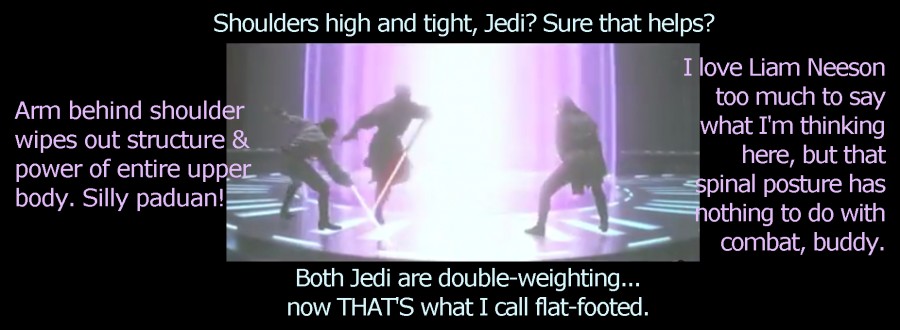
Martial arts is a bit more accessible to most people, so let me show you a popular and priceless example of an expert martial artist next to a couple of wonderful actors who can’t help getting in their own way. Here is the famous fight scene between Darth Maul and the two heroic Jedi, Qui Gon and a young Obi-Wan Kenobi:
All rights to this film belong to 20th Century Fox, in case someone forgets.

I included the whole fight scene. (You’re welcome, Marie P. and Steven R.) If you’re impatient, skip to the last 2 minutes. You’ll notice that the only reason the bad guy lost was a moment of inattention. He moves with effortless elegance, decisiveness, and power, while the Jedi are fighting their own bodies with every move, hulking their shoulders and flexing like mad. It looks exhausting! It took a lot of Lucasfilm to spin the contest out past the first minute, the imbalance of skill is so great.

Darth Maul is relaxed. It makes him effective. Qui Gon and Obi-Wan are not. They’re braced and clunky, utterly without pæng.

All right, given that this force (as it were) of pæng both protects space and creates space, what the heck is it, exactly?

Very simple. Not easy, but simple.

Pæng is the yielding resistance of a tree branch or a length of spring steel, or, for that matter, of a good dancer’s arms.

You push one part of the branch, and the whole bough may sway, but its balance is undisturbed. You push your good dance partner’s hand, but that doesn’t just move her hand — her whole frame absorbs and responds to your push with a graceful springy motion and she rotates, balanced over her own feet, as far as your push goes (backwards and in high heels, most likely. Be impressed.)

That is the force called pæng.

Let’s return to the tree branch for a moment. It allows us to extend the analogy without special training.

Take a good look at an oak, maple, or a eucalyptus tree. Look at a branch from its tip to the root of the tree. You can always follow a single, sinuous line from tip to root.

eucalyptus tree with lines showing the shape of each branch's support.
It’s the same tree, mirrored across. The lines are drawn in on the right-hand image.

That tree holds the branch up from root to tip, without any muscles at all. It lifts it from underneath its feet, up its trunk, and floats it out into space from there. This is how the force flows. Not muscular at all, but very, very strong. It’s pure physics.

The tree also holds the branch outward with curves that act as support structures (like the curvilinear welts in plastic packaging, to keep the package from being flattened), in order to make the most of the space.

Mmm... I wonder if they're gluten free?
Mmm… I wonder if they’re gluten free?

Bounce a branch lightly. Observe the change in the movement. It bounces more near the point of impact, and as the springiness absorbs the motion, it moves less the closer it gets to the spine. I mean trunk. Did I say spine? I meant trunk. Of the tree. In this case.

This calm-but-alive springiness, this resistance without strain, lifting up from the root through the trunk, opening without pushing, pressing without squeezing, all at the same time, is pæng: the whole branch, from trunk to leaftip, is awake all the time, ready to play with the wind all the time, ready to soak up the raindrops all the time, connected through the trunk or stem to its root all the time. Every touch on the way is received and understood, and responded to naturally. It is always alive with this springy yet relaxed, rooted yet responsive energy.

In humans, pæng can be modulated. This is part of the martial aspect of t’ai chi: intensify pæng to ward off an attack or prepare for one, shift pæng to draw the opponent, release pæng to snap into an attack, but always, always have pæng as your ground state. It gives you a safe, structured space to work from.

Ideally. That’w what we work towards.

Now that we’ve mulled the nature of pæng, we’re a bit closer to understanding what Ted and the t’ai chi chuan classics mean when they use the word “relaxed.” In our extreme-adoring Northern/Western Hemisphere culture, “relaxed” is the opposite of “tensed”, or even “stressed.” A certain floppiness comes to mind, even a resistance to being vertical.
Tense:

   []
   |
   |
   |
   L

Relaxed (Western style):


   8)________|

A “relaxed” body, in this sense, is not ready to move — far from it. It probably wants another drink!

The ancient Chinese traditions cultivate the middle way, not extremes.

As it happens, this is an excellent approach for many people with central nervous system dysfunctions, because our disrupted systems are hardwired to charge wildly between extremes. The more we strengthen our access to the middle ground, the more stable our central nervous systems become, and the better we can get.

Simple. Not easy.

With this in mind, we have to repurpose the word “relaxed” so it’s not a synonym for “floppy”, but a distinctly different term that describes the useful middle ground between “floppy” and “tense.”

   Tense: []    Relaxed: 0     Floppy:
          |            ( | )
          |             }|{
          |             / \
          L            /   \            8)_________|

It’s easy to see, even in these keyboard-figures, which level of energy makes it easiest to move in a useful way, doesn’t it?

How do you want your surgeon to be, heaven forbid you ever need one? How do you want to move when you dance?

Darth Maul seems quite a bit different now, doesn’t he? Actually, he does remind me of a couple of doctors I’ve worked with…

Shortly after I drafted this, Ted saw me struggling through a leg-intensive exercise. He said, with sympathy, “I see why you find these leg exercises so exhausting. Your leg muscles are fighting with each other in every direction.”

I went away and thought it over.
Sketch of brain, with bits falling off and popping out, and a bandaid over the worst
Well, of course they were fighting each other in every direction. This was the setup:

  1. When I was 10, I got the silly idea that I should have an adult arch to my foot, so I began to supinate.
  2. That led to my thigh muscles developing lopsidedly, and since I played varsity soccer in high school and ran in my 20’s, they developed lopsidedly a fair bit.
  3. That led to my kneecaps tracking wrong, and me losing the cartilage under my kneecaps. (I used to think that hurt. Cute!) Ted steered me away from his t’ai chi class in the 1990’s because I was so nervous about my knee pain (really cute!)… so I took his shaolin kung fu class instead.

So, over 15 years later… I’m far too frail for serious kung fu and Ted has become a breathtakingly subtle teacher of t’ai chi; I’ve gone through several rounds of posture training (round 1, round 2, round 3); and, now that the pieces are finally coming together (big clue: if it bears weight, it affects your posture), I’ve been working like mad to rectify my knees.

They still pull to the outside, from the habits laid in by my childhood efforts to lift my arch, and my knees hurt like blazes when they bend. To manage that, I practiced pulling them to the inside, but not directly — kind of rolling my lower thigh muscles inside and upward at the same time… While my habitual muscle pattern pulls outward and up.

Weren’t we just watching Liam Neeson and Ewan Macgregor do something very similar (if a lot more cutely)? Muscles fighting each other in every direction, literally at every turn?
jedifighting
The fighting was simply wrong. …And I don’t mean in the movie.

That’s no way for a body to behave, fighting itself. I don’t want my body to fight itself.

I didn’t see that changing the fighting would work, because there would still be fighting.

Finally, I straightened up. I said to myself, in tones of firm parental authority, “Knee, do it right. I’m not having you fight about it. I’m going to relax — unwind every muscle and make them stand down and wait for orders. You’re going to do it right the first time, because nothing is interfering and nothing is asleep. It is … relaxed.” Pæng.

I lifted my leg and put my foot down. It felt different.

I bent my knee. It was fine, absolutely fine.

I tried the exercise. The thing was completely painless, and floatingly easy.

Buyer beware — it’s a process. For me, the issues are simple, although annoyingly tricky to work with:

  • My levels of tension and awareness, not to mention relaxation and attention (those are 4 completely different concepts, you’ll notice), change so much from day to day.
  • I still have nearly 40 years of walking habits that I’m building an alternative to.
  • I still have to take lip from my knees now and then, which slows me down for recovery, and I have to mentally go down there and tell everyone to stop arguing and let me mend.

It’s a process. However, it’s well begun. It’s all about relaxing, in this special sense of pæng.

Cats are masters of pæng  :)
Cats are masters of pæng 🙂

It’s like this stuff works …
Who knew?
Who knew?

Ted’s Talks #1: know yourself best

A fellow martial arts teacher/competition judge once barked at Ted Mancuso, “None of your students move like you!”

Ted blinked, barked back “Good!” and walked away, shaking his head.

He refuses to model a move more than the essential minimum, and is no great fan of the mirror, either. However, he will coach the most clueless student with bottomless patience, week after week, as long as they don’t give up.

His model of teaching is based on the (all too rare) assumption that each of us should be the person most aware of, and most in charge of, our own bodies.

… I know, right?

If you follow the logic through, this implies that the correct structure for moving through, say, Fair/Jade Lady Weaves Shuttle (which is an upward block snappily followed by a nose break, which tells you something about those names)… as I was saying, the most effective and correct structure for that move is going to vary from one body to the next. The correct structure for HIS configuration of bones, ligaments, muscles, and chemistry is not going to be the most correct (or even passable) structure for MY configuration, or yours, or anyone else’s.

Ted doesn’t just say that, he bases his whole approach on it, from start to finish. His crogglingly refined sense of how to read that on others is probably another article, or rather book. Gifted pedagogue, yes.

In the long years of wrestling to take back control of my body from CRPS and all its ghastly little friends, I’ve taken PT for months, done intensive massage therapy ditto, and been overdosed on nearly every class of drug used to treat it — except the ones I flatly refused.

This inward/martial training with Ted is the first one that not only requires physical self-awareness, but actually helps me learn that awareness from the inside out, rather than passively requiring me to learn it from the outside in.

Once I gave permission for him to go to town on my structure, it would be tempting to say that he’s become merciless. That would be totally wrong, in both senses. He lives in an ocean consisting of equal proportions of mercy, humor, precision, and a degree of awareness of others that seems uncanny until you reflect that he’s been working on that since I could walk. So, yeah, he’s got that healer’s mercy that means he’ll do what’s right for you even if it sucks right now.

I’m now on the second round of fighting with my low back and hips for control of my spine, and it really sucks right now.

I am tired of trying to unlearn 40-odd years worth of faulty structure from the inside; it hurts, and more pain is tediously wearing.

So I found a massage therapist who suits my needs, and went to line up a series of sessions.

First available time?

3 weeks out.

… I know, right?

I came for a hot tub and chiropractic adjustment (which I believe is within spec for Ted’s style, given the intransigence of bony tissue and the ubiquity of hot water) and sat there letting my knotted thoughts and knotted muscles melt… until I smacked my forehead and started to laugh.

Why is my low spine putting up such a fight? Why has it kept falling back into the same darn reef-knots, despite the PT and massage and Round 1 of this struggle last year and so on?

Right.

It’s obvious, now that I think about it. There are no shortcuts! I have to learn how to identify, unravel, and rebuild those structures from the inside out. That’s the whole point. That’s why I undertook this training. This is exactly how it’s supposed to happen, aches and all.

This is me, having another laugh at my own expense, releasing one last sigh, and figuring out how to do this from the inside.

I love that teacher. I don’t exactly like him a lot right now, but that’s okay.

The Bean Dip Response, companion to the Spoon Theory

Those of us with crazy-bad illnesses appreciate the stroke of genius from Christine Miserandino, who originated the Spoon Theory to explain what it takes to get through the day.

For the most part, though, we shouldn’t have to explain much. Wouldn’t it be nice if everyone could get that memo?

To that end, here is a great article by family therapist and parent counselor Joanne Ketch on parenting boundaries, using the Bean Dip Response: http://www.joanneketch.com/ParentingChoiceBoundaries.en.html

With her permission and kind support, I’ve revised her article to reflect the realities of the chronically or severely ill. Please feel free to print out/pass on, with credit to her embedded as it is in this text.

Here’s my version…

Health Management Choices – Boundaries

A long time ago, as a developing patient educator, I found many chronic patients uncomfortable and frustrated with unsolicited advice – or inadvertently soliciting advice and then feeling uncomfortable with the discussion that followed.

Eventually, I read this great article on boundaries that eventually become known as “The Bean Dip Response”, “Pass the Bean Dip”, or even used as a verb: “bean dip” someone.

I rewrote the article from the perspective of a chronically ill, alternative-using or drug-disabled patient (one who can’t use common meds for the condition because of uselessness or devastating side-effects) – but the principles are transferrable to any constellation of health management choices.

The Bean Dip Response is best used when you don’t need to defend or don’t wish to engage with a person over a health management choice. If you are discussing issues with a person and you welcome their feedback, the Bean Dip Response is not needed.

I’ve found that chronic patients may confuse boundaries while trying to convince someone of the rightness of their choices. The best thing is to assert your boundary, rather than defend your choice. Your choice needs no defense.

Health management choices should be on a “need to know” basis. Most people don’t “need to know”. Since medical information is highly confidential, it’s NOT incumbent on you to explain yourself to those who don’t need to know. Those who need to know are essentially you, your doctors/providers, and your designated decision-maker for when you can’t make your own decisions.

If anyone else asks, "How are you sleeping?"
Answer: Great! Thanks for asking! Want some bean dip?

"Are you sure you should get picked up every time your legs flare?"
Answer: “Yes! Thank you! Want some bean dip?"

"When do you plan to wean off those meds?"
Answer: "When it's time. Thanks! Want some bean dip?"

"You should use my aunt's hairdresser's physiotherapist's product. It cleared up her [symptom du jour] in two weeks."
Answer: "That's great! I'm happy for her. Want some bean dip?"

Now, with some people you will need to set firm boundaries. The offer of bean dip won’t be sufficient to redirect them [I can’t imagine why not. -ed.] They either don’t respond to gentle redirection or they have emotion tied to the issue and a desire to “go there” more deeply. You may be able to anticipate this – if it’s a pattern of intrusion, for example, which you’ve seen in other circumstances.

In such a case, a stronger “Bean Dip” response may be needed. In these cases, the redirect will need to be backed up with action (like hanging up, leaving the room, or even unfriending them).

Remember, boundaries are not about forcing another person to comply. You cannot “do” that. Boundaries are about what YOU will do or not do. You are the person you own. You don’t own them and they don’t own you.

Practice kind but firm responses: "I know you love me and want to help. I am so glad. My health choices have been researched and made. I won't discuss it again.”

Don’t confuse setting boundaries with trying to convince someone of the rightness of your choices. It’s a common (and understandable) desire to present the same information that led you to your choices. The problem with that in dealing with a person who has boundary issues is that engaging with content invites discussion. (Also, different people’s minds work in different ways, so your train of thought may make no sense at all to them. Wasted effort all around.)

Chronic patients often struggle with this.

The boundary is that no one else has an inherent right to tell you how to take care of yourself.

You set boundaries by doing the above: acknowledging what they said and redirecting.

Where the chronically ill may invite problems is by citing authors, studies and sites to “defend” themselves. Each time you do so, you create more time for discussion and rebuttal and send the message that your decisions are up for debate.

Don’t defend your choices beyond generalities, and then only once or twice. “My doctor is in support of my choices. Want some bean dip?” Or maybe, “Well, this is my decision. Want some bean dip?”

If necessary, look them in the eye and say simply, “I want us to have a good relationship. I want to enjoy my time with you. I’ll take care of me, so that we both can make the most of our time together. Let’s not discuss this anymore. If you bring it up again, I will have to ask you to leave.”

Finally, an important corollary to the “Bean Dip Response” is reciprocity. Once again, the content of your choices should not dictate the interaction.

You may be totally, and correctly, convinced that you should be able to determine your own activity, medication, and supplementation regime; never be left to “cry it out”; and should be allowed to follow your own weaning path, if any.

But, if you post those opinions on Facebook (or communicate them in other ways), you invite (and therefore solicit) feedback and advice. Post accordingly and respond to comments with that in mind. You need to give the “other side” the same respect that you expect to receive.

Credit for original: Joanne Ketch, MA, LPC, LMFTa, LCDC
http://www.joanneketch.com/ParentingChoiceBoundaries.en.html

For those of us who are chronically ill, there are people we DO need to explain ourselves to. However, these are mostly highly educated people with specialist training, and that makes it a short list indeed.

Our loved ones may believe they want to understand, but, as my mother finally admitted, “I don’t think I really do want to understand what you’re going through. I couldn’t stand to know how much pain you’re in and how rotten you feel all the time. It would drive me crazy, knowing that.”

But, hoo boy, does she ever respect my boundaries! That’s worth the world. It makes everything open and clear between us, and our current relationship reflects that.

When someone confesses their limits to me, I take it as a gift. They have told me how to protect our relationship and how to move forward with it. I appreciate that. With that subject opened, we can move on to discuss how, or if, they can connect with me in a way that works for us both. This is priceless information. I’m glad my mother had the courage to open that can of worms, because then it got very manageable very quickly.

For an ever-changing kaleidescope of visual delight, check out my Mom’s photography from all around the world at http://jldtifft.com/

Preparing for winter in “Settler summer”

I’m too conscientious a historian to call it Indian summer, when the normally pleasant California shoulder season turns murderously hot.

I’m cleaning up, getting rid of clothes that were old a year ago and replacing them, and canning, dehydrating and even preserving food. I feel driven to, although it’s a lot of work and not necessarily CRPS-friendly tasks.

J cannot fathom why I’d be cooking in this heat, let alone making heavy, hearty food like bacon mash.

He’s cutting firewood instead.

Yeah, I know. We’re both kinda special.
matchgrins-horsenwoman_decamps-pauline_4blog
I have 4 blog posts almost ready to go up, but I keep making the mistake of starting my online time at social media. Within minutes, my attention is shot. I can’t finish a blog. I can barely finish a sentence.
me_wrysmile
This is the first vaguely functional day I’ve had after a spectacularly ghastly mast-cell-mediated flare.

Silly me, I ran out of my zyrtec (which I didn’t take very seriously; it’s not important like an SNRI, right? HAH!) and spent one day incoherent and two days merely swollen, crabby and able to cope only by losing myself in mindless tasks or Terry Pratchett books.

Took a day to figure out what was wrong. Partly, that was because I didn’t realize how much the zyrtec was doing for me, and then, of course, there was the headache that made me want to hack off the offending part, which made it quite hard to reason things through.
Sketch of brain, with bits falling off and popping out, and a bandaid over the worst
J is still avoiding me, hiding in the trailer with the tv when he’s not actively butchering logs. It’s possible this chicane isn’t over yet; his behavior is usually a reasonable guide to how unbearable I am.

I only took one zyrtec today, as my stomach would not even think about more. In a couple of days I may be back up to my usual 2. It will be nice to have normal fingers; reasonably functional digestion; less inflammatory pain playing xylophone on my spine, with rimshots off the other joints; and maybe a calm and considerate personality again.

Anything is possible.
Trapeze_artists_1890

Isy’s anti-inflammatory mashed potatoes
Obviously not for those with belladonna sensitivity.

  • 5 pounds organic red potatoes, cleaned and coarsely chopped
  • Turkey broth
  • 1 organic white onion, diced and lightly browned
  • 4 oz grassfed butter, like Kerrygold or Organic Valley Grassfed, in chunks
  • 10-12 oz grassfed aged cheddar, like Oscar Wilde 2 yr, Cabot Extra-Sharp, or Kerrygold aged cheddar, sliced or chunked
  • Optional: nitrate-free naturally-raised bacon, like Niman Ranch, cooked until very crisp, then drained and crumbled fine

Steam the potatoes in the turkey broth.

You might need to assemble the rest by halves, depending on the volume of your mixing bowl or blender.

Dump the rest of the ingredients into a mixing bowl or, if you have a really good blender, use that instead. Put the potatoes and broth on top, so the butter and cheese start melting under them and make it blend better.

Beat or blend until it’s the consistency you like.

Enjoy it nice and warm on an achy day.

Learning to stand: t’ai chi, qi gong, and unscrambling the CNS

About 15 years ago, I studied shaolin kung fu with Ted Mancuso at the Academy of Martial Arts in Santa Cruz. I was outrageously lucky to wind up there. I had too much spiritual feeling to tolerate the gym-type martial arts classes normally found in the US, but not nearly enough discipline to make the most of my time at the Academy.

However, I did learn a few things, including how to block a punch in such a way that my opponent’s spinal reflexes were disabled for my return punch. That was cool.
circulation-allbody-Anna_Fischer-Dückelmann_1856–1917
Being short, blonde, female, well-traveled, and — above all — a sometime Emergency nurse, all my illusions about bad things only happening to bad people were long since destroyed. It’s a great big world out there, and anything can happen to anybody.

So there I was, in my self-satisfied early 30’s, at a top-flight martial arts training school. The fact that the teacher (or “sifu”) had started in qi gong somehow totally eluded me. I was infatuated with the grandmother of martial arts, shaolin kung fu, and really had eyes for nothing else.

Smiling sparrers from Shaolinsuomi at Wikimedia.

I briefly flirted with t’ai chi, but decided it would be too hard on my knees… Knees are important, but shoddily made. I had cruddy cartilage (what was left of it) under my kneecaps. I thought that was painful (how cute!) and was afraid of making it worse before my time (another joke, in retrospect.) I got physical therapy for that problem, and learned that my legs had been aligning poorly at least since I was 11.

Retraining my legs to activate different muscles, ones I could hardly feel (and no wonder), was daunting at first.

I remarked to Sifu Ted, in tones of reflective melancholy overlaying a certain smugness, “I’m re-learning how to walk.”

That was supposed to be the opening line of a short discourse on rebuilding something so fundamental, literally repatterning one of the most reflexive early lessons in life, going right back to the beginning and restructuring an utterly basic activity … yeah. Cute.
children-Versailles_petit_appartement_de_la_reine_web
But, before I could get started, he said, in a tone of unrehearsed frankness overlaying a certain frustration, “I’m always relearning how to walk.”

My verbal hot-air balloon deflated on a laugh, before it ever left the ground.

He said, “It’s true.”

I nodded, and went away to think that over for a decade or so.

I thought of Ted when I realized that combining energy discipline and body work was the best rubric for managing my CRPS. I’m back at his school now, studying — you guessed it — qi gong and t’ai chi.

Um… No, it’s not too hard on my knees.

T’ai chi is second to nothing I’ve tried for correcting posture, the way Ted’s Academy teaches it. While each body is unique, there are certain things that have to happen in order for the movement to work. To do good t’ai chi is to line your body up properly. My low back is slowly opening and lengthening again, and my feet are remembering how to find the ground.

Qi gong is another dimension beyond that. I’m sweating over re-learning how to stand. When I find the words, which may take awhile, I’ll write about it more. To start with, I’ll just say that I had no idea how much I get in my own way — and I’m not that bad, for a Westerner. I started qi gong 20 years ago, but now I’m starting all over again.

I thought it was trippy to go back to when I was 11, and un-learn from there. Now I’m realizing I have to go back to when I was 1.
Faience_beer_stein_with_ball_scene_on_brown_background_web
But I’m looking forward to knowing how to walk.

Move slowly, stay happy… except when pushing one and a half to two inches straight down on the lower half of the sternum

We went to a great farmer’s market, where J got me a ceviche tostada that had to be tasted to be believed. I got a flat of outstanding organic peaches to dry for the winter. All this is much easier said than done, because today, for some reason, is pretty harsh as pain days go.

J wanted to know, in his brusque-backwards way, what I intend to do about it.

I replied that I’d probably trim his hair, then lie down for a bit, then watch a silly show, then come help with the wood — which means, bringing cold drinks and looking on admiringly.

I said, “Managing pain days is basically a matter of, move slowly and stay happy — to the extent that that’s possible.”

He liked that. He added jovially, “Used to be more like, move quick so I can get away from people — then I could stay happy,” he said, veteran of a socially hideous region.

We both laughed.

matchgrins-horsenwoman_decamps-pauline_4blog

Moments later, we saw people beside the road, one lying down. I saw CPR.

CPR

I barked, “Pull over NOW!” J knows my voice, and he’d never heard that tone before. He did. Instantly.

A first responder was doing chest compressions, and getting tired. CPR is incredibly hard work; if Mr. Universe did CPR, he’d tire even quicker.

I got down and planted my less-injured hand on the responder’s stacked palms and between us, we made a strong enough compression to create a pulse in the patient’s leg. This is what you want to do: create an artificial pulse, to sustain the vital organs until the heart itself can be restarted.

The runner had felt chest pains 5 minutes before, according to his workout partner. Then he went over. Just like that.

I won’t go into messy details, but by the time the helicopter was landing and I’d brushed myself off to come home again, I was aware of how strange it was to do this outside the ER, to snap into lifesaving mode from a standing start, and to find myself — without the mental shield of my work-badge and trusty stethoscope — turning away from a still-blue figure and not knowing if he’d make it.

J said of the man behind us, in his elliptical way, “He didn’t look like a jerk.”

I said quietly, “No. He had a really nice face.”

I’m sure he had good medical care. He worked out to keep fit, and had the muscle tone to show for it. He had a bit of chest pain 5 minutes before, then keeled over.

It’s not fair.

I took my clothes off carefully, keeping the dirt off me and turning them inside-out before dropping them in the laundry. I washed my hands and arms to above the elbows. I used to do that on coming home from work, every time. But I’m not able to work, and those weren’t scrubs.

I have some additional prayers to make now, and a body of my own to manage.

I have to move slowly, and stay happy, to the extent that that’s possible. There’s nothing else that could possibly help, because I’m no longer in the ER. I’m a 13-year veteran of the worst pain disease known to medicine, and I helped do CPR today.

I wrote this in the hope of coming to some conclusion that would make it easier to move on from this shell-shocked state of mental mumbling. I haven’t, yet… but let me add one thing.

This man had every chance, once he went down. CPR was started within a minute. The ambulance arrived within 5. He should be getting definitive care within 15 or 20 minutes of hitting the dirt. This is how it’s supposed to go.

In honor of this man who was given every chance, and in honor of my father who never had any, please learn CPR.

Even if your bones are too frail, as mine are, you can still provide the extra push that’s needed.

Even if you can’t risk infection from someone else’s fluids, you can still check for a pulse while others do the dirty work.

Even if all you can do is puff your chair a little closer, you can still direct the able-bodied, because it really helps to have a cool head looking over the whole scene.

Please learn CPR. You’d be amazed at what you can do with it. Those of us with disabilities get too much of the message that boils down to “can’t”, but when it comes to working to save a life, if you know the protocol and what to look for well enough, then there’s usually a “can” that you can go for.

I gave the police my name and number, and I hope to find out if our guy made it. (NB: Details were changed to protect his privacy… but I’m sure prayers and meditations and good thoughts will get through just the same.) I’ll post a comment to let you know.

In the meantime, here are a few links.

My ANS is going to be vibrating for awhile. I’ll start with lemon balm and see what else I can remember to do.

T’ai chi and emotional pain

When I’m out in the world, my reflex is to shove grief into a bundle and push it aside, and try to act as if I don’t feel it.

It’s always surprising how much energy that actually takes. When I’m doing anything else that takes much effort, it’s nearly impossible. It makes me forgetful and clumsy, just like a pain flare.

When I was at t’ai chi class yesterday, shoving and pushing one way with my mind while I was shoving and pushing another way with my body was so exhausting that I was wringing wet with sweat. Then I remembered something I’d tried briefly before, and decided to try it for the rest of the class.

I mentally drew the grief into my whole body. The grief turned to sadness and stretched out into every muscle fiber, every moving part. And I did t’ai chi with a body that was swarming with sadness.

It was, above all, peaceful.

I certainly wasn’t as tired. The sweat vanished as if by magic. I don’t even remember it drying on me.

The important thing is, I wasn’t expressing sadness in any deliberate way. I didn’t move more slowly, or try for any effect. I moved more deliberately and with better focus, because I was integrated. My body was filled with sadness, and I moved that body through the t’ai chi form.

The point of t’ai chi is to clear things up, straighten out what needs straightening, and separate muddled body parts and muddled energies into their proper alignments. Therefore, the sadness got a heck of a massage, and by the end of class, it was like it had been processed into something more wholesome. There wasn’t nearly as much sadness, as such. There was a lot more peace. There was a sense of strength I can’t put a name to.

I must add, as a footnote, that it’s been a long time since my feelings were capable of unshadowed joy. I have learned to cultivate a certain shallowness of mind at times, so I can be insulated from the deeps and be simply happy in the moment.

Therefore, when I say that I was happy as I left class, understand that it was a deep happiness. The shadows were very much a part of it, but that was fine. They were in the right place.

Define “invasive”

I was a Registered Nurse for 8 years — in one of the first HIV specialist units in the country, in the only public ER of one of the murder capitals of the US, in cardiac telemetry, in home care. It was a good, demanding, well-rounded career, if a bit short for my taste.

I’ve often wanted to re-educate my nursing self in light of my experience as a patient.
me-tongue-out
Here’s one of the most outstanding, outrageous lies we tell ourselves as clinicians: medications are not invasive.

That statement bears no resemblance to the reality of those being treated. It relates entirely and exclusively to the clinician’s experience. The clinician’s unstated assumption is, “I’m not hanging onto the thing that’s getting under your skin; therefore, what I’m doing is not invasive.”

News flash: Treatment is not about the clinician. It’s about the person being treated.
me_wrysmile
Medications get taken into the whole body, not just the ill part. Injections go right past the first barrier against infection and assault, the skin. Oral medications go through the mouth, descend into the stomach, and there meet the second barrier to infection and assault, the GI system… which they either aren’t bothered by, or can resist.

They’re then taken up by the blood, which goes everywhere.
circulation-allbody-Anna_Fischer-Dückelmann_1856–1917
They are all processed in the liver (it’s called “phosphorylation” and, privately, I suspect that’s why we tend to have trouble with phosphorus issues when we’re on lots of meds.) This is why too many meds for too long can lead, or contribute, to liver failure.

What goes through the liver goes through the spleen and kidneys, because that’s how it works. This is why some drugs can cause kidney damage.

What hangs out in the blood can, all too often, hang out in the brain. This is why some medications for organ issues or even a simple infection can cause deafness.

Blood circulation exchanges fluids with lymphatic circulation. Blood and lymph communicate with the central nervous system via the blood/brain barrier and the sheath around the spinal cord. The blood/brain barrier provides partial, rather temperamental protection, but it can be suborned by anything that makes the tissues fragile — fever, illness, injury… and some kinds of medication.

What is in the blood goes everywhere.
circulation-allbody-Anna_Fischer-Dückelmann_1856–1917
How is that not invasive?

I’m watching my partner fading with weakness after only a week on a couple of cardiac meds. I’m certain his heart has not gotten worse in a measly 7 days. The only thing that has changed is that he is seeing doctors and taking medication — for nearly the first time in his life. (“No side effects,” my left foot.)

How much of that weariness is stress, how much of it is the past couple of years catching up with him, how much of it is heart disease (actually, that part is pretty clear) and how much of it is medications? Each of these things has some part in it, there’s no question, but drawing the line between them is more than I can really do. I know the meds are part of it, but how much?

Medications are intimately, unavoidably invasive. There is no completely safe dose, and there is nothing that helps you for free.

Everything — meds, interventions, surgeries — EVERYTHING has side effects. There is no single thing you can do to your body, or allow others to do, that doesn’t affect every part of you in some way.

My years as a CRPSer, where the consequences of every change are so exaggerated, makes this pitilessly clear to me.

Given that there is no free ride, we have to look at the tradeoffs. Knowing that there are issues with absolutely everything, however “natural” or “close to our bodies’ own chemicals” it may be, we have to balance that against whatever benefits it may have.

Herbs are included, by the way. My increased sun sensitivity (which my disease causes a bit of anyway) and impairment of birth control (which I don’t take — what, mess with these chaotic hormones?) are side effects I shoulder with my eyes open, so that I can have the neurotransmitter support of the St. John’s wort herb I take twice a day.
St._Johns-wort_(Hypericum_tetrapetalum)_(6316227601)
I review all my medications twice a year at least, to see how I can tread the narrow path between optimum benefit and minimal confusion. Doing this from a chronically slightly confused state is, naturally, a whole different kind of fun. Working out which part of the daffiness is disease and which part is meds and supplements is really my most important task.

My partner has to choose between cautiously building back up some heart strength and circulation — and meanwhile have a life that is a small fraction of what he used to have for energy and activity, unless and until the medications and rehab really work; or risking the total loss of death by having a surgery which would leave him in pain and in rehab for awhile — but, afterwards, bring him back a lot closer to his normal, with many good years ahead.

Wait and see and work and hope, or take a leap and — if you live — work and probably win?

In a way, I envy him. If there were a procedure to do a bypass graft to eliminate CRPS, I’d be in the OR already. I’ve had enough of a twilit life, of exhaustion and fog. I want to get back into the full sun.

I miss running, too.

But it’s his heart, not mine. I do my best to explain things, listen carefully so as not to run over his real thoughts, and grab hold of my anxiety with both hands, so that any decision made is truly his. As it has to be.

Until then, he has to peer through the fog and work through the weariness of these “non-invasive” medications, to make his choices and his appointments. I’m just there to help — and to make sure he’s taken seriously, which is a real drawback to looking as fit as he does.
J-playing-on-treadmill
But that issue is another post…

Acute pain, chronic brain, and naming this ratfink disease

Complex Regional Pain Syndrome is the latest in a long line of names for this disease. Some of the older names have been recast to cover aspects of it, or versions of it, or special cases, and of course there are overpaid people who argue about it intensely. I’m going to go out on a limb and list a few sometime-names, sorta-names, and related-names to go on with:

  • Complex Regional Pain Syndrome
    Until recently, there were two subtypes: Type 1 had no visible nerve damage, Type 2 did. However, with chronic CRPS, there is extensive and pervasive nerve damage, and it makes no difference in treatment after the acute stage, so this subtyping is widely considered irrelevant.
  • Sudeck’s atrophy
    No longer used; atrophy of bone and muscle is really symptomatic, and not always present.
  • Causalgia
    No longer used, except as an old name for CRPS type 2.
  • Reflex Sympathetic Dystrophy
    Used by old-timers and sometimes for CRPS type 1, although CRPS-1 is not necessarily maintained by the sympathetic nervous system.
  • Algodystrophy
    More often used in Europe; also, neuroalgodystrophy. Problematic because it implies that this is the result of autosuggestion. I know I could not have made this up in a million years; moreover, extensive analyses of the literature show that there is simply no truth to that.
  • Neurodystrophy
    More often used in Europe. It’s a perfectly good name, but not the one that the IISP paid a bunch of specialists to come up with)
  • Reflex neurovascular dystrophy
    RND; no longer used, because it only addresses vascular changes, not neurology or systemic issues.
  • Shoulder-hand syndrome
    No longer used, except to refer to upper-body chronic neuropathic pain while dodging a CRPS diagnosis.
  • Peripheral trophoneurosis
    Good one, eh? No longer used, both because it may spread out of the periphery, and it’s not about neurosis. See “algodystrophy” above.

For more on comparative naming and different nations’ approaches over the years, check out the RSD Canada site.

A certain amount of acute CRPS does clear up (or go into remission) before it’s even diagnosed. Since it can take years to get diagnosed, there’s not a good way of figuring out what those numbers might be. Even after diagnosis, acute CRPS can go into full remission and never show up again, before it becomes the ground-in form of trouble I call chronic CRPS.

In its chronic form, CRPS is a disease of dysregulation — of everything being thrown off balance. Our efforts to push back against any given part of that are quite likely to throw our systems off balance in some other way.

The body doesn’t balance simply, like a seesaw; it dances in 4-D homeostasis, which I’ve explained here. It’s a bit more like this:
Trapeze_artists_trimmed
Now imagine pushing one of those trapeze bars the wrong way.

Adjustments need to be carefully incremental in order not to distort the system further, but often need to be done quickly because the situation is so horrible to be in.

It’s a conundrum.
Sketch of brain, with bits falling off and popping out, and a bandaid over the worst
Personally, I’d like to have different names for acute and chronic CRPS. Here’s why:

Acute CRPS is all about the pain, with swelling and dystonia and circulatory high-jinks playing second fiddle. With acute CRPS, good results are consistently found with vitamin C (500 mg twice or three times daily is the usual dose range) and also with activity plus pain control, both quite aggressive.

Apart from that, therapies vary widely as to what will work with whom, but chances of remission in the first few months are very good, and in the first few years are still comparatively good.

After that, the whole situation changes.

With chronic CRPS, you realize that you have to find a way to live around the pain because so many other things are going wrong, life itself has to take center stage at some point, and pain has to take its turn in the wings.

Once the brain plasticity has gotten going, it’s no longer just a pain disease, but a disease of dysregulation, as the signals change and the body’s responses to the signals change and the brain’s ability to even recognize appropriate responses to temperature, circulation demands, sensation, perception, and so forth, all slide downhill.
Bosch_painting_of_Hell_(582x800)
In acute CRPS, having the word “pain” in the name is absolutely appropriate, because that must be addressed to let the brain reboot and get back to normal.

In chronic CRPS, pain often remains a huge part of it, but the central brain-changes are what creates and sustains the disease state. Pain is, clinically speaking, a ghastly distraction.

It’s a key symptom, a good guide (since muscle weakness, sweat and circulatory changes all tend to track to it at least some of the time), but it is not the driving force of the disease. The brain changes are.
poison_skull
Pain is terribly seductive to researchers, because people who don’t have chronic CRPS think they “get it” about pain (hah!) and, since that’s easier to relate to than the word “complex,” let alone the hopelessly misunderstood terms “regional” and “syndrome”, what they focus on is the pain.

The real problem is the brain, not the pain.

In my private internal world of reason and order, chronic CRPS is actually known as Complex Neuro-plastic Dysregulation, CND.

My eyes make words out of letter groups, usually just by adding a vowel. What comes to mind for me is, if you don’t win at CR[a]PS, you get C[a]ND.
craps-tshirt-front
Makes all kinds of sense to me 🙂

Being clear about being grateful

We visited our favorite hot springs last week. There’s a hot pool that’s very hot indeed. When I alternate between that and the cold pool, preferably dipping several times, it becomes quite a fabulous experience.

Stone angel with hands clasped in prayer, standing on a pillar, sun like a glorious halo
Halleluiah!

Whether it’s the lymph getting going properly for a change, or toxins (the few that are left) getting sucked out of my system, or my autonomic system finally getting a clue and just taking a break, or possibly all that and something more, I have no idea. But it can be really good.

gleeful woman grinning, sitting in a sailboat cockpit, sunny water behind her
REALLY good!

I did my dips and bounced gently on the balls of my feet in the hot pool, overflowing with something like gratitude. I’m no fool (I just take an off-road approach to life) … offering gratitude works, even with a conception of spirituality based more on quantum physics than religious dogma.

Things go better when I’m classy enough to express whatever gratitude I feel.

However, it has to be “true enough to write,” my ultimate litmus test of sincerity. (That really is my key phrase when I’m thinking about truth, writing, or both.)

George_Goodwin_Kilburne_Writing_a_letter_home_1875There’s no fooling the All, because I’m part of it and I know the truth, even when I don’t want to.

Letting my head fall back into the welcoming warmth, I thought a moment, letting the feeling swirl through me like water.

Grateful for my life?
I have to be honest (though it may mean I have an inferior soul or something) … I’d love to be. I think that somehow I ought to be. But really, when you get right down to it… too many caveats.

Grateful for this day?
Well, y’know, there was too much of the day left that could go wrong. Experience has been too strong a teacher to make me grateful for something before it’s in the bag.

Grateful for this moment?
Ah yes, there we go.

I felt my spine let go of the last knot.

I could say, without hesitation and with perfect integrity, that I was definitely grateful for this moment. Completely, unwaveringly glad to have it. I was truly thankful for that heavenly bit of space-time I’d found myself in.

Crab_Nebula-crop
Heavenly, beautiful… grateful for it

The moment stretched and smiled and wrapped me in blissful arms. It made me stronger and more content, and I faced the bumps and mild insults of the rest of the day with fairly unruffled peace.

It turned out to be a good day. A day to be grateful for.