On the road again

I used to run between 3 and 12 miles, 3 to 5 times per week. Not so much because I wanted to be One Of Those Running Addicts, charging along with a ghastly snarl carved into their faces while insisting they were having a marvelous time. Initially, because I had to dump the stress from my nursing job without killing anyone, because there wasn’t enough Haagen Dasz in the world to smooth the edges of HIV care in 1991 or of working the only public ER in Washington, DC. Later, simply because it was fun, after the first few weeks of adjusting to the initial effort. When I had had to give up nursing due to illness, recovered my lung function eventually, then was burying someone I loved every other month while I learned to handle programming software enough to write about it, I needed a bit of fun.

Well, that was depressing! I sometimes forget that having an eventful life can correspond to having a catalog of horrors in the rearview mirror. It’s not all horrors, really, and my natural bent towards finding beauty in everyday life became well developed, as I dove into the beauties (or the work) of the moment as a coping skill, and then eventually because it’s so rewarding.

At that time my usual trail was up hill and down dale through a redwood preserve — to misquote William Allingham, “Up the airy redwoods, down the mucky glen.” Great for the calves.

Redwood National Park REDW9377

More to the point, getting out before work meant I could watch the sun touch the treetops high above, slowly stroking glowing gold down over their dusky purple and blue-green, each luminous inch bringing the birds roosting at that level to life, shrieking their fool heads off like this was the first time ever and they just couldn’t believe it!

THAT was definitely fun.

Coastal redwood

Speaking of fun: I’ve been reading thriller/adventure stories by an author who’s also an old pal. Like most thrillers and adventures, the characters are annoyingly fit. Unlike most thrillers and adventures, the characters have actual personalities (not just a set of quirks laid over a monotonously steely outlook), with the touch of weirdness I see in the people I’m drawn to, if I look closely enough. I certainly see it in myself.

These days, I have trouble identifying with fit, but I identify with weird just fine.

Suddenly, I couldn’t stand it any more. I got up, put on my sturdiest foundation garment, added a couple layers over that (it’s still chilly and soggy here) and went for a walk. My old, solid stride came back, the one that propelled my blonde fluffy self safely through the Tenderloin in SF and the drug commons of DC, with no more remark than, “Marines? Special Forces? How much do you bench press?” (The last was unusual, and actually made me pause to try and remember.)

I noted which clothes I went to put on, and moved them toward the door so it’ll be quicker to get dressed next time.

I forgot to stretch out afterwards, and getting up from this chair a minute ago was a useful reminder of the absolutely essential need to do so. Stiffening up happens!

I overdid a few days ago and it took 2 days to recover, so I know I have some exercise intolerance. I’m being careful (within the limits of my personality.) So far so good, and if I haven’t crashed and burned by this evening, I’ll know I chose the correct level of activity, and can increase first my distance, and then my intensity, by increments of no more than 10% at a time.

The tiny incrementation is frustrating for a former muscle-head, but I’m old enough (at last!) to know that little strokes really do fell great oaks, that the future will come anyway and I might as well be better for it, and the way to make that happen is to work at my margins and gradually, gently, persistently, open them out.

I don’t dream of marathons, but nor do I count them out. I don’t count them at all. I walk (briskly and sturdily) the dirt roads through my forests, and that’s enough for now, while leaving me plenty of room to grow into.

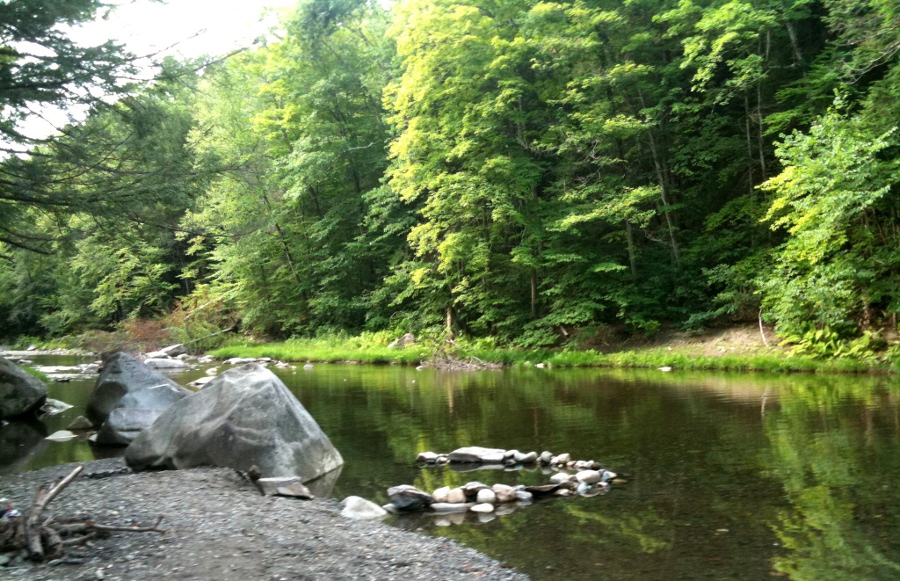
water_swimminghole-1

The third toughest job

While I’ve been absent from the blogosphere, I’ve been pushing the rock of life further uphill. I’m cautiously optimisitc about getting it to the top and watching at least this particular tedious weight roll off in a new direction, eventually.

Being safe, having survival assured, and being surrounded by loving and trustworthy people was the biggest part of it. For the tools that I can control, it was just what your grandma probably advocated: eating good food, drinking good water, and getting fresh air with a bit more exercise than I really wanted to go for.

Food:
With neuro disease, our bodies need more nutrition than our diets can possibly provide (especially when our guts don’t want any), but our supplements go down a lot better and get absorbed much more usefully if we eat well. I used lots of wild blueberries (dense little packets of brain-repairing anthocyanin antioxidants, yum!), a variety of hard cheeses (2-year-old cheddar, 15 month manchego, and 1 yr English goat cheddar, in my case) for the brain-boosting natural phenylalanine, and fresh leafy veg as close to every single day as the two of us could manage, because they are so good for everything.

Water:
We have artesian well water. It. Is. Outstanding.

Air & Activity:
I asked J to nudge me into getting some exercise every day, if I didn’t get onto it myself. That’s easy for him, because he too likes to get out and get into the open air. On bad days, I hold his arm and go anyway. On really bad days, I go slowly. But I get out, walk on the burning coals under my feet, and keep walking out until my feet stop spasming, then walk back. Sometimes that’s over a mile, but the thing is, I find that if I walk long enough, with enough breaks and the right footwear, I can knock back the pain and spasms — not to mention the frame of mind that tends to go with them — well enough to brighten up the whole day.

So.. I can think! Amazingly often!

I wrote a BUDGET last week!!!

It wasn’t entirely in the right direction, but I figured out how to stay (just barely) in the black. BRAINWORK FTW!

So, with that incredibly awkward seque, here’s the hot issue.

It’s a topic that is all too pressing a reality for people who’ve had their butts handed to them by a disability that affected their ability to work, and then destroyed their means of making a living:

Credit repair.

That’s right, ladies and gentlebeings, I am tackling the third toughest issue (right after 1. survival and 2. getting responsible doctors): 3. working through the PTSD, ADD, anxiety, brain fog, and intermittent dyscalculia which this brain disease and its financial consequences have caused, in order to get my credit rating back in the black.

I have barely been able to look at a spreadsheet for years, due to the numbers dancing around like a hallucination. Dada via Josephine Baker. Just unmanageable. But I can look at one almost every day now, and it’s amazing how easy it can be to push those numbers around intentionally!

I’m glad to be able to take this up. More on it later, with numbers to call and strategies to take for rational results.

Music lit me up and doused the fire

Okay, this is weird… good weird, though.

I’d been in a really bitter, increasing pain jag for days, and though a dose of Norco and dramamine gave me one good night Wednesday night, the pain started ramping up again once the meds wore off on Thursday morning.

That was bad. Very bad.

The Norco usually breaks the cycle. I definitely did not want my body thinking it was normal and appropriate to keep cranking up the pain.

I worked in the yard Thursday late morning (John keeping me from overdoing on any one thing, because I couldn’t track well enough to notice), because I just had to move through the pain to keep it from making me lock up.

Then I took a disco nap, dressed up minimally, and went to see Boz Scaggs at the Calvin Theatre in Northampton, which we’ve been looking forward to for a month.

Side note… I haven’t been inside the Calvin for 30 years, and it looks it around the gingerbreading, but apart from the art-nouveau panels it was in great shape.

The opening artist was a solo acoustic set by Jeff LeBlanc, who has had some success but not that much; an unfair position to be in, because he has the creamiest tenor I’ve ever heard in the rock/folk-rock realm, a pleasing and rather classy onstage personality, and a delightful way of framing and playing his material. He has matured just since recording this:

I mean, John Mayer can just shut up and move over. Beautiful.

The Boz show was outstanding.

He used to go in for pyrotechnics and flash, I’m told, but this show was just pure, perfect musicianship. His 7-member band fattened up the sound in the smoothest, tightest way — every note perfect, every beat perfect, and the band grinning and digging into the show like they were as happy as we were.

Bonus: I finally understand what musical stage lighting is supposed to do. I’ve seen a few shows and, apart from the spotlight, the shifting colors and intensities just seemed to be either distracting or hokey. The lighting actually worked this time, and I only noticed because there was one single slightly missed cue, and then I noticed how flawlessly it had been guiding my attention and floating with the music until then. I could see everyone, but each musician was distinct, and the soloists glowed. Every moment was beautiful. Who knew?

I was absolutely jamming. Every song was just a whisker better than the last (perfect) song, and everyone was having a fabulous time. I was lost in it, elated. I was rocking in that ecstatic state that a great performance can put you in… and suddenly, I swear I felt my brain move: my left front inferior pareital portion and my right lower temporal lobe and some bits elsewhere gave a squirm, a shift, and then clunked into a more comfortable position.

Then I realized I was in no pain. No pain! I mean, NO FREAKING PAIN AT ALL!

I’ve got to look those parts up and see what they relate to. I may be overthinking it, of course.

Fast forward past a couple post-show hours of “wow” and a happy thunk into the pillows; waking up to a beautiful dawn and feeling, in the words of Tony the Tiger, grrrRRRRREAT.

Still have allodynia, where a breeze feels a bit like a hot iron sliding over my skin. Still feeling a bit fragile, like my body might tear at the seams if I try too hard. Still not pushing it (which means I gotta get off this keyboard.) But my baseline pain is back down, well below the event horizon of functionality, and I can sit and stand and move and there is NO FIRE. NOR FIRE AT ALL.

Those coals banked in my feet and hands and knees and every single bone of my spine and so on and so forth are just gone.

This is a good day, folks.

Next on the agenda, after finding our own home and getting the outstanding business nailed down: Music lessons. I don’t know in what, but all those scientific studies about the different ways the brain benefits from hearing and playing good music are suddenly making a boatload of very personal sense. Victory! Thank you, Boz & co. 🙂

Fixing the brakes

Interesting week here.

A dear friend is embroiled in one of those ghastly legal tangles where the vultures are rigged to win. I’m the key defense witness. This comes up later.

This whole winter, I’ve been basking — simply basking! — in the sheer delight of being safe, sheltered, warm, loved, and with as little chaos as anyone with a recent move, a complex illness, and widely scattered relationships can get. Occasionally, I’ve wondered if I’m allowed to be in such a situation, and strained my ears for the sound of the other shoe dropping… Then I do a reality check, tune in with my lovely partner and my lovely housemate/hostess, and it appears that no, it’s okay, things are right, and this is what’s right now.

My nod to the fairly relentless self-management that got me through the past decade has been an occasional effort at meditiation, a minute or three of qi gong, a few moves of t’ai chi now and then, or the occasional mood-check.

In short, diddly-squat.

In December, I lost it with a dear friend.[LINK] I did more mood-checks for awhile, a bit more meditation, maybe ten whole minutes of t’ai chi every other day for a couple weeks.

Diddly-squat doubleplusgood.

I was heartbroken at the mess I’d contributed to, but couldn’t dig up the motivation to really “do the Do”, to restart my hard-won disciplines.

Dear heavens, it was soooooo good to rest, just relax for a change, enjoy the sensation of not looking over my shoulder and not being constantly *forced* to calm sometimes-legitimate terror or possibly-reasonable panic.

It was winter. I was safe. I let my disciplines sleep.

Meanwhile, the brakes on my car[LINK] were acting up, or rather, occasionally failing to. $2,000 later, that was supposed to be fixed.

Gradually, I noticed that J was telling me, more and more often, to lower my voice: “I’m right here!” Huh. I didn’t think I was talking that loudly…

As I relaxed, other humans became more interesting and I started striking up conversations with strangers, as I used to do. They didn’t respond as well as they used to. Odd…

On social media, I found myself being snippy where I used to be sweetly witty or wryly amusing to make the same point. I backed off of my online time, because if I can’t manage myself well, I’d better not interact with anybody else who might be feeling frail. “Do no further harm” has been wired into me from way back. It’s the most basic courtesy.

I took the car back for a second brake job a few weeks ago, only $150 this time, and that seems to have taken care of the problem. So my cynicism about car dealerships remains unimpaired, thank you.

Meanwhile, there were some tellingly unpleasant procedures[LINK] which illuminated a fact I’m still failing to accept: CRPS has moved into my viscera — it has leaped out of the musculoskeletal bounds and gotten right into my core. I used to say my case was “all-body”, but that was because of the gastroparesis and subtle endocrine weirdness, which I figured was simply faulty autonomic signaling. It has definitely become much more.

I could feel every line of my intestines and the springy squashiness of my organs as the ultrasound tech noodled around on my abdomen, and the less said about the gynecological exam the better. It’s real. It’s a bed of coals in there. This finally sank right through my skull over the past few days.

Damn damn damn damn damn damn damn damn damn damn damn damn damn damn damn. With extra damn.

So, now we’re up to this week.

I spoke with the lawyer involved with the vulture case mentioned above. I went off on a tear about the duplicity and injustice involved. He finally broke through by howling my name in exactly the tone my mother used when I was getting out of hand. Once I was quiet (and abashed), he said very sweetly, “If you’re going to go on like that, you might as well hit your friend over the head with a two by four.”

Two things happened. I realized that my self-regulation was much worse than I had ever imagined; and I spent the day in a state of total exhaustion and emotional fragility, the classic signs of a massive adrenal-dump.

SIMPLY GETTING WOUND UP IS BAD FOR ME. The mere state of emotional excitement is poison to my system.

I used to know that.

I used to know when the emotional excitement was coming, and could head it off.

Nope. Caught me completely by surprise.

So, I’ve been processing all this for a few days to a few weeks now. I’m coming to some conclusions, and have a few remaining questions.

I’m pretty sure the spread into my viscera had a lot to do with the merry-go-round of the past few years.

The spread in my brain may be related, in fact it must be; however, I’m pretty sure that re-incorporating my habits of self-care and diligence can get back quite a lot of the gentle precision, sweet tact, and pleasant diplomacy I was once capable of.

So, in keeping with this revelation, I’m going to acknowledge that I’ve completed my alotted time for being on the computer and get up to go do some morning activity. Then I’ll put my feet up for a bit and lunch on brain-supporting food. After a digestion break of an hour or two, I’ll do something physical in the afternoon, including 20 minutes of t’ai chi or qi gong. After that, an hour of work, which today will consist of loading my classical collection onto my tablet. This evening, I’ll spend an hour listening to classical music, then meditate, then apply my lotions for pain and muscle spasms before bed.

There are no bloody shortcuts. None. It’s just work, and it doesn’t stop.

I’m still supremely glad to be safe and warm and loved. I just have to wrap my thick head around the fact that it doesn’t mean I’m off the hook for taking care of myself.

The weather is flailing, and so am I

On average, it takes 2-5 days to adjust to a change in the weather. This is part of the fun and excitement of CRPS, dysautonomia, fibromyalgia, and all those lovely dysregulating diseases of pain and neurological shenanigans.

New Englanders like to say, “If you don’t like the weather, just wait a minute.” Clouds and sunshine chase each other swirlingly across the sky like teenagers at a party. Precipitation, in one form or another, is bound to happen at least twice a week.

However, up until recently, there was a pattern in the seeming chaos. October hosted the last of the 50-degree weather, December saw the first few inches of snow that really stuck, January and part of February were bloody cold, March was named Mud Month for good reason.

Bar the occasional storm front, when the barometer plunges like necklines at a Red Carpet party, I could live with that. Once it’s fall, it’s fall; once it’s winter, it stays winter, until it gets muddy, and eventually the glorious summer blesses us all and reminds us why we put up with the rest.

Not now.

Over the winter holiday season, the naked (???) earth finally got dusted with snow. That quickly turned to sleet and then it froze (!!!). There were a couple of warm spells which didn’t melt the packed ice, just packed it further… we spent alternate days staggering over frozen rucks and through soggy mud, to try to maintain the dirt driveway.

Sunday, it was pushing 50 (like me), and raining cats and dogs; the ice finally melted — except for a few sneaky patches that merely absorbed the color of the sand so they could lurk, invisible, and slap down the unwary walker. Then it went down to well below freezing, and I got slapped down on a sneaky patch of ice because I forgot to wear friction doohickies on my boots. Last night, guess what? It snowed! We got almost 2 inches and we might get more.

I’m begging the weather gods to let it stay.

In the last few weeks, temperatures have seesawed between 20 degrees Fahrenheit above normal to 10 degrees below normal for this time of year (when it’s supposed to be simply bloody cold and frequently snowy.) Sometimes, we see that difference happen in one day.

So, if it takes 2-5 days to adjust to a weather change, and the weather is changing every day or three, what is a poor body supposed to do? Mine is whining. It’s just curling up in the chair and whimpering gently and steadily. It’s working so hard at handling the weather changes that showers and shampoos are something that happen to other people; there is no way this blood pressure and neurological system can take that much direct stimulus. A few swipes with a washcloth, a scarf or hat over the unwashed hair — it will have to do.

I still have to snap the leash on and drag this body outside at least once a day, but it’s duty, not fun. I’m sure I’m better for it afterwards — but I still climb straight back into the squishy chair, and let my body whimper for a bit.

The meteorologists on TV refer often to “the El Niño” effect, which makes me laugh. I’m pushing 50, remember? I’ve been through a lot of El Niño years, on both coasts. This isn’t El Niño. This is a huge bloody shift in the climate, and I don’t know how long it’ll last or where it will leave us.

I just hope it finds some consistency from day to day. As long as I have a few days to adjust, I’ll be fine. All I want is time to do something besides listen to my cells whimper!

Isy’s Pocket Guide to Managing CRPS Naturally

Is it possible to manage CRPS without drugs?

I tell you from personal experience, it takes time and study and a lot of experimenting, but many have done it and I did for years.

I found that nutrition, activity/rest, and mental hygiene were the Magic Triumvirate.

Nutrition has a huge effect on what happens in our cells.

Activity re-regulates the whole CNS, while our bodies require rest and pacing to let the activity happen.

Mental hygeine encompasses meditation (sitting, yoga, tai chi, qi gong, relaxation exercises), cognitive behavioral tools (such as noticing tense postures and re-grounding and releasing them, playing chamber music or soft rock or soft jazz to calm the brain down, using lenses and mirrors to remap the brain’s crazy ideas about our bodies, biofeedback), and the art of distraction (absorbing books/shows, phone calls with friends, coloring abstract designs, doing something you enjoy, doing something productive for the neurotransmitter-boosting pat on the back you give yourself for doing it)…. all very important and useful stuff.

Learning to plug all this into daily life is a monumental task and it takes time to learn what YOU need to do, but the time will pass anyway and crps is still a full-time gig anyway, so you might as well be healthier and bether informed.

If you don’t mind one strenuous suggestion: before you take out anything, be sure you’ve plugged in something else that already helps. So, for instance, I got healthy fats (for neuroprotection) on board before I cut additives and phosphoric acid out of my diet. Those substances are neurologically addictive (“have a cola and a smile!”) and I knew from seeing people deprived of preservatives and sodas suddenly, that there’d be an unhappy withdrawal period. Once I had the coconut oil for cooking veggies, the grass-fed butter, and the olive oil & avocados going, I hardly noticed the change and didn’t even want colas or packaged food after a few weeks.

Again from experience, I suggest a combination of liver cleansing food (parsley, milk thistle, avocado hearts, dandelion, cilantro) and phosphorus-rich food (lecithin especially, mixed nuts) to calm the shift off of medications.

The liver uses phosphorus to process meds, in a process called (not surprisingly) phosphorylation. Providing plenty of raw material for phosphorylation really smoothes out medication issues for me. Lecithin has a mild, slightly buttery taste, the granules are easy to clean up after, and it makes fats (neuroprotection, remember) a lot easier on my sulky digestion.

Also tons of water, seltzer, whatever fluids you can get in. Most modern human central nervous systems are chronically dehydrated, which makes crap build up and that increases inflammatory response and pain. The bathroom breaks are time well spent: I need to get up and move a little anyway.

I blog some of my stuff here at livinganyway.com. I also recommend www.tamingthebeast.ca since she manages mast cell disease (massive drug allergies) on top of crps.

I use lemon balm (Melissa officinalis) extract for flares, and it is great for nerve inflammation. It’s been used for shingles and cold sores for millenia.

Clove oil — well diluted! — is outstanding for nerve pain.

Emu oil is good for almost every kind of pain, and absorbs amazingly. I use it by the drop, it’s so effective, and I add a bit of clove oil for good measure.

I’d add st johns wort oil as well, if I had any, because it does something remarkable to neurotransmission that smoothes out the pain.

I take neurotransmitter precursors twice daily, and they’ve been found to suppress pain signals at the spinal nerve root: 5-HTP and D,L Phenylalanine.

I also take st johns wort. I used to use it instead of neurotransmitter meds like SSRIs, SNRIs, tricyclics, etc, but now I take it alongside and I find I get better results with fewer side effects.

Epsom salt baths help with flares, pain, dysautonomia, all kinds of yuckiness. I have to be up to a bath, but when I am, it’s wonderful.

I stick to whole foods with almost no grains, healthy fats and oils, quality meat and eggs daily but not hugely, starch from root veg and stalks. I have to hit the roadside stands, membership stores, and offbrand markets, because this stuff costs rather a lot in the supermarket, but this is a great area for organic and whole food.

I did without meds for years and I’m glad I did. For someone who’s had this disease, with several complications, for 15 years, I’m in phenomenally good shape. Now I take a wee bit of an SSRI and an SNRI, and antihistamines to manage my own mast cell histrionics, and with everything together, my pain is roughly 90% managed, sensory sensitivity is down to a functional level, stamina allows me to be up for most of the day, and my dysautonomia probably 50% managed. Sadly, still not enough for a job or much of a social life, but, fortunately, I did finally get disability income and many of my friends are able to come to me 🙂

Life is good.

Pacing, from the outside for a change

Now that I’m writing more, I find (again) that I don’t always know if I’m writing a blog post or journal entry until after the fact. (When I’m in practice, I always know ahead of time.) Naturally, the blog posts go here, and the journal entries don’t, so this is only visible at my end. However, I’m getting more journaling done, and that’s definitely good for my brain!

My partner J is learning to pace himself. He’s bit older than I am, is a bit hyperactive, and has had outrageously good health all his life. The onset of, um, late middle age is coming as a rather shocking surprise to someone whose body seemed to hold its position from 25 to 55 … and then it only took a decade or so for him to have some peace and wisdom around the fact that it’s time to act with more peace and wisdom.

Of course, in his case, he first had to find a place where acting with peace and wisdom was a survival path, rather than an invitation to younger predators.

Etching of elephant in distance, man taking aim at elephant with rifle, another man preparing to stab the man with rifle.
Life in J’s old neighborhood. Img from Wikimedia Commons.

I used to think that it didn’t much matter where I lived, that people were people and that things would work out much the same nonetheless. Boy, have I ever changed my mind about that. Some places are nice to visit, but I wouldn’t want to live there.

Back here in the North Beast, the cold snap has us both moving slowly. We’re about 2/3 done with sanding the driveway, and will take a couple days to rest until the next push on that task. It’s good to sit here in the living room all cozy and peaceful, because he’s now comfortable with doing things in episodes.

Pacing is a tough thing to learn, but it’s nice once you get it. It’s easier on those around you, too. Who knew? I never thought of that before, until I was one of those hanging around a person who paced himself successfully.

Line drawing of woman flat on floor, with woozles coming out of her head
Image mine. Creative Commons share-alike attribution license 🙂

We are warm, safe, housed, fed, loved, and cherished. For all the years that none of that was true for either of us, well, we never knew this was up ahead. We had to stay alive long enough to get to this point. It wasn’t easy. I’m glad we did.

Don’t abandon yourself

Um, I’m embarrassed here, but WordPress decided I wanted to publish this instead of keeping it as a draft, despite my (I thought) clear button-clicking. And after all this work, naturally, I’m too clobbered to figure out how to back out and fix that. So I won’t advertise this until it’s done. Meanwhile, enjoy reading the beta version, if you want…

// markup
// consider splitting into 2 or 3
// sanity check
// images

Don’t abandon yourself

As individuals and as a group, we have far too much experience of being abandoned by those who are supposed to care for us and those who, we believed, cared about us. Sooner or later, those of us with invisible disabilities in general, and disruptive neurological and pain diseases particularly, *really* learn who our friends and allies *truly* are — if we have any at all. It’s a brutal lesson.

On top of this, those of us who survive the initial assaults of the disease — not to mention the staggering rounds of betrayals and abandonments — tend to be rather driven. If we weren’t when we started, we sure are by the time we get through those ghastly shivarees. We can keep going by will alone, without the muscle, the memory, or the means to do so. We do it anyway.

In the long run, this is a skill that needs to be used selectively. It gets us through the pinches and punches of life, but we have to learn when to turn that off and take care of ourselves, as we wish others had taken care of us.

The trickiest lesson of all may be, how not to abandon ourselves.

It’s not that hard. It’s difficult, but it’s not hard. The trick is learning to walk fine lines, using our judgment instead of our impulses — which are a LOT more impulsive because of the neurochemistry of relentless pain.

The deck is stacked against us. But we are still in the game.

Here are some notes on the distinctions we have to learn, even when our brains can’t cooperate. The fact that we get as far as we do is astounding, when you think about it.

H/The difference between comfort and care

There are habitual comforts that belonged to our pre-disease life, and care that belongs to the present. I’ve found that care itself has become very comforting, so the work of leaving behind old comforts that suddenly came with a very high price has turned out to be well worth the years of effort. (I rarely even want pastries any more, which is just as well, considering all the problems they trigger in this body… but Epsom baths are wonderful, and berries are delicious!)

H/The difference between rest and sluggishness

There are four pillars to self-care for CRPS and, indeed, most pain diseases: activity, rest, nutrition, and distraction.

We have GOT to move. We have GOT to rest. Neither is optional. But the pain makes it hard to start moving, and once you get comfortable… oh, dear heavens, why get up when it just makes things hurt again? Initiating movement is awful at the time, but maintaining flow of blood and lymph is absolutely crucial for *ongoing* pain control and keeping the damage down.

Putting your feet up between tasks, taking it easy the day before and the day after an appointment or event, and [LINK] having good sleep habits[/] is resting. Resting is good. Resting is helpful. Resting makes you stronger.

H/The difference between doing and overdoing — and undoing

One great advantage that kids with CRPS have is parents. Parents push you when you can’t push yourself. It’s their job. I suspect that two reasons why kids have a better chance at remission is that, for one thing, they have a structured daily routine, which reduces the CNS chaos; and, for another, they have parents helping and coaching and maybe crying with them as they push through the pain to keep moving and
get their activity in, as well as their rest.

One great disadvantage that adults have is less resilience. If we overdo, our bodies go straight to Hell — go to Hell, go directly to Hell, do not pass Go, do not collect $200 (to paraphrase the game Monopoly.)

At worst, we can create a spread or an intensifying of CRPS if we push ourselves too hard, eat the wrong thing, have a procedure, break a bone. We can, by one misjudgment or accident, find ourselves far more disabled and agonized and in need than we already were. Which is unimaginable to a healthy person in the first place.

And yet, we must move… While exhibiting good judgment… With a brain that hasn’t got much judgment-juice at the best of times.

No, it’s not fair! It’s CRPS!

H/The difference between pushing and pacing

Pacing is key. Pacing is how I built up from being able to walk just 100 feet to a couple of miles. Pushing is how I got CRPS in the first place, and it’s insane to do the same thing in the hope of getting different results.

Learning how to pace, when you’re used to pushing, is relentlessly frustrating… but it *can* be done! For me, it’s usually a question of turning my stubbornness towards my own service, instead of the service of my frustration, ADD-driven fixation, or impulsiveness.

Actually, come to think of it, it’s really a question of *remembering* to do that, prioritizing accordingly, and following through on the decision. Easier said than done. This brain doesn’t have much judgment-juice, remember? It’s unspeakably weird to feel myself make the choice to stop doing whatever task I’ve gotten sucked into, realize it’s a good idea, find that I’m totally unable to make the switch, and — here’s the kicker — hear myself say in my head, “I haven’t got enough dopamine,” and simply realize I’m going to be in trouble and that’s all there is to it.

H/The difference between a bad decision, the end of life as you know it, and being dead.

Normally, only one of these is unrecoverable. Remember that. Being dead eliminates aaaaaaaaall your future options. Every last one. This is why I say, with Barrie Rosen, that *only suicide* is failure; everything else is just tactics.

Bad decisions have consequences, as we know better than most. We are often underfunded in what it takes to make those decisions, as my example in the previous section indicates. Bad decisions suck, they’re often costly, and it’s not like we can always help making them, adding a layer of humiliation that isn’t fun.

But they aren’t the end of the world. Not usually. They rarely result in our deaths. Being able to manage or mitigate the consequences and move on with a minimum of fuss is a hugely valuable skill. This brings us to our next topic.

H/The difference between being irresponsible, and forgiving yourself for a mistake.

Forgiving ourselves is key. The neurochemistry of judgment and decision-making takes heavy damage from the neurochemistry of pain *and* the particular neurological re-mapping and re-wiring of CRPS.

That’s not fair!

Would you dis someone with no legs because they couldn’t climb a mountain? No, of course not. You’d be much more likely to offer to help them get their chair up to where they can get a better view.

Between our greater likelihood of dropping a brick, so to speak, and the incredibly high price we pay for every mistake, being able to forgive ourselves is essential to keeping some perspective and keeping ourselves going.

Not forgiving ourselves actually leaves us with *less* judgment-juice (otherwise known as dopamine.) Being critical is hard work, neurologically speaking. Our brains are already overtaxed, in every possible sense of the word; do we really need to strip still more dopamine from this system and work the pain pathways even harder? Probably not, eh?

Being irresponsible boils down to surrendering your own agency. Agency, in this case, means being the active force in your own life. Whose body is it? Yours. Who is it who has this pain and all that goes with it? You. Who is responsible for learning how to manage this body? Who is it who has to find the right treatment and negotiate usefully with your providers? One guess…

Doctors spend a decade just being trained to treat this disease. We don’t have that luxury, even though we have to depend on them to get the care. Since it shows up uniquely in each one of us, we have to become our own best specialists. To quote Ojocion Ingram, a passive patient is a dead patient.

While modern conventional medicine does not take kindly to patients who drive their own care, there’s a reason for that: modern conventional medicine was not designed to create healthy patients, it was designed to create healthy profits. The system does not have your best interests at heart. It’s up to you to manage the system to serve your needs to the extent that it can… and then to find ways to stretch it a little further.

Although others may help us (and isn’t it wonderful when they do?) the final decisions are ours, for better or worse. The law still mostly respects that, if only because it shifts responsibility off the “health care” system.

H/The difference between inner wisdom and inner chaos

I recently lost a friend with CRPS who released her agency to her surgeon, for very logical reasons, but very much against her inner voice. Her voice is now silenced, and we miss her dreadfully.

This raises an interesting conundrum: with or without adequate brain-juice, we have to find ways to make decisions which can have consequences up to, and including, death. Is the logical decision the right one? Or should we listen to our inner voice, even if we can’t find logical reasons to do so? Is it inner wisdom, or yet another anxiety attack? How can we know?

I’m an old triage nurse. I used to say, always go with that inner voice. I’ve seen it be right more often than the best of doctors. There is something inside us that knows more than we can possibly perceive. Sadly, we can’t always hear it clearly, especially when our brains are hotwired and hair-triggered by the constant barrage of weirdness that CRPS creates.

The primitive parts of our brain that monitor risk and reward, hazards and fears, aversion and attraction, are all potentially infected with the disruption and misfiring that CRPS causes. It’s a central disease, so the pain it creates in the body can be reflected and echoed and magnified by the upheaval it creates in the brain. This can make it very hard to know what’s really going on, especially for the person most closely involved.

This is why coloring, meditation/contemplation, relaxation techniques, and inner arts like yoga and qi gong are so useful. They smooth out the chaotic ripples set off by the disease, so we can hear our inner voices a bit more clearly. Sadly, they’re still seen as something absurd (coloring? Really??), out of reach, exotic, or personally irrelevant. My doctors almost never mention them, and if they do, it’s usually clear that it’s something they don’t do themselves — it’s for the patients. And, as every practitioner knows, patients are just a little less than fully human.

That’s one thing I learned from working as a nurse at 6 teaching hospitals. Patients are consistently seen as less than fully human. The training in that regard goes very deep. Knowing that may make it easier to understand why things are the way they are in the modern health care system.

Managing with one foot

CRPS tends to demineralize the bones, creating a sort of Swiss-cheese-looking osteoporosis. I’ve held that at bay so far, and I believe it relates to jumping on the vitamin D bandwagon long before I saw it in the news — I followed a tip from a friend without CRPS, who found that it kept her teeth from chipping. Well, I know why teeth chip — demineralization. So I started on the D3 at the first sign of soft teeth, years ago.

The other main thing to hold back osteoporosis is weight-bearing exercise.

I am absolutely certain that the old nursing/physiotherapy trope, “Use it or lose it,” is nearly always true.

Mind you, there are no guarantees.

Another trope: absolutist statements are always flawed.

Preferring to stack the oddds in my favor, I’ve stayed active and weightbearing despite considerable slumps, occasional backslides, and the occasional wish to throw myself off a bridge rather than mobilize.

So here I am with a broken foot, bone pain for the very first time since I got CRPS, and camping in our trailer as a diversion and a coping measure for being in between homes right now. (And that’s another looooong story.)

The second week post-fracture was interesting, as I figured out how to stay mobile. In this third week, I’ve learned that I should probably spend more time sitting down with my leg up.

Lay-people keep asking where my cast is. Casting slows healing. I have CRPS, which means my healing is already slowed considerably. Do I really need to slow it further? Hard to see an upside to that.

The point of casting is immobilization, and there are other, safer, saner ways to do that. Jamming a hard surface against a soft and variably swelling one doesn’t strike me as the best way to stabilize a small but essential bone. There’s nothing quite as rational as just leaving the darn thing COMPLETELY ALONE. Especially when even the touch of the sheet is unbearable … because, oh yeah, I’ve got CRPS.

The single biggest cause of nonhealing bones is overuse. Even I, type A-ish as I might sometimes be, can’t think of anything stupider and more wooly-headed than putting any weight or stress on a broken foot. Those are small bones with the most fundamental job in the whole skeleton. When they go wrong, it’s not good!

At first, I didn’t even put a sock on it — just a light lady’s scarf at times (a gift from a healer friend), gently wrapped around to keep the breeze off — or, as I thought of it, the burning blast from hell.
mismatched_sox
Recently, I graduated to a loose, bright red fleece sleeve with the end stapled shut (breeze…) Now that the swelling is down enough, I can wear the “walking” (no, that’s not a sensible suggestion) shoe…
Red fleece sleeve slid over foot and lower leg. Walking shoe on.
… to minimize the effects of the occasional little bumps and jostles the foot gets as I dart around on my stunning little knee-walker.
scooterfreesme
I can’t use the knee-walker in the trailer, too close to the car, on rough terrain, or when the bruising on my shin gets too bad. So the moves I developed in my first week are getting more refined.

Major problem… Despite an eating pattern averaging 1,450 kcal a day of steamed greens, lean protein, and highest-quality fats, I weigh 200 pounds (90 kg.) So,

  • every time I lever myself up from the floor on one foot .. that’s 200 pounds going through one knee bent double, on a frame designed for less than 150.
  • Every time I hop, even in my scoop-bottomed sneakers, that’s 200# — plus velocity — landing on that leg each time.
  • I do my best to control my velocity and distribute the load through the whole spring-structure of the leg, but … 200 pounds. I thought my Achilles tendon was going to pop off my heel yesterday.
  • Every time I brace myself with my hands on a rail or counter as I swing or scoot along, that’s 3 digits of poundage on my CRPS’d carpal tunnels.
  • And then there’s getting in or out of the trailer I’m living in, with its two and a half foot rise… makes me feel faint to think of it.

It’s kind of unreal that my body has held it together for so long. But hey, like I’ve said, a lot of us find that we are capable of far more than the science might think.

The t’ai chi is invaluable. It’s all about the curves. Everything, in the end, is embodied in the swooping lines of the taiji symbol.
Yin_yang-sm
I can get a lot more leverage than should be humanly possible out of a curving or looping wave of my hand — a Roll-sideways rather than Roll-back, for my fellow t’ai chi-kans.

I propel myself from the ground up onto my foot by sending energy down from my back in a spiral into the floor, and letting that “imaginary” spring push me up. Go Dragon!

I settle onto the toilet while keeping one foot aloft by using a really cool sort of 3-D scissor-swoop with my two arms — Part Wild Horse’s Mane, but with less tilting and more curve.

The pain is, well, beyond words, so let’s pass on. The level of dependency is, for me, even worse. The hardest part of all, though, was giving up chocolate. It interferes with calcium absorption. I did say about not slowing healing, right?
choco-giving-it-up
I’m grateful beyond words for the t’ai chi moves. They save me, in a very physical, literal sense.

While we may find, in impossible situations, that we are a little superhuman, it isn’t good that we have to do these things. It isn’t healthy. In fact, it’s all rather ghastly from the first-person standpoint, however much it seems to inspire outsiders. In short, it sucks. And we suck it up. Then move on.

Swoopingly, if we know how.
I think I’m halfway to Bagua Zhang by now.

But it’s all related.

I wish I were an animator. I have these ideas in mind of a cartoon character who wiggles where I do, and not only could I make the character bounce and thud and stagger and scoot like I do, but I could animate wa-wa-ing waves and oscillating ropes of pain in morphing colors for each move. It’s really rather elegant, as well as side-splittingly funny in a greusome way. At the same time, extremely informative. Extremely.

Hmmm.. I guess I’ll download and learn some suitable animation software. In between the fractures, fallouts, fall-throughs, snafus, and the dribbling detritus of a slightly ridiculous life.

On treatments and at-home management strategies for CRPS

Quick brain dump here. There have been a lot of questions lately about treatment options. THIS LIST IS NOT EXHAUSTIVE. It’s barely an overview. It’s just a note I worote in answer to someone who asked about prolotherapy, where a sugar or basic solution is injected into a painful area and the harmless irritation causes just the right kind of healing bloodflow for some people. Here is my answer…

Prolotherapy is one of those things that works great when it works at all. It’s definitely individual-dependent. The tissue irritation, so helpful to those who don’t have spastic vessels, can do a number on us. But not everyone.

If your CRPS is more peripherally maintained, then it might help, assuming the irritation does what it’s supposed to and the tissue response doesn’t trigger autonomic dysfunction, with circulatory weirdness and the whole color/swelling/pain circus that comes with it.

If your CRPS is more centrally maintained, which is kind of a hallmark of the ongoing disease, then I don’t see how treating the area with anything, let alone an irritant, would be any good. It does nothing for the central part of the nervous system.

I consider myself lucky that the usual pain meds nearly killed me, and I had to go the diet modification/supplementation route almost right away. Eliminating things that irritate my central nervous system, and supplementing with things that help repair damaged nerves and fragile tissues, was absolutely essential. If I hadn’t done that, I wouldn’t have lived long enough to do anything else.

At the risk of starting a shooting war here, the MCS (multiple chemical sensitivities) and neuro research hounds I’m close to, indicate that the most common neuro allergens in the diet are gluten (wheat, rye, barley, spelt, triticale, “natural flavorings”; oats have a similar molecule, so YMMV), corn (especially corn fractions like HFCS and “natural flavorings”), fresh dairy (which an incompetent gut like mine breaks down into a molecule a lot like gluten), MSG (often wheat derived), phosphoric acid (found in most dark sodas), and benzene (anything with the syllable “benz” in it — read labels, or better yet, don’t eat things that come in packages, which usually have BHA or BHT added to the packaging.)

Common neuro allergens in the environment include petrochemical products (photo chemicals, printing chemicals, gasoline, many cleaning products) and most chemical scents, most notoriously the line called Axe, which may trigger psychotic breaks in vulnerable people, according to disturbing reports.

A couple of techniques do address central sensitization:

– Calmare, which is a subtle, varied, electric signal that rescrambles the pain impulses and has given many CRPSers outstanding relief.

– Ketamine, which is an anesthetic that sort of reboots the brain. It must be administered by a competent physician well-trained in ketamine administration for CRPS, as it’s still a dangerous drug, but with right matching of patient to protocol, it can work wonders.

– Spinal cord stimulators. These are surgically placed and can be highly problematic, but if they’re the right thing for you, they can give you your life back to a large degree. There are electrodes shoved right into your spine, so if your pain is mediated mostly in the brain, not so good. If it’s still at or below the spinal root, excellent.

As for supplementation, which you don’t need doctors to do … Good, health-food-store supplements are essential. Don’t waste your money on the plastic pills at the pharmacy (check Consumer Reports to find out just how bad they are.) Your body is burning through nutrients desperately fast all the time. It can’t keep up. We need a healthy diet so as not to bring in more problems, but we can’t possibly meet our needs that way any more, with all the pain and the other cellular and metabolic insults of CRPS.

The nerve cells and muscle cells are the biggest suppliers and the biggest consumers of antioxidants. As muscle cells degenerate and nerve cells take a beating, they need more and more but can produce less and less. The math catches up to us after awhile and then it takes time for the supplementation to penetrate enough of the starved tissue around the gut to work its way to our CNS — but, from my experience, it was well worth it! The time was going to pass anyway, and I was better at the end of it.

Neuro-oriented antioxidants include SAMe (a type of methionine, primal antioxidant used inside the mitochondrial cell), N-acetyl cysteine (NAC), and co-q 10.

Vitamins A, D, E, K, and moderate amounts of C are important, especially the D3 — much bone loss and the concomitant pain could likely be avoided if we all had our D levels checked and then supplemented accordingly.
(I’ve been told that C can become pro-oxidative in a sickly environment, so I have to look into that.)
B vitamins are absolutely crucial to neuro and other cellular repair, so a good B complex is important.

Magnesium, whether as lotions, Epsom baths/rubs, or supplements, is essential. It’s simply huge for cutting spasms, which underlie so much of the nagging side of the pain, and supporting basic cellular functions as an electrolyte.

There are supplements that can provide precursors to neurotransmitters, and I find they roughly double the effectiveness of my SSRI and SNRI, keeping me in the low-middle range of doses instead of me getting overdosed to near dying as I once was. Phenylalanine is a precursor for dopamine and norepinephrine, and the d,l form has been found to be genuinely helpful in reducing nerve pain for many. It also helps me stay less confused (dopamine, perhaps.) 5-HTP is widely known as a serotonin precursor, as is tryptophan. Both can help with sleep, too. I do better with 5-HTP.

There are a lot of brands, and there’s a lot of behind-the-scenes business ugliness behind the brands as the whole “natural everything” movement creates the possibility of money. I’ve watched the circus for awhile, and at this point, there are just a few brands I can recommend as still being good, consistent, and generally digestible:

Jarrow (great antioxidants)
NOW (inexpensive and very good; I always get my 5-htp from them)
RAW Vitamin Code (a Garden of Life line of food-based products, excellent; I take only half the recommended dose of the multis, and boy do they help)
Twinlabs (my second choice for multis and neurotransmitter supplements; widely available)
Solgar (pricier than Twinlabs, but much the same; widely available)
My fallback brand is Life Extension, which is still excellent.

I get mine for wholesale at vitacost.com (fast delivery, but don’t carry Jarrow), luckyvitamin.com, or occasionally for a bit more at Amazon if the others are out of what I need.

It’s a hideously complex disease, and in cases like ours where conventional medicine has almost completely failed, we have to take charge of that complexity and redesign our lives in order to have something worth living.

We really do have to change or die, and it is a surprisingly hard choice at times.

Further comments and suggestions on treatments and management would be most welcome.