New glasses, renewed perspective

I used to have remarkably acute vision (20/15, if you’re curious) and exceptional color perception to go with it. It used to make me happy just to look. Turning my sweet eagle’s eyes on a treetop and picking out each leaf really felt good. Noticing the individual speckles on a falcon overhead made my heart sing.

I liked to see.

That has been changing for some years; I remember when I could no longer see the star at the center of the sparkle in the night sky, for instance. With more pressing matters (food, rent, keeping CRPS under control) I’ve adapted and adapted and adapted to my worsening vision, using pattern-matching skills (another 5-star category in my old brain) to replace actual perception.

It is an excellent adaptation to use, leveraging a primitive part of the brain that is very hard to screw up. However, it does have its limits.

My housemate, the excellent R. (I avoid using personal names without permission), finally confessed that my driving scared him because he really thought I couldn’t see well enough to manage it safely. He worried even more when he wasn’t in the car. That made me think.

And then I scared myself today on the road, and decided that was the last time. I called the ocular shop and they squeezed me in at 4 o’clock on a Sunday.

My visual acuity had deteriorated from 20/15 to 20/80.

Some things should not be adapted to.

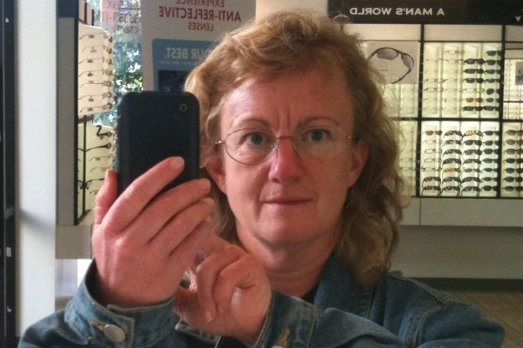
I’m now a member of the four-eyed fraternity.

I think my nose was red because I almost cried.

I wear my polycarbonate steel-rimmed cheaters as if they were portals into heaven, because they are. I spent an hour and a half simply strolling around, agog, with the whole world smacking me squarely in the eyeballs.

First thing I noticed is, everything has an edge. I had forgotten that; more precisely, I had taken it so much for granted when I could see, that I didn’t notice when it faded from view. It’s like the resolution on the world is turned up to infinity. (…It is, in case you’re wondering.)

The next humdinger was the warping effect. Looking through the lenses is hunky-dory, but it gets a bit weird at the very edges, and beyond the rims there is no correction at all — the world is a palid mess, off to the sides and around the bottom, right where my feet and hands are most of the time.

I twisted my head slowly around, expecting wa-wa noises and doppler effects to accompany the dizzying twist of light around the margins of my sight.

I stumbled until I figured out that my feet were just where I’d left them, and I’d have to treat them just the same as I did before the glasses.

I was sure the pavement was breathing.

I’ve never taken hallucinogens (apart from exhaustion, surgery and chronic pain). I have nothing against them, I just felt no need to. There might be a reason why: all it takes is a pair of new glasses and I’m nearly there.

I went down to the beach and saw two boys in red shirts. I was riveted. My ocular nerve itself was stained, the color was so intense. Did you know red is the color of healthy, living blood? Red so glorious and alive that it almost quivered was all over street signs, cars, carts — shirts.

When I noticed that, I noticed that all the colors were darker, richer, more alive. The dim shapes of the SF Peninsula across the Bay were purple, dark steel and deep amber. I had no idea. It was spectacular, in a tasteful and slightly intimidating palette.

Then the shapes and colors came together for me as I looked up at the sky. The clouds didn’t just drift stately by, they floated in a tender dance of radiant whites and silvers, caressing the air with fingertips trailing Chantilly lace and oxygen.

As I saw that, I realized that the movement of things had taken on new poetry. Palm trees shifted in the breeze with the distracted grace of mermaids playing with their hair. Every frond was alive and had a finger of wind wrapped around it. Who knew?

I walked until I could bear to focus on a path, could do head checks without headspins, and generally felt able to drive more safely. It was still a stunning trip home, and I got here just as the sun touched the top of the Marin Headlands and dropped out of sight, staining the sky with farewell colors. I said thanks to it, right out loud.

I’m told it will take another day to adapt, and by then I’ll know what my world will look like from now on. The hallucinatory wonder will probably be replaced by something I can talk about in public (“Didja see that? Looked like the Goodyear blimp!”) but, from my personal history as a visual junkie of ocular delight, this intense thrill of LOOKING will probably be mine again forever — or for as long as I keep my prescription up to date.

I’m pretty motivated. This cuts into my car-buying budget, but I do think it’s worth it. Being able to survive driving is not a bad idea at all.


Gluten exposure and recovery – Testing myself (silly me)

Gluten: really is that bad

Yesterday, I walked past the bread display at Trader Joe’s three times, breathing deeply. It smelled good, but not as good as I remembered. That was odd.

As I left the store about ten minutes later, my face turned beet-red and puffed up, my brain went into a deep white fog, colors faded to pastels, and the pain left my arms and foot briefly to return, five minutes later, to every joint in my body.

I was in full neurological gluten reaction. From inhaling near a bread display!

I did that in the first place because I just could not believe I was that sensitive to something I’ve eaten – and really enjoyed – all my life until last summer.

I know there’s a difference between the kind of food sensitivity where, if you avoid that food most of the time, you can tolerate a little now and then with no trouble; it’s about keeping the contact down below a certain minimum. Then there are the sensitivities where, if you eat a bit on a regular basis, your body retains an ability to deal with it and you don’t get a reaction (vegetarians who go back to eating meat are familiar with this – it takes awhile for the body to readjust.) And then there are the sensitivities that amount to true allergies, where any contact causes a reaction and the reaction can get intense enough to create a crisis.

That was an intense reaction. I’m not interested in seeing how much more my face can inflate.

It’s true that I used to eat wheat regularly and experienced nothing as dramatic. Would it be less dramatic if I ate a little on a regular basis?

Considering how quickly my health was slipping while I was eating gluten, and the fact that I continue to get sicker but I appreciate that it’s at a slower rate, I don’t see any real point in making the experiment.

Moreover, the literature on gluten allergies does not support that. The science indicates that, if your body has trouble with that particular protein, then the further you can stay from it, the better off you are.

I called my acupuncturonaturohomeopath. He gave me a recipe for gluten exposure, which is mostly about buffering the heck out of the molecule. I cobbled together a gluten exposure kit from my talk with him and my nursing background.

Gluten Exposure Kit:

–          2 Alka Seltzer tablets,
–          4 Tums,
–          500 mg body-friendly Vitamin C (not more),
–          Minimum of 5,000 mg activated carbon (could be 5 to 12 capsules, depending on bramd), to soak up any toxins in the gut. (More for eating it by accident, but it can’t hurt if you keep your bowels moving. I think it cleared a few things up, in fact.)

Just add water! And plenty of it.

Keep it in snack-baggies in key places: glove compartment, purse, first aid kit, desk drawer.

I turned normal Isy color almost immediately and then had a great, rippling burp every 10 minutes for about half an hour – feeling considerably more human each time. A day later, I’m not quite up to where I was before exposing myself, but am LOTS better than I’d expect to be, without that treatment. A reaction like that usually puts me down & out for about three days. Drooling Barbie doll. It’s awful.

Why so little Vitamin C? Doesn’t your body just wash away the excess?

Actually, if you take in excess Vitamin C, your body washes away all of it that it can still get hold of. 500 mg seems to be the sweet spot of maximum absorption and minimum waste. I used to megadose it, but with a frail system, that’s intolerable. 500 mg lets me take in and use every bit of it. If I need more, I just take it 3 times a day instead of twice.

Meditation and Reiki: really is that good

Today, I had to test myself on the value of my mental disciplines. I’m not sure why I’m testing myself so much; I doubt myself, perhaps. There is something surreal about what this disease does to you; I suppose the occasional reality check makes sense.

I didn’t meditate last night or this morning. The emotional surges are quite noticeable, but I’m well aware that they are what they are, which is not me.

After my gluten experiment, I feel no need to push this farther.

I’m now perfectly convinced that my relentless internal work does keep the rudder in line, the engine tuned, the brake pads operational, etc. Basically, it keeps CRPS from taking over my brain.

Dammit. I wanted to be normal again. Though, to quote the fabulous Stockard Channing in Practical Magic, “Darling, when are you going to learn that being normal is not a virtue? It rather denotes a lack of ambition!”

Friends & other forms of support

I have the help I need.
I can’t believe I’m writing those words, but I think it should be said. It won’t last forever and there are some rough spots, but let’s put this in perspective.
I can no longer wash dishes because I don’t have a water heater and the touch of cold water has become utterly unbearable. I got back from my shower this afternoon to find the dishes washed — and the galley & front step picked up, a wholly unlooked-for bonus.
My excellent friend R. was living on the smaller boat and helping me with the boat-fixing and laundry. He set up the sale of that boat (completed today) and is moving onto Voyager. He’s taking my old cubbyhole in the quarterberth and (thanks to him moving the tools and lumber out) I’m finally moving into the forepeak — that is, the room at the pointy end of the boat. For the first time in years, I have a bedroom door that closes.
After watching me constantly overestimate my capacities (which are constantly changing), he wisely introduced the Pinky Rule: if I’m not confident of being able to pick it up or handle it with just my pinky finger, I don’t pick it up or handle it.
This doesn’t render me the complete nonentity that pure helplessness does — which helpful men are wont to suggest, with the best of intentions. (Yeah, I’ll sit back and do nothing if you let me lop off yours before lopping off mine.)
But, like the Elbow Rule I gave kids who came into my ER with things stuck in their ears and noses (“only stick things in there if they’re bigger than your elbow”), it has a certain brainless simplicity that’s hard to argue with. It is turning out to be an excellent guideline. You’d be amazed at what I can lift with a pinky.
In the fullness of time, his busy life will carry him onwards. In the meantime, I have a wise and helpful friend who is making this chicane of my own life a whole lot smoother.
It’s difficult, but strangely peaceful, to learn to share my life without the inherent drama or forced weight of romance. I’m honored to have the opportunity and I could never have imagined a better partner to learn this dance with.
I have to say, if there’s one thing CRPS teaches, it’s that Hollywood doesn’t have the answers; real life is a lot more subtle and inflected.
There is more than one way to love someone. This one comes with clever solutions. Others come with passing kisses. Which would you choose — really?
I could even learn to live with the bits of loose tobacco that find their way into everything. He rolls his own, and the stuff is more intrusive than stray tape. But we’ll find a peaceful solution there, too. I’m absolutely sure of it.

Mind: more useful than you think

The power we have over our own minds is so often underestimated — or misinterpreted. The “you’re sick because you obviously don’t think the right thoughts” frame of mind makes me livid — it’s inexcusable.
But mental & emotional discipline is absolutely key to my function and survival. I know every moment I take to notice enjoyment, my brain gets a shot of pain-reducing endorphins and decision-improving dopamine. Every time I grab my brain when it wants to go to pain-lashed catastrophizing, and stop and do a reality check and look for good things, I know I’m cutting the pro-inflammatory cycle and reducing a pain-spiking dose of cortisol.
It’s bloody hard to remember to do at times, but practice makes perfect and I do get better the more I work at it.
… Speaking of neurotransmitters …
I’ve been meaning to write a primer on brain chemistry and neurotransmitters. It’s so convoluted I don’t know where to start. I’m thinking of setting up the table (or 3-d matrix!) of chemicals, body parts & functions, then writing about one segment of that at a time. As my Mom says, cut large tasks into bite-sized pieces, then go after them one by one.

Leaping

I’m finally putting a book together for publication. I sent the first part out to readers for feedback, coasting that post-prep phase of being certain it’s practically perfect and totally wonderful.
Unlike the delightfully daft P. G. Wodehouse, I only think my work is perfect for about half a day. Then, with no warning, everything changes: my heart hits my feet and I become certain that what I’ve just thrown out all naked and unprotected into the world, is nothing more than a puerile squall which will soon be riddled with well-deserved flaming arrows.
I’m eating too much sugar (for which I’ll pay the price in pain, don’t worry) and trying to settle down for a bit of brain-soothing meditation. Then a bit of light boatwork, maybe some laundry … and then a couple of hours on the next part of the book. Because what I think of it doesn’t matter.

Pertinent pain data

Here’s a little gem I found while cleaning up my hard drive. It’s from early last year…

===========

Each year, 80,000,000 (that’s eighty million) Americans seek professional care for pain.

Combine the numbers of Americans who seek care for diabetes, heart disease, or cancer — three much sexier issues — and they still aren’t as many as those who seek care for pain.

  • Pain is the cause of 25% of all sick days.
  • 50% of those with nonmalignant pain have considered suicide.  (That puts a real crimp in a family’s earning power.)

The consequent costs of lost productivity and reduced contribution to the tax base & economic flow, the social impact with concomitant loss of productivity, etc., has never been quantified (that I know of), although it certainly exists. With that large a base, and that wide a ripple-effect, it has to run into billions of dollars per year.


Each year, we spend $100,000,000,000 (that’s one hundred billion) on the direct costs of dealing — badly, expensively, and inconclusively — with pain.

That same amount could buy:

  • More than one-fifth of Medicare’s entire 2010 budget.
  • 60% of 2010 Federal spending on long-term unemployment (to which disability is the single biggest contributing factor, and pain is the single most common factor in disability.)
  • 5 weeks of current military spending, with two wars to prosecute and unprecedented numbers of walking wounded to care for.

===========

I had forgotten those facts.  I was geekishly delighted to find them. But it is definitely an answer in search of a question, and in this case the question is this: why the hell are we wasting so much money, time, life and energy on handling pain so badly??

There are profound cultural and economic reasons why the present, appalling system is still in place.  I’m not rich enough to face those reasons down so I’ll leave that as an exercise in logic for the reader: follow the money.  Who profits by this system?  Who funds it?  Who benefits, and of those who benefit, exactly how do they benefit? What do they give up or pay, in order to reap those benefits? What are the benefit/drawback profiles for the many different stakeholders in this system?

Pain patients are the least important stakeholders in this system, and that doesn’t seem right to me. I realize I may be biased.

Sorting out the answers could keep you busy for awhile, but once you figure out a couple of common denominators, it starts to fall into place very easily. It’s a bit disconcerting at first, though.

The point, as far as pain control is concerned, is this: we’re studying the wrong things about it, and we’re treating it the wrong way around.  There is no conclusive success path on the present trajectory, just increasingly expensive ways of mitigating these largely failed clinical (and economic) strategies.

And that’s today’s ray of sunshine! 🙂

References:
“Chronic Pain Fact Sheet”, http://www.cssa-inc.org/Articles/Chronic_Pain.htm (journalistic summary)
“AAPM Facts and Figures on Pain” , http://www.painmed.org/patient/facts.html (cited sources include the AMA, ADA, AHA, NIH)
THOMAS (Library of Congress online)
Office of ppp, http://www.whitehouse.gov/sites/default/files/omb/budget/fy2011

Reality check bounce

I got a settlement last year of $40,000. In 8 months, it’s nearly gone. I ran through my numbers and realized that all that money went into taking care of myself (clothes, for the first time in years; chiropracty, not covered by insurance; acupuncture, which should be covered but is sometimes improperly denied; $300/month in supplements which aren’t covered, but do let me function; $500/month for fresh whole food that keeps me from getting worse, more important now that I’m allergic to inexpensive foods like wheat, corn and rice; massage prepayments, for my masseur who was stuck abroad but is finally back & starting to work on me.) There were a couple of large one-offs, but they total the equivalent of the other 3-4 months of the year.
Although I’m certainly far better than I’d have been without it, I’m considerably sicker, weaker, sorer and more mentally impaired overall.
Meanwhile, insurance has — most improperly — denied any of the care that they are supposed to pay for and have covered in the past.
This disease is a bit like cancer in that, if treatment is delayed, you’re liable to lose ground, and there’s no realistic hope of regaining the ground you lose.
I’ve been pegging my hopes on federal disability (the dole, but a relatively generous dole) but even that will provide only one-third of what I need to live on. If I weren’t tending this illness — and could eat grains — it would be enough; that gives scale to these expenses. It takes 40k to support me for a year and the best I’ll get is 14.4k.
If I move ashore, which I’m trying to do (finishing up the boats and selling them being this winter/spring’s project), then it will be considerably less, because rent ashore is so high. However, it’s becoming impossible to function without hot running water, a bath and a laundry machine. Catch-22, or at least a choice of impossible situations.
If I could get a year’s funding for the intensive health work I’d hoped to do this year, I’d stand a chance of regaining enough ground to work and earn. I don’t see how to make that happen. I may be lacking in imagination.
Anyway, I’m beginning to wonder if it makes sense to keep working on figuring out how to mend. I’ve contemplated the babbling fool I’ll become on the present trajectory without supplements and so forth: pride and dignity aside, there’s no realistic way to bear it — the waking with a muddle in my mind, the increasing helplessness and isolation as my friends get more and more frustrated with dealing with me, the waxing helplessness in the face of the most basic tasks like budgets and shopping, the inability to make decisions on the basis of imperfect understanding, the constant wounding of my amour propre as the patronizing tones and “there, there” remarks continue to mount. The startling shafts of clarity when I see just how stupid I’ve been, and knowing I’ll soon fall into the fog again. It’s simply unbearable.
Had I grown up unintelligent, I’d have the skills to manage life with fuzzy brains, but I really don’t. It’s desperately confusing and the constant humiliation doesn’t help.
When I can just sit down and write, focusing on the one thing for a stretch of time, I do fine. (I hope that’s obvious.) The hopping about from topic to topic, without having time to sink into one and pull up the mental flash cards, is becoming impossible. And that’s what life requires.
My mind is thixotrophic: quick moves bounce right off; it takes time and gentle pressure for me to get in.
Though without the rigorously pure food and costly supplements, that focused writing-mind doesn’t work either. It can’t even start.
I read up on Woolf and Hemingway some years ago. I felt the usual poignant poetic feelings about their deaths, gilding over a sneaking suspicion that they’d copped out. But, as my own mental life becomes ever more fraught, I become ever more awed at the strength, grace and nerve each brought to their final stages. The words that sounded just a little bit like whining or wounded vainglory, were really a symptom of the inadequacy of language in the face of an assault on one’s core that defies meaning itself, let alone language’s ability to convey meaning.
I need more options. I need real care. I’m out of ideas.
I liked being happy & relieved last summer. I could do with more of that!

Quantum physics and the divine plan

Post on one of my CRPS groups: “Everything that happens to me is part of the plan for my good.”

The responses to this seemed to come through a blissed-out narcotic haze. I’m afraid I administered the verbal Narcan. Surprised? 🙂

I’ve counseled too many rape victims and abuse survivors, and treated far too many accident victims, to hold the belief that bad things happen to us as part of a greater plan — let alone that it’s for our own good.

Bad things happen, full stop. As living humans, we take our chances in the world; sometimes it works out for us, sometimes it doesn’t.

If we grow and learn and become stronger, then it’s because of how we chose to deal with it and what we could bring to bear — not because some faceless force thought it would be interesting and valuable to cause us so much agony, because — of all counter-logical reasons — it loves us.

I aim to find a way to become free of CRPS. Nevertheless, I perceive that the skills, the inward peace, the strength, the poise I’ve developed in coping with these unimaginable challenges over so many years, have certainly made me something I never would’ve reached without it.

I thoroughly honor the brilliance, creativity and strength that my comrades with CRPS bring to their lives. It’s breathtaking to belong to such a select group — although the cost of membership is a little high.

It’s a special disease: agonizing, rare, destructive, poorly researched, underfunded, extremely long-lasting, and — most special of all — widely believed to be hysterical in nature. The challenges it poses are distinctive and seemingly endless.

After eight years with it, I’m proud of myself and I even care about myself, even though I can accomplish so much less than before. 8 1/2 years ago, I felt that I had to earn my right to even breathe.

The credit for all that growth goes to innate qualities, my excellent friends (some of whom I’m related to), and a handful of gifted clinicians.

The causal lines are very clear: hard work, relentless study, determination, safe places to stay, loving words, wise ideas, needed gifts, perfect loans, valid diagnoses, key treatments — these are what gave me strength and let me grow and learn.

It’s been painstakingly pointed out to me that I have the friends I’ve earned. I’m not sure any mortal deserves such friends as mine, but I’m glad of them all the same.

Cold chronic CRPS and all that goes with it… Part of a plan? What plan? Whose bloody plan? I want the bastard’s address! And so does my army.

Plan is a four letter word.

I will never forget the days and nights and years of desperate prayer, with nothing but silence coming back. The goodness, the help, the peace, these all came from other people and my own work. The natural results of many extraordinary efforts.

Inflicting this kind of agony and loss “for your own good” would be absolutely unthinkable for a conscious, caring being of any kind. Moreover, to have the power of withholding destruction and pain, and to fail to do so, is quintessentially evil.

I’m a theist, but I don’t see deity as a psychopathic abuser — as something that would clobber me for the fun of it, or be persuaded to stop the beating if I figured out the right things to say.

Moreover, I can really see why people would be atheists. Without quantum physics to make sense of things, deity is an indefensible concept. With quantum physics, I’m certain of three things:

We ARE a permanent part of something greater. It IS aware, omniscient, and ubiquitous.

Its job is not to screw things up, but to notice, communicate, and keep flowing. That’s it.

Nothing else agrees with the evidence.

It’s not intrusive, manipulative or evil. It can’t be, because it doesn’t possess the mechanisms.

Not to kill the buzz or anything 🙂

Whatever belief system works for you, use it!  Just remember, there’s more than one path to personal salvation — or whatever your metaphor is — but very few of them get discussed, because of the ancient hegemony that a few groups have held over religious and spiritual expression. Let’s open the world up a bit.

All too often, the power of human connection is mentioned only as an afterthought. In practice, I’ve found nothing more important when the chips are down.

I no longer pray for help. I ask.

Because beliefs vary, it’s important to give a voice to those who find the traditional idea of our helpless subjection to a greater will to be the opposite of comforting. We don’t get much airtime, but we still find peace, strength and grace.

Just not in that particular idea. Thank God.

Questing for a strange beast — a laptop I can use

I’m shopping for a laptop. This is not a trivial task. Here’s why:

– It has to be light enough for me to handle easily.  That right there is a huge barrier. I’m looking at 3 pounds or less — preferrably less.

– It has to be fast enough and strong enough to handle my dictation software, Dragon NaturallySpeaking, while running Windows Office plus whatever provides access to what I’m writing about — the internet, media programs, etc.

You can see the Dragon hardware requirements here:
http://shop.nuance.com/store/nuanceus/en_US/pd/productID.202412500
(click the Requirements tab to see the hardware specs)

I find that, in practice, it’s best to exceed their recommendations by 50-100%, in order to be able to run Dragon alongside the other stuff.  Windows writes crap code, meaning it’s cumbersome, demanding, redundant and sluggish; the same features, if written on a well-designed and well-described codebase, should take up about 1/80th the size of Windows’ codebase.  The damn thing is a monster.

But it’s the only OS that Dragon Professional handles well. Dragon was written to run specifically on Windows, so if I’m doing my budget I have to use Excel, and if I’m writing I’d better be using Word, or all sorts of wretched things happen.

I dream of the day when everyone takes 501 (adaptive-software) compliance really seriously. I dream of the day when they’ll hold off on production until they fix a bug that interferes with Dragon compatibility.  Mind you, I dream of a day when Dragon has real competition at the Professional SKU level.  I’ve tried the lower levels and, yup, all sorts of wretched things happen. (I had no idea my voice was so odd.)

Moreover, I’ve gotten my heart set on solid-state drives, after trashing my much-loved Acer Travelmate (2.8#!) by dropping it from a height of 3 feet.  $1,200 later, I had my data, but no hard drive.  Solid state drives are not bullet proof by any means, but their physical mechanism is totally different and it takes a lot more effort to trash them. As I am getting clumsier, this is getting more and more important.  I’ve filled up a 150 MB drive (despite considerable pruning, keeping music and books on thumb drives) and have nowhere to go, so it will have to be a rather large hard drive.

Fewmets: How I Know when I’m Getting Close

Between my lifting and handling limitations, and the hardware required of a system that could serve my purposes, we’re talking about a fairly exotic beast:

– 3# or less in total weight
– Multi-core CPU with a top speed of 3.5 GHz
– Cache size of 3 MB or better
– RAM of 6-8 MB (8 is better)
– 256 SSD hard drive
– A fast connector, like USB 3.0, to make external drives reasonable to use.
– Windows 7 Professional OS (Vista is against my religion)
– Insurance or warranty covering accidental damage, because it will get accidentally damaged and this is cheaper than a new laptop.

The hunt for such a strange creature is one heck of a challenge.  I feel like Sir Pellinore, King Arthur’s great-uncle, charging after the terrible Beast Glatisant, wearing shiny but battered armor and trailing a puppy on a string.

Of course, I feel the same way when looking for a cure, only more so.

I run into a similar problem with the cure as with the computer: affordability. You’ll see why.

The Long List

I’ve looked at Asus, Acer, Lenovo/IBM, Samsung’s 9 series, Sony, Toshiba, and even Mac, despite the obvious software issues. I have objections to how Dell and HP handle their chipsets and the Windows registry, in that order, so I don’t use them. Fujitsu makes nothing this light.

Neither the delicious ZenBook and MacAir, nor the workmanlike Thinkpads and Ideapads have the chip speed or RAM, more’s the pity.

Besides, though I like Mac, I can’t run my programs on it, and years of experience have taught me that a virtual Windows machine is just not the same as an actual Windows machine.

The Short List

I’ve found exactly two machines that come close to meeting my criteria:

Sony Vaio Z:
$3,100 as spec’d.

Benefits: 2.6#!
Drawbacks: DVD drive and USB 3 in port replicator.

Toshiba Portege R830:
$2,700 as spec’d.

Benefits: Has a built-in DVD drive!
Drawbacks: 3#.  (Due, no doubt, to the drive.)

Conclusions (so far)

The .4# difference is huge to me. It may well be worth the extra $400 (wherever they come from) because of the huge difference in grab-ability. Also, the extra ports on the Vaio’s port replicator are worth a lot.

So I’m leaning towards the Vaio on its features, but if I have to make the choice solely on price, I’ll go for the Toshiba.

In either case, the only thing to do with a really expensive laptop is to make it look like a total POS. So I’m thinking of a skin that will not only cover the brand name but look like a tire tread or barbed wire or something that growls through the hole in its lip, “Don’t touch me.”

Psychological tactics work, because crooks — especially amateurs — are ever so human. …And that’s another random life-lesson I learned from working in the ER.

Donations would be lovely, of course, but I hardly expect them. For those saintly people who want to contribute to this quest (and of course the quest for a cure), there’s now a button in the blue panel on the lower right for the purpose. May all good things come to you.

LINKS
Both of the lovely monster images were snagged from this blog:
http://archideaconalwhitterings.blogspot.com/2010/03/whitterings-april-2010.html

I got the tire tread image from this blog offering free designs:
http://creatingthehive.com/blog-post/143186/tires-amp-treads-free-mds-punches