The sheer activity of Epsom salt baths

Taking a day to rest has been just the thing.Now here’s what I mean when I say, “I took an Epsom bath…” And I’m sorry to say that getting images loaded will have to wait for another day, so use your imaginations for now 🙂

Nearly all motels have a bathtub. I consider this essential. They’re small, but adequate. With a swipe of cleanser and a quick rinse, I’ve found all of them usable so far.

I should add that baths are not essential to Epsom treatment for CRPS. Here are a couple of tricks I’ve used, with a degree of success which not only included the targeted limb but also improved CRPS for me generally:

  • I’ve immersed my arms in an Epsom solution in a sink or basin. This is great when I’m not up to a bath, but I’m too chilly to sit around with wet limbs. I lean into the basin, with sleeves all the way up, and slosh and slosh and just soak it up. I’ve found that not only does it help my arms, but the relief goes up through my shoulders, down my back, and even my feet feel better after doing this with my arms for 15 minutes or so, 20 minutes if I can stand there that long.
  • When the dysautonomia is being REALLY bratty, I sit with a basin of Epsom solution and a tea towel nearby, and simply wipe the bothersome limb, stroking from healthy area to painful/spasming/misbehaving area, with the same mental chants I describe below…

Both of these strategies work extremely well. Many of us are accustomed to sink baths, and it’s no harder than that — easier, because rinsing is optional.

Temperature – the first consideration

People with chronic CRPS have two substantial issues that affect bath temperature: wonky signals to the circulatory system, and screwy temperature regulation.

Hot baths are a thing of the past. They aren’t good to me any more.

I like a bath that’s just a few degrees warmer than the temperature that feels like nothing on your skin. That seems to provide the best results.

I find chlorine to be counterproductive, so I let it go first. I run the tub a little hot, with the fan on, and leave the room for 5-10 minutes until most of the chlorine dissipates. (This really works.) Then I adjust the temperature.

MgSO4, my ally

I’ve gone up to using about 2 pounds of Epsom salt for one bath. That’s about a third of the 6 pound bag, costing between $3.50 and $6.50, depending on where you buy them. I used to use a cup or two, but I really get better results with a stronger solution.

The process

Remember, this is about re-regulating and re-normalizing, so leaping into the bath and getting busy is the wrong thing to do!

Going one step at a time and persuading my body to stabilize at each point is how the process works.

So I take a couple minutes to just sink into it, let the mottling pattern on my lower body and arms fade, and get some circulation going to my overworked skin.

I brush over all my limbs with my hands, introducing them to the idea of tactile input, and how that should go. This is an important first step, because the touch of a hand wet with Epsom solution is softer than silk, and it’s important to start with the most positive possible sensations. This helps de-alarm your central nervous system as well as re-acquaint your skin with the world. This is supposed to start, and end, as a definitely positive experience. In between, there might be some work.

When working on such deep and challenging health issues, it’s important to set yourself up for success whenever possible!

Back to our bath.

Nearly all motels have washcloths with a nice scrubby texture. The soft kind that you get in the bath and body store feels to me like turgid gelatin, soaking up a lot of soap and doing very little in the way of exfoliation – which is what I used to use washcloths for.

Now, it’s all about renormalization – or, to use the standard allopathic medical term, desensitization.

Leave it to medicine to make returning to normal sound like something bad!

I start with the soles of my feet. If yours are too sensitive to touch, start where you can touch. Remember, set your body up for success. This second pass distinguishes between contact on the surface and underneath, which are two different sensory realms. The first thing I do is go underneath, to the tissues below the surface of my feet, in a gentle and encouraging way.

I hold the washcloth in my open hand, using a big, squishing gesture.

IMAGE:

With that big gesture, and a certain amount of gentle elbow grease, I reassure the soles of my feet that they’re doing fine. Once they start sending appropriate signals of touch and motion, I work around the foot and up my ankles.

Using the washcloth in one hand, and nothing in the other, I alternate strokes, soothing the frazzled burning sensation left by the terrycloth with the silkiness of Epsom water in my palm. The frazzled sensation eases off gradually.

I don’t just notice what the sensations are from my skin, I tell that part of me what the sensations ought to be:
It’s just terrycloth. There’s no burning here. It’s just terrycloth. It should feel pleasantly scrubby, nothing more.

Every now and then, I move the washcloth to a part of my body that still thinks terrycloth is just terrycloth, and give myself a brief demonstration. That seems to help.

Once the signals start calming down a bit, I can go deeper. My calves take a little extra care. I start on the left, and it feels like a hunk of plastic. I tell it to calm down – in firm, maternal, authoritative tones – and go squish my right calf instead. When my right calf and shin are sending nice, normal signals of terrycloth texture in motion, I go back to my left calf, reassuring it that you can be normal, you know perfectly well what that feels like, there you go, you can do it.

Firm, yet loving, maternal tones are hard to resist. It’s a great re-progamming tool for bringing your brain closer to normal.

IMAGE:

Eventually, my left calf loses that awful dense feeling and starts to feel like a leg again.

The next step is to address the surface sensations on up the rest of me.

I coach my skin not to send sparkling messages of hot and cold where the washcloth goes, but just the sensation of terrycloth rubbing moderately over skin, and that that’s okay and the right thing to do.

I work my way up my legs, paying attention to the major nerve path and the major muscle groups (always with big, squishy gestures, not too challenging, but very tissue-mobilizing.)

I go back to my knees a couple of times, where the main effort is to mobilize the circulation and draw away the swelling.

I work on my low back and hips until the inclination to spasm turns off. I tell them to take it easy, just let go, you’ll know when it’s time to contract, now settle down.

IMAGE:

Then I lean forward to dip my arms and work on them, with somewhat gentler gestures. Since I can’t remember just what normal sensation is there, I look for overall warmth and better mobility in my forearms, with touch signals as close to normal as we can get.

IMAGE:

Part of the idea, obviously, is not only to re-normalize my skin as much as possible, but to improve surface circulation, so that as much magnesium as possible can be taken up by the troubled tissues.

Once I have squishy-massaged my arms from fingertips to collarbones, I do a quick scrubby pass on my back (where I used to get symptoms, and don’t want anymore)…

And then I get the Calgon experience, lying back in a warm bath, feeling alive and remarkably well, with nothing to do but enjoy myself until the water cools.

IMAGE:

Speaking to my brain in a way it can’t ignore

Health professionals dress it up in fancy words, but this is what brain plasticity boils down to: our brains take in messages that are so simple and so primal they slide in below the level of words. The way to push back against that plasticity and make it go the way you want, is to address your brain in ways that are simple, primal, and slide in below the level of words – even if you use words at the time. Even in spoken exchanges, remember, 90% of the communication is nonverbal. This is true when we talk to ourselves, as well as others.

With enough persistence, and a persuasive enough message, the brain can be re-reshaped.

Since so much of CRPS’s maintenance relates to the brain having been reshaped in a distorted way, part of the task is to reshape it into a healthier structure.

Dr. S. V. Ramachandran’s work on mirror therapy and lens therapy for people with amputations and other limb pain problems led the way in brain plasticity work, highlighting the very powerful (and nonverbal) effect of visual input on brain remapping.

There are several other ways to do this, including forms of brain retraining such as hypnosis, biofeedback, meditation, specific and clear visualization of painless movement (which, if done clearly enough, can cause brain activity nearly identical to the real thing) – and, naturally, using tones of parental imperative with your own sensations.

Speaking to my body in tones of loving maternal authority, I find, is remarkably persuasive.

Why I start deep and work my way out

I find that it’s often easier to start with deep tissues and then address the surface issues. It sounds weird, but it’s often easier for me to get past the surface sensations when I’m reaching into the muscle and fascial layers, and then, when the deeper tissues are responsive and the blood is flowing through them again, it’s a lot easier and more productive to work out the surface sensations.

Conversely, if I start with the surface sensations, I may not get far enough to be able to dig in to release and mobilize the deeper tissues. Getting halfway through surface pain leaves my body a lot more sensitive to intrusions than just charging in and starting with the deeper tissues.

On the other hand, there are times when the surface simply has to be dealt with, or there’s no chance of getting to the deeper tissues. My left calf was like that when I first wrote this, though it has improved a lot since then.

YMMV. Each of us is different. That is part of what makes CRPS so interesting, and at the same time so darn hard to treat.

Physical issues

In mobilizing tissue, the washcloth provides traction against my skin, so I hardly have to use any hand strength at all. This is important, because if I had to rely on my grip to get hold of the tissues, this would be totally out of the question.

The water neutralizes a lot of gravity, so it’s easier to control a limb you’re massaging. I can squish the muscles with either one hand or two, boof them against the bone, and jostle them around.

I can mobilize a lot of tissue with very little effort, if I use a washcloth in the bath.

I figure I should spend at least a solid 20 min. in the tub, to absorb as much as possible of the magnesium, the warmth, and the chance to melt all the little knots out of my brain. It’s not a bad prescription. Not bad at all. There is always considerable improvement, and sometimes it makes me feel almost completely well.

Not much scenery after dark

Usually, or at least so far, I’ve ended each day with some coherent sense of things. Not today!

Perhaps that’s because I spent several hours in the middle of it, struggling with a terrible wireless signal and time sensitive need to book a flight. My sweetie is flying out to meet me and help with the rest of the drive. How cool is that?

View Larger Map
The last-minute logistics have been horrible, but so far, with much persistence and lateral thinking, things are shaking out. Finding a safe place for his dog for a week was probably the most worrisome, but an online search turned up Canine Energetics.

I spoke with the owner, Sean, who struck me as extremely decent, sensible and accommodating. The facilities sounds like dog heaven. I have every faith in her ability to play well with others, and she’ll probably have as good a time as she can away from her human.

I pushed on for an hour past dark, and realized that somehow I’m almost (not quite) a whole day ahead of myself. This means I have time to pull the car apart, make it easier to manage getting what I need, and clear the entire front seat (including the foot well) for another person. Not a trivial task!

I also have a ton of paperwork to catch up on: finding a suitable ISP, nailing down the design for the website, and filing the paperwork for registering “CRPS: Art & Spirit” as a tax-exempt nonprofit. I’ve gotten much-needed logistical help, so at this point, the next tasks are approachable. I’m grateful for all the help I get, and the help I get for this project is more important still. We’re going to have a “gratitude” page, where we can publicly thank those who will let us, for the help they give 🙂

Now, all I need is a web geek who’s reasonably up-to-date on the technology and knows how to design an accessible page. Suggestions…?

Southern Illinois was exquisite. It’s so pretty and so shapely that I can’t wait until Hollywood discovers it as a shooting spot. I knew I couldn’t do justice to the shape of the land, so I cheated:

Somehow, at least along Interstate 70, Missouri isn’t quite as nice, and neither was Indiana. There’s definitely a difference.

Y’know, I feel a lot safer, noodling around by myself, than I did in the coastal Northeast or pretty much anywhere in California. I still keep my word to my sweetie, though: locking all the locks, no hitch-hikers, and — it still cracks me up, but I do it — be careful who I talk to. There’s so much more to human nature than what’s on the surface.

Off for Epsom bath. Incidentally, these are not a “Calgon, take me away!” kind of bath. But I think I’ll talk about that another time.

Re-learning how to drive

I’m either half a day ahead of schedule or half a day behind, and I’m honestly not sure which. It’s roughly another 5 days to Denver, and with my sweetie’s troubles slowly and expensively resolving, it’s probably best not to try to rush, but to let things unfold.

Mind you, an hour’s reiki this morning might be helping me think that way.

Badly as I want to be there already, snuggled up to him and brainstorming, here I am …

View Larger Map
Between Richmond and Centerville, Indiana.

My room has a fog of mildew which stopped me on entering, but I paid before asking to see the room, so I’m stuck. I can’t remember where the AC power cord is for the car’s air filter, though I may have tossed it in a burst of mindless efficiency before leaving.

The window is wide open while I do laundry on the other side of town, so we’ll see if that makes enough difference. If I wake up brain-dead, I’m sure you’ll hear about it.

Despite good energy and good progress, I decided to reef it in and stop early tonight — largely because I’m out of long-sleeved shirts, and needed to save arm-time for dealing with that.

I stopped here, precisely, because I had mail forwarded here to me at General Delivery — a system that actually seems to work. It included my permanent Massachusetts driver’s  license (which might be handy after the temporary one expires) and a really lovely card from one of the really lovely people I’ve met on this trip. A wonderful cherry on top of a rather good day.

It occurred to me that I haven’t discussed  my accommodative strategies much. Here are a few things I’ve done, redone, and learned on the way:

Grabbing the wheel

Those of you who know CRPS well know that vibration is absolute hell, and a steering wheel is a big vibrating thing that’s made to press against the weakest, most pain-frazzled tendons in my entire body. So that had to be dealt with.

I’ve learned, from all my adventures with tools when I lived on the boat, that no amount of padding will make up for harsh hardware.  So buying a vehicle with the lowest possible level of wheel-vibration in the first place was a major consideration.

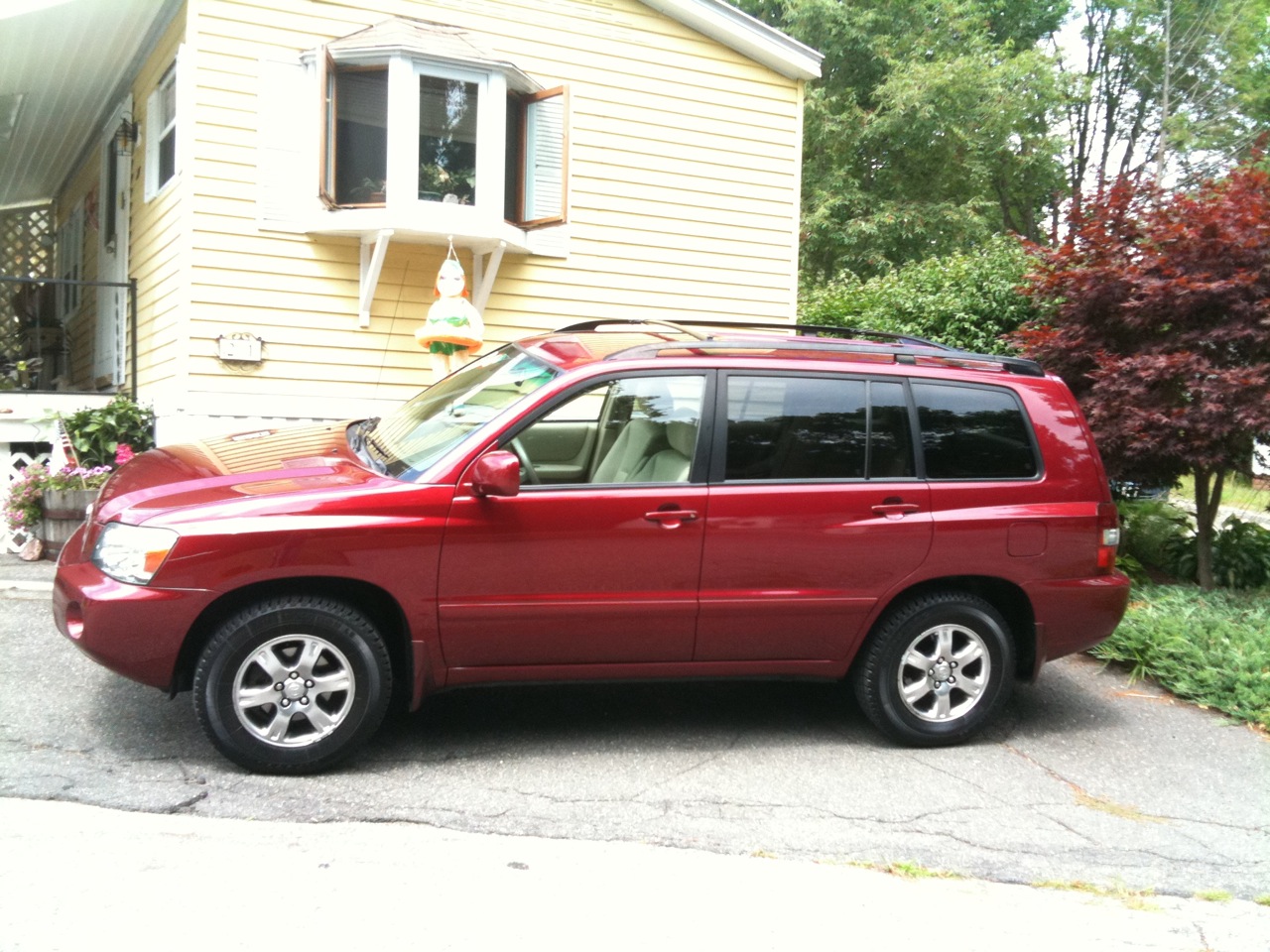
My car, Henrietta, is a Toyota truck:


… but it’s built on a Camry base:

This means it has a much more forgiving frame than trucks and truck-mounted SUVs (though it can still tow 5,000 pounds!) and it handles the road very gracefully.

I’ve learned through many years of athletics that gel provides the cushioning my body likes best. So that was the next thing to go on:

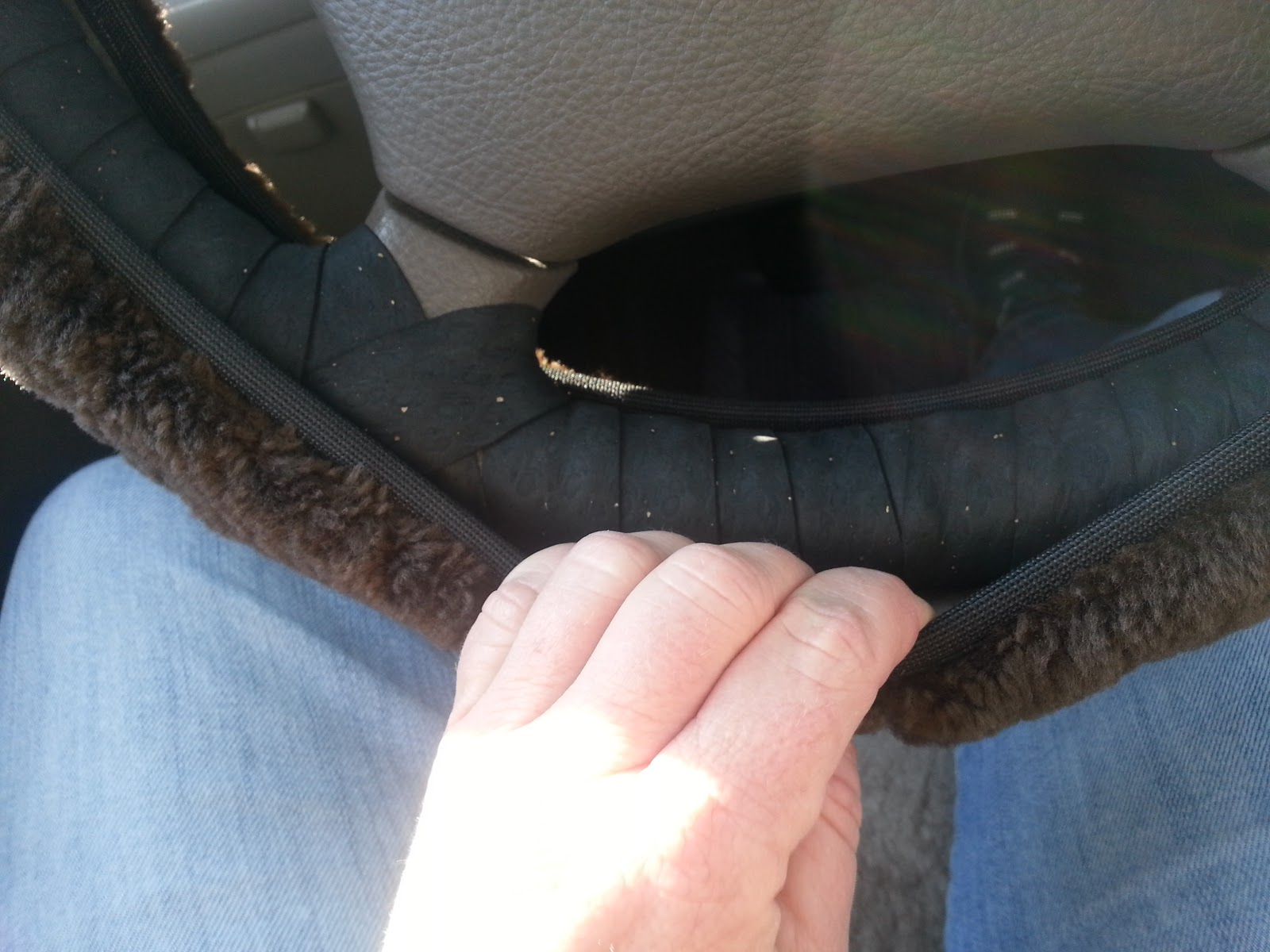
That’s extra-thick gel-padded bicycle wrap on the steering wheel.

(And, incidentally, that’s the driving grip I use half the time. Holding the cover, rather than the wheel, nearly eliminates vibration altogether, and it’s very easy to grab the wheel if I need to dodge.)

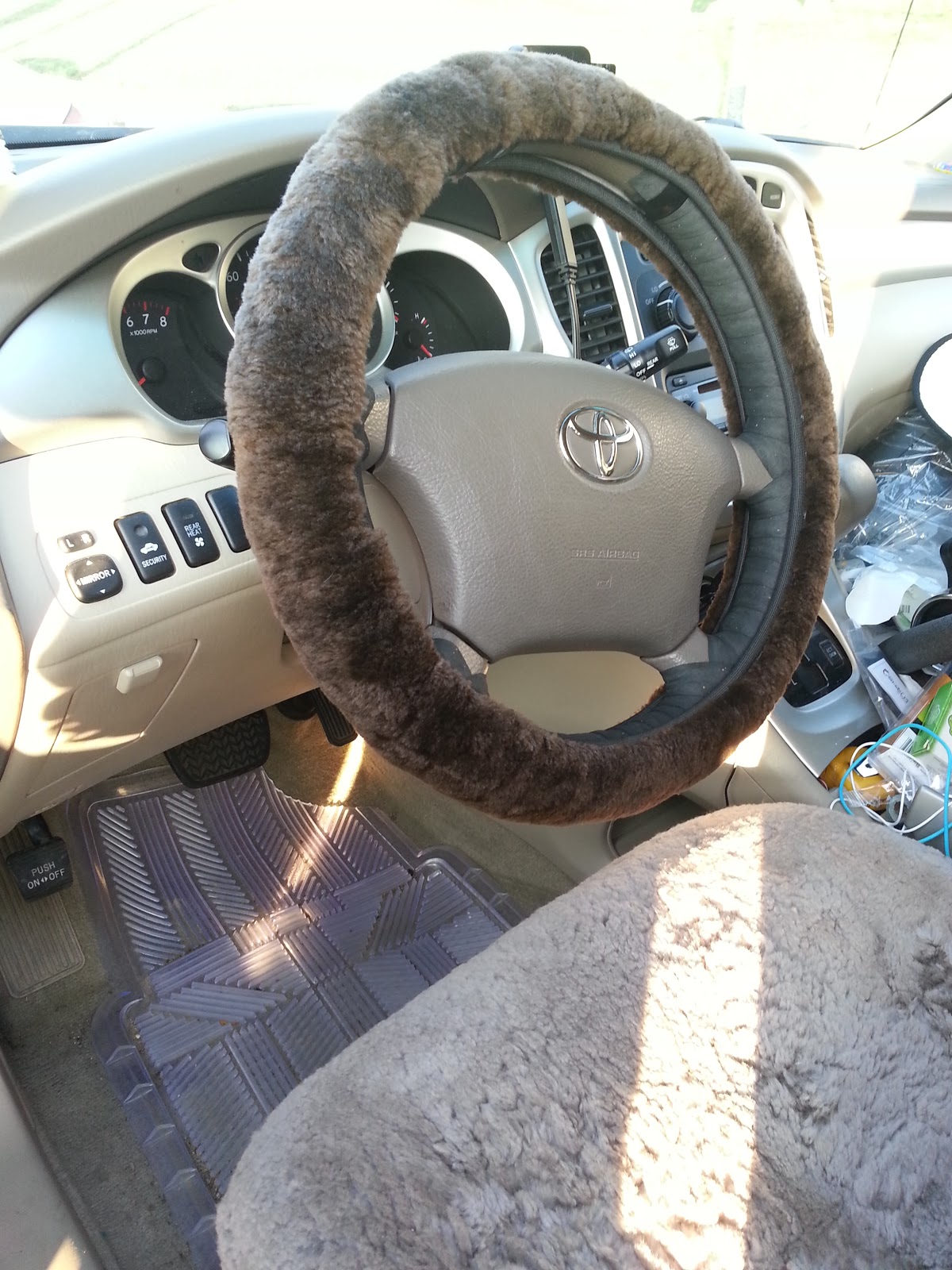
Years of nursing and my own experiences with increasingly, um… responsive skin have made me a HUGE fan of good wool. It breathes even when wet, pads even when squashed, and if you keep your eyes open, you can find wholesale prices on new sheepskin (– and get sturdy sweaters of cashmere, merino, or alpaca for $5-10 at the right Goodwill stores, but that’s another post.)

In Massachussetts, I live near the Sheepskin Outpost on the Mohawk Trail, and I lucked into a sale there. That got me:

– The steering wheel cover, to provide more padding and keep my hands off hot rubber;

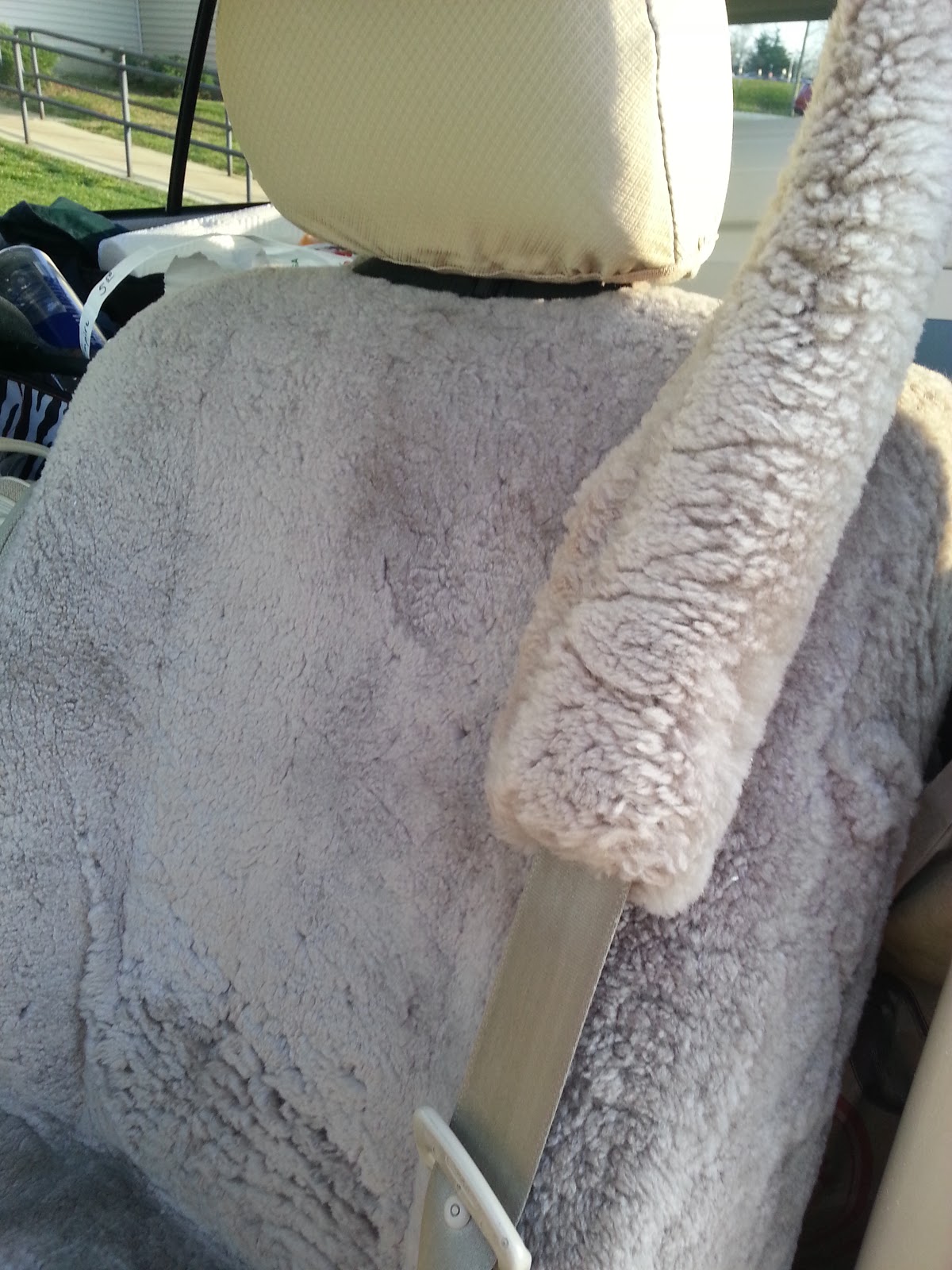
– The seatbelt cover, to keep the edge of the belt off me and keep the skin on my shoulder and chest aired;

– The seat covers, which I wound up getting for half of wholesale, because they’d just bought the stock of a company that went out of business and had more inventory than they could afford to store.


Boy, did that ever work out for me!

Covering my can

This is about traveling with disability, so here’s some physical reality.

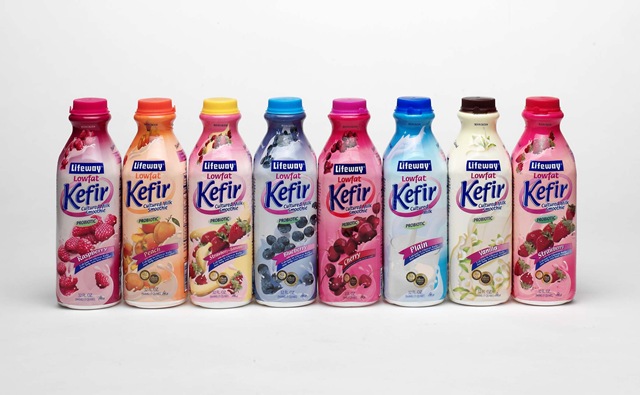
I started megadeath antibiotics a few days ago, and the first symptoms are making themselves felt. Kefir just isn’t enough to save my skin.

My very favorite brand. I’m getting nothing for saying so, but I’d like that to change 🙂

Also, I’ve really been having trouble getting the circulation in my left leg to behave.

Today, in the middle of my day, I had a brainstorm that would minimize the reduction of circulation to my legs and maximize airflow to my antibiotic-ravaged sit-down.

I swapped my underpants for my white silk long-john bottoms instead, and decided I could just wash out the silk each evening and hang-dry it overnight. Besides, the extra layer kept the chill from cutting into my leg every time I opened the door.

Tonight at 6:22 pm, my left leg is feeling better than it did at 2:22 pm, when I made the switch — despite a couple of hours in the car and far too little activity. Who knew such a little bit of material could make such a difference?

And I’m happy and relieved to say that the parts my undies have to cover are doing better, too. I had no idea that white silk was so healthful.

No more elastic around these legs. It’s too bad, because I’d just stocked up on undies. But of course, I got them on sale. It could have been worse.

Gratuitous toilet humor…

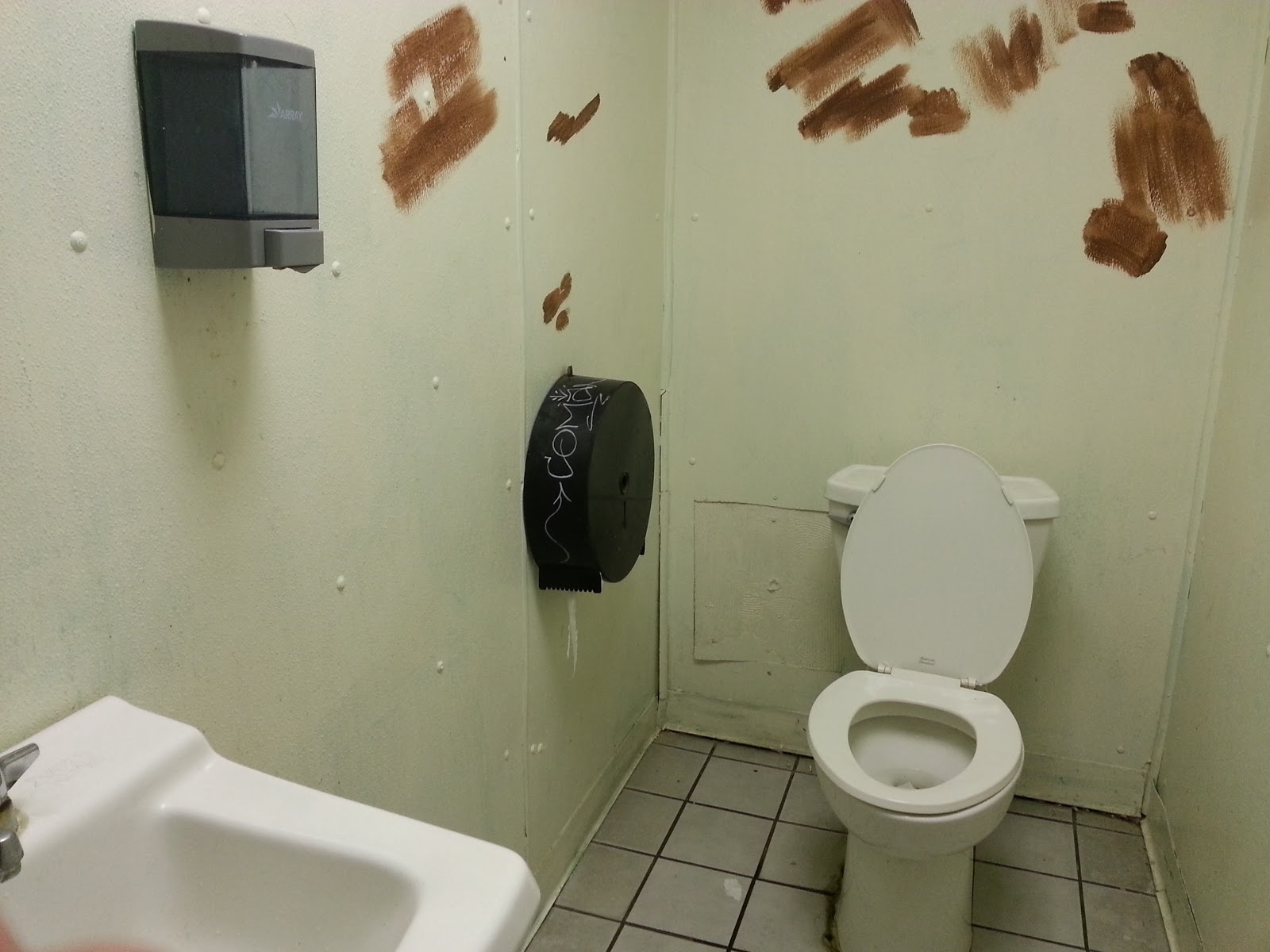
I stopped in a gas station that had the kind of bathroom I grew up thinking of as a gas station bathroom. It’s not chair-accessible (in fact, there’s hardly room for a standing person to turn around in) and the tile might be original with the building.

However, in a totally novel approach to graffiti, this gas station found a new use for the wrongest possible shade of brown paint:

There’s really nothing to add, is there?

Into hot water.. then cold water.. then hot..

This is a bit odd and I haven’t heard anyone else with CRPS trying it, so I’m just tossing it out to show how weird things can be…

I’m cold intolerant. Absolutely can’t handle it. My body locks up and the pain goes all-body and through the roof.

Can’t take too much heat either; makes me weak and foggy, and can trigger POTS symptoms (in my case, that’s mostly nausea, bloating, dizziness, weakness, lethargy.)

My body temp drops so much when I sleep that I’m cold to the touch. A housemate woke me once when she touched me affectionately as I slept, then found I was so cold that she shook me awake — she wanted to be sure I wasn’t dying. That’s how cold I was.

My first massage therapist, a good friend of mine, insisted I try the hot/cold plunges at Harbin Hot Springs, which happen to be 47 F and 118 F.


I told him that was completely insane and did I need to explain dysautonomia again?

He kept at it, and I finally went there for a few days. I was in bad shape, one of those times when I think I’m not going to live for long because there’s so much that’s so wrong and there’s so little energy left. So there wasn’t much to lose, as far as I was concerned…

At least it’s not an ugly place.

Took two and a half days to work up to it, starting with cool bath/dry sauna, working up to going between intermediate baths, dipping in the really hot for moments, splashing arms then trunk with cold. Eventually I could go for the full plunge. I did 2 full exchanges, and was all right. In fact, I was pretty good. Felt crisp, not chewed.

I went back later and did at least 5 or 6 more (I lost count, truthfully.) By then, I could FEEL my hands and feet as I couldn’t remember having felt them before: exactly where and what and how they were — which was, keenly alive.

I had no pain, no pain anywhere at all, everything was the right color — only a much better shade than I’d seen in years, and my head felt as sparkly as a diamond.

I don’t like to sound over the top, but it was such a feeling of absolute, perfect, poised and healthy ecstasy that words simply fail in the face of that experience.

Being totally pain-free makes us CRPSers high, but this was more than that. Everything worked, from the tiniest microvessel to the least drop of chemical messenger. My cells sang with the bouyant joy of it.

I copyrighted this image… kinda cool. Think I’ll use it as a logo.

I went out to the main pool, actually enjoying the cold roughness of the path on my unharmed feet, and drifted into the “quiet zone”, that is, the temperate pool. Although it’s not etiquette to contact strangers there, an awful lot of people turned to look at me and smile the sweetest smiles. I can only imagine how radiantly happy I looked. I felt that I was glowing brightly enough to light the whole space.

According to my online research, there aren’t many hot springs that have contrast baths at all, let alone to that extreme degree. If they do, they’re awfully coy about it…

I have hopes of a particular roadside hot spring at Yellowstone National Park that runs into a chilly stream. In winter, which it nearly is, that could be worth trying, though it would take a bit of effort.

I’m not sure how slippery it is, what the currents are like, or what sort of work is involved to get from hot to cold. I do have to be mindful of physical damage, until I can really find that cure I’m convinced is just around some corner on my winding path.

We shall see what comes up. I know this is something to add to the repertoire, one of the ingredients to combine into a cure, or something like it.

One more piece of the puzzle… a twitchy, morphing, complex, incredibly irritating puzzle, but one I’m rather stuck with until further notice.

Dietary limitations? Where? I’m too busy feasting, thank you

Dietary limitations are a recurring theme in my life — and that of many who read this.  There’s little self-pity left in me for it, because my world of food has opened up in magnificent new ways. I hardly miss wheat, for instance, because I have so many other wonderful things to wrap my teeth around.

This attitude is essential to a bearable life.  Admittedly, it’s an adjustment to learn not to think in terms of “not“… Wait, let me rephrase that…

Since it’s hard to get started with food changes, and my energy and attention are limited, it helps to have people show me alternatives.The past decade or so has been filled with people who do things — like eating — differently from how I did, and that has been a huge help. I’ve mentioned the Brain Food shakes (once or twice) but the blender is only one of the arrows I have in my dietary quiver.

I’ve also had the advantage of living in “foodie” areas where it’s not that hard to find alternative sources of nutrition:

– heritage and heirloom strains of vegetables abound (a good way to reduce exposure to problematic proteins is to eat unmodified strains),

– gluten-free mixes of several different brands let me figure out what works for me (I do best with sorghum/tapioca based blends), and

– it’s easy to find foreign foods like quinoa (a quick-cooking grain which is extremely high in protein and tastes fantastic with a little butter) and English cucumbers (which are more digestible than the US kind).

It also helps to experiment with different forms of cookery. For instance, I loved discovering sprouting, because it creates lots of food from very little outlay, it’s mechanically easy, and it takes only a few seconds of effort at a time — perfect for CRPS-induced ADD!

There’s a lot of, well, let’s call it culture, around sprouting. Don’t be fooled by the complex gear and the long lists of instructions. Those complications are for those who find it satisfying to work out the details.

That’s fine. It’s also optional.

Sprouting

It’s really very simple. There are only 3 things you need to have and 3 things you need to do.

Have

1. Clean jar,
2. organic (or close) sproutees,
3. safe water.

That’s all you need. A mesh top for the jar is handy, but you can make one with cotton gauze and a canning band, or by drilling the original lid. Toss the used gauze in the washer and reuse, or just toss it and cut off more.

Do

1. Water them.
  a. Soak sproutees overnight, covered +2″ with water, in the fridge. Pour out water in the morning.
  b. Then rinse 2-3 times a day, more if it starts smelling anything other than fresh and bright. Just stagger to sink, pour water in over gauze/mesh, give it a gentle slosh around, and pour it out. Repeat.
  c. Park aslant, head down, in a clean drainer or in a lip of the sink. Drains excess moisture.
No fussing.

2. Grow them until the tails are at least 1/4″ or 60mm long, for best nutrition; up to 2″, if you like greenery. Takes 1-3 days to get to 1/4″.

3. Eat them fresh; keep a couple jars going so you always have something coming up. It’s very encouraging. As soon as I empty a jar, I set it back up.

Whatever I sprout, I buy it fresh enough to have its proper color and scent, and that yields 80% or more of sprouted germs. Less yield with older product.

I’ve discovered that tiny red lentils sprout quickly and have a subtle sweetness that’s wonderfully satisfying and goes with soup, salad, on sandwiches, in rollups, and (usually) straight out of the jar.

Sprout amaranth to just over 1/4″, add half and half or cream, sweeten with a touch of brown sugar … it’s halfway between Cream of Wheat and Malt-O-Meal. I was stunned. Had to try it a couple more times just to be sure.

If you’re inspired, please let me know if you discover any real gems, like amaranth cream of wheat 🙂

Moderation, part 2 (with footnotes)

Last week’s experimental overdose was not without consequences. There were a couple of days of the most astounding vacuousness, combined with a lethargy and inertia so profound that I find it hard even to remember… Also, record-setting levels of forgetfulness.

So that was the “overdoing on bad stuff” side of the question.

Because I don’t know when to quit, apparently, I did another experiment yesterday: allowed myself to run out of greens, and had a whole day without my Brain Food shakes. That was the “neglecting the good stuff” part, because of course //wide eyes// one must have both the yin and the yang.

Here’s how that went:

I was scheduled for a massage at one, but my massage therapist had (for once) forgotten to change it in his schedule, so he thought it was at noon. As I was leaving the house, I walked through a cell signal (few and far between here) and got the happy blurt that tells me I have a message. It was Ed, my massage therapist, calling to see if I was all right because it was 30 minutes into my session and I wasn’t there. (It’s not like me to be late.)

Here’s the fun part: I stood there, phone in hand, mentally cursing because now I had to go back in the house and look up his number.

While holding the cellphone he’d called me on.

I went back inside to where I keep my cell phone plugged in, looked at the empty space, realized my mistake, cursed inwardly, went back outside to make the call. Before I started dialing, I realized my vision was too bad to drive without my glasses. (It varies with my brain state.) Slightly panicked, I went back inside for my glasses. I didn’t want to forget and drive off without them, which I feared I might be capable of.

By the time I got there, I’d forgotten why I had gone inside, and was very annoyed with myself for wasting time. I stood there, staring into the blurry living room which I could not see across accurately, wondering what the hell I had come inside for and why it was important enough to keep me from driving off.

I went back outside, and was almost at the car…

when I realized, again, that I couldn’t possibly drive like that. Muttering, “Glasses, glasses, glasses,” so I wouldn’t forget again (which I was fully capable of), I went back inside and retrieved them.

I came back out, found my way to the phone zone, and made a slightly hysterical call to my massage therapist. I was now 15 min. late by my time, and an hour and a quarter by his. Bless his golden heart, he calmed me right down, and my day was considerably better soon after.

I’m preparing for a cross-country meander, meant to be conducted within my limits of capacity – mental, physical, and financial – which may be yet another fantasy, but at least it will be an interesting one.

I’ve taught myself 2 important lessons this week, though, and it’s good to be absolutely clear about them before I have so much else to think about:

1. Sugar in strictest moderation. It used to be a matter of avoiding pain, but this was a neurologic meltdown of a depth and duration best avoided in future.

2. Eat my damn Brain Food shake. I didn’t spend all these years figuring it out, just to dis my own discovery. Figuring out how to get them on the road just became the most important job of my life!

Is it just me? I sometimes wonder how many of us, who turn to sweets for comfort and let our distaste for kale exceed our longing to function (as I certainly did until very recently), could be doing so much better.

My pain levels rest very low, as long as I eat right and drink enough water. And my mental function — as, wow, I have reeeeeally demonstrated this week — is hugely affected by what I do, and don’t, get into my system.

  • If I still ate wheat, I’d be so thoroughly impaired I’d be in need of daily care to make sure I showered and ate and — literally — didn’t wander into traffic. 
  • If I still ate corn regularly, I’d be so sore, cranky and ill-behaved that it would be impossible to find an aide to help me. 
  • If I still ate rice I’d regularly be in so much pain I couldn’t think of anything else.
  • If I still ate grains in any amount (even of good quality, as I used to), I’d be nearly immobilized by the extra weight I’d be carrying, making that care even more necessary but even harder to get. 
  • If I ate sweets for comfort, I’d never really find it. But I’d keep trying, probably by eating more sweets! With insulin resistance, it’s a vicious cycle of longing with temporary and partial satisfaction overlaying a bottomless need.

How many undiagnosed food sensitivities and metabolic dysregulations are deepening the levels of Hell in which CRPSers live? Especially given that it’s a disease of the central nervous system, which most certainly does include the gut? It really makes me wonder.

The largest concentration of nerves outside the brain is in the gut, and there’s a breathtaking new field of science about that, called gastroneurology or neurogasteroenterology (it’s only been around for 20 years, so the name is not yet fixed).

Metabolically, I’m just not that weird,  that so many core, neuro-immunologic issues that show up in me could be all that unusual. It makes me wonder if my brain is really all that broken, or if it’s just signalling really hard…

I know how desperately hard it is to change the way you eat, because it means changing the way you have to respond to your most primitive longings at your most vulnerable and achingly needy times. (I have an extremely high tolerance for uncertainty and an extremely low one for needless stupidity, especially in myself, and that has been a great help in working this out.)

It helps to have a structure worked out and some sort of support: hence the success of Weight Watchers and clinician-approved eating patterns like the Stone Age diet or the South Beach Diet.

These dramatically different strategies coexist because … drumroll please … we aren’t all the same! Some will work on some, others will work for others.

Personally, I’m intrigued by the immunological component of digestion and assimilation (another key characteristic of gastroneurology), best addressed by the Blood Type bouquet of diets. The Type O eating pattern (with added wheat) was what I did naturally when I was fit and well, and guess what, I’m type O.

mmmmm, lunch!

But things have gotten weirder since then…

Now that I’ve finished my tea, it’s time for breakfast. Guess what that’ll be? 🙂

Links:

What comes first, comes first

Hard lesson I keep re-learning: My very first priority is taking care of this bodymind complex. My very second priority is taking care of my relationships. Studying and writing about this disease and everything that relates to it … no better than third.

No matter how fascinating a line of inquiry is… no matter how badly I want to make that conference call… no matter how scintillatingly brilliant that blog post that’s unrolling in my head will be…

Something else has to come first.

If I haven’t had my brain-food shake, or it’s time for a massage, or the phone is ringing and it’s someone I haven’t connected with in awhile, then shake or massage or phone comes first, in that order.

And then, CRPS doing what it does to attention and memory, whatever I had on my mind beforehand is gone. Taking notes, unfortunately, doesn’t work — I’ve tried it. Notes work for those whose brains maintain networks of ideas, who can trigger a cascade of memories from the brief mnemonics. I’m working to get it back… which brings us back to the first priority.

And, I’ve found over the years, the second priority is inextricably linked to the first — directly and indirectly. But I think that’s a whole ‘nother post, all by itself.

I’ve been a Type A worker for about 24 years. Relaxing does not come naturally, but I’ve learned to manage it in reasonable doses. Losing work is bad enough, but losing it before I’ve even had a crack at doing it is, well, what those with pithier vocabularies call a mindf!ck.

Knowing that I’ll probably lose the work, and making the choice to go ahead anyway, takes more discipline than I always have. But — despite the learning difficulties — I’m getting better. Even I can learn to keep my priorities in order.

Just enough

The feds owe me backpay. It should come to quite a chunk of money. Naturally, some of my friends are spending it for me according to their own wishes and tastes. Bless their hearts.

It’s not here yet, and I have to manage with what I have. I’m grateful for my monthly disability income. It would be nice to have more, but it’s enough for me to live on. Just enough. My  income is more than many have, and I have really simple tastes… but most people can live a whole lot cheaper than I can, because my “basics” are different.

I want to ask my blithe friends to point to something in their cupboards — something to eat. Anything.

  • Pasta? For me, that’s 3 days of poor vision, no memory, no thought, of being so disoriented I’m unable to drive, let alone get to the end of a sentence. Corn and rice aren’t quite as bad, but they still cost my body too much.
  • Beans? Depends on the bean, but it usually means sluggish bowels, insulin resistance, worse nerve pain (because the endocrine misbehavior triggers inflammatory responses), and disproportionate weight gain. Every extra pound I weigh is a tax on my feet and legs, where the pain and swelling are already about all I can cope with. 
  • Cannned goods?  Neurotoxic preservatives that set my thoughts rattling, interfere with sleep, make me feel like someone took a baseball bat to my head. 
  • Soda? Oh boy, let’s talk about soda. The phosphoric acid alone will send my peripheral and central nervous systems into spasms, and the caffeine throws my fight-or-flight response a curve-ball. Don’t even get me started on the corn syrup. Corn fractions are bad, but high fructose corn syrup is a straight descent into neurogenic Hell.

I have to put expensive berries and piles of organic greens in my cart.

  • If I don’t eat them several times absolutely every day, my brain starts to shut down. 
  • If I eat too much of the herbicides and pesticides used in conventional produce, it’s a quick descent into autonomic Hell, with weeks of constant PMS, radiant gin blossoms, and blood pressure that won’t settle down. 
  • I choose the high-end cheddar over the store brand. Want to know what they use to keep the store brand “fresh”? I need to let my bowels continue working, thank you… But aged cheeses provide precursors for the neurotransmitters used in memory and decision-making; when I’m having trouble thinking, sometimes all I need is a bit of good cheese and a couple of hours to absorb it.

I spend hundreds of dollars each month on supplements, herbs and homeopathic preparations, carefully tuned at every purchase to make sure I’m getting the best possible effect for my money. Collectively, they let

  • my mitochondria cope, 
  • my nerves fire, 
  • my brain work, 
  • my body repair itself — reasonably successfully, most of the time. 

I constantly double-check and experiment to make sure I’m not wasting my money, that every one of them makes a real difference. They are not optional, and there is no slack in the system.

I can’t live like a normal person. If I try, I’m dead. It’s not drama, it’s just a fact.

I don’t choose to live like this because I can afford it. I live this way, and do without other things. I think of those who live in houses or flats with multiple rooms, petting the companion animals they can afford to feed, with their feet on a coffee table or rug, drinking out of their own mugs. And the poor things don’t realize how good they’ve got it, but eye my windfall askance and look for something more to be dissatisfied with. It’s human nature. I’ve done the same, back when I could afford to.

Everything I own right now fits into a messenger bag and a carryon; that’s it. There are three boxes and a dive bag stored with a friend somewhere. I know I’ll see the friend again (to the extent one can be sure of anything), but heaven only knows whether I’ll see the stuff, because stuff tends to leave me by freaks of chance. In the end, if it’s not important enough to keep with me, how badly do I really need it?

I’ve learned to be relaxed about possessions. Having the US Postal Service lose thousands of dollars of art, books and paraphernalia at a formative moment in life, can have that effect. All I need is enough to wear, plus the laptop and e-reader. Other things (pots, knives, movies) are useful, but I find them hard to hold onto; they keep slipping away, one way or another.

I know exactly what I’m going to do with that backpay. Every penny will be used. Not spent, not frittered, not idly indulged with. Nothing will be wasted. It should be just enough.

There is still no excess or slack in the system. But as long as there is just enough, I can make it work.

EM-hmmmm

Last year, I could tell exactly when the fallout from Japan got here, because my hands and arms swelled up the moment I stepped outside. I could tell which gloves had been left in the rain, because they made my fingertips go numb when I touched them.

Who needs Geiger counters when you’ve got cold chronic CRPS?

So I took off for the summer & went East until September, when the air and sunlight had calmed down quite a bit. However, the entire SF Bay is simply carpeted with wifi, radio, EM, and a whole lot of other stuff in the band that’s so noxious to CRPS — at least, in me … And in almost everyone I know who has CRPS who has taken the time to reflect on what triggers swelling, autonomia and pain.

I had staggering improvements from a trip I got to a hot springs, where I did hot & cold plunges. In all my life, it was the most amazingly recuperative experience that didn’t involve persuading someone else to work on me. That low emotional overhead has a certain appeal, in these dysregulated times. But I do look forward to finding lots of good company along the way.

I’m clearing the boat for sale then taking off on an extended tour of hot springs. I have no idea where it’ll take me, but what a trip! I expect you’ll read quite a lot about van camping, because remember, I’m on Disability and that doesn’t leave much for hotels.

New glasses, renewed perspective

I used to have remarkably acute vision (20/15, if you’re curious) and exceptional color perception to go with it. It used to make me happy just to look. Turning my sweet eagle’s eyes on a treetop and picking out each leaf really felt good. Noticing the individual speckles on a falcon overhead made my heart sing.

I liked to see.

That has been changing for some years; I remember when I could no longer see the star at the center of the sparkle in the night sky, for instance. With more pressing matters (food, rent, keeping CRPS under control) I’ve adapted and adapted and adapted to my worsening vision, using pattern-matching skills (another 5-star category in my old brain) to replace actual perception.

It is an excellent adaptation to use, leveraging a primitive part of the brain that is very hard to screw up. However, it does have its limits.

My housemate, the excellent R. (I avoid using personal names without permission), finally confessed that my driving scared him because he really thought I couldn’t see well enough to manage it safely. He worried even more when he wasn’t in the car. That made me think.

And then I scared myself today on the road, and decided that was the last time. I called the ocular shop and they squeezed me in at 4 o’clock on a Sunday.

My visual acuity had deteriorated from 20/15 to 20/80.

Some things should not be adapted to.

I’m now a member of the four-eyed fraternity.

I think my nose was red because I almost cried.

I wear my polycarbonate steel-rimmed cheaters as if they were portals into heaven, because they are. I spent an hour and a half simply strolling around, agog, with the whole world smacking me squarely in the eyeballs.

First thing I noticed is, everything has an edge. I had forgotten that; more precisely, I had taken it so much for granted when I could see, that I didn’t notice when it faded from view. It’s like the resolution on the world is turned up to infinity. (…It is, in case you’re wondering.)

The next humdinger was the warping effect. Looking through the lenses is hunky-dory, but it gets a bit weird at the very edges, and beyond the rims there is no correction at all — the world is a palid mess, off to the sides and around the bottom, right where my feet and hands are most of the time.

I twisted my head slowly around, expecting wa-wa noises and doppler effects to accompany the dizzying twist of light around the margins of my sight.

I stumbled until I figured out that my feet were just where I’d left them, and I’d have to treat them just the same as I did before the glasses.

I was sure the pavement was breathing.

I’ve never taken hallucinogens (apart from exhaustion, surgery and chronic pain). I have nothing against them, I just felt no need to. There might be a reason why: all it takes is a pair of new glasses and I’m nearly there.

I went down to the beach and saw two boys in red shirts. I was riveted. My ocular nerve itself was stained, the color was so intense. Did you know red is the color of healthy, living blood? Red so glorious and alive that it almost quivered was all over street signs, cars, carts — shirts.

When I noticed that, I noticed that all the colors were darker, richer, more alive. The dim shapes of the SF Peninsula across the Bay were purple, dark steel and deep amber. I had no idea. It was spectacular, in a tasteful and slightly intimidating palette.

Then the shapes and colors came together for me as I looked up at the sky. The clouds didn’t just drift stately by, they floated in a tender dance of radiant whites and silvers, caressing the air with fingertips trailing Chantilly lace and oxygen.

As I saw that, I realized that the movement of things had taken on new poetry. Palm trees shifted in the breeze with the distracted grace of mermaids playing with their hair. Every frond was alive and had a finger of wind wrapped around it. Who knew?

I walked until I could bear to focus on a path, could do head checks without headspins, and generally felt able to drive more safely. It was still a stunning trip home, and I got here just as the sun touched the top of the Marin Headlands and dropped out of sight, staining the sky with farewell colors. I said thanks to it, right out loud.

I’m told it will take another day to adapt, and by then I’ll know what my world will look like from now on. The hallucinatory wonder will probably be replaced by something I can talk about in public (“Didja see that? Looked like the Goodyear blimp!”) but, from my personal history as a visual junkie of ocular delight, this intense thrill of LOOKING will probably be mine again forever — or for as long as I keep my prescription up to date.

I’m pretty motivated. This cuts into my car-buying budget, but I do think it’s worth it. Being able to survive driving is not a bad idea at all.