Category: self-care
Changing the glass, resetting limits
– No more than 2 hours daily for all internet activity: email, FaceBook, Twitter, research, posting and illustrating blogs.
– This includes surfing on the phone.
– Had to save life of same friend twice in three months.
– Sold my boat/home.
– Moved 3 times.
– Travelled for 6 months at a stretch.
– Started an important romantic relationship.
– Had 2 serious threats hanging over my own life.
Breathing

Without adequate breath, obviously, nothing else matters. As a sometime ER nurse and continuing asthmatic, I’m more than usually aware of that fact.
I mean something beyond that, though. Something more pervasive.
Breathing, like walking, is one of those things that I keep coming back to as an interesting study — one that’s so fundamental that I forget, in between times, exactly how deeply it changes everything else in life.
I first began meditating in my very early teens, after basic instruction from my mother:
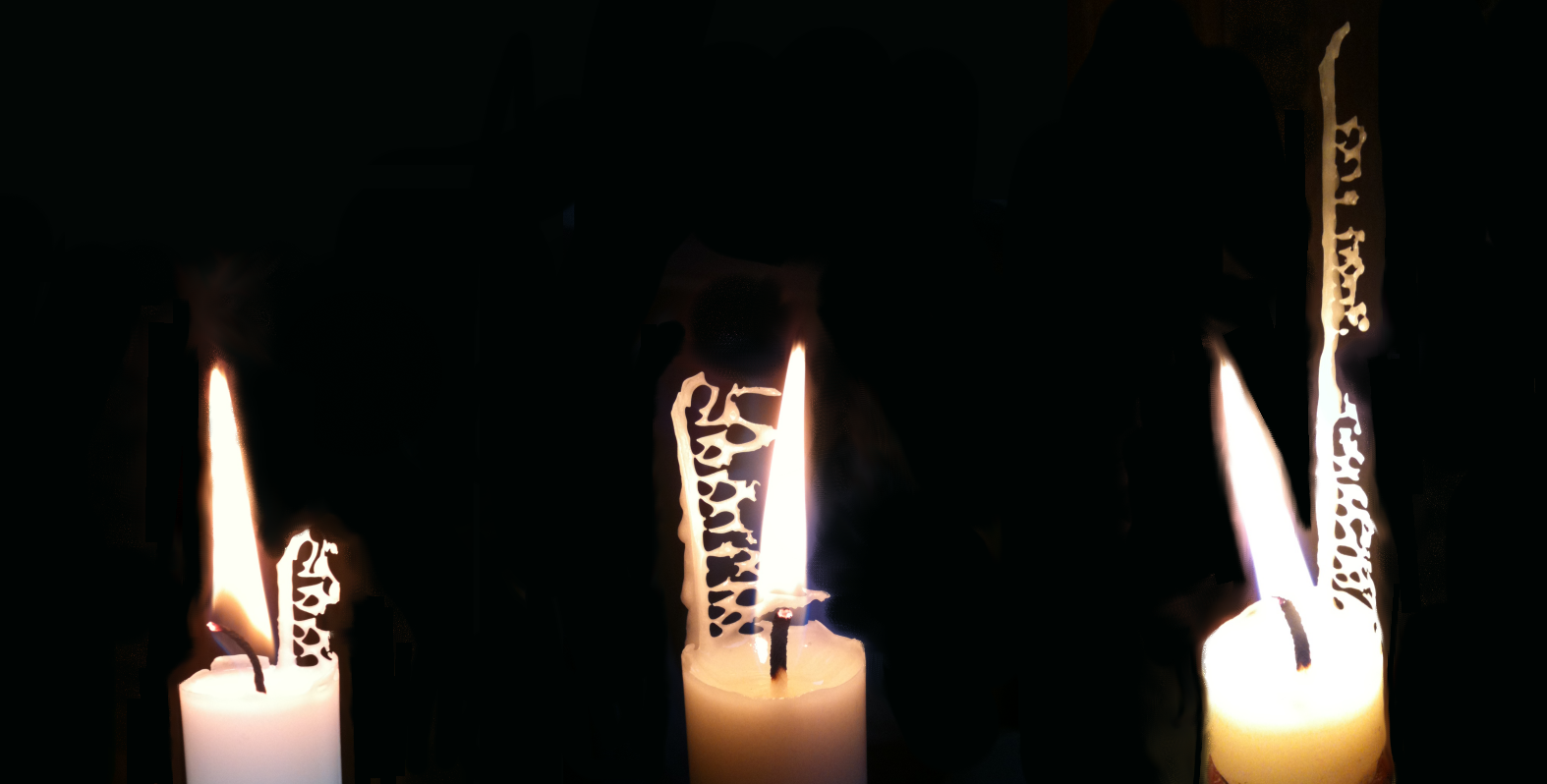
1. Think of a simple, unemotional mental image, like a burning candle flame, and breathe.
2. As thoughts come and go, let them go (sometimes, especially at first, I had to chase them off) then…
3. Bring your attention back to the image and the breath.
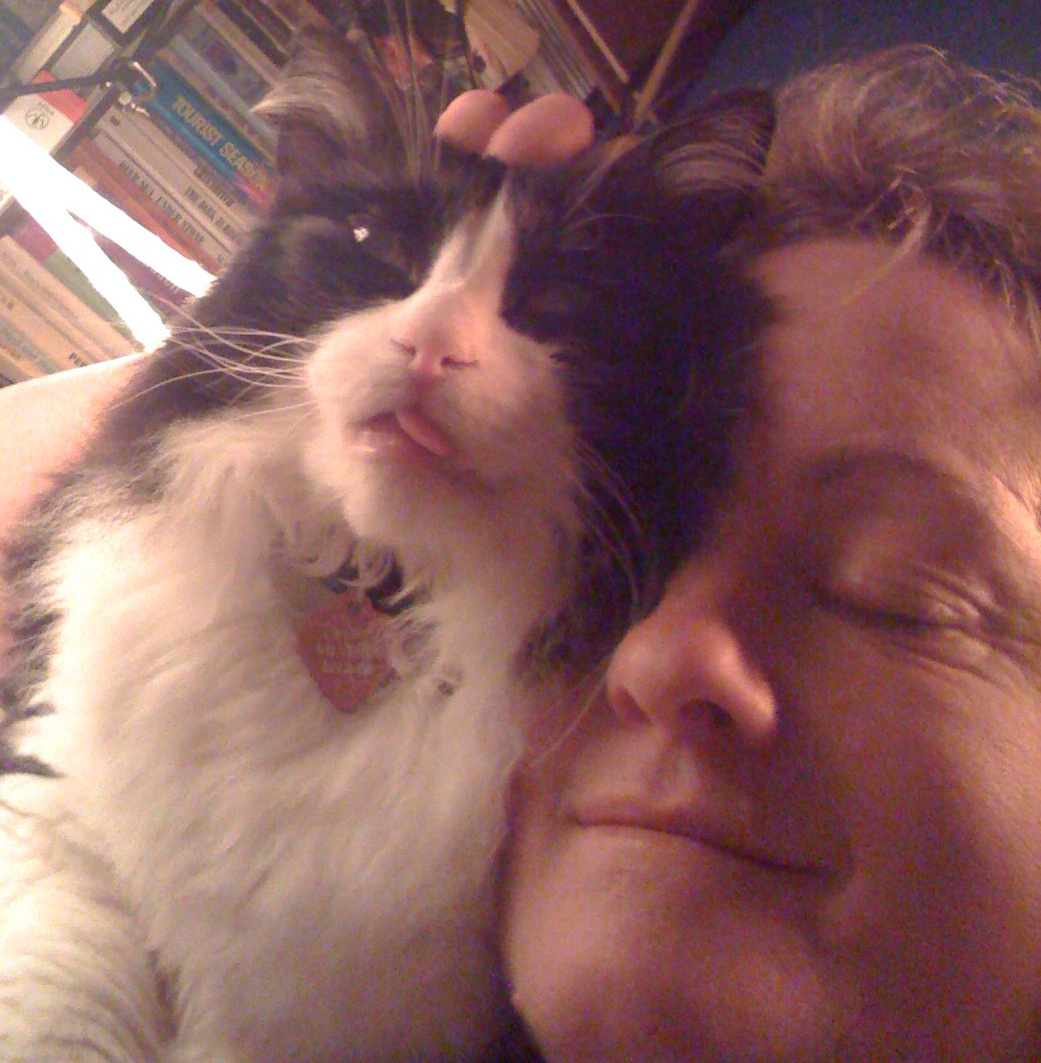
The image didn’t do me much good – I think fire is a little too emotional for me – but simply being at home to my breath, and letting the haywire-ness of the day drift off into the mist… with my odd and beguiling little cat softly nestled against my leg under the covers… did me all the good in the world. Especially at 13.
The language of breath is interesting. Breath, spirit, life, and insight often share the same word or sounds in languages around the world. For instance, in English, “inspiration” means both a breath, and a sudden idea; the root word means spirit. There is no divide between these ideas.

(Life, breath, spirit, ideas… how can these be separated? How can a life worth living, let alone a bearable life, let alone a pulse, exist without all of them?)
As I said, I’ve been breathing intentionally for decades. In my 20’s, I taught my ER and ICU patients a particular form of breathing which, I’d noticed, cut their pain response, lowered their blood pressure, and improved the level of oxygen in their blood — no matter what they came in with.
In 3 breaths the difference was noticeable, and if I could persuade them to take 10, we were halfway home.
It goes like this:
1. Breathe in through your nose.
2. Draw the breath all the way down into your lower abdomen.
3. Let it out through gently pursed lips, like softly blowing out a birthday candle.
4. Repeat.
The abdominal breathing improves lung expansion. The slight backpressure on the exhalation nudges extra oxygen into the system (the importance of oxygen can’t be overstated, especially in emergencies) and sends a gentle message to the blood-pressure sensors in the neck, telling them to lower pressure.
This kind of breathing activates the “calm down” part of the central nervous system, that is, the parasympathetic branch of the autonomic nervous system.
The extra oxygen helps clear some of the oxidative damage away.
It feels wonderful.
And it always works.
(Clinical note: for people with COPD, I did 2-3 breaths, and checked in. As with most adults with a chronic disease, they could generally be trusted to sense their limits and stop. Youngsters soon learn, though very few youngsters have COPD.)
Recently, I’ve learned a slightly different technique from the same psychologist I mentioned in my last post…
1. Notice my breathing. That’s all. Let everything calm down for a bit.
2. Draw the breath into my abdomen.
3. Gradually increase the size of those abdominal breaths.
4. Let the midchest join in, getting still more air in. Exhale from the top down.
5. Eventually, let air into my abdomen, then midchest, then upper chest — inhaling from the bottom up. My lungs are pretty fully expanded in the inhale now, and I still exhale from the top down.
6. I tell myself: My arms are heavy and warm. Soon, they are.
7. I tell myself: My legs are heavy and warm. Soon, they are.
8. I tell myself: My lower abdomen is warm and relaxed. The whole bowl of my pelvis becomes a sea of lovely calm. (I had no idea how much standing tension was stored there, at the bottom of the spine and where all the exits are — though it makes sense, when I think about it…)
9. Then I stop contriving my breathing, and let it just flow.
After about 15 minutes, well, life is good. Really good. Talk about activating the parasympathetic nervous system. 
I’ve forgotten what else I was going to say. I want to be that peaceful and warm right now.
Oh yeah. The point is this:
Breathing well makes everything better.
It shouldn’t be that simple, but it is.
Excuse me. My limbs need to be heavy and warm… In a good way.
The wall, redux — with demons on the side
When I came to adulthood, I realized that I felt a powerful need to earn my right to take up space and breathe the air. You’d think I’d be a cringing slave with that underlying attitude, but I wasn’t. I felt I deserved good pay, reasonable work/life conditions, and common courtesy, because that was fair; I just didn’t deserve to live.
Once I could no longer work, but had to fight like mad to live, this was a bit stressful. Like many, I almost didn’t make it. But then, as the very deepest trough began fading into memory, I noticed that something remarkable had happened.
Rewind about 10 years… I was a nurse for eight years, which put me in a critical relationship to others at critical points in their lives. I might have dealt with 10 patients in an hour, but, in the moment that I was dealing with each person, that was the most important person in my life. I may have coded hundreds of people, but every life I fought for, I fought for with all I had.
There were no caveats or conditions: if you were my patient, you had my absolute attention every moment I was with you.
![]() |
| I think this healer outranks me, but you can see how focused he is on his patient. It’s like that. |
I found that it’s impossible for me to work hard for someone’s survival, and not come to care about them – no matter who or what they are.
Fast forward to where we started, after the deepest trough, around early 2010… I had spent several years increasingly incapacitated, used up all my money, all my favors, all my savings, and lost a lot of friends – some of them to the Grim Reaper.
I won’t go into the brutal and abusive bureaucracy of California EDD or Oakland Social Security offices, because if you haven’t been through it, you wouldn’t believe me. That bad. Worse, even.
I woke up one spring day, with a strange sense of dawning inside. It took an hour or two to wake up, and to realize that I’d been fighting so hard, for so long, for my own survival, that I had become important to myself.
I no longer felt I needed to earn the right to live.
Ever since that time, I’ve never had a serious case of any kind of block – writer’s block, self-care block, learning block, anything – that lasted more than a couple days, unless it was explicitly disease-related.
Then, with this move to a strange area, with no connections, near a city I almost loathe… To get real care, for the first time in years, from seven highly skilled and capable professionals…
I hit a wall. Not just a block, but a huge, massive, precision-crafted, towering, deeply bedded, gateless wall.
Since writing “Frustration at the wall“, I’ve been faking it in the hope of making it. That’s a lot of weeks to keep running up against the same damn wall!
I finally started talking about it – I’m a writer; I’m a woman; I process by words; let’s move on – and began to get unscrambled. Then I had the deeply disconcerting pleasure of having my brain picked apart, cleaned with a dental pick, and neatly reassembled by the deliciously incisive Dr. Faye Weinstein.
I can’t help thinking that the following is going to strike a few chords with some of my lovely readers…
I am, as she said with characteristic precision, “a helpful, compulsively self-reliant minimizer.” Really, why should I trust these people, who wield the power of Gods over what happens to me?
There’s a deep part of me that says “blow that, let’s go hide instead” and off I go, hiding behind advising on Facebook and diving into books and catching up on others’ crises; my condition is not that bad, so my care is not really that important, and it’s not like these people care more for me than their own crap anyway, so I’m on my own really.
My distraction activity is all very worthy, so I needn’t justify it. But, well, so much for the many new things I need to do to put together my own health…
Unconscious reactivity could be the death of me yet.
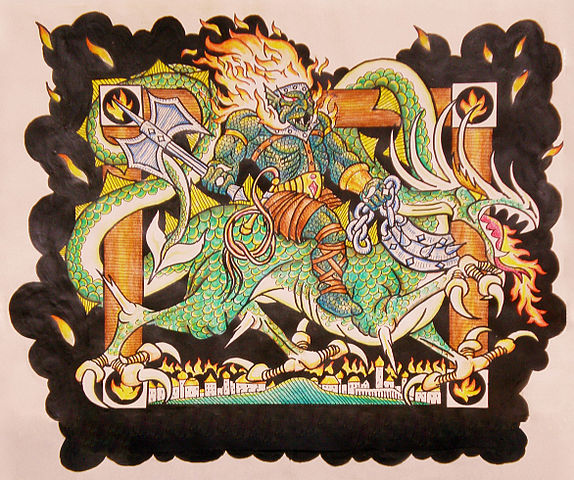
I said this illness would raise all your demons, even the ones you’ve hammered a stake through the hearts of. It turns out that the squat and fetid cranks who propped up my old conviction that I “don’t deserve to live” are still there, farting wetly and hawking loogies.
![]() |
| With apologies to Heironymous Bosch. |
The demons of our earliest perils can shape our responses to major change forever. The trick is to see them for what they are, face them honestly, and put them back where they belong: in the past.
(Easier said… I think a booger just landed in my hair. At least, I hope it was a booger.)
To add to that, with years of excruciating work behind me and more ahead, my old motto of “change or die” doesn’t carry the same weight: Yes, part of me wants to lie down and die. The frantic, aching, endless weariness is beyond description.
But change is more interesting. A lot more interesting. And I only get to do this life once.
Conscious curiosity could be the birth of me yet. With luck.
With a better sense of what I’m doing, I’m preparing to turn and, with tactful and gentle persistence, come to terms with those monsters.
I might as well. I’m going to be here awhile.
Speaking of which…
Marathon training update
After one day to recover from the trip south, I was able to pull off my .8 mile route up and down this hill, and recover enough a few hours later to unpack the car (that’s a lot of steps!) and get some things done. Today was a lot of appointments, which involved walking at least a mile on city surfaces.
On Thursday or Friday, I hope to increase my hill walking to 1.1 or 1.2 miles. We shall see. No more overdoing.
Need more than "Dysphoria"
![]() |
| One of these people is Dysphoric and one is Euphoric. Guess… 🙂 |
The trouble is, there are so very many ways to feel yucky, or dysphoric, especially with a disease like CRPS, but only one word to describe it all. Our experience of life no longer maps to that of a normal person, but language can’t describe what we experience. However elegant it sounds, “dysphoria” is inadequate.
That’s about to change. Here are some words I’m adding to the lexicon, a short selection of the most common and most describable (because some are indescribable) of the dysphoric states I move in and out of…
Dysphoria Sunnysidedown
The particular kind of yucky I feel when I get up before I’m ready. It takes about an hour, usually, to avoid D-Sunnysidedown.
Otherwise, I get tremulous, nauseous, my heart races (but quietly), and I’m aware of a particular kind of fragile ghastliness in a minor key. If I really get up too fast, I fall over — muscles quit. This adds up to Dysphoria Sunnysidedown.
![]() |
| Flip ’em! |
Dysphoria Darkofnoon
This is a natural consequence of D-Sunnysidedown and usually happens later the same day, but occasionally happens by itself. Darkofnoon involves feeling peculiarly ragged (as if my adrenals had been in overdrive for hours, which is accurate if I arose too fast), forgetful, physically weak, slightly shaky, and of course nauseous. Sometimes dizzy spells.
There’s a more solid kind of ghastliness, more in a dominant chord. Dysphoria Darkofnoon usually happens when the day is brightest, between 11 am and 3 or 4 pm.
Lying down periodically helps me get through the day, but I’m not likely to be quite right until a good night’s sleep and a proper start to the next morning.
Dysphoria Hate2Bme
Stunning levels of distraction, with a dense pale-grey cloud wound around and through my mind and perceptions, dissolving what it doesn’t hide.
It insulates me from such trivial issues as major appointments, where I put the keys, and the state of traffic lights. I can tell where my body is in space, but not how it feels. Likely to injure myself, risking further spread.
It would be tolerable if there weren’t any consequences or anyone leaning nervously away while looking at me with worried pity. When I’m experiencing Dysphoria Hate2Bme, the humiliation and underlying fear are the most dysphoric elements, though there is something intrisically unpleasant and destructive-feeling about the dense grey cloud.
Dysphoria Mitoshriek
This happens when I’ve overtaxed my body, though sometimes it happens by itself. I think of it as the mitochondria in my muscle and nerve cells all setting up a synchronized shriek of anguish as they fall over in a dead faint. (I don’t know how they scream while fainting, but they seem to manage it.)
It feels like my soft tissue threatens to dissolve when I try to get up or do anything. There’s a sort of wholesale, pitiable unpleasantness in mind, body and soul with the least physical effort.
My muscles react with a sort of “You’re kidding, right?” when I try to use them, and if I push through in order to get something done, it’s done by pure determination and then I’m out of commission for a couple of days. I pay hard for pushing back against Dysphoria Mitoshriek.
For all I know, my mitochondria have nothing to do with it, but mito self-care seems to help: tons of antioxidants, lots of vegetables, and as much horizontality as I can stand. I can tell when it’s time to start moving — about 3/4 of a day after I start really wanting to.
One thing that is no worry at all: I don’t ever have to worry about being too lazy.
![]() |
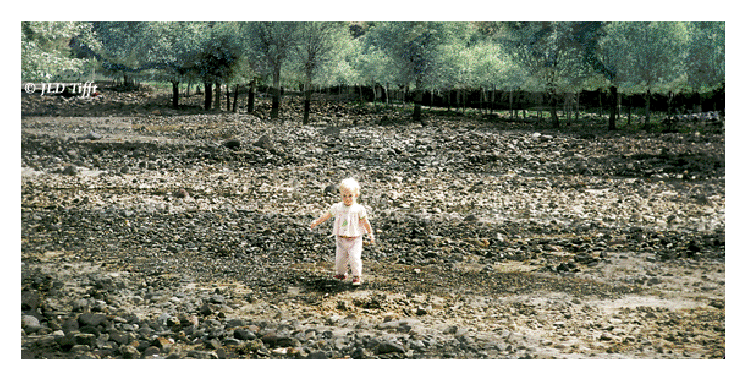
| Your faithful writer at 2 yrs old. I refused help; I was going to cross that dry riverbed all by myself, come Hell or high water. Photo: JLD Tifft, used by kind permission 🙂 |
Bodies and minds, like engines, were made to go, and I’m most at home when I’m going in mine.
After the intense inward training of living as usefully and zestfully as possible despite CRPS, can you imagine what it would be like to have all this determination and energy unleashed on the world if I were finally well again, and could focus on, remember, and do things on a vaguely regular basis?
Can’t wait to find out.
So this is peaceful ol’ me…
…saluting all that keeps me from that.
Speaking of which…
Marathon training note
I’m stable with walking 1.5 miles at a time, and recover fast enough to do more later that day. Will aim for 1.8 later this week, after recovering from this trip.
Despite spasms and cramps etc., I made it all the way home in 1 day yesterday, instead of splitting the drive into 2 days as I usually must. This amazes me. My eyes didn’t cross and my mind didn’t splay into a messy 10-pointed star, both of which usually happen after 4-5 hours of driving with hourly breaks. So, there are some key neurological pieces that are definitely doing better.
Yay cerebral blood flow! Yay exercise!
It might be smart to take today off and stick to PT exercises and tai chi. No more bloody relapses. But boy, I sure am heartened!
Making progress
On the steepest part, I wanted to stop, but my old athletic training kicked in: do anything *but* stop, because it’s worth it to get the hill behind you. So I moved forward less than one foot-length at a time, giving the sick feeling in my chest enough ease to pass. (At least I know it’s not a heart attack. One of the wonders of chronic CRPS is, your physical experience of life has changed so much that words don’t exist to explain it. But I know for sure it wasn’t a heart attack.)
Today was my second: the same distance, but noticeably better – on the steepest part, I could maintain something close to a walk, and I never got that sick feeling in my chest.
Wonderful progress!
Today was also my first lesson in biofeedback. I thought I was hot stuff, because I can knock 10 to 12 points off my blood pressure at will. Today, though, we measured galvanic skin response. It’s much more subtle, and a lot harder to finesse. I got compelling evidence that the physiologic back pressure of this disease is pretty much as bad as I’ve ever said it was. I won’t go into that, because it’s depressing.
I’ve been thinking about a blog entry on breathing, the simplest and most profound of our daily actions. I have to absorb today’s lessons first… I really see why I haven’t been able to put it together yet, even though it’s been on my mind for weeks. Breathing, like living, is so fundamentally simple that I have to think it through very carefully before I try to put it to words.
Back in the saddle again
Dignity is optional. Progress is not. Words I live by.
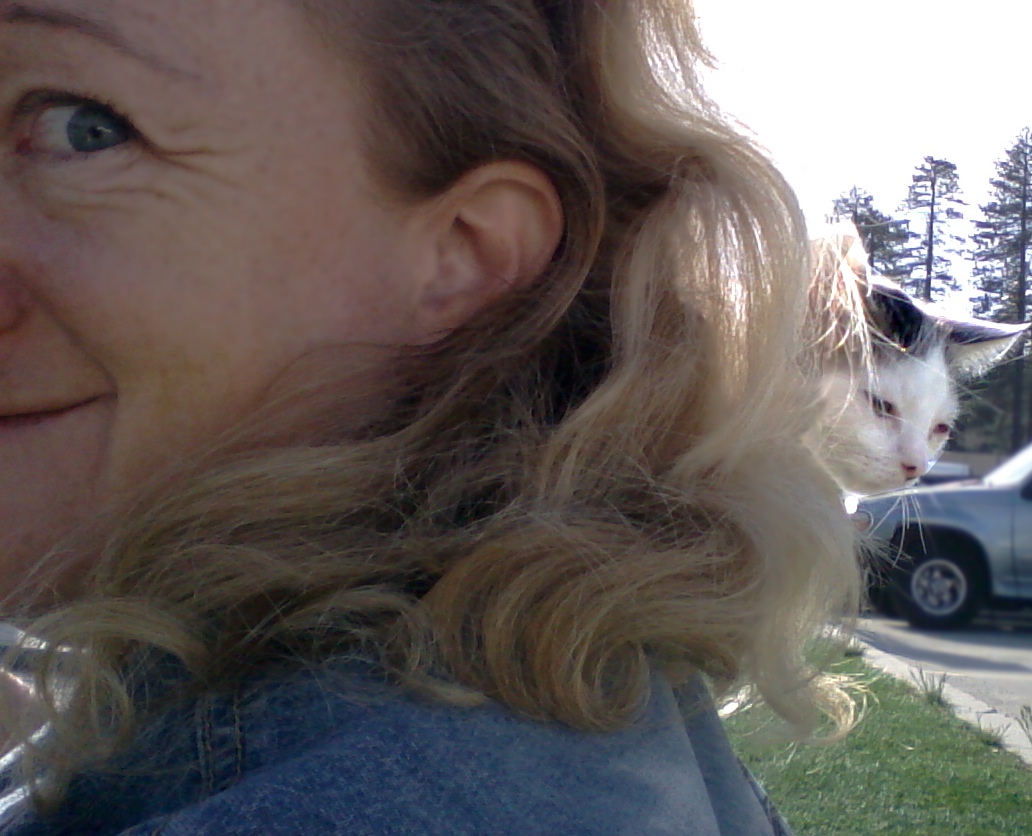
My new kitten has changed apparent gender twice, and is back to being a boy kitty — not that it matters in any practical way. I was looking for a name as elegant, good-natured and playful as he/she/it, while treating an upper respiratory infection that made that left eye look like a mouse:
![]() |
| My cat’s mouse |
But then, with returning health and strength, his natural energy and violence reasserted itself. He has exactly two gears:
1. Unconscious (or nearly so)
2. Full-tilt, greedy, grasping, and spikily impulsive (as the scratch-marks around my blinked eyelashes attest)
So I’ve named him Siddhartha, in the hope that something will rub off.
![]() |
| Siddhi playing hide-n-seek. (“Siddi” is an Arabic address used towards a respectable gentleman. Another fine malapropism from the chronically punny.) |
All of his front nails are trimmed now…
![]() |
| In health care, we call this “desensitization” |
As for my own care, I’m up to 2/3 of my reiki time and 2/3 of my basic qi gong routine, and hope to get some t’ai chi in today as well. This is tremendous progress.
Vegetables are once again a chief component of my diet, thanks in no small part to an enormous bag of frozen “Normandy style” blend from Costco and our local dollar store, which sells cheap organic produce out of cardboard boxes.
I actually did laundry yesterday. Today, I hope to take a shower and — gasp — wash my hair!
I realize only a minority of you will find that truly inspiring, but the rest can have a good laugh… and then think for a minute 🙂
For me, life with CRPS is indeed a matter of tiny triumphs and great goals. For the record, I’m still bound and determined to advance the search for a cure, and yes, I’ve gotten slightly more concrete in my ideas about that… More to come in time.
And now, just for the deliciously hokey yodeling at the end…
Links list:
Here is a recap and explication of the links used in this post:
- Frustration at the wall
- The Buddhist World: Gautama Buddha (external site)
- On desensitization, I linked to my post on Remembering and re-membering.
Also see:
The sheer activity of Espom salt
Pushing back on neuroplasticity - Where you can buy Lee Holden’s excellent beginner routine, which gets more interesting, more useful and more inwardly complex the more I do it: Qi Gong Flow (external site; his work highly recommended)
- An excellent blog post on the relationship between tiny triumphs and great goals: New year, new thinking from Elle and the Auto Gnome (external site, very highly recommended)
Posture matters, across species
I lived in a dog-friendly marina. – Trust me, this is relevant.
|
It’s not just about the scenery.
|
I saw dogs in every degree of getting along — or not.
I saw the active posture of dogs who were used to plenty of food and care…
and dogs who clearly weren’t.
This was interesting to me as I was coming out of a period of being thugged on by every force outside myself that had a duty to care for me. Being, not only neglected, but frequently tormented and abused in response to most of my efforts towards survival and care, left me very nervous indeed.
![]() |
| Not good for the brain. Or anything else. |
I was having trouble with my posture, and – limited by impaired kinesthesia (the sense we have of where our body is in space) – I was working out exactly what the trick points were.
– My low back was in a tight sway, sticking my stomach and butt out egregiously. I lost over an inch of height to that sway in my back.
– I recently realized that, when I fall back in this posture, my abdominal muscles are braced outward. I’m not slack in the belly; the muscles are braced for an incoming blow!
– My neck was hunched against my shoulders. This was funny because I did used to have a bit of a weightlifter’s neck, short and thick; but that was many years ago… when I lifted weights.
– My tailbone was curled in tight, which I only realized after my physiotherapist at the time taught me to straighten it out as a way of releasing tension on the nerve “sleeve.”
– The points of my shoulders were rotated inward. I attributed this to an effort to ease the nerve opening through my shoulders, but that doesn’t actually make sense.
All of these things reduced effective nerve flow to my limbs, shortened the wrong muscles, limited blood flow to where I needed it most, and reduced my capacity for physical exercise.
![]() |
| And you can see how happy it makes me! |
Since activity is key to managing CRPS and keeping the autonomic nervous system under some kind of regulation, this is actually a huge problem.
Good posture is not about vanity, it’s about feeling better, being stronger, hurting less, and surviving tolerably well.
Watching all those dogs running around and deciding whether to let others sniff their butts,
![]() |
| You’re not imagining things: the pit bull is missing a leg. |
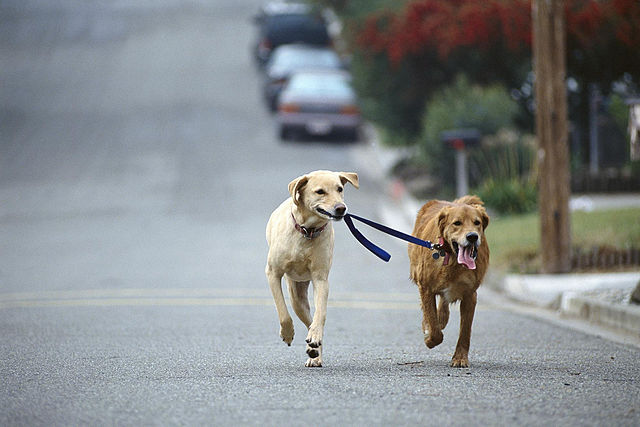
I realized exactly what my posture looked like: a dog in a hostile area, not wanting to fight, but protecting its spine while bracing for blows. Always ready to snap into action. Never knowing when things will go sour, but pretty sure they soon will.
That’s what those years had brought me to. It was a reasonable response, but not useful.
![]() |
| This is what’s really going on when I fall back into that posture. |
I’ve managed to explain this “braced dog” image to my current physiotherapist, who’s wonderfully willing to work with my rather original views. He comes up with ways to tell my body how to stand/sit/move like a calm, alert animal, instead of one that’s braced for the next fight…
![]() |
| I can’t do anything about the 3 extra cup sizes this endocrine dysregulation caused, but my back and shoulders hurt less anyway. |
And I remind my too-nervous nervous system that a calm dog can snap into a fight about as fast, but tends to find far fewer of them.
In the meantime, relaxed animals have a lot more fun.
Postscript on self-imaging
Nearly every time I see pictures of someone in regard to posture or movement explanations, it’s someone really fit.
Now, really. Is that who needs to know?
Much as I loathe looking at myself from the outside, using my own image here is preferable to the implicit lie of using others’ figures. So here I am, warts (so to speak) and all.
![]() |
| /shrug/ Could be worse. |
Pushing back on neuroplasticity
-
from the first refusal to cut pain signals off…
-
to the growth of the brain cortex area that monitors that body part, so it can handle more pain signals and provide less space for normal body areas…
-
to the deeper remapping and rewiring that alters cognition, disrupts memory formation, screws up autonomic signalling, knocks endocrine and digestive function out of whack…
-
and so forth.
It’s important to stay on top of the brain, so to speak.
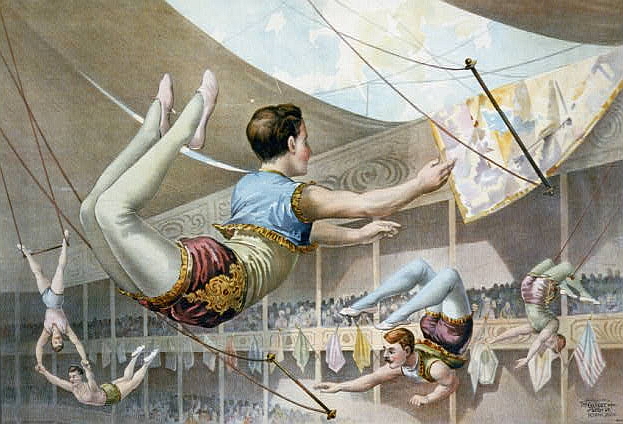
Having said that, it’s not completely reciprocal, nor is it ever under perfect control — unlike a good trapeze act.
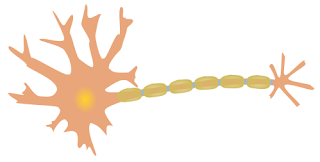
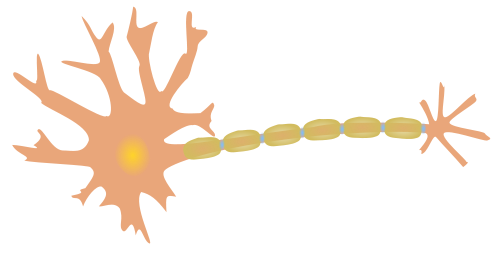
- neurons hook up, and a connection (or association) is made;
- if the connection gets used (or the association is allowed to stand), more neurons hook up to make it stronger;
- once enough neurons have hooked up, the connection becomes like a good road;
- and the thing about good roads is, they get used, even if they’re used for something odd.
- Make sure the roads in your brain are useful to you.
- Do that by pruning the connections you don’t want.
- Prune those connections by letting the associations die.
- Let a connection die by deciding to think about, or do, something else, whenever it comes up.
Consistently. Persistently. Relentlessly. - And keep making that decision every time it comes up.
It works by a negative, which is not how we are taught to do things: turn away from the response, shut out the perception, ignore the link. That’s how you prune an unhealthy connection.
It takes time, but it works. The time will pass anyway, so your brain might as well be better off at the end of it…
![]() |
| Only constructive connections, please. |
![]() |
| Egrets make great distraction, especially in funny socks. |
In a house of flu
Yesterday, I got a little more white grape juice and pedialyte than I thought he’d need, just in case we needed to jump-start someone ele’s treatment. Looks like it was just about enough, though.
Over last night, L and I hammered 3 doses each of oscillococcinum, which we usually find very effective in warding off the flu. I’m used to respiratory flus. We shall see.
Today, L wiped all the knobs and surfaces with alcohol and washed all the towels and linens in hot water. Growing up, she had two rounds of rheumatic fever and her mother had adult polio, and the entire family got chicken pox at the same time; she knows what to do “when there’s sickness in the house,” to use her timeless phrase.
I stood back and made encouraging noises, and wished — for the very first time, every time — that I was able to be just a bit more use.
With the autonomic nausea I’ve been fighting off and on for weeks now, it’s hard to say if I’m actually getting flu-y or if the autonomia is kicking up. As I finished picking up the kitchen, though, my insides let me know that they are considering the value of reverse gear. Nothing substantial, just a warning…
![]() |
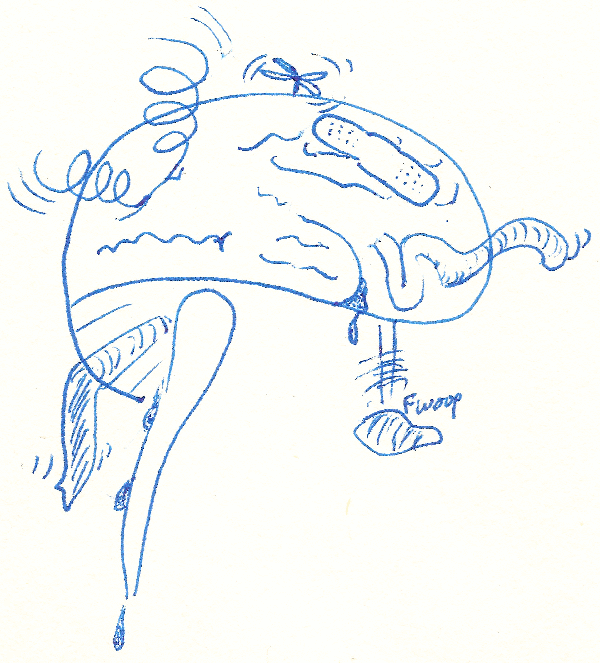
| That’s the autonomic transmission, on the right… |
Intestinal flu wreaks havoc on the autonomic system:
- Turns the GI system inside out, which boosts inflammation, disturbs blood sugar, and wastes fluids;
- Whacks out the electrolytes, which alters nerve transmission and pretty much every other cellular process, generally spiking a pain flare and roasting the higher cognitive functions;
- Dries out the body, which puts what’s left of the fluid-dependent brain and CNS in the toilet — along with everything you’ve eaten for the last day.
A healthy body has metabolic margins to absorb this with considerably more grace. It’s still bad, mind you — really rotten, in fact. Pre-injury, tummy flus always made me wish I was dead.
In a body with dysautonomia and CRPS, it’s a ghastly festival of burning, of mindless agony, and a sheer dreadfulness to existence that words can’t touch.
So I’m considering a quick Epsom salt bath to preload my system with that lovely electrolyte, I’m getting up a blog post with these wonderfully dinner-appropriate details (hah!), and hoping that L — who, as she has often said, did have her flu shot this year — will be well enough tomorrow to run to the store for more pedialyte and white grape juice.
Everything comes to an end, even the flu. The awareness that there is always an “afterwards” is always with me now. It’s a good thing to keep in mind, because the reflex is to get lost in the now, when it’s overwhelming. But there is always an afterwards.
I’m not worried, I’m not anticipating, I’m not buying into the nerves. My mind always runs contingency plans, but that’s natural for me. (If I can’t come up with a plan B and a plan C, check for a pulse.)
So it’s time to catch up on a few things, push extra fluids, coach my body into the tub and back out again, and take things as they come. The low energy just means I have more time to watch DVDs; the wonky tum just means I don’t have to think as often about what to eat.
But seriously… take every opportunity to be happy; it makes you stronger. 🙂