Pulling the masks off in pieces

Having crashed and burned in a (for me) spectacular manner, I’m being (ahem) encouraged by many of my nearest and dearest to stop pretending I’m so much healthier and stronger and more multi-systemically resilient than I am.

My underlying state of health is not good, and I hate discussing it. It’s tiresome and depressing. That said, ignoring it obviously doesn’t work for long. Need a 3rd way.

I’m pushing 60. Time to stop pretending I’m 34… which was my last year of what I still reflexively consider my normal health & athleticism, and it was also when this pain syndrome was laying down its first tracks. Between multiple bereavements, recurring respiratory infections, and repeated courses of megadeath antibiotics, my nervous system was primed for disruption.

As one friend said, “We habitually present a version of our pre-CRPS selves” and, outside my 4 walls and the privacy within, I don’t seem to have anyone else to be yet. How can I exist without coming off as hardy and buoyant? I don’t know what that could even look like.

I go out and do things in public view, then crawl home (nope still no car, yes it’s been all of 2025, yes I’m struggling more all the time, don’t ask) to recover in private. Those are my 2 gears. I’ve recently developed a half-gear of being in my garden plot, but that now requires a lift because the bus is too brutal – although I love that it’s currently free!

It feels like I’m waiting for the world to allow me to heal. If that sounds self-pitying, you’re probably right. I’m new to un-masking, and it’ll take practice to get the tone right – un-self-pitying, but fully honest for a change.

Showing showering

I’ve been drawing cartoons of lives like mine for years. I was waiting to put them into a book, but they’re doing no good in my folio and some have been there for way too long. I’ve also drawn communication tools. It didn’t seem time to share them before, but it sure does now.

First up…

Taking a shower on a bad day:

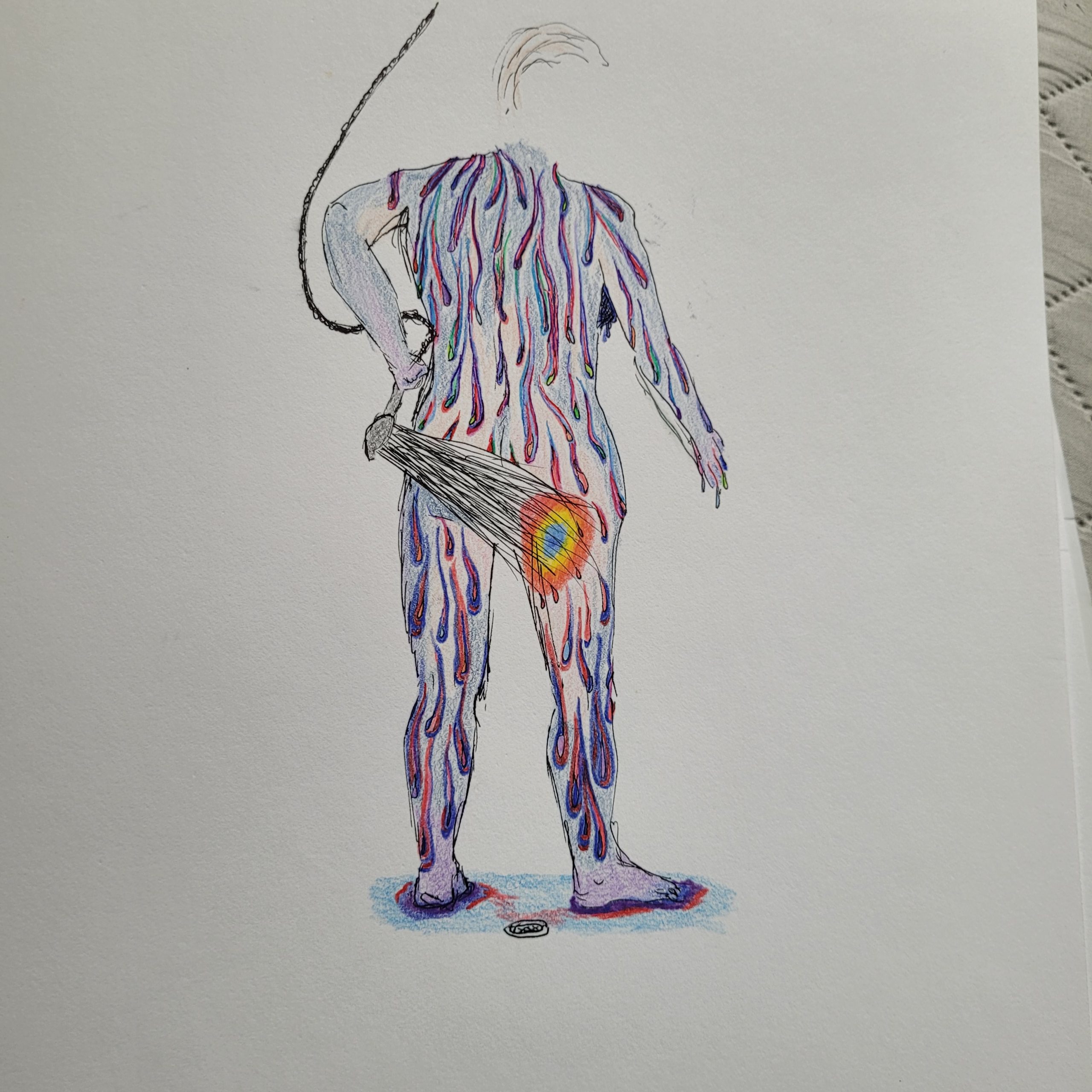
When I’m rash enough to shower on a bad day, it feels kinda like this.

This picture isn’t finished, but it’s good enough. You can enlarge it to see the way the (to my senses) appalling changes of temperature wrap around every individual drop’s path all the way into the drain.

I couldn’t find a way to draw the way each drop feels like there’s a hook in its head, physically latching onto and dragging energy out of my body. That doesn’t hurt (unlike the hot/cold nonsense) but boy, is it exhausting!

So, when you can tell (pew!) that I haven’t had a proper shower or even gotten wet recently, you’ll be able to surmise that the pain has been higher than my ability to cope with the intensity of the experience.

For the record – I gritted my teeth and showered & washed my hair yesterday morning! I’m taking a bow, frankly. I had a familiar audiobook to listen to, which sometimes can keep my attention off those hot/cold and dragging sensations.

Keep in mind that everyone’s pain is their own. CRPSers don’t all have the same experience in the shower, because, for some, it’s awful in some other way. Not all days are this bad, even 24 years in. Nuance is key. Also, boundaries.

My pain isn’t yours, and nor should it be.

The idea here is to give you a chance to look on, without looking for anything more than your witness. That right there is a powerful thing: just being seen.

Don’t take it on.  Just adjust your expectations, maybe, as I’m learning to do myself.

If you’re a bio-nerd, read up on how humans go from mad mitosis to having skin and organs. It is absolutely fascinating – and explains a lot about neurological variations!

Communication tool: moods & self-care

I’ve also got a delightful communication tool to share.

As we all now know, my mood may not reflect the outward, apparent situation. There can be stuff burbling away that affects me in ways I might not realize, but others can.

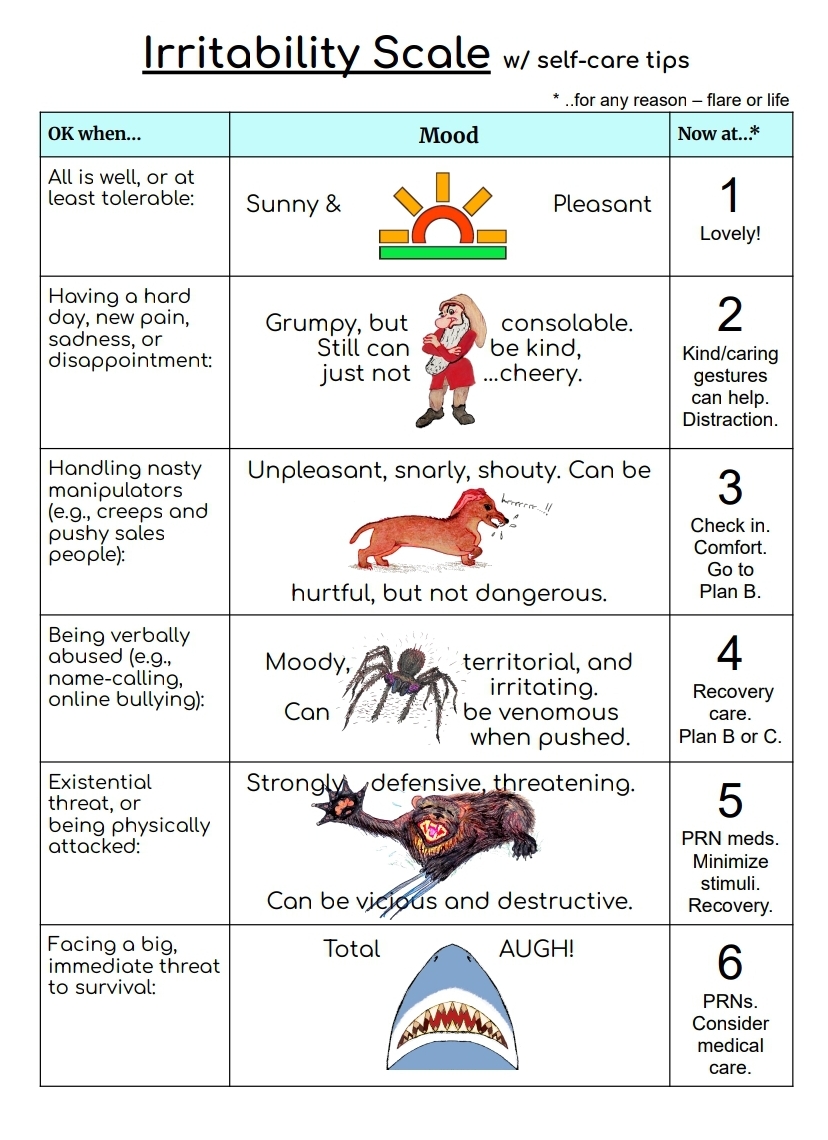
I came up with a rough drawing of a rating scale for my housemates to use (when I had some) and it was a huge help to get that objective feedback – without anyone being defensive! I’d sometimes find the magnet moved to a different number, then go away and take care of myself until I was pretty sure it could move back up. Usually, though, they felt free to call me over and show me where my behavior was, and I loved their honesty. Did me a lot of good.

Click here for the full-sized PDF: Irritability Scale

I particularly like how it indicates when a level of irritation is appropriate. That was a mind- blower for me, as I’d been telling myself that it was always bad to be unpleasant. Nope! Sometimes it’s perfectly appropriate!

I think, and hope, that sharing these images and tools will:

A. Be useful, and

B. Get it right through the concrete (taps own head) that I need to come up with ways to live and engage with the world that are congruent with this reality.

My inner Cleopatra, queen of de Nile, needs to get back to Egypt.

Cheers and virtual hugs are most welcome! I’m daunted by this job. I mean… I value honesty enormously… just not about my weaknesses and disabilities 🤣

The Beast

One of the characteristics of CRPS and some other longstanding brain-driven pain conditions is the occasional personality transplants which, especially combined with memory-holes and perceptual shifts, can really do a number on relationships. This situation is called the Beast. Medically, it’s considered part of the territory.

I’ve been absolutely smug about my aability to stay away from the Beast. Since regular psychotherapy is part of the gold standard of treatment for CRPS, I’ve prioritized psych care — from professionals who have a good understanding of trauma and PTSD, since actual specialists in central pain are so rare, and trauma/PTSD is a good model to start from. That care hasn’t been possible for most of the past 5 months, and I’m taking stock of how much I’ve lost in that time, now that I’m back on the schedule.

I can count on 3 fingers (now 4) the times I’ve been the Beast in ~21 years. (I’m fuzzy on my first ~4 years of illness. It was a blur.) The most recent of those times was due to a neurotoxic exposure. One was when I lived in a mold infestation I hadn’t mitigated yet. One was during a particularly hectic trauma period. The current one was after I decided to make an extended, extravagant physical effort in not-very-safe air. I really thought I could pull it off, and just rest afterwards.

But these are reasons, not excuses. I hurt people who didn’t have it coming at all. I injured relationships I care about deeply and intend to protect. Today’s event cuts particularly deep.

“Why would you do that?” is an unanswerable question. If you don’t have this shit disease, it can’t be explained. All I know is that I felt myself being pulled under, not recognizing fractured memory and wacked perceptions. I grabbed for a rope. Didn’t think what it was attached to, because I thought I was drowning.

Mind you (adds that inveterate shit, Sarcastic Sister), my feelings are such that I’d rather be dead than hurt my loved ones. But this is not the time to say that, because it makes no sense from the outside, in light of what they just experienced from me.

Need a moment to process this.

So… diligent psychoemotional tune-ups, reasonable pacing of activity, and a safe environment are not at all optional. That rubric is my best insurance against the Beast. What I know from seeing my long-term survivor cohort is that there’s no guarantee I’ll be able to avoid the Beast forever. So, I’m wrestling with this reality and not really wanting to be here for my life. (“I’d rather be dead than feel this way” was a state my late BiL and I could bond over.) Many of my fellow CRPSers know the feeling, and it eases my soul ever so slightly to know it’s part of this disease experience, and not because I’ve actually become evil.

I’ve done what I can for now. I’m off home for meditation time, if I can, and a familiar show if I can’t. I have to remember how to rest and how to push myself no harder than is good for me. I have to take recuperation very seriously and basically expect nothing from myself for a week. I have to manage this terrible storm of feelings in the absence of a stable central nervous/ endocrine system. I hope to have the chance to rebuild a couple of relationships. We’ll see if that’s do-able. Fun times.

I’m looking for some more positive message to turn towards or even something to lighten this a little, since the point of this blog is “living anyway” in spite of what this craptastic disease does to people. The only thing I’ve got to offer right now is the passage of time and the hope of some recovery… within the context of this horror-show snowballing around me, around us all.

Care of Spines & CRPS

This is about the messy intersection of CRPS & the mechanical aspects of central nervous system dysfunction, and dealing with those effects.

I’m writing through the waunnng, waunnng, waunnng of a ringing headache. I’m hoping that if I hydrate, urinate, and (carefully) ambulate enough, it’ll pass faster. We shall see. Meantime, I’ll do my best to pass on some useful info.

The brain and spine are supposed to float in cerebrospinal fluid. We are supposed to stay hydrated enough to keep those sensitive tissues from grounding out.

We have 2 kidneys – each one capable of filtering twice the water we actually need – as a practical accommodation for the fact that, throughout history, most water was filthy and needed lots of filtering.

We have 4 times the kidney power we need for a busy, messy lifetime. We’re supposed to use them! The more we use them, the healthier they can stay. They love to do their job.

When we’re properly hydrated, our brains and spines can float comfortably in their spaces. When they float comfortably, they have plenty of shock absorption protecting them.

Spinal care

Dr Faye Weinstein taught me an important part of brain & spine care.

I had too little cartilage in my knees, so I had developed the habit of dropping into chairs instead of using my legs to lower myself neatly.

She hated that. She visibly flinched, and one day she finally cried out in audible distress, “Stop doing that!”

I stopped doing that.

Just as she had predicted, my baseline level of misery became less.

Once I was out of the habit of dropping into chairs, then, when I did it again, it caused headaches and sometimes back pain (depending on my hydration, of course). I was no longer used to enduring this as part of my daily quorum of yuk.

That was (checks watch) over 10 years ago. My brain and spine, oddly enough, haven’t gotten any younger since then.

Yesterday (after a couple of days of being “too busy” to hydrate properly), while I was turning to admire something across the street (a boat or a building; I forget which)… I stepped off a step I hadn’t noticed. One step down, caught myself, barely stumbled, no harm done. Massaged my neck a bit, to ease the slight jamming on one side. In my formerly healthy system, that would have been that. Probably would have forgotten about it instantly.

But now is different.

It took 10 minutes for the icky feeling to set in at my low back and back of head. It took a little over 2 hours for the whole brain-fog and uncontrolled body pain to take hold. Chronic CRPS really is wired into the whole neurological system, and one of the hallmarks is how the spine takes on an anti-life of its own in the face of any signs of disrespect.

Clearly, my spine felt seriously disrespected.

Content warning – skip this description if you’re squeamish about pain:

We know that I have no effective pain control left to me, with genetic tweaks making narcotics disgusting (they make the pain worse, cause untreatable nausea, and trigger horrific mood swings), and mast-cell activation making NSAIDS unbearable (they cause a soft-tissue-wide inflammatory pain, making it feel like shards of hot glass are hammered into all my cells).

So, how to approach this?

There’s a super-concentrated lemon balm extract that helps calm down inflamed nerves. Lemon balm has been used to calm nerve inflammation & pain for, approximate thousands of years.

Since all the nerves coming out of my spine are feeling very hot right now, I’m taking that about every 8 hours.

Note: check this against your meds, especially with GABAnergics. Ask your pharmacist to check their standard herb-drug interaction charts.

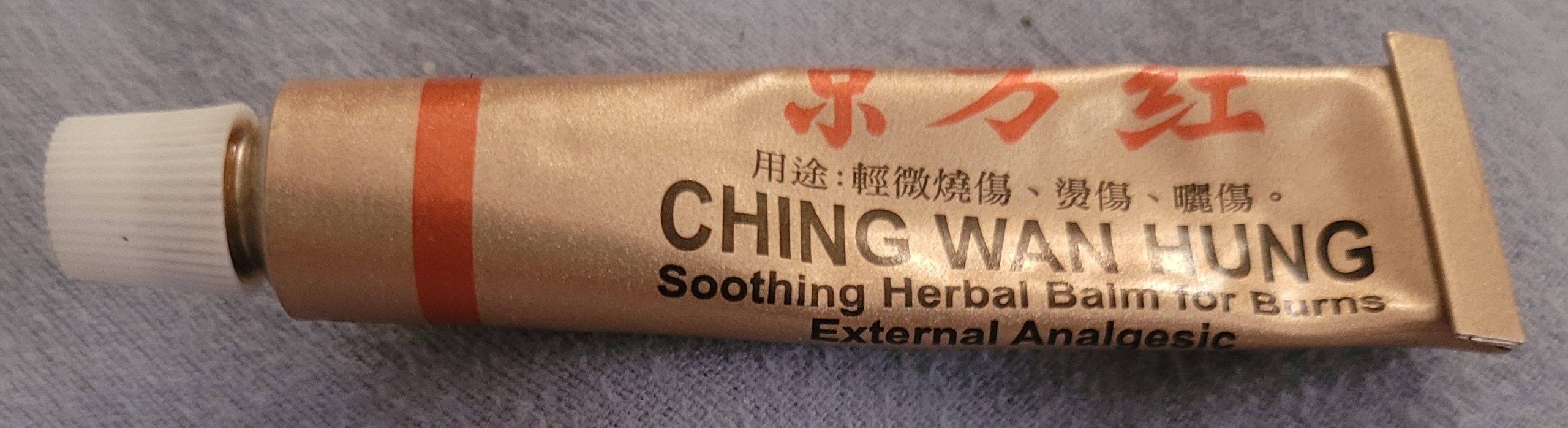
Pain salve on my spine and up my neck before bed, and also on arms/ shoulders and hips once I tried to sleep, helped noticeably.

It was a rocky night, but I’ve been getting as much water down as my tummy will tolerate and, now that my kidneys have been flushed 3 times, the headache is noticeably easing.

Conclusion

We can’t be alert every second. Our senses are so distracting at the best of times. Finding ways to manage these impacts is unspeakably important.

Long-term pain patients tend to get self-concerned to a degree that could be obnoxious normally, but it’s a legitimate self-care attribute in a life where one wrong move or one wrong exposure can destroy weeks or months of work.

Mouse brain neurons, two pairs, stained flame yellow against red background
Image by neurollero on flickr, CC share-alike attribution license.

One benefit of this self-attention is learning how to manage and mitigate the problems that arise by catching them early, and sharing the info in the hope that it’ll do some other painee or their caretakers some good. We have to learn from each other. Nobody else is as qualified.

With a pet & chronic illness

This is a long one. Grab something to drink and put your feet up, if you want to…

In the wildly unlikely event that, say, a vulnerable American citizen felt moved to respect the anti-immigration feeling and return to the lands that, say, my ancestors left in the 1600s and 1700s… how would that work?

It helps if you already have a passport. This is important. Go here:

https://travel.state.gov/content/travel/en/passports.html

and follow the instructions there – whenever you land on it. Passports are issued by the State Department, and the State Department is currently being defunded and depopulated, so their processes may change.

This hypothetical traveler – let’s call her Max Peregrine – and why not? – is female, disabled, poor, and has very short hair. This puts her in several categories of risk in the US in 2025, and she’d like to know what other options there are for someone like her. Her service animal, a minature goldendoodle, has to go with her.

This is important.

Max has learned that a pet leaving the US has to get a certificate from a vet specifically qualified to issue international pet health certificates. She asked her usual vet, who referred her to the USDA web site to find one.

The USDA has been running increasingly lean for years, and has recently been gutted by the incoming president and his team, so the list of vets qualified to give this pet health certificate is out of date.

Max has been disabled a long time and is used to this kind of disappointment, so, after an Epsom salt bath and a TV break, she called down the list of veterinarians in the area until she found one who can (theoretically) give this certificate.

It took the one vet she found 3 weeks to research whether this is even possible. The USDA (which supervises animal health certificates for travel) is running out of staff, after all, and every country people want to bring their animals to has its own peculiarities over what is required to clear a pet for arrival, so it gets very complicated very quickly.

Sadly, the information that non-vets like Max find about import requirements is less than half the story.

Also, the US export process is complex in itself, and requires a 3-hour minimum turnaround between the vet and the USDA for the form to be submitted, reviewed, inspected, corrected, approved, and printed out. That is, if nothing goes wrong.

This vet certificate has to be issued within 10 days of departure (in some cases, 3 days, depending on the country the traveler is going to) so it’s good to start this process well in advance, and be willing to stay flexible.

If, like Max, your pet had an uncertain history or belongs to someone with limited mobility, it’s possible you’ll hit a snag: if the initial rabies series was not done exactly right, you might have to start the series over, do a blood test in 3 weeks, and be sure to get the next one inside of a year.

If you travel to Europe, you’re in luck: go to a certified vet there and get your pet an EU Pet Passport. It’ll make everything a lot easier as it’s widely accepted.

It’s important to remember that Max belongs to a category of people who can’t afford a package trip, nor a concierge trip. She has to do all the planning and reservations herself, and track all that info if, for instance, her pet’s initial rabies vaccination did not happen exactly as intended, and every leg of her trip has to be adjusted, by herself, one piece at a time.

Every transport company has their own pet policies, so she also has to call every single carrier in the chain of the journey to make sure her pet reservation has followed her.

It’s fortunate for Max that her executive function happens to have extra bandwidth for travel planning. It’s in her DNA. Her ancestors have been traveling for at least 350 years.

Since Max’s mini goldendoodle, a girl named Sam, is a Service Animal, there’s no question of that pet being refused. She has to fly with her person.

However, her paperwork still has to be in order!

So, having rectified the rabies shot situation, changed the entire trip to 2 weeks later to make sure her dog can come, and found half a dozen places to get food that matched her dietary requirements in each place she planned to stay in, Max was smart enough to know she could not possibly relax until she actually had her toes in the sand and her dog in her arms at the same time. The preparation for this trip had only just started.

Max is probably a bit overwhelmed, but can get good advice and good tools. She got Smart Tags for her luggage, found friends willing to be phone buddies to use Find My Phone to watch her progress, set an alarm to remind her to turn on Location and 5G at every transfer to give Find My Phone a signal, and then returns to low-rad mode so she’s not battling cyclical vomiting syndrome (which is what happens when she’s around too much signal too close to her body) while conducting a long trirp.

Cyclical vomiting is never fun, but it’s worse all around when you’re packed into Economy class.

Max, who hates travel surprises and likes to be organized, has also prepared a travel folder with pockets and tabs:

  • Complete itinerary in the inside pocket in front.
  • First tab: Check in information for each stage of the trip. This also proves that she plans to return in less than 90 days, because that’s important in an increasingly immigrant-hostile world.
  • 2nd tab: Visa related info: trip insurance coverage, with the coverages page copied and stapled to the front for easy reference.
  • 3rd tab, more visa related info: Lodging reservations, printed in every language she’ll be travelling through, so each border can conduct its own checks. Arriving with nowhere to stay is a big no-no these days; no more turning up and finding the nearest hostel.
  • Health tab: vaccination info. A lot of places really care about this, so get your shots if you want to travel, and get printouts from your provider. If you can afford it, you can have a travel specialist doctor make a yellow International Certificate of Vaccination, which is accepted everywhere – like the best credit cards.
  • Emergency: this tab is particular because Max has underlying medical conditions. There’s a MOLST form, which providees instructions for when someone is unconscious and can’t tell you if they want CPR or oxygen. It should also have copies of prescriptions, which you can get by calling your pharmacist and asking them to print them out. (Some countries require prescriptions hand-signed from the doctor’s office, but electronics are making their way into this process more over time.)
  • The pet, naturally, has her own tab. Her health certification, rabies documentation, and whatever else is needed, go here. This includes her microchip number, because pets require a chip for travel.

At the back of the folder, Max has left space to keep brochures and flyers for things she most wants – from safe places to get food, to inexpensive trips, free/cheap sights, and bus schedules. Max looks forward to filling that up, but knows she has to be careful with money because she’s still poor … she’s just staying somewhere a lot cheaper than her home at the moment, somewhere the government is not (yet) committing very messy self-merc.

And then there’s packing. Max has to bring her own self-care mechanisms, which involve a lot of pillows and some extra gear. Being disabled is a lot of work and there’s just no getting around that. Everything that’s most necessary for that work has to come with, or be bought there, and she’s on a tight budget.

Happily, sunshine is free!

Max is an expert at enjoying the little beauties and making the most of whatever blessings come her way. She’s going to have a fabulous time, and so is her service animal.

I’m a little envious, but I’ll be sticking around for the foreseeable. I helped Max with some of her research, though, so there’s likely to be more to come…

Neuro reset FTW

I’m working on building up stamina because being a blob doesn’t agree with me.

I had one of our rare, hard-won, absolutely stunning neuro physiotherapy sessions yesterday. It usually takes time (days or even weeks) for my body to embrace the resetting, but this one is showing up fast.

Until last week, walking a bit too far would wipe me out.

When I was well, walking lifted my spirits and calmed my mind, and “too far” had more to do with comfort & convenience than anything more pressing.

For most of my illness, walking helped in the aggregate – if I kept it up, I did better over time. It was good, and I was glad to do it, but…

I’d forgotten, until today, just how lovely it was possible to feel after a good walk.

Yes, I’ve overdone a bit, and I’m open to the idea of staying in tomorrow & taking it easy.

I just… I haven’t had a workout high in… dear heavens, I can’t even remember. Decades, possibly.

Must remember to send this link to my physiotherapist. She’ll be:

A. Over the moon for me.

B. Reminding me to drink a lot of water and put my feet up for a bit.

It’s hard to keep it all in perspective – to celebrate this properly, without falling into the old trap of ignoring all the ongoing work it took to get here; to keep it up & stay honest about the jungle of limits I still have to negotiate.

Good day, though, eh? Really, really good. My heart is as light as the feather of Ma’at…

Tough gift, but a good one

American Thanksgiving is the 4th Thursday in November. I had a gift that day – a difficult one, but I’ve been unwrapping it and wondering ever since.

Wide-eyed kitten staring at a roast chicken on table in front of its face

My phone (which has my i.d. and my bank cards in it, and it provides my only internet access) disappeared on Wednesday evening.

While this is momentous for anyone these days, I have a disease-specific reason for being harrowed by it:

  • I listen to audiobooks to drown out my brain’s ongoing response to the ongoing pain, wonky signaling, and that disconcerting imbalance between what I need and what I have or can get to keep my environment safer for my body. To me, it sounds like screaming; I’ve heard others describe it other ways, as crunchiness or a kind of rattling wobble or other experiences entirely. My sensory processing apparatus decided that it’s a constant, ongoing scream from someone too upset to be the least bit self-conscious. Audiobooks and internet rabbit-holes are fantastic ways to manage this, partly by drowning out the internally-generated sound by the external one that I want to hear, and partly with the power of distraction.
  • Pain, reasonable & irreconcilable anxiety about how I’m going to get through anything from this day to the next chapter in my life, and the occasional neurological crumping (when my cognition shuts down and my coordination goes to hell, so I can’t make ideas or hold things) … all of these are best addressed by comfort and distraction. For me, books and memes and contact with absent friends are all good for that.

For Thanksgiving – when everything is shut aaaaaaaall day – I had none of that.

I just need a moment to process this.

It was a sad day. I couldn’t make or receive any of the usual holiday calls with people I love. I couldn’t go out to eat, and the previous evening I’d had to put back all the holiday food I had in my cart and get only what I could pay for in the cash I had on hand.

I had the sweetest visit from 2 friends (I explained why I had nothing to feed them with) who made it their mission to check on me twice daily until I was en-phoned again, and that helped me get through several hours much better.

Apart from that, I had little to do but hear the screaming, and wonder what I would do next year in a country that has voted for unprecedented chaos that, on the showing so far, is liable to shatter a large part of what makes it possible for me to live. The litany starts off like this: “The level of daily chaos to come is unbearable to think about. Every time I read up on the latest plans or appointments, it gets worse.” Not good for dysautonomia, among other things.

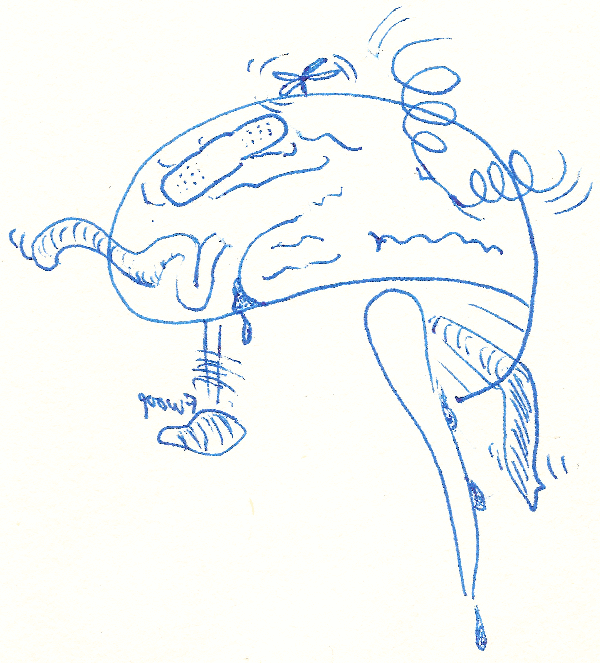
Sketch of brain, with bits falling off and popping out, and a bandaid over the worst

At the end of the day, I began to apply a bit of cognition to this experience (as you do) and realized something important…

The screaming was a whole lot quieter than it used to be; than it was, say, a year ago.

Last year, it was a lot quieter than when I first moved in here, right before the Pandemic. That was a tough time and the screaming was so loud I had to play the audiobooks and dvds at a fairly ridiculous volume to get the benefit. (The neighbor knocked on my wall a couple of times.) That volume might be partly why I now have ongoing tinnitus, a ringing in my ears that’s always at a different pitch and volume from the inward screaming. Clearly, my brain decided not to confuse the two.

Also, I noticed that my mind had actually recovered some ebb and flow!

There were times of day where it was natural to fix things, other times for doing something creative, times to sit and be quiet and times to move around and chat with the cats…

Natural texture and dimension in my mental activity, which the constant audiobooks had smoothed out and neutralized since they came back until that day of enforced quiet.

To the able-bodied and -minded, this is perfectly natural. It didn’t used to be for me. I had 10 or 12 alarms set throughout each day to tell me exactly when to do each kind of activity, because that mental texture had been quite, quite lost.

I got through 2 nights and a day without any alarms. I survived, and I also realized that alarms are jarring.

Who knew??

It turns out that my slowly-healing autonomic system has finally agreed with me that a stable diurnal schedule is a good thing to do, so I wake up within the same half-hour every day, without needing to be kicked awake by a series of 3-4 alarms.

The phone climbed out of its hiding place the next day. (Of course, I had already thoroughly checked there.) I canceled almost all of the alarms, except the one for feeding the cat.

I can make a short list for each day and get through it by riding those mental waves – and being kind if I can’t get them done at the very time that I wish to. It seems that being kind to myself knocks down a number of stress-related barriers.

Horse & woman laughing hysterically

I’m still digesting this new experience of the world. It’ll probably continue evolving over some time to come.

It’s not exactly normal to have such a significant level of recovery when you’re close to pushing 60 and sitting on 25 years of pain-related neurological disruption, including 20 years of dysautonomia.

So yeah, it was a sad day and not an easy one, but what a gift it turned out to contain!

I needed such a gift. My life is about to change drastically, and it’s up to me to work out which path to take through it. None of them are easy, but some could be more rewarding than others.

Can’t wait to see, not only how I’ll screw up, but what I’ll learn from it!

I’m going to try something new, as I navigate this tricky shift in life: asking for input and advice from people outside my head and its rabbit-warrens of associated ideas.

I know, wild idea… and for that reason alone, probably worth trying.


Defining my terms: burny brain

Current science states that there are no nerves that convey temperature or pain in the brain.

Well, not a normal brain.

Well… not as far as we know.

Since I’m terribly clear about the fact that my sensory experience of life has been extensively revised over the past quarter century of constant and increasingly centralized (that is, brain- and spine-driven) neurogenic pain, I’m going to sail sweetly right over that assumption and get on with today’s topic.

We live in the messy and extensive reality of the world outside of labs, scientific studies, and academic debates. Don’t worry about them – they’ll catch up eventually, usually in about 10-30 years.

Brain inflammation

Brain inflammation is one of those topics which patients and wholistic or ancillary professionals have been working with & evolving strategies for for years, but many clinical practitioners have trouble working out how it applies in real life, let alone how to work with it given current techniques.

Practical point:

This is not a dis of those practitioners, it reflects their environment of practice. Their training – and liability insurance coverage – focuses on what has been proven through multiple double-blind placebo-controlled studies, preferably on thousands of patients. Those take time, funding, lots of patients (which rare diseases don’t provide anyway), and a crucial position away from interfering with vested interests.

This is why clinical practice lags 10-30 years behind practical patient experience.

Where were we? Oh – brain inflammation.

One of my dear friends has been working specifically on chronic longstanding brain Inflammation, and it’s been validating as heck to see someone so smart, disciplined, and articulate work through that. Burny brain is, in my case, a sign of acute flare-ups, and talking the concepts over has helped me articulate my own situation.

And then there was Election Day and this lifelong historian & longtime spoonie saw my future get thrown on the flames.

NB: I don’t believe ideology or labeling, I believe that past performance is a good indicator of future behavior and, more importantly, that a written plan is a big fat clue about what to expect – and it’s not good for someone in my position.

After days of feeling staggered, my brain caught fire.

Inflamed brain, level 1

When a series of events, or one overwhelming and life-altering event, land in my life and awareness, my brain takes a few days to go into full bonfire mode. But it does:

Managing that

I depend on my well-established habits around self care and communication to mask my real state and continue to function, but it’s not reliable.

I crank up my vitamins, especially B complex, and do what it takes to get enough protein in. This is tricky, because eating is hard work and few things taste ok.

Keeping a stable schedule is important, to avoid feeding into the general autonomic instability.

Stabilize, stabilize, stabilize.

Since I lose track of time constantly in this state, I have to double-check whether I’ve taken my meds on time, and they’re one of the most important ways of stabilizing that there are.

If I had a bathtub, I’d take baths with vitamin C (20 min very warm; lie down on the C-powder as the bath fills) and then Epsom salt (20 min not so warm) then take naps – a fantastic 1-2-3 recovery technique that I really miss having access to. I recommend it highly.

Level 2

Once the flames get lower and my brain feels more like heavy coals, I know I’m making progress, although it doesn’t feel great:

This feeling of roaring combustion comes with big, fragile feelings. I limit contact and focus hard on noticing when & how I’m functioning, and grab tasks off the to-do list that relate to that.

So, laundry was a significant part of my weekend: no brain required, little physical effort, quick reward, and a huge improvement in my life. Now I’m  dressing off the clean laundry pile rather than my drawers & closet, because I can’t focus on folding & putting away, but that’s okay.

More veg today, partly because I was finally hungry for them, and also because protein was too difficult.

All the olive oil all the time.

Level 3

This is how my brain feels today, more or less:

Honestly, this still sucks beyond belief, but it is improvement and improvement is good. I could eat in portions larger than half-cups and palmfuls, finally.

Today, I wanted to make some calls about getting something fixed, but that wasn’t possible – I kept going blank and stumbling into furniture when I tried (burny brain comes with worse coordination).

Instead, I went and got a ball of yarn to finish a project, which felt good and freed up more focus; with that, I dropped in at the law library and learned how best to approach an issue and then did some online research with that in mind. Now, when I do make those calls that i couldnt make today, I’m actually going to be much better prepared. Still not possible, but it will be at some point.

I wanted to make progress on another administrative task (paperwork, urgh) but my friend has taught us that, even though the clock keeps ticking, when the inflamed brain says “no”, it’s useless to argue. Let it go and rest that brain.

So I put on a movie. Then a dear old friend called out of the blue and we enjoyed reconnecting. Very good for the brain!

Level 4

With any luck, tomorrow my brain will feel more like this, still raw and hot, but somewhat contained, and with more cool spots:

Unless something else happens to shake my foundations. You never know. But still, I hope for continued improvement!

If you’re having trouble understanding brain inflammation as a physiological thing, write a query in the comments and I’ll explain…

Later <grin>


Olive oil all the time

I’m likely to post more often, about littler things, and to mask less about the impacts of my illness and circumstances. I’m hunkering, and inviting you to join me.

Today’s topic is about a beautiful thing.

Olive oil is proof that the Earth loves us and wants us to be comfortable.

Sadly – and, I’m sorry to say, despite marvelous advertising and gorgeous labels – most of the olive oil you can buy is mixed with other oils, whether or not that’s legal or whether the labelling indicates this. This dilution is so integrated in key parts of the industry that there’s not much hope of stopping it, but honest people keep trying (https://www.foodnavigator.com/Article/2024/08/08/olive-oil-fraud-increases-in-europe).

However, it’s a big world and artisanal food is becoming more accepted and appreciated. This creates light between the cracks, so it’s still possible to get 100% olive oil that’s not diluted with something unfortunate, as long as you have a sufficiently sensitive laboratory on hand to check it with.

I do. My analytical laboratory looks remarkably like a reactive, chemically over-sensitive, mast-cell-activated human system which I’ve been working with and paying attention to almost since I was born. It’s expensive to maintain but easy to move. It goes everywhere with me, so I can always check what I eat, drink, and breathe – whether I like it or not!

It’s not always clear about the details of what it reacts to, but if there’s something at all whacky with whatever I’m taking in, my system will generally let me know in anything from moments to hours.

My body can’t stand any rancidness and it screams its head off at oils that should, theoretically, be fine – as long as they’re highly processed. Canola and deodorized oils are pure hell for me, triggering pain like ice-picks swinging into my arms and stomach.

Certain kinds of refining techniques make otherwise innocent oils do likewise, although they might fool other, more ordinary labs into reporting that there’s simply nothing amiss. Technically, there isn’t, and an ordinarily healthy body would agree with that. Lucky things.

My body has its own criteria and levels of accuracy, levels which remind me that some physiological events are triggered by molecule-sized exposures (as are hormones and immunity, even in healthy systems) rather than by mouthfuls or serving sizes.

Experience has taught me that it’s cheaper and easier to pay attention to my built-in laboratory and its reports, rather than try to convince myself it’s imaginary and the marketing, labels, and purported 3rd-party tests must be more correct than my own body. Nah… my body is a better guide about what to do for my body.

Where to start

The easiest test of olive oil’s purity is whether the oil smells olive-y. (If you don’t want olive-smelling oil, might as well use something else anyway.) I always start there.

From much experimentation over the years, I’ve found that olive oil that’s 100% Californian is pretty reliable. Almost anything can be grown in that region, but the market for adulterants (like deodorized hazelnut oil, commonly used in the Mediterranean) is hotter in their more natural state in California. I can’t really imagine California nut farmers – a proud group, not to mention bright & as profitable as possible in a drought-torn land – processing their oils into bleah and selling it for pennies on the dollar. Nope, they’ll take top dollar for their good nut oils, thankyew!

Olives are probably better-suited to California’s arid weather than thirsty nut trees. So, apparently, it still makes financial sense to deliver all-olive olive oil.

Naming names

I’ve found 2 brands of olive oil that currently work for me. There used to be 3, but one got hugely popular and ramped up their supply to meet demand and draw down prices, and (for whatever reason – I’m not making any accusations) their oil started hurting like heck.

Oil #1

Paesanol is a family-grown Italian oil. It has a slightly buttery mouth-feel with an olive-rich scent and a glorious flavor. The organic version is as good as a pain pill, actually knocking back the pain and confusion for about 4 hours, or even breaking the cycle. The price varies considerably through the seasons and right now it’s at peak price. (I stop paying attention when it gets over $30/bottle). The price should come down again when the new season is bottled and shipped, probably pretty soon.

It doesn’t have all the usual tags and certifications that a foodie might look for. I live in a great growing region and I know that good farming doesn’t always mean being willing or able to handle the extra paperwork that certificates require. Whatever its status, it works like a charm for me and I love it.

Oil #2

My go-to (now that Paesanol is out of reach price-wise) is Cobram Estate, a 100% Californian olive oil from an area I used to live in. It’s very good, though it doesn’t have quite the lush personality of Paesanol. Slightly peppery, which I like (because I can’t have real pepper any more). It marries well with other flavors, making it a wonderful base for simmering with garlic and herbs and making flavored oils with, topping soup with, mixing with veggie mash for those of us on low-residue diets, or splashing on eggs or salad or bread or anything else. Excellent all-arounder.

It helps a little with the pain, but, most reliably & importantly, it never makes it worse. That’s the key, really.

Afterthought

As food prices rise (amidst record profits for agri-biz and food suppliers, hmm), I expect to have to revisit this and try some more beautiful bountiful olive oils. I hope I can find a few that settle well and don’t hurt. It’s good to have options. 2 is not a lot of options.

Most people want a reasonable life: reasonable effort should result in a reasonable income, so they can keep a roof over their heads, feed and clothe their kids reliably, and be able to get out once in awhile.

This is increasingly difficult. That’s not reasonable.

As for me, I want to be, not only safely housed and fed, but also in not-too-much pain so I can get a few things done that help, cheer up, and inform & amuse those I care about.

Good olive oil helps. … It’s the little things.

New pain doc & big insights

I’m profoundly curious. (Take that however you want, LOL)

When I was an inch from dying, around 12-14 years ago, when there was nothing left of anything I thought made up my life… I found, down there at the bottom of everything that had been, this relentless creature who had to know how the story would go. I could not allow death to overtake me because I’d never know. So I lived – on pure willpower for a while, but then things started to change and get better & better.

This came up in my Pain Psychology appointment today, following on from the “new pain doc” appointment I’d had the day before. I’ve had 4 pain specialists in 9 years, and (thanks to extended litigation) around 19 in the past 20. Since much more than my life depends on my pain docs, and I have no control over the situation, this is harrowing, every single time.

My medical PTSD is a main focus of my pain psychology treatment, which is how this came up for discussion.

My curiosity is clearly more fundamental than my reflexes and primal needs, so, “Let’s figure out how to use it to interrupt some primally-driven anxieties.” Today’s quote from Kylie Steinhilber, PhD, my pain psychologist. From this, we discussed 2 further insights:

  • Being inquisitive is about holding an empty mind/heart in the present: pure now, with an open eye to the unknown future.
  • Trauma responses are about having emotional context and re-experiencing that history, thinking (“knowing”) it will go this way or that way based on what’s happened before.

I’ve never realized that quite so clearly.

If this had been a rough “new pain doc” visit, I could go to the open & curious state of, “so that’s what’s here/now. I wonder where it will go?” – instead of falling into the misery and grim anxiety of “knowing” what it will be like based on prior experience.

Note to self:

BE CURIOUS about where the story will go! That is rational, even though it doesn’t come with a plan.

Prior experience matters, but it’s a lot better for me to stay open and inquisitive and be with what’s going on now. More options, less antipathy between us, and that opens up communication – which improves outcomes, even in a crap situation.

Serendipity was my brain’s home base pre-injury, & it likely still is. It’s OK to go there and hang on when things get uncertain.

I’m in the 20% of humans who thrive through a serendipitous approach, although it drives more linear people (the 80%) up a tree, because it looks crazy to them & sometimes makes them want to reach for a net – or a straight-jacket.

When I use their (the 80%’s) linear approach (which I’m technically good at; mad skillz), the best I can do is mediocrity, if that. It doesn’t work well, no matter how careful the planning and research I put into it. Makes no sense, but that’s how it goes.

Chaos and WTFery are going to find me. I’m one of those people that things happen to. No, that’s not logical, but accepting it is rational. Interesting distinction between logic and reason there.

I see my mental job as learning – over & over – how to ride the metaphorical wild horses, not keep trying to dodge their flinty hooves as they run over my well-plotted garden.

20% of humans are like this. We’re not alone, just unusual.

Note to self:

I CAN TRUST MYSELF to know how to go and when to stop. Truly.

Cf. my “15% overdo recovery time” note in my personal pain rating scale. I really do know what it means to overdo by 15%, and why it’s harder to recover from than 10%. *That’s* evidence of a high level of insight & self-management. I can perceive it accurately when I loosen my grip on “tha Plan” and listen to myself.

I said to myself, “Self…

“LET the inner story that ‘everything will go wrong’ BE WRONG.”

Some moments suck anyway, but they pass a whole lot faster when I stay curious and open and let things go differently than expected.

All that said… I am simply over the moon with delight that this “new pain doc” visit was such a good one and that I feel safe at last in that part of the system! That frees up a ton of energy, now and ongoing. The relief is stupendous.

The resident (training) physician remarked, unprompted and naturally, “After all, you are the expert in your own body.”

Hearing that from a doctor is a show-stopper. As one friend & compatriot said, “I’d be less surprised if a unicorn came to your door and told you you’d won the lottery.”

It feels a bit like that..

Onward and downward

My poor ol’ body has been carrying an unfair load for a long time. It does its very best, but the dice are loaded and, of course, aging intensifies all the problems and reduces all the healing mechanisms that keep it going.

Its experience as a physio-electro-mechanical system constantly in search of homeostasis – that is, a flexibly stable state — is seriously affected by the fact that it’s got these conditions which seem to think that homeostasis is a nice big target to shoot at and instability is fun. Woohoo!

I’m having what I suspect is a barrage of endocrine stuff which, among other things, makes my body’s pain and ability to adapt simply go phut.

CW: graphic descriptions of pain.

The bone pain triggered by walking is off the charts. Now I get one walk per week, it has to be less than 2 miles, I come home and go straight to sleep for 3-4 hours after, and have no attention or stamina the following day; I have to write off that time completely. My muscles and tendons feel like they’re filled with burning shards of glass. My leg bones feel like gelid columns of fire, like stiffened napalm, so that I’m half-afraid they’ll go squish and disintegrate under me, and who knows where that napalm would go if they did.

Honestly, that’s weird.

Activity is good. Moving is the secret of life.

Used to be.

My cycles still help at times. The recumbent trike, while it unloads my lower back beautifully, exacerbates my neck posture, which redounds into headaches for days. It also takes up a huge amount of space (it’s over a meter wide), so I have to stick to the wider paths and not try to use it in winter. However, it gave me back a lot of life last summer and fall. I had no idea what this year had in store for me, or honestly I’d have gotten something cheaper. Less safe, less comfortable (despite the neck thing), less of a joy to ride, because that trike is fantastic of its kind and fits like a glove… below the neck.

The cute retro bicycle? I didn’t sell it (though I probably should). I’ve been able to use it on some good days, but unfortunately I was still right about the road vibration on my spine and arms, and the pressure on my carpal tunnels. But it does fit into narrower spaces.

So, at this point, I have 3 modes of transport which used to work well, but this absolutely relentless business of being chronically ill has nearly, if not quite, taken them away.

Breathe, me. It’s just a problem.

It’s just a problem, and problems are meant to be solved.

I have a rowing machine which is currently my safest option for activity, although it doesn’t get me anywhere. It uses most of the body’s muscles, and I can tell because I can go for 6-8 minutes before I get sick and light-headed and the burning shards turn up. I’ve been trying to go up from 6 minutes without making myself sick, but my body can’t get past the 7.5-minute barrier without the spiculated pain all over and the desperate exhaustion for days. And yes, I incremented very slowly, but it just won’t work.

Weird. I cannot get used to that.

Time was I’d row for 20 minutes at “fit man” level, and go even longer in the water. I wanted to get a sea kayak and use it for transportation; I loved the motion of kayaking and could not imagine a better way to start or end the day. Middle-distance running (3 to 13 miles, depending on how much time I had) was a lot more affordable and accessible, so I did that instead. I was one of those annoying people who really enjoyed running.

I try not to think about that. These kinds of losses are about so much more than “hey, I could do this thing, yay me”; it’s more about how I fit into life and engaged with the world around me, about the tools I had available to help me through the hard times and illuminate the good ones. So much is out of reach.

That’s life.

Breathe, me.

I’ve got more specialist appointments crammed into the next few months than I’ve had in years; possibly ever. The science is a lot further along than it was when I was working as a nurse, thank goodness. The reason why I get heavier when I don’t eat enough is technically understood. The trouble lies in getting people to believe it and trust that I’m telling the truth.

It’s very weird to me to be disbelieved: I’m white, well-educated, have big blue honest eyes, and present info well. Now, as a fat middle-aged woman, apparently I’m inherently much less credible. Obviously, I must be kidding myself (if only!) and comfort eating (if only!) and clearly just being too lazy to work out (if only!)

I have no idea how that works, because you don’t get to middle age with significant illnesses by being stupid or incapable of self-care.

Breathe.

Keep breathing.

Problems are meant to be solved.

I’ve been thinking over solutions to the “how to be able to get things done outside the house” issue. I have partial solutions – all of them depending on others or on problematic systems.

For now, they’ll have to do. I’m glad I’ve got even them, of course. For all the towering cost of agony, uncertainty, and logistics, it beats having none.

Keep breathing.

I have a good home that I love. That’s one huge thing right, an unbearably difficult problem that has definitely been solved. From here, I’ll just have to figure out the rest.