Seeing, as in looking at, stars

I saw a whole lot of stars last night. Good for the soul, that.

I’ve been taking this opportunity to be in the experience of life without having to explain it, or articulate reasons to anyone outside my own skin. I had almost forgotten what that’s like. With very bright and articulate people in my life, it’s hard to get that in my personal life. Their need to understand is borne of pure love — they worry, because they’ve seen me through some rough times, and in order not to worry too much, they need to understand in their own minds what’s going on in this mind over here, which is in a completely different person. (Mom, you’re in good company with my lot! <3)

I’m in a lot of “thin end of the bell curve” categories, so this can take some doing: INFP (about 2-4% of the population, last I heard), serendipitously rather than linearly accomplishing (about 20%), and ADHD female (goodness knows, but the proportion seems to be growing as the markers are better understood), in addition to the weird requirements of all these illnesses — pretty much guarantee that anything normal won’t work, no matter how carefully I plan and execute.

This is the second summer in a row where things have not gone according to plan, so much so that a new term somewhere between “not according to plan” and “WTF just happened” needs to be coined to express it. I’m beginning to think I should just take this as a new life pattern, since the switchbacks tend to heal the dribbling wounds of layers & layers of PTSD. (Well-managed PTSD is not the same as resolved PTSD, although the most dramatic difference is on the inside.)

My friend and honorary BIL Ron wound up with massively metastatic liver cancer because 2 years of pandemic disruption and lousy treatment from LA’s indigent support system (which is a criminally bad system, worse than war-escaping migrant camps and most internment camps, according to the UN) left his early, localized, treatable cancer as an undiagnosed blurch on a CT scan which he had a few months before the pandemic was identified.

His care was denied because there weren’t enough staff or open beds. He was killed because of, but not from, Covid. When you think about maskless people and Covid deniers, think about treatable, localized cancer turning into a deadly and agonizing bloodbath for people like Ronnie.

Yeah… I’m not bitter… much!

Folks, this is not a drill. It’s not imaginary. It’s a fast-evolving pandemic in its early days. Read up on the Black Death for a little perspective.

A couple months ago, as people told themselves the pandemic was “settling down” right before the peak of record-setting waves of contagion and death (check the data, not the ideology) Ronnie bent down to pick something up, passed out, and woke up in hospital getting the third of eight units of blood. Then he found out over half his liver was lost to cancer and that treatment would only buy him a matter of months.

He opted to skip treatment and make the best of his remaining time.

He wanted to go fishing, so he set his mind to get strong enough for one last boat trip. His family proposed bringing him home to Northern California, where there’s glorious fishing in all sorts of waters.

Long story short, the appalling facility he was in was so good at losing contact information, that his hospice social worker didn’t realize he even had family until I had the option of including a gift card with a care package I sent from Amazon, and I included four names and numbers. Then things started happening.

If you’ve got someone in a facility, send them a card! It’s documentation that people care, and nothing happens in health care without documentation!

I never thought of it as anything other than a nice gesture, but turns out it’s a whole lot more: It’s evidence that they’re worth saving. ÷O

Put your number on it if they’re in bad shape, so the facility has someone to call. Atrocious that this should be needful, but hey, welcome to modern America! o_O

OK… maybe a *little* bitter.

Since I was about ready to have him kidnapped to get out of that stupid facility, we had contingency plans up the wazoo to get him out of there and home.

Even longer story short, it turned out that the only feasible option was to drive him home, which was a 2 person job and only one person in that elderly and health-challenged family could do that, so I changed my own plans (plan is a 4-letter word anyway) and got the soonest ticket I could.

As he listened to this planning conversation, Ronnie smiled from ear to ear with tears streaming down his face. He could take in how much he was loved and wanted, and he was going home to a slice of paradise to be surrounded and supported by the care of those who loved him.

Important note here: he already had this information, but he also had his own layers of damage which made it hard to let the information in. That resistance was there for a reason. You can say something to someone all you want, but if they aren’t equipped to accept it, it won’t go much further. There has to be a big enough change in themselves and their circumstances for those scars to shift, so the info can flow.

Ron was able to put aside everything that kept him from being able to accept that information, and he had, as the wise social worker said, “a moment of pure happiness.”

The following day, his condition deteriorated. We updated our plans to go visit and hope for the best.

The morning I was supposed to fly out, he was gone.

I did my quiet-inner-voice thing, and it said “go anyway.” So I did.

Bodhisattva oath

I’ve been contemplating the distinction between working the Bodhisattva vow and being a doormat (or codependent, as we call it now), off and on, ever since I discovered the concept when I was 12 or 13. It’s been an important part of my work of dealing with the last couple decades of harrowing illness, poverty, and systematized abuse as a patient. It’s become a regular topic recently in my meditation class. This is a big deal and an important point to consider.

The difference, it seems, is about self-care and responsible boundaries. These are particularly key for people who are women, healers, and in a vulnerable situation; it may not have escaped your notice that the wording which defines these terms was developed by men who had quite a bit of support in their work, and such people need a lot less protecting.

It’s healthful for people in habitual authority/access/power over others to embrace a practice of profound and selfless compassion. It gives them more insight and calm.

Those of us whose ground state is based on acute awareness of others require a more nuanced approach.

There are techniques which allow a diligent practitioner to pursue the Bodhisattva vow over the rim of what appears as boundaried behavior without psychological damage, but they only come after many years of serious training and discipline with qualified supervision. So, people like me have to be pretty darned careful how we proceed.

In short, I was in two minds about my own reasons for coming, but I yielded to the quiet tidal bore of my inner voice and took that flight.

Serendipity

I’ve landed in a beautifully imperfect place among people who wear their glorious sweetness and relentless flaws in flowing symmetry. From Ronnie’s kin, I’d expect nothing less.

Above all, I realize it’s not my bathtub to soak in and not a set of problems for me to fix. I’m just here as a welcomed guest and loved part of this extended & protracted family system.

This is a big deal.

There’s a lot of work for me to do (administrative nonsense, since death and life are both business matters; my trip will be paid for) and that’s healthy, because it’s easy for me and a real boon to the family. Healthy boundary there.

There is a lot of soft, verdant ground for me to walk on; a ton of stars spilling across the sky overhead; a cornucopia of Isy-friendly food pouring out of the greenery on this well-kept land; and my allergies have backed off considerably. My ex has put my health needs absolutely first in every consideration and the rest of the family is happy to support that. Definitely healthy.

And me? I’m not over-explaining! It’s amazing :D! I just quietly take care of my needs and appreciate everything that I *can* partake of. Good boundaries there, too.

I’m learning, carefully, again, how to be present. How to unlock from anxiety without letting go of my real needs. My phone is nearby and in signal, but usually off. That’s healthy too, right now. It’s a kind of technology break, which my battered and hyperactive brain is probably long overdue for.

I’m also bereaved in the presence of others who are also old hands at bereavement. It’s a peaceful thing. It feels curiously wholesome, even as grief and mortality are shredding sorts of events. Ronnie and all our late loved ones are very present in their very absence.

I could natter on about the wheel of life and possibly even spout some Buddhist wisdom about interconnectedness and emptiness, but to put it in words is to miss the point. It’s an experience. All you can really do with an experience is to be in it and allow it to be part of you.

So that’s what I’m doing. And there’s real healing in it.

For some things, no explanation is needed because, at root, none is… oh I don’t know… possible?

Anyway, I’m OK. I’m doing the things and being the me and accepting the limits (including transport) while appreciating the strengths (like interconnectedness) and feeling very secure and centered and remarkably peaceful withal. This is good. And if my phone is off, be assured it would be on if I needed it. Right now, the stars and the green and the peace are healing me, and I’m simply letting them. <3

Update: using adaptation tools

Yesterday, it came naturally to be warmly present for V during a big event where I stood in for her, even at a distance of 3,000 miles or so. Gotta love technology for that!

Today, I think of D and the anticipatory grief is like a warm finger of current, pulling at me without tearing at my core or dragging my mind away. He’s here now, and everyone who cares about him is working on a graceful last chapter to his intense, vivid, improbably well-groomed life. (Yes, he’s quite a character!)

This recovery is not all perfect: after yesterday’s 8-hour social endurance event (a physical and physiological experience piled on top of a very neurologically demanding week) I woke up this morning with a pure dys-autonomic experience I haven’t had in a very long time.

On the very cusp of waking, as I first became physically aware of the real world, my body’s temperature-regulation mechanism dropped off the rails.

I suddenly got intensely cold, that bone-deep cold that makes the smallest touch of air feel like knives. Imagine full-body Reynaud’s, with added concertina wire. It’s amazing how cold my skin suddenly gets to the touch when this happens, after feeling just right at the moment I started to wake.

So, I did what I learned to do 10 years ago, when the dysautonomia really kicked in with this: I pulled my down duvet completely over me and tucked in every gap, wrapping it right around my head, and constructed a little tunnel just big enough to breathe fresh air through. (Fresh air seems to speed up the recovery period.)

Nothing I can do after that but wait for it to pass, as my regulatory thingies come to terms with being awake instead of asleep (one autonomic function) and being able to be at the right temperature (another autonomic function.) I know that it will pass, while my system creeps toward wakefulness.

Big shrug. The Nasty Cold Snap hasn’t been part of my day in a very long time, which is good!

This just goes to show that the physical/physiological impact of these flows of stress and anguish isn’t negated. Expecting that would be unrealistic.

They are manageable. That’s the point.

Doing those “brain first aid” things makes handling the weighty, current reality bearable. That means I’m still capable of several important tasks:

  • I can bring my tips and tricks to bear against the physical effects of this illness.
  • I can think my way through ordinary (to me) problems.
  • I can remember that things pass: the Nasty Cold Snap will pass, as the mental shock passed, as even terror passes when it’s allowed to.
  • I return fairly quickly to my normal frame of mind — which beats trauma-brain all hollow!

There’s still a bit more physical recovery involved, mostly giving my systems a chance to finish returning to their normal function and easing up on the extra weakness, reactivity, and pain.

But, basically, I’m OK. I’m able to show up for myself and my friends. That’s what it’s all about.

My point (and I do have one) is…

The skills I learned in psychotherapy really work when I use them, and I’m so relieved.

I want to make the point that psychotherapy is not “just like talking to a friend”, because our friends don’t need a graduate degree to be our friends. Psychotherapy is a professional-level, highly customized form of care, even if it feels relaxed (creating an environment where you can relax is one of the skills of a good shrink.)

Nor is it a passive process; the skills and concepts only work if you work them. It’s good to be heard; that said, it’s also good to remember that real healing involves relevant changes. The fun (??) part is, in medicine, we may influence the changes but there’s a significant random element involved in them; in psychotherapy, the client steers the whole process. While being an active, involved patient can improve outcomes in medicine, being an active, involved client does improve outcomes in psychotherapy.

So, there’s the core message behind this 2-part series, part of the ongoing “what works” toolkit. Psychotherapy works, when done properly and used diligently. Just like any other kind of care. It’s not magic. It’s skills.

Adaptation tools in use

As some of you know, CRPS & dysautonomia involve constant re-traumatizing of the brain & nervous system. Our brains have flows that can resemble that of people living with domestic violence, because the CRPS itself keeps waling on us physiologically, in the same way people who get abused are waled on physically and emotionally.
Old amber-screen lettering showing *TILT* like on old pinball machines
This is why psychotherapy is part of the gold standard of treatment for intense chronic pain generally, and CRPS particularly: it takes good, highly specialized training — and ongoing coaching — to keep re-claiming and re-training the brain, so it can climb out of the being-beat-up mode and stay in the this-is-what’s-going-on-right-now mode.

Since I take the view that “whatever it takes, I’ll do it” is the way to work with such an intransigent, mean-spirited illness… I’ve naturally been persistent about holding to the gold standard of treatment, and working hard to implement everything that works for me. (Let it be clear that, just because that’s such a nice pat sentence, it is a hard road and a lot of work. Sisyphus thought pushing the same rock up the same hill was a lot of work? He should try claiming & holding ground against pain-brain.)

I’ve had tremendously capable psychotherapeutic teachers & coaches, and my present providers are over the moon for me. I tell them, “Gee, it’s like this stuff works!”

***

It’s graduation season in this college-rich area, and there are a lot of transitions taking place. I had a glorious week of family visiting and more social time than I’ve had all year. It was lovely and absolutely wonderful… yet, for a dys-y system, it’s still a lot of work. Big emotions, even good ones, trigger big neurotransmitter flows and that takes managing.

Yesterday, I got set straight by a friend I’ll call V, which was terrifying (really don’t want to lose that one) but the relationship will be better for it.

Big emotions kick out dysautonomic systems, so I started up the brain-stabilizing routines. Cool.

Then, I found out that a friend I’ll call D had nearly bled out last week and was currently in the hospital with massively metastatic cancer. He was diagnosed with limited cancer right before the first Covid-19 lock down. You know what happened with hospitals after that.

So, because he couldn’t get any treatment when it was treatable, he’s now faced with pretty horrific options and chose to go for comfort care for a very short life rather than horrendous chemo with a poor outlook anyway. He was an extreme athlete and had a rough life as a wee wiry guy in the city, so pain is no stranger, but at his age, it starts looking stupid to chase more discomfort.

Because of wacky human stuff, we hadn’t spoken in quite awhile. I’m glad we couldn’t see each other during the call because I know I was crying from the first sentence he spoke, and I suspect he was too. He’s a live wire & a cheery sprite by nature, and he made me laugh before I made him laugh, so I’m happy to say he won that round. We sorted out some heavy material and he said very nice things that were good to hear.

After that conversation, my usual brain-care toolkit was useless.

The first thing I do is, “don’t rehearse, replay, or dwell on it.” This is because that’s how trauma-tracks get laid in.

The more it replays in the mind, the deeper the distress gets planted. So, whatever it takes to prevent another topic of PTSD from getting laid in, is what I do.

I do come back and evaluate the experience for lessons a little later, but first… got to let the flaring, blaring intensity wash off before it stains, so to speak!

When the anguish of 2 perilous-feeling conversations, atop a beleaguered and recently worn brain, keeps roaring back, my usual low-key books/ shows/ audio/ doodling distractions aren’t enough.

I sat back and reached for a thought I’d had recently. There’s nothing more stabilizing for those who can do it than… what was it again?

Activity. Bilateral activity.

In my case, taking a walk.
Walking cat,distorted with closeness while coming at the viewer
So, with my phone reading me an audio book at the same time (clever, right?), I pulled on appropriate garments and got my wobbling butt out the door, one foot after another.

Blaring replays started up often, but I’ve had practice with this technique, and I reminded myself that *now* I walk, breathe, and follow along with a silly story; processing events comes later, *not now.*

The blaring replays got quieter by the end of the walk, and by the time I was 2 blocks from home, I could just about bear to be in my skin again.

The combination of bilateral activity (walking, wheeling, and most forms of warming activity qualify) and the distraction of a plot to follow combined to get me through the first stage of harrowing. Yay!

I followed up on a task I’d committed to for V and meditated briefly on how to follow through on family notification for D, a task that couldn’t go further last night.

The first task wasn’t executed perfectly, but I saw the error almost immediately and rectified it.

The second task, the one for D, has yet to be tried: there’s no good way to tell someone their estranged, love-hate sibling is dying, but of course it must be done and it’s not my job to try to be perfect in an impossible situation, it’s my job to be an honest, kind, and diligent friend to both of them.

So, today, once my pills are down (i.e. in a couple of hours) I’m going to the Y for non-weight-bearing exercise (because there’s only so much walking my hips and legs will tolerate) and then do something involving lots of colors (either drawing or crochet) afterwards, while listening to another story… and waiting for D’s sibling to call, so I can relay the dreadful info.

Update:
D’s sibling called, took the news with love and tears, and we conferenced in D for an agonizingly beautiful conversation. Older Sibling being lovingly overbearing and Younger Sibling trying to keep one foot in what’s really do-able, with me occasionally calling time or translating across the gaps, felt very normal to me, even though it’s not my family.

Some things are just human.

So I’ll keep breathing. And drinking lots of water. And taking extra vitamins, because this kind of stuff sucks them right outta me. (Truth to tell, you’ve only heard half of it. It’s been quite a heckin’ week.)

I can see the point of fiddling as your own city burns. Wait, I mean, Nero was a hot mess and a dreadful person to have in charge, if the legends are true.

The point I’m striving (awkwardly) to make is that arty activity calms and settles the mind, so that even devastation is less all-consuming.

I think today is a colored pencils day, or possibly even crayons. Crochet takes more thought, and I don’t want to hold myself responsible for that yet. Besides, my arm tendons are acting up, so crochet isn’t wise.

Update, Part 2:
I think I’ll take some crayons to the gym. Is that allowed? XD

Feelings pass. It’s what they do.

New normals emerge, and we learn to live with what was once unthinkable.

Adaptation is a big job sometimes, but, well, here we go again.

First aid kit – homeopathic side

I’d like to eschew certain arguments altogether. This is not about dissing or justifying one approach over others. Every one of us has to figure out what works for our own individual selves. Anybody who feels they have the right or duty to argue otherwise, please read the last 3 paragraphs first. Thank you!

My homeopathic first aid kit

I used to keep just Arnica montana and Symphytum officinale around. As an old trauma nurse & athletic over-doer, dealing with sprains, bruises, and occasional bone bruises & minor fractures was the main point, and these two remedies are outstanding.

Then Zicam became over-the-counter shortly after Oscillococcinum hit the market during flu season, followed a year or two later by the blend Cold Calm, and winters got a lot less snurgee. So that was another win. It was interesting to finally care whether a virus came on fast or slow, because until then, it didn’t matter, because I was in for 10 to 14 days of aching yukiness either way. (Generally speaking, if it hits fast, it’s flu; if it comes on over a day or three, it’s a cold.)

It was good to be young! And healthier! XD

The current cabinet

Now I’ve got a lot more to deal with, including lower and fewer possibilities for meds, herbs, and food. Homeopathics are taking up more of my “treatment options” space as other things fall away and conventional therapeutics have less to do for me.

Here’s my current lineup:

Pain

Body pain: Arnica, 6c or 30c, or both starting with 30c and going down.

Bone pain*: still evolving this solution. Currently isolating effects of Symphytum o.(absolutely brilliant for previous fractures and bone aches in early CRPS) vs. Bryonia (commonly used for my type of bone pain) vs. Calcarea flourica (helped with aching bones 15 years ago, on occasions when Symphytum wasn’t helpful.)

Muscle cramps and spasms: Magnesium phosphorica, known as Mag phos by its many fans, 6c for pre-spasm tension or sudden onset, 30c for deeper or more persistent cramping.

Labeled as a remedy for menstrual cramps, I have found it to be outstanding for my skeletal muscles and intestinal muscles as well — as long as:

  • My serum magnesium is ok (I supplement with chelated magnesium twice a week, since my body plows through this electrolyte at a consistent rate);
  • My other electrolytes are ok, including calcium, and my vitamin D is high enough to regulate the calcium properly;
  • My hydration is adequate. If I can’t experience thirst normally, I blink and feel for discomfort in my eyelids, or pinch up the skin on the back of my hand and give it 1/10 of a second to return to flat. (I need to stay in the upper level of hydration for the sale of my brain & spine — as well as my kidneys, which work hard to deal with my meds.)

Note of caution: Muscle spasms are not necessarily a simple fix. Start with the simple thing and work out what your underlying tendencies are: dehydration is usually easy to sort out, and you’ll know if it helps within a day; magnesium/calcium/electrolyte levels need a simple blood test to discover; once you’ve got good info to work from, you’ll know if your next step is supplementation, medication, homeopathy, or a call to your doctor.

So, please, start with getting good objective info so you know what your particular system is likely to need when your muscles cramp. There is definitely such a thing as too much dietary magnesium, so throwing magnesium chelates at spasms can make things considerably worse if that’s not the underlying problem!

G.I.

Colic & abdominal cramps: Mag phos for the win! See above.

Constipation: As I’ve recently been reminded… first, call your pharmacist, and ask about your med side effects. Sigh, so easy to do, so hard to remember to do.

Homeopathically, Sepia and Alumina took turns being helpful, but didn’t complete the turnaround I needed.

In the end, getting off a key med, while also minimizing histamine release in my gut, while also supporting digestion with a prescribed suite of digestive enzymes and some Chinese herbs, while also eating tapioca with nothing in it but a bit of coconut sugar nearly every darned day for 6 weeks… turned that intransigent problem right around. Plus, Mag phos for the abdominal cramps.

This is a 5-star example of a multi-front approach: med revision, diet revision, toxicity reduction, and a combination of supportive measures: prescription, dietary, herbal, and homeopathic.

Life, at this end, isn’t simple. Simple solutions often aren’t enough. That’s why I value the “multi-factor” approach: nothing works that well in isolation, so I often wind up getting everything possible to head in the desired direction.

Brain

“Heated” brain feeling & stormy sensory sensitivity: still best with herbal concentrated lemon balm, which is effective & reasonable. Good homeopathic fallbacks (for me) are Silicea or Kali phosphorica, depending on accompanying feeling of irritability (Silicea) or dullness (Kali phos.).

*Bone pain treatment note: The bone pain started up as Savella cleared my system. My bowels got back into gear over the same span of time. This week, I trialled a small dose (12.5 mg twice daily) of Savella to see what it did; in 2 days, the bone pain decreased by ~80% — and my bowels shut down at the same time, leaving me with the poor sleep, delayed recovery, body pain, and joint pain that comes with the inflammatory bloom that produces.

I might give it one more shot, but honestly, there was no other change involved and I hate torturing myself.

I’ve learned what it’s like to survive without a working gut,  and it’s too hard. The knock-on effects of pain, fog, and allergic activity is brutal.

So, my current personal project is to figure out another way to manage bone pain. It’s just awful, but a stalled gut is still worse.

Diet and nutrition has brought me a very long way forward, but at the moment, there’s not much more it can do. I’ve had a squeaky clean diet for years, but now it’s so carefully tuned it could probably hit high C. This may change, and if I have to do something else, I’ll figure it out when the time comes.

Pharmaceuticals have come a long, long way, especially these amazing mixed-SNRI neurotransmitter supporters. However, between my genetic tweaks affecting med assimilation and the natural effects of biochemistry, there isn’t an obvious way forward here, now that Savella has washed out for me.

Herbs are so built into my life that it’s a specific mental effort to think what else I could try here. Given that herbs A. Require frequent dosing and B. Do have side effects and I’m exhausted with side effects right now, that currently there’s nothing herbal I know of that I’m willing to try.

Homeopathics have a history of being more predictable, consistent, reliable, and safer for me than herbs and pharmaceuticals (though I owe my life to pharmaceuticals and am not dissing them, just facing another tough reality). There are several possibilities to explore, so that’s where the next step leads me.

Onward!

Felix the Cat with bag of tricks and scientist

Last 3 paragraphs

My own approach is absolutely comprehensive — pharmaceutical, nutritional, dietetic, physical, psychological, mental, herbal, artistic, behavioral, and energetic techniques all play a part, and there’s peer-reviewed science behind over 90% of what I do. Every single intervention gets tested on me — and assessed for benefit and drawbacks — before being incorporated, and gets retested at least yearly.

I’m a diligent empiricist; as I’m responsible for exactly 1 clinical case, that is the most rational approach. Empirical science is the only method of scientific inquiry which consistently considers the individual case.

Sarcastic Sister adds:

Anyone who sincerely & totally refutes the value of homeopathic remedies is welcome to borrow my body for a week or two & see what works for themselves; I’d be happy to borrow theirs while they figure it out.

New set of wheels

I walk everywhere I need to go. I finally tried the bus, and honestly, it could have been worse — but the base of my spine is still not prepared to put up with more than about a mile of that banging.

The problem with walking is that my legs are getting really good at “Burning Bones” — one of those trippy CRPS nerve games where it feels like the bones themselves are covered in & consisting of fire.

I used to wonder what burning bones were like and felt lucky for not having experienced it — and highly inclined to keep hammering massive doses of D3 to keep my blood levels in normal range. (D3 helps keep calcium in the bones & teeth, where it belongs, and prevents excess calcium from causing nerves to misbehave, among other things.)

Well, this clears *that* up! I know exactly what burning bone pain feels like now. But still, I’m well aware it could be so much worse: I just get little yellow flames, not big blue-based barn-burning flames. Those are definitely worse. I don’t know if I could keep walking through big blue flames.

Do I walk through the little yellow ones?

Go on, guess.

Shows woman flat on floor, with woozles coming out of her head
Creative Commons share-alike attribution license, credit livinganyway.com.

Carrying the bag I use as a purse adds a few pounds to the load on my legs, hips, and knees, and a bag or two of groceries adds about another 10-12, however carefully chosen they are for weight.

Plus, I’ve been slinging those from my shoulders — better than a backpack, which puts the stress right across the anterior nerve plexus for the shoulders, but — as we say about little yellow flames for bones — is, um, less than ideal.

I have tried every grocery cart conceived of in the last decade. The vibration on my hotwired palms is like hanging onto a working jackhammer covered in razorwire. (I don’t recommend doing that, however much you want to see what this is really like.)

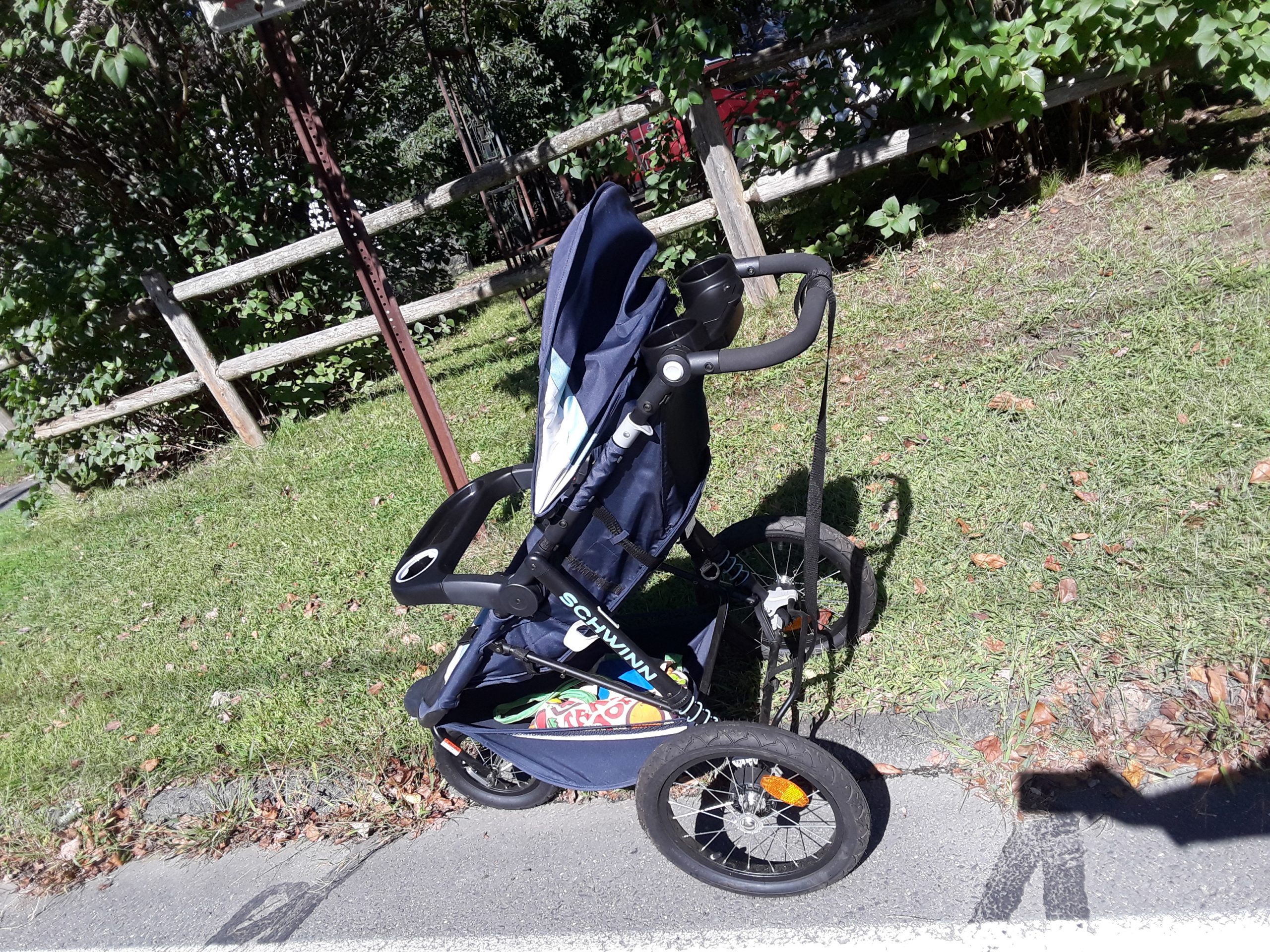
I stared longingly at jogging strollers all year.

I designed my own grocery conveyance, priced the parts, and realized I had just designed a jogging stroller and it would cost about as much.

I haunted Craigslist and Freecycle for weeks, until an add for a Schwinn jogging stroller popped up.

Shows cupholder bracket affixed to handle of stroller

Is that a cushy push or what? ?

And, guess what, it has pockets! — I mean, cupholders! (Cupholders are definitely the pockets of non-clothing items, say I.)

For once, I kept myself from saying *just how much* this means to me and why, because who wants to hear sob stories, right? I handed over the very reasonable sum, thanked him 4 times but not nearly enough, and sailed away.

Even though my legs are starting up the burning bones awfully quick today, in every other respect I feel like I’m walking on air.

I can pick my own *groceries*! OMG!!! And *get them home* with minimal further damage! WOOHOOO!!

Life is good.

Thank goodness for that sweet family who let this go ❤, and for craigslist.org for linking our complementary needs.

Planning ahead

I’m getting an allergy panel in a month or so. This means I have to be off my antihistamine for 5 days before.

THAT means I have to start tapering off ~2 weeks ahead of time; 3 weeks would be safer, but I don’t see how to endure over 3.5 weeks total with that level of obnoxious symptomatology and brittle physical fragility. 

That said, I *really* want the data.

You might ask, “Why?” (Or possibly, depending on how familiar you are with the twisted satire that is my health record, “WhyTF?? Are you *crazy*??” As if you didn’t already have a definite opinion about *that*! ?) 

Well, here goes…

Flash back to 2013

Years ago, under the tutelage of a late & very lamented friend who Knew Mast Cell Stuff like I know the back of my hands, I finally (in 2013) did my empirical testing around whether mast cell & histamine activation-like signs & symptoms I was struggling with, would respond to treatment. 

Step 1: reducing & eliminating competing problems

I had already gotten excellent neurological & biofeedback training, which worked well for many things (Go, Pain Psychologist Dr Faye Weinstein! I got tremendous and lasting benefits from my work with her. Highly recommended. “Stabilize, stabilize, stabilize.”) While I had excellent results from the neuro stabilization, it didn’t make much difference to the allergies, a particular “flavor” of brain fog, food & digestion issues, or the usual allergy circus of itching facial orifices & random urticaria.

The histological issues persisted most obnoxiously. This was 9 years ago when the mast cell activation diagnoses were not as well developed, and at a time that, though I had access to an enormous pool of well trained doctors, I was already up to my hip-waders in the maximum number of appointments I was able to keep. 

What do you think? Pursuing testing and inquiry into a set of issues that were still widely considered to be a matter of hysteria? — For a middle-aged woman with pain diseases and 60 extra pounds of weight, do you think *that* would have been a good use of my limited time? 

Smh!

So, I went empirical on it.

Two methods of science: “empirical” and “scientific” method

Both methods are scientific, in that they require diligent examination & limiting of variables as well as testing, retesting, and recording results accurately. 

(But hey, that nomenclature isn’t confusing, right? <eyeroll>)

It boils down to this: 

Empirical method: what works in this case in particular? 

Scientific method: what’s generally likely to work in many cases?

The empirical method of science is brilliant on a case-by-case basis, there’s nothing better; but avoid making assumptions beyond that case. The scientific method of science depends on hundreds, ultimately thousands, of cases, and from all those together, it generates statistical probabilities about what’s *likely* to work under certain circumstances as a general rule. It’s much more widely applied, but explicitly *not*  individualized.

This is why, as someone dealing with multiple rare issues, I test everything ~3 times on myself before deciding if it’s a good idea for my particular situation.

Now the next section will make more sense.

Right med, right dose, right time

I tried several antihistamines to see which one helped me the most. 

Then I experimented with dosing to see how much it took to get me functional most of the time. 

Then I experimented further with once-daily dosing, or dividing the dose in two and taking it twice daily. It had better results (and no “oog” feeling) if I took it twice a day.

In the end, I wound up on one of the top 3 meds for mast cell/histamine issues. I also wound up at the common dose for those with a solid case of Mast Cell Activation Disorder. (The twice-daily dosing was my own special twist, but I’ve since learned it’s not that uncommon among “masties”, as people with mast cell dysfunctions refer to themselves.)

Without any further ado, my doctors added MCAD to my list of diagnoses.

(As with every med and supplement, I continued testing it every 6 months or so, backing off the dose and looking for the minimum effective dose, but stopped doing this because of … we’ll get to that.)

But, frankly, a differential diagnosis doesn’t yield enough info to change anything causative. If I can nail specific allergens — or culprits — and receive treatments that can actually reverse this ghastly crap, that would be *great*!

So, I really want the data.

Histamines & tendon problems

I stopped trying to cut down on the antihistamines a couple of years ago, because I couldn’t bear any more injuries that threatened my mobility.

“Mobility? Huh??” I hear you ask.

One of the things the antihistamine helped with was tissue-tearing. I didn’t expect that, but was delighted not to be twisting my ankles on uneven ground or sudden jumps away from traffic, then having to crawl or scoot home because hopping on 1 foot when your tendons don’t work is a terrible idea.

As I thought about it, it made sense though…

Histology review:

Q: What happens when your histamines are active?

A: Among other things, inflammation in and around your cells.

Q: What happens when cells get inflamed?

A: Among other things, cell walls get weak and leaky.

Q: What happens when connective tissue cells get weak?

A: They tear more easily. 

Ah hah!

So, yeah, maybe MCAD could weaken my connective tissue after all — especially because, for one thing, I started out hyperflexible, which is a setup for these kinds of problems; and for another thing, the fibrosity of fibromyalgia has made my connective tissue more brittle & easier to tear.

Ducky! Another hat-trick! ??

Back to the testing

This is the test where they put a grid on your back and scratch or inject tiny amounts of different stuff into your skin. In about 20 minutes, whatever you’re going to react to should be a nice hot ruddy lump, technically a “wheal”. 

For this to happen, your body has to have nothing interfering with histamine reactions — in other words, no anti-histamines.

Since the antihistamine I wound up on has a long half-life, I have to be off it for 5 full days before testing.

Prepping for the test

Because going from full dose to no dose means I can barely get out of bed safely (see “Histamines & tendon problems” above), I have to taper down. I’ve done this before, usually to eke out my meds when my supply is running late. It’s familiar territory. 

Experience tells me that:

  • I have to taper at a rate of no more than 12.5% of my daily dose at a time.
  • I’m best off (in this terrible sitiation) stopping for 3 days at each new dose before the next step down.

This means that it would take 20 days to taper off to 0 (shorting the last step to 2 days instead of 3) *and then* 5 more days at 0.

Doing this with tissues crying, “Go on — tear me!” And every bite of food, breath of air, bit of furniture, bump in the sidewalk, or tussock of grass all giggling in evil tones (so to speak), eager to hear my muffled yells.

Yeah. Tasteless spoofing aside, that’s not a great situation to spend 3.5 weeks in.

Then, of course, as soon as I can horse down my meds again, it’ll be several days before I qualify as human.

Then, about another 1 to 3 weeks before I get back up to baseline function.

My Halloween costume will require very little makeup for me to pass as a zombie, so that’s one bonus.

What a month-and-a-half to look forward to!

Is all this really necessary?

Well… I really, *really* want the data. If this is at all reversible, wouldn’t that be worth a few weeks of howl-worthy endurance?

Obviously, yes… but I don’t think I could keep at it for over a month. I’m good at enduring, but I’ve got hard limits.

I really, *really* want the data.

Managing towards the best possible outcome 

My doc prescribed me some prednisone to take in order to avoid winding up in the hospital over this. I look at the results of my last round of prednisone — the change in my face and the truly shocking stretch marks (which made my dermatologists blanch and leap back, no kidding) — and I consider this truly last-ditch stuff. Beats nothing, I guess. It might keep me out of our ER.

There are dietary issues to consider. (What follows is a brain-dump from my years of querying doctors and reading, as well as my empirical food testing.)

Food matters: boost the signal

I know that the system being tested (mine) can respond more truthfully if it’s familiar with the molecule being tested. For instance, I haven’t eaten gluten in years, so this test might possibly come up negative to that. 

Doesn’t mean that, the next time I walk past a bakery without my mask on, I won’t get an itchy swollen throat and everything won’t turn white for a bit, it just means my body had enough of a break to stand down, and will need to re-arm.

With that in mind, I might grab a couple of saltines before I go in. If I could calm the gluten circus enough to just be safer walking around, that would be awesome.

Food matters: reduce the noise

I’m getting off the aged and fermented food, because that makes such a dramatic difference in my pain and swelling. This includes seafood and beef and anything packaged (look up what creates histamine in food).

Despite that, I’m making exceptions for things which I want to make sure my body has experienced in the month before testing — nuts, bananas, stone fruit, fish, grains in addition to glutinous ones, even beans — although that’ll be a period of gastroparesis hell, but this system must not be “bean-naïve” for the test.

Because I really, *really*, REALLY want the data. This is the kind of info that could change the course of my life for the better. 

For that, I can get through some serious struggle. 

Ramping down steeper

I’m going to go down 12.5% of my dose every 2 days, instead of 3. This will shorten the ramp-time to 2 weeks. Recovery might be a little longer, but I can maintain attention on what I’m doing this for, for that length of time. 

Until then, I’ve got a lot of cooking to do and a freezer to stuff with things that 

  1. Won’t hurt me more than absolutely necessary, and
  2. Will include exactly what I think I need to be exposed to, to maximize the value of the test. 

If you’re in a similar situation, remember that your mileage may vary. Ask your own docs, and then ask their nurses the same questions.

The differences in the answers tend to reflect the wholism that nurses work with, a nitty-gritty pragmatism that rounds out the more optimistic notional-ness that doctors can succumb to. Both views matter.

For only the second time in my life, I might do actual menu planning. I’m usually more of a “what’s fresh? What’s cheap? What’s safe? What’s appealing? Throw it in the pan” kind of cook, but that takes brain. I’d like to insulate myself from a potentially very brain-free near future and reduce my frustration over the coming month. Having easy-to-grab, safely frozen meals sounds fabulous.

Here’s my plan…

The grocery order just arrived, so if you’ll excuse me…

Wholeness is order

Many people have figured out before me that approaching life coherently, as a complex creature with inward & outward lives, as physical and energetic beings at once, and so on, is probably a really good idea.

I’ve spent years describing myself as a “text-based life form”, and “better in print than in person.” That was useful for a time; most of us need something to cling to, to carry us through, when we feel terribly broken.

This summer was transformative. I started it wholly committed to making my legacy; I’ve come out of it realizing that I’m very much alive, and that, if I’m going to get anything done, it has to be as a whole person — minding my relationships with those who can relate to me, minding my physical care as a loving duty rather than an intransigent puzzle, tending my crafts as sweetly as I need to be tending my recuperation, and so on.

Somehow, I’m absolutely certain that only in this way — and not in the head-first, head-down policy of my old working self — only in this way can I make meaningful progress.

Of course, that means it’ll take longer up front. But, as an old mariner, I’m well aware that prep is between 80 and 90% of the final result — so you take the time and do the prep, if you want good results.

I happily think of star nurseries (thank you, NASA , for this image), which look like glorious messes — but, from these, galaxies are born.

Logical? Well, not in any linear sense. Organically it works, though.


Seat-shaped rock in a shallow stream.

The Place to Be

On a rock in a river

Clean quiet murbles and shushes

everything Not Me drawn gently off

So easy.


Skeeters drift on, slackjawed with peace.

Dogs huff and slosh in the shallows,

Just going by,

In furry certainty

That happy playtime is normal

And right.


White white aspen tickles

Blue blue sky

And the birds zip

& comment benignly

up there.


The wet scent

Of contentment

Soaks to my marrow

And I’m finally


Still.

Seat-shaped rock in a shallow stream.

When momentum uses inertia

Wizard, with hat and staff, standing next to text of Tolkien quote.That last post, about acknowledging the shimmering sense of mortality I’ve lived with for nearly a year? Well, I kept meaning to post an update, but I’ve been having too much fun making progress elsewhere, and simply dropped the ball. I often think, “oh, I should post that on my blog,” and then – pain diseases being what they are – when I shift context to hop online, I’ve forgotten what it was and quickly get sucked into something else.

At the risk of using terms improperly, I found myself explaining this normality of painee existence as a sort of “acquired ADD.” As it happens, our brains get changed in the same places and pathways that ADD brains live in, so that our scans look amazingly similar. Those ADD-like symptoms are definitely not imaginary. I have found myself using adaptations very much like those I’ve read about in some of the terrific books on ADD. I recommend reading up on it. There’s a ton of helpful material on how to manage with and work around these attention issues.

I miss blogging. So, I hope to automate (or at least simplify) moving information here from social media. There are still interesting questions to answer, and I think that useful info we generate in pain groups should find its way to a more stable, searchable medium.

I have been sinking into this life, having acknowledged that inward message about its likely brevity. I’ve been here a year, and love my little flat more and more each day. I’ve been rearranging, creating more usable space within the same square footage. It’s delightful!

I keep the picture that reminds me of those who made this happen over the decorative fireplace, where it looks wonderful, and send grateful thoughts to its source/s – even when reaching out in real life only creates confusion and misunderstanding. We humans generally, and painees particularly, sometimes realize we don’t control how others receive us, but we can steer our own thoughts. So, I maintain this practice of gratitude, because that’s who I am and always have been, and wait for better times.

More health problems? Certainly! I will write about the gastrointestinal circus another time. I’m currently working on digesting a drink of water, and I’d prefer not to think about it until that’s done. This is the big, hairy, stinking follow-up to the first sign of trouble nearly 2 decades ago, which I wrote about (with disgusting toilet humor, inevitably) over at the post Intestinal Fortitude.

Apart from one misunderstanding and that additional body system, this life is amazing. Bit by bit, I’ve been getting a broader pool of professional and personal help and support. Bit by bit, I’ve been coming up with adaptations that bring more art, craft, and productive time into my weeks, although I have to be careful (of course) about changing tasks and changing position and managing time better than I really want to. For instance: “No,” I had to myself yesterday evening; “you don’t get to finish that row of adaptive crochet! I don’t care how pretty this is, or how soft the yarn. These helpful tools only improve my function, they don’t correct the problem! Put. The yarn. Down. Thank you.  Now go do something else.”

So I did.

And then I treated my right forearm with everything in my toolkit. And then I made myself promise not to pick up those tools for at least two more days, because that’s what it takes to recover when I’m forgetful enough to do crochet on a couple of consecutive days. Change those tasks! Figuring out a crafty solution is not as important as protecting tomorrow’s ability. Or even tonight’s. I can use myself hard, but I’m not allowed to use myself up. I don’t count on a ton of recovery time.

I’m back to using dictation software, in order to make better use of my arm time. The stylistic difference is clear to me, but it probably doesn’t matter. This is a good compromise to make, although it’s not necessarily an easy one. Dictation is a strange, slow way of speaking, and it forces me to think in chunks rather than in thoughts and words. But hey, it works!

Times are changing. Whether or not the current American president behaves any better, whether or not the next American president has the moral courage for fundamental changes, whatever, times are changing. My own possibilities are opening up, and I’m not holding back. I didn’t even know I was, but boy, things have changed since I stopped trying to eke everything out! I’ve got things to do, and I’m not waiting any longer to do them.

If I were more self-conscious, I’d throw in a bumper sticker-appropriate remark here. I’m out of ideas. I’ve got other things to do now. Maybe next time. Maybe. 🙂

Take care of yourselves. When you can’t, take care of each other. When you can’t do that, take care of your world. It helps.

Active presence

I love the term “radical presence” because it feels radical to jump the barrier of overwhelming emotion to land face-to-face with the moment and be able to look straight at it regardless. However, in practical terms it’s the opposite of radical — it’s conservative in the classic sense, because it puts us back into the realm of what’s demonstrably real and solid.

Therefore, conservative presence is the same as radical presence.

What a wonderful object lesson in putting political branding aside.

However, for the sake of clarity, I think I’ll start calling it “active presence”, as it usually takes an act of will.

When I was working as a nurse, an important part of the job was teaching people what they needed to know in order to go on better: dress the wounds, improve activity, improve nutrition, manage impaired systems (immunity, pain, respiratory), take care of relevant organs (heart, liver, pancreas, kidneys, gut, brain) and so on.

I’m sorry to say I was too idealistic at first and found myself being scoldy. The word “should” showed up a lot; worse still, “shouldn’t.” Argh! Words I’d love to take back!

I finally learned the key principle of teaching & training around life skills, especially primal ones like eating/drinking/moving: people have to start from where they are, not from where anyone, including them, thinks they should (ugh) be. The ideal is not relevant, only the real.

The first step, therefore, is to find out what that reality is, no matter how egregious. Their best hope of improvement is almost always in small, manageable steps, starting right from their current reality.

This led me to my first understanding of active presence: change has to start from this eating habit, this activity level, this degree of self management. No others exist yet! Trying to pretend they do only builds castles in the air.

However, I’ve seen patients of mine go, for example, from couch potatoes with snack-stocked shops and triple-bypass heart attacks to organic-grocery-owning half-marathon runners in a couple of years, by starting with tiny stepwise improvements: cardiac rehab class, to slow walks, and on up from there.

woman walking up beach, looking totally at home in her skin.

There are no guarantees (it’s easy to joke about people with great life habits getting hit by a bus) but hydration, nutrition, fresh air, and exercise tend to pay off tremendously– usually after a clunky adjustment period, as body and mind lurch through the initial changes.

Of course, the time that new habits take is going to pass anyway. Would you rather be reaping rewards at the end of it, or find yourself back in the rut that put you into medical care?

I’ve said exactly that to many people, with honest attention. This isn’t a trick question, nor is it an occasion for smarm. It’s a key question we all have to ask ourselves periodically throughout our lives, in one way or another. Everyone has the right to contemplate and answer that question honestly, even if the real reaponse is, “I like my habits/my rut, I see the trajectory, I know where it will take me, and I accept that probable outcome with open eyes.” I’ve had people say that, in tones varying from sweet concern for my feelings to roaring defiance. It’s all okay; it’s their call. I’d ask if they’re interested in cushioning their fall or minimizing damage to others, tailor suggestions accordingly, and then call their physician to adjust expectations and ask about/offer any ideas for mitigation over improvement. (It was never a total surprise to their doctors.)

As a patient, I have made — and continue making — complex changes in order to stay as well and functional as possible. I’m persistent like that. To me, being incapacitated is intolerable. I’d rather have better options.

“When you’re alive, anything is possible. It’s being dead that seriously limits your options.”
– Jodi Taylor

Active presence puts me on ground firm enough to step off from, and actually get somewhere. I’ve been living with a strong inward nudge to simplify, focus, and hurry up, because I don’t have much time left. It may be fallacious (I hope so), my subconscious working to override my “completion anxiety” about larger works. Given the accuracy rate of these deep, strong inward messages up to now, I’d be a complete idiot to ignore it. So, I’m simplifying, focusing, putting my ego (which is where this anxiety resides) off to one side, and buckling down on building the structure of my legacy in my head. I’ll discuss that more when there’s some output.

Dying is horrible. I don’t want to do that, ever. I’ve started to, a couple of times, and I’ve seen far too many loved ones go, especially those with these diseases. No words, no words for it… That said: Being out of this relentless, grinding circus of delicately-balanced tolerability, with horrific and likely further life-limiting consequences for certain mistakes? Really looking forward to being done with it! There will come a time — at some point, for me as for anyone — which will suck, and shortly after that, I’m absolutely certain there’ll be an end to this (extremely well-managed) biological terror and the unimaginably cruel pain that drives it.

I have this stubborn inner nudge that it’s not far off for me personally. That’s definitely NOT my choice, it’s the circumstance I find myself in. Without having wanted or chosen it, I somehow find acknowledging it to be hugely freeing!

That is intensely weird, I know. Also uncomfortable and maybe bitter and sad.

But that’s what is true for me, right here and right now.

From here, and only from this point in my often tortuous reality, can I move on.

I accept that.

Here I am.

Time for the next little step. Who knows where it’ll take me in the long run?

Let’s find out.