I got the Sydney norovirus right before it hit the news. I’m recovering, but slowly; the persistent low-grade nausea is annoying — and worrisome. I don’t want my body to get the idea that this is the new normal…
Brain plasticity is a major culprit in CRPS and its maintenance —
-
from the first refusal to cut pain signals off…
-
to the growth of the brain cortex area that monitors that body part, so it can handle more pain signals and provide less space for normal body areas…
-
to the deeper remapping and rewiring that alters cognition, disrupts memory formation, screws up autonomic signalling, knocks endocrine and digestive function out of whack…
-
and so forth.
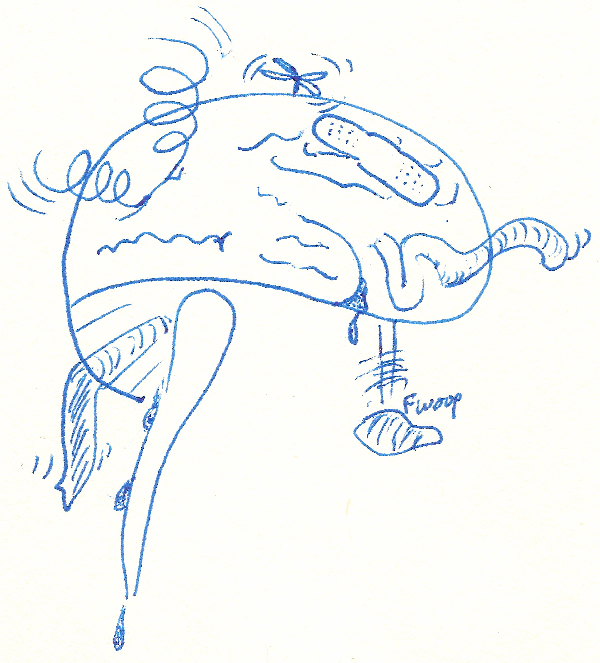
It’s important to stay on top of the brain, so to speak.
Thanks to the brilliant pioneering work of Dr. V. S. Ramachandran, we now know that mirror therapy and reducing-lens therapy can remap the brain’s perception of injured body parts to something closer to normal. That was a huge help with the pain, when I had CRPS in limited areas.
The reality-shattering concept behind mirror therapy is, basically, that conditioning can work in reverse: rather than allowing ourselves to be the passive objects of what our brain becomes accustomed to doing, we can push back against the brain’s alterations using our natural mechanisms of perception and intent. (The basis of Dr. Ramachandran’s discovery is that perception alone can provide the altering input. Intent gives it more focus, force and direction.)
The relationship between body, intention, and brain is interactive, multi-dimensional, and interdependent.

Having said that, it’s not completely reciprocal, nor is it ever under perfect control — unlike a good trapeze act.
If we could will ourselves better, then, given the extraordinary focus and determination of my fellow CRPSers, I know for a fact that we would have done so already. I never had met anyone with as much determination as me, until I met my core group of CRPS friends. If will alone were the answer, we’d have it!
CPRS is complex indeed.
Anyway… back to what we CAN do.
Communicating with the brain, in language it can’t ignore
The basic principle of RE-re-mapping the brain is this: describing to the brain, in language it can’t ignore (combining sensory perception and intent), what it should be doing.
In my Epsom bath article, I described rubbing a washcloth over body parts that have distorted perceptions and telling them silently, over and over again, “It’s just a washcloth. Feel just a washcloth.”
Where there is normal perception, or even nearly-normal perception, I stroke from the normal area to the abnormal area — never, ever in reverse! the brain understands the concept of “spread” — and tell my brain and body, with absolute focus, “This is what normal feels like. Feel normal HERE now. This is normal. Feel it here now. That is the correct feeling. It’s just a washcloth. Feel a washcloth.”
Not a burning sheet of sandpaper twice the size of my leg. Not a blunt sense of almost nothing, somewhere else.
A washcloth, right here.

When I’m doing this, I don’t even think about what the abnormal feelings are like; I came up with those metaphors just now, sifting through my memory. I shut the incorrect perceptions out of my mind and dismiss them, over and over, as obviously false information.
I have to take a break sometimes when the pain is bad and just breathe, but I don’t think about it, I focus on the point: learning to perceive what’s really there.
Vision, tactile input, kinesthesia (meaning that, as my hand and arm moves over the body part, my brain’s mechanisms triangulate on where things really are and its picture of my body gets corrected), and the focus of intent, are all part of the exercise.
This combination of factors is what makes it so effective. The multisensory inputs, the constant messaging of proper information, eventually overrides the false information.
Slowly at first, but with increasing pace, the normal sensation spreads over into the abnormal area. Every time. Not always completely or perfectly, but often both.
So far, I’ve reclaimed normal sensation in my back and most of my left leg, and I’ve kept the sensation and function in my arms at a level almost incompatible with the decade that I’ve had this disease.
Considering how bad things have gotten when I let this slide, the value of this exercise is clear to me.
Pruning your neurons intelligently
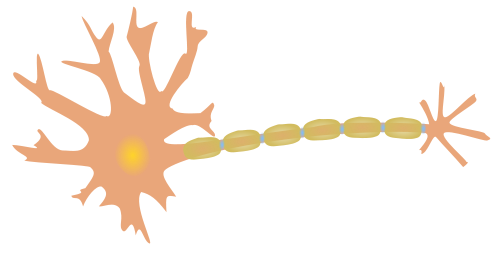
Learned responses are due to the basic learning mechanism in the brain:
- neurons hook up, and a connection (or association) is made;
- if the connection gets used (or the association is allowed to stand), more neurons hook up to make it stronger;
- once enough neurons have hooked up, the connection becomes like a good road;
- and the thing about good roads is, they get used, even if they’re used for something odd.


It’s important to manage the roads in your brain, especially when you have a neuro-plasticity disease like CRPS:
- Make sure the roads in your brain are useful to you.
- Do that by pruning the connections you don’t want.
- Prune those connections by letting the associations die.
- Let a connection die by deciding to think about, or do, something else, whenever it comes up.
Consistently. Persistently. Relentlessly. - And keep making that decision every time it comes up.
It works by a negative, which is not how we are taught to do things: turn away from the response, shut out the perception, ignore the link. That’s how you prune an unhealthy connection.
It takes time, but it works. The time will pass anyway, so your brain might as well be better off at the end of it…
Masters of distraction
We CRPSers are masters of distraction — not to mention the kind of persistence that this pruning takes. We can learn to be diligent about applying it to sensory associations we don’t want. This is where ADD, used selectively, becomes truly — oh look! Yellow feet!
… Wait, what was the connection I was about to make? I’ve forgotten.
See? It works!
The joy of having a bit of ADD and being a meditator is, you really can choose when and how to let out the ADD — as long as you do it often enough. It’s a great tool, and I’m grateful for it.
Pruning specific sensory and functional associations
I’ve had recurring nausea for months now. It’s related to upticks in stress, of which I’ve had more than an elegant sufficiency in the past year.
Then there was this tummy bug…
It’s day 5 and I haven’t vomited in 3 days but I’m still nauseous. While this bug is supposed to leave one nauseous for quite some time afterwards, I really don’t want my brain getting the idea that sending nausea signals is going to be the new normal. I’m not going to let the nausea become habitual. So I’m pruning those connections.
I can’t will nausea away, as it comes from quite deep in the brain from a primitive place. And, unlike pain, distraction doesn’t help much for long.
So I’m balancing the use of ginger (short acting, “hot i’ the mouth”, sugary) and anti-nausea meds (long-acting, makes me slower in brain and gut) to shut down the nausea for a good part of each day.
This means I’m not nauseous for a good part of the time. This helps retrain my brain away from constant nausea by letting the relentless association, and the neurons that make it, die off. I’m going to keep after it over the expected week of recovery still to come.
 |
| Only constructive connections, please. |
That’s one example. It doesn’t take much thought or mental discipline, just persistence.
My lovely friend X has a recent example of something different, an obviously inappropriate new association being made.
She multitasks, making full use of her functional time. When she was eating, then turned aside to the plastic phone or plastic computer to respond to someone, then turned back, her food suddenly tasted and smelled like plastic.
That is a very errant association indeed. Prune it!
She is now putting aside the laptop and turning off the phone while she eats, so the association doesn’t develop further. Moreover — and she may have just enough ADD to pull this off — she hopes to be able to switch her attention immediately when the plastic taste pops back into her — Look! Yellow feet!
 |
| Egrets make great distraction, especially in funny socks. |
It takes time to let those connecting neurons die, but if you get on it quickly, as X did, it can turn around pretty well and pretty quickly.
The Principle of Primal Exclusivity
This is simpler than it sounds. It’s the opposite of pruning.
When you’re doing something really basic (or primal), like eating or drinking or sleeping or running or sex, keep your attention basically on that activity. It helps keep your brain straightened out about those things.
You really don’t want them getting bollixed up, because rewiring primal functions takes more work to undo.
That’s one reason why insomniac advice is about having a calming bedtime routine and sticking to it: it’s retraining the brain around a primal activity. The brain needs absolutely consistent signals over a period of time, to retrain successfully.
Incidentally, sex (alone or together) is the only activity that (ideally) engages both sides of the autonomic nervous system: arousal is mediated by the sympathetic nervous system, and orgasm by the parasympathetic nervous system. It provides a balancing mechanism I can’t think of occurring in any other sphere of life. Done properly, it could be the perfect autonomic tuning tool…
And with that happy thought, I’ll leave you to wash your hands against this norovirus and do whatever seems best.