The Bean Dip Response, companion to the Spoon Theory

Those of us with crazy-bad illnesses appreciate the stroke of genius from Christine Miserandino, who originated the Spoon Theory to explain what it takes to get through the day.

For the most part, though, we shouldn’t have to explain much. Wouldn’t it be nice if everyone could get that memo?

To that end, here is a great article by family therapist and parent counselor Joanne Ketch on parenting boundaries, using the Bean Dip Response: http://www.joanneketch.com/ParentingChoiceBoundaries.en.html

With her permission and kind support, I’ve revised her article to reflect the realities of the chronically or severely ill. Please feel free to print out/pass on, with credit to her embedded as it is in this text.

Here’s my version…

Health Management Choices – Boundaries

A long time ago, as a developing patient educator, I found many chronic patients uncomfortable and frustrated with unsolicited advice – or inadvertently soliciting advice and then feeling uncomfortable with the discussion that followed.

Eventually, I read this great article on boundaries that eventually become known as “The Bean Dip Response”, “Pass the Bean Dip”, or even used as a verb: “bean dip” someone.

I rewrote the article from the perspective of a chronically ill, alternative-using or drug-disabled patient (one who can’t use common meds for the condition because of uselessness or devastating side-effects) – but the principles are transferrable to any constellation of health management choices.

The Bean Dip Response is best used when you don’t need to defend or don’t wish to engage with a person over a health management choice. If you are discussing issues with a person and you welcome their feedback, the Bean Dip Response is not needed.

I’ve found that chronic patients may confuse boundaries while trying to convince someone of the rightness of their choices. The best thing is to assert your boundary, rather than defend your choice. Your choice needs no defense.

Health management choices should be on a “need to know” basis. Most people don’t “need to know”. Since medical information is highly confidential, it’s NOT incumbent on you to explain yourself to those who don’t need to know. Those who need to know are essentially you, your doctors/providers, and your designated decision-maker for when you can’t make your own decisions.

If anyone else asks, "How are you sleeping?"
Answer: Great! Thanks for asking! Want some bean dip?

"Are you sure you should get picked up every time your legs flare?"
Answer: “Yes! Thank you! Want some bean dip?"

"When do you plan to wean off those meds?"
Answer: "When it's time. Thanks! Want some bean dip?"

"You should use my aunt's hairdresser's physiotherapist's product. It cleared up her [symptom du jour] in two weeks."
Answer: "That's great! I'm happy for her. Want some bean dip?"

Now, with some people you will need to set firm boundaries. The offer of bean dip won’t be sufficient to redirect them [I can’t imagine why not. -ed.] They either don’t respond to gentle redirection or they have emotion tied to the issue and a desire to “go there” more deeply. You may be able to anticipate this – if it’s a pattern of intrusion, for example, which you’ve seen in other circumstances.

In such a case, a stronger “Bean Dip” response may be needed. In these cases, the redirect will need to be backed up with action (like hanging up, leaving the room, or even unfriending them).

Remember, boundaries are not about forcing another person to comply. You cannot “do” that. Boundaries are about what YOU will do or not do. You are the person you own. You don’t own them and they don’t own you.

Practice kind but firm responses: "I know you love me and want to help. I am so glad. My health choices have been researched and made. I won't discuss it again.”

Don’t confuse setting boundaries with trying to convince someone of the rightness of your choices. It’s a common (and understandable) desire to present the same information that led you to your choices. The problem with that in dealing with a person who has boundary issues is that engaging with content invites discussion. (Also, different people’s minds work in different ways, so your train of thought may make no sense at all to them. Wasted effort all around.)

Chronic patients often struggle with this.

The boundary is that no one else has an inherent right to tell you how to take care of yourself.

You set boundaries by doing the above: acknowledging what they said and redirecting.

Where the chronically ill may invite problems is by citing authors, studies and sites to “defend” themselves. Each time you do so, you create more time for discussion and rebuttal and send the message that your decisions are up for debate.

Don’t defend your choices beyond generalities, and then only once or twice. “My doctor is in support of my choices. Want some bean dip?” Or maybe, “Well, this is my decision. Want some bean dip?”

If necessary, look them in the eye and say simply, “I want us to have a good relationship. I want to enjoy my time with you. I’ll take care of me, so that we both can make the most of our time together. Let’s not discuss this anymore. If you bring it up again, I will have to ask you to leave.”

Finally, an important corollary to the “Bean Dip Response” is reciprocity. Once again, the content of your choices should not dictate the interaction.

You may be totally, and correctly, convinced that you should be able to determine your own activity, medication, and supplementation regime; never be left to “cry it out”; and should be allowed to follow your own weaning path, if any.

But, if you post those opinions on Facebook (or communicate them in other ways), you invite (and therefore solicit) feedback and advice. Post accordingly and respond to comments with that in mind. You need to give the “other side” the same respect that you expect to receive.

Credit for original: Joanne Ketch, MA, LPC, LMFTa, LCDC
http://www.joanneketch.com/ParentingChoiceBoundaries.en.html

For those of us who are chronically ill, there are people we DO need to explain ourselves to. However, these are mostly highly educated people with specialist training, and that makes it a short list indeed.

Our loved ones may believe they want to understand, but, as my mother finally admitted, “I don’t think I really do want to understand what you’re going through. I couldn’t stand to know how much pain you’re in and how rotten you feel all the time. It would drive me crazy, knowing that.”

But, hoo boy, does she ever respect my boundaries! That’s worth the world. It makes everything open and clear between us, and our current relationship reflects that.

When someone confesses their limits to me, I take it as a gift. They have told me how to protect our relationship and how to move forward with it. I appreciate that. With that subject opened, we can move on to discuss how, or if, they can connect with me in a way that works for us both. This is priceless information. I’m glad my mother had the courage to open that can of worms, because then it got very manageable very quickly.

For an ever-changing kaleidescope of visual delight, check out my Mom’s photography from all around the world at http://jldtifft.com/

Just like Hemingway (no, really)

I read, years ago, something from Ernest Hemingway about his process. (I can’t wait to see which of my literary friends will be able to tell me where he wrote this.)

He took off, for months or years at a time, to live. In his terms, that meant running with the bulls, or falling down mountains, or shaking his sweat off into the sea. He had what most of us would call adventures, big hairy spans of eventfulness, in which he’d get immersed past the reach of words, and soak up sheer experience.
boat-bittenbycrocodile
He said, mindfully, that it took weeks or months to regain his command of his wordcraft, but if he didn’t take the time out from writing in order to take time to live, there would be nothing to write about.

Needless to say, I’m envious that he had the choice. Lucky swine.

It’s safe to say that I’ve been living — if not in Hemingway’s terms, then certainly in my own — occasionally even past the reach of words, or at least past the desire to use them.
me-fingers-2up
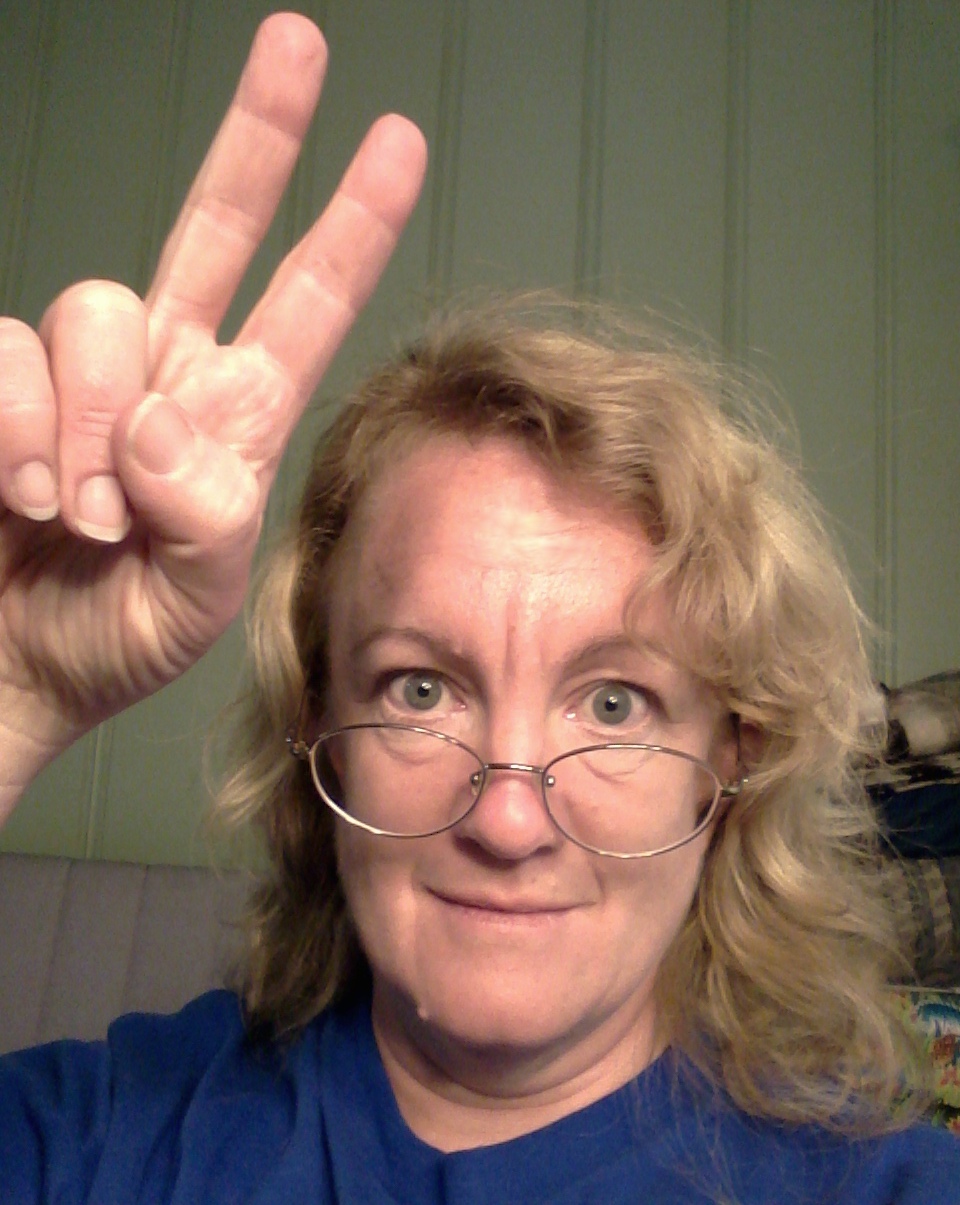
Some experiences are beyond words, but not beyond gestures.

Some things are a lot more entertaining in retrospect, and if it takes a few weeks or a few months to be able to write about them in the way I want to, well, the time will pass anyway.

Meanwhile, we are working simultaneously on getting me back my brain and getting darling J back his heart. Both are turning out to be a bit trickier than we’d thought.
sketc h of excessively happy doctor running with a hypodermic needle

I’m sorry, Dave. I’m afraid I can’t do that.

Interesting metaphor for this, um, ratfink disease.

Interviewer:
HAL, you have an enormous responsibility on this mission, in many ways perhaps the greatest responsibility of any single mission element. You’re the brain and central nervous system of the ship…

Poole:
Unfortunately, that sounds a little like famous last words.

I had the pleasure of explaining CRPS to a doctor who isn’t mine, who really wanted to understand. After listening to me for 15 minutes nonstop, he summarized it perfectly.

He said, “It’s a bit like HAL, in 2001.”

I asked if I could borrow that.

I’ve culled movie quotes off the web and my CRPS compatriots can say how breathtakingly parallel they are. In no particular order:

Dr. Frank Poole:
… That would pretty well wrap it up as far as HAL was concerned, wouldn’t it?
Dave Bowman:
Well, we’d be in very serious trouble.
Frank Poole:
We would, wouldn’t we. What the hell could we do?
Dave Bowman: [sigh]
Well, we wouldn’t have too many alternatives.
Frank Poole:
I don’t think we’d have any alternatives. There isn’t a single aspect of ship operations that isn’t under his control.

And that, ladies and gentlemen, is the central nervous system in a nutshell.

Dave Bowman:
All right, HAL; I’ll go in through the emergency airlock.
HAL:
Without your space helmet, Dave, you’re going to find that rather difficult.
Dave Bowman:
HAL, I won’t argue with you any more! Open the doors!
HAL:
Dave, this conversation can serve no purpose anymore. Goodbye.

We’ve all had that happen!

HAL:
Just what do you think you’re doing, Dave?

Um, trying to survive?

[Regarding an apparent problem which HAL itself falsified]
HAL:
It can only be attributable to human error.

Swine. YOU did this, CRPS!

HAL:
I know I’ve made some very poor decisions recently, but I can give you my complete assurance that my work will be back to normal. I’ve still got the greatest enthusiasm and confidence in the mission. And I want to help you.

This reminds me of the “you have CRPS because you think wrong” school of thought. Right… thanks for the help… next time, suck the oxygen out of my atmosphere; that’d be a real help.

Dave Bowman:
Hello, HAL. Do you read me, HAL?
HAL:
Affirmative, Dave. I read you.
Dave Bowman:
Open the pod bay doors, HAL.
HAL:
I’m sorry, Dave. I’m afraid I can’t do that.

Because sometimes this system seems to get input, but it just won’t generate any output.

On providers trying to assess from outside:

Mission Controller:
X-ray delta one, this is Mission Control. Roger your two-zero-one-three. Sorry you fellows are having a bit of trouble. We are reviewing telemetric information in our mission simulator and will advise.

On trying different treatments:

Dr. Frank Poole:
Let’s see, king… anyway, Queen takes Pawn. Okay.
HAL:
Bishop takes Knight’s Pawn.
Frank Poole:
Huh, lousy move. Um, Rook to King 1.
HAL:
I’m sorry, Frank, I think you missed it. Queen to Bishop 3, Bishop takes Queen, Knight takes Bishop. Mate.
Frank Poole:
Huh. Yeah, it looks like you’re right. I resign.
HAL:
Thank you for a very enjoyable game.
Frank Poole:
Yeah, thank you.

Yeah, thank you. Sooooooo much.
me-fingers-2up

This movie says everything you need to know about what it takes to deal with this disease:

  • It’s hard. Breathtakingly hard.
  • We don’t really know where it came from, and we really don’t understand why.
  • It’s crazy, and it does its best to make us crazy — and those around us.
  • It takes away more than we knew we had to lose.
  • We have to out-think it, even though it seems to stay 3 steps ahead of us.
  • Persistence — unvarnished, absolute, bloody-minded persistence — is key. Even when you feel you can’t, take a breath and make the next move. Keep working.
  • It seems impossible. It’s a harrowing thing to face, and has killed so many of us, in different ways.
  • It sabotages our efforts to improve things.
  • It’s worse than we could have imagined.

It really is like HAL.

So … Let’s remember who won.

Now a bit of Youtube for dessert, and a hopeful image for all in search of remission. Let’s pop those modules, one by one.

Being clear about being grateful

We visited our favorite hot springs last week. There’s a hot pool that’s very hot indeed. When I alternate between that and the cold pool, preferably dipping several times, it becomes quite a fabulous experience.

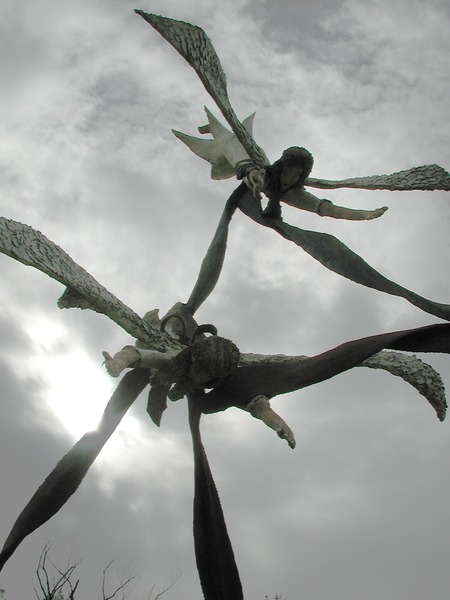
Stone angel with hands clasped in prayer, standing on a pillar, sun like a glorious halo
Halleluiah!

Whether it’s the lymph getting going properly for a change, or toxins (the few that are left) getting sucked out of my system, or my autonomic system finally getting a clue and just taking a break, or possibly all that and something more, I have no idea. But it can be really good.

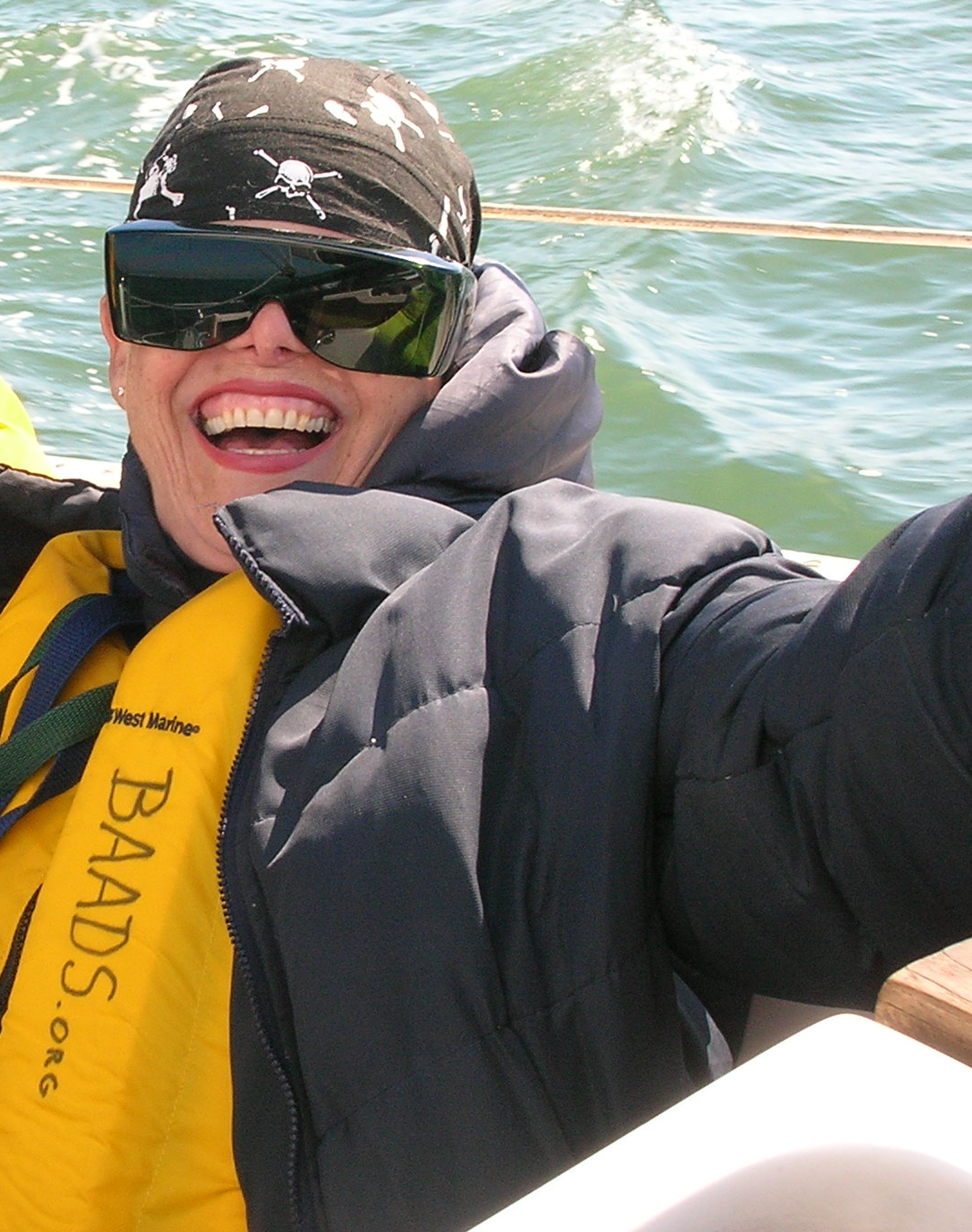
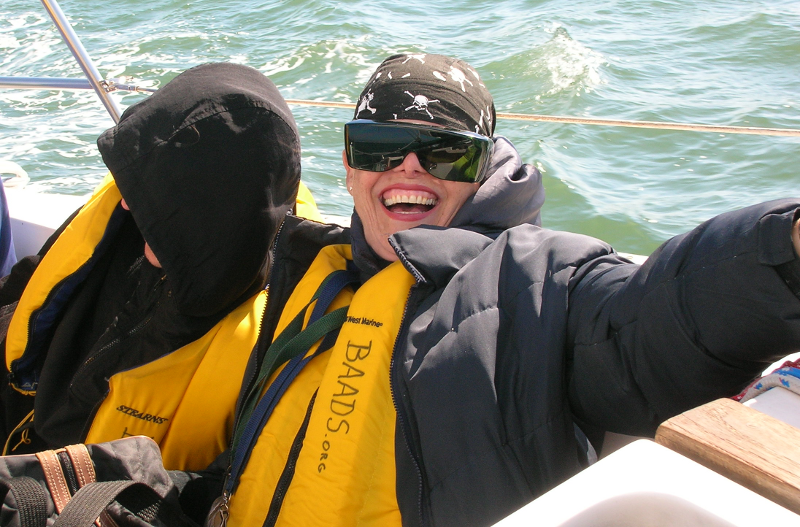
gleeful woman grinning, sitting in a sailboat cockpit, sunny water behind her
REALLY good!

I did my dips and bounced gently on the balls of my feet in the hot pool, overflowing with something like gratitude. I’m no fool (I just take an off-road approach to life) … offering gratitude works, even with a conception of spirituality based more on quantum physics than religious dogma.

Things go better when I’m classy enough to express whatever gratitude I feel.

However, it has to be “true enough to write,” my ultimate litmus test of sincerity. (That really is my key phrase when I’m thinking about truth, writing, or both.)

George_Goodwin_Kilburne_Writing_a_letter_home_1875There’s no fooling the All, because I’m part of it and I know the truth, even when I don’t want to.

Letting my head fall back into the welcoming warmth, I thought a moment, letting the feeling swirl through me like water.

Grateful for my life?
I have to be honest (though it may mean I have an inferior soul or something) … I’d love to be. I think that somehow I ought to be. But really, when you get right down to it… too many caveats.

Grateful for this day?
Well, y’know, there was too much of the day left that could go wrong. Experience has been too strong a teacher to make me grateful for something before it’s in the bag.

Grateful for this moment?
Ah yes, there we go.

I felt my spine let go of the last knot.

I could say, without hesitation and with perfect integrity, that I was definitely grateful for this moment. Completely, unwaveringly glad to have it. I was truly thankful for that heavenly bit of space-time I’d found myself in.

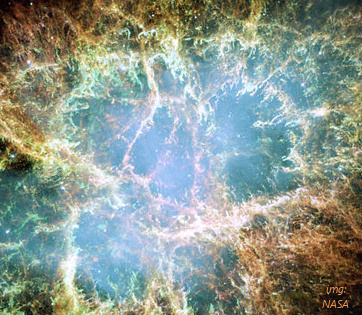
Crab_Nebula-crop
Heavenly, beautiful… grateful for it

The moment stretched and smiled and wrapped me in blissful arms. It made me stronger and more content, and I faced the bumps and mild insults of the rest of the day with fairly unruffled peace.

It turned out to be a good day. A day to be grateful for.

Persistence, chronic illness, mortality, and other perky subjects

I’m recovering from packing and moving to my homestead. [I’m sorry to say that I don’t have internet yet, and the library’s uplink is slo-o-o-o-ow. Images will be filled in once that’s corrected. In the meantime, you get to see how I flag where the images will go.]
[img]
The cat is ecstatic. He’s getting muscular, too. He’s bigger than most of the cats I’ve ever had, and he’s only 8 or 9 months old. J is falling in love with his saucy sweetness — they’re a well-matched pair.

It took a week just to be able to think in a straight line again. I’m still very slow, but improving. Breakfast is my best meal, so I try to make it a good one — my stomach is not nearly as happy as the cat about all this.

Yesterday, as an aid to recovery, J and I went to the nearby hot springs for steaming and soaking.
[img]
We usually get nicely parboiled in a couple of hours, but I got horrifically dizzy going from the hot pool to the cold. Usually it feels terrific (one reason I keep going back) but I think I stayed in too long — 2 whole minutes… When I was able to see, I noticed that my skin was bright red; I touched it, and it was as hot as if I had a fever.

That’s the hyper-reactive response we get with a twitchy autonomic nervous system (ANS.) This is why we don’t ice our injuries with most forms of CRPS.

All my skin’s blood vessels spasmed with the cold, then the spasming set off an alarm in my wackadoodle ANS, and my ANS ordered all those peripheral vessels to open wa-a-a-y up.

What does that do? Sucks all the blood out of my brain and out into my skin, that’s what. Result: dizziness to a frightening degree. J helped me get out of the pool without drowning, and got me safely benched.
[img]
I realize I tend to overestimate my capacities, but that really was a first for me.

Periodically — and with increasing frequency — I get FED the heck UP with having these diseases — CRPS, FM, MCS, POTS, GERD … I’d have to be a British peer with medals and degrees to have that many letters after my name, in any other context.

These diseases are not recreational. They don’t just pop in, have a good time, and then take off.

They’ve moved in. They’re here for the long haul, or at least that’s what they seem to think. They take the concept of “persistence” to a whole new level.

It reminds me of something… H’mm. Oh yes.

In February 1999, I got a phone call at 4:10 am from my stepmother, telling me my father was dead. I still remember the way the word “no” kept echoing off the walls, until I realized it was me who had cried it out. I won’t describe the next few weeks, except that there was a lot to do (he had died in Egypt) and I learned a lot about the people in my family (interesting, not worrisome.)

After a few months, when the acute grieving was more or less behind me and I could drive safely and notice the birds and sunshine in a more normal way, I found myself unconsciously expecting him to be alive again. As if dying of a double heart attack face down in the water was like a curable cancer, horrific but eventually over. Then I’d catch myself, and that awful “no” would stab through me again.

There was a part of me that just could not get the permanence of death.

I haven’t spoken to anyone who has had this same experience. It may be so peculiarly daft that it could only happen to a wing-nut like me.

Death, take a holiday? Only in a Terry Pratchett novel.
[img]
Over the next couple of years, I had plenty of opportunity to come to terms with the persistence of death, as I was bereaved of friends and extended family about once every other month. None of them came back.

I don’t recommend it.

And this is where Walt and Pogo come stumbling in from the past:
[IMG: “don’t take life so serious, son, it ain’t nohow permanent.”]

It’s impossible to have a rotten, devastating condition and not face my own mortality once in awhile, if only because the blank spot that bereavement leaves in the world sometimes seems better than this mess. And it’s a persistent mess, too.

The real question is, is it just as persistent as death? Will there really be no end to this? The poetic injustice is, that question might not be answered until my ashes melt into the sea.

There are good times and strong times and, of course, I’m almost constantly panning for those nuggets of gold, so don’t worry.

It’s just that anyone vile enough to stick a gun in my ribs and say, “Your money or your life,” is going to have to hold me up with both arms, I’ll be laughing so hard.

Nice work, Clint, but I think me and my cohorts could top this delivery…

Anagrams and T-shirt designs for the irreverent

This started when someone posted a t-shirt design that said, “RSD: Really Sucky Disease.” (RSD is the old name for CRPS.) I thought that was a wonderful way to recast it, and a good conversation starter. So that got me going on CRPS.

Enjoy — and please, feel free to add more…

Complex,
Ridiculously
Pathological
Situation

Complete
Range of
Painful
Sh!t

Craving
Really
Priceless
Science
(that’s a thinly-disguised commentary on how profitable it is to treat CRPS)

Curative
Routines
Pressingly
Sought

I could go on, but I won’t… I’m looking forward to seeing what others come up with.

What would you wear? And what style of shirt would you like to wear it in?

Here’s another idea I had:

Pale blue women's T-shirt with "C.R.P.S.: like craps without the A", and the A is painted on half a pair of dice.
Text: C.R.P.S. like CRAPS without the A.

In one version, the back says, “Complex Regional Pain Syndrome: It’s weird. It’s random. It’s harsh. IT’S REAL.”

But that’s a little discouraging.

I’ll work on it.

It’s a different world in here

TRIGGER WARNING: Body image. With a twist.

I feel like I’ve been inflated. If I get any larger, I may collapse in on myself and form a neutron star — possibly even a black hole.

"Portrait of the Quasar as a Young Black Hole" from NASA's Hubble telescope
Charming, eh? And round.

My pain psychologist isn’t worried. She thinks there’s nothing wrong with “a little comfort weight”, especially as I’ve been making such progress in her area.  Of course, she has a slender elfin figure herself.

This isn’t the usual rant about weight and health, or the girly American whining about fat. This is about living from the inside out, and what happens when my physical vehicle takes up a whole lane.

Nursing has a diagnosis called, “Body Image Disturbance.” Take a look at that phrase for a minute. It’s very telling.

Body
Our physical interface with the world; the medium we use to communicate with others; the first sensory impression we get of our surroundings; the complex organism that gets us from one place to another; the thing that gives others their first sense of who or what we are.

Image
Our mental framework, or paradigm; the belief or understanding we have about our presence or effect in the world; the way others tend to think of us; the way we think they think of us.

Disturbance
Something awry — probably disturbingly so. Not good.

Do we need to address the usual social issues? Yes, skinny people get treated better, all across the board; fat people are far more likely to get abused and overlooked, and not just for sex — for everything. Lots of people have made lots of money writing lots of books about that, so read them if you’re confused.

Let’s move on.

I’m in a different sensory and physical world from what I’m used to, and it’s a really strange one. The experience of physical life from this different shape is, yes, disturbing.

My feet are pressing so hard against the ground that my shoes fit differently.  When I carry something, it pushes my weight over the tolerable limit and threatens to bring the CRPS in my feet back to life — and I had just about gotten rid of the pain symptoms there. The circulatory symptoms are another matter — zombie-foot is a regular event.

My cat floats above me by quite a few inches, when he should be lying more or less on my abdominal muscles plus a blanket of padding.  It’s weird to have to reach so far up from my spine to pet him — my shoulder rotates much further in my cuff than I’d expect. I’m getting better at feeling my joints, and this is not exactly a positive feedback loop.

My upper arms keep catching against my sides. This is rather disorienting, since I’m improving my sense of my body in space and usually, when my arm catches on something, it means I need to increase the space between me and foreign object. There’s no foreign object. It’s just more of me. Weird.

I had a sway in my lower  back which I managed to straighten out awhile ago. Better spinal posture means less pain overall. So now I have a substantial, unstable weight hanging in front of my spine, which means I have to work my abdominal muscles really hard to pull it closer to my center of gravity so I can just stay in balance.

My abs are killing me. If I don’t use them, my lower back hurts me worse, so those abs are constantly on duty.

I give them a break and relax them when I sit down — and it’s like being on top of a balloon that inflates, as my stomach takes over the lower horizon.

balloons-innflating

I poke it curiously, wondering how far down I have to go to find the original outline. I give up at the second knuckle. Too discouraging.

When I sit in my car, my right hip brushes against the driver’s armrest.  First thought: I’m over too far to the right; my hip shouldn’t be near that. Wrong. I’m dead center. It’s my hip that has travelled far.

But there is an up-side. When I fold my hands together, I have a perfect armrest. Soooo comfortable. It’s like it was made for me!

And the stares I used to get — or rather, that my endocrine-disrupted DDD cups used to get? Gone. No wolf-whistles or dribble on the sidewalk from creepy slimebuckets who seem to think I should be delighted at their lack of self-command. Nobody’s goosed me or grabbed a feel in ages!

It’s very peaceful. Makes it a lot easier to feel at home in my own skin, not to be bracing for the next random invasion of privacy.

I’m no longer constantly holding a sharp elbow at the ready, to fend off some suddenly-clumsy dude who goggles briefly, with a word-balloon appearing above his head that says “are those real?”, then says “oops” and bumps into my pneumatic (and sensitive) form as if by mistake. I got so freakin’ tired of that!

Perhaps a leather vest with spikes all around…

myvest_front_med

This, incidentally, is why so many women feel  comforted wearing a burka. It makes the wearer more sexually invisible and insulates her from much of this random predatory crap.

My fleshly burka. Take that, right-wing-nuts — of any religion. You don’t even WANT to control this.

And, in a huge relief to my CRPS-riddled body, nobody wants to slam into it now, either. Yesssss!

I’ve got to get that vest. I can’t, and don’t want to, keep the fleshly burka, but I have to find a way to manage the body-slams. Never again.

As for food… Here’s what I’ve learned for the current incarnation of CRPS endocrine/digestive ballyhoo:

– No grains of any kind. No lentils or beans.
– No dairy, except small amounts of hard cheese — the protein sufficiently altered that I can handle it in small doses.
– No sugar at all, but more unrefined stevia.
– I’ll have to get kefir “grains” and make my own water-kefir. I have some ideas for that.

I still have most of the world of nontoxic produce, nuts, and meat from healthy animals to sit down to. There are worse things… It isn’t cheap, but I’m learning where to shop. And it sure tastes good.

P.S. You want what?? Measurements, weight, photographs? They miss the point. I’m not looking at me, I’m looking from me.

I’m not comparing myself to anyone or anything. This is simply the view from inside. Hope it’s worth a laugh or two 🙂

The wall, redux — with demons on the side

Sooner or later, deep and chronic illness (like, oh, let’s take an example at random, CRPS) will bring you face-to-face with your worst demons. It’s only a question of when, and precisely how.

When I came to adulthood, I realized that I felt a powerful need to earn my right to take up space and breathe the air. You’d think I’d be a cringing slave with that underlying attitude, but I wasn’t. I felt I deserved good pay, reasonable work/life conditions, and common courtesy, because that was fair; I just didn’t deserve to live.

Once I could no longer work, but had to fight like mad to live, this was a bit stressful. Like many, I almost didn’t make it. But then, as the very deepest trough began fading into memory, I noticed that something remarkable had happened.

Rewind about 10 years… I was a nurse for eight years, which put me in a critical relationship to others at critical points in their lives. I might have dealt with 10 patients in an hour, but, in the moment that I was dealing with each person, that was the most important person in my life. I may have coded hundreds of people, but every life I fought for, I fought for with all I had.

There were no caveats or conditions: if you were my patient, you had my absolute attention every moment I was with you.

I think this healer outranks me, but you can see
how focused he is on his patient. It’s like that.

I found that it’s impossible for me to work hard for someone’s survival, and not come to care about them – no matter who or what they are.

Fast forward to where we started, after the deepest trough, around early 2010… I had spent several years increasingly incapacitated, used up all my money, all my favors, all my savings, and lost a lot of friends – some of them to the Grim Reaper.

I won’t go into the brutal and abusive bureaucracy of California EDD or Oakland Social Security offices, because if you haven’t been through it, you wouldn’t believe me. That bad. Worse, even.

I woke up one spring day, with a strange sense of dawning inside. It took an hour or two to wake up, and to realize that I’d been fighting so hard, for so long, for my own survival, that I had become important to myself.

I no longer felt I needed to earn the right to live.

Ever since that time, I’ve never had a serious case of any kind of block – writer’s block, self-care block, learning block, anything – that lasted more than a couple days, unless it was explicitly disease-related.

Then, with this move to a strange area, with no connections, near a city I almost loathe… To get real care, for the first time in years, from seven highly skilled and capable professionals…

I hit a wall. Not just a block, but a huge, massive, precision-crafted, towering, deeply bedded, gateless wall.

Since writing “Frustration at the wall“, I’ve been faking it in the hope of making it. That’s a lot of weeks to keep running up against the same damn wall!

I finally started talking about it – I’m a writer; I’m a woman; I process by words; let’s move on – and began to get unscrambled. Then I had the deeply disconcerting pleasure of having my brain picked apart, cleaned with a dental pick, and neatly reassembled by the deliciously incisive Dr. Faye Weinstein. 

I can’t help thinking that the following is going to strike a few chords with some of my lovely readers…

I am, as she said with characteristic precision, “a helpful, compulsively self-reliant minimizer.” Really, why should I trust these people, who wield the power of Gods over what happens to me?

There’s a deep part of me that says “blow that, let’s go hide instead” and off I go, hiding behind advising on Facebook and diving into books and catching up on others’ crises; my condition is not that bad, so my care is not really that important, and it’s not like these people care more for me than their own crap anyway, so I’m on my own really.

My distraction activity is all very worthy, so I needn’t justify it. But, well, so much for the many new things I need to do to put together my own health…

Unconscious reactivity could be the death of me yet.

I said this illness would raise all your demons, even the ones you’ve hammered a stake through the hearts of. It turns out that the squat and fetid cranks who propped up my old conviction that I “don’t deserve to live” are still there, farting wetly and hawking loogies.

With apologies to Heironymous Bosch.

The demons of our earliest perils can shape our responses to major change forever. The trick is to see them for what they are, face them honestly, and put them back where they belong: in the past.

(Easier said… I think a booger just landed in my hair. At least, I hope it was a booger.)

To add to that, with years of excruciating work behind me and more ahead, my old motto of “change or die” doesn’t carry the same weight: Yes, part of me wants to lie down and die. The frantic, aching, endless weariness is beyond description.

But change is more interesting. A lot more interesting. And I only get to do this life once.

Conscious curiosity could be the birth of me yet. With luck.

With a better sense of what I’m doing, I’m preparing to turn and, with tactful and gentle persistence, come to terms with those monsters.

I might as well. I’m going to be here awhile.

Speaking of which…

Marathon training update

After one day to recover from the trip south, I was able to pull off my .8 mile route up and down this hill, and recover enough a few hours later to unpack the car (that’s a lot of steps!) and get some things done. Today was a lot of appointments, which involved walking at least a mile on city surfaces.

On Thursday or Friday, I hope to increase my hill walking to 1.1 or 1.2 miles. We shall see. No more overdoing.

Need more than "Dysphoria"

There’s an impressive clinical word for “feeling yucky” — it’s “dysphoria.” It’s literally the opposite of “euphoria.”
One of these people is Dysphoric and one is Euphoric. Guess… 🙂

The trouble is, there are so very many ways to feel yucky, or dysphoric, especially with a disease like CRPS, but only one word to describe it all. Our experience of life no longer maps to that of a normal person, but language can’t describe what we experience. However elegant it sounds, “dysphoria” is inadequate.

That’s about to change. Here are some words I’m adding to the lexicon, a short selection of the most common and most describable (because some are indescribable) of the dysphoric states I move in and out of…

Dysphoria Sunnysidedown
The particular kind of yucky I feel when I get up before I’m ready. It takes about an hour, usually, to avoid D-Sunnysidedown.

Otherwise, I get tremulous, nauseous, my heart races (but quietly), and I’m aware of a particular kind of fragile ghastliness in a minor key. If I really get up too fast, I fall over — muscles quit. This adds up to Dysphoria Sunnysidedown.


Flip ’em!

Dysphoria Darkofnoon
This is a natural consequence of D-Sunnysidedown and usually happens later the same day, but occasionally happens by itself. Darkofnoon involves feeling peculiarly ragged (as if my adrenals had been in overdrive for hours, which is accurate if I arose too fast), forgetful, physically weak, slightly shaky, and of course nauseous. Sometimes dizzy spells.

There’s a more solid kind of ghastliness, more in a dominant chord. Dysphoria Darkofnoon usually happens when the day is brightest, between 11 am and 3 or 4 pm.

Lying down periodically helps me get through the day, but I’m not likely to be quite right until a good night’s sleep and a proper start to the next morning.


Dysphoria Hate2Bme
Stunning levels of distraction, with a dense pale-grey cloud wound around and through my mind and perceptions, dissolving what it doesn’t hide.

It insulates me from such trivial issues as major appointments, where I put the keys, and the state of traffic lights. I can tell where my body is in space, but not how it feels. Likely to injure myself, risking further spread.

It would be tolerable if there weren’t any consequences or anyone leaning nervously away while looking at me with worried pity. When I’m experiencing Dysphoria Hate2Bme, the humiliation and underlying fear are the most dysphoric elements, though there is something intrisically unpleasant and destructive-feeling about the dense grey cloud.

Dysphoria Mitoshriek
This happens when I’ve overtaxed my body, though sometimes it happens by itself. I think of it as the mitochondria in my muscle and nerve cells all setting up a synchronized shriek of anguish as they fall over in a dead faint. (I don’t know how they scream while fainting, but they seem to manage it.)

It feels like my soft tissue threatens to dissolve when I try to get up or do anything. There’s a sort of wholesale, pitiable unpleasantness in mind, body and soul with the least physical effort.

My muscles react with a sort of “You’re kidding, right?” when I try to use them, and if I push through in order to get something done, it’s done by pure determination and then I’m out of commission for a couple of days. I pay hard for pushing back against Dysphoria Mitoshriek.

For all I know, my mitochondria have nothing to do with it, but mito self-care seems to help: tons of antioxidants, lots of vegetables, and as much horizontality as I can stand. I can tell when it’s time to start moving — about 3/4 of a day after I start really wanting to.

One thing that is no worry at all: I don’t ever have to worry about being too lazy.


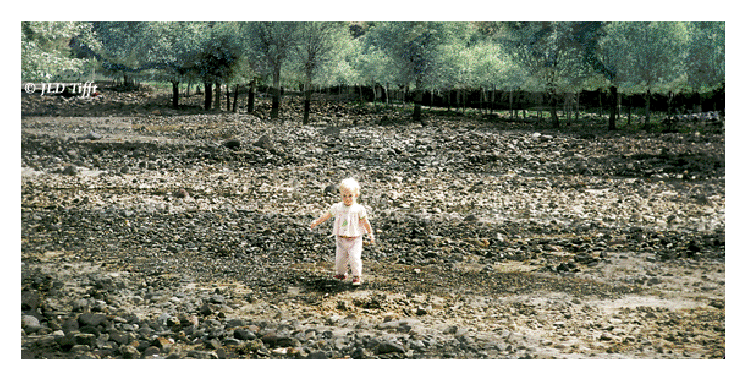
Your faithful writer at 2 yrs old. I refused help; I was going to
cross that dry riverbed all by myself, come Hell or high water.
Photo: JLD Tifft, used by kind permission 🙂

Bodies and minds, like engines, were made to go, and I’m most at home when I’m going in mine.

After the intense inward training of living as usefully and zestfully as possible despite CRPS, can you imagine what it would be like to have all this determination and energy unleashed on the world if I were finally well again, and could focus on, remember, and do things on a vaguely regular basis?

Can’t wait to find out.

So this is peaceful ol’ me…

…saluting all that keeps me from that.

Speaking of which…

Marathon training note

I’m stable with walking 1.5 miles at a time, and recover fast enough to do more later that day. Will aim for 1.8 later this week, after recovering from this trip.

Despite spasms and cramps etc., I made it all the way home in 1 day yesterday, instead of splitting the drive into 2 days as I usually must. This amazes me. My eyes didn’t cross and my mind didn’t splay into a messy 10-pointed star, both of which usually happen after 4-5 hours of driving with hourly breaks. So, there are some key neurological pieces that are definitely doing better.

Yay cerebral blood flow! Yay exercise!

It might be smart to take today off and stick to PT exercises and tai chi. No more bloody relapses. But boy, I sure am heartened!

Marathon — second thoughts

I’ve gotten some interesting responses to my marathon proposal, some of them very worried, bless their excellent, loving hearts. I feel I owe some explanation.

My tiny handful of fellow “imps of the possible” are all for it, completely understanding the uncertainties and sidetracks and possible (even probable) different endings in store – and knowing that it’s the reach that’s important, that spreading