Different doctors FTW

My pain diagnostic specialist is elegantly opinionated. Fortunately, he acts out the distinction between being opinionated and being rude about it.

We talked over a few things today. He’s still researching my past exposures to uranium, which he has a hard time believing wouldn’t have lasting effects.

He spent a lot of time combing through the idea that evidence-based medicine (in the sense that doctors use the term, not the sense that insurers do, where it means “how can we treat this as cheaply and barbarically as possible”) is really the best and least scary thing out there. Because, data.

I mentioned Dr. Scott Reuben at this point, and he owned that the scientist-practitioner does have to practice with integrity for the science to be meaningful.

He went on to say that the miracle cases that wind up in the literature leave physicians panting to find the next patient who shows up looking just like that case, so they can try the miracle. Doesn’t happen much, and so, there winds up being a paucity of data on rare cases (like mine) that meets the criteria of medical science as he sees it should be.

In the end, as always happens in conversation with a physician who has intellectual integrity, we found ourselves in the cleft stick of modern science:

While statistical probabilities indicate the best chances of success for groups overall, it has two glaring weaknesses, even in ideal circumstances: statistics depend on copious data, which aren’t always obtainable; and statistics mean nothing in the case of the individual.

Thousands of individuals are studied in order to come up with meaningful statistics. Of those individuals studied, how many respond to the treatment at the level of the group’s statistical probability? How many patients in real life will respond at that level? Pfft. All the statistics do is tell you how much of a crap-shoot a given treatment really is; it doesn’t tell you how well or badly it will do for you.

Last Friday, I saw my allergist/naturopathic MD at Northampton Integrative Wellness. He’s exploring mold toxicity, which sure hits all the hot issues I deal with. It doesn’t meet Dr. Saberski’s mental criteria, as I suspected, but that’s okay — I don’t need Dr. Saberski to follow up on it. I need someone like the docs at Integrative Wellness, who have the relevant background and tools, to follow up on it.

Because of my own experiences, I don’t necessarily assume that a well-educated, well-respected, well-published physician necessarily has a lot of intellectual integrity. However, I’ve come to the conclusion, through our conversations and his decisions along the way, that Dr. Saberski’s entire being (at work) is oriented on intellectual integrity.

We may not view things the same way, and he may not be thrilled at everything I do, but the fact is, he shouldn’t have to be. He’s delighted with my good results when I get them, and if this mold toxicity thing pans out and the treatment goes well, he’ll be truly elated for me — and will keep my chart on file, just in case I come back later.

I find it HUGELY relaxing to have such a resolute scientific conservative with such ferociously diligent, relentlessly inquisitive intelligence, which is completely balanced on intellectual integrity, on my case.

All I have to do in relation to the standard science is let him do his job! I do not have to educate this one — quite the reverse! I savor our conversations and make extensive notes, because he always has something to teach me. (Today’s exciting topics: what makes me NOT look like CRPS; the Flexner Report in history; how anesthesiologists, who have the diagnostic training of a spaniel, wound up running pain clinics — another stupid consequence of US insurance companies; and how the nociceptors and immune signaling in the skin are all entangled into being one thing. Woot! Fun stuff 🙂 )

That, frankly, has been unheard of for most of my time with this illness, whatever it turns out to be. I’m well and truly rid of the fearful weight of using my rare full-brain times to try to stay one step ahead of the risk to my survival and management that every doctor visit can be.

I can use my full- and even three-quarters brain time to study up on the stuff he can’t be interested in. For one thing, the vocabulary and writing style is usually less klunky and demanding. For another, that is supposed to be my job.

Patients should figure out what they can do for themselves without making things worse, so I’m happy to do that.

Now, I’m going to find out more about mold toxicity, methods and treatments, plus what data do exist on what to expect from those treatments and what they do in the body. According to my current info, the main researchers are Shoemaker on one hand, and Nathan and Brewer on the other. My allergy/naturo doc is leaving, so I’ll have to start with another one at the same practice. This means I’d better prepare, so I can move the conversation forward a little faster than usual. That means being able to speak her language in regard to what we’re looking into.

I find it’s best to impress doctors right off and for the first several visits, and then, if I’m having a bad day another time, they have a meaningful bar to measure against, and they don’t lose respect for me or dump me into that “just another whacky pain patient” mental garbage-can. I work hard to make visits as useful as possible, as regular readers know.

I’m also getting ready to do another massage intensive. Looking forward to that! It’s pretty uncomfortable for a couple weeks (arnica pills 6c and 30c, and Advil Liqui-Gels, are essential pre- and post-massage medication), but the payoff could be so spectacular. I’m tired of the downward slide and intend to crank up the functional level one way or another.

Winter bit me pretty hard. It’s time to start biting back.

"Visis mu! I care for you, so let me hand you this wildly inappropriate thing, because I’m too rushed to think things all the way through!"
“Visis mu! I care for you, so let me hand you this wildly inappropriate thing, because I’m too rushed to think things all the way through!”

Aw, nuts!

While I was mulling the constancy of nausea and yuckiness, looking for a reason more useful than “it’s winter”, I realized I had relentless cascades of post-nasal drip.

The stomach isn’t too fond of relentless cascades of post-nasal drip, because the glucoprotein complex generically called “mucus”, which we usually call “snot”, is not that easy to digest. It’s not really meant to be digested; it’s meant to do its job (picking up and trapping obnoxious particles or germs or what-have-you) and then get blown out. It’s not supposed to roll into the tummy in a never-ending stream.

me-tongue-out

I was reading up on GI issues (as one does) and stumbled across a piece which said something like, “Stay away from nuts and seeds entirely. The oil is rancid by the time it gets to you and that rancidity is poison to the systems of people who have leaky guts and sensitized systems. You can usually tell because the immune reaction affects your sinuses and causes lots of extra mucus.” If you’re curious, this article was about the GAPS diet and explained the whats and whys.

I threw my hands up in exasperation and disgust. I relied on nut and seed butters to start my day, because they cut the morning pain down to a quite bearable level and gave me a bit of protein that didn’t bring my stomach up in revolt. My mornings are tough enough and this info just pissed me off.

The next morning, I woke up noticing that I didn’t have post-nasal drip. Nice. Then I started on my morning breakfast of apple (malic acid helps the pain ease off too) and sunflower or almond butter (I forget which.)

Two bites…. then a relentless cascade of post-nasal drip.

My first thoughts were mostly expletives. Totally unprintable in a family-friendly blog.

I went off the rails a bit. I’ve been dealing with this disease complex for nigh on 15 years now and I have evolved a pretty limited (and not cheap) diet to manage it. Rather than thinking, “Oh great, a good clue as to what I can do to improve things!” I mentally roared, “WHAT THE BLEEDING HECK CAN I EAT ANYWAY????”

Tiger yawning hugely. Looks like roaring.

Let’s review.

– Genetically-determined mild allergy to white beans. That means soy, chick peas (which wipes out hummus and much Indian food), most multi-bean soups and salads.

– Roaring neurologic gluten response, which in my case spills over into related molecules. This means: no wheat, barley, triticale, rye, oats — in fact, most grains; nor fresh milk, soft cheese, dairy ice cream; and eggs only in strict moderation.

– Hashimoto’s disease means my body is chewing up my thyroid. This means definitely no soy, but also, no broccoli, chard, kale, bok choy, cauliflower — no cabbage/brassicas of any kind — and that’s an awful lot of vegetables not to have as an option, including most winter veg. And yet, I need lots of vegetables and happen to like all of those. Even in small amounts, brassicas can squash thyroid response. It’s very sad.

– Candida/c.diff overgrowth, which means no sugars (not even unrefined honey or maple syrup, not even low-glycemic stuff like agave [which makes me cramp] or maltose), no rice, minimal fruit, no juice, no root starch (too high in sugars) or white starch of any kind (if I’m doing this diligently) which wipes out the potato family and remaining grains except amaranth (I can’t digest quinoa at all, so it’s not even an option.) Then there are the limitations that are less obvious, which means, no tea or coffee, no vinegar or cultured food (if I followed that parameter, I’d be unable to digest anything and my guts would be even worse), no artificial anything because they tend to be grown on yeast or malt slurries (which is fine because packaged foods tend to happen to other people, not me.)

– The constant immune-y fuss means I should probably be more diligent about the inflammatory culprits: tomatos, eggplant, potatos, peppers, the whole belladonna group. I LOVE those things. Also, no canned foods, because the trace amounts of preservative stuff are so neurotoxic that molecules matter to my body, and homemade canned stuff can still grow trace amounts of the fungusy-yeasty stuff that boots me back into candida territory.

– Now, no nuts or seeds. At all. Possibly no cooking oil. I was diligent about getting the freshest and checking best-by dates and inspecting the packaging, for the candida reason. Not enough any more. No nuts or seeds at all.

OW OW OW OW OW OW OW OW OW OW OW OW OW OW OW OW OW OW OW OW OW OW OW OW OW OW OW OW OW OW

I think i’m down to squashes, lettuce, and incredibly expensive pastured/wild flesh foods. Oh, and grassfed (Kerrygold) butter. I can put that on the squash, I guess.

To be frank, I haven’t been very diligent about eliminating the root veg and I’ve had some broccoli and cauli lately, because it’s freaking winter and I’ve needed to eat something that’s available.

Since reading about the nuts/seeds thing, I totally fell off the rails. No gluten, because I’d rather die than go through all that again, but I’ve gone to town on sweets, rice, vinegar, ice cream, root veg, brassicas, belladonnas — everything but nuts and seeds.

Wide-eyed kitten staring at a roast chicken on table in front of its face

Paying the price for it, too… as one does.

Two nights ago, I made myself a new bedtime meditation recording, designed to rebuild my own mental core. I’ve just about had it with trying to cope with the world (if you have one eye on US politics, you’ll understand that well enough, especially if you have friends and family who are losing care due to political brangling, losing property due to corporate gamesmanship, or losing their liberty due to being not-White); add to that some family crises of illness and a bereavement in the extended family, and… yeah.) I’ve reached March feeling absolutely shredded inside.

And then…. NUTS!

Old amber-screen lettering showing *TILT* like on old pinball machines

Lately and increasingly, my brain was really resisting the relaxation response training — which is very odd for me — and I was having nightmares and waking up 5 times a night. I thought that, if I backed off the calming exercises and instead re-integrated my core self, that would make more sense than trying to pretend everything’s all right for half an hour. I have no idea what that looks like for other people, but I have a pretty good idea what it looks like for me. So, I made a recording with a series of mental/imaginative exercises that boil down to my individualized psychological structural support.

The chaos and rage are abating, which is just as well, because I have a follow-up appointment with my pain specialist tomorrow. I’m calming myself down with this article before turning my fragile attention to encapsulating the physical fallout and revelations of this winter in a coherent patient update.

I get to tell him that I’m seeing the GI specialist later this week, and that I have tested marginally positive in a screening test for mold toxicity, so more blood tests are coming from my allergist. That would actually explain a lot, but I’m not sure where he stands on the subject. Mold toxicity, as a driver of illness, is one of those things where the physician’s belief-state has more bearing on care than the coherent, consistent, verifiable facts of the patient’s disease-state — in that respect, it’s like chronic fatigue, neurogenic pain, and most immune disorders. Familiar territory to many of us.

A few days ago, I apologized to J for being such a piece of work lately. I told him I’ve been ill and in more pain than usual. He said, with the kindest intentions, “Well, it’s hard to act right when you’re sick. You have to feel good.”

I said, “I never get to feel good. It’s just different levels of –” (waved my arm expressively.) “I usually do a pretty good job of managing myself anyway.” He agreed, bless him.

That first phrase, “I never get to feel good,” has been preying on my mind. But then, it’s winter. This will pass, and I’ll find it easier to put my focus where it belongs — on what I CAN do, CAN eat, CAN feel, that’s not so — (wave my arm expressively.)

Until then, I’ll keep breathing, keep making my appointments, keep tending my relationships as well as possible, keep up on my documentation, keep on keeping on. As one does.

My gut has a mind of its own

I take good care of my brain. I work hard at learning more all the time about how to support and foster it in spite of this tedious collage of illnesses. Neurology interests me — always has. Now that it’s so personal an issue, it’s positively compelling. Neurology’s very complex, and hooks into everything — fascinatingly fractal, in the way it repeats the same physiological “phrases” to very different effect in different parts of the body in response to different changes.

I’ve been wrestling with my gut this past year or so. Lately, it looks and feels like someone’s taking a bicycle pump to it and bringing it up a little more every day. When it interferes with your breathing, that’s a lot of bloat!

I’ve found the gastrointestinal (GI) system to be a bit of a trial. It’s very complex, and hooks into everything. There’s no getting away from the endless iterations of its main roles of sensing, transforming, processing, and discarding: at the intracellular level, intercellular level, endocrine level, organ level, and so on.

Some observant part of my brain notes that the same characteristics I find appealing in neurology, are the same ones I find appalling in gastroenterology.

And the gut has so much STUFF in it…

  • The liver parked under the ribs at one side, the spleen at the other, holding half your blood at any one time, right across the top of your abdomen;
  • The endless loops of squirming intestine, stretching and shifting within their blobby webs of mesentery, shoving along several pounds of food residue at any one time along its length;
  • Lymphatic nodes linked in constellations in the shining webs of mesentery and glistening loops of intestine, ready to respond instantly to allergens or pathogens or anything else in your GI tract that could make your body revolt;
  • Major vessels, the abdominal aorta and the vena cava, coursing alongside the spine, apparently apart from the mess, but branching out so thoroughly and so minutely into the organs and the mesentery that the smartest rats in science couldn’t make it through that maze;
  • The tenth cranial nerve, forming an intimate and instant link between your brain and your gut, linking your brain directly to the largest grouping of nerves outside your brain, the nerves that surround and penetrate your organs and your gut, embedded in and supported by that amazing net of connective and fatty tissue, the mesentery;
  • And let’s not even go into the endocrine system, responding minutely — at the level of individual molecules at times — to the constituents in your food, the way you feel about them, what you need them for right then, what else you’re sensing at the time, and even what time of day or year or month it is… then hooking the info back out through the nervous system, cardiovascular system, lymphatic system, and of course the gastrointestinal system.

I was sitting in my Epsom bath today, mulling this over after the battery in my e-book died. I had done the squishing of my legs and arms with the washcloth, and ran it over my neck and back and sides too, but had a terrible time making myself touch my abdomen. It felt just awful. It also felt like it was somewhat detached from me, like it was floating a couple of inches off my back and spine, simply hovering, slightly displaced, in front of the rest of my physical self. Touching it was deeply upsetting in some way, triggering a wordless revulsion.

This is not an unusual experience for CRPSers. We often feel as if the affected parts of our bodies are almost separate from us, or like they belong to someone else, and touching them is — even apart from the allodynia — a crankiness-inducing, unpleasant experience. It’s a perceptual trick the brain plays, probably part of its general effort to manage more ghastliness than it’s really set up to deal with.

One reason I do the Epsom baths (and the stretching, and the activity, and the relaxation meditations, and the aikido/tai chi/qigong, etc.) is to stay on good terms with my body. That whole self-alienation thing is just too wrong, to me — my life is always best when I’m in my skin, so to speak, whether or not my circumstances suck.

Also, to be fair, my body has done nothing wrong; it just got some of the shortest darn straws out there, and it’s doing its mighty best to manage that. It doesn’t deserve my loathing at all. So, I work to keep on good terms with it.

This is probably one reason why I’m still often functional, frequently productive, and can still walk a mile without sitting down to rest on a good day — even after 15 years with this disease on little or no medication (here’s why no CNS depressants like narcotics, here’s why minimal other meds.)

Anyway, there I was in the bath, watching my belly inflate and almost float away, even though I was Epsom bathing (which usually calms my systems down), and realizing I was finding it unbearable to touch the darn thing, even though it was practically in front of me.

I thought, “Neurology is not that hard for me. Why is gastroenterology so impenetrable? Why am I making so little headway on figuring out this stomach stuff, and dealing with so many setbacks? Why do I get these little tailspins of terror about it? What’s going on in… the second largest collection of nerves outside my brain?” I said, as the lightbulb over my head turned on.

I thought, “I’ve been having a lot of trouble with gastroenterology. But I can usually do neurology.”

And the word for the neurology of the gut, ladies and gentlemen, is neurogastroenterology. (Break it down: neuro meaning nerves, gastro meaning stomach, entero meaning inestines, ology meaning study of. Now you have it.)

I’m pretty sure I can do that. I can sure take a stab at it.

First lesson: review the vagus, a.k.a. Cranial Nerve X. It’s a doozy.

The right toothpaste turns out to be my own

Updated to reflect much experimentation and the final recipe, Dec 16, 2016

We forget that tooth pain is nerve pain. There are big fat nerves going right up into every one of those 30-odd things in your head.

Cross sections of teeth intl

I have sensitive teeth, related to the fact that I have CRPS, which does its very best to thin the bony tissue out until it’s like a lacework pattern crocheted by the famous one-armed wallpaper-hanger.

So, basically, my head is set up for lots and lots of nerve pain.
poison_skull
Have you noticed that there are no brands of toothpaste for sensitive teeth that are anything other than mint-flavored? Moreover, the toothpaste focus groups apparently like a strong minty taste, because that makes them feel like it’s working. Heaven forbid they just lick their teeth to find out, I guess.

The vocal but persistent minority that does NOT like a strong minty taste apparently just isn’t profitable enough to serve.

Those of us who find it obnoxious or uncomfortable, or who are sufficiently chemically sensitive that the mint actually causes a chemical burn? Tom’s of Maine provides a couple of marginally less-caustic alternatives, but none for sensitive teeth.

That’s right, folks. Chemical burns to go with your sensitive teeth. Isn’t that clever?

So, my dental routine has sucked for years. First, brushing requires tension in my wrist tendons for a couple of minutes. Second, it jars my joints every time I switch direction, which happens a lot. Thirdly, I’M GIVING MYSELF CHEMICAL BURNS THROUGHOUT MY MOUTH. There’s something very wrong with that. Fourthly, in the nature of a cherry on the sundae, toothpaste doesn’t actually seem to get my teeth clean. It scores lines in the muck, but it doesn’t actually clear it away.

The routine I developed, which I could only do every few days, was this:
1. Damp washcloth to wipe off the muck, front and back, top and bottom. Only way to clear it off.
2. Floss with a flossing sword, hoicking more muck out from between the choppers.
3. Brush with the least-burning sensitive-teeth toothpaste I could find, the Walgreens brand.

That’s going to happen twice a week at most, not twice a day. It’s a lot of fine-motor maneuvering and, of course, the CHEMICAL BURNS THROUGHOUT MY MOUTH make it hard to look forward to. I can’t eat or drink anything for at least an hour, not without slamming the cup down as I’m sharply reminded why that was a bad idea.

This is a stupid problem to have. It should not be hard to have a non-burning toothpaste which will get the muck off my teeth and protect them afterwards!

Then a friend of mine (a fellow spoonie with a different set of spectacular health challenges) mentioned that she had been using calcium carbonate to brush her teeth, and they were suddenly whiter and stronger and better.

Then the pieces started coming together in my head. I put the calcium carbonate (yes, it’s chalk, in case you were going to look it up) together with some other things I knew about handling oral hygiene in the non-conventional, post-industrial world, and made my own toothpaste.

With one brushing, half as long as my old brushings, my teeth got COMPLETELY CLEAN. I might be hallucinating, but they seem a half a shade lighter after 1 day and 3 (that’s right, 3) brushings.

I’m keeping the potassium-nitrate toothpaste nearby in case this doesn’t work out within a week for sensitivity, but this is a real pleasure to use! It’s tasty, it doesn’t hurt, the jarring isn’t as bad on my wrists and I don’t have to do it as long, so I can actually brush my teeth a couple of times a day and it hardly takes any spoons at all!

This was so worth it 🙂

ADDENDUM/CORRECTION: So, the original recipe for toothpaste was outstanding for a few more days (when my teeth got visibly whiter and felt fabulous!) but the pain came back, absolutely unbearable. I couldn’t eat solids at all. I suspected that the calcium carbonate, which is extremely absorbent, basically sucked the potassium nitrate out of my teeth and may even have trapped the clove oil so it couldn’t do its job. I used commercial sensitive-teeth toothpaste for a few days until it stopped, went back to the homemade toothpaste to build up my teeth, and went back to the commercial stuff every so often as needed, until my home-made tooth PASTE turned into tooth SOLID. The calcium simply did what calcium carbonate does: it absorbed all the water and solidified. It is spectacularly good at absorbing liquid.

After lots of, um, learning experiences, I came to terms with the fact that the only tooth care I can manage to make for myself is not going to be a paste.

I’m not interested in adding glycerine and strange oozy substances to my dentifrice. It’s tedious, mucky, and provides no benefit I care about.

I grew up watching my dad clean his teeth with tooth powder, and he had the best teeth in the house, so it doesn’t seem odd to me at all.

I shake about a half teaspoon into my palm, dab it up with a wet toothbrush that’s as soft as I can find, and my teeth are cleaner and whiter, with less effort, than ever before.

I’m pleased.

Here is my..

Toothpowder recipe for sensitive tissues:

  • ~1/3  powdered xylitol, a specific non-caloric sweetener.
  • ~2/3 powdered calcium carbonate.


If you like, add to each cup of powder mix:

  • 20 drops essential oil of sweet orange (to boost the cleaning and de-mucking)
  • 20 drops essential oil of clove (to ease nerve pain)


+Why xylitol? Because it loosens the muck. It disrupts the biofilm made by all the different bacteria getting together on your teeth, by dissolving the glue that holds them together. (This is why your dentist likes you to have xylitol candy if you must have candy.) I recommend the xylitol made from hardwood, because the corn-derivation has gotten so that almost anything derived from corn makes my pain spike. Sad but true.  I get mine from http://store.xylitolusa.com/xylitol/.

Forward-looking statement (e.g., dream castle)

In the fullness of time, I hope to have a little cottage industry making this stuff up and selling it on to those who need it but can’t put it together or can’t get the stuff in bulk. Fingers crossed..


On treatments and at-home management strategies for CRPS

Quick brain dump here. There have been a lot of questions lately about treatment options. THIS LIST IS NOT EXHAUSTIVE. It’s barely an overview. It’s just a note I worote in answer to someone who asked about prolotherapy, where a sugar or basic solution is injected into a painful area and the harmless irritation causes just the right kind of healing bloodflow for some people. Here is my answer…

Prolotherapy is one of those things that works great when it works at all. It’s definitely individual-dependent. The tissue irritation, so helpful to those who don’t have spastic vessels, can do a number on us. But not everyone.

If your CRPS is more peripherally maintained, then it might help, assuming the irritation does what it’s supposed to and the tissue response doesn’t trigger autonomic dysfunction, with circulatory weirdness and the whole color/swelling/pain circus that comes with it.

If your CRPS is more centrally maintained, which is kind of a hallmark of the ongoing disease, then I don’t see how treating the area with anything, let alone an irritant, would be any good. It does nothing for the central part of the nervous system.

I consider myself lucky that the usual pain meds nearly killed me, and I had to go the diet modification/supplementation route almost right away. Eliminating things that irritate my central nervous system, and supplementing with things that help repair damaged nerves and fragile tissues, was absolutely essential. If I hadn’t done that, I wouldn’t have lived long enough to do anything else.

At the risk of starting a shooting war here, the MCS (multiple chemical sensitivities) and neuro research hounds I’m close to, indicate that the most common neuro allergens in the diet are gluten (wheat, rye, barley, spelt, triticale, “natural flavorings”; oats have a similar molecule, so YMMV), corn (especially corn fractions like HFCS and “natural flavorings”), fresh dairy (which an incompetent gut like mine breaks down into a molecule a lot like gluten), MSG (often wheat derived), phosphoric acid (found in most dark sodas), and benzene (anything with the syllable “benz” in it — read labels, or better yet, don’t eat things that come in packages, which usually have BHA or BHT added to the packaging.)

Common neuro allergens in the environment include petrochemical products (photo chemicals, printing chemicals, gasoline, many cleaning products) and most chemical scents, most notoriously the line called Axe, which may trigger psychotic breaks in vulnerable people, according to disturbing reports.

A couple of techniques do address central sensitization:

– Calmare, which is a subtle, varied, electric signal that rescrambles the pain impulses and has given many CRPSers outstanding relief.

– Ketamine, which is an anesthetic that sort of reboots the brain. It must be administered by a competent physician well-trained in ketamine administration for CRPS, as it’s still a dangerous drug, but with right matching of patient to protocol, it can work wonders.

– Spinal cord stimulators. These are surgically placed and can be highly problematic, but if they’re the right thing for you, they can give you your life back to a large degree. There are electrodes shoved right into your spine, so if your pain is mediated mostly in the brain, not so good. If it’s still at or below the spinal root, excellent.

As for supplementation, which you don’t need doctors to do … Good, health-food-store supplements are essential. Don’t waste your money on the plastic pills at the pharmacy (check Consumer Reports to find out just how bad they are.) Your body is burning through nutrients desperately fast all the time. It can’t keep up. We need a healthy diet so as not to bring in more problems, but we can’t possibly meet our needs that way any more, with all the pain and the other cellular and metabolic insults of CRPS.

The nerve cells and muscle cells are the biggest suppliers and the biggest consumers of antioxidants. As muscle cells degenerate and nerve cells take a beating, they need more and more but can produce less and less. The math catches up to us after awhile and then it takes time for the supplementation to penetrate enough of the starved tissue around the gut to work its way to our CNS — but, from my experience, it was well worth it! The time was going to pass anyway, and I was better at the end of it.

Neuro-oriented antioxidants include SAMe (a type of methionine, primal antioxidant used inside the mitochondrial cell), N-acetyl cysteine (NAC), and co-q 10.

Vitamins A, D, E, K, and moderate amounts of C are important, especially the D3 — much bone loss and the concomitant pain could likely be avoided if we all had our D levels checked and then supplemented accordingly.
(I’ve been told that C can become pro-oxidative in a sickly environment, so I have to look into that.)
B vitamins are absolutely crucial to neuro and other cellular repair, so a good B complex is important.

Magnesium, whether as lotions, Epsom baths/rubs, or supplements, is essential. It’s simply huge for cutting spasms, which underlie so much of the nagging side of the pain, and supporting basic cellular functions as an electrolyte.

There are supplements that can provide precursors to neurotransmitters, and I find they roughly double the effectiveness of my SSRI and SNRI, keeping me in the low-middle range of doses instead of me getting overdosed to near dying as I once was. Phenylalanine is a precursor for dopamine and norepinephrine, and the d,l form has been found to be genuinely helpful in reducing nerve pain for many. It also helps me stay less confused (dopamine, perhaps.) 5-HTP is widely known as a serotonin precursor, as is tryptophan. Both can help with sleep, too. I do better with 5-HTP.

There are a lot of brands, and there’s a lot of behind-the-scenes business ugliness behind the brands as the whole “natural everything” movement creates the possibility of money. I’ve watched the circus for awhile, and at this point, there are just a few brands I can recommend as still being good, consistent, and generally digestible:

Jarrow (great antioxidants)
NOW (inexpensive and very good; I always get my 5-htp from them)
RAW Vitamin Code (a Garden of Life line of food-based products, excellent; I take only half the recommended dose of the multis, and boy do they help)
Twinlabs (my second choice for multis and neurotransmitter supplements; widely available)
Solgar (pricier than Twinlabs, but much the same; widely available)
My fallback brand is Life Extension, which is still excellent.

I get mine for wholesale at vitacost.com (fast delivery, but don’t carry Jarrow), luckyvitamin.com, or occasionally for a bit more at Amazon if the others are out of what I need.

It’s a hideously complex disease, and in cases like ours where conventional medicine has almost completely failed, we have to take charge of that complexity and redesign our lives in order to have something worth living.

We really do have to change or die, and it is a surprisingly hard choice at times.

Further comments and suggestions on treatments and management would be most welcome.

Prelude to winter canning recipes

Don’t you love the change of season? Especially here in Middle Cali, where there’s a hint o’ green to mark the second of our two seasons — Drought and Mold.

But seriously… I just had my first blueberry-clove shake in awhile, and boy am I glad I remembered about them. I’m actually stringing a thought or two together. Not eloquently, but let’s not be fussy, ok?

It’s worth noting that I’m staying off social media until I’ve finished a couple of very important projects. I’m using my brain time in a highly focused manner.

Why? Because the seasons are changing, the barometer is bouncing around like a honeymooner’s pillow, the solar radiation (between eclipse, sunspot the size of Jupiter, and X-class flares) is doing the hesitation waltz ALL over my nervous system, and my otherwise lovely partner is genuinely addicted to TV so I have that constant, impersonal nag grating against my brain.
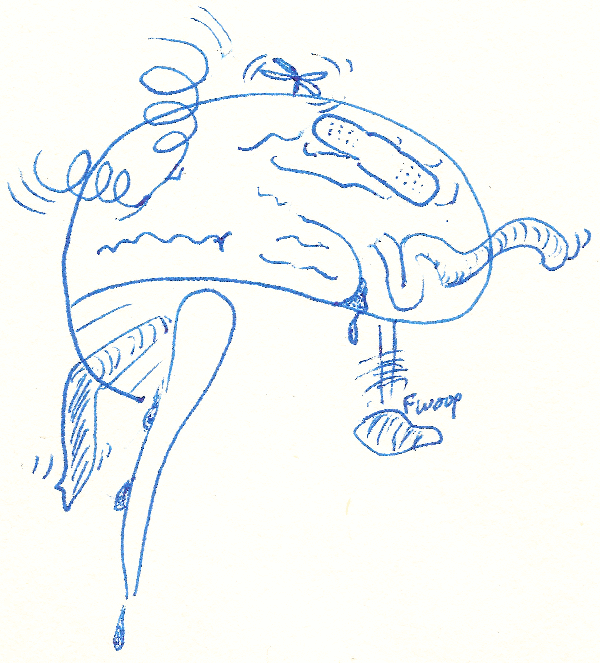
Sketch of brain, with bits falling off and popping out, and a bandaid over the worst
If I weren’t so well-equipped with irony and sarcasm, I’d be howling like a princess with a split nail right before her prom date.

So I remembered about my blueberry clove shakes. This reminded me that I need to prepare for the REALLY hard times that winter brings. And that made me think that there are a few principles to keep in mind for my dietary framework:

  • Vegetables. Lots of healthy vegetables.

    I have that covered for emergencies already: vegetable juice with one of those thought-out “super green” organic powders (my choice is Garden of Life’s Perfect Food.)
  • Anthocyanins in ridiculously strong doses. This is key for my brain function. Huge.
  • Something for bad pain.
  • Something for bad pain with a different protein profile, to lower the risk of developing an allergy.
  • Immune support. Winter, right? Virus heaven.

Brains which are under siege need appropriate saturated fats. I know, I know, we’re told they’re bad. Back up a bit and take a look at that, because it doesn’t hold up to closer inquiry. What we don’t need are INappropriate saturated fats, which, admittedly, are most of the ones in the grocery store.

Chocolate, coconut oil, organic palm oil, and pastured butter are appropriate fats. These are well within the kinds of foods we have been eating for thousands of years, if not longer.

One reason why a bite of something fatty is like an instant lift. The saturated fat goes right to the brain’s pleasure centers. The brain knows what it needs, and we’re wired to like it.
glee
It’s up to us to use appropriate forms of fat, which our bodies can reliably use.

When I’m fighting off a virus, I crave raw coconut, coconut oil, coconut butter, or coconut milk with a gnawing passion. I’m old enough to do what my body tells me to. Interestingly, studies are coming to light showing that just the coconut oil has real benefit for fighting off viruses, among other things. Imagine what we’ll find in the rest of the nut, one day.

For pain, I find that half a tablespoon of 100% grass-fed/pastured butter is better than a pain pill. (It cuts the pain dramatically but doesn’t make me goofy at all.) It doesn’t always last for more than a few hours, but there are no side-effects that aren’t healthy: it makes my heart stronger, helps stabilize my immune system, and reduces my tendency to pack on weight. I’ve found this to be consistently true over the years, and, since it doesn’t match our expectations of dairy fat, I checked the science.

For a fairly extensive and science-supported discussion, look here. I’ll provide some highlights.

100% pastured bovine fat, of any kind, is such an effective anti-inflammatory that it can reverse heart and vascular damage. I’m not sure why it helps moderate my weight, but I suspect it has to do with cleaning the metabolic pathways.

Conventionally-raised or grain-finished cattle are sensitive to grain, as a species, so they have ongoing low-level immune responses to their feed (even without the steroids and antibiotics normally used in beef and milk production.)
feedlot-NRCSAZ02094_-_Arizona_(471)(NRCS_Photo_Gallery)
Naturally, the histamine outfall, metabolic garbage, and fats get stored in their flesh, milk, and fat.

That’s how animal bodies work — a lot of stuff gets concentrated in our flesh and stored in our fat, and if what went into us isn’t right, what gets stored in us isn’t right, either. That’s why people pay so much for the grass-fed stuff.

Now you know 🙂

Getting pastured butter is not hard. In Ireland, grass is cheaper than grain, and (unlike New England or Wisconsin) it’s available nearly year-round.

Gorgeous black and white Frisian cows grazing deep green grass with colorful, healthy fields patchworked down to the edge of a body of water.
Breathtaking shot of Irish cows from Richard Webb

Next time you’re at a major supermarket, grab yourself a block of Kerrygold butter and try a slice on some non-inflammatory food, like a dish of steamed veggies.

Go on, try it…

Now you know what’s behind the recipes I’m going to post next.

It’s a different world in here

TRIGGER WARNING: Body image. With a twist.

I feel like I’ve been inflated. If I get any larger, I may collapse in on myself and form a neutron star — possibly even a black hole.

"Portrait of the Quasar as a Young Black Hole" from NASA's Hubble telescope
Charming, eh? And round.

My pain psychologist isn’t worried. She thinks there’s nothing wrong with “a little comfort weight”, especially as I’ve been making such progress in her area.  Of course, she has a slender elfin figure herself.

This isn’t the usual rant about weight and health, or the girly American whining about fat. This is about living from the inside out, and what happens when my physical vehicle takes up a whole lane.

Nursing has a diagnosis called, “Body Image Disturbance.” Take a look at that phrase for a minute. It’s very telling.

Body
Our physical interface with the world; the medium we use to communicate with others; the first sensory impression we get of our surroundings; the complex organism that gets us from one place to another; the thing that gives others their first sense of who or what we are.

Image
Our mental framework, or paradigm; the belief or understanding we have about our presence or effect in the world; the way others tend to think of us; the way we think they think of us.

Disturbance
Something awry — probably disturbingly so. Not good.

Do we need to address the usual social issues? Yes, skinny people get treated better, all across the board; fat people are far more likely to get abused and overlooked, and not just for sex — for everything. Lots of people have made lots of money writing lots of books about that, so read them if you’re confused.

Let’s move on.

I’m in a different sensory and physical world from what I’m used to, and it’s a really strange one. The experience of physical life from this different shape is, yes, disturbing.

My feet are pressing so hard against the ground that my shoes fit differently.  When I carry something, it pushes my weight over the tolerable limit and threatens to bring the CRPS in my feet back to life — and I had just about gotten rid of the pain symptoms there. The circulatory symptoms are another matter — zombie-foot is a regular event.

My cat floats above me by quite a few inches, when he should be lying more or less on my abdominal muscles plus a blanket of padding.  It’s weird to have to reach so far up from my spine to pet him — my shoulder rotates much further in my cuff than I’d expect. I’m getting better at feeling my joints, and this is not exactly a positive feedback loop.

My upper arms keep catching against my sides. This is rather disorienting, since I’m improving my sense of my body in space and usually, when my arm catches on something, it means I need to increase the space between me and foreign object. There’s no foreign object. It’s just more of me. Weird.

I had a sway in my lower  back which I managed to straighten out awhile ago. Better spinal posture means less pain overall. So now I have a substantial, unstable weight hanging in front of my spine, which means I have to work my abdominal muscles really hard to pull it closer to my center of gravity so I can just stay in balance.

My abs are killing me. If I don’t use them, my lower back hurts me worse, so those abs are constantly on duty.

I give them a break and relax them when I sit down — and it’s like being on top of a balloon that inflates, as my stomach takes over the lower horizon.

balloons-innflating

I poke it curiously, wondering how far down I have to go to find the original outline. I give up at the second knuckle. Too discouraging.

When I sit in my car, my right hip brushes against the driver’s armrest.  First thought: I’m over too far to the right; my hip shouldn’t be near that. Wrong. I’m dead center. It’s my hip that has travelled far.

But there is an up-side. When I fold my hands together, I have a perfect armrest. Soooo comfortable. It’s like it was made for me!

And the stares I used to get — or rather, that my endocrine-disrupted DDD cups used to get? Gone. No wolf-whistles or dribble on the sidewalk from creepy slimebuckets who seem to think I should be delighted at their lack of self-command. Nobody’s goosed me or grabbed a feel in ages!

It’s very peaceful. Makes it a lot easier to feel at home in my own skin, not to be bracing for the next random invasion of privacy.

I’m no longer constantly holding a sharp elbow at the ready, to fend off some suddenly-clumsy dude who goggles briefly, with a word-balloon appearing above his head that says “are those real?”, then says “oops” and bumps into my pneumatic (and sensitive) form as if by mistake. I got so freakin’ tired of that!

Perhaps a leather vest with spikes all around…

myvest_front_med

This, incidentally, is why so many women feel  comforted wearing a burka. It makes the wearer more sexually invisible and insulates her from much of this random predatory crap.

My fleshly burka. Take that, right-wing-nuts — of any religion. You don’t even WANT to control this.

And, in a huge relief to my CRPS-riddled body, nobody wants to slam into it now, either. Yesssss!

I’ve got to get that vest. I can’t, and don’t want to, keep the fleshly burka, but I have to find a way to manage the body-slams. Never again.

As for food… Here’s what I’ve learned for the current incarnation of CRPS endocrine/digestive ballyhoo:

– No grains of any kind. No lentils or beans.
– No dairy, except small amounts of hard cheese — the protein sufficiently altered that I can handle it in small doses.
– No sugar at all, but more unrefined stevia.
– I’ll have to get kefir “grains” and make my own water-kefir. I have some ideas for that.

I still have most of the world of nontoxic produce, nuts, and meat from healthy animals to sit down to. There are worse things… It isn’t cheap, but I’m learning where to shop. And it sure tastes good.

P.S. You want what?? Measurements, weight, photographs? They miss the point. I’m not looking at me, I’m looking from me.

I’m not comparing myself to anyone or anything. This is simply the view from inside. Hope it’s worth a laugh or two 🙂

Dietary limitations? Where? I’m too busy feasting, thank you

Dietary limitations are a recurring theme in my life — and that of many who read this.  There’s little self-pity left in me for it, because my world of food has opened up in magnificent new ways. I hardly miss wheat, for instance, because I have so many other wonderful things to wrap my teeth around.

This attitude is essential to a bearable life.  Admittedly, it’s an adjustment to learn not to think in terms of “not“… Wait, let me rephrase that…

Since it’s hard to get started with food changes, and my energy and attention are limited, it helps to have people show me alternatives.The past decade or so has been filled with people who do things — like eating — differently from how I did, and that has been a huge help. I’ve mentioned the Brain Food shakes (once or twice) but the blender is only one of the arrows I have in my dietary quiver.

I’ve also had the advantage of living in “foodie” areas where it’s not that hard to find alternative sources of nutrition:

– heritage and heirloom strains of vegetables abound (a good way to reduce exposure to problematic proteins is to eat unmodified strains),

– gluten-free mixes of several different brands let me figure out what works for me (I do best with sorghum/tapioca based blends), and

– it’s easy to find foreign foods like quinoa (a quick-cooking grain which is extremely high in protein and tastes fantastic with a little butter) and English cucumbers (which are more digestible than the US kind).

It also helps to experiment with different forms of cookery. For instance, I loved discovering sprouting, because it creates lots of food from very little outlay, it’s mechanically easy, and it takes only a few seconds of effort at a time — perfect for CRPS-induced ADD!

There’s a lot of, well, let’s call it culture, around sprouting. Don’t be fooled by the complex gear and the long lists of instructions. Those complications are for those who find it satisfying to work out the details.

That’s fine. It’s also optional.

Sprouting

It’s really very simple. There are only 3 things you need to have and 3 things you need to do.

Have

1. Clean jar,
2. organic (or close) sproutees,
3. safe water.

That’s all you need. A mesh top for the jar is handy, but you can make one with cotton gauze and a canning band, or by drilling the original lid. Toss the used gauze in the washer and reuse, or just toss it and cut off more.

Do

1. Water them.
  a. Soak sproutees overnight, covered +2″ with water, in the fridge. Pour out water in the morning.
  b. Then rinse 2-3 times a day, more if it starts smelling anything other than fresh and bright. Just stagger to sink, pour water in over gauze/mesh, give it a gentle slosh around, and pour it out. Repeat.
  c. Park aslant, head down, in a clean drainer or in a lip of the sink. Drains excess moisture.
No fussing.

2. Grow them until the tails are at least 1/4″ or 60mm long, for best nutrition; up to 2″, if you like greenery. Takes 1-3 days to get to 1/4″.

3. Eat them fresh; keep a couple jars going so you always have something coming up. It’s very encouraging. As soon as I empty a jar, I set it back up.

Whatever I sprout, I buy it fresh enough to have its proper color and scent, and that yields 80% or more of sprouted germs. Less yield with older product.

I’ve discovered that tiny red lentils sprout quickly and have a subtle sweetness that’s wonderfully satisfying and goes with soup, salad, on sandwiches, in rollups, and (usually) straight out of the jar.

Sprout amaranth to just over 1/4″, add half and half or cream, sweeten with a touch of brown sugar … it’s halfway between Cream of Wheat and Malt-O-Meal. I was stunned. Had to try it a couple more times just to be sure.

If you’re inspired, please let me know if you discover any real gems, like amaranth cream of wheat 🙂

Moderation, part 2 (with footnotes)

Last week’s experimental overdose was not without consequences. There were a couple of days of the most astounding vacuousness, combined with a lethargy and inertia so profound that I find it hard even to remember… Also, record-setting levels of forgetfulness.

So that was the “overdoing on bad stuff” side of the question.

Because I don’t know when to quit, apparently, I did another experiment yesterday: allowed myself to run out of greens, and had a whole day without my Brain Food shakes. That was the “neglecting the good stuff” part, because of course //wide eyes// one must have both the yin and the yang.

Here’s how that went:

I was scheduled for a massage at one, but my massage therapist had (for once) forgotten to change it in his schedule, so he thought it was at noon. As I was leaving the house, I walked through a cell signal (few and far between here) and got the happy blurt that tells me I have a message. It was Ed, my massage therapist, calling to see if I was all right because it was 30 minutes into my session and I wasn’t there. (It’s not like me to be late.)

Here’s the fun part: I stood there, phone in hand, mentally cursing because now I had to go back in the house and look up his number.

While holding the cellphone he’d called me on.

I went back inside to where I keep my cell phone plugged in, looked at the empty space, realized my mistake, cursed inwardly, went back outside to make the call. Before I started dialing, I realized my vision was too bad to drive without my glasses. (It varies with my brain state.) Slightly panicked, I went back inside for my glasses. I didn’t want to forget and drive off without them, which I feared I might be capable of.

By the time I got there, I’d forgotten why I had gone inside, and was very annoyed with myself for wasting time. I stood there, staring into the blurry living room which I could not see across accurately, wondering what the hell I had come inside for and why it was important enough to keep me from driving off.

I went back outside, and was almost at the car…

when I realized, again, that I couldn’t possibly drive like that. Muttering, “Glasses, glasses, glasses,” so I wouldn’t forget again (which I was fully capable of), I went back inside and retrieved them.

I came back out, found my way to the phone zone, and made a slightly hysterical call to my massage therapist. I was now 15 min. late by my time, and an hour and a quarter by his. Bless his golden heart, he calmed me right down, and my day was considerably better soon after.

I’m preparing for a cross-country meander, meant to be conducted within my limits of capacity – mental, physical, and financial – which may be yet another fantasy, but at least it will be an interesting one.

I’ve taught myself 2 important lessons this week, though, and it’s good to be absolutely clear about them before I have so much else to think about:

1. Sugar in strictest moderation. It used to be a matter of avoiding pain, but this was a neurologic meltdown of a depth and duration best avoided in future.

2. Eat my damn Brain Food shake. I didn’t spend all these years figuring it out, just to dis my own discovery. Figuring out how to get them on the road just became the most important job of my life!

Is it just me? I sometimes wonder how many of us, who turn to sweets for comfort and let our distaste for kale exceed our longing to function (as I certainly did until very recently), could be doing so much better.

My pain levels rest very low, as long as I eat right and drink enough water. And my mental function — as, wow, I have reeeeeally demonstrated this week — is hugely affected by what I do, and don’t, get into my system.

  • If I still ate wheat, I’d be so thoroughly impaired I’d be in need of daily care to make sure I showered and ate and — literally — didn’t wander into traffic. 
  • If I still ate corn regularly, I’d be so sore, cranky and ill-behaved that it would be impossible to find an aide to help me. 
  • If I still ate rice I’d regularly be in so much pain I couldn’t think of anything else.
  • If I still ate grains in any amount (even of good quality, as I used to), I’d be nearly immobilized by the extra weight I’d be carrying, making that care even more necessary but even harder to get. 
  • If I ate sweets for comfort, I’d never really find it. But I’d keep trying, probably by eating more sweets! With insulin resistance, it’s a vicious cycle of longing with temporary and partial satisfaction overlaying a bottomless need.

How many undiagnosed food sensitivities and metabolic dysregulations are deepening the levels of Hell in which CRPSers live? Especially given that it’s a disease of the central nervous system, which most certainly does include the gut? It really makes me wonder.

The largest concentration of nerves outside the brain is in the gut, and there’s a breathtaking new field of science about that, called gastroneurology or neurogasteroenterology (it’s only been around for 20 years, so the name is not yet fixed).

Metabolically, I’m just not that weird,  that so many core, neuro-immunologic issues that show up in me could be all that unusual. It makes me wonder if my brain is really all that broken, or if it’s just signalling really hard…

I know how desperately hard it is to change the way you eat, because it means changing the way you have to respond to your most primitive longings at your most vulnerable and achingly needy times. (I have an extremely high tolerance for uncertainty and an extremely low one for needless stupidity, especially in myself, and that has been a great help in working this out.)

It helps to have a structure worked out and some sort of support: hence the success of Weight Watchers and clinician-approved eating patterns like the Stone Age diet or the South Beach Diet.

These dramatically different strategies coexist because … drumroll please … we aren’t all the same! Some will work on some, others will work for others.

Personally, I’m intrigued by the immunological component of digestion and assimilation (another key characteristic of gastroneurology), best addressed by the Blood Type bouquet of diets. The Type O eating pattern (with added wheat) was what I did naturally when I was fit and well, and guess what, I’m type O.

mmmmm, lunch!

But things have gotten weirder since then…

Now that I’ve finished my tea, it’s time for breakfast. Guess what that’ll be? 🙂

Links:

Gluten exposure and recovery – Testing myself (silly me)

Gluten: really is that bad

Yesterday, I walked past the bread display at Trader Joe’s three times, breathing deeply. It smelled good, but not as good as I remembered. That was odd.

As I left the store about ten minutes later, my face turned beet-red and puffed up, my brain went into a deep white fog, colors faded to pastels, and the pain left my arms and foot briefly to return, five minutes later, to every joint in my body.

I was in full neurological gluten reaction. From inhaling near a bread display!

I did that in the first place because I just could not believe I was that sensitive to something I’ve eaten – and really enjoyed – all my life until last summer.

I know there’s a difference between the kind of food sensitivity where, if you avoid that food most of the time, you can tolerate a little now and then with no trouble; it’s about keeping the contact down below a certain minimum. Then there are the sensitivities where, if you eat a bit on a regular basis, your body retains an ability to deal with it and you don’t get a reaction (vegetarians who go back to eating meat are familiar with this – it takes awhile for the body to readjust.) And then there are the sensitivities that amount to true allergies, where any contact causes a reaction and the reaction can get intense enough to create a crisis.

That was an intense reaction. I’m not interested in seeing how much more my face can inflate.

It’s true that I used to eat wheat regularly and experienced nothing as dramatic. Would it be less dramatic if I ate a little on a regular basis?

Considering how quickly my health was slipping while I was eating gluten, and the fact that I continue to get sicker but I appreciate that it’s at a slower rate, I don’t see any real point in making the experiment.

Moreover, the literature on gluten allergies does not support that. The science indicates that, if your body has trouble with that particular protein, then the further you can stay from it, the better off you are.

I called my acupuncturonaturohomeopath. He gave me a recipe for gluten exposure, which is mostly about buffering the heck out of the molecule. I cobbled together a gluten exposure kit from my talk with him and my nursing background.

Gluten Exposure Kit:

–          2 Alka Seltzer tablets,
–          4 Tums,
–          500 mg body-friendly Vitamin C (not more),
–          10-15 capsules of activated carbon, to soak up any toxins in the gut. (More for eating it by accident, but it can’t hurt. I think it cleared a few things up, in fact.)

Just add water! And plenty of it.

Keep it in snack-baggies in key places: glove compartment, purse, first aid kit, desk drawer.

I turned normal Isy color almost immediately and then had a great, rippling burp every 10 minutes for about half an hour – feeling considerably more human each time. A day later, I’m not quite up to where I was before exposing myself, but am LOTS better than I’d expect to be, without that treatment. A reaction like that usually puts me down & out for about three days. Drooling Barbie doll. It’s awful.

Why so little Vitamin C? Doesn’t your body just wash away the excess?

Actually, if you take in excess Vitamin C, your body washes away all of it that it can still get hold of. 500 mg seems to be the sweet spot of maximum absorption and minimum waste. I used to megadose it, but with a frail system, that’s intolerable. 500 mg lets me take in and use every bit of it. If I need more, I just take it 3 times a day instead of twice.

Meditation and Reiki: really is that good

Today, I had to test myself on the value of my mental disciplines. I’m not sure why I’m testing myself so much; I doubt myself, perhaps. There is something surreal about what this disease does to you; I suppose the occasional reality check makes sense.

I didn’t meditate last night or this morning. The emotional surges are quite noticeable, but I’m well aware that they are what they are, which is not me.

After my gluten experiment, I feel no need to push this farther.

I’m now perfectly convinced that my relentless internal work does keep the rudder in line, the engine tuned, the brake pads operational, etc. Basically, it keeps CRPS from taking over my brain.

Dammit. I wanted to be normal again. Though, to quote the fabulous Stockard Channing in Practical Magic, “Darling, when are you going to learn that being normal is not a virtue? It rather denotes a lack of ambition!”