Documentation — Long time? Timeline!

I collected health info on others for years. I’m what clinicians call “a good historian” — and in the health context, it means someone who can tell you exactly what happened to them and when it happened, and they turn out to be right.

This is fine… as long as I can keep track, and as long as the story is short enough for someone else to remember after a single telling.

cartoon of surgeon hiding a saw behind his back.
They aren’t always paying attention.

This isn’t going to remain true for any case over a couple of years in the making, and certainly not for a case that even started out with multiple diagnoses: volar ganglion, tendonitis, and repetitive strain.

When I noticed that a doctor’s eyes were glazing 5 minutes into my recital of events, I knew I had to do this differently.

I started keeping a timeline. It was a nuisance to set up, because I got injured at work, and U.S. law doesn’t necessarily allow me to get copies of my records under those circumstances.

So I drafted my first timeline from memory, journal entries, and my datebook, and asked my doctor’s staff, as sweetly as possible, to please check the dates for me. They loved the timeline and were happy to do so.

As you can see, this is before I had a lawyer, and reflected my personal tendency towards information overload:

First 2 pages of first timeline
Click to link to the 3-page PDF.

As you can see, I decided to keep my timeline in a table. I found that to be the most natural way for me to organize the layers of information in a readable way. But then, I had just finished hand-coding and debugging about 21 pages of HTML tables in raw markup. Tables were easy for me!

To some people, a table of text just looks like word salad.


I can understand that.


There are other ways to organize information: brain maps, fishbone diagrams, bullet lists with nested lists, even labeled images linked together. Search any of those terms, or even terms like “information architecture” or “flow charts”, to look for ideas.

I took a later version of this to my first QME (QME=Qualified Medical Examiner, a consultant called upon when a U.S. insurance company disputes care in an injured-worker case.) Bless his stern and rock-bound heart, he gave me excellent advice. Here it is, as close to his wording as I remember:

  • “Leave out the insurance stuff. It’s not my department. It’s distracting, annoying, and clutters up the timeline for me.”
    (I was not offended, because I’ve worked with a lot of hotshot doctors. I fully expected the brusqueness and just listened to the words for information. That information was pure gold.)
  • “In fact, thin this out a lot. I want facts, data, not suppositions or what you read. I want to know exactly what happened to you and what your doctors said or did. Everything else is filler. I’m a doctor, so doctors’ ideas are what I care about.”
    (That was frank! And an excellent statement of inherent bias, which I really appreciated knowing up-front.)
  • “Take out the personal impact? No! No. I want that in there. It tells me how this really affects your life, and I should know that.”
    (He was almost human when he looked at me then. It was a cool moment.)
  • “But I DO want the personal impact to be visually distinctive, so I can screen it out when I’m looking for the medical part alone.”
    (That’s fair.)
  • “I’d also like to be able to find your work status more easily. This is a worker’s compensation case, after all.”
    (Good point.)

That man should advise more designers. He’s retired from his medical career now, and I hope he’s enjoying himself immensely.

My next timeline, for my next QME, was much leaner and it distinguished between three key types of info: straight medical information, work status, and personal impact.

timeline-beta
Click for the full PDF.

Did you notice how the hand images I wrote about before are referenced right in the timeline? This is a great way to build your case. The pictures kick the message of your disease progress and your needs right through concrete.

Incidentally, this uses mutually-reinforcing teaching principles: multiple sensory inputs, plus multiple paths to the same info, equals excellent retention. Your doctors will really be able to remember what your case looked like and what happened along the way, what worked and what didn’t.

Dr. F was pleased to see the table and thought it was basically a good idea, but looking at it through 78-year-old eyes was a different experience. He gave me his own feedback, speaking as someone who had gone through more medical records and had more problematic vision than anyone who’d looked at it yet:

  • “Yes, it’s nice that you picked out the work status, but I want to be able to see surgeries, x-rays, the really important stuff, just as easily. No, even more easily.”

I picked those out in bold and flagged them in the left column:

timeline-gamma
Click for a closer look at the PDF.

Before long, I learned to condense multiple entries so I could use one row for several visits that were about one issue, or where there wasn’t much change:
timeline-condensed
Then I saw a doctor who had more human sensibilities. He said,

  • “Why not use colors? I want to see surgeries and tests in different colors.”

I asked, “Do you want the different kinds of tests in different colors, so you can distinguish Xrays from MRIs from nerve studies at a glance?”

  • “No, no, that’s too much. I can read EMG versus MRI; I don’t want too many colors. I want the surgeries to really stand out, though. Put them in red.
  • “And I want to see the legal pivot-points, too, because that affects your case.”

Easy enough.

timeline-colors
Click for pretty colors. subtly used, in the PDF.

Then the first page grew legs. Someone along the line said,

  • “One more thing. I’d really like to see your allergies and medical-surgical history immediately. If you could put that up front on this, that would give me the most critical medical information right off.”

That was a real forehead-smacker for me…

I used to be a triage nurse. I used to collect certain information on every patient I saw, regardless of age, sex, race, or what they came in with.

TRIAGE INFORMATION:
– Name, date of birth.
– Any medical diagnoses.
– Any surgery, with dates.
– Current medications and doses (if they recall), and what they take it for. (This fills in a lot of holes on the medical and surgical stuff — you’d be surprised what people forget. “Oh yeah, my heart stopped last month.” Good to know!)
– Allergies — and what the reaction is (because there’s a world of difference between something that gives you a stomachache and one that stops your breathing, and we need to know this if it winds up in the air or, heaven forbid, the IV line.)

This is basic. This is absolutely basic. It’s essential information that should be immediately surfaced on every patient’s chart. How could I take for granted that it would be easy to find in my medical record? The whole point of needing the timeline is that, after a couple of years, my medical record was a mess!

Also, after years of popping from one specialist/QME/consultant to another, I got tired of having to dig out the same demographic and billing information every time they had to generate a new chart.

I had a brainstorm: make the first page into a billing/demographic sheet, add the triage information, and start the table on its own page after that.

It all goes together on the medical chart anyway, and one of the unsung truths of medical care is this: make life easier for the desk staff, and they will make life easier for you.

timeline-coverpage
Click to see how I organized this info. PDF format.

After all this time, I can put my whole history with this disease into one single document that totals 10 pages.

  1. The first sheet has my contact, billing, and demographic info.
  2. The second has my more-extensive medical/surgical history, medications and yet more allergies, and priority notes, highlighting my CNS sensitivity and emphasizing that cognition matters most.
  3. The rest tells all the key points of 14, yes, 14 YEARS of injury and disease, in only seven and a half pages.

Here is the final result:
timeline-current
Every doctor, with one exception, who has seen this, has cooed — literally, cooed — with delight. They ask if they can keep it (I tell them to put it in my chart, so they can always find it. “Ooo, great!” they say.)

This one doctor looked at it, laughed rather sardonically, and said, “You spend way too much time on this.”

Clinical note: For the record, that is not an acceptable response. What clinician makes progress by dissing patients on the first visit? Right. None. The thing to do here is ASK; in this case, ASK how much time this patient put into creating the documentation. The answer certainly surprised this one.

I set him straight, in my sweetest tone of voice. I said, “After the initial setup, it requires only a couple of minutes of maintenance every few months. That’s it. Moreover, you’re forgetting that I used to be an RN and a software documentation writer; this information is easy for me to understand and easy for me to organize. If I CAN’T do this [gesturing to the document in his hand], you need to check for a pulse.”

He never sassed me again.

However, most of what I told him is true for all of us.

We are the subject-matter experts on our own bodies. Never forget this and never let anyone tell you otherwise, because they are wrong. You ARE the subject matter expert on your own life. Nobody else really knows how you feel or what you’ve been through.


It’s in your power to communicate that clearly enough to work with. It’s just a matter of figuring out how.

Once you get a timeline set up and put in the key events so far, it takes very little to maintain. I update mine before every key doctor visit — when I see a new one or when I need to see a QME or, of course, when I think a doc is losing the plot.

It takes me less than half an hour to update contact info, meds, and current entries, and I do that once or twice a year now. That’s a great effort/benefit trade-off!

Moreover, keeping a timeline has life-changing benefits besides simplifying explanations to my doctors. Every long-term patient can see how utterly transformative these changes can be:

  • The doctors take me and my case absolutely seriously from the get-go (or else it’s obvious right off that this person is never going to, and I need to move on. That saves time!) It stops arguments and attitudes before they even start. It makes me almost human in any good physician’s eyes, and that’s nearly a miracle, because, generally, they can’t emotionally afford to think of their pain patients as human. (This explains a lot.)
  • My medical records are a lot more accurate, because the providers writing them have this great cheat-sheet right there to help them stay on track and keep their facts straight. This has saved me more grief, bad treatments, misapplied care, getting meds I’m allergic to, and chasing red-herring issues with the insurance company, than I could ever count.
  • I can keep my limited brain-space free for handling the appointment and looking ahead, instead of trying to wrestle my complex history into shape. This makes my visits a lot more valuable to all concerned.

I consider my timelines to be worth roughly 1,000 times their weight in plutonium. A little bit of effort has paid off thousands of times over, and made it immeasurably easier to keep this messy, protracted, brutally complex case on track for nearly one and a half decades.

Now that’s a good trick!

clip-art-dancing-755667

Timeline Tips:

  • Put your name and the date on every page.
  • Put triage information (in second blockquote above) at the top.
  • Highlight surgeries and invasive procedures in bold and red.
  • Highlight tests and noninvasive procedures in a different color or style.
  • Highlight life impact, but keep it separate from medical info.
  • Attach the relevant doctor’s name to each procedure, diagnosis, or consultation.
  • Track adverse events.

Remember, this and all my blog work is under a Creative Commons Share-Alike Attribution license: do anything you want with it, as long as you don’t keep others from using it. I’d love it if you’d credit me with my work, but don’t let that slow you down.

Use it. Share it. Spread it around.

Bien approveche — may it do you good 🙂

Documentation – a picture’s worth a thousand words

Doctors believe what they see.The training they get and the laws they must follow all reinforce that. If they see it themselves, then it’s real; if they only hear about it, it’s hearsay, which is much less believable.

This is why it’s hard for us, as chronic pain patients with all sorts of hidden issues, not to come off as shrill and demanding: we expect them to believe what we say, and they find that outstandingly hard. It goes against everything they really know.

Therefore, show them. Put it in pictures, put it in print, and watch their expressions change before your very eyes.

sketch of excessively happy doctor running with a hypodermic needle
They should always move with such alacrity and glee 🙂

This is the first in a series of posts about the documentation that I’ve used over the years. I’m starting with the time I got tired of pointing to my arm and saying, “Well, it was like this (gestures) last week and it’s like this (different gestures) most of the time this week. It’s only blue because of the cold.” And then he couldn’t remember what I said it looked like a week ago.

No help at all.

So I went home, put my hand and forearm on a piece of paper, and drew an outline around it. I came up with a set of symbols to show what I needed to track, and marked up the outline accordingly.

As my situation changed from week to week and month to month, I grabbed paper, put my arm on it, drew another outline (I really should have made blank copies), and filled it in with the current state of my arm.

Lo and behold, I hardly had to say a thing. One doctor looked over my stack of images and said, “Wow. They really tell the whole story, don’t they? I hardly need to look at the medical record.” He did anyway, but was pretty quick.

My office visits were a lot more productive after I started keeping those pictures. I called them “snapshots” and collected quite a few of them before the case became too complex and moved into different territory. (More on that later.)

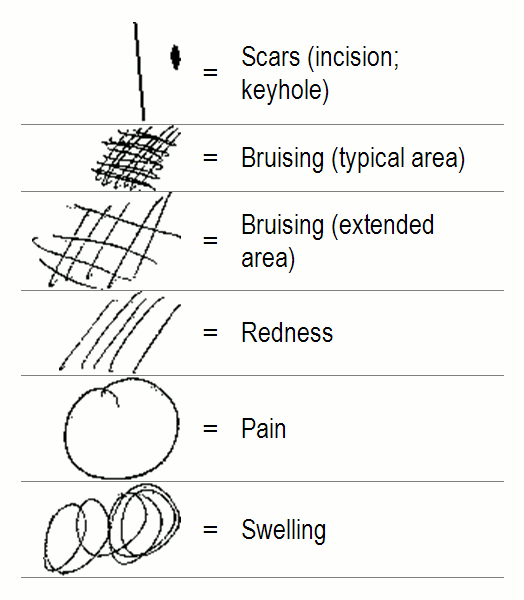
Here’s the key I came up with to explain the symbols I used for the symptoms I had at the time:

6 different scribbles to show 6 different signs and symptoms
key to snapshot scribbles

As you can see, I just scribbled patterns which I found easy to remember. Nothing fancy.

Each sign is distinct from the others, except for the two strengths of “bruising” (I now know that that was CRPS discoloration), which are the same symbol at different densities. Makes sense, right?

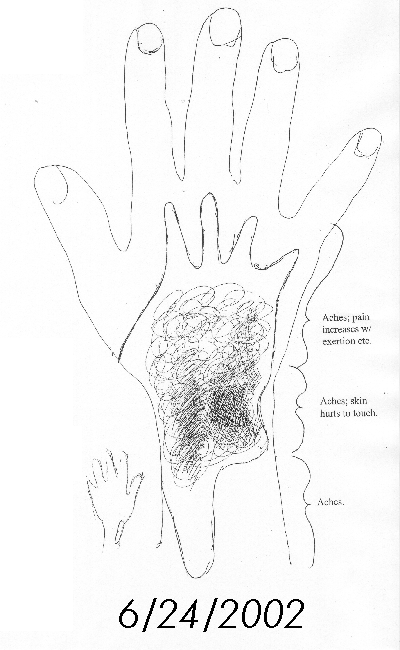
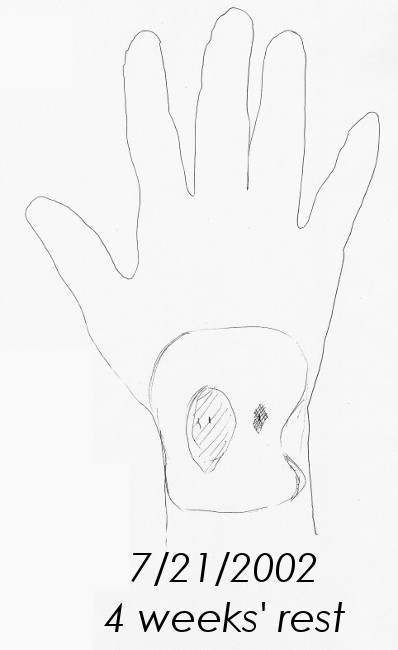
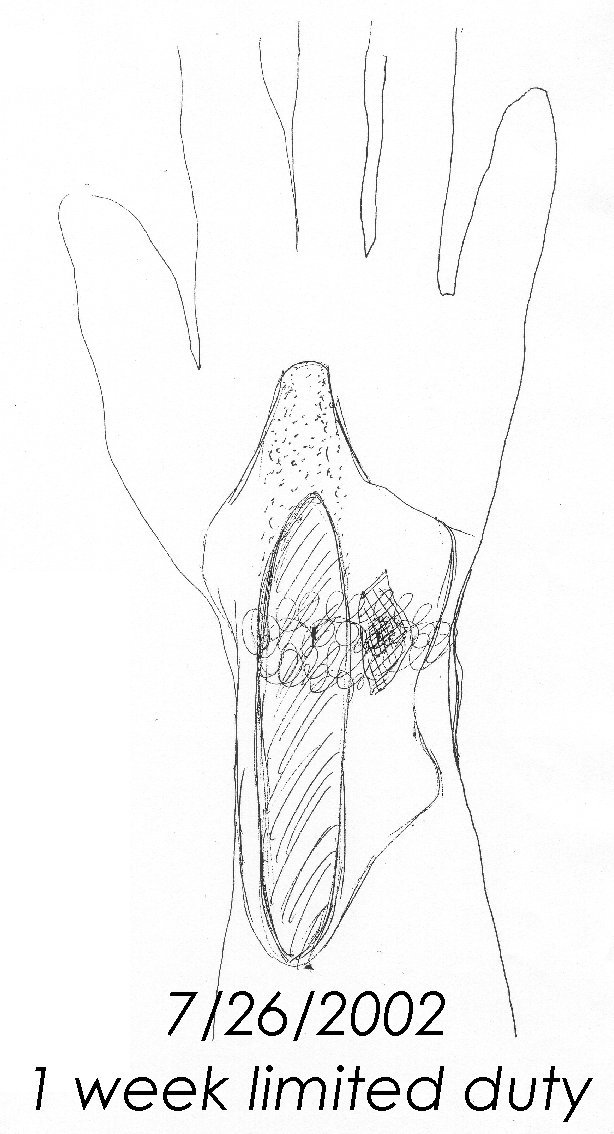
Here are the first 3 images, and what made the difference between them:

Baseline, after working as best I could with the injuries:

sketch of hand that shows extensive pain and bruising.
My first stab at this. What can I say? I was a writer and musician, so I took my hands very seriously.

After about 4 weeks off duty, resting and recuperating:

sketch of hand showing very little pain or discoloration.
It took 2 weeks just to relax, but I succeeded.

After 1 single week back at work on restricted duty:

sketch of hand showing pain and discoloration going further up the forearm than ever before
Yeah. Sucks, huh?

That doctor was right. They really do tell the whole story.

See how easy that was? 🙂 All it took was a pen, paper, and a few notes.

Here are some tips:

  • Put the date and your name on every single one, always.
  • Be consistent about how you label things. They don’t need to learn different labeling systems, they need to learn your case’s course over time.
  • This is a good place to note your pain ratings.I annotated my snapshots with current pain range (at rest and on exertion), bullet points and narrative notes, but it took awhile to learn to keep those annotations very short and to the point.

I scanned all the snapshots into my hard drive, so I can recreate these at any time. I find it very useful when breaking in a new team, because the story told by my first few years of pictures really does tell the key parts of those first few years. They “hardly have to look at the medical record” to understand — and remember! — what happened.

Plus, you clearly don’t have to be an artist to make these pictures accurate and useful 🙂 If tracing around your own limb is too painful or awkward, there’s no reason not to ask someone else to do theirs. Alternatively, you could take a photograph and use image-editing software (available with your camera, or for free or cheap online) to mark the image with your signs and symptoms.

There are lots of ways to get these images going, with any set of tools. And boy, are they ever worth it.

As a point of interest, the freeware I use for editing images is called Gimp. Perfect tool-name for someone like me, eh?

The Red Pen Technique (dramatic music, please)

This is probably the simplest, most powerful tool for getting your complex care back into the realm of sanity.

It’s easier said than done, but it’s worth it. More valuable than words can say.

It’s a fairly simple 3-step process:

  1.  Get copies of your medical records.
  2.  Prepare: understand the records, get a colored pen, and stock up on post-its.
  3.  Mark it like you own it.

Here’s the step-by-step rundown of this process, with insider insights, tips and suggestions. (I apologize in advance for the clunky formatting. I’ll work on it.)

1. Get copies of your medical records

[Updated 3/2018 to reflect current trend towards soft copy documentation.]

In the US, you are LEGALLY ENTITLED to all the information in your medical chart. (Worker’s Compensation is a special case; you can still get copies through your lawyer or sometimes directly from the doctor, but don’t talk to the insurer about any of that.)

To get copies,

A. Call the hospital, clinic, or office and ask for the Medical Records department.

B. Ask what their process is for obtaining copies of your medical records. Most MR departments are honest, understaffed, and extremely literal-minded. Be clear, frank, and polite-but-not-wimpy; that seems to work well with the MR mindset.

i. Some will let you come into the office and make your own photocopies. They may charge you for the copies. Some may have soft copy they can send you on a CD or provide a secure way to download.

ii. Some don’t allow non-staff into the department and will make the copies for you (and it’s best to provide them with a list of what you want, so they don’t provide you with the usual thin, doctor-oriented version. More on that later.) They will probably charge you for pulling the record, making the copies, reassembling the chart, and packaging your copies up for you. They might fax them to you, but, if they don’t require you to come in personally and show ID, then the chart copy is usually mailed or FedExed. Soft copy may be free or cheap. Ask about the cost for each method, and if they don’t offer the method you want, ask if they can provide it anyway.

iii. Some will give you the runaround. In that case, be polite but firm, and let them know that you have a legal right to the information in your chart, so let’s figure out how to get it to you. (Never buy into a power struggle with petty power weilders. Just refocus on the goal — like with toddlers.)

iv. If you had films of any kind (X-ray, MRI, CT scan, ultrasound), ask how to get those films. You usually get them directly from the Radiology or Sonography department rather than Medical Records. They’re most likely to drop a CD in the mail for you. You’ll need software that can view DICOM images — do an internet search to find the best current free application for reading DICOM files.

The radiology departments no longer use film. They used to recycle it every 2 years, so the only way to keep those records was to get the physical films and hang onto them despite promises they’d demand to return them. That didn’t mean you were any better or that the film was irrelevant in two years!

C. Follow the instructions they give you for getting those copies. Be sure to request copies of the following:

i. Doctor’s notes, both narrative notes and forms.

ia. Consults’/Specialists’ notes. (Yes, they need to be specifically requested in some facilities.)

ii. Medication orders. This is what was supposed to be given.

iii. Medication Administration Record (MAR.) This is what was actually given.

iv. Nurse’s notes, both narrative notes and forms. (These days, some places only have forms.) These should include Nursing Diagnoses (which gives a good idea of just how worried or confused they were about you) and daily tracking of what care was needed and provided.

v. Vital signs and intake/output sheets. (Includes fingerstick blood sugars when used.) This is usually background information, but every now and then there’s a nasty surprise. There is no substitute for the clarity and simplicity of this info.

vi. Results of tests. These include labs taken from your blood, urine, stool, saliva, tissue samples, or whatever else they examined. It can include psych tests, behavioral tests, and any other test.

vii. Readings. This refers to what a trained specialist concluded from looking at your films, ultrasound, EEGs, EMGs, EKGs, and so on. It’s usually a couple of paragraphs.

viii. Rehab notes: narrative notes, test results, and forms. This is what your PT, OT, and other rehab specialists saw.

ix. Discharge planning notes. Discharge planning is supposed to start as soon as you’re admitted. These notes will tell you what they knew or assumed about your context and abilities. Very useful info between the lines.

x. List of charges. This is what they’re telling the insurance company they did for you and how much it cost. This should include pharmacy charges as well as “floor” charges. Another place to find both corroborations and surprises.

xi. If they say, “Would you also like [something else in the chart]?” The right answer is usually, “Why yes, thank you, that would be helpful.” Sometimes they offer it because they’re so detail-oriented, but sometimes they offer it because it fits into the pattern of the care you received. Feel free to ask why they suggested it or what it relates to.

D. When you get your chart copy, either scan it into your hard drive before you do anything else, or make 2 more copies and put the original (clearly labeled) somewhere safe.

Some people consider this step optional. I won’t argue with someone else’s working style or legal situation; you’re the one best-qualified to decide how protective to be of your chart copy.

I have everything on my hard drive. I have dealt with a hospital, a federal agency and an insurance company that forgot, mislaid, misread, or destroyed part or all of my chart. I don’t trust any institution to get it right any more.

2. Prepare

When your original copy of your chart is as safe as you want it to be, take a copy to mark up. This is where the real fun begins.

A. Read the whole thing over once. Try not to get bogged down — this quick run-through will help you familiarize yourself with the lingo and the special way of thinking that’s used in the health care field. It will also give you an overall idea of what you’re working with and will shine a light on the most obvious gaps — in your knowledge or vocabulary, or in theirs. Put flags in the strangest, most egregious or excitiing parts, so you can refer to them quickly. Use post-its to comment on the page.

B. Whether or not your first read-through is quick, your second read-through will be a LOT more informative. Pick out and investigate the obvious holes in your own knowledge, looking up words and concepts that aren’t clear, or checking your assumptions about what they meant.

C. (You can start doing this in 2.B., but you’ll be better-equipped if you wait until you’ve got your vocabulary and assumptions squared away.)

GRAB A COLORED PEN. Mwahahahahahahaaaa!

Red, green, dark  pink, and medium purple are all great, because they stand out so well from the black and grey of the copy. Use a color you enjoy commenting with, in a pen that feels good to write with.

No black. No grey. Blue if you must, but it’s a very “normal” color and easy to overlook.

3. Mark it like you own it

Now that you’re prepared, are familiar with the chart, have the hot spots flagged, and know the vocabulary, you’re ready to TAKE BACK YOUR CARE.

A. Go through the chart with your colored pen.

B. Mark everything that is wrong, misleading, or unclear. (Feel free to color-code, if that works for you.)

C. Comment on:

i.  what the real deal was,

ii. what was wrong with what they wrote,

iii. your own observations,

iv. any evidence or witnesses,

v. and — this is usually relevant! — where else in the chart this error, confusion or lie is brought into question. (This is why you get the nurse’s notes. They tend to be accurate, front-line reportage of what happened at the bedside.)

Generally, you can keep emotions out of it. The facts WILL tell the story, and the reader’s own emotions will fill in the blanks.  If you can do this, then you will wind up with a much more powerful piece of documentation than if you’d given into the natural urge to editorialize. Sometimes, if I’m just too mad, I editorialize (and use expletives and call names) on separate paper, then, when I’m calmer and my thoughts are clearer, I go back and write in a calmer note.

D. Write (or tabulate, or draw; whatever works for you to nail your understanding) a summary of issues with the chart.

i. Pick out major issues, overarching issues, and the points where things really should have gone differently. (If you’re writing, use headings — that impresses the heck out of people.)

ii. Summarize the whole thing in a paragraph or two at the end.

4. Now what?

It’s up to  you. You have documentation that is worth presenting in court. (Yes, believe it or not, you can talk until you’re blue in the face and be only tolerated, but if you really want to persuade highly-educated people, then put it in print — with annotations. They will believe exactly the same thing in print, that they’ll be incredulous of when you speak.)

Regardless of what happens next, you will have a whole new approach to medical care. Your perspective on the whole business will change as a result of doing this exercise. You will be much more collegial with your doctors — much less the supplicant praying for something beyond your control. You will speak about your care with more clarity and authority, and your care providers will respond to that, usually with more forthcoming-ness and respect.

Depending on the issues involved (and whether your case is already part of a legal process, such as Worker’s Comp), you can:

  •  Send a (color?) copy to  your attorney. You can always do this. It’s guaranteed to get some attention, and your attorney is liable to  respond well to the nonverbal message that this is important enough to you to go to all this effort. That’s a big deal. Most clients of attorneys are kind of helpless. You set yourself apart with this.
  •  Take it with you to your next visit with a key physician — the worst offender, or his boss, or the one who’s on your side and can help you figure out how to proceed most effectively. Be prepared to let the “good guy” take a copy, and consider bringing a copy for the “bad guy” since you don’t want to let your copy out of your hands there.
  •  Arrange a meeting with the facility’s adminstrators to address the hot issues. Take it with you (or scan copies and show it from your laptop — lots of tech assumptions there) and let them know, kindly and clearly, what you want them to do about it. Administrators tend to be goal-oriented, so give them a goal. Tip: If they have legal counsel present, it’s good if you do, too. In any case, it’s not a bad idea to bring a couple of respectable-looking friends (“my assistants/associates/posse”) who have faith in you, for moral support — and so you’re not all alone on your side of the table.
  •  Send a color copy to your local paper, your congresscritter, the medical board for your state, or the Department of Health, with a cover letter explaining your concerns and what you would like to see change. This could raise some attention, all right. (If your case is currently in a legal process, it may be illegal to do this. Ask your lawyer.)

If you’ve never done this before, you’re in for a transformative experience. Even if you do nothing further with it, your situation will feel very different, and you’ll find yourself facing future care with a stronger, clearer, more in-charge attitude.

Pain rating scales that describe reality

I’m filling out paperwork for these assessments. It’s a lot of homework, especially since they didn’t provide anything I could edit in softcopy. (Wait… how long have computers and the internet been around? Doesn’t the ADA require hospitals to provide access? … ok, never mind. Anyway.)

 
I got to the usual 1-10 pain rating scale and my gorge rose. That’s so irrelevant to my life now that I can’t even throw a dart at it.

 
Between my self-care strategies and spectacular mental gymnastics, the level of what most people would experience as “pain” is a secret even from me, until it’s strong enough to blast through the equivalent of 14 steel doors, each three inches thick. At that point, the numeric level is off the charts.

 
What’s useful and relevant is how well I can cope with the backpressure caused by the pain reflexes and the central and peripheral nervous system disruption this disease causes.

 
You can read on without fear, because for one thing, it’s not contagious, and for another, your experience of pain — whether you have CRPS or not — is uniquely your own. This is mine, as it has changed over the years…


Step 1: Acute CRPS, with otherwise normal responses

My first pain rating scale, just a few years into the disease’s progress, was suitable for a normal person’s experience. My experience of pain was still pretty normal (apart from the fact that it didn’t know when to stop):

Mental impact

Physical changes

0


No pain at all.


1


Hurts when I stop and look.


3

3

Neither looking for it nor distracted.


5

5

Noticeable when concentrating on something else. 

Nausea, headache, appetite loss.

7

7

Interferes with concentration. 
Drop things, grip unreliable.
8

8

Difficult to think about anything else. 

Trouble picking things up.

9

9

Makes concentration impossible. 

Interferes with breathing pattern.  No grip.

10

Can’t think, can’t speak, can’t draw full breath, tears start –  or any 3 of these 4.

Unrated even numbersindicate a worse level of pain than prior odd number, which does not yet meet the criteria of the following odd number.

Note that weakness is only loosely related to pain.  I drop things and have trouble picking things up at times when I have little or no pain.  However, as pain worsens, physical function consistently deteriorates.

Notice how the scale ties the rating numerals to physical and mental function. This is crucial, for two reasons — one personal and one practical:

 
– Personally, I can’t bear to let misery get the better of me for long. Tying the numbers to specific features keeps the awful emotional experience of pain from overwhelming me. Making the numbers practical makes the pain less dramatic.

– Practically, in the US, health care is funded by a complex system of insurance. Insurance companies are profit-driven entities who are motivated not to pay. They don’t pay for pain as such, only for limits on function. This makes my pain scales excellent documentation to support getting care paid for, because MY numbers are tied to explicit levels of function. (Hah! Wiggle out of that, you bottom-feeders.)


Step 2: Early chronic CRPS, with altered responses

My next was upwardly adjusted to describe learning to live with a higher level of baseline pain and noticeable alterations in ability:

Mental impact

Physical changes

3

3

Neither looking for it nor distracted.  Forget new names & faces instantly.

Cool to touch @ main points (RCN both, dorsal  R wrist, ventral L wrist). Hyperesthesia noticeable.  .

5

5

Interferes with concentration.  Anxiety levels rise.  Can’t retain new info. Can’t follow directions past step 4. May forget known names.

Nausea, headache, appetite loss.  Grip unreliable.  Hyperesthesia pronounced. Color changes noticeable.

7

7

Absent-minded.  White haze in vision.  Can’t build much on existing info.  Can follow 1 step, maybe 2.  May forget friends’ names.

Drop things.  Cold to touch, often clammy. Arms & palms hurt to touch.

8

8

Speech slows.  No focus. Behavior off-key. Can’t follow step 1 without prompting.

Can’t pick things up; use two hands for glass/bottle of water. 

9

9

Makes concentration impossible.  Hard to perceive and respond to outer world.

Interferes with breathing pattern.  No grip. Everything hurts.

10

Can’t think, can’t speak, can’t stand up, can’t draw full breath, tears start –  or any 3 of these.

Notice how specific I am about what general tasks I can complete — following instructions, lifting things. These are the fundamental tasks of life, and how do-able they are is a fairly precise description of practical impairments.
 

Step 3: Established chronic CRPS

And my third changed to describe living with more widespread pain, a higher level of disability, and — most tellingly — a physical experience of life that’s definitely no longer normal:

Mental impact

Physical changes

3

3

Neither looking for it nor distracted.  Forget new names & faces instantly.

Cool to touch @ main points (RCN both, dorsal  R wrist, ventral L wrist, lower outer L leg/ankle, R foot, B toes). Hyper/hypoesthesia. Swelling.

5

5

Interferes with concentration.  Anxiety levels rise.  Can’t retain new info. Can’t follow directions past step 4. May forget known names.

Nausea, headache, appetite loss.  Grip unreliable.  Hyper/hypoesthesia & swelling pronounced. Color changes. Must move L leg.

7

7

Absent-minded.  White haze in vision.  Can’t build on existing info.  Can follow 1 step, maybe 2.  May forget friends’ names.

Drop things. Knees buckle on steps or uphill.  Cold to touch, often clammy. Shoulders, arms & hands, most of back, L hip and leg, B feet, all hurt to touch. L foot, B toes dark.

8

8

Speech slows.  No focus. Behavior off-key. Can’t follow step 1 without prompting.

Can’t pick things up; use two hands for glass/bottle of water.  No stairs.

9

9

Makes concentration impossible.  Hard to perceive and respond to outer world.

Interferes with breathing pattern.  No grip.  No standing.  Everything hurts.

10

Can’t think, can’t speak, can’t stand up, can’t draw full breath, tears start –  or any 3 of these.


The CRPS Grading Scale

The other scales measure the wrong things now. Asking me about my pain level is bogus. It would have the asker in a fetal position, mindless; is that a 5 or a 10? Does it matter?

 
I need to avoid thinking about depressing things like my pain and my disability. I focus pretty relentlessly on coping with them and squeeezing as much of life into the cracks as possible — on functioning beyond or in spite of these limitations.

 
The fourth rating scale is much simpler than its predecessors. It’s based, not on level of pain or disability, but on the degree to which I can compensate for the disability and cope past the pain. Therefore, this rating scale remains meaningful, because it describes my actual experience of life.

Mental impact

Physical changes

A. Coping gracefully

(baseline)

Track to completion, baseline memory aids sufficient, comprehend primary science, think laterally, mood is managed, manner friendly.

Relatively good strength and stamina, able to grasp and carry reliably, knees and hips act normal, nausea absent to minimal, pulse mostly regular.

B. Coping roughly

B

Completion unrealistic, extra memory aids required and still don’t do it all, comprehend simple directions (to 3-4 steps), think simply with self-care as central concern, unstable mood, manner from prim to edgy to irritable.

Moderate strength and stamina, grip unreliable and muscles weaker, balance goes in and out, knees and hips unreliable, nausea and blood sugar instability alter type and frequency of intake, occasional multifocal PVCs (wrong heartbeats) and mild chest discomfort.

C. Not coping well

C

Hear constant screaming in my head, see white haze over everything, likely to forget what was just said, focus on getting through each moment until level improves, manner from absorbed to flat to strange, will snap if pushed.

Muscle-flops, poor fine and gross motor coordination, major joints react stiffly and awkwardly, restless because it’s hard to get comfortable, unstable blood sugar requires eating q2h, bouts of irregularly irregular heartbeat.

D. Nonfuntional

D

Unable to process interactions with others, suicidal ideation.

Unable either to rest or be active. No position is bearable for long.

There is no Grade F. Did you notice that? As long as I have a pulse, there is no F, which stands for Failure.

In the words of that divine immortal, Barrie Rosen, “Suicide is failure. Everything else is just tactics.”

So what’s the point of all this?

Documenting our own experience in terms that are meaningful and appropriate advances the science. The treatment for this disease is stuck in the last century in many ways, but that’s partly because it’s so hard to make sense of it. The better we track our experience with it, the better outsiders can make sense of it.

 
Since studies, and the funding for them, come from those who don’t have the disease, this is the least — and yet most important — thing that we can do to improve the situation for ourselves and those who come after us.
 

This isn’t a bad snapshot of the natural history of my case, either. Understanding the natural history of a disease is a key element of understanding the disease. Imagine if we all kept pain rating scales, and pooled them over the years. What a bitingly clear picture would emerge.

 
I’ve never sat back and looked at all of these pain rating scales together. It’s certainly an interesting mental journey.

 
Important legal note: These forms are available free and without practical usage limitations; to use, alter, and distribute; by individuals and institutions; as long as you provide free access to them and don’t try to claim the IP yourself or prevent others from using it. All my material is protected under the Creative Commons license indicated at the foot of the page, but for these pain scales, I’m saying that you don’t have to credit me — if you need them, just use them.
 

Bien approveche: may it do you good.