Reality check in the pause for breath

With some relief in sight, I can admit that being on the road somewhat underequipped and jnderfunded is really hard. The overnight options, as I learned in Centerville, are fraught with the potential for devastating toxic exposures. Packing and unpacking dvery day is painful and an egregious time sink. The solitude doesnt bother me but the lack of distraction does. The constant, relentless struggle with tbis poor body leaves the words “frustration” and “hovering bitterness” feeling hopelessly inadequate.

I’m supposed to create a budget fod implementi g the CRPS: Art & Spirit projdct. I’m much mord clear about what ig will need to include. Good information to have.

"Plan" is a 4-letter word

Last night, in an effort to give my autonomic nervous system a chance to calm down, I turned off my lovely hostess’s wifi while I slept. Eventually, I did sleep, after several hours of meditation.

Why the insomnia?

People change with time. My sweetie is discovering that in the harshest way. A friend of 20 years is sinking into the pit of addiction and her transformation has put him at considerable risk, due to the company she now keeps and what they think of him.

I hadn’t heard from him since midday yesterday, and since we had agreed to call twice more that day for different logistical reasons, not being able to get hold of him was deeply worrying.

I followed my inner prompting to head away from the coast (where another storm is heading in, this one bitterly cold) and get to Cleveland, with the option of flying out from there to get to California to do whatever was needed for my sweetie.

I took off at 9:30 (woefully early for me) after plugging the router back in and forgetting my jacket — which my lovely hostess chased me down to my parking spot to return.

Worth a thousand words

Dr. Goyal and White Plains Urgent Care were a small parking lot and two buildings over from where my nav device had placed them yesterday. /sigh/

She was saddened and intrigued by CRPS, making notes in the margins of my sheet.  She was initially somewhat dismissive of my description of the bite, because this morning it was being coy, hardly red at all.

I said, “I knew I should have taken pictures. Let me draw you a picture.”

Despite my having explained its vacilating nature clearly, I know from long experience that they need to see it to believe it.

So, using the big white paper sheet they have you sit on, I sketched the bite when I first noticed it, half a day later, a day after that, and so on. I wound up drawing a series of concentric circle patterns, growing, then shrinking, then growing, then shrinking.

I finished by drawing an arrow from top to bottom and saying, “Would you trust that pattern? Because I wouldn’t.”

I walked out with a prescription for 3 weeks of doxycycline and having promised to follow up with my CRPS specialist.

I know it’ll take 3-6 months just to get my insides back into any kind of order. Could take up to a year. I had a bad feeling about this bite, so I’ll consider it time well spent.

 When people talk about Mercury Retrograde, this is what they mean

 While I was in there, my lovely hostess texted me: “Internet still not working – what to do?” An hour (and a lot of non-Mac behavior from her Mac) later, my best answer was, “Call the cable company; it’s a hardware problem.”

Doing unsuccessful telephone tech support for one dear friend behind you, for a problem you might have caused, while driving at highway speeds on strange roads, when you’re sick with worry over another dear friend ahead of you, is not something I would recommend. In fact, now that I can check it off my bucket list, I think I’ll try not to do it ever again.

Her life depends on the internet even more than mine. It’s not optional. I wanted to whip around and ride back to save the day … but for the lashing in my brain to go on, and the fact that her hands work better than mine and I know the interfaces by heart, so there was nothing — in practical terms — that my presence would have added.

I had a fierce feeling that, if I could get far enough away from the tangled vibes behind me, both of these problems would resolve themselves.

So, with solid logic on one side of me, and crystal-clear intuition on the other, I charged ahead.

I crossed the New Jersey/New York state line. Then my lovely hostess texted me to say that she had found a second loose connection — and that the internet was now working fine.

How to search for someone who’s gone missing

I crossed into Pennsylvania. I’d been stopping every hour to stretch and breathe, but I couldn’t stop mulling my sweetie’s situation, so I pulled over to start the legwork of searching.

Here’s the drill. The order varies depending on what you think the situation is, but, when someone has gone missing and you fear the worst, I find it’s very soothing to rule out the worst as soon as you can bear to:

– Contact the police in the area you last knew them to be in. (Use the non-emergency number; the goodwill is worth the effort.) Have they had any dealings with that person? Car accident, fight, anything? One of the first things cops do is ask for ID, whether it’s appropriate or not, so they’re likely to have records of even minor events.
– The police can connect you to the morgue. Rule out the worst, breathe a sigh of relief, and move on.
– Call the hospitals.
– If they aren’t admitted to the hospital, ask for the Emergency Room admissions, which may be a different number.

If all of those turn up negative, count your blessings and wait for them to get back into signal range or to realize they let their phone’s battery die.

First, I surfed the police logs to see if anything was reported. If there was any violence, then it’s a small enough town to turn up on the online blotter. Nothing matched.

I mulled whether it was worth calling the non-emergency number to see if they’d had any other dealings, and I decided to go straight on to calling the hospitals, on the grounds that any police involvement in the situation would be blotter-worthy.

Then the phone rang.

And it was him.

I really think there were gouts of steam poufing out of my ears. My eyes closed and I dropped against the door, so I’m guessing, but it felt like it.

He was slightly shaken, but intact, and maybe beginning to really “get it” about how some people change.

He told me emphatically to be careful who I trust, not to pick up hitch-hikers, and be careful who I talked to.

Naturally, I promised him that I would.

Just for the record, I have really great friends who always have my back to the best of their ability. I am one lucky human, and I know it.

Kylertown, PA (don’t blink… No, really,  don’t blink, or you’ll totally miss it)

After sorting out some logistics and stopping for a quarter of hot roasted chicken (definitely a local bird — tasty!) I came to the sinking realization that Motel 6 doesn’t go along I-80, and I can’t afford the ones that do.

Garmin is no help, because they just list the upper scale lodgings. Lots of B&Bs, but no cheap little roadside doss-houses.

I don’t need much, and can afford slightly less. It can be a problem.

I stabbed “Kwik-Fill Motel” on my phone’s map. What the heck, truckers know a thing or two about cheap dossing.

I spoke to a woman, which was reassuring; when I blew past the exit (# 133, if you’re curious, and it’s right after a wooded curve) she did a swell sales-job that convinced me to drive the 10 miles to the next exit and come back… and it turned out to be a good decision. 

This place has been in business since the 1970’s and has only raised its prices $10 since then. It skips the kitsch, thank goodness. My decent-sized room has the tasteful modicum of furniture with classy Colonial lines, with just the occasional bit of ’70’s carpentry or carpeting peeking around the edges. Decoration and color schemes are quite tasteful, for a motel, and — most importantly — the heater works.

A total find.

Next time you want to come to the wilds of Western Pennsylvania, you might as well plan an overnight at the Kwik-Fill; you can’t do any better, but you could do a great deal worse.

The only downside is, I wasn’t prepared for Pennsylvania water. I’d intended to bring a case of bottled for PA, but it was just like I didn’t have time this morning.

I’m going to run the bath and the fan, and give the whole thing time to clear the copious chlorine. If it doesn’t smell bad after that, I’ll have a nice bath at the end of this roller-coaster day. If it does, well, I’ll let it go and be grateful for the rest.


Vocation and purpose (illustrated)

I’ve spoken of myself as a writer for ages, and made a decent living writing professionally (about software) for several years — until I got disabled as a consequence of the long hours.

Look a little more closely…

My inward life (narrative, spirit, meaning) and outward life (events, tasks, purpose) have been approaching each other at an increasing rate, and the transparency this creates causes some re-evaluation of publicly-held assumptions like what I am. For instance, is being a writer my core occupation — my “real” job, where “real” means “true, valid, essential”?

It dawned on me that writing, for all its wry, playful and muscular delight, 

is, for me, a means to an end. Here’s why.

I’ve considered myself a writer since I was 10 years old. My mother gave me a blank book to write my poems and stories in, when I was 11 years old — a step up from my plethora of scoliotoc spiral-bound notebooks — so at that point I was clearly committed.

But my earliest coherent memories are of comforting her, of trying to rescue baby birds, of helping to wash and change my baby brother.

So there’s something I’ve been doing longer than writing.

As an adolescent, I probably spent more time rescuing cats, dogs and (more successfully this time) birds than I did putting words down on paper.

Writing is a joy, and it’s a tool. I know I wrote the right thing when someone says, “That really cleared things up for me,” or more transcendently, “This helped me so much.”

I write to heal. First, I wrote to heal myself, but now, it’s a way of doing a bit of good in the world outside my own head.

As I remarked to a friend of mine, some people go into the healing professions because they like the feeling of power it gives them to help others.

(Many of them are very good at their challenging jobs, so I’m not inclined to dis their motivations.)

Some of us go into it because we like to help people find their strength and set themselves free.

I used to enjoy some of that power, though I believe I did a good job of maintaining perspective in the face of the quite extraordinary impact an emergency nurse can have. 

Of course, what I really loved about that job was the scope and depth of challenge, and the instant feedback. Never a dull moment, and I learned a lot.

Now I have lost what taste I had for power over others, even benevolent power. But I have always loved helping people find their strength and watching them set themselves free.

These days, when I think of anything worth doing (after taking care of myself), that’s what it comes back to: helping people find their own strength, and watching them set themselves free.

Writing lets me do that in absentia, while I’m unconscious, perhaps even long after I’m gone. If I do my job well, others will be reminded of their own strength, or find the clue they need to set themselves free.

So, I’m a healer… who writes.

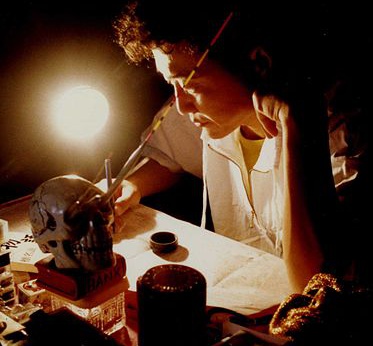
At least I have better dress sense and less disturbing kibitzers than this guy.

I hope it helps.

(revised 12 March 2013, to add images and improve clarity)

Getting it right

H’mm… Struggling with the recurring message from the world around me that I can’t do this, I can’t cure this case of cold chronic CRPS. It’s twinned with the message that, whatever I’m doing, it’s wrong.

I’m not interested in whining, because, as my CRPS cohorts know, this nonsense is par for the course… but every now and then, it’s good to step back and do a reality check.Let’s take a good look at this thinking:

  • On the conventional medicine side, I walked into a new doctor’s office with my tabulated timeline of years of a complex case, pictures showing the evolution of the disease in this body, and documentation about what works and what doesn’t. The response: “You spend way too much time thinking about this!”

Don’t waste time trying to find any upside to that remark. It surprised me especially because most of my docs (the best in the biz) loved my documentation. Now I know that the really good doctors love it, and the ones who don’t love it are either one-trick ponies or second-rate. This one was a one-trick pony, and once he’d done his job, I was gone.

Let’s back up and pretend this guy asked,

  • “Wow, that’s a boatload of well-crafted, thoughtful documentation. Why did you go to so much apparent effort?”

I’d say, “I was a nurse so the concepts are easy, and I was a tech writer so the structure is even easier. This is a cakewalk for me. If I CAN’T document what’s going on, check for a pulse!

“Moreover,” I’d go on, assuming the doctor cared about my well-being, “tracking this stuff frees up my attention by letting me plonk it down in black & white and then put it out of my head. That leaves the rest of my time free for meditating, friends, bathing, housework, and so on.

“Besides,” I’d add, if the doctor looked like one who could take a joke, “most docs find this case hopelessly confusing, and I don’t need you wasting my time by asking the same questions 3 times and still getting it all wrong in the end, just like the one other doc who refused to look at this!” Ha ha.

Clinical note: Seriously, physicians, that’s how to handle an expert patient: Ask, then listen. Saves time.

  • The alt-health folks are liable to tell me, first, that I’m sick because I think the wrong thoughts; then, if they ask about my mental habits, it’s obviously because I eat toxic foods; if they want to get straightened out about that, “it’s clear, dear, that you’re too attached to this disease” and there’s nothing anyone can do to help. (Direct quote.)

My fellow CRPSers are thinking exactly the same things as me right now.

Besides the sheer cruelty of that response, the fact is that spontaneous total remission from CRPS after the first 3 years is even rarer than spontaneous remission in cancer or AIDS. I’ve heard of it happening once as late as 7 years; I’ve had it for roughly 10; average survival is 30 years after onset. If any of you has more optimistic data, I’d love to see it!

Here are some things I’ve learned about how what you think and what you do REALLY affect the course of your CRPS:

  • Those who stick exclusively with the conventional model and submit to their doctors without question, especially when they have noxious drug reactions (as I do), tend to suffer much and die young.
    That’s what happens when you’re a passive patient with a disease that few doctors understand.
  • Those who become well-informed and educate their doctors, have better results and do considerably better for much longer.
    That’s what happens when you open your eyes and take initiative regarding a very rare and complex disease.
  • Those who research and implement changes to diet and lifestyle most vigorously, have the best results from their care and use a lot less medication with much better results, higher function, and lower disability.
    That’s what happens when you shoulder real responsibility for what you do and how it affects your life.
  • Those who are active in the online communities, seeking support and providing support to others and sharing information, tend to beat the odds.
    That’s what happens when you constructively engage with your community.

I’m looking for something I’m not doing yet. I will figure it out, hunt it down and I will do it.

CRPS is an incredibly hard disease, in every conceivable way. Where there is any spontaneous remission at all, there is something to work with. I just haven’t figured out what yet.

Since I still have CRPS, I find those recurring messages a little intimidating. I  don’t yet have hard data to throw back against the key message.

I can see that, when others say I’m doing things wrong, the statements tend to be presumptuous and ill-informed — but the fact is, I still haven’t cured my own case of CRPS …YET.