Need more than "Dysphoria"

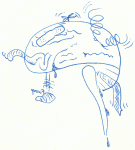
There’s an impressive clinical word for “feeling yucky” — it’s “dysphoria.” It’s literally the opposite of “euphoria.”
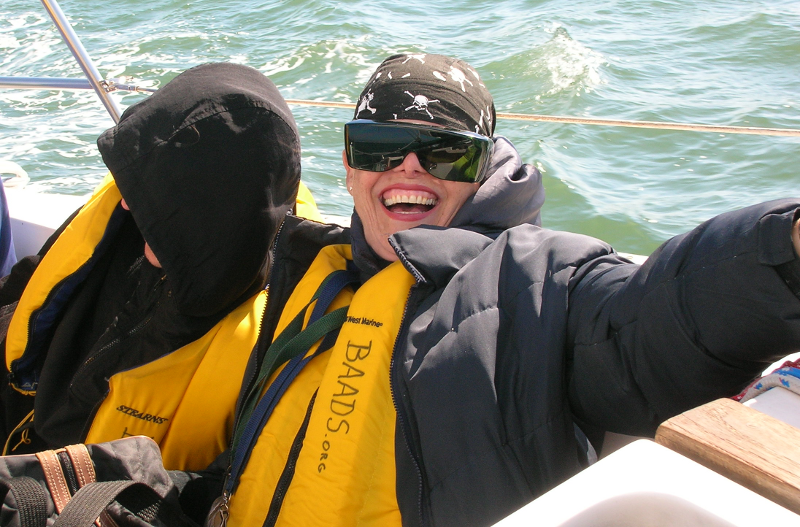
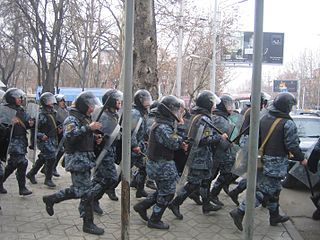
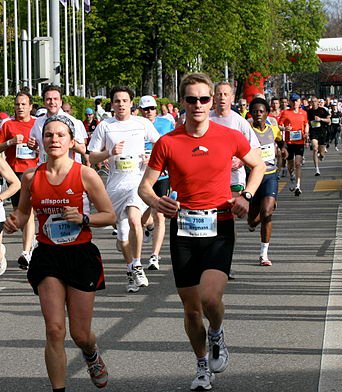
One of these people is Dysphoric and one is Euphoric. Guess… 🙂

The trouble is, there are so very many ways to feel yucky, or dysphoric, especially with a disease like CRPS, but only one word to describe it all. Our experience of life no longer maps to that of a normal person, but language can’t describe what we experience. However elegant it sounds, “dysphoria” is inadequate.

That’s about to change. Here are some words I’m adding to the lexicon, a short selection of the most common and most describable (because some are indescribable) of the dysphoric states I move in and out of…

Dysphoria Sunnysidedown
The particular kind of yucky I feel when I get up before I’m ready. It takes about an hour, usually, to avoid D-Sunnysidedown.

Otherwise, I get tremulous, nauseous, my heart races (but quietly), and I’m aware of a particular kind of fragile ghastliness in a minor key. If I really get up too fast, I fall over — muscles quit. This adds up to Dysphoria Sunnysidedown.


Flip ’em!

Dysphoria Darkofnoon
This is a natural consequence of D-Sunnysidedown and usually happens later the same day, but occasionally happens by itself. Darkofnoon involves feeling peculiarly ragged (as if my adrenals had been in overdrive for hours, which is accurate if I arose too fast), forgetful, physically weak, slightly shaky, and of course nauseous. Sometimes dizzy spells.

There’s a more solid kind of ghastliness, more in a dominant chord. Dysphoria Darkofnoon usually happens when the day is brightest, between 11 am and 3 or 4 pm.

Lying down periodically helps me get through the day, but I’m not likely to be quite right until a good night’s sleep and a proper start to the next morning.


Dysphoria Hate2Bme
Stunning levels of distraction, with a dense pale-grey cloud wound around and through my mind and perceptions, dissolving what it doesn’t hide.

It insulates me from such trivial issues as major appointments, where I put the keys, and the state of traffic lights. I can tell where my body is in space, but not how it feels. Likely to injure myself, risking further spread.

It would be tolerable if there weren’t any consequences or anyone leaning nervously away while looking at me with worried pity. When I’m experiencing Dysphoria Hate2Bme, the humiliation and underlying fear are the most dysphoric elements, though there is something intrisically unpleasant and destructive-feeling about the dense grey cloud.

Dysphoria Mitoshriek
This happens when I’ve overtaxed my body, though sometimes it happens by itself. I think of it as the mitochondria in my muscle and nerve cells all setting up a synchronized shriek of anguish as they fall over in a dead faint. (I don’t know how they scream while fainting, but they seem to manage it.)

It feels like my soft tissue threatens to dissolve when I try to get up or do anything. There’s a sort of wholesale, pitiable unpleasantness in mind, body and soul with the least physical effort.

My muscles react with a sort of “You’re kidding, right?” when I try to use them, and if I push through in order to get something done, it’s done by pure determination and then I’m out of commission for a couple of days. I pay hard for pushing back against Dysphoria Mitoshriek.

For all I know, my mitochondria have nothing to do with it, but mito self-care seems to help: tons of antioxidants, lots of vegetables, and as much horizontality as I can stand. I can tell when it’s time to start moving — about 3/4 of a day after I start really wanting to.

One thing that is no worry at all: I don’t ever have to worry about being too lazy.


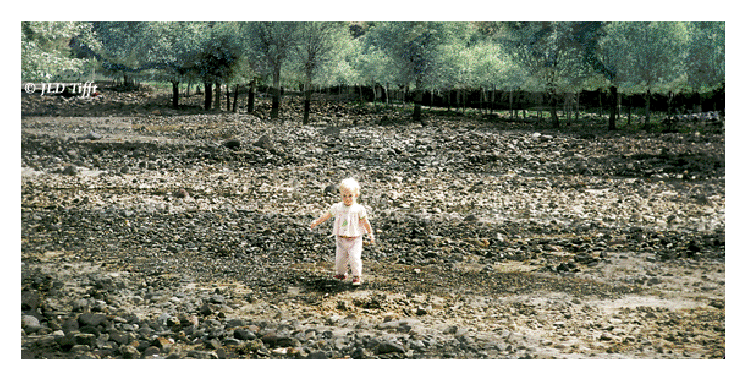
Your faithful writer at 2 yrs old. I refused help; I was going to
cross that dry riverbed all by myself, come Hell or high water.
Photo: JLD Tifft, used by kind permission 🙂

Bodies and minds, like engines, were made to go, and I’m most at home when I’m going in mine.

After the intense inward training of living as usefully and zestfully as possible despite CRPS, can you imagine what it would be like to have all this determination and energy unleashed on the world if I were finally well again, and could focus on, remember, and do things on a vaguely regular basis?

Can’t wait to find out.

So this is peaceful ol’ me…

…saluting all that keeps me from that.

Speaking of which…

Marathon training note

I’m stable with walking 1.5 miles at a time, and recover fast enough to do more later that day. Will aim for 1.8 later this week, after recovering from this trip.

Despite spasms and cramps etc., I made it all the way home in 1 day yesterday, instead of splitting the drive into 2 days as I usually must. This amazes me. My eyes didn’t cross and my mind didn’t splay into a messy 10-pointed star, both of which usually happen after 4-5 hours of driving with hourly breaks. So, there are some key neurological pieces that are definitely doing better.

Yay cerebral blood flow! Yay exercise!

It might be smart to take today off and stick to PT exercises and tai chi. No more bloody relapses. But boy, I sure am heartened!

Marathoning, murder, and masses

Who the hell would bomb a marathon? The shock and fury make my eyes hot and narrow.

Second thought: what a way to go – accomplishment, adrenaline, euphoria, and a quick blast.

Yesterday, ironically, I realized I was fully recovered from overdoing. That only took 11 days… I took careful walks around the park while recovering, so as not to lose much ground.

Leading myself along, and minding my posture.
Today I roughly doubled my walking distance and I’m back up to ~18 min. On a flat.

I’m grateful.

I grew up in Egypt, a Middle Eastern country. We were there in the relatively tranquil days of the late 1970s: Sadat was secure in power, a secularist who stood no nonsense and could be bought – excuse me, persuaded – into a peace treaty that ended several thousand years of war. (For the meantime.)

Islam was a thoughtful, neighborly religion. Guests were treated like the loveliest royalty. A blonde 13-year-old girl with a forward figure could (at least, did) walk the streets in daylight fearing nothing more than vile remarks and, in a crowd, a vile grope.

That was the key to life in a tourist country: avoid the crowds.
 
When terrorist attacks happened, and they were rare then, they happened in crowds. My family was constitutionally adventurous and put off by mob thinking, quite apart from the (really tiny) chance of bombs, so we just did what came naturally and took off on our own.
 
We saw crowds the way a sailor sees sandbars: a lot of work, and not much fun to get stuck with.

Moreover, I’ve always been an introvert in the Myers-Briggs sense, meaning that I recharge in solitude and that I find society in large doses simply exhausting.

Now, with CRPS, this distaste for crowds has become a deep aversion. The physical dynamic of being in crowds is unbearable: when people bump me unexpectedly, it’s horrific; the noise overwhelms my sensory brain, which, let’s face it, is overworked already; and, of course, my hotwired autonomic nervous system is ready with the fight or flight response… with nowhere to go that isn’t in the crowd.

Breathe. Breathe. Breathe.

I was reading Angela N. Hunt’s book about living while training for a first marathon, and her description of the starting crowd was appalling. For me, it would be like being inside a tiny electric fence, cattle jostling around against the outside, bashing and zapping me mindlessly and endlessly.

Not do-able. Not even think-able.

But that’s just a problem, and problems are meant to be solved.

There are several possible solutions: invoke the ADA and start in my own class behind the crowd; rustle up about five good buddies — preferably large, sturdy types — to run around me for the first half, and be a better fence until the crowd thins enough;

run a different marathon course over open country, with only a handful of others; or abandon the whole thing.

I can hear some strenuous votes for the last option. In the wake of the Boston marathon bombing, I’ll ignore them. Completely.

I will go on. If distance is not an insuperable barrier, then neither is willful fear. I’m a woman, weakened, disabled, and rather poor; I have enough to be afraid of. I don’t let it stop me. Why should this? I’ll wear the names of the dead, if it helps. I won’t let it stop me.

I will go on. I’ll find a way to avoid the crowds, in some creative and tasteful fashion.

I will go on.

“Watch me go.”

Overdoing…the first time

My walking time in PT went from 5 min. to 10 min. when we decided to start training for the marathon. My walking at home took the 10 min. up to nearly 20 min., a third of that uphill.

That was nearly a mile. In a burst of what I thought was genius, on Friday I decided to walk down to town (0.8 miles), run a couple of errands, sit down on a sunny bench if need be, and walk back (0.8 miles, all gently but steadily uphill.)

Then, I thought bouyantly, I’d throw necessaries in the car and take off for my two week vacation.

Well, I got as far as making it back to the house. I knew, as I started back from town, that this had been a bad idea, and that there were three outstanding questions: would I have to find a place to sit down en route, exactly how hard would it hit me, and how long would it take to recover.

Saturday was a dead loss.

Sunday, I packed in small loads, resting for an hour or two between each trip to the car. No kidding: an hour or two. By Sunday around 4pm I was beginning to recoup a little. I left at 5.

I had forgotten what a mitochondrial shriek-fest felt like. An almost devastating feeling that my flesh turns to rot when I try to get up. I don’t recommend it.

Mitochondria are the wonderful little hitchhikers that house our bodies’ energy factories, in return for a warm place to live. They are most thickly concentrated in nerve cells and muscle cells. I knew all along that rebuilding my mitochondria was going to be perhaps the most essential part of training, but after my stellar success on the Hill, I thought I had more to draw on than that.

A delightful piece of training advice I got years ago was, “You can do all the cardiovascular you want.” Perhaps that was true at the time, although I noticed I did better when training four days per week than five or six. Perhaps I should’ve remembered that last week.

I think I should’ve rested for a day after my Hill expedition, for one thing. More importantly, I should’ve had a backup plan on my “adventure”, so I wasn’t stuck with the hike back. And I probably shouldn’t have done this around the excitement of going to see my sweetie.

My kitten just typed $. I have no idea…

Perhaps he’s telling me that overdoing doesn’t pay.

Putting together the team

I saw  my counselor this morning and told her I was thinking of running the marathon. She waited for me to go on, then said, “Wait, you’re not laughing. You’re serious!”

I waved a hand generously and said, “Take a moment to have your reaction…”

It was priceless.

After talking it over a bit, she began to get behind it, rather  breathlessly but with real glee.

I saw my PT just now, for our first conversation since his rather cryptic reply to my email. He doubled my treadmill time (up to 10 minutes from 5), and said without preamble, in his cooly unflappable way, “That marathon idea of yours? It’s going to be slow, it’s going to be hard work, but I think we can do it. It’s a good goal.”

I nearly burst with relief and delight.

He set a 5-mile limit on my exercise over the coming 2 weeks of my vacation, then checked and said, “You’re  going to come back and say, ‘He-e-ey, I did 15!”

Finally… a PT I don’t have to train.

Last, I saw my rheumatologist, who laughed in a pleased fashion and said, “I’m glad you’ve got a good PT for this. That makes my job a lot easier.” Didn’t turn a hair.

I’m seeing my primary care doc and my pain doc on Thursday.  As for data (I am a geek; gotta have data!) I have current baseline levels for all basic chemistries, immune globulins, and a complete blood count, plus vitamin C and D. I have cortisol reports from when I was in adrenal exhaustion.

I’d like a baseline cortisol test now, and talk over what other stress/adaptation/compensation markers we could be tracking and how often.

I might have to shop around to different labs to keep in budget, if insurance can’t be persuaded to cover the lab-based data collection, or if I can’t get it covered some other way.

I’m dead serious about not hurting myself. I’m also dead serious about going for this. In any case,  we might as well collect data, so if nothing else, we’ll have one damn good case study to publish.

See you on the trails.

Marathon — second thoughts

I’ve gotten some interesting responses to my marathon proposal, some of them very worried, bless their excellent, loving hearts. I feel I owe some explanation.

My tiny handful of fellow “imps of the possible” are all for it, completely understanding the uncertainties and sidetracks and possible (even probable) different endings in store – and knowing that it’s the reach that’s important, that spreading

Making progress

Yesterday was my first workout: walking 0.8 miles around the block. I live on the side of a pretty steep hill, so that’s not completely trivial.

On the steepest part, I wanted to stop, but my old athletic training kicked in: do anything *but* stop, because it’s worth it to get the hill behind you. So I moved forward less than one foot-length at a time, giving the sick feeling in my chest enough ease to pass. (At least I know it’s not a heart attack. One of the wonders of chronic CRPS is, your physical experience of life has changed so much that words don’t exist to explain it. But I know for sure it wasn’t a heart attack.)

Today was my second: the same distance, but noticeably better – on the steepest part, I could maintain something close to a walk, and I never got that sick feeling in my chest.

Wonderful progress!

Today was also my first lesson in biofeedback. I thought I was hot stuff, because I can knock 10 to 12 points off my blood pressure at will. Today, though, we measured galvanic skin response. It’s much more subtle, and a lot harder to finesse. I got compelling evidence that the physiologic back pressure of this disease is pretty much as bad as I’ve ever said it was. I won’t go into that, because it’s depressing.

I’ve been thinking about a blog entry on breathing, the simplest and most profound of our daily actions. I have to absorb today’s lessons first… I really see why I haven’t been able to put it together yet, even though it’s been on my mind for weeks. Breathing, like living, is so fundamentally simple that I have to think it through very carefully before I try to put it to words.

Letter to my PT – how about a marathon?

Dear [PT],

Something crystalized in my mind, after reading the preface to a friend’s book. (On Kindle here.)

I  do well with having rather demanding overarching goals. (Trauma nurse at DC General, software geek at Borland? yeah :)…) I have some good mental and creative goals (books on mythology and CRPS neuro-endocrine-immunology, 501c3 called “CRPS: Art and Spirit”, etc.), but my physical goals are reactive rather than proactive

Right now, it’s all about beating back the assaults on my function; there’s none of that necessary “F.U.!”-sized stuff on my horizon that can help me bring enough focus and determination to vault over such paltry issues as washing my damn hair. (One side of my face laughs wryly as I say that.)

There’s the shorter CRPS walk/roll/run in December, Quench the Fire!, and that’s a good, reasonable goal.

I need a slightly unreasonable goal, or I can’t really focus. Normal goals really do bore me. Sad, possibly warped, but true. 

And this reactive mindset is doing me no good at all — look at my last stallout. Awful. 

It’s just awful to be reactive in my goals, and especially in the goals for my horribly challenged physical self — my only vehicle of life. 

I have to do better. 

I need something more — something a bit larger than life to strive for. (Just ask my mother. I’ve been like this since I was at least 2.)

So… I’m considering running next year’s marathon.

Positives:

+ I have a year to pull myself together. If you could help hook me up with some kind of structure for training, so much the better.
+ Keck staffs the medical tents, which I find automatically reassuring.
+ It’s slightly crazy, but not completely insane. Perfect.

Negatives:

– Mostly pavement. A real problem. (I don’t have to train on pavement, though.)

– Potentially difficult, risky and expensive. …Just like life.

– Ummm…

I think the Ayes have it. What do you think? And, if I’m in town, I’d be delighted to do the 5/10k at the end of this year. Not as a goal, but as a coincidental benefit.

It’s all about pacing.
I realize we’ve only just met, and this might strike you as brash or ill-considered. I’m not saying it isn’t, but it’s very much in character and, with a little bit of faith from those backing me, could be just the mental kick to help with quite a few intermediate hurdles.

And, of course, I might finish.

(With a little publicity, this could be pretty cool all around. Fat, brittle, middle-aged, chronic CRPSer turns marathoner. — Huh, that gets MY attention! And how cool if I was not the only one….)

I used to be a middle-distance runner, going 4 miles up and down a canyon or 6-10 over surface streets, 2-5 days a week. I kept getting back to it, pre-injury; I enjoyed it, and looked for places to live where it was safe to run.

Marathoning is a different mindset, but I think it’s learnable. And learning to do a marathon in a paced, calm, controlled, ANS-managed, non-frantic manner… well, that’s one hell of an F.U. to CRPS!

I look forward to hearing what you think about this… I think 🙂 I really do want your advice and would love to be able to check in with you as I go, so please mull it over. I’m seeing my whole team next week, so I’ll get to do plenty of hashing-out. I’ll blog it and talk it over with some of my old guard this weekend, too, so I’ll be better prepared for our conversations.

Many thanks,

Isabel


Writing on science, adaptation, surviving, and running…
* Health and Life with CRPS-1: http://livinganyway.blogspot.com/
* Cauterizing the Bleeding Edge of medicine and science: http://biowizardry.blogspot.com