Marathon — second thoughts

I’ve gotten some interesting responses to my marathon proposal, some of them very worried, bless their excellent, loving hearts. I feel I owe some explanation.

My tiny handful of fellow “imps of the possible” are all for it, completely understanding the uncertainties and sidetracks and possible (even probable) different endings in store – and knowing that it’s the reach that’s important, that spreading 1 Comment on Marathon — second thoughts/

Making progress

Yesterday was my first workout: walking 0.8 miles around the block. I live on the side of a pretty steep hill, so that’s not completely trivial.

On the steepest part, I wanted to stop, but my old athletic training kicked in: do anything *but* stop, because it’s worth it to get the hill behind you. So I moved forward less than one foot-length at a time, giving the sick feeling in my chest enough ease to pass. (At least I know it’s not a heart attack. One of the wonders of chronic CRPS is, your physical experience of life has changed so much that words don’t exist to explain it. But I know for sure it wasn’t a heart attack.)

Today was my second: the same distance, but noticeably better – on the steepest part, I could maintain something close to a walk, and I never got that sick feeling in my chest.

Wonderful progress!

Today was also my first lesson in biofeedback. I thought I was hot stuff, because I can knock 10 to 12 points off my blood pressure at will. Today, though, we measured galvanic skin response. It’s much more subtle, and a lot harder to finesse. I got compelling evidence that the physiologic back pressure of this disease is pretty much as bad as I’ve ever said it was. I won’t go into that, because it’s depressing.

I’ve been thinking about a blog entry on breathing, the simplest and most profound of our daily actions. I have to absorb today’s lessons first… I really see why I haven’t been able to put it together yet, even though it’s been on my mind for weeks. Breathing, like living, is so fundamentally simple that I have to think it through very carefully before I try to put it to words.

Letter to my PT – how about a marathon?

Dear [PT],

Something crystalized in my mind, after reading the preface to a friend’s book. (On Kindle here.)

I  do well with having rather demanding overarching goals. (Trauma nurse at DC General, software geek at Borland? yeah :)…) I have some good mental and creative goals (books on mythology and CRPS neuro-endocrine-immunology, 501c3 called “CRPS: Art and Spirit”, etc.), but my physical goals are reactive rather than proactive

Right now, it’s all about beating back the assaults on my function; there’s none of that necessary “F.U.!”-sized stuff on my horizon that can help me bring enough focus and determination to vault over such paltry issues as washing my damn hair. (One side of my face laughs wryly as I say that.)

There’s the shorter CRPS walk/roll/run in December, Quench the Fire!, and that’s a good, reasonable goal.

I need a slightly unreasonable goal, or I can’t really focus. Normal goals really do bore me. Sad, possibly warped, but true. 

And this reactive mindset is doing me no good at all — look at my last stallout. Awful. 

It’s just awful to be reactive in my goals, and especially in the goals for my horribly challenged physical self — my only vehicle of life. 

I have to do better. 

I need something more — something a bit larger than life to strive for. (Just ask my mother. I’ve been like this since I was at least 2.)

So… I’m considering running next year’s marathon.

Positives:

+ I have a year to pull myself together. If you could help hook me up with some kind of structure for training, so much the better.
+ Keck staffs the medical tents, which I find automatically reassuring.
+ It’s slightly crazy, but not completely insane. Perfect.

Negatives:

– Mostly pavement. A real problem. (I don’t have to train on pavement, though.)

– Potentially difficult, risky and expensive. …Just like life.

– Ummm…

I think the Ayes have it. What do you think? And, if I’m in town, I’d be delighted to do the 5/10k at the end of this year. Not as a goal, but as a coincidental benefit.

It’s all about pacing.
I realize we’ve only just met, and this might strike you as brash or ill-considered. I’m not saying it isn’t, but it’s very much in character and, with a little bit of faith from those backing me, could be just the mental kick to help with quite a few intermediate hurdles.

And, of course, I might finish.

(With a little publicity, this could be pretty cool all around. Fat, brittle, middle-aged, chronic CRPSer turns marathoner. — Huh, that gets MY attention! And how cool if I was not the only one….)

I used to be a middle-distance runner, going 4 miles up and down a canyon or 6-10 over surface streets, 2-5 days a week. I kept getting back to it, pre-injury; I enjoyed it, and looked for places to live where it was safe to run.

Marathoning is a different mindset, but I think it’s learnable. And learning to do a marathon in a paced, calm, controlled, ANS-managed, non-frantic manner… well, that’s one hell of an F.U. to CRPS!

I look forward to hearing what you think about this… I think 🙂 I really do want your advice and would love to be able to check in with you as I go, so please mull it over. I’m seeing my whole team next week, so I’ll get to do plenty of hashing-out. I’ll blog it and talk it over with some of my old guard this weekend, too, so I’ll be better prepared for our conversations.

Many thanks,

Isabel


Writing on science, adaptation, surviving, and running…
* Health and Life with CRPS-1: http://livinganyway.blogspot.com/
* Cauterizing the Bleeding Edge of medicine and science: http://biowizardry.blogspot.com

Back in the saddle again

The grip of the last round of the Yucks started to break right after posting my last. I hate it when I have to go that far to get past a bad spot, but hey, I’ll do whatever it takes to keep heading in the right direction.

Dignity is optional. Progress is not. Words I live by.

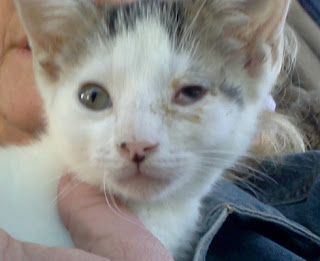
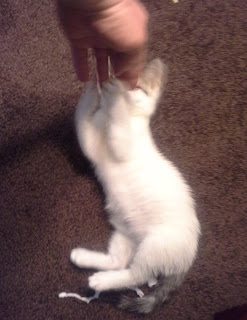
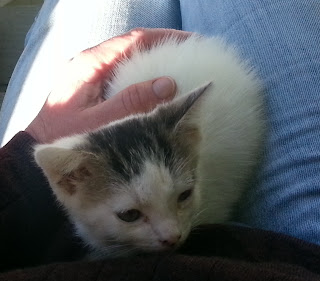
My new kitten has changed apparent gender twice, and is back to being a boy kitty — not that it matters in any practical way. I was looking for a name as elegant, good-natured and playful as he/she/it, while treating an upper respiratory infection that made that left eye look like a mouse:

My cat’s mouse

But then, with returning health and strength, his natural energy and violence reasserted itself. He has exactly two gears:
1. Unconscious (or nearly so)
2. Full-tilt, greedy, grasping, and spikily impulsive (as the scratch-marks around my blinked eyelashes attest)

So I’ve named him Siddhartha, in the hope that something will rub off.

Siddhi playing hide-n-seek.
(“Siddi” is an Arabic address used towards a respectable gentleman.
Another fine malapropism from the chronically punny.)

All of his front nails are trimmed now…

In health care, we call this “desensitization”

As for my own care, I’m up to 2/3 of my reiki time and 2/3 of my basic qi gong routine, and hope to get some t’ai chi in today as well. This is tremendous progress.

Vegetables are once again a chief component of my diet, thanks in no small part to an enormous bag of frozen “Normandy style” blend from Costco and our local dollar store, which sells cheap organic produce out of cardboard boxes.

I actually did laundry yesterday.  Today, I hope to take a shower and — gasp — wash my hair!


I realize only a minority of you will find that truly inspiring, but the rest can have a good laugh… and then think for a minute 🙂

For me, life with CRPS is indeed a matter of tiny triumphs and great goals. For the record, I’m still bound and determined to advance the search for a cure, and yes, I’ve gotten slightly more concrete in my ideas about that… More to come in time.

And now, just for the deliciously hokey yodeling at the end…

Links list:
Here is a recap and explication of the links used in this post:

Frustration at the wall

I’ve had my nose shoved up against a wall for two and a half weeks now. It’s very frustrating but it’s the nature of this disease that, at times, I’m going to get stopped in my tracks, and I may not always understand why.

I have had less energy than I do now, but I have never had less motivation. Me? Unable to start something? This is so out of character that it’s a bit like seeing Mother Teresa bite a kitten — unfathomable.


Speaking of eating, I’ve been craving sugar so intensely I have truly felt like I’d lose my mind if I didn’t eat sweets. I haven’t had serious sugar cravings for almost a decade. That was one problem I never ever thought I’d be dealing with again. That’s finally lightening up, thank goodness — and thanks to some mental judo and nutritional first-aid. I can’t take on any more weight or the pain in my feet will become unbearable, and my hips are already giving me hell.

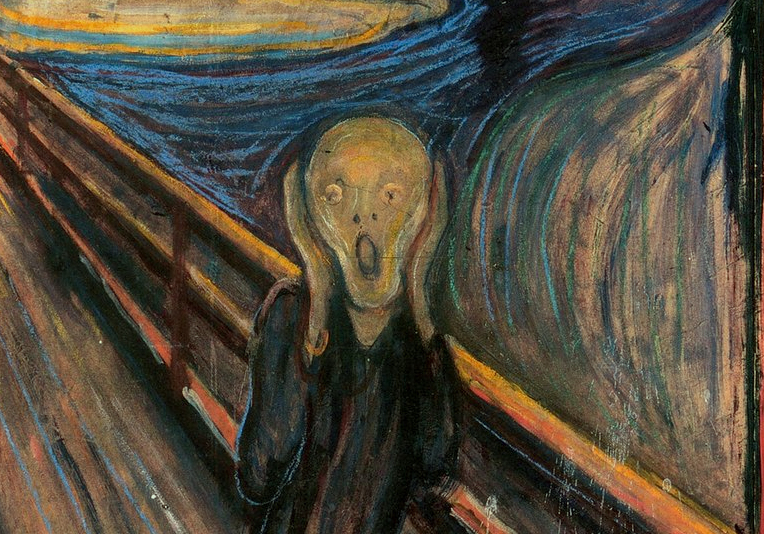
I have great blog ideas, but getting them into words isn’t happening. No… words… come… together. This is so strange I don’t even need to elaborate. This is the first thing I’ve been able to write in weeks and it’s not a blog, it’s a tirade. Excuse me while I scream.

My muscles across my shoulders and upper back are so tightly knotted I can’t do my exercises or qi gong or even more than a stroke or two of tai chi without that weird warping sensation when the muscles pull my moves awry — and then the nerves pull back and howl. Some activity would be better than none, but low as that bar is, I just can’t make it over.

I got a break from my muscles last night when I loaded up on Flexeril (if you follow this blog, you know it’s almost unheard-of for me to hit the CNS-affecting meds) but the lethargy, brain fog and stupidity this caused, for 18 hours afterwards, is hideously limiting in itself.

After trying to do my most basic stretches just now, I took another dose. I will NOT let this twisty locked-up posture become the new normal.

And somehow, nevertheless, I will function tomorrow enough to get my pills and get my gear and get my food for the day and get my sorry ass over to OT and PT and hope something can break through this maddeningly comprehensive barricade.

Needless to say, this is not my usual pleasant, mindful, lemons-into-lemonade sort of post.

This is me grabbing the damn lemons and throwing them right back, hoping to hear a few screams as they connect. 

In the fullness of time, I expect I’ll be able to  find a trigger, or a clue, as to what exactly started this and how to avoid it in future.  I can’t see it from here, and maybe this is the start of what I dread most: The Slide, the final descent into irresistible helplessness and incompetence.

But I think not. I’m too damn angry to give it that much room.

Let’s see what happens next. My money’s on the chunky blonde with the harsh mouth and crappy attitude. 

… And the new kitten…

Now here’s an interesting point, mentioned in passing in my prior post: It’s not very useful to be nervous, but it’s generally perfectly rational.
There is a reason why people become nervous. It’s not to irritate those around them, regardless of others’ views.
It’s generally an appropriate response to some hideous experience, or, more likely, a consistent and extensive series of hideous experiences. After enough hideous experiences (or enough hideousness in one experience), it’s irrational not to be nervous.
It’s important to distinguish between what’s irrational and what’s not useful. Very little human behavior is truly irrational, but there’s a lot that’s not useful. (One popular term is “dysfunctional”, but that’s a cranky, judgmental-sounding word, so I won’t use it.)
CRPS, along with many central nervous system disorders, triggers more than its share of non-useful responses… However, I find that recognizing that the response has a cause, that it’s not crazy or irrational, that there is a reason for it, goes a long way towards making those twitchy responses more manageable.
You know me: it’s just a problem, and problems are meant to be solved. Therefore, how can I solve the problem of handling non-useful responses?
Here’s my strategy:
  1.  Identify the nonuseful response: when do people react badly to me? What was I doing at the time? How did I sound, how did I feel? I zero in on the non-useful response by exploring what was going on outwards and inwards when it happened.
     
  2.  Internal inquiry: I look at what’s going on inside me when those events occur, when similar events occur, and what I remember from before I started the inquiry. This gives me insight into what, in me, contributes to the negative reactions in others.
     
  3.  Get perspective: discuss it with friends, check my assumptions, try to find out if I’m overreacting (gee, that never happens!), look for an outside point of view on specific incidents. I do this after the internal inquiry, so I have time to brace myself for unpleasant truths. Sometimes it’s other people; sometimes it’s me. Quite often it’s both, but I only control one end of that.
     
  4.  Identify the underlying problem: this is when it starts getting easy. Having faced the unpleasant reality that the world can’t read my mind and might not think well of me when I behave less-than-brilliantly, now I just have to notice what the fear or the need was that triggered my unuseful reaction in the first place. There’s usually a fairly easy way to address that, sometimes simply by crediting it.
     
  5.  Monitor and reprogram myself: when similar situations arise, I pay attention to the present moment, and react appropriately to that, keeping half an eye on my old reactions so they stay out of the way. It doesn’t take long to reset to the usual defaults of consideration and common courtesy. I’m lucky that way.
With care under way, survival taken care of (more or less), and my relationships whittled down to the ones that work, I can further reduce the mess in my life by managing my own CRPS- and chronic stress-rattled reactions better. The time will pass anyway, so I might as well be better for it.
I’m not going to become something different just by changing a few responses (for the better, I hope.) I’m still me, and anything that changes is optional to that.
The past few years have been… How shall I put this… Rich with opportunities to relearn how to manage myself, as the storms of neurochemistry, medications, medical neglect, institutional harrowing in so very many ways, stripped relationships, the loss of everything (and I do mean every thing), have marched through and torn up all that I thought was my life.
I find great calm in one simple fact. When everything has been ripped away, when life and purpose and capacity and identity are nothing but rubble flung in shapeless heaps as far as the eye can see, when there is simply nothing left… As I stand there, too far gone for tears, too empty to complain, too lost to move… and wonder, “Who, or what, am I now?”
I’m the one standing there, doing the asking.
I love the unkillable certainty of that.
Have you noticed how freeing it is to let go of your ideas of who you are?
 
Among other things, it makes re-learning how to manage reactions a whole lot simpler.

Posture matters, across species

For the past forty-mumble years, and for some time to come, my experience of life is shaped by the particular body I’m in. The reciprocal nature of the mind-body experience fills more books than I’d ever want to read, and that’s saying something, so let’s cut past that idea of, “Wow, the mind can influence the body and the body can influence the mind, but neither has sole control of the steering wheel” and look at the subtle, but strangely clear, ways that it plays out – at least in me.

I lived in a dog-friendly marina. – Trust me, this is relevant.

It’s not just about the scenery.
I found that, even before I knew the neighborhood dogs, I could tell which ones belonged on the dock by their posture as they stood, sat, walked, and moved.


I saw dogs in every degree of getting along — or not.

I saw the active posture of dogs who were used to plenty of food and care…


and dogs who clearly weren’t.


This was interesting to me as I was coming out of a period of being thugged on by every force outside myself that had a duty to care for me. Being, not only neglected, but frequently tormented and abused in response to most of my efforts towards survival and care, left me very nervous indeed.

Not good for the brain. Or anything else.

I was having trouble with my posture, and – limited by impaired kinesthesia (the sense we have of where our body is in space) – I was working out exactly what the trick points were.

– My low back was in a tight sway, sticking my stomach and butt out egregiously. I lost over an inch of height to that sway in my back.

– I recently realized that, when I fall back in this posture, my abdominal muscles are braced outward. I’m not slack in the belly; the muscles are braced for an incoming blow!

– My neck was hunched against my shoulders. This was funny because I did used to have a bit of a weightlifter’s neck, short and thick; but that was many years ago… when I lifted weights.

– My tailbone was curled in tight, which I only realized after my physiotherapist at the time taught me to straighten it out as a way of releasing tension on the nerve “sleeve.”

– The points of my shoulders were rotated inward. I attributed this to an effort to ease the nerve opening through my shoulders, but that doesn’t actually make sense.

All of these things reduced effective nerve flow to my limbs, shortened the wrong muscles, limited blood flow to where I needed it most, and reduced my capacity for physical exercise.

And you can see how happy it makes me!

Since activity is key to managing CRPS and keeping the autonomic nervous system under some kind of regulation, this is actually a huge problem.

Good posture is not about vanity, it’s about feeling better, being stronger, hurting less, and surviving tolerably well.

Watching all those dogs running around and deciding whether to let others sniff their butts,

You’re not imagining things: the pit bull is missing a leg.

I realized exactly what my posture looked like: a dog in a hostile area, not wanting to fight, but protecting its spine while bracing for blows. Always ready to snap into action. Never knowing when things will go sour, but pretty sure they soon will.

That’s what those years had brought me to. It was a reasonable response, but not useful.

This is what’s really going on when I fall back into that posture.

I’ve managed to explain this “braced dog” image to my current physiotherapist, who’s wonderfully willing to work with my rather original views. He comes up with ways to tell my body how to stand/sit/move like a calm, alert animal, instead of one that’s braced for the next fight… 

I can’t do anything about the 3 extra cup sizes
this endocrine dysregulation caused, but
my back and shoulders hurt less anyway.

And I remind my too-nervous nervous system that a calm dog can snap into a fight about as fast, but tends to find far fewer of them.

In the meantime, relaxed animals have a lot more fun.

Postscript on self-imaging

Nearly every time I see pictures of someone in regard to posture or movement explanations, it’s someone really fit.

Now, really. Is that who needs to know?

Much as I loathe looking at myself from the outside, using my own image here is preferable to the implicit lie of using others’ figures. So here I am, warts (so to speak) and all.

/shrug/ Could be worse.

Waiting

I’m sitting in the lab’s waiting room, recovering from the most recent vampire attack.

It’s always a bit of a circus. As I said to the lab tech, “I used to be a trauma nurse. What would be the fun of being an easy stick?”

This time, I had the joyful opportunity of having the first lab tech assess my veins and go find a better vampire without even poking me first. His hands were actually shaking by the time he left.

All I could do was laugh to myself. I used to have hosepipes for veins. They were still leathery, full of valves, and inclined to roll, but with a sharp needle and good technique, you could nail ’em with your eyes closed.

Now it takes 5 minutes with the warm pack (hot water in a blue glove) and the sharpest needler in the house. She got it in one.

In thematically related news… I’ve been essentially incommunicado since I moved into the new cabin. Internet is supposed to come tomorrow and AT&T has knocked $50 off my bill for not providing service yet and having terrible communication with me (losing notes, calling back the wrong week, trying to send me on wild goose chases) when they do get through.

Every effort to do anything other than nest — carefully, gently, and in small controlled increments of effort — seems to take 10 times the effort it should. Not two or three times. 10 times.

All I can do is laugh to myself… and, when necessary (such as when someone’s looming over me with a sharp instrument and a purposeful expression), sitting firmly on my perpetually hair-triggered fight-or-flight response.

As I said to the same skillful lab tech, “I have good doctors, and I’m finally getting lab tests, PT and good care.”

This is why I protect my mental faculties so vigilantly. They let me assess the real risk, the real effort, the real impact of the moment, so I can talk the CRPS-triggered responses down out of the sky.

And then wait for my system to recover.

I think I’m ready to go now.

Pain rating scales that describe reality

I’m filling out paperwork for these assessments. It’s a lot of homework, especially since they didn’t provide anything I could edit in softcopy. (Wait… how long have computers and the internet been around? Doesn’t the ADA require hospitals to provide access? … ok, never mind. Anyway.)

 
I got to the usual 1-10 pain rating scale and my gorge rose. That’s so irrelevant to my life now that I can’t even throw a dart at it.

 
Between my self-care strategies and spectacular mental gymnastics, the level of what most people would experience as “pain” is a secret even from me, until it’s strong enough to blast through the equivalent of 14 steel doors, each three inches thick. At that point, the numeric level is off the charts.

 
What’s useful and relevant is how well I can cope with the backpressure caused by the pain reflexes and the central and peripheral nervous system disruption this disease causes.

 
You can read on without fear, because for one thing, it’s not contagious, and for another, your experience of pain — whether you have CRPS or not — is uniquely your own. This is mine, as it has changed over the years…


Step 1: Acute CRPS, with otherwise normal responses

My first pain rating scale, just a few years into the disease’s progress, was suitable for a normal person’s experience. My experience of pain was still pretty normal (apart from the fact that it didn’t know when to stop):

Mental impact

Physical changes

0


No pain at all.


1


Hurts when I stop and look.


3

3

Neither looking for it nor distracted.


5

5

Noticeable when concentrating on something else. 

Nausea, headache, appetite loss.

7

7

Interferes with concentration. 
Drop things, grip unreliable.
8

8

Difficult to think about anything else. 

Trouble picking things up.

9

9

Makes concentration impossible. 

Interferes with breathing pattern.  No grip.

10

Can’t think, can’t speak, can’t draw full breath, tears start –  or any 3 of these 4.

Unrated even numbersindicate a worse level of pain than prior odd number, which does not yet meet the criteria of the following odd number.

Note that weakness is only loosely related to pain.  I drop things and have trouble picking things up at times when I have little or no pain.  However, as pain worsens, physical function consistently deteriorates.

Notice how the scale ties the rating numerals to physical and mental function. This is crucial, for two reasons — one personal and one practical:

 
– Personally, I can’t bear to let misery get the better of me for long. Tying the numbers to specific features keeps the awful emotional experience of pain from overwhelming me. Making the numbers practical makes the pain less dramatic.

– Practically, in the US, health care is funded by a complex system of insurance. Insurance companies are profit-driven entities who are motivated not to pay. They don’t pay for pain as such, only for limits on function. This makes my pain scales excellent documentation to support getting care paid for, because MY numbers are tied to explicit levels of function. (Hah! Wiggle out of that, you bottom-feeders.)


Step 2: Early chronic CRPS, with altered responses

My next was upwardly adjusted to describe learning to live with a higher level of baseline pain and noticeable alterations in ability:

Mental impact

Physical changes

3

3

Neither looking for it nor distracted.  Forget new names & faces instantly.

Cool to touch @ main points (RCN both, dorsal  R wrist, ventral L wrist). Hyperesthesia noticeable.  .

5

5

Interferes with concentration.  Anxiety levels rise.  Can’t retain new info. Can’t follow directions past step 4. May forget known names.

Nausea, headache, appetite loss.  Grip unreliable.  Hyperesthesia pronounced. Color changes noticeable.

7

7

Absent-minded.  White haze in vision.  Can’t build much on existing info.  Can follow 1 step, maybe 2.  May forget friends’ names.

Drop things.  Cold to touch, often clammy. Arms & palms hurt to touch.

8

8

Speech slows.  No focus. Behavior off-key. Can’t follow step 1 without prompting.

Can’t pick things up; use two hands for glass/bottle of water. 

9

9

Makes concentration impossible.  Hard to perceive and respond to outer world.

Interferes with breathing pattern.  No grip. Everything hurts.

10

Can’t think, can’t speak, can’t stand up, can’t draw full breath, tears start –  or any 3 of these.

Notice how specific I am about what general tasks I can complete — following instructions, lifting things. These are the fundamental tasks of life, and how do-able they are is a fairly precise description of practical impairments.
 

Step 3: Established chronic CRPS

And my third changed to describe living with more widespread pain, a higher level of disability, and — most tellingly — a physical experience of life that’s definitely no longer normal:

Mental impact

Physical changes

3

3

Neither looking for it nor distracted.  Forget new names & faces instantly.

Cool to touch @ main points (RCN both, dorsal  R wrist, ventral L wrist, lower outer L leg/ankle, R foot, B toes). Hyper/hypoesthesia. Swelling.

5

5

Interferes with concentration.  Anxiety levels rise.  Can’t retain new info. Can’t follow directions past step 4. May forget known names.

Nausea, headache, appetite loss.  Grip unreliable.  Hyper/hypoesthesia & swelling pronounced. Color changes. Must move L leg.

7

7

Absent-minded.  White haze in vision.  Can’t build on existing info.  Can follow 1 step, maybe 2.  May forget friends’ names.

Drop things. Knees buckle on steps or uphill.  Cold to touch, often clammy. Shoulders, arms & hands, most of back, L hip and leg, B feet, all hurt to touch. L foot, B toes dark.

8

8

Speech slows.  No focus. Behavior off-key. Can’t follow step 1 without prompting.

Can’t pick things up; use two hands for glass/bottle of water.  No stairs.

9

9

Makes concentration impossible.  Hard to perceive and respond to outer world.

Interferes with breathing pattern.  No grip.  No standing.  Everything hurts.

10

Can’t think, can’t speak, can’t stand up, can’t draw full breath, tears start –  or any 3 of these.


The CRPS Grading Scale

The other scales measure the wrong things now. Asking me about my pain level is bogus. It would have the asker in a fetal position, mindless; is that a 5 or a 10? Does it matter?

 
I need to avoid thinking about depressing things like my pain and my disability. I focus pretty relentlessly on coping with them and squeeezing as much of life into the cracks as possible — on functioning beyond or in spite of these limitations.

 
The fourth rating scale is much simpler than its predecessors. It’s based, not on level of pain or disability, but on the degree to which I can compensate for the disability and cope past the pain. Therefore, this rating scale remains meaningful, because it describes my actual experience of life.

Mental impact

Physical changes

A. Coping gracefully

(baseline)

Track to completion, baseline memory aids sufficient, comprehend primary science, think laterally, mood is managed, manner friendly.

Relatively good strength and stamina, able to grasp and carry reliably, knees and hips act normal, nausea absent to minimal, pulse mostly regular.

B. Coping roughly

B

Completion unrealistic, extra memory aids required and still don’t do it all, comprehend simple directions (to 3-4 steps), think simply with self-care as central concern, unstable mood, manner from prim to edgy to irritable.

Moderate strength and stamina, grip unreliable and muscles weaker, balance goes in and out, knees and hips unreliable, nausea and blood sugar instability alter type and frequency of intake, occasional multifocal PVCs (wrong heartbeats) and mild chest discomfort.

C. Not coping well

C

Hear constant screaming in my head, see white haze over everything, likely to forget what was just said, focus on getting through each moment until level improves, manner from absorbed to flat to strange, will snap if pushed.

Muscle-flops, poor fine and gross motor coordination, major joints react stiffly and awkwardly, restless because it’s hard to get comfortable, unstable blood sugar requires eating q2h, bouts of irregularly irregular heartbeat.

D. Nonfuntional

D

Unable to process interactions with others, suicidal ideation.

Unable either to rest or be active. No position is bearable for long.

There is no Grade F. Did you notice that? As long as I have a pulse, there is no F, which stands for Failure.

In the words of that divine immortal, Barrie Rosen, “Suicide is failure. Everything else is just tactics.”

So what’s the point of all this?

Documenting our own experience in terms that are meaningful and appropriate advances the science. The treatment for this disease is stuck in the last century in many ways, but that’s partly because it’s so hard to make sense of it. The better we track our experience with it, the better outsiders can make sense of it.

 
Since studies, and the funding for them, come from those who don’t have the disease, this is the least — and yet most important — thing that we can do to improve the situation for ourselves and those who come after us.
 

This isn’t a bad snapshot of the natural history of my case, either. Understanding the natural history of a disease is a key element of understanding the disease. Imagine if we all kept pain rating scales, and pooled them over the years. What a bitingly clear picture would emerge.

 
I’ve never sat back and looked at all of these pain rating scales together. It’s certainly an interesting mental journey.

 
Important legal note: These forms are available free and without practical usage limitations; to use, alter, and distribute; by individuals and institutions; as long as you provide free access to them and don’t try to claim the IP yourself or prevent others from using it. All my material is protected under the Creative Commons license indicated at the foot of the page, but for these pain scales, I’m saying that you don’t have to credit me — if you need them, just use them.
 

Bien approveche: may it do you good.