We’re on an extended camping trip, simultaneously waiting for my broken foot to mend, waiting to find out when we can move our travel trailer into a long-term spot, and figuring out how we are going to manage this relationship over the long term — which involves a lot of waiting. So things are quiet and scenic, but, on the whole, not very comfortable.
I was sitting by the cold firepit, looking out across the sere grass and low hills, in a quiet reverie in a quiet hour. I sent my imagination off to find something utterly irrelevant.
What came back was the sign of Pluto, which approached in a portentous manner —
And, in the sideways manner of dreams, said it was Mercury, which normally looks like this:
Then it grew flames, starting from the ball.
The flames spread, and as they spread around the symbol and over it, the symbol came close to me.
Closer.
Closer still.
Then it hooked its barbs into my side. It was intrusive as dammit. It poked right into my flesh, as if it wanted to climb in.
Trying to pull away, I said, “What the heck are you doing? What do you want?”
It said, “We need your stories.”
I thought of my science writing at my biowizardry blog, and it said No. I thought of my anecdotes here, and it said No.
It waved a few pages of books and stories I’ve half-written and said, “We need your STORIES.”
Oh. The imaginative stuff. Didn’t think that was the most unique thing I had to offer, but hey, I’m a writer … I usually do what the little voices tell me.
So here’s a story.
One day, there was a woodcutter and … no, wait, you’ve heard that one. How about this, and I’m writing it from sentence to sentence, no idea what comes next, so be kind…
The story of Bathsheba
Bathsheba was beautiful and did not know it, despite her luscious name. She wanted little, and got slightly less, but she had a gift for appreciation and made the most of it.
One day, while dumpster-diving (she did even that with grace), she came across half a salmon, nearly fresh, cooked with red wine and oranges. It was heavenly. She was only three bites in when a bully named Tom came by, heard her happy little sounds, and cursed and smacked her away so he could have the rest. He never learned that it’s wrong to hit people smaller than you, especially girls.
She scrambled out in a hurry, but he didn’t come after her, so she calmed down and wandered away to somewhere more peaceful. She was glad she had gotten the three bites, and sat on the curb in the sun, licking her lips and enjoying the aftertaste.
A car drove by, spitting fumes and loud music, and a half-empty can nearly beaned her. She leaned aside to dodge it, and went back to soaking up the sun. It was part of city life — she could tell that they hadn’t been aiming.
Another car pulled up, partly blocking the sun, large and with something sturdy on the roof. She pulled her feet in neatly. The occupants didn’t seem to notice; they were busy talking, sounding uncomfortable and distracted. The one on the street side got out and opened the back up, then returned to the front. The two occupants opened out an enormous sheet of paper between them. A map.
Bathsheba loved maps. It had been ages since she’d been able to just relax and look at a map. Curiosity flashed a fin.
Very quietly, she sidled closer to the car’s rear end.
No reaction from up front.
Very gently, very quietly, she leaned — oh so casually — against the rear bumper.
They were having technical issues: the space was too small to turn the map over in, but they were trying.
Bathsheba put one foot on the bumper, experimentally. The piles of clothing and sleeping gear obscured her view.
Up front, the map turning had not gone well, so there were some knocked mirrors and banged knuckles and bumped heads. The trivial dip of the bumper didn’t even show up in the chaos up front.
She shifted her weight, oh so carefully… just to see …
And, up front, the map tore.
One of the occupants burst into tears.
Bathsheba leaped towards the front of the car, then remembered herself — you don’t just go up to strangers, even if all you want to do is comfort them!
Instead, with wide eyes, she crouched behind the back seat, half-buried by piles of clothing and pillows, her back against the hard plastic side of a cooler, looking all her sympathy, yet terrified of the very questionable position she found herself in. She had absolutely no idea what to do.
The conversation up front shifted gear, from frustration and recrimination to apology and comforting. Eventually, and more or less in the middle of a word, the driver put the idling car into gear and pulled away from the curb.
Bathsheba clutched the clothing under her, eyes now very wide indeed. She definitely didn’t belong here, but the car was going too fast to jump out; all she could do was hold onto the clothing, which she was now half-buried in, and hope with all her might that it didn’t fall out the still-open back.
Some time later, she was startled awake by a thud. The driver had stopped the car and put the back lift-gate down. He apparently hadn’t noticed Bathsheba, curled up among the tumbled clothing. The car lurched forward and took off again at highway speed.
She peered over the cooler and gazed out at the darkening sky. There was a great big wall along the road and city smells blew in through the vent, but not the strong stenches she was used to.
She wondered if being homeless out here was any better than being homeless in the heart of the city. She couldn’t even begin to think of how she’d get back. It wasn’t a great life, sure, but at least she knew where the good dumpsters were, and who to avoid. Mind you, it smelled better out here.
She wanted to cry, and maybe she whimpered very quietly so nobody else could hear, but she didn’t dare to announce herself. She had no idea how she was going to get out of this, but maybe something would go right… later…
With nothing else to do and a short lifetime’s experience of stress under her belt already, she burrowed in and went back to sleep among the strangers’ clothes. They smelled kind of nice, like cotton and lemon and something crisp and soft which she couldn’t name, but felt so at home with.
She woke later to a voice, a nice gentle man’s voice tinged with wonder: “Kate, come look.” It was one of the occupants.
The car was still. The air was full of that crisp, soft smell. The sky was dark, with millions of points of light — stars, so rare in the city. There was a fire burning nearby under a grill loaded with wonderful things. The other occupant got up from her seat by the fire and came over.
The two people looked down at Bathsheba, utterly tangled in their clothing, utterly helpless, and curiously at home.
They didn’t snarl. They didn’t throw cans. They didn’t invade her privacy or try to grab at her.
They just smiled — two kind, sweet, wondering smiles. They looked like they were witnessing a minor miracle, and like Bathsheba was someone they already considered a friend.
Bathsheba couldn’t help herself. The clothes under her fingers curled. Her chest stretched. Her eyelids squished gently closed, then opened again. She purred.
“I think you’re going to like it a lot better out here, kitty,” said Kate.
Bathsheba wanted to correct her, and say her name was Bathsheba, not Kitty. But just then, Kate reached out with two hands and gently scooped her in. Bathsheba felt Kate’s slow, solid heartbeat — thubump, thubump, thubump — against her own soft little body, and melted into joy.
Don’t worry. There will be plenty more science, and plenty more stories too.
CRPS tends to demineralize the bones, creating a sort of Swiss-cheese-looking osteoporosis. I’ve held that at bay so far, and I believe it relates to jumping on the vitamin D bandwagon long before I saw it in the news — I followed a tip from a friend without CRPS, who found that it kept her teeth from chipping. Well, I know why teeth chip — demineralization. So I started on the D3 at the first sign of soft teeth, years ago.
The other main thing to hold back osteoporosis is weight-bearing exercise.
I am absolutely certain that the old nursing/physiotherapy trope, “Use it or lose it,” is nearly always true.
Mind you, there are no guarantees.
Another trope: absolutist statements are always flawed.
Preferring to stack the oddds in my favor, I’ve stayed active and weightbearing despite considerable slumps, occasional backslides, and the occasional wish to throw myself off a bridge rather than mobilize.
So here I am with a broken foot, bone pain for the very first time since I got CRPS, and camping in our trailer as a diversion and a coping measure for being in between homes right now. (And that’s another looooong story.)
The second week post-fracture was interesting, as I figured out how to stay mobile. In this third week, I’ve learned that I should probably spend more time sitting down with my leg up.
Lay-people keep asking where my cast is. Casting slows healing. I have CRPS, which means my healing is already slowed considerably. Do I really need to slow it further? Hard to see an upside to that.
The point of casting is immobilization, and there are other, safer, saner ways to do that. Jamming a hard surface against a soft and variably swelling one doesn’t strike me as the best way to stabilize a small but essential bone. There’s nothing quite as rational as just leaving the darn thing COMPLETELY ALONE. Especially when even the touch of the sheet is unbearable … because, oh yeah, I’ve got CRPS.
The single biggest cause of nonhealing bones is overuse. Even I, type A-ish as I might sometimes be, can’t think of anything stupider and more wooly-headed than putting any weight or stress on a broken foot. Those are small bones with the most fundamental job in the whole skeleton. When they go wrong, it’s not good!
At first, I didn’t even put a sock on it — just a light lady’s scarf at times (a gift from a healer friend), gently wrapped around to keep the breeze off — or, as I thought of it, the burning blast from hell.
Recently, I graduated to a loose, bright red fleece sleeve with the end stapled shut (breeze…) Now that the swelling is down enough, I can wear the “walking” (no, that’s not a sensible suggestion) shoe…
… to minimize the effects of the occasional little bumps and jostles the foot gets as I dart around on my stunning little knee-walker.
I can’t use the knee-walker in the trailer, too close to the car, on rough terrain, or when the bruising on my shin gets too bad. So the moves I developed in my first week are getting more refined.
Major problem… Despite an eating pattern averaging 1,450 kcal a day of steamed greens, lean protein, and highest-quality fats, I weigh 200 pounds (90 kg.) So,
every time I lever myself up from the floor on one foot .. that’s 200 pounds going through one knee bent double, on a frame designed for less than 150.
Every time I hop, even in my scoop-bottomed sneakers, that’s 200# — plus velocity — landing on that leg each time.
I do my best to control my velocity and distribute the load through the whole spring-structure of the leg, but … 200 pounds. I thought my Achilles tendon was going to pop off my heel yesterday.
Every time I brace myself with my hands on a rail or counter as I swing or scoot along, that’s 3 digits of poundage on my CRPS’d carpal tunnels.
And then there’s getting in or out of the trailer I’m living in, with its two and a half foot rise… makes me feel faint to think of it.
The t’ai chi is invaluable. It’s all about the curves. Everything, in the end, is embodied in the swooping lines of the taiji symbol.
I can get a lot more leverage than should be humanly possible out of a curving or looping wave of my hand — a Roll-sideways rather than Roll-back, for my fellow t’ai chi-kans.
I propel myself from the ground up onto my foot by sending energy down from my back in a spiral into the floor, and letting that “imaginary” spring push me up. Go Dragon!
I settle onto the toilet while keeping one foot aloft by using a really cool sort of 3-D scissor-swoop with my two arms — Part Wild Horse’s Mane, but with less tilting and more curve.
The pain is, well, beyond words, so let’s pass on. The level of dependency is, for me, even worse. The hardest part of all, though, was giving up chocolate. It interferes with calcium absorption. I did say about not slowing healing, right?
I’m grateful beyond words for the t’ai chi moves. They save me, in a very physical, literal sense.
While we may find, in impossible situations, that we are a little superhuman, it isn’t good that we have to do these things. It isn’t healthy. In fact, it’s all rather ghastly from the first-person standpoint, however much it seems to inspire outsiders. In short, it sucks. And we suck it up. Then move on.
Swoopingly, if we know how.
I think I’m halfway to Bagua Zhang by now.
But it’s all related.
I wish I were an animator. I have these ideas in mind of a cartoon character who wiggles where I do, and not only could I make the character bounce and thud and stagger and scoot like I do, but I could animate wa-wa-ing waves and oscillating ropes of pain in morphing colors for each move. It’s really rather elegant, as well as side-splittingly funny in a greusome way. At the same time, extremely informative. Extremely.
Hmmm.. I guess I’ll download and learn some suitable animation software. In between the fractures, fallouts, fall-throughs, snafus, and the dribbling detritus of a slightly ridiculous life.
There are no shortcuts with grief. There’s no trick to it. It just is. It’s just one part of life, different from joy or ecstasy or delight, but still one part of life, and as such, its real purpose is to be experienced.
I thought there was something more, and that I must be doing something wrong in the way I dealt with it. I don’t think so, though. I think it just is.
I was in deep meditation when an image came to me. A dear and excellent friend I meet in my dream-times was standing by me while I burned. He is a profoundly spiritual person, wise beyond reckoning, and always calm.
He was not calm this time. He looked at me in agony as I went up like a torch. There was nothing he could do. I burned away until my flesh was gone, then my skeleton tumbled, still burning, and soon there was nothing but ash.
He fell to his knees among my cooling remains, frantically sifting through the ashes for anything left of me, sobbing great wracking sobs that tore through him like bombs.
He found a strand of pearls, and from them made me a backbone. He and a great bird worked together to build me anew.
I asked him why he had cried. He said, “I didn’t know if we were going to get you back. I knew I might lose you.”
This most enlightened being, according to my subconscious, was torn up and bereft by his young friend’s death. The fact that he subsequently brought me back was not the point. At that time, he was bereaved, and it hurt like hell.
On reflection, I find that freeing. I thought there was something I should be doing differently about bereavement, but it turns out, what I have to do is simply feel it, and then get on with the work.
My beloved Uncle Peter died last weekend. He died painlessly, a stroke knocking him down and out between one breath and the next. Naturally, I keep wanting to call him, and running headlong into his absence. He had a terrible illness all his life, and to combat it, he created a personal life-structure of great simplicity, absolute rigidity, and total decency. He was the most forgiving, truly charitable person I ever met.
He lived in a poky little flat on the cheap side of town, lived on emergency rations and diner food, slept in a sleeping bag on an unwrapped mattress, and gave half of his respectable middle-class income, before taxes, to charities. His correspondence was filled with replies from his letters to legislators and the White House, doubtless written on half-sheets in his very shaky old-man’s cursive, since he was consistent in his habits, and that was how he wrote to me. He would probably see no appreciable difference between the importance of writing heartfelt encouragement to his niece or well-informed thoughts to the White House. To him, we are all under Heaven.
Uncle Peter was an exceptionally good and self-disciplined character, notwithstanding his twinkling share of the family sass. His humility and sincerity always were there, but I never really knew how humble and sincere he really was until after he died and the proof turned up. I can’t emulate him, but I can aim to be better in my own way because I know now how extraordinarily good it really is possible to be, and still live and breathe in this world.
He’ll always outshine me, morally, but I think of him as a Klieg light, illuminating the extent of what is possible. It’s much further than I thought.
I could talk to him about anything, the most humiliating and terrible events of this… interesting life, and his reaction was always the same, utterly sincere every time: “You deserve a lot of credit, you really do. You deserve a lot of credit for dealing with all this and still plugging along.”
I can hear his soft, husky baritone humming the words to me again, as I sit here with a break in my foot and a break in my heart.
Bereavement is agony. I am in agony (and not just because of the broken foot.) But it’s okay. It’s right and natural. There’s no trick to it, and I’m not handling it wrong. I love Uncle Peter and I can weep for my selfish loss, and when each storm of tears passes, I can get on with the work.
I know he’d approve. He’d say, with perfect sincerity, “You deserve a lot of credit for dealing with all this and still just plugging along.” And he’d go on plugging along himself … shrugging off the most astonishing insults from life with steady calm, advising the silliest and the wisest with equal sincerity, supporting himself in hermetic simplicity, and going on giving.
I heard from a lovely friend of my youth, who wanted to know what I’ve been doing since Egypt. I tried to tell her. I realized that, embedded in my nutshell autobiography, were a lot of clues about why I blog and why I approach CRPS and its ghastly little friends with this sort of incisive determination seasoned with a laugh, a sort of functional contempt — an attitude of, “not going to let such a nasty little mindless rat-fink take any more of my life than required.” It goes way back. So here’s a little background…
I was born in Ankara, Turkey, though I nearly wasn’t born at all. My mother started bleeding well into her pregnancy. The protocol at the time was to get care from the Army base near Ankara. The Army doctor told her, “The baby’s dead. Come back on Monday and we’ll have it out.” Which, if it were true, would have killed my mother… but she didn’t think the baby was dead.
She asked around and found a Turkish doctor (her Turkish was pretty good) and he said, “The baby’s not dead, but you’re going to bed and will stay there until it’s born.” (She spent her time reading, smoking, and knitting, so I have something to blame for the asthma. I think it was all that knitting. The sweater made its way all the way down three children intact, so it was some very good knitting, but still… )
A few months later, the wonderful Turkish doctor strolled into my mother’s hospital room, threw open the blinds, and said in Turkish, “A new day, a new baby!”
As we left Turkey 3 years later, me toddling along with my little stuffie in one hand and my mother’s hand in the other, my older brother charging ahead of my Dad who was carrying the bags, and my younger brother a babe in arms, my mom was stopped on our way to the gate. It was the nurse from the Army hospital. She said, ever so kindly, “Oh Mrs. Aweigh, I remembered that you’d lost a baby. I’ve thought of you often, and I just wanted to know that you’re all right, now.”
My mother was very touched, but she had a plane to catch. She looked at me, looked at the nurse, looked at me, looked at the nurse, and said, as nicely as she could manage, “I’m fine, thank you,” then caught up with the rest of her family.
We survived 7 years Stateside, and left for Egypt in January of 1976. I consider that to be my humanization, as I never felt at home in New Jersey. That could come off as a cheap shot, but it’s the simple truth. I was all wrong there.
Cairo was a dream come true, only I never could have imagined being somewhere so rich — rich in history, rich in culture, rich in the textures of language, rich in feeling. I had finally come home.
I also discovered healing, taking in whatever sick or injured animals came my way and figuring out how to help them — kittens, pups, birds both wild and tame… I’d have gotten a donkey, if the neighbors would have let me.
This little colt is nearly as cute as the one I had my heart set on.
I was a dependent, however, and we weren’t allowed to stay in one place for more than two “tours”, totaling four and a half years. My folks went to Bangladesh, and my older brother and I went to high school in Massachusetts.
I was in rural Western Massachusetts, a slice of heaven on earth, especially if you grew up in a desert.
I wound up starting at a Seven Sisters college there. Left the ivory tower when school was interfering with my education (thus neatly acquiring the black sheepskin from my disreputable older brother, who had meanwhile cleaned up his act and gone to law school.)
I became a registered nurse after surviving a sailing trip from Cape Cod to the US Virgin Islands, taking the deep-water route outside Bermuda. The captain was a drug-addicted control freak and sexually inappropriate — none of which became apparent until we were signed on and nearly underweigh. (Now, I’d run anyway, and let her lawyers try and find me. I was younger then.)
She had been an ivory tower classmate of mine, an older student who had been locked up for most of her youth for being gay. She probably was perfectly sane to start with, but after being thrown off by parents and socialized in a nut house, nobody stands a chance. However, she was in her 30’s and living as an adult, so it was not ok.
Side note: queer people are somehow expected to be better than straight people, but that’s just unfair. People are people. Some straight people are really decent. Some queer people are really awful. And vice versa! Just let everyone be human, okay? Rant over.
Due to the intolerable hostility and tension aboard the boat, the nicest member of the crew developed a stomach ulcer, which hemmorhaged… so I started my first IV on the high seas and we had a day-long wait for the helicopter to air lift her. Why? Because the drug-addicted captain had plotted us as being about 80 miles landward of our actual position.
That bleeding ulcer saved us all!
We got safely to anchor in Tortola a few days later.
After a screaming row with the captain at 1 am over something irrelevant and stupid (not danger, not losing the dinghy, not being hit on, not being verbally abused day in and day out, but something totally stupid and irrelevant), I was kicked off the boat in a foreign country, with $5 and a tube of toothpaste in my pocket — which exploded as I lay sleeping on a picnic table at Pusser’s Landing, halving my resources and adding a mess.
My dad was posted to Jamaica at the time. I was allowed back on the boat to get my things and call him and arrange for my extrication. Nothing happened on weekends on the Islands in the late 1980’s, so I wound up being the house-guest of a truly kind and decent Island couple, who took in penniless waifs and strays simply in order to make the world a better place. I’m everlastingly grateful to Marina and Samuel. May all good things come to them.
After that, nursing school was a stroll.
I supported myself by tutoring in the school and splitting and hauling cordwood in the forest. However, between the time I started and the time I graduated, the economy in Massachusetts crashed, so I headed to Washington DC, where my State Department-associated family members and friends roosted.
My first nursing job was on an HIV unit, until it closed when visitors realized that most people there had, my goodness, HIV. (Sigh…) My second job was at DC General Emergency Dept, the only public hospital in one of the roughest cities in the country at the time. I learned a LOT.
I found my way back to rural Massachusetts, once I had the resume to get a good job in a lean market. I had first learned about herbs and energy healing there, and treated my illnesses and injuries with no health insurance from the time I left college through nearly all of my nursing career. (How ironic is it that it was so hard to get health insurance when I was a nurse?) I also took care of a couple of “incurable” things that patients of mine had, and cured them. I became a good empiricist. Home care nurses HAVE to get results, because there’s no backup.
Scientific-method science is very sound when it’s properly applied, but money and access distorts it too easily. Empirical-method science is the only kind that can actually tell you what works in the case of the individual.
While I prefer to understand how things work, I really only care WHETHER they work in a given case. I’m also well aware that, in medicine, at every point in history, we always think we know a lot — but, 10 or 20 or 100 years later, we look like idiots.
My favorite Star Trek clip of all time sums it up well:
A few years later, as the economy softened again and all but the worst jobs dried up, I allowed myself to be drawn to California by a nice face — which ditched me once we arrived. Not so nice.
I worked as a nurse and made my home in Central California until my immune system gave out, for no discernible reason. Shortly after the immune system pooped, my dad died, preventably (CPR would have clearly saved him, but he was in Egypt and swimming alone) and that was the final straw. Well, the penultimate straw…. Afterwards, my lungs shut down and my doctor was out of ideas. I’m pretty sure that acupuncture saved my life, because nothing else worked.
Once I was well enough to do some career research and put together a portfolio, I was hired to document programming software, starting with an internship on the basis of the raw talent my supervisor saw in my work. I was quickly hired out of the internship. They had an onsite gym, and one of the loveliest running trails through the redwoods was right on my way to work, so I got into outstanding shape …
…And then the repetitive stress injuries hit.
A couple of surgeries later, with odd complications, I developed a horrific central AND peripheral nervous system disorder called Complex Regional Pain Syndrome, or CRPS. It took from 2001 to 2005 to get diagnosed, then fighting until 2012 to get disability dole (SSDI) and get worker’s compensation insurance off my back. (Call it another 3 near-death experiences. They so badly wanted me to just die, it was stunning to see what they’d do to try to effect that, short of hiring a hit man.) This gave me a lot of insight into the approaching-3rd-world status of US health care and its social administration.
The U.S. spends twice as much on care as other “civilized” countries, and turns out the worst outcomes of all. Tell me how an insurance-driven, corporate-owned system is efficient and economical, again? Because that’s not what the data show. This link takes you to the full story.
The nursing background and the information-architecture and explanatory experience have formed my current career, the (currently unpaid, but highly useful) job of explicating CRPS, its mechanisms and management, and how I adapt my world to function, in spite one of the most invisibly crippling diseases known to science.
I’ve been trying to think how to turn the plot arc of this life into a nice, suitable-for-polite-company little anecdote, but I broke my foot in my one non-affected limb last Friday (I am laughing with heartfelt irony as I write this) and am hugely motivated to simplify. For me, simplicity is most congruent with honesty and straightforwardness — less to remember. So I just spat it out.
This might explain a few things, among them my fascination with health and medical science, my very wide view of healing (belief is irrelevant; what matters is if it works for you), and why I have zero to negative patience for the arrogantly overeducated — they’ve nearly killed me a few too many times. Right from the start!
The first thing our bodies do when we get a burst of pain or other shock is, clench. Hard to breathe effectively when clenched and, oddly, it’s hard to do anything else — except let the anxiety-mad sympathetic nervous system run riot.
For normal people, the exercise I’m about to describe is a calming exercise, but for the chronically ill and chronically hurting, it’s more like an elementary coping exercise.
That feeling of being frozen? It’s shock. It’s normal to go there, but don’t dwell in it.
Ways to help yourself through it are largely little physical shifts that send a message back up to your brain that it’s time to process now.
Notice where your shoulders are. Just notice. Notice how your neck feels. No judgment or “I should”s, just notice. Notice how you’re sitting or standing. Notice how your hips are rotated in relation to your posture. Just observe these things.
Now exhale all the way. Not to the point of straining or coughing, just comfortably emptied out. Let your lungs spring open naturally and — this is key — open your teeth as you inhale.
Now, when you breathe out, purse your lips softly, as if puffing out a match. That does two things: keeps your jaw unlocked and nudges a little extra oxygen into your lungs.
When you breathe in, after that first open-mouth inhale, breathe in through your nostrils if you can. If you can’t, put your tongue tip on the roof of your mouth and breathe around your tongue. Either way, it opens the back of your throat slightly so you can…
Imagine the breath sliding down your spine and into the bowl of your pelvis. This helps your body do an end-run around the clenched-torso breathing we get into when we freeze. Just let the good air wash into your spine and slosh into the bowl of your pelvis.
Then let it out through gently pursed lips, and in through opened throat, then down, and back out, and so on.
Do ten cycles. It’ll be a different and better world after. Notice how your shoulders and neck soften, and your hips unwind. Colors are a little brighter. Feelings are closer, but less overwhelming.
You can do this. I have faith in you. You are life warriors and we handle it. It’s our gift to be this strong and still be this alive.
Quick brain dump here. There have been a lot of questions lately about treatment options. THIS LIST IS NOT EXHAUSTIVE. It’s barely an overview. It’s just a note I worote in answer to someone who asked about prolotherapy, where a sugar or basic solution is injected into a painful area and the harmless irritation causes just the right kind of healing bloodflow for some people. Here is my answer…
Prolotherapy is one of those things that works great when it works at all. It’s definitely individual-dependent. The tissue irritation, so helpful to those who don’t have spastic vessels, can do a number on us. But not everyone.
If your CRPS is more peripherally maintained, then it might help, assuming the irritation does what it’s supposed to and the tissue response doesn’t trigger autonomic dysfunction, with circulatory weirdness and the whole color/swelling/pain circus that comes with it.
If your CRPS is more centrally maintained, which is kind of a hallmark of the ongoing disease, then I don’t see how treating the area with anything, let alone an irritant, would be any good. It does nothing for the central part of the nervous system.
I consider myself lucky that the usual pain meds nearly killed me, and I had to go the diet modification/supplementation route almost right away. Eliminating things that irritate my central nervous system, and supplementing with things that help repair damaged nerves and fragile tissues, was absolutely essential. If I hadn’t done that, I wouldn’t have lived long enough to do anything else.
At the risk of starting a shooting war here, the MCS (multiple chemical sensitivities) and neuro research hounds I’m close to, indicate that the most common neuro allergens in the diet are gluten (wheat, rye, barley, spelt, triticale, “natural flavorings”; oats have a similar molecule, so YMMV), corn (especially corn fractions like HFCS and “natural flavorings”), fresh dairy (which an incompetent gut like mine breaks down into a molecule a lot like gluten), MSG (often wheat derived), phosphoric acid (found in most dark sodas), and benzene (anything with the syllable “benz” in it — read labels, or better yet, don’t eat things that come in packages, which usually have BHA or BHT added to the packaging.)
Common neuro allergens in the environment include petrochemical products (photo chemicals, printing chemicals, gasoline, many cleaning products) and most chemical scents, most notoriously the line called Axe, which may trigger psychotic breaks in vulnerable people, according to disturbing reports.
A couple of techniques do address central sensitization:
– Calmare, which is a subtle, varied, electric signal that rescrambles the pain impulses and has given many CRPSers outstanding relief.
– Ketamine, which is an anesthetic that sort of reboots the brain. It must be administered by a competent physician well-trained in ketamine administration for CRPS, as it’s still a dangerous drug, but with right matching of patient to protocol, it can work wonders.
– Spinal cord stimulators. These are surgically placed and can be highly problematic, but if they’re the right thing for you, they can give you your life back to a large degree. There are electrodes shoved right into your spine, so if your pain is mediated mostly in the brain, not so good. If it’s still at or below the spinal root, excellent.
As for supplementation, which you don’t need doctors to do … Good, health-food-store supplements are essential. Don’t waste your money on the plastic pills at the pharmacy (check Consumer Reports to find out just how bad they are.) Your body is burning through nutrients desperately fast all the time. It can’t keep up. We need a healthy diet so as not to bring in more problems, but we can’t possibly meet our needs that way any more, with all the pain and the other cellular and metabolic insults of CRPS.
The nerve cells and muscle cells are the biggest suppliers and the biggest consumers of antioxidants. As muscle cells degenerate and nerve cells take a beating, they need more and more but can produce less and less. The math catches up to us after awhile and then it takes time for the supplementation to penetrate enough of the starved tissue around the gut to work its way to our CNS — but, from my experience, it was well worth it! The time was going to pass anyway, and I was better at the end of it.
Neuro-oriented antioxidants include SAMe (a type of methionine, primal antioxidant used inside the mitochondrial cell), N-acetyl cysteine (NAC), and co-q 10.
Vitamins A, D, E, K, and moderate amounts of C are important, especially the D3 — much bone loss and the concomitant pain could likely be avoided if we all had our D levels checked and then supplemented accordingly.
(I’ve been told that C can become pro-oxidative in a sickly environment, so I have to look into that.)
B vitamins are absolutely crucial to neuro and other cellular repair, so a good B complex is important.
Magnesium, whether as lotions, Epsom baths/rubs, or supplements, is essential. It’s simply huge for cutting spasms, which underlie so much of the nagging side of the pain, and supporting basic cellular functions as an electrolyte.
There are supplements that can provide precursors to neurotransmitters, and I find they roughly double the effectiveness of my SSRI and SNRI, keeping me in the low-middle range of doses instead of me getting overdosed to near dying as I once was. Phenylalanine is a precursor for dopamine and norepinephrine, and the d,l form has been found to be genuinely helpful in reducing nerve pain for many. It also helps me stay less confused (dopamine, perhaps.) 5-HTP is widely known as a serotonin precursor, as is tryptophan. Both can help with sleep, too. I do better with 5-HTP.
There are a lot of brands, and there’s a lot of behind-the-scenes business ugliness behind the brands as the whole “natural everything” movement creates the possibility of money. I’ve watched the circus for awhile, and at this point, there are just a few brands I can recommend as still being good, consistent, and generally digestible:
Jarrow (great antioxidants)
NOW (inexpensive and very good; I always get my 5-htp from them)
RAW Vitamin Code (a Garden of Life line of food-based products, excellent; I take only half the recommended dose of the multis, and boy do they help)
Twinlabs (my second choice for multis and neurotransmitter supplements; widely available)
Solgar (pricier than Twinlabs, but much the same; widely available)
My fallback brand is Life Extension, which is still excellent.
I get mine for wholesale at vitacost.com (fast delivery, but don’t carry Jarrow), luckyvitamin.com, or occasionally for a bit more at Amazon if the others are out of what I need.
It’s a hideously complex disease, and in cases like ours where conventional medicine has almost completely failed, we have to take charge of that complexity and redesign our lives in order to have something worth living.
We really do have to change or die, and it is a surprisingly hard choice at times.
Further comments and suggestions on treatments and management would be most welcome.
Ted Mancuso is famous for his enthusiastic Renaissance mind and the kinds of explanations it leads to. If that kind of thing doesn’t drive you up a tree, it’s enormously rewarding, because it can pay off for years.
It may not be immediately obvious how Chinese calligraphy, the evolution of the yin/yang symbol, James Joyce’s “The Dubliners”, a great general who died 2 thousand years ago, and the spinal root of a nerve, all relate to each other — let alone to the logic of a single move in t’ai chi.
For him, they do.
Moreover, when he explains it, it makes perfect sense.
Compared to his ferally free discursiveness, my mind is almost tame. It helps me relax into training, because I don’t have to struggle with my own lateral-mindedness and force it into literal-mindedness — I can just say what I think and get instant yes/no/kinda, from a teacher who gets it. As I said to his wife once, “I LOVE that man.”
There’s a lot to think about in t’ai chi chuan, the way it’s taught at Ted’s academy. For that reason — and here I apologize to my fellow ADD-ers — this is a long piece, because I have to circle through a few related ideas to get to the point in a meaningful way.
One thing that’s becoming very clear to me is that, ideally, there is no such thing as an inattentive moment or an inactive body part. Even a part that’s held still, is still alive, still alert, still awake to the world and present in the mind.
Ideally.
Introducing Peng (however you spell it)
The concept of “peng” leads us closer to understanding this. If your native language is a Chinese language or French, your pronunciation is fine or nearly fine. If it’s not, you’re in trouble.
The word is pronounced with a very hard P and an English A that clearly came from the upper crust in the south of England. Its pronunciation is closest to “bong” in English, but, as a resident of a medical-marijuana state, I can’t write “bong” without inviting confusion, and as a longtime pain patient, I can’t write “pang” for much the same reason.
So, hard P, haughty A, and in here I’ll spell it pæng.
Pæng is often explained as a defensive or guarding force, but that’s an oversimplification. Ideally, pæng never leaves, except when displaced by a more specifically directed action.
Pæng makes directed action a lot faster, too, because of the way it creates potential space in any direction, which is then easy for you to fill. Much more efficient than the usual wind-up we usually find ourselves doing before initiating a directed action.
(This Marx Brothers compilation is hypnotic, to the point of being kinda creepy. If you’re triggered by casual violence, skip it.)
Pæng is the force you use to define the space you inhabit. Since you’re always in your own space, it makes sense to maintain pæng. Pæng is the ground state of each limb “at rest” (a relative term.)
Ideally.
This is what we work towards, anyway.
A relevant discussion of expertise
I’ve noticed, for much of my life, how the true experts in any movement (martial arts, dancing, rock climbing, surgery) don’t get in their own way. This is a lot easier said than done.
There’s a reason why true excellence is generally pegged at 10 years of experience. I figure it takes a couple of years to learn what’s supposed to happen, and then it takes most of the rest of the time to unlearn the reflexes that get in the way of achieving that. That’s my theory. Unlearning is that hard.
We lack faith in ourselves, at a subtle level, and it creates the interferences of hesitation, fidgets, and engaging the wrong efforts, then having to disengage them and reassess, then go forward again, in a sort of ongoing, half-unconscious dance towards accomplishing the goal.
Ted says that people come to his classes hoping to come in as they are and go straight on to excellence, and have to come to terms with the need to back up to roughly when they learned to walk/run really well and go on from there.
It’s part of his particular genius that he doesn’t try to get each person to unlearn their ways, he simply creates what he calls a shadow posture, and I call a parallel posture (though we mean the same thing), so that class time and practice time are spent in this new and evolving structure that creates the foundation for excellence to be built on. It’s up to you whether you go into that space the rest of the time, but it’s pretty hard to resist, because it’s delightful.
That very delightfulness is unnerving. I’ve had to integrate a lot to be able to accept something so alien to my experience of the last 14… no, actually, 40-odd years. It’s just so foreign, so antipathetic to what I have known for so long. Fortunately, I have ways of dealing with that…
My style of learning something profound goes like this:
I charge in for a bit, throwing myself at it like spaghetti at the wall.
Then, when my body-mind has reached a saturation point of new information and everything inside is sitting up and screaming, “WTH??”, I sit back for awhile to rethink and mull the new ideas involved in these skills.
I feel and learn how they filter down and across and through every applicable aspect of life, and I have to semi-consciously work to let those old assumptions shift, evolve, and change.
Then, when my mind has reached a saturation point of digested information, I can move back into activity, usually with a significant bump up to a new level.
Winter is a good time to digest, and with the waxing days I’m getting impatient and ready to bump up. I’m thorough, and I give full credit to my subconscious processes and the importance of mental digestion. When it comes to my learning style, I’m fairly relaxed…
We’re not relaxed in our tasks until we’re expert. I wonder if we can accelerate towards expertness by learning to relax in our tasks. There’s an empowering thought.
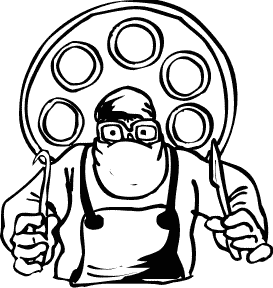
Expert surgeons have far better outcomes, partly because their lack of irrelevant motion means that they leave less trauma behind. Their scalpels don’t make any pointless cuts, their hands don’t jostle any irrelevant flesh, there simply isn’t anything done under the skin that isn’t directed towards the goal. There is not a wasted motion, and not a wasted moment.
They don’t dither; they do, and they do it decisively and cleanly. If something turns out a bit different from what they expect, they go with it — no holding back, no denial, just accept, redirect, and move on. They don’t interfere with themselves, and thus they don’t interfere with the work.
The truly expert surgeon, a few of which I’ve been privileged to see, is a breathing artwork of purposeful action and focused intent.
Martial arts is a bit more accessible to most people, so let me show you a popular and priceless example of an expert martial artist next to a couple of wonderful actors who can’t help getting in their own way. Here is the famous fight scene between Darth Maul and the two heroic Jedi, Qui Gon and a young Obi-Wan Kenobi:
All rights to this film belong to 20th Century Fox, in case someone forgets.
I included the whole fight scene. (You’re welcome, Marie P. and Steven R.) If you’re impatient, skip to the last 2 minutes. You’ll notice that the only reason the bad guy lost was a moment of inattention. He moves with effortless elegance, decisiveness, and power, while the Jedi are fighting their own bodies with every move, hulking their shoulders and flexing like mad. It looks exhausting! It took a lot of Lucasfilm to spin the contest out past the first minute, the imbalance of skill is so great.
Darth Maul is relaxed. It makes him effective. Qui Gon and Obi-Wan are not. They’re braced and clunky, utterly without pæng.
All right, given that this force (as it were) of pæng both protects space and creates space, what the heck is it, exactly?
Very simple. Not easy, but simple.
Pæng is the yielding resistance of a tree branch or a length of spring steel, or, for that matter, of a good dancer’s arms.
You push one part of the branch, and the whole bough may sway, but its balance is undisturbed. You push your good dance partner’s hand, but that doesn’t just move her hand — her whole frame absorbs and responds to your push with a graceful springy motion and she rotates, balanced over her own feet, as far as your push goes (backwards and in high heels, most likely. Be impressed.)
That is the force called pæng.
Let’s return to the tree branch for a moment. It allows us to extend the analogy without special training.
Take a good look at an oak, maple, or a eucalyptus tree. Look at a branch from its tip to the root of the tree. You can always follow a single, sinuous line from tip to root.
It’s the same tree, mirrored across. The lines are drawn in on the right-hand image.
That tree holds the branch up from root to tip, without any muscles at all. It lifts it from underneath its feet, up its trunk, and floats it out into space from there. This is how the force flows. Not muscular at all, but very, very strong. It’s pure physics.
The tree also holds the branch outward with curves that act as support structures (like the curvilinear welts in plastic packaging, to keep the package from being flattened), in order to make the most of the space.
Mmm… I wonder if they’re gluten free?
Bounce a branch lightly. Observe the change in the movement. It bounces more near the point of impact, and as the springiness absorbs the motion, it moves less the closer it gets to the spine. I mean trunk. Did I say spine? I meant trunk. Of the tree. In this case.
This calm-but-alive springiness, this resistance without strain, lifting up from the root through the trunk, opening without pushing, pressing without squeezing, all at the same time, is pæng: the whole branch, from trunk to leaftip, is awake all the time, ready to play with the wind all the time, ready to soak up the raindrops all the time, connected through the trunk or stem to its root all the time. Every touch on the way is received and understood, and responded to naturally. It is always alive with this springy yet relaxed, rooted yet responsive energy.
In humans, pæng can be modulated. This is part of the martial aspect of t’ai chi: intensify pæng to ward off an attack or prepare for one, shift pæng to draw the opponent, release pæng to snap into an attack, but always, always have pæng as your ground state. It gives you a safe, structured space to work from.
Ideally. That’w what we work towards.
Now that we’ve mulled the nature of pæng, we’re a bit closer to understanding what Ted and the t’ai chi chuan classics mean when they use the word “relaxed.” In our extreme-adoring Northern/Western Hemisphere culture, “relaxed” is the opposite of “tensed”, or even “stressed.” A certain floppiness comes to mind, even a resistance to being vertical.
Tense:
[]
|
|
|
L
Relaxed (Western style):
8)________|
A “relaxed” body, in this sense, is not ready to move — far from it. It probably wants another drink!
The ancient Chinese traditions cultivate the middle way, not extremes.
As it happens, this is an excellent approach for many people with central nervous system dysfunctions, because our disrupted systems are hardwired to charge wildly between extremes. The more we strengthen our access to the middle ground, the more stable our central nervous systems become, and the better we can get.
Simple. Not easy.
With this in mind, we have to repurpose the word “relaxed” so it’s not a synonym for “floppy”, but a distinctly different term that describes the useful middle ground between “floppy” and “tense.”
It’s easy to see, even in these keyboard-figures, which level of energy makes it easiest to move in a useful way, doesn’t it?
How do you want your surgeon to be, heaven forbid you ever need one? How do you want to move when you dance?
Darth Maul seems quite a bit different now, doesn’t he? Actually, he does remind me of a couple of doctors I’ve worked with…
Shortly after I drafted this, Ted saw me struggling through a leg-intensive exercise. He said, with sympathy, “I see why you find these leg exercises so exhausting. Your leg muscles are fighting with each other in every direction.”
I went away and thought it over.
Well, of course they were fighting each other in every direction. This was the setup:
When I was 10, I got the silly idea that I should have an adult arch to my foot, so I began to supinate.
That led to my thigh muscles developing lopsidedly, and since I played varsity soccer in high school and ran in my 20’s, they developed lopsidedly a fair bit.
That led to my kneecaps tracking wrong, and me losing the cartilage under my kneecaps. (I used to think that hurt. Cute!) Ted steered me away from his t’ai chi class in the 1990’s because I was so nervous about my knee pain (really cute!)… so I took his shaolin kung fu class instead.
So, over 15 years later… I’m far too frail for serious kung fu and Ted has become a breathtakingly subtle teacher of t’ai chi; I’ve gone through several rounds of posture training (round 1, round 2, round 3); and, now that the pieces are finally coming together (big clue: if it bears weight, it affects your posture), I’ve been working like mad to rectify my knees.
They still pull to the outside, from the habits laid in by my childhood efforts to lift my arch, and my knees hurt like blazes when they bend. To manage that, I practiced pulling them to the inside, but not directly — kind of rolling my lower thigh muscles inside and upward at the same time… While my habitual muscle pattern pulls outward and up.
Weren’t we just watching Liam Neeson and Ewan Macgregor do something very similar (if a lot more cutely)? Muscles fighting each other in every direction, literally at every turn?
The fighting was simply wrong. …And I don’t mean in the movie.
That’s no way for a body to behave, fighting itself. I don’t want my body to fight itself.
I didn’t see that changing the fighting would work, because there would still be fighting.
Finally, I straightened up. I said to myself, in tones of firm parental authority, “Knee, do it right. I’m not having you fight about it. I’m going to relax — unwind every muscle and make them stand down and wait for orders. You’re going to do it right the first time, because nothing is interfering and nothing is asleep. It is … relaxed.” Pæng.
I lifted my leg and put my foot down. It felt different.
I bent my knee. It was fine, absolutely fine.
I tried the exercise. The thing was completely painless, and floatingly easy.
Buyer beware — it’s a process. For me, the issues are simple, although annoyingly tricky to work with:
My levels of tension and awareness, not to mention relaxation and attention (those are 4 completely different concepts, you’ll notice), change so much from day to day.
I still have nearly 40 years of walking habits that I’m building an alternative to.
I still have to take lip from my knees now and then, which slows me down for recovery, and I have to mentally go down there and tell everyone to stop arguing and let me mend.
It’s a process. However, it’s well begun. It’s all about relaxing, in this special sense of pæng.
Cats are masters of pæng 🙂
It’s like this stuff works … Who knew?
I used to be punctual, meaning, 3-10 minutes early. I used to be relentlessly diligent. I used to be cast-iron reliable. (I worked hard to acquire those skills, after drifting through my first couple of decades with my energy and attention set to “simmer.”)
These were so much a part of my identity that, after a memorable lunch with 12 engineers and one writer (me), they passed me the bill to calculate. I didn’t know whether to laugh or cry, but I scolded them and passed it back. CRPS had already set in and numbers tended to cartwheel in front of my eyes, but I didn’t tell them that.
My care providers know they have to call me to confirm the day before an appointment, because even with the calendar in my phone and on the wall, and now with a weekly dry-erase scheduler on the fridge, I need the added sensory input to make sure the other 3 are correct and, above all, to give my brain one more hook to the info.
Reliable, remember? I’ve still got a lot of identity tied up in being reliable, and it takes a LOT more work, but it’s important enough to me to do, and ask for a little practical assistance with.
Today, I looked at the clock when I woke up and thought, “Hour and a half to appointment time. OK.”
As I set up my tea, I thought, “I’ll let J sleep. He’d only have half an hour to get ready and I don’t want to spoil his morning.”
As I washed and dressed, I thought, “Excellent, time to read a little while I have my tea, fruit and morning pillage.” Can’t just call them pills. Definitely pillage. I hope to lay waste to CRPS as it tries to lay waste to me, so that could go either way.
En route to my appointment, I found a whopping case of vehicular atherosclerosis — a traffic jam, in a country stretch of highway. Very odd. The clock read 9:50, and I realized I was going to be late gor my appointment.
Diligently, I picked up my phone and made an illegal call to notify Dr. Resneck that I’d be late.
She said, in slightly worried tones, “But… your appointment isn’t until 11.”
Not missing a beat, I said, “Excellent! I’ll pull over and read for an hour. That’ll be nice!”
In response to the still-shocky silence, I added, “Well, an hour early is better than an hour late, isn’t it! See you soon!” And hung up.
I realized that my brain had simply done an ER-worthy triage — is anyone hurt? Anything made worse? No? Fine! — and moved straight on to a good Plan B. I’m reading Jodi Taylor, and St Mary’s is about to be incinerated and I’m dying to know what happens. And yes, I’ve read it before, though not for awhile.
If I were a clinician caring for me, I’d note this incident down and give a worried little sigh. It’s not good, just not very good.
But I have learned, in this brutal school of my life with this ratfink stinker of a disease, that I CAN’T WORRY ABOUT THESE THINGS. From the standpoint of the person doing this, I am really pleased with my handling of it.
Anyone hurt? Anything worse because of my mistake? No? Fine! Now let’s advance some other agenda I’ve got! Because as long as the first two questions come up negative, IT’S OKAY. I am not a failure, oddly enough. I’m just not. I get a free hour, and that’s pure bonus!
Off to read my book. Enjoy the rest of your day, and remember that blessings can come in heavy disguise.
A fellow martial arts teacher/competition judge once barked at Ted Mancuso, “None of your students move like you!”
Ted blinked, barked back “Good!” and walked away, shaking his head.
He refuses to model a move more than the essential minimum, and is no great fan of the mirror, either. However, he will coach the most clueless student with bottomless patience, week after week, as long as they don’t give up.
His model of teaching is based on the (all too rare) assumption that each of us should be the person most aware of, and most in charge of, our own bodies.
… I know, right?
If you follow the logic through, this implies that the correct structure for moving through, say, Fair/Jade Lady Weaves Shuttle (which is an upward block snappily followed by a nose break, which tells you something about those names)… as I was saying, the most effective and correct structure for that move is going to vary from one body to the next. The correct structure for HIS configuration of bones, ligaments, muscles, and chemistry is not going to be the most correct (or even passable) structure for MY configuration, or yours, or anyone else’s.
Ted doesn’t just say that, he bases his whole approach on it, from start to finish. His crogglingly refined sense of how to read that on others is probably another article, or rather book. Gifted pedagogue, yes.
In the long years of wrestling to take back control of my body from CRPS and all its ghastly little friends, I’ve taken PT for months, done intensive massage therapy ditto, and been overdosed on nearly every class of drug used to treat it — except the ones I flatly refused.
This inward/martial training with Ted is the first one that not only requires physical self-awareness, but actually helps me learn that awareness from the inside out, rather than passively requiring me to learn it from the outside in.
Once I gave permission for him to go to town on my structure, it would be tempting to say that he’s become merciless. That would be totally wrong, in both senses. He lives in an ocean consisting of equal proportions of mercy, humor, precision, and a degree of awareness of others that seems uncanny until you reflect that he’s been working on that since I could walk. So, yeah, he’s got that healer’s mercy that means he’ll do what’s right for you even if it sucks right now.
I’m now on the second round of fighting with my low back and hips for control of my spine, and it really sucks right now.
I am tired of trying to unlearn 40-odd years worth of faulty structure from the inside; it hurts, and more pain is tediously wearing.
So I found a massage therapist who suits my needs, and went to line up a series of sessions.
First available time?
3 weeks out.
… I know, right?
I came for a hot tub and chiropractic adjustment (which I believe is within spec for Ted’s style, given the intransigence of bony tissue and the ubiquity of hot water) and sat there letting my knotted thoughts and knotted muscles melt… until I smacked my forehead and started to laugh.
Why is my low spine putting up such a fight? Why has it kept falling back into the same darn reef-knots, despite the PT and massage and Round 1 of this struggle last year and so on?
Right.
It’s obvious, now that I think about it. There are no shortcuts! I have to learn how to identify, unravel, and rebuild those structures from the inside out. That’s the whole point. That’s why I undertook this training. This is exactly how it’s supposed to happen, aches and all.
This is me, having another laugh at my own expense, releasing one last sigh, and figuring out how to do this from the inside.
I love that teacher. I don’t exactly like him a lot right now, but that’s okay.
Those of us with crazy-bad illnesses appreciate the stroke of genius from Christine Miserandino, who originated the Spoon Theory to explain what it takes to get through the day.
For the most part, though, we shouldn’t have to explain much. Wouldn’t it be nice if everyone could get that memo?
With her permission and kind support, I’ve revised her article to reflect the realities of the chronically or severely ill. Please feel free to print out/pass on, with credit to her embedded as it is in this text.
Here’s my version…
Health Management Choices – Boundaries
A long time ago, as a developing patient educator, I found many chronic patients uncomfortable and frustrated with unsolicited advice – or inadvertently soliciting advice and then feeling uncomfortable with the discussion that followed.
Eventually, I read this great article on boundaries that eventually become known as “The Bean Dip Response”, “Pass the Bean Dip”, or even used as a verb: “bean dip” someone.
I rewrote the article from the perspective of a chronically ill, alternative-using or drug-disabled patient (one who can’t use common meds for the condition because of uselessness or devastating side-effects) – but the principles are transferrable to any constellation of health management choices.
The Bean Dip Response is best used when you don’t need to defend or don’t wish to engage with a person over a health management choice. If you are discussing issues with a person and you welcome their feedback, the Bean Dip Response is not needed.
I’ve found that chronic patients may confuse boundaries while trying to convince someone of the rightness of their choices. The best thing is to assert your boundary, rather than defend your choice. Your choice needs no defense.
Health management choices should be on a “need to know” basis. Most people don’t “need to know”. Since medical information is highly confidential, it’s NOT incumbent on you to explain yourself to those who don’t need to know. Those who need to know are essentially you, your doctors/providers, and your designated decision-maker for when you can’t make your own decisions.
If anyone else asks, "How are you sleeping?"
Answer: Great! Thanks for asking! Want some bean dip?
"Are you sure you should get picked up every time your legs flare?"
Answer: “Yes! Thank you! Want some bean dip?"
"When do you plan to wean off those meds?"
Answer: "When it's time. Thanks! Want some bean dip?"
"You should use my aunt's hairdresser's physiotherapist's product. It cleared up her [symptom du jour] in two weeks."
Answer: "That's great! I'm happy for her. Want some bean dip?"
Now, with some people you will need to set firm boundaries. The offer of bean dip won’t be sufficient to redirect them [I can’t imagine why not. -ed.] They either don’t respond to gentle redirection or they have emotion tied to the issue and a desire to “go there” more deeply. You may be able to anticipate this – if it’s a pattern of intrusion, for example, which you’ve seen in other circumstances.
In such a case, a stronger “Bean Dip” response may be needed. In these cases, the redirect will need to be backed up with action (like hanging up, leaving the room, or even unfriending them).
Remember, boundaries are not about forcing another person to comply. You cannot “do” that. Boundaries are about what YOU will do or not do. You are the person you own. You don’t own them and they don’t own you.
Practice kind but firm responses: "I know you love me and want to help. I am so glad. My health choices have been researched and made. I won't discuss it again.”
Don’t confuse setting boundaries with trying to convince someone of the rightness of your choices. It’s a common (and understandable) desire to present the same information that led you to your choices. The problem with that in dealing with a person who has boundary issues is that engaging with content invites discussion. (Also, different people’s minds work in different ways, so your train of thought may make no sense at all to them. Wasted effort all around.)
Chronic patients often struggle with this.
The boundary is that no one else has an inherent right to tell you how to take care of yourself.
You set boundaries by doing the above: acknowledging what they said and redirecting.
Where the chronically ill may invite problems is by citing authors, studies and sites to “defend” themselves. Each time you do so, you create more time for discussion and rebuttal and send the message that your decisions are up for debate.
Don’t defend your choices beyond generalities, and then only once or twice. “My doctor is in support of my choices. Want some bean dip?” Or maybe, “Well, this is my decision. Want some bean dip?”
If necessary, look them in the eye and say simply, “I want us to have a good relationship. I want to enjoy my time with you. I’ll take care of me, so that we both can make the most of our time together. Let’s not discuss this anymore. If you bring it up again, I will have to ask you to leave.”
Finally, an important corollary to the “Bean Dip Response” is reciprocity. Once again, the content of your choices should not dictate the interaction.
You may be totally, and correctly, convinced that you should be able to determine your own activity, medication, and supplementation regime; never be left to “cry it out”; and should be allowed to follow your own weaning path, if any.
But, if you post those opinions on Facebook (or communicate them in other ways), you invite (and therefore solicit) feedback and advice. Post accordingly and respond to comments with that in mind. You need to give the “other side” the same respect that you expect to receive.
For those of us who are chronically ill, there are people we DO need to explain ourselves to. However, these are mostly highly educated people with specialist training, and that makes it a short list indeed.
Our loved ones may believe they want to understand, but, as my mother finally admitted, “I don’t think I really do want to understand what you’re going through. I couldn’t stand to know how much pain you’re in and how rotten you feel all the time. It would drive me crazy, knowing that.”
But, hoo boy, does she ever respect my boundaries! That’s worth the world. It makes everything open and clear between us, and our current relationship reflects that.
When someone confesses their limits to me, I take it as a gift. They have told me how to protect our relationship and how to move forward with it. I appreciate that. With that subject opened, we can move on to discuss how, or if, they can connect with me in a way that works for us both. This is priceless information. I’m glad my mother had the courage to open that can of worms, because then it got very manageable very quickly.
For an ever-changing kaleidescope of visual delight, check out my Mom’s photography from all around the world at http://jldtifft.com/