Glorious moment

I’m enjoying my monthly latte, and it’s excellent. The café is playing songs from my youth — more precisely, Elder Brother’s youth. He got an extra share of social instincts, and the latest music — starting in the early 1970s and going through the mid-1980s, an unbeatable time for music — soaked through his walls and filled my burgeoning world from the time I was in single digits. Name any great artist of that time, and I heard them through his walls.

In the evenings, my mother would claim ownership of the air with “her” music, playing records (vinyl was it, for a long time) of gorgeous classical music and the occasional lush opera; the latest by Jacqueline DuPré; a masterclass from Yitzhak Perlman… unless she felt like practicing piano, when she’d float upon Mozart or Haydn, or dance out a buoyant dose of Scott Joplin. (She could jam on that ragtime!)

Because she adored her kids and knew how to listen to music even when it wasn’t “her” genre, she learned some Beatles, 5th Dimension, and Elton John. She even wound up getting a guitar and learning that, because this was the very height of popular American folk music and she had a social conscience as well as an ear for music. Carole King, Buffy Sainte-Marie, and Pete Seeger came into the rotation.

I never learned to choose music, because I had the astonishing luxury of growing up on the best of it chosen by those around me.

So, I’m sitting here finishing a creamy gorgeous latte that won’t make me sick; listening to the Beatles, Steely Dan, CSNY, Prince, Paul Simon, Peter Frampton, and other luscious familiar voices; in the middle of one of the sickest and sorest summers of my entire life (which is saying something)… and this, folks, this right here is a glorious moment.

In this moment, I do not hurt. I’m not struggling to stand or move. I don’t have to fight to remember something crucial or organize another superhuman effort to stretch across the sometimes-impossible gulf between a conventional physician and someone who’s been very sick for a very long time. I’ve acquired 5 new specialists so far, and, mostly, I’m desperately tired.

Right now, I’m gently suspended in a better time. It doesn’t demand anything from me; it just feels good to pay attention to it.

I told the barrista, “This is the song list of my youth.”

She said, “Aw!”

I said, “I had a great youth.”

She caught my eye and was too moved to speak for a moment.

I’m not misty-eyed. Must be allergies acting up. Even though I feel so good.

My job as a complex chronic patient

My first nursing job was on an HIV unit in 1991. We were in the 2nd wave of the med mixes, so there were some treatment options. We knew which precautions were necessary, and when.

Those precautions had been newly dubbed, “universal precautions”. HIV was the last global pandemic that had a powerful effect on ordinary patient care, legislation, daily activities, travel, everything. The lessons we learned were rolled so thoroughly into our lives that we no longer think about it.

Anecdote from the front lines..

At that time, it was all rather new. Old nurses were afraid to go near any patients on our unit. We had about 80% novice nurses, an unheard-of proportion on a specialty ward in a nationally-ranked hospital in a major city! We had to pay attention, and we had to learn fast.

Because we weren’t abandoned enough already…

Our rather young nursing preceptor had bone cancer in her knee. She went in for surgery as soon as the last of us (me + 1 other) got signed off on training.

But wait, there’s more: as soon as she came out of surgery, she wrote a message insisting they pull the plug on the machines and let her die. Husband supported that, in tears.

Considering how close to hysterical she’d gotten 3 days earlier, when I tried to dig in my heels and tell her I was not ready to practice autonomously and might need more training after her op; and how strenuously this woman — who’d done little but put me down for weeks and express frustration at how slow I was — now insisted I was ready, really ready; and considering how improbable that post-op scenario is, in so many ways… I think she had planned it well in advance. Most expensive euthanasia ever.

Her 2nd-to-last words to me were: “Change your socks. They should be white. Bright colors are not professionally appropriate.” And gave me a fierce look. She came back for a nice goodbye, telling us we were all “good nurses” despite our occasional touches of color (a laugh and a nudge for the main transgressors, me & a fabulous fellow), before she turned and left the unit for the last time.

She’d been working on me about the sock thing for weeks. Slouchy cotton socks in gem-bright colors were still fashionable; drove her crazy.

She was the only one who hated them. The patients, the other nurses, and my immediate supervisor thought my gaudy ankles were delightful. I was referred to as “the one with the socks” and everyone knew. (I also introduced the fanny pack to nursing life. Nobody had heard of it before I showed up with a white, wipe-clean, bleachable one. You’re welcome.)

It’s possible that I got a packet of white socks, as a gesture of respect to that tough young woman… which quickly got grubby-looking, as white socks always do on me, and thus were eliminated from my wardrobe as not being professionally appropriate.

… That was largely irrelevant, but I’ve stopped suppressing my storytelling urge. There are just too many; they leak.

Back to the job of being a complex chronic patient.

It’s surprisingly logical — it just takes a long time to figure it out. I hope this will shorten that course for whoever reads this! There are 3 key principles to follow, and 3 sets of jobs, one for each kind of person involved in each case.

Three key principles

My patients on that ward taught me a lot about how to navigate hard, complex, intransigent illness. There are 3 key principles:

  1. Grandma was right” kinds of things: fresh air, activity, nutrition, sincere friends, learning all you can — they make a huge difference.
  2. Find the light, or life, in the cracks. Doing #1 makes that a lot easier.
  3. Communicate with others in the way they need to be communicated with.

That can be a tricky one, but I’ve got a lot of material on it. Some of it is here on this blog. And one day I’m going to complete and organize that collection of communication tools. (Any day now…)

Three different sets of jobs

It’s important to remember that you can’t do everything. I learned that (and keep re-learning it) the hard way.

There are specific realms of responsibilities which the important people in this situation have:

  • My job.
  • Significant other’s job.
  • Provider’s job.

They’re perfectly straightforward.

My (the patient’s) job

A note on terminology: some object to the word “patient” as dehumanizing. I’ll let you mull over what it means to think of someone who needs care as less than human. I don’t.

I’m sticking with the word “patient” here, because it describes a person who has specific, unavoidable experiences with alterations in their bodies, care providers, and whatever health-care system they have access to.

Complex chronic patients have a depth and breadth of experience with these things that most people simply can’t imagine — and nor should they. We wouldn’t wish this on anyone.

So, as a patient, my job boils down to this…

Take care of myself; take care of my responsibilities; take care of my relationships. All this includes having fun and seizing little joys!

  • Manage my illness. This includes: meds, nutrition, activity, learning about the disease and how to manage it, self-care (whatever that turns out to include, but it always includes pacing: alternating activity and rest.)
  • Track important signs, symptoms, and changes, and document them meaningfully.
  • Share this info with providers and significant others when it makes sense to.
  • Find useful ways to communicate with significant others & care providers about changing needs and abilities.
  • Make all my appointments on time, every time.
  • Contact my Dr for anything I need their support with: changes, meds, treatments, info.
  • Get through the days one at a time. (Thinking of the whole span of my existence is not my job. One day at a time is plenty.)
  • Find life in the cracks: notice the little beauties, regularly do something I enjoy, stop and smell the flowers.
  • Make time for fun and happiness. It makes me so much stronger!
  • Be good to my loved ones, whatever that means and within my limits.
  • Know that I’m the subject matter expert on my body, and hold myself responsible for managing it accordingly.

Significant other’s job

shows images suggesting love, friendship, and work

These two principles can be used by people at work, at home, on the playground, wherever. Very simply, “believe me” and “avoid making this harder, whenever possible”.

Believe me

Nobody — trust me, nobody — can make this stuff up, and there are far too many expensively-educated people working on this for it to be imaginary.

  • If you can’t believe it, then try pretending you do for awhile, just to test the concept, and see how that works.
  • Learn about the disease. There’s good info out there and I, or my doctor, can help you find it.
  • If you’re really important to me, come to an office visit with me and ask the doctor your own questions.

Avoid making this harder

Communicate with me about changing levels of activity and needs. I hate to keep saying how broken I am, so let’s come up with a code to pinpoint the different levels of broken that I could be.

Then, I don’t have to talk about how close I am to puking or crying or passing out, you can know anyway, and we can get on with things appropriately.

That’s what I really want — to be as productive as possible for all the time that I can; to be as good a partner/employee/friend/family member as I can.

Provider’s job

Another note on terminology: I’m old enough to remember when physicians, who were relieved that good schools for PAs, NPs, and APNs were starting to flourish, advocated for the term “provider” as a collective noun, encompassing themselves and the advanced-practice professionals who potentiated their work and multiplied their efforts.

That worm has turned, and now it’s not so popular with physicians.

Please allow this old nurse to use the term with all the respect it originally included, in memory of the brilliant and capable physicians who taught me to use it as the inclusive term of choice.

The provider’s job (as of course you know) is threefold: keeping the larger view, providing appropriate care (of course), and providing info and guidance.

This is sometimes easier said than done, because every time I see you is a rough day. You hold more than the power of life or death over me — you hold the power of tolerability or pure Hell. Thus, it’s natural for me to be a little fragile, possibly overwhelmed, in our conversations.

I do my best to be prepared and “keep it together”. I want to make the best use of our time.

Due to the additional insults of pain and CNS dysfunction, I can be subtly or even grossly impaired when I most need to be responsive, intelligent, and clear.

Given all this, please know that your kindness makes a great difference in my life.

Here is what I hope for, from my providers:

  • Consider context. Notice where I fall in the statistical ranges and how might this affect my care; help me distinguish between reasonable vs. unreasonable efforts, as well as watchable vs. reportable signs/symptoms; steer me through that intersection created by my medical & physiological peculiarities in one axis, and the statistical probabilities generated by reams of studies and years of clinical practice on the axis which crosses it.
  • Prescribe appropriate tests, ancillary care (physical therapy, occupational therapy, speech therapy, and so on), and medications.
  • Respond sensibly and kindly to concerns about meds, therapies, and changes in my illness. (Fragile egg here.)
  • Let me know what I really need to know about my condition, meds, or treatment, before I leave the room (virtual or 3-D), so I neither ignore something important nor over-study and confuse myself. My responsibility to learn benefits from yours to inform me. Also, it helps me to know the right keywords.
  • Be the subject matter expert on the scientific and clinical knowledge-base for the illness I see you for, and be willing to figure out relevant context that my other conditions create.

See this article about just how fabulous an experience it is to have a physician who does all that. It’s such a relief and such a joy. Thank you from the bottom of my vital signs for doing what you do.

All 3 working together = best possible situation

When complex chronic patients can monitor and communicate effectively, prioritizing our care while keeping life in center stage most of the time; when our loved ones can coordinate around our limits, allowing us to be at our best, considering; and when doctors apply their staggering breadth of knowledge to our particular situations with attention; we have a fabulous chance of doing as well as possible.

I like doing as well as possible. I have a lot to give and I want to be able to give it — that said, my care comes first, last, and always; it’s the only way!

Thanks to significant help and support, good friends and loving family, and some real rock-stars on my medical team, I’m well set right now. I’m almost afraid to admit it, because I don’t want to rock the boat…

And here we are

There you have it: the 3 key principles and the 3 main jobs of living/working with complex chronic illness.

I know they are that fundamental, because I’ve had a few providers almost plead with me to come and participate in their patient support groups, specifically so I could talk about it with other patients.

Well, here we are, sharing this information all over the world! Send this article wherever you see fit. I’d love to know what your support groups think about it.

Patients, caregivers, loved ones of complex chronic patients, doctors, P.A.s, A.P.N.s and N.P.s… feel free to comment. This is about all of us, after all.

Shore Break

There I was, trying to steer the 3-headed rhinoceros that is the de-mold-the-mobile-home project (dubbed “DeStroy DeMold.”) Two of my volunteers had gotten sick with things that could conceivably relate to:

  1. Their refusal to wear respirator masks, and
  2. The craptastic nature of the stuff coming out of the walls.

So, no more volunteers, and I was trying to figure out what next.

With heavy multiple mold exposures.

Detail of a Bosch painting. Whiskery demon holding and reaching for a misereable man.
Bosch knew.

And food poisoning (different story.)

First things first

I declared a personal moratorium on entering my place unless I had to. Ditto for my car.

Counting the inescapable mold-factory of the leaky place where I’m staying, that means I had been sucking in three, count ’em, three, substantially different species of mold. …And feeling very sorry for myself that I was strangely unable to compensate with supplements and air filters, think my way through the end of a compound sentence, get through a pain flare without going zombie, or recover from an ordinary bout of hit-the-opposite-wall vomiting.

Sorry, letting my vile sense of humor run away with me there. I actually did get it all in the toilet; I’m just not sure how.

Attitude adjustment (with cast of characters)

Last week, my gracious hostess Laurie and I realized we had not gone to the shore this year, despite our good intentions. 24 hours later, she had us all set up, and invited her excellent friend & traveling companion Dave along for the ride.

Dave & Laurie are wonderful together. A gal so butch her nephews call her Uncle Laurie and a guy so cis he could — and did — show up in white Gucci snaffle loafers and still look straight, they bring out a gleeful zest in each other that’s contagious.

woman and man in nearly identical shirts, thumbs up and laughing

Laurie was our hinge, the one who is so close to us both, and it was impossible for me to be stranger-shy with their buoyancy lightening everything.

Dave has an enormous, unflappable black lab named Bernie as his guide dog, who avoids being lethargic simply through being so good-natured. Laurie has a teeny weeny toy fox terrier named Vinny who is irretrievably in love with Big Black Beautiful Bernie.

Imagine a stately black galleon with a high-powered white tender zipping around alongside, and you’ll have the image perfectly.

I almost brought the cat…

cat,distorted with closeness while coming at the viewer

But five bodies and 14 feet seemed like quite enough.

So: me, a human; Laurie, human, with Vinny, pocket pup; Dave, human, with Bernie, guide dog.

If everyone sucked in their hips, there was just room to pass between the beds in our one room.

The weather was perfect. The waves were influenced by a hurricane out at sea, and were nearly Californian in size and color. The dark sand was almost silky. The water was about as warm as it gets, brisk but not bracing, according to Dave’s well-tested algorithm.

photo of everyone but me, on the beach

What I did on my vacation

It wasn’t an eventful trip on the outside — mostly. At one point, I saw Vinny heading down to the water, mooning hopefully after Bernie; I almost called him back, but if you’ve ever seen a terrier on a mission, you know that only going over and picking him up would change his mind. Something told me to wait.

Bernie ambled into the lap of the waves, checking on his master. Vinny toddled after, absorbed and elated. The wash of the wave splashed up Bernie’s ankles; Vinny’s little legs shot out to the sides as he tried to brace against the movement, and off he went. His human turned with perfect timing and lifted him out of the water as the backwash carried him to her, knee-deep.

I was braced to race and plunge in for some dog-rescuing, but watching that remarkable little ballet unfold was quite a moment.

Vinny isn’t the only one who got a bit more than he bargained for.

I was having a bangup time, playing at the shore break. Diving under, popping over, and frequently getting trashed by the waves is such a blast. I might have some retriever in me — probably more than Bernie, who couldn’t be bothered with boisterous water.

I saw two waves converge at an angle, and jumped on them to ride the double-act into shore. Little did I know that two other waves had approached that intersection from behind me. I got washing-machined like I rarely have — completely bashed and thrashed and flung around under the water. My sinuses got washed along with everything else. I’m really glad there were no solid objects (besides me) in that water.

I came up hooting with glee — then felt something was amiss.

Somehow, over the surf, the words, “It came out!” reached me from our pretty neighbors on the thinly-populated beach. I looked down and, sure enough, one half of my generous allotment of, um, chest flesh was making a determined dive for freedom.

Wrestling it back under cover was considerably hampered, not only by the cantankerous mechanics of a soggy bathing suit, but by the fact that I was laughing so hard I could barely control my limbs.

I’m over 50. I don’t have to care what people think. Laughing is so much healthier than anxiety!

Most of my exits were much more successful.

me climbing out of the surf, with another breaker behind me

But seriously…

Apart from that, we just found the nearest beach on the first day, found the best beach on the second, chatted with the neighbors, walked, ate, told each other stories, and enjoyed the muscular shush of the sounds of the shore. We all got ice cream.

It was transformative on the inside, at least for me.

I found that I kept talking about my childhood and my family of origin — not about life as a spoonie or neuro-nerd or an Isypedia of potentially life-saving information, but about life as something quirky and full of character; if not innocent, then willing to be optimistic in spite of it all.

That was odd, but refreshing.

After a day at the seaside and a good night’s sleep (despite the pillows fighting back against my leaning-tower arrangement), I woke up feeling…

What’s the word…

Um…

Oh, how shall I put it…

What do you call it when you feel like you can tell you’re inside your skin and the mental lights are on and you can tell what’s going on around you? Y’know, zestful and buoyant and present and awake and alive?

Oh right.

I felt more like myself than I had in about as long as I can remember.

woman walking up beach, looking totally at home in her skin.

THAT was the opposite of odd, though it was totally unexpected.

Mold toxicity: CONFIRMED.
Prognosis: EXCELLENT.
Recommendation: GIT THAT SH-T.
Target: ACQUIRED.

My brain unfolded like an origami map and alternative ways to get this mobile home taken care of — AND paid for — emerged from the crumpled mess of blocked avenues and despair.

And all that quiet, worried persistence about getting in at least one short walk most days? Well, the exercise intolerance packed it in, too — I walked a couple of miles the day before we left, the day we arrived, and the day after; definitely no exercise intolerance, without the wicked mold exposures.

This is huge. So huge.

Being able to exercise opens up new worlds of improvement. Nothing is as stabilizing to every body system as exercise. Few things are as stabilizing to the brain. I can’t even find words for the explosion of gasping hope I hardly dare to let myself feel.

My planner is about to explode. I’ve got things to do this week! WOOHOOOO!

A word to my  longtime readers & fellow spoonies (a wise & canny crew)

Remember all the times I’ve said that it’s sometimes just a question of getting through one day, one hour, or one breath at a time, and that there is always an afterwards?

This, my dears, THIS looks like an afterwards worth surviving long enough for. Let’s see what I can make of it.

May we all have the right care, the right meds, the right supplements, the right routine, the right friends — and the right breaks.

Coda

30 hours

Five years of no ocean
ended at last:
the waves curled almost Pacific blue
and crashed most assertively;
soft silky sand
burled them mackerel-patterned
below utterly spotless blue skies.

I ran out all daffy abandon
“Hi water! Here I am!”
and the waves came to greet me,
and beat me, and rub me all over
like a pack of retrievers convinced I held food…

A smug Californian, I dissed the sun’s vigor
But turns out I do burn — quite well! —
on Block Island
in mid-September…
but oh, it was worth every sting.

Rainbow sky melts above while returning.
Sun rivers and I’m stupid happy
One glint, one shimmy, and all I can smile
is eyes locked on water, waiting for more.

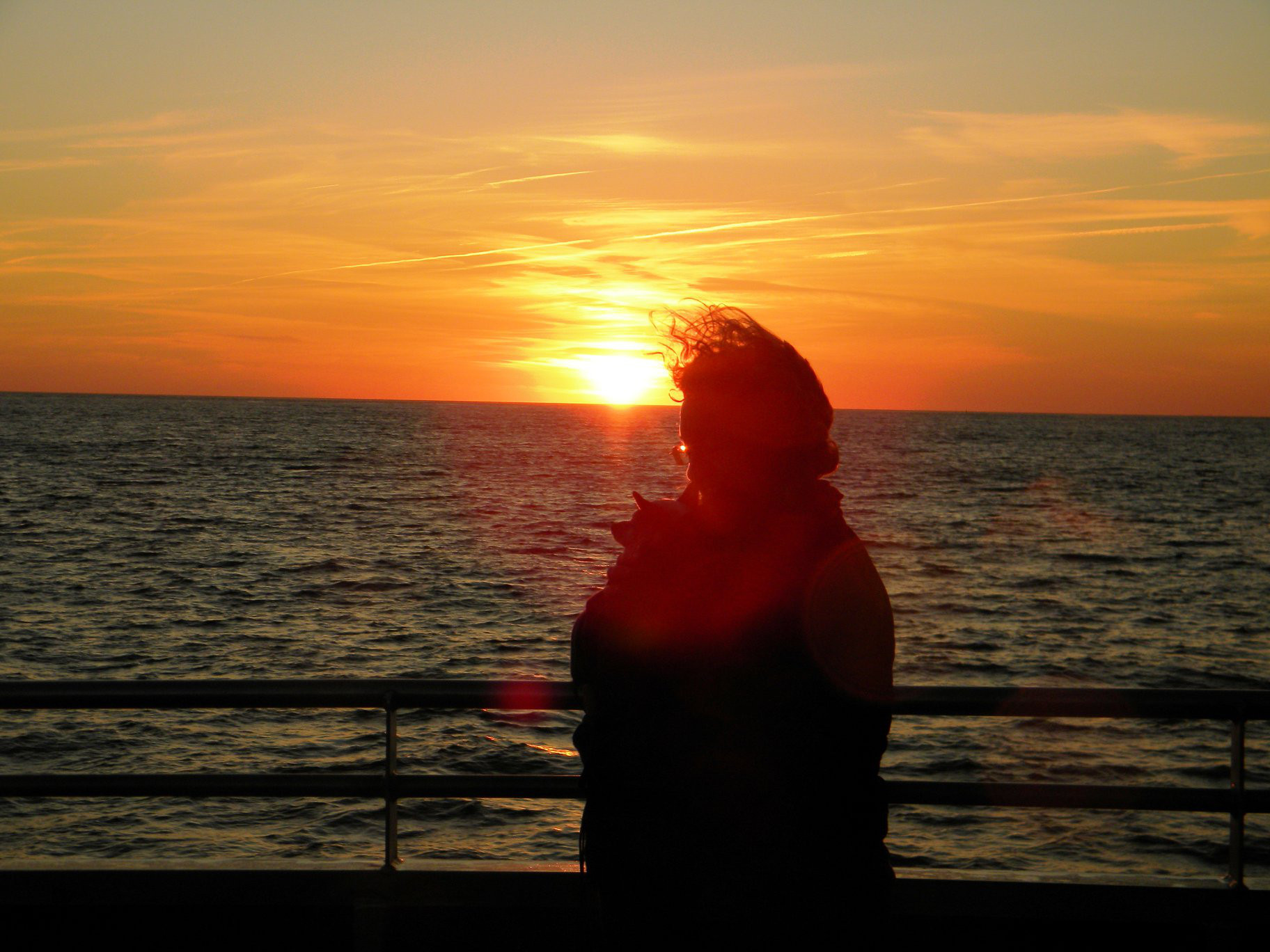
woman looking at sunset over water, dog nose poking out of jacket.

Shameless plugs

DJ Fabulous! LaurieB, a local fixture at sober fests and community events, works in Western Massachusetts. She plays all styles, genres, and eras of music, specializing in all-ages events. She gets people smiling and moving and having a good time. 🙂

David Roulston, Esq, is the sort of lawyer every  community should have. He does, or has done: probate & wills, criminal defense, designing implementation of legislation, mental health and community health, poverty & homeless issues, and business law.

Laurie took almost all of the photographs. When I mentioned I’d credit her, she said, “I think they’ll figure it out. Who else is gonna take them? The blind guy??”

Story: Shasta suggests a dog

This is another story improvised on the fly. One solution to boredom, when my studying-brain won’t work: I send it wandering, and it brings back souvenirs. I find that these mental excursions strengthen my mind and my focus when my studying-brain does work. (Jung might have been onto something, there.) It’s also very satisfying to feel capable of nothing, yet still produce something. I mean, wow, how cool is that?

Enjoy.

Shasta suggests a dog

Dark wings overhead. Are they angled up in a V, or flat across? Flat. Oh. Time to get the kids in.

She ran back towards the house, waving and barking. “Eagle! Eagle!” she snarled, when she was close enough to be understood.

Denny reacted quickly. He extended one gangly arm and snapped open two gates so that the pasture led straight into the barn. Then he followed Shasta, who had raced back up the pasture and was getting around behind the herd, shepherding them in. Danny called out the goats’ supper-call, but the goats didn’t take that well. They knew it wasn’t anywhere near suppertime!

Shasta‘s more direct approach got them going. She hustled and hassled the goats, coaxing here and pushing there, taking attitude from the harder-headed nannies and dishing it out in return. Fortunately, the billy was a lamb. Figuratively speaking.

Making soothing noises, Denny stood near the gate and persuaded the disgruntled herbivores, despite their complaining and nagging, to shuffle along and take a break in the barn.

Shasta sneezed after the last little goat, making it skip, jump up, and bounce off its mother’s side. Or, at least, giving it an excuse to.

Denny swung the barn door shut and sighed. The goats farted and burped, some of them eating their breakfast for lunch, settling in to hurry up and wait.

“So now we’ve got eagles,” Denny said. “I thought the hawks had that niche filled.”

“That pair of red-tails didn’t come back last year, and I saw a peregrine in the road yesterday,” Shasta muttered. “And now there’s baby goat,” she sighed.

Denny shrugged and walked back to the cabin. Shasta shuffled after, looking back moodily now and then.

“C’mon, old girl, let’s go in and have a cup of coffee.”

Coffee made and distributed, Denny sat down hard with a woof. Shasta flopped on the rug.

“I don’t know what to do about eagles,” Denny fretted.

Shasta blinked agreement.

There was a long silence.

“I know what,” said Shasta, pushing up on her hands. “Let’s get a dog.”

Denny looked at her with light slowly dawning. “You’ve got that friend,” he started.

Who breeds kuvasch,” Shasta finished.

Denny sank down, cross-quartering the idea for feasibility.

“Let’s call,” she said. “It can’t hurt to ask about it.”

Denny’s face didn’t change, but something in the air smelled of masculine resistance to asking.

“I’ll call,” Shasta rephrased. “Time I caught up with him anyway.”

She came back with a bag of peanuts and a grin. “He’s moving and has one pup left from the last litter,” she said, “so we get a deal, if it works out. We need the right kind of dog, because most of them don’t look up. Not normally. Not unless they’ve got a really tall owner, I guess. Kuvasch are enormous, and they’ll take on anything that attacks their flock, up, down, or sideways. They’re left in charge of herds for months at a time, they’re that good. We get to meet the puppy and try each other on, but in two weeks he’ll be gone, so he’s kind of on the fence about it.”

That was a long speech from Shasta.

Once Denny recovered from the verbosity, he gave his head a little shake and said, “He’s on the fence about it? What does that mean? Doesn’t he want to get rid of the dog?”

Shasta offered him the peanuts. “He’s a breeder. A real one. It’s not about unloading the dogs for a profit, it’s about spreading the kuvasch love and covering his expenses.” She chewed thoughtfully. “These are good peanuts,” she remarked. “Fresh.”

She examined the label while Denny absorbed that.

“Okay, so what’s so special about kuvasches?” he asked, making it an honest question, not snarking.

Shasta passed him her smart phone, with a search on “kuvasch” already done. “In rural Turkey, my parents had trouble finding childcare for me and my little brother. They were going to get a kuvasch, but then the neighbor’s sister came home from a bad marriage, and she became our nanny instead.” She shrugged. “Worked out for everyone. The dog was considered a reasonable solution, though.”

They went to meet the puppy three days later. He would scarcely even acknowledge Shasta‘s presence.

Half an hour later, after Denny had escorted a shell-shocked Shasta to the car and helped her to sit, he just sat and looked at her for a long moment.

Finally, she said, “He wouldn’t even look at me.” She turned to Denny. “How could he not even look at me? Dogs love me.” She turned away, sinking her chin. “I love dogs. Even that one, the rotten ratfink little bastidge.” She shook her head, tears trickling beside her nose. “I love dogs. I never met a dog who didn’t like me. I don’t understand.”

Worse still, in Denny’s mind, was the increasingly suspicious looks cast at Shasta by the breeder. Some friend. Even now, he was peering through the blinds, as Shasta wept over his churlish pup. (The sire and dam had been delighted with her, within the cat-like restraint typical of the breed. Only the pup had snubbed her.)

Denny gave up the pat-pat-there-there routine, cast a look of good riddance at the tacky suburban front of the breeder’s house, and drove off.

He was keeping his thoughts to himself, but they weren’t nice ones. He didn’t realize he was muttering nasty things under his breath, imagining the conversation he would have *liked* to have with the supercilious breeder.

Shasta noticed. She poked him.

He turned to her. “What is it?”

“You’re mutt–“

Denny checked the road just in time, swerved, ran the car off the road and stopped after several vaulting leaps over curbs, hummocks and undergrowth.

The car went pink-pink-pink. Denny and Shasta looked at each other with big eyes. Then they unbelted, cursed a bit as they got their feet under them, and tottered shakily back up to the road.

Yup. There was a green gym bag in the middle of the lane. And it was wiggling and whining.

Later, back at the cabin, Shasta, who was having the most talkative day of her adult life, puzzled some more. “Who would abandon such a beautiful pup?” She was on the rug with their new find, or new friend, stroking the drizzle of white that ran from nose to tummy through the short black fur. “She can’t be more than a few months old.”

The youngster looked at her worshippingly, as Shasta‘s hand traced the white drizzle again.

The next day, at the vet, Denny asked if the vet could identify the dog.

“Well, pit bull of some kind, I’d guess a thinking breed rather than a musclehead like most of them are.” The vet looked at the dog with her head cocked on one side, her fabulously chic lopsided fade blending up into a gorgeous cap of kinky curls. She was the sharpest vet for hundreds of miles, and even though she looked out of place in the country, there was something in her air — like the way she cocked her head — that made it impossible not to feel you’d found a good ally in troubled times.

“Hang on,” she said. “I’ll see if there’s a chip.”

There was.

“I have to look it up,” she said, clearly rather sorry.

Denny nodded.

She rattled at the keyboard for several minutes, shifting screens several times. Then she picked up the phone. “Mr. Mess? Hi, I’m the veterinarian at –“

She looked at the phone, surprised. She hit Redial, and began again. “Hi, Mr. Mess, I believe we were just disconnected. … Uh huh. Yes. … I’m sure you do, but I can hear you perfectly, so …. Why yes, it is about a dog with your chip in it. … Uh huh. … Uh huh. … Oh dear. … I didn’t hear about that. Oh, you did, did you? Well, I go home every night to the county sherif, and he never mentioned that call to me. … Oh, I see.”

Denny saw a vein start to throb in the side of her forehead.

“No, he would not have forgotten, because I’m the only forensic vet in the county. He would certainly have let me know. … Uh huh. … I see. … I think that would be best. … No, we are not a shelter, we’re a vet hospital. Howev-” she had clearly been interrupted, but was listening .. for another moment, anyway. “Let me say that there’s someone who might be interest –” Interrupted again.

The vet made eye contact with him, made a gesture to be quiet, and put the call on speakerphone. A grating male voice came out.

“– and then there’s the vet bills, vaccinations and so forth, plus five weeks of dog food,” the guy said, clearly compiling a bill to see how much he could get for the dog he’d abandoned for free. “And wear and tear on the furniture. And the makeup. That stupid bitch got into my wife’s Lancôme! Do you have any idea how much that crap costs? I’m seriously out of pocket here, and if someone wants that dog –“

She tried to intervene. “Mr. Mess, you misunder–“

He rode right over her. “And then there was the gas to take the dog out to where she could be found. That was not a short trip, you know.”

Denny had had enough. Shasta had long ago told him that she didn’t say much because she hated being interrupted or ignored, and men always interrupt women and most of them never listen.

He stepped up to the phone and, in his most alpha tones, rumbled, “Mr. Mess. This is Mr. Grill. If you’re interested in an accounting, then you should know that this dog has required treatment for damage due to her injuries on the road. As Dr. Smart stated, this is not a charity, it’s a veterinary hospital. If you are saying that, despite endangering and abandoning your pet, you still claim legal ownership, then we will be happy to send you a bill payable on receipt. It’s only fair to say that, even if your lawyer can persuade a judge to grant you everything you’ve listed, you’ll still owe us –” he stretched the word out — “thooooouuusands.”

He took a breath, then pulled on the velvet glove. “If, on the other hand, you relinquish all claim to the dog, then of course what happens after you abandoned it, illegally and in a manner which endangered both the animal and all traffic on that road, then of course this bill is not your problem. And, naturally, your expenses up to that point are yours and yours alone.”

There was a stage wait. Dr. Smart used the time to pick her jaw up off the floor and try to compose herself for speech.

There was a shaky little mumble, in which the word “relinquish” was barely distinguishable.

Denny needed to make this vaguely legal, so he added, “Would you like to conclude your business with Dr. Smart?”

Obliging gurgling sounds. Denny backed off the phone.

Dr. Smart said, very precisely, “Do I understand you to say that you relinquish all claim to this dog?”

Obliging hiss, probably a yes.

“And I can reassign ownership however I want?” She added briskly, “And speak up, I can barely hear you.”

“Sorry. Yes. Do whatever you want. She’s not mine anyway.” He muttered nastily, “Stupid black bitch.”

Dr. Smart reared back, took one look at Denny’s expression, and hung up.

She said to Denny, crossing her arms and leaning back slightly, “You do know she’s all right, don’t you? And this visit is not much more than a well-puppy checkup? And, although I appreciate the good intentions that made you run interference, I can’t support lying, and I and only I am in charge of what happens in my practice?”

Denny thought fast. He reached carefully over to point at one paw. “Um, I think she stubbed a toe. That was related to her being abandoned on the road. Right?” He spoke humbly. It was b.s., but it was obvious b.s., and he radiated apology.

She smiled, unbending just this once. “She certainly could have gotten much worse. Now take her home and teach her to watch the skies for eagles. Something tells me she’ll be good at that, in spite of the odds. I’ll update the microchip database for you.”

Denny reached into his pocket. “What do I owe?”

She smiled wryly at him. “Thooooouuusands. Now get home before Shasta starts worrying.”

Denny said, offhandedly, “Shasta never worries. She’s too sensible.”

The vet gave him a look, a very womanly and very smart Look. “She just doesn’t tell you about it. Good afternoon, Mr. Grill. And good driving.”