Isy’s Pocket Guide to Managing CRPS Naturally

Is it possible to manage CRPS without drugs?

I tell you from personal experience, it takes time and study and a lot of experimenting, but many have done it and I did for years.

I found that nutrition, activity/rest, and mental hygiene were the Magic Triumvirate.

Nutrition has a huge effect on what happens in our cells.

Activity re-regulates the whole CNS, while our bodies require rest and pacing to let the activity happen.

Mental hygeine encompasses meditation (sitting, yoga, tai chi, qi gong, relaxation exercises), cognitive behavioral tools (such as noticing tense postures and re-grounding and releasing them, playing chamber music or soft rock or soft jazz to calm the brain down, using lenses and mirrors to remap the brain’s crazy ideas about our bodies, biofeedback), and the art of distraction (absorbing books/shows, phone calls with friends, coloring abstract designs, doing something you enjoy, doing something productive for the neurotransmitter-boosting pat on the back you give yourself for doing it)…. all very important and useful stuff.

Learning to plug all this into daily life is a monumental task and it takes time to learn what YOU need to do, but the time will pass anyway and crps is still a full-time gig anyway, so you might as well be healthier and bether informed.

If you don’t mind one strenuous suggestion: before you take out anything, be sure you’ve plugged in something else that already helps. So, for instance, I got healthy fats (for neuroprotection) on board before I cut additives and phosphoric acid out of my diet. Those substances are neurologically addictive (“have a cola and a smile!”) and I knew from seeing people deprived of preservatives and sodas suddenly, that there’d be an unhappy withdrawal period. Once I had the coconut oil for cooking veggies, the grass-fed butter, and the olive oil & avocados going, I hardly noticed the change and didn’t even want colas or packaged food after a few weeks.

Again from experience, I suggest a combination of liver cleansing food (parsley, milk thistle, avocado hearts, dandelion, cilantro) and phosphorus-rich food (lecithin especially, mixed nuts) to calm the shift off of medications.

The liver uses phosphorus to process meds, in a process called (not surprisingly) phosphorylation. Providing plenty of raw material for phosphorylation really smoothes out medication issues for me. Lecithin has a mild, slightly buttery taste, the granules are easy to clean up after, and it makes fats (neuroprotection, remember) a lot easier on my sulky digestion.

Also tons of water, seltzer, whatever fluids you can get in. Most modern human central nervous systems are chronically dehydrated, which makes crap build up and that increases inflammatory response and pain. The bathroom breaks are time well spent: I need to get up and move a little anyway.

I blog some of my stuff here at livinganyway.com. I also recommend www.tamingthebeast.ca since she manages mast cell disease (massive drug allergies) on top of crps.

I use lemon balm (Melissa officinalis) extract for flares, and it is great for nerve inflammation. It’s been used for shingles and cold sores for millenia.

Clove oil — well diluted! — is outstanding for nerve pain.

Emu oil is good for almost every kind of pain, and absorbs amazingly. I use it by the drop, it’s so effective, and I add a bit of clove oil for good measure.

I’d add st johns wort oil as well, if I had any, because it does something remarkable to neurotransmission that smoothes out the pain.

I take neurotransmitter precursors twice daily, and they’ve been found to suppress pain signals at the spinal nerve root: 5-HTP and D,L Phenylalanine.

I also take st johns wort. I used to use it instead of neurotransmitter meds like SSRIs, SNRIs, tricyclics, etc, but now I take it alongside and I find I get better results with fewer side effects.

Epsom salt baths help with flares, pain, dysautonomia, all kinds of yuckiness. I have to be up to a bath, but when I am, it’s wonderful.

I stick to whole foods with almost no grains, healthy fats and oils, quality meat and eggs daily but not hugely, starch from root veg and stalks. I have to hit the roadside stands, membership stores, and offbrand markets, because this stuff costs rather a lot in the supermarket, but this is a great area for organic and whole food.

I did without meds for years and I’m glad I did. For someone who’s had this disease, with several complications, for 15 years, I’m in phenomenally good shape. Now I take a wee bit of an SSRI and an SNRI, and antihistamines to manage my own mast cell histrionics, and with everything together, my pain is roughly 90% managed, sensory sensitivity is down to a functional level, stamina allows me to be up for most of the day, and my dysautonomia probably 50% managed. Sadly, still not enough for a job or much of a social life, but, fortunately, I did finally get disability income and many of my friends are able to come to me 🙂

Life is good.

To fail myself is to fail others, and doesn’t that suck!

My desk setup is nonexistent and much of it still buried in unpacking. I wish I’d been writing some of the wonderful blog ideas that have passed through, but I didn’t. Rather than trying to reconstruct them from addled hindsight, I’ll just go on as if I had a whole nest of posts to plop this one into, and go on from here.

As my desk situation indicates, I still feel perched, rather than settled. I’m going to have to find a rental in the spring and then start looking for a miraculously good deal on a house to buy after that, so it’s hard to unpack all the way.

Moreover, California is still extending opportunistic tendrils into our wallets, task lists, and attention.

And then there are the periodic health crises: a bit of allergy exposure here, a bit of partner’s chest pain there, a sprained wrist from me overdoing, a sprained back from him overdoing… you know. Stuff.

Oh, and the holidays, with a trip and gifties to prepare, mostly for people I haven’t seen for over a decade… no pressure.

These aren’t excuses, they’re reasons. I don’t really believe in excuses; it’s largely an irrelevant concept. It’s for an injured party to decide if I’m excused, not me, so “offering an excuse” just doesn’t make sense. I have reasons, but so does everyone.

Here’s the thing I feel a need to mention my reasons for:

I’ve let my self-disciplines go. T’ai chi, qigong, meditation, reiki, relaxation exercises, stretching, even listening to chamber music — I think about them, but I don’t do them. I still have my morning routine, or at least half of it… if that… OK, yeah, my self-disciplines are pretty much out the window.

Like medication, meditation only works if you use it.

After weeks, actually months, of coping and managing with (and concealing, because that’s what chronically ill people do) my rising instability and neural chaos, I’ve finally started skidding off the cliff.

As for the effect… I’m trying to come up with a good image.

Imagine a patch of sea. I’m in a well-rigged little sailboat, noodling along in a fair wind.
view forward from deck of sailboat. Mainsail on right, jib on left, Marin headlands and Golden Gate visible between.
The oil of willpower is constantly sprinkled on the water’s surface, keeping it smooth and flat, easy to sail along on.

Underneath, the weedy patches pluck at the propeller and keel, the barnacles grow restive and start plucking back, the creatures swimming underneath get bigger and more voracious, and then they get big enough to break the surface now and then.

More oil! Keep sailing!

Those surface-breaking tiddlers get chased off by the real mondo beasts. The boat is getting sprayed by the monsters breeching.

Everything’s fine, I’m too busy to pay attention, la la la la la I’m not listening!

Also, the wind is acting up. The boom is starting to swing across at head-height.

Just a little farther now! More oil! /BOOM/ It’s OK, I’m fine, just a flesh wound!

Unbeknownst to me (since I’ve got the radio turned off, because I’m not listening), there was a string of earthquakes.

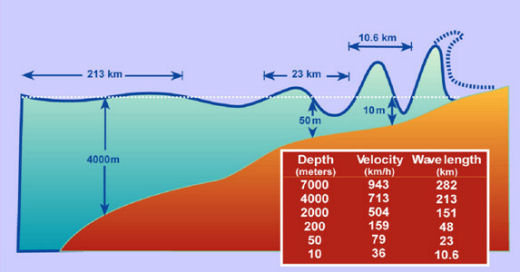
Since Banda Aceh and the meltdown at Fukijima, we’ve all learned about how earhquakes make waves. The shock of the quake trundles happily along the ocean floor until the ocean floor rises towards the shore. Then it sucks the landward water into itself and brings it all back as a tsunami.
water_tsunamiformation
If you’re afloat and listening, you move out to deep water, sail over the bump without losing stability, and you’re fine. If not… cue exciting sound track and hire George Clooney for the (possibly race- and gender-inappropriate) lead in another disaster movie.

There was a wave and I wasn’t in deep water. I didn’t handle it well; I was dysregulated and chaotic for days. Days. I was so dysregulated and chaotic I didn’t even see that that’s what I was, until it was pointed out to me — by the person who’d just gotten butt-kicked by an earthquake. That is not a fair burden to put on someone who’s already having trouble.

I have a personal meme about being good to friends. This is important for us spoonies (as chronically ill people sometimes call themselves.) My disease treats me like crap, but that isn’t a license for me to treat others like crap.

People who are protected from the true impact of this illness need to not get it at close range, or they run away (understandably) feeling as if they just got burned.

People who have this illness can understand a lot more, but are able to do much less.

I have to communicate appropriately. That’s my job in each relationship.

Basically, humans are emotionally fragile creatures and — whether I want to be judgmental about it or not — I can either respect that, keep the worst of my crap to myself, and have good relationships; or I can expect them to be as tough as me and to do so on my schedule, neglecting that they have to be as tough as themselves on their own schedule, and wind up isolated. Because I’m human too, I’m emotionally fragile enough that being isolated sucks.

I absolutely dropped my backlog of frustration and pain and rage on someone who was about the last to ever deserve it. That’s quite a breach of trust.

I stopped taking care of myself. As a result, I fkdup and hurt someone else. Now I have to own up (did that), figure it out (working on it), and do what needs to be done (re-integrate my practices) to prevent it ever happening again (and find a way to cue myself before I get bad: the missing piece.)

At that point, I’m allowed to make amends. It’s another tweak of my logic that I can’t make amends until I’m sure I won’t make the same mistake.

Being a spoonie is hard work. Part of that work is these time-intensive disciplines that seem like “oh how nice, you’re so cool, I wish I could do that” — but, as it turns out, are really not optional if I want to function.
Allie Brosch cartoon,
Why I need to do my disciplines: to stay out of this pit with Allie.

BTW, do you notice how people excuse themselves by saying, “I wish I could do that”? I listen for these words coming out of my own mouth. It’s a sure flag that I’m throwing the baby out with the bathwater. Oh, a little extra effort up front to save a whole lot of trouble later on? H’mmm…

We all screw up at times. The consequences for spoonies can be life-threatening, if the wrong relationship gets ruined. Handling these issues is part of “living anyway” in the face of profound disease. It’s harder to figure out and harder to repair the damage, because of the nature of central nervous system diseases. So, dear reader, I’ll try to stay on the right side of the line between washing dirty laundry and discussing a common issue here.

We often tell each other, “You can’t take care of others if you don’t take care of yourself.” That’s a tough one for caregiver personalities; we’d much rather take care of others than ourselves. However, it was through failing to take care of myself that I actively hurt another. That is a whole different octave of problem. I guess I’d better learn this lesson.

This is a lot of thinking for a breached boat. I can do it, though. I must. I’m still a long way from harbor.
boatsSBMarina_night

How I find my doctors

It’s not easy to find providers who can pay attention to the people in front of them and think their way out of a wet paper bag at the best of times, especially in the increasingly money-oriented and depersonalized model of care that grows and spreads out from the US like a bad rash.

When you’re looking for a specialist in a rare disease like CRPS, it’s even more interesting.

Sources for lists of providers


The online info-and-education site, RSDS.org, can send you a list of providers if you write to them and ask:
http://rsds.org/finding-a-crps-specialist/. More usefully, though, they also provide a list of links to medical-specialist licensing board sites, where you can find specialists in your region.

I checked these out.

American Board of Pain Medicine

Enter your city, state/province, and country in the fields provided; choose your target category (Anaesthesiology, Physical Medicine & Rehab, Neurology, Psychiatry, etc.) to find someone board-certified in that specialty; and click Find.
http://imis.abpm.org/abpmimis/abpm/directory.aspx

American Academy of Physical Medicine & Rehab

Same as above but with better instructions at the site.
https://members.aapmr.org/AAPMR/AAPMR_FINDER.aspx

American Academy of Pain Management

This very useful search tool includes a range of natural, ancillary, and supportive fields of care, not just physicians. It also allows you to set a distance, so you can expand or limit your commute as you see fit.
https://members.aapainmanage.org/aapmssa/censsacustlkup.query_page

Last but not least

Of course, if your insurance provider has a specific list of providers they’re willing to pay for, you may have to start with the list they give you. That simplifies the process initially.

Using online reviews rationally

Having found a list of specialists, I strongly recommend reading lots of reviews to find the one who suits you the best.

That will be different for different people, of course, because we have different bodies and we each have found that certain kinds of things work best for us; doctors, likewise, have different brains and are inclined to use a distinctive set of treatments, believing that that is what’s best.

So, if possible, we probably want to find a doctor whose approach and treatments bear some resemblance to our own.

Excellence

In addition to that, I recommend finding someone with over a decade of practice. There is no substitute for experience. It’s the only way that judgment — that subtle sense that takes in a lot of info subconsciously to arrive faster at a better result — can develop.

Excellence takes time. Extensive research on excellence indicates that 10 years is the functional minimum to develop it.

Personally, I tend to go for 25-30 years. I know that I require a collegial relationship with my doctor, and it takes an unusual degree of poise for most specialists to handle that gracefully. Also, I really need to be treated by someone who knows more than I do, and the longer I have this, the rarer that is….

Review sites

List of review sites I’ve used

Doctor review sites I’ve used include:

Yelp.com
ratemds.com
www.vitals.com
healthgrades.com
zocdoc.com

Using review sites rationally

Once I get a list of specialists, it’s pretty easy to screen out the majority on the first pass, on the basis of inexperience or irrelevant experience. Some of these review sites, like ratemds.com and healthgrades.com, show the education, experience, rewards, and publication highlights for each physician. (All of this is public info.) These data make a great screening tool.

I only need to do in-depth review reading for less than a dozen doctors, usually. I don’t feel comfortable with less than 4 review sites for each doc I take seriously. Each site has its own slant, so I prefer to triangulate on each provider’s patient relationships from different sites.

Caveat emptor: It’s important to look at review sites with my brain plugged in and working. We know that some reviews are posted malevolently, and that everyone — including doctors — has a bad day. We also know that everyone — including doctors — has got their blind spots. That’s fine. I’m looking for PATTERNS, not exceptional instances.

For instance, one memorable doc treated beautiful people very well, and everyone else very dismissively. When his attention was engaged (which, for him, was about looks), he was intelligent, appropriate, and did outstanding work; these are valuable traits. Therefore, I’d recommend him (with an explanation), to friends who meet the age/BMI criteria in his sweet spot, because good care is good care — but I’d emphatically warn against him to the rest!

Last time, I wound up choosing a doctor who had a super high proportion of “he listens to me” remarks, had over 30 years of practice, had started in psychiatry (which indicated a more human-oriented and less problem-oriented approach, I thought), and did charity work for pain in his own time. That turned out extremely well. I wish I could get him to move across the country now, because I hate having to start the search all over again.

Now that I’ve got all my links in one place, it’ll be a lot easier.

Recap of my process

1. Create a list of potential providers:


Choose an appropriate specialty, such as..

  • anaesthesiology (training is oriented towards meds and procedures)
  • physical medicine and rehab (training is oriented toward physiotherapy and mental discipline)
  • psychiatry (training is oriented toward neurochemistry and life habits)

Choose an appropriate level of experience,with 10 years as my recommended minimum.

Make a comprehensive list of possibilities in your commute distance, using one of the board-certification bodies above or the list your insurance company provides you with.

2. Narrow it down to what makes sense:


First, quick pass through the list: screen for appropriate specialty (you’d be amazed at what winds up in those lists) and experience.

Second pass through the list: Start looking at online reviews. Cross out those who do a great job of pissing off their patients. Again, you’d be amazed… Every single doc gets a certain number of “he treated me like crap! I’ve never been so insulted in my life!” remarks, so I don’t notice a few of those, but when they predominate, out that doctor goes.

Third pass through the list: I look at 3-4 sites containing online reviews for the surprisingly short list of names I’ve got left. Some reviews are cut-and-pasted across sites, so I count those only once. This is where a pattern of personalities and approaches comes across.

Final triangulation: These impressions are easy enough to check by looking at the doctor’s web presence — activities they’re involved in, published work, what they do in their spare time (I find doing disease-related charities more compelling than golf club or Rotarian memberships, for instance), and I’m quickly down to 1 or 2 practitioners.

From there it’s a very simple choice.

3. Pick one.

If it’s a hard choice, I’ll call the office and ask to talk to the nurse. The staff a doctor hires have an awful lot to do with my experience there, so, by the time I know the doc has met my other criteria, incompetent or stupid staff is a perfectly reasonable deal-breaker.

I’m willing and able to travel quite a distance for a good provider, and this makes it a lot easier for me to find one. I’m deeply indebted to my partner for being so willing and happy to do so much driving on my behalf. It makes an enormous difference, and I’m suitably grateful.

I hope you all can find the right doctor where you need one. There is simply no substitute for good and appropriate care.

Don’t abandon yourself

Um, I’m embarrassed here, but WordPress decided I wanted to publish this instead of keeping it as a draft, despite my (I thought) clear button-clicking. And after all this work, naturally, I’m too clobbered to figure out how to back out and fix that. So I won’t advertise this until it’s done. Meanwhile, enjoy reading the beta version, if you want…

// markup
// consider splitting into 2 or 3
// sanity check
// images

Don’t abandon yourself

As individuals and as a group, we have far too much experience of being abandoned by those who are supposed to care for us and those who, we believed, cared about us. Sooner or later, those of us with invisible disabilities in general, and disruptive neurological and pain diseases particularly, *really* learn who our friends and allies *truly* are — if we have any at all. It’s a brutal lesson.

On top of this, those of us who survive the initial assaults of the disease — not to mention the staggering rounds of betrayals and abandonments — tend to be rather driven. If we weren’t when we started, we sure are by the time we get through those ghastly shivarees. We can keep going by will alone, without the muscle, the memory, or the means to do so. We do it anyway.

In the long run, this is a skill that needs to be used selectively. It gets us through the pinches and punches of life, but we have to learn when to turn that off and take care of ourselves, as we wish others had taken care of us.

The trickiest lesson of all may be, how not to abandon ourselves.

It’s not that hard. It’s difficult, but it’s not hard. The trick is learning to walk fine lines, using our judgment instead of our impulses — which are a LOT more impulsive because of the neurochemistry of relentless pain.

The deck is stacked against us. But we are still in the game.

Here are some notes on the distinctions we have to learn, even when our brains can’t cooperate. The fact that we get as far as we do is astounding, when you think about it.

H/The difference between comfort and care

There are habitual comforts that belonged to our pre-disease life, and care that belongs to the present. I’ve found that care itself has become very comforting, so the work of leaving behind old comforts that suddenly came with a very high price has turned out to be well worth the years of effort. (I rarely even want pastries any more, which is just as well, considering all the problems they trigger in this body… but Epsom baths are wonderful, and berries are delicious!)

H/The difference between rest and sluggishness

There are four pillars to self-care for CRPS and, indeed, most pain diseases: activity, rest, nutrition, and distraction.

We have GOT to move. We have GOT to rest. Neither is optional. But the pain makes it hard to start moving, and once you get comfortable… oh, dear heavens, why get up when it just makes things hurt again? Initiating movement is awful at the time, but maintaining flow of blood and lymph is absolutely crucial for *ongoing* pain control and keeping the damage down.

Putting your feet up between tasks, taking it easy the day before and the day after an appointment or event, and [LINK] having good sleep habits[/] is resting. Resting is good. Resting is helpful. Resting makes you stronger.

H/The difference between doing and overdoing — and undoing

One great advantage that kids with CRPS have is parents. Parents push you when you can’t push yourself. It’s their job. I suspect that two reasons why kids have a better chance at remission is that, for one thing, they have a structured daily routine, which reduces the CNS chaos; and, for another, they have parents helping and coaching and maybe crying with them as they push through the pain to keep moving and
get their activity in, as well as their rest.

One great disadvantage that adults have is less resilience. If we overdo, our bodies go straight to Hell — go to Hell, go directly to Hell, do not pass Go, do not collect $200 (to paraphrase the game Monopoly.)

At worst, we can create a spread or an intensifying of CRPS if we push ourselves too hard, eat the wrong thing, have a procedure, break a bone. We can, by one misjudgment or accident, find ourselves far more disabled and agonized and in need than we already were. Which is unimaginable to a healthy person in the first place.

And yet, we must move… While exhibiting good judgment… With a brain that hasn’t got much judgment-juice at the best of times.

No, it’s not fair! It’s CRPS!

H/The difference between pushing and pacing

Pacing is key. Pacing is how I built up from being able to walk just 100 feet to a couple of miles. Pushing is how I got CRPS in the first place, and it’s insane to do the same thing in the hope of getting different results.

Learning how to pace, when you’re used to pushing, is relentlessly frustrating… but it *can* be done! For me, it’s usually a question of turning my stubbornness towards my own service, instead of the service of my frustration, ADD-driven fixation, or impulsiveness.

Actually, come to think of it, it’s really a question of *remembering* to do that, prioritizing accordingly, and following through on the decision. Easier said than done. This brain doesn’t have much judgment-juice, remember? It’s unspeakably weird to feel myself make the choice to stop doing whatever task I’ve gotten sucked into, realize it’s a good idea, find that I’m totally unable to make the switch, and — here’s the kicker — hear myself say in my head, “I haven’t got enough dopamine,” and simply realize I’m going to be in trouble and that’s all there is to it.

H/The difference between a bad decision, the end of life as you know it, and being dead.

Normally, only one of these is unrecoverable. Remember that. Being dead eliminates aaaaaaaaall your future options. Every last one. This is why I say, with Barrie Rosen, that *only suicide* is failure; everything else is just tactics.

Bad decisions have consequences, as we know better than most. We are often underfunded in what it takes to make those decisions, as my example in the previous section indicates. Bad decisions suck, they’re often costly, and it’s not like we can always help making them, adding a layer of humiliation that isn’t fun.

But they aren’t the end of the world. Not usually. They rarely result in our deaths. Being able to manage or mitigate the consequences and move on with a minimum of fuss is a hugely valuable skill. This brings us to our next topic.

H/The difference between being irresponsible, and forgiving yourself for a mistake.

Forgiving ourselves is key. The neurochemistry of judgment and decision-making takes heavy damage from the neurochemistry of pain *and* the particular neurological re-mapping and re-wiring of CRPS.

That’s not fair!

Would you dis someone with no legs because they couldn’t climb a mountain? No, of course not. You’d be much more likely to offer to help them get their chair up to where they can get a better view.

Between our greater likelihood of dropping a brick, so to speak, and the incredibly high price we pay for every mistake, being able to forgive ourselves is essential to keeping some perspective and keeping ourselves going.

Not forgiving ourselves actually leaves us with *less* judgment-juice (otherwise known as dopamine.) Being critical is hard work, neurologically speaking. Our brains are already overtaxed, in every possible sense of the word; do we really need to strip still more dopamine from this system and work the pain pathways even harder? Probably not, eh?

Being irresponsible boils down to surrendering your own agency. Agency, in this case, means being the active force in your own life. Whose body is it? Yours. Who is it who has this pain and all that goes with it? You. Who is responsible for learning how to manage this body? Who is it who has to find the right treatment and negotiate usefully with your providers? One guess…

Doctors spend a decade just being trained to treat this disease. We don’t have that luxury, even though we have to depend on them to get the care. Since it shows up uniquely in each one of us, we have to become our own best specialists. To quote Ojocion Ingram, a passive patient is a dead patient.

While modern conventional medicine does not take kindly to patients who drive their own care, there’s a reason for that: modern conventional medicine was not designed to create healthy patients, it was designed to create healthy profits. The system does not have your best interests at heart. It’s up to you to manage the system to serve your needs to the extent that it can… and then to find ways to stretch it a little further.

Although others may help us (and isn’t it wonderful when they do?) the final decisions are ours, for better or worse. The law still mostly respects that, if only because it shifts responsibility off the “health care” system.

H/The difference between inner wisdom and inner chaos

I recently lost a friend with CRPS who released her agency to her surgeon, for very logical reasons, but very much against her inner voice. Her voice is now silenced, and we miss her dreadfully.

This raises an interesting conundrum: with or without adequate brain-juice, we have to find ways to make decisions which can have consequences up to, and including, death. Is the logical decision the right one? Or should we listen to our inner voice, even if we can’t find logical reasons to do so? Is it inner wisdom, or yet another anxiety attack? How can we know?

I’m an old triage nurse. I used to say, always go with that inner voice. I’ve seen it be right more often than the best of doctors. There is something inside us that knows more than we can possibly perceive. Sadly, we can’t always hear it clearly, especially when our brains are hotwired and hair-triggered by the constant barrage of weirdness that CRPS creates.

The primitive parts of our brain that monitor risk and reward, hazards and fears, aversion and attraction, are all potentially infected with the disruption and misfiring that CRPS causes. It’s a central disease, so the pain it creates in the body can be reflected and echoed and magnified by the upheaval it creates in the brain. This can make it very hard to know what’s really going on, especially for the person most closely involved.

This is why coloring, meditation/contemplation, relaxation techniques, and inner arts like yoga and qi gong are so useful. They smooth out the chaotic ripples set off by the disease, so we can hear our inner voices a bit more clearly. Sadly, they’re still seen as something absurd (coloring? Really??), out of reach, exotic, or personally irrelevant. My doctors almost never mention them, and if they do, it’s usually clear that it’s something they don’t do themselves — it’s for the patients. And, as every practitioner knows, patients are just a little less than fully human.

That’s one thing I learned from working as a nurse at 6 teaching hospitals. Patients are consistently seen as less than fully human. The training in that regard goes very deep. Knowing that may make it easier to understand why things are the way they are in the modern health care system.


A simple 3-step program for bearing the unbearable

It’s been an interesting summer. It’s good to be safe and well. And that’s all I want to say about it right now. On to more interesting things.

Those of us who have to bear the unbearable eventually learn that there’s no trick to it, no shortcuts, no secret wisdom. I’m sorry to say it, but there isn’t. It’s very simple — not easy, but simple.

There are just three things we have to do:

1. Keep breathing.
2. Put one foot in front of the other.
3. Keep going through the motions until we adapt to the New Normal.

That seems a bit telegraphic. Let me expand on these a little:

  1. Keep breathing.

    If we don’t do that, we’ve got nothing. Literally. Keep breathing. In fact, the better we breathe, the better we cope. (There’s a ton of science on this, if you care about that.) For those who need reminding how, try this:

    1. Ease your lower back, if you can. Gently drop your shoulders, which are probably up near your ears.
       
    2. Breathe in through your nose, if you can; if you can’t, stick your tongue out loosely between your open jaws and breathe through your mouth. (This opens the back of your throat — and releases clenched teeth.) Imagine the breath going down in front of your spine and into the bowl of your pelvis. This helps draw it in deeper, which is key to calming and strengthening your system.
       
    3. Breathe out naturally, or by gently exhaling through pursed lips — like blowing out a little candle. The pursed-lips one is great for tense moments and higher pain.

    Breathing well disrupts the “anxious/fight/flight” loop in the nervous system. It’s amazing. So simple, can’t beat the price, and no bad side-effects!

  2. Put one foot in front of the other.
     
    This means doing the work of survival:

    1. Do what it takes to get fresh air, water, food, clothing, and shelter, plus a phone and internet access. (In this isolated and far-flung age, phone and internet are essential elements of survival.) The safer and more effective, the better, but we can’t always be choosy.
       
    2. Keep our bills paid, if we can. If we can’t, find out how to get assistance with them. (This is one task where we need the phone and internet.)
       
    3. Put the minimum effective effort into maintaining our relationships. (More phone and internet.) We need to know who won’t fade away at the first real sign of trouble. We can’t expect much, though — a sad fact of life. Just stay in touch and see what happens.

      One way or another, we do find out who our real friends are.

  3. Keep going through the motions until we adapt to the New Normal.

    What that involves varies for each of us; you’ll know it when you see it starting to happen. Things you’ll probably notice include:

    • The work of survival shifts from “minimum survival” to meeting slightly higher expectations.
       
    • New relationships have begun to form, and old bonds to re-form, around the new realities.
       
    • The inevitable grief over what we’ve lost (abilities, opportunities, friends, and so on) begins to separate from the general mash of misery.

That’s actually a good sign.

When grief becomes distinct, it makes room for other things — relief, moments of joy, feelings of love, appreciation for what we now have.

If we keep breathing well, we can notice those other things better, and get closer to that quality of “radical acceptance” (which can work with or without hope) that makes even hellacious lives so much richer.

When in doubt, breathe. Then just go through the steps.

First, keep breathing

I say that a lot.

The first thing our bodies do when we get a burst of pain or other shock is, clench. Hard to breathe effectively when clenched and, oddly, it’s hard to do anything else — except let the anxiety-mad sympathetic nervous system run riot.

For normal people, the exercise I’m about to describe is a calming exercise, but for the chronically ill and chronically hurting, it’s more like an elementary coping exercise.

That feeling of being frozen? It’s shock. It’s normal to go there, but don’t dwell in it.

Ways to help yourself through it are largely little physical shifts that send a message back up to your brain that it’s time to process now.

Notice where your shoulders are. Just notice. Notice how your neck feels. No judgment or “I should”s, just notice. Notice how you’re sitting or standing. Notice how your hips are rotated in relation to your posture. Just observe these things.

Now exhale all the way. Not to the point of straining or coughing, just comfortably emptied out. Let your lungs spring open naturally and — this is key — open your teeth as you inhale.

Now, when you breathe out, purse your lips softly, as if puffing out a match. That does two things: keeps your jaw unlocked and nudges a little extra oxygen into your lungs.

When you breathe in, after that first open-mouth inhale, breathe in through your nostrils if you can. If you can’t, put your tongue tip on the roof of your mouth and breathe around your tongue. Either way, it opens the back of your throat slightly so you can…

Imagine the breath sliding down your spine and into the bowl of your pelvis. This helps your body do an end-run around the clenched-torso breathing we get into when we freeze. Just let the good air wash into your spine and slosh into the bowl of your pelvis.

Then let it out through gently pursed lips, and in through opened throat, then down, and back out, and so on.

Do ten cycles. It’ll be a different and better world after. Notice how your shoulders and neck soften, and your hips unwind. Colors are a little brighter. Feelings are closer, but less overwhelming.

You can do this. I have faith in you. You are life warriors and we handle it. It’s our gift to be this strong and still be this alive.

On treatments and at-home management strategies for CRPS

Quick brain dump here. There have been a lot of questions lately about treatment options. THIS LIST IS NOT EXHAUSTIVE. It’s barely an overview. It’s just a note I worote in answer to someone who asked about prolotherapy, where a sugar or basic solution is injected into a painful area and the harmless irritation causes just the right kind of healing bloodflow for some people. Here is my answer…

Prolotherapy is one of those things that works great when it works at all. It’s definitely individual-dependent. The tissue irritation, so helpful to those who don’t have spastic vessels, can do a number on us. But not everyone.

If your CRPS is more peripherally maintained, then it might help, assuming the irritation does what it’s supposed to and the tissue response doesn’t trigger autonomic dysfunction, with circulatory weirdness and the whole color/swelling/pain circus that comes with it.

If your CRPS is more centrally maintained, which is kind of a hallmark of the ongoing disease, then I don’t see how treating the area with anything, let alone an irritant, would be any good. It does nothing for the central part of the nervous system.

I consider myself lucky that the usual pain meds nearly killed me, and I had to go the diet modification/supplementation route almost right away. Eliminating things that irritate my central nervous system, and supplementing with things that help repair damaged nerves and fragile tissues, was absolutely essential. If I hadn’t done that, I wouldn’t have lived long enough to do anything else.

At the risk of starting a shooting war here, the MCS (multiple chemical sensitivities) and neuro research hounds I’m close to, indicate that the most common neuro allergens in the diet are gluten (wheat, rye, barley, spelt, triticale, “natural flavorings”; oats have a similar molecule, so YMMV), corn (especially corn fractions like HFCS and “natural flavorings”), fresh dairy (which an incompetent gut like mine breaks down into a molecule a lot like gluten), MSG (often wheat derived), phosphoric acid (found in most dark sodas), and benzene (anything with the syllable “benz” in it — read labels, or better yet, don’t eat things that come in packages, which usually have BHA or BHT added to the packaging.)

Common neuro allergens in the environment include petrochemical products (photo chemicals, printing chemicals, gasoline, many cleaning products) and most chemical scents, most notoriously the line called Axe, which may trigger psychotic breaks in vulnerable people, according to disturbing reports.

A couple of techniques do address central sensitization:

– Calmare, which is a subtle, varied, electric signal that rescrambles the pain impulses and has given many CRPSers outstanding relief.

– Ketamine, which is an anesthetic that sort of reboots the brain. It must be administered by a competent physician well-trained in ketamine administration for CRPS, as it’s still a dangerous drug, but with right matching of patient to protocol, it can work wonders.

– Spinal cord stimulators. These are surgically placed and can be highly problematic, but if they’re the right thing for you, they can give you your life back to a large degree. There are electrodes shoved right into your spine, so if your pain is mediated mostly in the brain, not so good. If it’s still at or below the spinal root, excellent.

As for supplementation, which you don’t need doctors to do … Good, health-food-store supplements are essential. Don’t waste your money on the plastic pills at the pharmacy (check Consumer Reports to find out just how bad they are.) Your body is burning through nutrients desperately fast all the time. It can’t keep up. We need a healthy diet so as not to bring in more problems, but we can’t possibly meet our needs that way any more, with all the pain and the other cellular and metabolic insults of CRPS.

The nerve cells and muscle cells are the biggest suppliers and the biggest consumers of antioxidants. As muscle cells degenerate and nerve cells take a beating, they need more and more but can produce less and less. The math catches up to us after awhile and then it takes time for the supplementation to penetrate enough of the starved tissue around the gut to work its way to our CNS — but, from my experience, it was well worth it! The time was going to pass anyway, and I was better at the end of it.

Neuro-oriented antioxidants include SAMe (a type of methionine, primal antioxidant used inside the mitochondrial cell), N-acetyl cysteine (NAC), and co-q 10.

Vitamins A, D, E, K, and moderate amounts of C are important, especially the D3 — much bone loss and the concomitant pain could likely be avoided if we all had our D levels checked and then supplemented accordingly.
(I’ve been told that C can become pro-oxidative in a sickly environment, so I have to look into that.)
B vitamins are absolutely crucial to neuro and other cellular repair, so a good B complex is important.

Magnesium, whether as lotions, Epsom baths/rubs, or supplements, is essential. It’s simply huge for cutting spasms, which underlie so much of the nagging side of the pain, and supporting basic cellular functions as an electrolyte.

There are supplements that can provide precursors to neurotransmitters, and I find they roughly double the effectiveness of my SSRI and SNRI, keeping me in the low-middle range of doses instead of me getting overdosed to near dying as I once was. Phenylalanine is a precursor for dopamine and norepinephrine, and the d,l form has been found to be genuinely helpful in reducing nerve pain for many. It also helps me stay less confused (dopamine, perhaps.) 5-HTP is widely known as a serotonin precursor, as is tryptophan. Both can help with sleep, too. I do better with 5-HTP.

There are a lot of brands, and there’s a lot of behind-the-scenes business ugliness behind the brands as the whole “natural everything” movement creates the possibility of money. I’ve watched the circus for awhile, and at this point, there are just a few brands I can recommend as still being good, consistent, and generally digestible:

Jarrow (great antioxidants)
NOW (inexpensive and very good; I always get my 5-htp from them)
RAW Vitamin Code (a Garden of Life line of food-based products, excellent; I take only half the recommended dose of the multis, and boy do they help)
Twinlabs (my second choice for multis and neurotransmitter supplements; widely available)
Solgar (pricier than Twinlabs, but much the same; widely available)
My fallback brand is Life Extension, which is still excellent.

I get mine for wholesale at vitacost.com (fast delivery, but don’t carry Jarrow), luckyvitamin.com, or occasionally for a bit more at Amazon if the others are out of what I need.

It’s a hideously complex disease, and in cases like ours where conventional medicine has almost completely failed, we have to take charge of that complexity and redesign our lives in order to have something worth living.

We really do have to change or die, and it is a surprisingly hard choice at times.

Further comments and suggestions on treatments and management would be most welcome.

Oh look! I’ve adapted!

I used to be punctual, meaning, 3-10 minutes early. I used to be relentlessly diligent. I used to be cast-iron reliable. (I worked hard to acquire those skills, after drifting through my first couple of decades with my energy and attention set to “simmer.”)

These were so much a part of my identity that, after a memorable lunch with 12 engineers and one writer (me), they passed me the bill to calculate. I didn’t know whether to laugh or cry, but I scolded them and passed it back. CRPS had already set in and numbers tended to cartwheel in front of my eyes, but I didn’t tell them that.

My care providers know they have to call me to confirm the day before an appointment, because even with the calendar in my phone and on the wall, and now with a weekly dry-erase scheduler on the fridge, I need the added sensory input to make sure the other 3 are correct and, above all, to give my brain one more hook to the info.

Reliable, remember? I’ve still got a lot of identity tied up in being reliable, and it takes a LOT more work, but it’s important enough to me to do, and ask for a little practical assistance with.

Today, I looked at the clock when I woke up and thought, “Hour and a half to appointment time. OK.”

As I set up my tea, I thought, “I’ll let J sleep. He’d only have half an hour to get ready and I don’t want to spoil his morning.”

As I washed and dressed, I thought, “Excellent, time to read a little while I have my tea, fruit and morning pillage.” Can’t just call them pills. Definitely pillage. I hope to lay waste to CRPS as it tries to lay waste to me, so that could go either way.

En route to my appointment, I found a whopping case of vehicular atherosclerosis — a traffic jam, in a country stretch of highway. Very odd. The clock read 9:50, and I realized I was going to be late gor my appointment.

Diligently, I picked up my phone and made an illegal call to notify Dr. Resneck that I’d be late.

She said, in slightly worried tones, “But… your appointment isn’t until 11.”

Not missing a beat, I said, “Excellent! I’ll pull over and read for an hour. That’ll be nice!”

In response to the still-shocky silence, I added, “Well, an hour early is better than an hour late, isn’t it! See you soon!” And hung up.

I realized that my brain had simply done an ER-worthy triage — is anyone hurt? Anything made worse? No? Fine! — and moved straight on to a good Plan B. I’m reading Jodi Taylor, and St Mary’s is about to be incinerated and I’m dying to know what happens. And yes, I’ve read it before, though not for awhile.

If I were a clinician caring for me, I’d note this incident down and give a worried little sigh. It’s not good, just not very good.

But I have learned, in this brutal school of my life with this ratfink stinker of a disease, that I CAN’T WORRY ABOUT THESE THINGS. From the standpoint of the person doing this, I am really pleased with my handling of it.

Anyone hurt? Anything worse because of my mistake? No? Fine! Now let’s advance some other agenda I’ve got! Because as long as the first two questions come up negative, IT’S OKAY. I am not a failure, oddly enough. I’m just not. I get a free hour, and that’s pure bonus!

Off to read my book. Enjoy the rest of your day, and remember that blessings can come in heavy disguise.

The Bean Dip Response, companion to the Spoon Theory

Those of us with crazy-bad illnesses appreciate the stroke of genius from Christine Miserandino, who originated the Spoon Theory to explain what it takes to get through the day.

For the most part, though, we shouldn’t have to explain much. Wouldn’t it be nice if everyone could get that memo?

To that end, here is a great article by family therapist and parent counselor Joanne Ketch on parenting boundaries, using the Bean Dip Response: http://www.joanneketch.com/ParentingChoiceBoundaries.en.html

With her permission and kind support, I’ve revised her article to reflect the realities of the chronically or severely ill. Please feel free to print out/pass on, with credit to her embedded as it is in this text.

Here’s my version…

Health Management Choices – Boundaries

A long time ago, as a developing patient educator, I found many chronic patients uncomfortable and frustrated with unsolicited advice – or inadvertently soliciting advice and then feeling uncomfortable with the discussion that followed.

Eventually, I read this great article on boundaries that eventually become known as “The Bean Dip Response”, “Pass the Bean Dip”, or even used as a verb: “bean dip” someone.

I rewrote the article from the perspective of a chronically ill, alternative-using or drug-disabled patient (one who can’t use common meds for the condition because of uselessness or devastating side-effects) – but the principles are transferrable to any constellation of health management choices.

The Bean Dip Response is best used when you don’t need to defend or don’t wish to engage with a person over a health management choice. If you are discussing issues with a person and you welcome their feedback, the Bean Dip Response is not needed.

I’ve found that chronic patients may confuse boundaries while trying to convince someone of the rightness of their choices. The best thing is to assert your boundary, rather than defend your choice. Your choice needs no defense.

Health management choices should be on a “need to know” basis. Most people don’t “need to know”. Since medical information is highly confidential, it’s NOT incumbent on you to explain yourself to those who don’t need to know. Those who need to know are essentially you, your doctors/providers, and your designated decision-maker for when you can’t make your own decisions.

If anyone else asks, "How are you sleeping?"
Answer: Great! Thanks for asking! Want some bean dip?

"Are you sure you should get picked up every time your legs flare?"
Answer: “Yes! Thank you! Want some bean dip?"

"When do you plan to wean off those meds?"
Answer: "When it's time. Thanks! Want some bean dip?"

"You should use my aunt's hairdresser's physiotherapist's product. It cleared up her [symptom du jour] in two weeks."
Answer: "That's great! I'm happy for her. Want some bean dip?"

Now, with some people you will need to set firm boundaries. The offer of bean dip won’t be sufficient to redirect them [I can’t imagine why not. -ed.] They either don’t respond to gentle redirection or they have emotion tied to the issue and a desire to “go there” more deeply. You may be able to anticipate this – if it’s a pattern of intrusion, for example, which you’ve seen in other circumstances.

In such a case, a stronger “Bean Dip” response may be needed. In these cases, the redirect will need to be backed up with action (like hanging up, leaving the room, or even unfriending them).

Remember, boundaries are not about forcing another person to comply. You cannot “do” that. Boundaries are about what YOU will do or not do. You are the person you own. You don’t own them and they don’t own you.

Practice kind but firm responses: "I know you love me and want to help. I am so glad. My health choices have been researched and made. I won't discuss it again.”

Don’t confuse setting boundaries with trying to convince someone of the rightness of your choices. It’s a common (and understandable) desire to present the same information that led you to your choices. The problem with that in dealing with a person who has boundary issues is that engaging with content invites discussion. (Also, different people’s minds work in different ways, so your train of thought may make no sense at all to them. Wasted effort all around.)

Chronic patients often struggle with this.

The boundary is that no one else has an inherent right to tell you how to take care of yourself.

You set boundaries by doing the above: acknowledging what they said and redirecting.

Where the chronically ill may invite problems is by citing authors, studies and sites to “defend” themselves. Each time you do so, you create more time for discussion and rebuttal and send the message that your decisions are up for debate.

Don’t defend your choices beyond generalities, and then only once or twice. “My doctor is in support of my choices. Want some bean dip?” Or maybe, “Well, this is my decision. Want some bean dip?”

If necessary, look them in the eye and say simply, “I want us to have a good relationship. I want to enjoy my time with you. I’ll take care of me, so that we both can make the most of our time together. Let’s not discuss this anymore. If you bring it up again, I will have to ask you to leave.”

Finally, an important corollary to the “Bean Dip Response” is reciprocity. Once again, the content of your choices should not dictate the interaction.

You may be totally, and correctly, convinced that you should be able to determine your own activity, medication, and supplementation regime; never be left to “cry it out”; and should be allowed to follow your own weaning path, if any.

But, if you post those opinions on Facebook (or communicate them in other ways), you invite (and therefore solicit) feedback and advice. Post accordingly and respond to comments with that in mind. You need to give the “other side” the same respect that you expect to receive.

Credit for original: Joanne Ketch, MA, LPC, LMFTa, LCDC
http://www.joanneketch.com/ParentingChoiceBoundaries.en.html

For those of us who are chronically ill, there are people we DO need to explain ourselves to. However, these are mostly highly educated people with specialist training, and that makes it a short list indeed.

Our loved ones may believe they want to understand, but, as my mother finally admitted, “I don’t think I really do want to understand what you’re going through. I couldn’t stand to know how much pain you’re in and how rotten you feel all the time. It would drive me crazy, knowing that.”

But, hoo boy, does she ever respect my boundaries! That’s worth the world. It makes everything open and clear between us, and our current relationship reflects that.

When someone confesses their limits to me, I take it as a gift. They have told me how to protect our relationship and how to move forward with it. I appreciate that. With that subject opened, we can move on to discuss how, or if, they can connect with me in a way that works for us both. This is priceless information. I’m glad my mother had the courage to open that can of worms, because then it got very manageable very quickly.

For an ever-changing kaleidescope of visual delight, check out my Mom’s photography from all around the world at http://jldtifft.com/

Frozen

I was mulling a post called, “The Pulse,” about how my life tends to go in surges, and when I work with that, things go better, but when I try too hard to flatten life out to a steady level, everything goes badly.

Some people try to flatten the ocean. That's above my paygrade. I just try to ride the waves. Photo Brocken Inaglory/Wikipedia.
Some people try to flatten the ocean. That’s above my paygrade. I just try to ride the waves. Photo Brocken Inaglory/Wikipedia.

It’s about the pulse — push when I have the momentum to push, pause when the momentum fades, sink when even standing still feels like a sucking drain; push, pause, sink, push, pause, sink, and so forth.

If you’ve ever held a stethoscope to the sound of a beating heart, you have an idea what that sounds like.

It’s like pacing, a familiar concept to the chronically ill, but on a larger timescale.

Winter always involves some withdrawal, some sinking. This makes lots of sense to my acupuncturists and martial arts teachers. The traditional Chinese medical model assumes that we’re embedded in a larger reality, with weather and climate and timely changes, a key idea which conventional medicine doesn’t acknowledge very well.

I used to be able to push enough, even in winter, that the annual sinking wasn’t that obvious, given that most of those around me were in winter too. However, since my mid-30’s, a lot of people I’ve loved, liked, and depended on have died in the chilly armpit of the year. Deathiversaries, as I’ve noted, tend to have an effect on me, especially when they pile up like… well… bodies.

Perhaps I should move south of the equator. Then it’ll be warm at this time of year, at least for me, if not for my lovely ghosts.

Photo in the public domain, with thanks to the photographer Nello Rolleri

Late last year, two honorary brothers, one of my dear CRPS friends and a young friend whose life I actually saved at one time, both died. Now, at least two of my honorary sisters are at the end of their lives, one of CRPS and the other who’s working on her 6th cancer.

I’m not whining. It’s not about me, it’s definitely about them. I’m not dying.

It’s just that it’s hard to remember that, sometimes.
Angels_lossy_notsonice
Helpless as I am to hold back the grim reaper’s scythe, there are sometimes things I can do to soften the end of others’ lives. My first nursing job was on an HIV/AIDS unit in 1991, so this is a well-established idea for me.

This year, though, 24 years on, some invisible line has been crossed, or some invisible straw has landed on this camel’s back. I cannot move. (It’s kind of wild that I can write, finally.)

I am paralyzed, generally anesthetized, frozen. There is no pulse, no pause, no sinking, not a microgram of push.

My mind currently looks something like this.  Photo  Chris Stubbs/Wikimedia.
My mind currently looks something like this. Photo Chris Stubbs/Wikimedia.

Four days of work, pushing so hard it sucks my breath away, and I now have a psychotherapy appointment with a 30-year veteran of helping the chronically ill and deeply traumatized. Plus one blog post.

I can’t do a thing for anyone else until I can move and breathe again. This thought alone is like a blanket of razors, since the condition of my friends isn’t going to wait for me to get my act together, but still — it doesn’t break the ice.

There are some things that are too much to expect a reasonable person to bear, and anyone with a hellacious disease already has one of those things on their plate. Those who are in the last stage of life have another. Those who are bereaved … you get the idea.

I’m posting this, not to write my diary in public, but because I know I’m not alone. Those of you who can barely move enough to shift the cursor, be assured that I know you’re not alone, either. Somehow, we will get through this. We will melt the ice, with help if we can get it. There is always an afterwards.

There’s one thing that offers this frozen veteran of grief the kind of scathing consolation that’s all I can expect these days: when my time comes to shuffle off this mortal coil, then, if there’s anything left of me to notice or care (as I strongly suspect the more subtle yet intransigent laws of physics require), I will be in the very best company.