The sheer activity of Epsom salt baths

Taking a day to rest has been just the thing.Now here’s what I mean when I say, “I took an Epsom bath…” And I’m sorry to say that getting images loaded will have to wait for another day, so use your imaginations for now 🙂

Nearly all motels have a bathtub. I consider this essential. They’re small, but adequate. With a swipe of cleanser and a quick rinse, I’ve found all of them usable so far.

I should add that baths are not essential to Epsom treatment for CRPS. Here are a couple of tricks I’ve used, with a degree of success which not only included the targeted limb but also improved CRPS for me generally:

  • I’ve immersed my arms in an Epsom solution in a sink or basin. This is great when I’m not up to a bath, but I’m too chilly to sit around with wet limbs. I lean into the basin, with sleeves all the way up, and slosh and slosh and just soak it up. I’ve found that not only does it help my arms, but the relief goes up through my shoulders, down my back, and even my feet feel better after doing this with my arms for 15 minutes or so, 20 minutes if I can stand there that long.
  • When the dysautonomia is being REALLY bratty, I sit with a basin of Epsom solution and a tea towel nearby, and simply wipe the bothersome limb, stroking from healthy area to painful/spasming/misbehaving area, with the same mental chants I describe below…

Both of these strategies work extremely well. Many of us are accustomed to sink baths, and it’s no harder than that — easier, because rinsing is optional.

Temperature – the first consideration

People with chronic CRPS have two substantial issues that affect bath temperature: wonky signals to the circulatory system, and screwy temperature regulation.

Hot baths are a thing of the past. They aren’t good to me any more.

I like a bath that’s just a few degrees warmer than the temperature that feels like nothing on your skin. That seems to provide the best results.

I find chlorine to be counterproductive, so I let it go first. I run the tub a little hot, with the fan on, and leave the room for 5-10 minutes until most of the chlorine dissipates. (This really works.) Then I adjust the temperature.

MgSO4, my ally

I’ve gone up to using about 2 pounds of Epsom salt for one bath. That’s about a third of the 6 pound bag, costing between $3.50 and $6.50, depending on where you buy them. I used to use a cup or two, but I really get better results with a stronger solution.

The process

Remember, this is about re-regulating and re-normalizing, so leaping into the bath and getting busy is the wrong thing to do!

Going one step at a time and persuading my body to stabilize at each point is how the process works.

So I take a couple minutes to just sink into it, let the mottling pattern on my lower body and arms fade, and get some circulation going to my overworked skin.

I brush over all my limbs with my hands, introducing them to the idea of tactile input, and how that should go. This is an important first step, because the touch of a hand wet with Epsom solution is softer than silk, and it’s important to start with the most positive possible sensations. This helps de-alarm your central nervous system as well as re-acquaint your skin with the world. This is supposed to start, and end, as a definitely positive experience. In between, there might be some work.

When working on such deep and challenging health issues, it’s important to set yourself up for success whenever possible!

Back to our bath.

Nearly all motels have washcloths with a nice scrubby texture. The soft kind that you get in the bath and body store feels to me like turgid gelatin, soaking up a lot of soap and doing very little in the way of exfoliation – which is what I used to use washcloths for.

Now, it’s all about renormalization – or, to use the standard allopathic medical term, desensitization.

Leave it to medicine to make returning to normal sound like something bad!

I start with the soles of my feet. If yours are too sensitive to touch, start where you can touch. Remember, set your body up for success. This second pass distinguishes between contact on the surface and underneath, which are two different sensory realms. The first thing I do is go underneath, to the tissues below the surface of my feet, in a gentle and encouraging way.

I hold the washcloth in my open hand, using a big, squishing gesture.

IMAGE:

With that big gesture, and a certain amount of gentle elbow grease, I reassure the soles of my feet that they’re doing fine. Once they start sending appropriate signals of touch and motion, I work around the foot and up my ankles.

Using the washcloth in one hand, and nothing in the other, I alternate strokes, soothing the frazzled burning sensation left by the terrycloth with the silkiness of Epsom water in my palm. The frazzled sensation eases off gradually.

I don’t just notice what the sensations are from my skin, I tell that part of me what the sensations ought to be:
It’s just terrycloth. There’s no burning here. It’s just terrycloth. It should feel pleasantly scrubby, nothing more.

Every now and then, I move the washcloth to a part of my body that still thinks terrycloth is just terrycloth, and give myself a brief demonstration. That seems to help.

Once the signals start calming down a bit, I can go deeper. My calves take a little extra care. I start on the left, and it feels like a hunk of plastic. I tell it to calm down – in firm, maternal, authoritative tones – and go squish my right calf instead. When my right calf and shin are sending nice, normal signals of terrycloth texture in motion, I go back to my left calf, reassuring it that you can be normal, you know perfectly well what that feels like, there you go, you can do it.

Firm, yet loving, maternal tones are hard to resist. It’s a great re-progamming tool for bringing your brain closer to normal.

IMAGE:

Eventually, my left calf loses that awful dense feeling and starts to feel like a leg again.

The next step is to address the surface sensations on up the rest of me.

I coach my skin not to send sparkling messages of hot and cold where the washcloth goes, but just the sensation of terrycloth rubbing moderately over skin, and that that’s okay and the right thing to do.

I work my way up my legs, paying attention to the major nerve path and the major muscle groups (always with big, squishy gestures, not too challenging, but very tissue-mobilizing.)

I go back to my knees a couple of times, where the main effort is to mobilize the circulation and draw away the swelling.

I work on my low back and hips until the inclination to spasm turns off. I tell them to take it easy, just let go, you’ll know when it’s time to contract, now settle down.

IMAGE:

Then I lean forward to dip my arms and work on them, with somewhat gentler gestures. Since I can’t remember just what normal sensation is there, I look for overall warmth and better mobility in my forearms, with touch signals as close to normal as we can get.

IMAGE:

Part of the idea, obviously, is not only to re-normalize my skin as much as possible, but to improve surface circulation, so that as much magnesium as possible can be taken up by the troubled tissues.

Once I have squishy-massaged my arms from fingertips to collarbones, I do a quick scrubby pass on my back (where I used to get symptoms, and don’t want anymore)…

And then I get the Calgon experience, lying back in a warm bath, feeling alive and remarkably well, with nothing to do but enjoy myself until the water cools.

IMAGE:

Speaking to my brain in a way it can’t ignore

Health professionals dress it up in fancy words, but this is what brain plasticity boils down to: our brains take in messages that are so simple and so primal they slide in below the level of words. The way to push back against that plasticity and make it go the way you want, is to address your brain in ways that are simple, primal, and slide in below the level of words – even if you use words at the time. Even in spoken exchanges, remember, 90% of the communication is nonverbal. This is true when we talk to ourselves, as well as others.

With enough persistence, and a persuasive enough message, the brain can be re-reshaped.

Since so much of CRPS’s maintenance relates to the brain having been reshaped in a distorted way, part of the task is to reshape it into a healthier structure.

Dr. S. V. Ramachandran’s work on mirror therapy and lens therapy for people with amputations and other limb pain problems led the way in brain plasticity work, highlighting the very powerful (and nonverbal) effect of visual input on brain remapping.

There are several other ways to do this, including forms of brain retraining such as hypnosis, biofeedback, meditation, specific and clear visualization of painless movement (which, if done clearly enough, can cause brain activity nearly identical to the real thing) – and, naturally, using tones of parental imperative with your own sensations.

Speaking to my body in tones of loving maternal authority, I find, is remarkably persuasive.

Why I start deep and work my way out

I find that it’s often easier to start with deep tissues and then address the surface issues. It sounds weird, but it’s often easier for me to get past the surface sensations when I’m reaching into the muscle and fascial layers, and then, when the deeper tissues are responsive and the blood is flowing through them again, it’s a lot easier and more productive to work out the surface sensations.

Conversely, if I start with the surface sensations, I may not get far enough to be able to dig in to release and mobilize the deeper tissues. Getting halfway through surface pain leaves my body a lot more sensitive to intrusions than just charging in and starting with the deeper tissues.

On the other hand, there are times when the surface simply has to be dealt with, or there’s no chance of getting to the deeper tissues. My left calf was like that when I first wrote this, though it has improved a lot since then.

YMMV. Each of us is different. That is part of what makes CRPS so interesting, and at the same time so darn hard to treat.

Physical issues

In mobilizing tissue, the washcloth provides traction against my skin, so I hardly have to use any hand strength at all. This is important, because if I had to rely on my grip to get hold of the tissues, this would be totally out of the question.

The water neutralizes a lot of gravity, so it’s easier to control a limb you’re massaging. I can squish the muscles with either one hand or two, boof them against the bone, and jostle them around.

I can mobilize a lot of tissue with very little effort, if I use a washcloth in the bath.

I figure I should spend at least a solid 20 min. in the tub, to absorb as much as possible of the magnesium, the warmth, and the chance to melt all the little knots out of my brain. It’s not a bad prescription. Not bad at all. There is always considerable improvement, and sometimes it makes me feel almost completely well.

Re-learning how to drive

I’m either half a day ahead of schedule or half a day behind, and I’m honestly not sure which. It’s roughly another 5 days to Denver, and with my sweetie’s troubles slowly and expensively resolving, it’s probably best not to try to rush, but to let things unfold.

Mind you, an hour’s reiki this morning might be helping me think that way.

Badly as I want to be there already, snuggled up to him and brainstorming, here I am …

View Larger Map
Between Richmond and Centerville, Indiana.

My room has a fog of mildew which stopped me on entering, but I paid before asking to see the room, so I’m stuck. I can’t remember where the AC power cord is for the car’s air filter, though I may have tossed it in a burst of mindless efficiency before leaving.

The window is wide open while I do laundry on the other side of town, so we’ll see if that makes enough difference. If I wake up brain-dead, I’m sure you’ll hear about it.

Despite good energy and good progress, I decided to reef it in and stop early tonight — largely because I’m out of long-sleeved shirts, and needed to save arm-time for dealing with that.

I stopped here, precisely, because I had mail forwarded here to me at General Delivery — a system that actually seems to work. It included my permanent Massachusetts driver’s  license (which might be handy after the temporary one expires) and a really lovely card from one of the really lovely people I’ve met on this trip. A wonderful cherry on top of a rather good day.

It occurred to me that I haven’t discussed  my accommodative strategies much. Here are a few things I’ve done, redone, and learned on the way:

Grabbing the wheel

Those of you who know CRPS well know that vibration is absolute hell, and a steering wheel is a big vibrating thing that’s made to press against the weakest, most pain-frazzled tendons in my entire body. So that had to be dealt with.

I’ve learned, from all my adventures with tools when I lived on the boat, that no amount of padding will make up for harsh hardware.  So buying a vehicle with the lowest possible level of wheel-vibration in the first place was a major consideration.

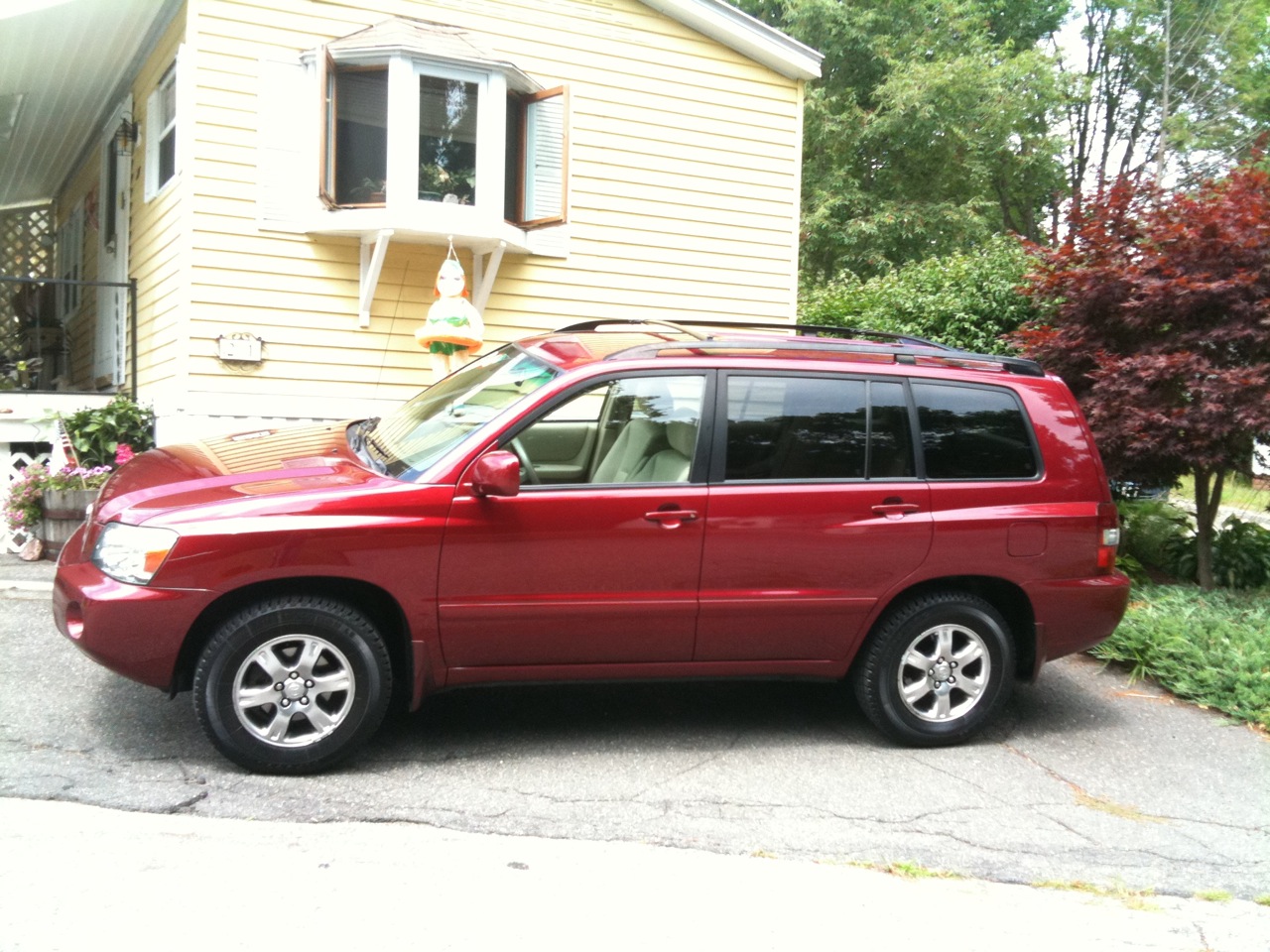
My car, Henrietta, is a Toyota truck:


… but it’s built on a Camry base:

This means it has a much more forgiving frame than trucks and truck-mounted SUVs (though it can still tow 5,000 pounds!) and it handles the road very gracefully.

I’ve learned through many years of athletics that gel provides the cushioning my body likes best. So that was the next thing to go on:

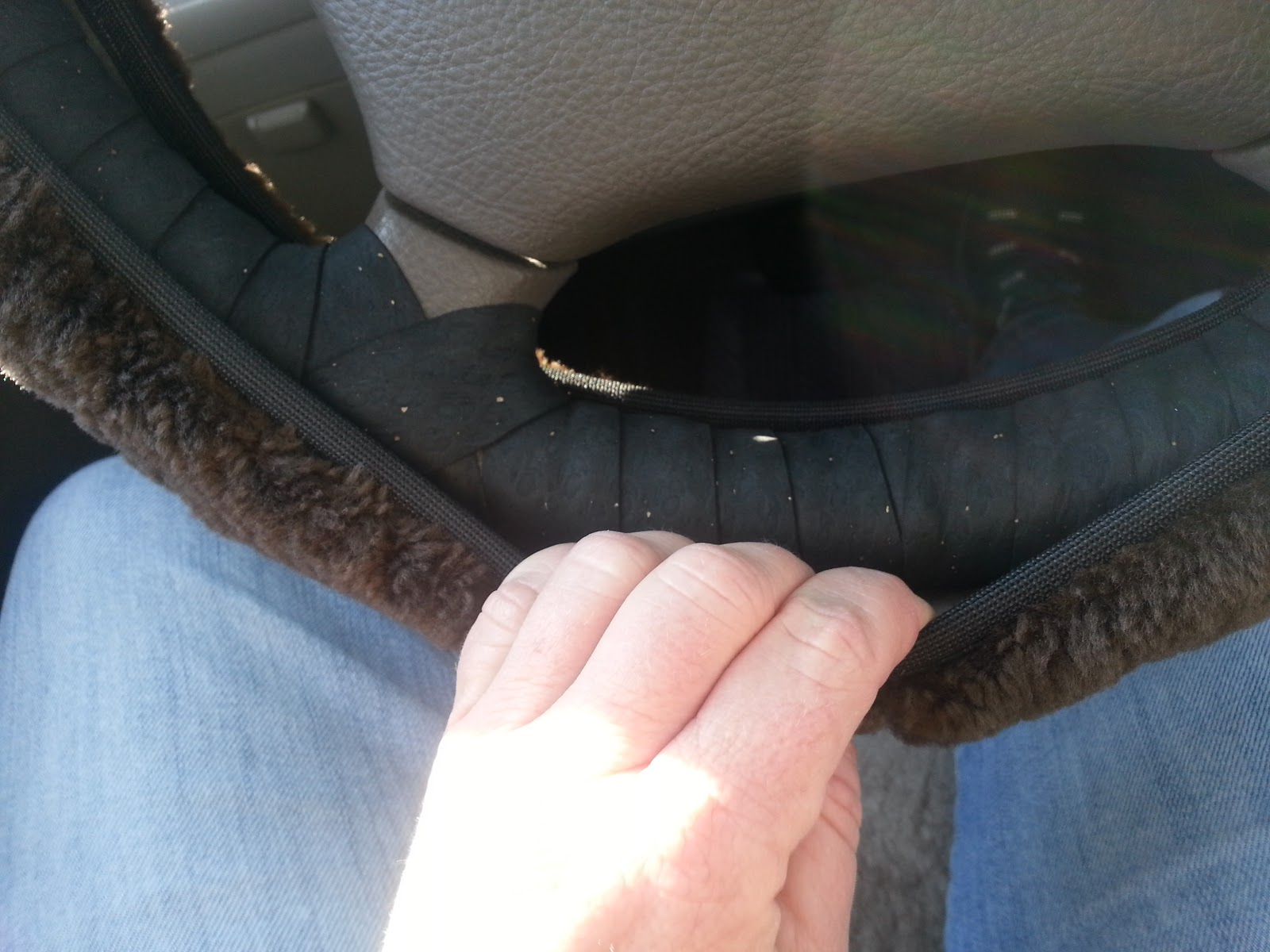
That’s extra-thick gel-padded bicycle wrap on the steering wheel.

(And, incidentally, that’s the driving grip I use half the time. Holding the cover, rather than the wheel, nearly eliminates vibration altogether, and it’s very easy to grab the wheel if I need to dodge.)

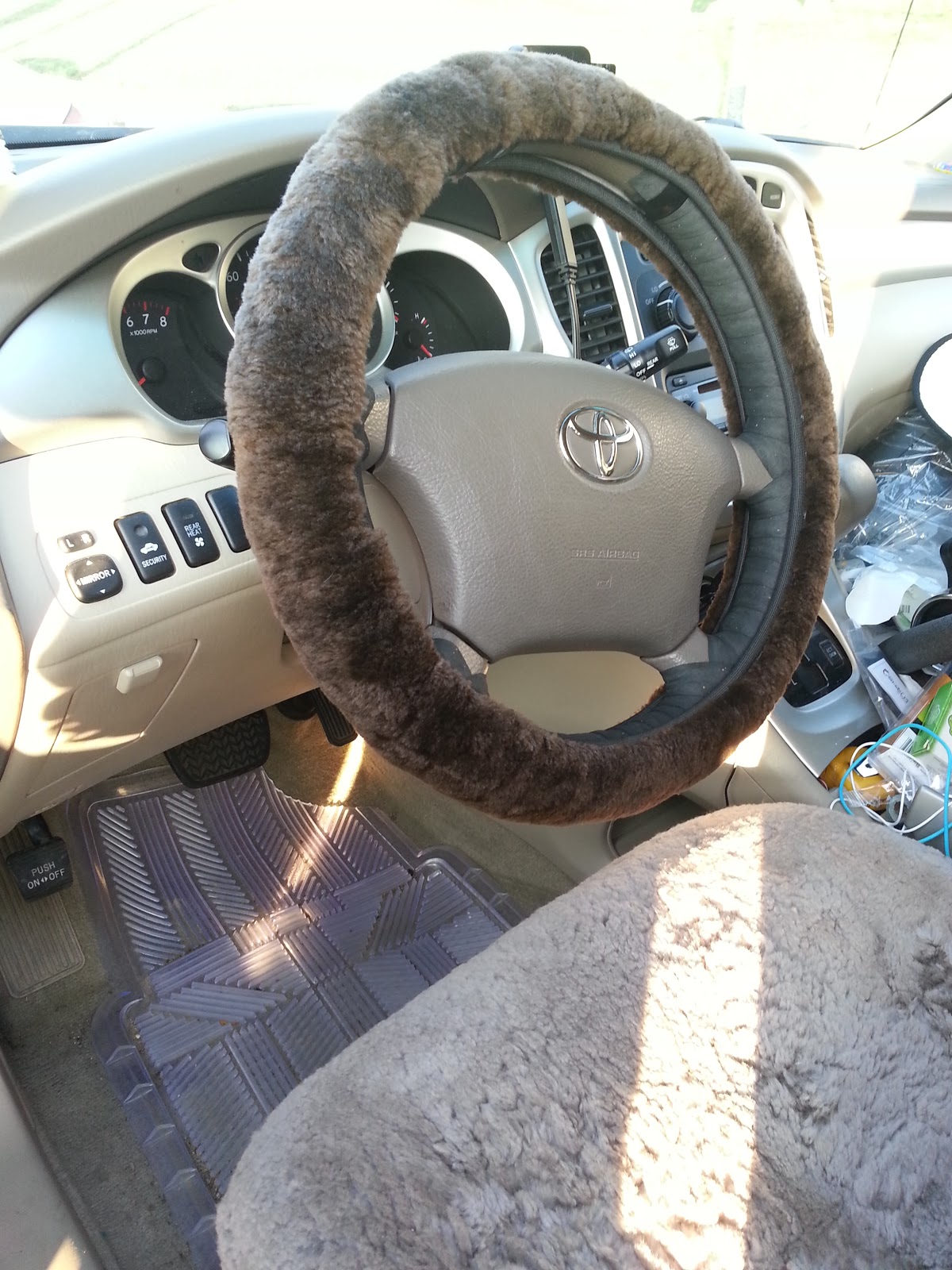
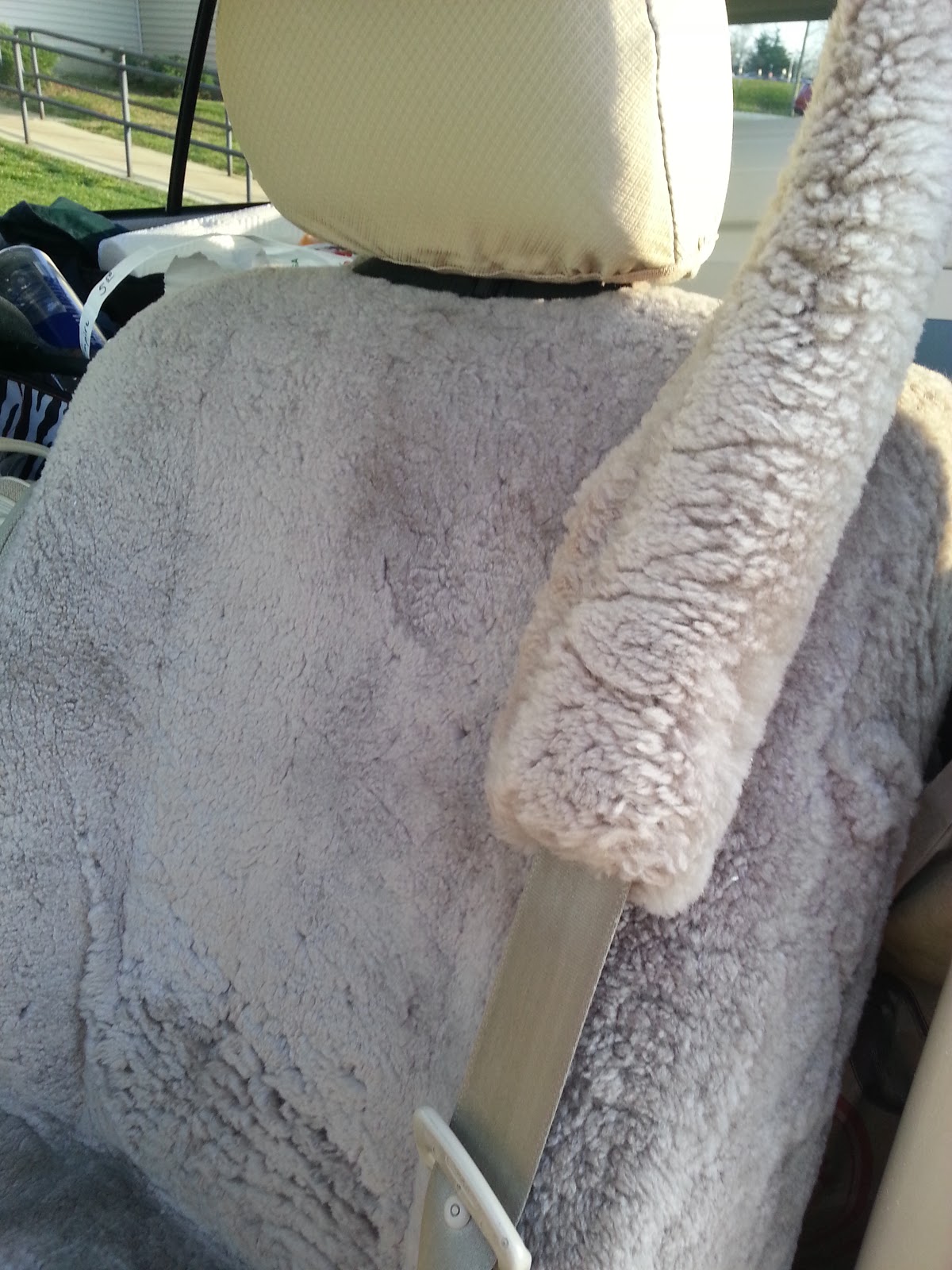
Years of nursing and my own experiences with increasingly, um… responsive skin have made me a HUGE fan of good wool. It breathes even when wet, pads even when squashed, and if you keep your eyes open, you can find wholesale prices on new sheepskin (– and get sturdy sweaters of cashmere, merino, or alpaca for $5-10 at the right Goodwill stores, but that’s another post.)

In Massachussetts, I live near the Sheepskin Outpost on the Mohawk Trail, and I lucked into a sale there. That got me:

– The steering wheel cover, to provide more padding and keep my hands off hot rubber;

– The seatbelt cover, to keep the edge of the belt off me and keep the skin on my shoulder and chest aired;

– The seat covers, which I wound up getting for half of wholesale, because they’d just bought the stock of a company that went out of business and had more inventory than they could afford to store.


Boy, did that ever work out for me!

Covering my can

This is about traveling with disability, so here’s some physical reality.

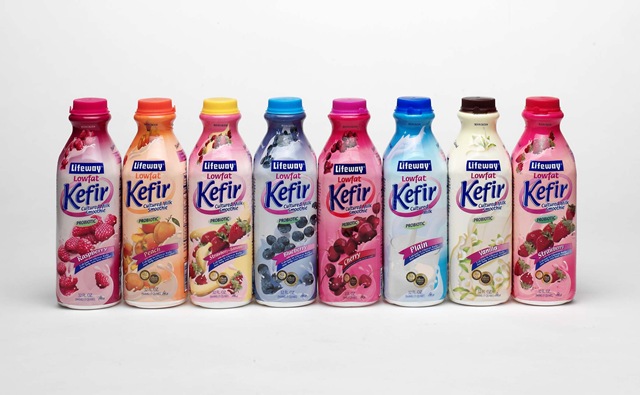
I started megadeath antibiotics a few days ago, and the first symptoms are making themselves felt. Kefir just isn’t enough to save my skin.

My very favorite brand. I’m getting nothing for saying so, but I’d like that to change 🙂

Also, I’ve really been having trouble getting the circulation in my left leg to behave.

Today, in the middle of my day, I had a brainstorm that would minimize the reduction of circulation to my legs and maximize airflow to my antibiotic-ravaged sit-down.

I swapped my underpants for my white silk long-john bottoms instead, and decided I could just wash out the silk each evening and hang-dry it overnight. Besides, the extra layer kept the chill from cutting into my leg every time I opened the door.

Tonight at 6:22 pm, my left leg is feeling better than it did at 2:22 pm, when I made the switch — despite a couple of hours in the car and far too little activity. Who knew such a little bit of material could make such a difference?

And I’m happy and relieved to say that the parts my undies have to cover are doing better, too. I had no idea that white silk was so healthful.

No more elastic around these legs. It’s too bad, because I’d just stocked up on undies. But of course, I got them on sale. It could have been worse.

Gratuitous toilet humor…

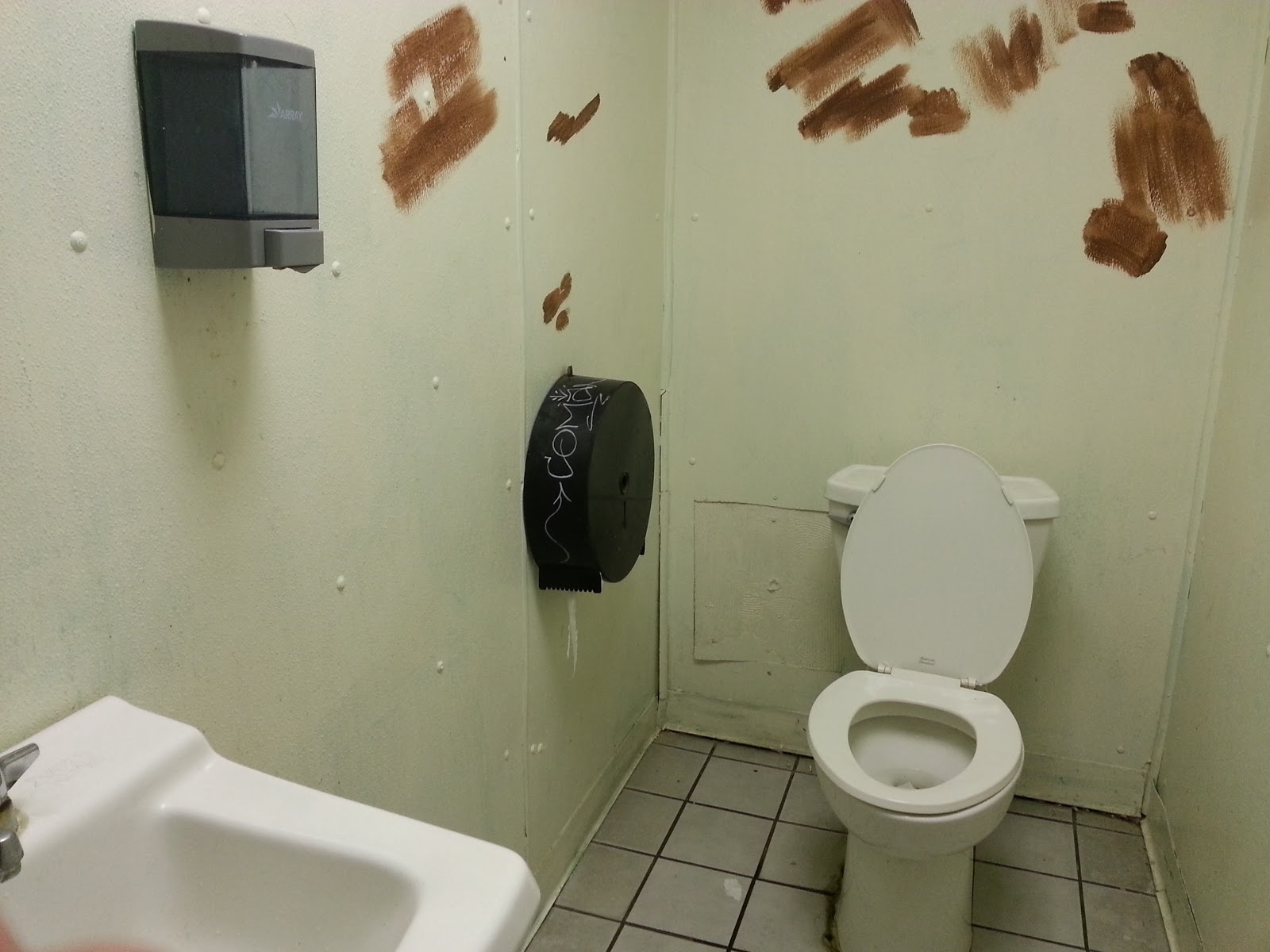
I stopped in a gas station that had the kind of bathroom I grew up thinking of as a gas station bathroom. It’s not chair-accessible (in fact, there’s hardly room for a standing person to turn around in) and the tile might be original with the building.

However, in a totally novel approach to graffiti, this gas station found a new use for the wrongest possible shade of brown paint:

There’s really nothing to add, is there?

Not even anger is wasted

I’ve been struggling with how to make certain changes when my mind and body are so intolerant of change. I’m not naturally intolerant to change — quite the opposite! — but CRPS makes changes cost me a whole lot more.

Selling my home of 6 years, moving twice in one month to different regions under difficult circumstances, starting a relationship (which quickly became long-distance), having a setback with CRPS, and getting a windfall, is a heck of a lot of change in less than two months.

Some of them are good changes (for a change, ha ha) and am I ever grateful for that! But they cause significant shifts in the mind, which causes significant shifts in the body. …With chronic CRPS, there’s simply no practical difference between physical shifts and mental or emotional shifts any more. The domino effect is complete.

I had malabsorption syndrome for a few weeks there, where all my food went whizzing through me and I couldn’t get much nutrition out of it. It has settled down, but I still have considerable endocrine weirdness and I’m gaining too much weight (more than my intake should cause.) This means my feet and knees are under still-heavier attack from CRPS and fibromyalgia.

I find this disturbing enough to be frightening — if my feet get wiped out, there goes my one good form of exercise — until I got reminded of one of those things I used to know, back when philosophy was easy, before this past decade’s descent into Hell: “Fear and sorrow inhibit action… anger generates it. When you learn to make proper use of your anger, you can transmute fear and sorrow to anger, and anger, to action.”

That’s from Millman’s Way of the Peaceful Warrior, a book I couldn’t read for years because allegory’s contrived tone always put me off. One of the great advantages to getting my butt so severely kicked for so long is that I finally shed a lot of intellectual arrogance; I can now stomach the clumsiness of allegory, if there’s something worth gleaning from it.

That tip alone might be worth the effort. I’ve got plenty of anger, and rightly so. Rather than always managing it out of sight, I can dump my fear in there, where I can use it.

Chosen change is mine. Make way.

Brain fog …and living anyway

I’ve been struggling with chronic brain fog for awhile. I generally wait for a clearer time to blog, but I’m not sure that’s sensible. It’s been ages.

This could go on for quite some time, especially since my figuring out how to fix it is going to involve a better-functioning brain than I’ve been able to bring to bear. Or else a flash of insight. Or a tremendous stroke of luck. Possibly a gift from the great good gods. I’m open to all of that!

The old idea was that it was silly to post unless I could post something I’d be happy to reread, and I can tell when I’m not happy to reread something if it gets changed or deleted. I’ve been changing and deleting  more, indicating a certain amount of wasted effort.

I’m beginning to think it’s silly not to post. This is life with CRPS, after all. It goes on, whether I’m ready for it or not, and frankly, it does involve a certain amount of apparently wasted effort.

Just enough

The feds owe me backpay. It should come to quite a chunk of money. Naturally, some of my friends are spending it for me according to their own wishes and tastes. Bless their hearts.

It’s not here yet, and I have to manage with what I have. I’m grateful for my monthly disability income. It would be nice to have more, but it’s enough for me to live on. Just enough. My  income is more than many have, and I have really simple tastes… but most people can live a whole lot cheaper than I can, because my “basics” are different.

I want to ask my blithe friends to point to something in their cupboards — something to eat. Anything.

  • Pasta? For me, that’s 3 days of poor vision, no memory, no thought, of being so disoriented I’m unable to drive, let alone get to the end of a sentence. Corn and rice aren’t quite as bad, but they still cost my body too much.
  • Beans? Depends on the bean, but it usually means sluggish bowels, insulin resistance, worse nerve pain (because the endocrine misbehavior triggers inflammatory responses), and disproportionate weight gain. Every extra pound I weigh is a tax on my feet and legs, where the pain and swelling are already about all I can cope with. 
  • Cannned goods?  Neurotoxic preservatives that set my thoughts rattling, interfere with sleep, make me feel like someone took a baseball bat to my head. 
  • Soda? Oh boy, let’s talk about soda. The phosphoric acid alone will send my peripheral and central nervous systems into spasms, and the caffeine throws my fight-or-flight response a curve-ball. Don’t even get me started on the corn syrup. Corn fractions are bad, but high fructose corn syrup is a straight descent into neurogenic Hell.

I have to put expensive berries and piles of organic greens in my cart.

  • If I don’t eat them several times absolutely every day, my brain starts to shut down. 
  • If I eat too much of the herbicides and pesticides used in conventional produce, it’s a quick descent into autonomic Hell, with weeks of constant PMS, radiant gin blossoms, and blood pressure that won’t settle down. 
  • I choose the high-end cheddar over the store brand. Want to know what they use to keep the store brand “fresh”? I need to let my bowels continue working, thank you… But aged cheeses provide precursors for the neurotransmitters used in memory and decision-making; when I’m having trouble thinking, sometimes all I need is a bit of good cheese and a couple of hours to absorb it.

I spend hundreds of dollars each month on supplements, herbs and homeopathic preparations, carefully tuned at every purchase to make sure I’m getting the best possible effect for my money. Collectively, they let

  • my mitochondria cope, 
  • my nerves fire, 
  • my brain work, 
  • my body repair itself — reasonably successfully, most of the time. 

I constantly double-check and experiment to make sure I’m not wasting my money, that every one of them makes a real difference. They are not optional, and there is no slack in the system.

I can’t live like a normal person. If I try, I’m dead. It’s not drama, it’s just a fact.

I don’t choose to live like this because I can afford it. I live this way, and do without other things. I think of those who live in houses or flats with multiple rooms, petting the companion animals they can afford to feed, with their feet on a coffee table or rug, drinking out of their own mugs. And the poor things don’t realize how good they’ve got it, but eye my windfall askance and look for something more to be dissatisfied with. It’s human nature. I’ve done the same, back when I could afford to.

Everything I own right now fits into a messenger bag and a carryon; that’s it. There are three boxes and a dive bag stored with a friend somewhere. I know I’ll see the friend again (to the extent one can be sure of anything), but heaven only knows whether I’ll see the stuff, because stuff tends to leave me by freaks of chance. In the end, if it’s not important enough to keep with me, how badly do I really need it?

I’ve learned to be relaxed about possessions. Having the US Postal Service lose thousands of dollars of art, books and paraphernalia at a formative moment in life, can have that effect. All I need is enough to wear, plus the laptop and e-reader. Other things (pots, knives, movies) are useful, but I find them hard to hold onto; they keep slipping away, one way or another.

I know exactly what I’m going to do with that backpay. Every penny will be used. Not spent, not frittered, not idly indulged with. Nothing will be wasted. It should be just enough.

There is still no excess or slack in the system. But as long as there is just enough, I can make it work.

Look on the bright side

I’m losing weight rather quickly. Clinically, this is unfortunate, and I’m not crazy about the bags of skin.

However, it lightens the load on my feet and makes transit-sized seating less harrowing.

For getting about, there’s really nothing more shiny than a narrow heiny.

And now, an automatic word from our communication device…

iPhone. Because, when you can press only 1 button, there is no substitute.

Pride of pwnership

I transferred my prescription to a new pharmacy today. When I was asked about existing conditions, I said, “CRPS – Complex Regional Pain Syndrome – and fibromyalgia.” My tone, I realized, was firm and proud.
At first, that freaked me out. Proud? To have CRPS? Just how far have I come to identify myself with this disease? 
It bothered me, but not as much as it should have. I put it on a back burner to mull for a bit.
I did some paperwork and watched a movie: Mulan, and I don’t think that’s irrelevant.
I realized that it’s not having CRPS and fibromyalgia that I’m proud of. It’s having CRPS and fibromyalgia, and still being alive – still hugely engaged – still moving to a new place, still sorting out my paperwork, still finding a new adventure, and still organizing that adventure even as it unfolds. 
I identify with whatever it took to develop the nerve, courage, and modicum of grace that got me this far. I identify with what it took to discover those who kept me alive, and made that life worth living. I identify with having gotten to the point where the things that I think about, much of the time, have nothing to do with pain, frailty, and other losses. I have this ridiculously awful disease, but that’s not where my life is. 
I have CRPS, but the verb “to have” has a number of meanings: to possess, to be in relationship to, to be required, to have a duty or need, and so on. If you’ve ever done any translation, you know what a headache the verb “to have” can be. 
In this case, it might just mean that I own the disease, in the way that hackers mean when they spell “own” with a P: pwn. To pwn something (a device, troublesome software, the CIA mainframe) is to figure out how to dominate it, because you know exactly how to make it play ball — whether that’s legal, approved, or otherwise. 
As it happens, that’s pretty much what I intend to do with CRPS.
I’m okay with being proud about that.

Tern to the present

This is the third major purge of my possessions in 7 years. 

The first time, I decided that anything that I was keeping for sentimental value had to trigger only good feelings; I’d keep nothing that made me unhappy.

The second time, I moved onto the boat, so everything had to have at least two uses.

Now, I’m eliminating everything that isn’t easy to handle, as well as being useful and pleasing.

That meme is extending into the realm of perception. Images and events that used to trigger emotional cascades, because of memories and associations, are finally losing their sickening zap. Associations fall away, and images and events stand out  in simple splendor as just what they are: unlayered, transient, colorful, done.

For instance, I used to hate terns, because their cry sounds exactly like a drowning cat. I blame their awful caw for my not being aware that my cat was in jeopardy when he died. For a couple years now, I’ve gotten snarly at tern-time, when they come here to breed. But, with this shift in my perspective, a tern is just a tern. My excellent companion was still an excellent companion — and, obviously, a kindred spirit.

A tern is not about the past or the future. It’s here now. It’s just that, at this moment, one is floating past with its strange sharp wings twinkling; then it hovers and wiggles for a moment; twists, plunges, spears the water; bobs up again, looking smug, with a little fish in its mouth; takes off and disappears.

Usually, there is no fish. But right now, there goes a pleased tern, enjoying the moment.

It’s just a tern, and it’s doing tern things in a ternish kind of way. Tomorrow it will do tern stuff in a slightly different, but still ternish way. Doesn’t matter. It’s just a tern — nothing more nor less.

There is no furry friend dying alone.

There is just a bird.

Gorgeous photo: Geert Wilders at http://www.freerepublic.com/focus/f-chat/2426290/posts

And I want credit for resisting the obvious urge to make a crack about taking a tern for the worse.

Oops…

Anyway.

I stumbled across a quote that seemed shiningly appropriate:

“To live here and now, you must train yourself: in the seen there will be just the seen, in the heard just the heard, in the sensed just the sensed, in the thought just the thought. That is the end of  sorrow.” – Gautama Buddha

I don’t know about the end of sorrow, but it’s true that it is far easier to manage my moods, notice my body’s signals, and do what I need to do, when I keep things in this charmingly simple, deceptively rigorous perspective.

It’s rigorous because it goes against all my socialization about the importance of hair-trigger reactions and emotional responses: Am I an ice-queen? Don’t I care about things? Aren’t I human? What’s wrong with me?

I’ve gotten all of those remarks in my time, when I strove for calm in former years — especially from mere acquaintances and random strangers, which always shocked me. How I, and those around me, survived my 13th-23rd years is unimaginable at this distance of time and self-certainty, but falling into the reactivity trap was one good way not to get verbally assaulted.

One advantage of being plumply middle-aged is that, for one thing, people watch you less; for another, a degree of equanimity seems to be less … annoying.


Exqueeze me?!?

I’ve had it up to here with emotional reactions. CRPS is a roller coaster par excellence, for emotional reactions. I’m quite done, thank you, and I’d like to get off now.

Actually, I think I just did.

And now, a tern is just a tern. For better … or worse.

Getting it right

H’mm… Struggling with the recurring message from the world around me that I can’t do this, I can’t cure this case of cold chronic CRPS. It’s twinned with the message that, whatever I’m doing, it’s wrong.

I’m not interested in whining, because, as my CRPS cohorts know, this nonsense is par for the course… but every now and then, it’s good to step back and do a reality check.Let’s take a good look at this thinking:

  • On the conventional medicine side, I walked into a new doctor’s office with my tabulated timeline of years of a complex case, pictures showing the evolution of the disease in this body, and documentation about what works and what doesn’t. The response: “You spend way too much time thinking about this!”

Don’t waste time trying to find any upside to that remark. It surprised me especially because most of my docs (the best in the biz) loved my documentation. Now I know that the really good doctors love it, and the ones who don’t love it are either one-trick ponies or second-rate. This one was a one-trick pony, and once he’d done his job, I was gone.

Let’s back up and pretend this guy asked,

  • “Wow, that’s a boatload of well-crafted, thoughtful documentation. Why did you go to so much apparent effort?”

I’d say, “I was a nurse so the concepts are easy, and I was a tech writer so the structure is even easier. This is a cakewalk for me. If I CAN’T document what’s going on, check for a pulse!

“Moreover,” I’d go on, assuming the doctor cared about my well-being, “tracking this stuff frees up my attention by letting me plonk it down in black & white and then put it out of my head. That leaves the rest of my time free for meditating, friends, bathing, housework, and so on.

“Besides,” I’d add, if the doctor looked like one who could take a joke, “most docs find this case hopelessly confusing, and I don’t need you wasting my time by asking the same questions 3 times and still getting it all wrong in the end, just like the one other doc who refused to look at this!” Ha ha.

Clinical note: Seriously, physicians, that’s how to handle an expert patient: Ask, then listen. Saves time.

  • The alt-health folks are liable to tell me, first, that I’m sick because I think the wrong thoughts; then, if they ask about my mental habits, it’s obviously because I eat toxic foods; if they want to get straightened out about that, “it’s clear, dear, that you’re too attached to this disease” and there’s nothing anyone can do to help. (Direct quote.)

My fellow CRPSers are thinking exactly the same things as me right now.

Besides the sheer cruelty of that response, the fact is that spontaneous total remission from CRPS after the first 3 years is even rarer than spontaneous remission in cancer or AIDS. I’ve heard of it happening once as late as 7 years; I’ve had it for roughly 10; average survival is 30 years after onset. If any of you has more optimistic data, I’d love to see it!

Here are some things I’ve learned about how what you think and what you do REALLY affect the course of your CRPS:

  • Those who stick exclusively with the conventional model and submit to their doctors without question, especially when they have noxious drug reactions (as I do), tend to suffer much and die young.
    That’s what happens when you’re a passive patient with a disease that few doctors understand.
  • Those who become well-informed and educate their doctors, have better results and do considerably better for much longer.
    That’s what happens when you open your eyes and take initiative regarding a very rare and complex disease.
  • Those who research and implement changes to diet and lifestyle most vigorously, have the best results from their care and use a lot less medication with much better results, higher function, and lower disability.
    That’s what happens when you shoulder real responsibility for what you do and how it affects your life.
  • Those who are active in the online communities, seeking support and providing support to others and sharing information, tend to beat the odds.
    That’s what happens when you constructively engage with your community.

I’m looking for something I’m not doing yet. I will figure it out, hunt it down and I will do it.

CRPS is an incredibly hard disease, in every conceivable way. Where there is any spontaneous remission at all, there is something to work with. I just haven’t figured out what yet.

Since I still have CRPS, I find those recurring messages a little intimidating. I  don’t yet have hard data to throw back against the key message.

I can see that, when others say I’m doing things wrong, the statements tend to be presumptuous and ill-informed — but the fact is, I still haven’t cured my own case of CRPS …YET.