Blessing by the seat of her pantaloons

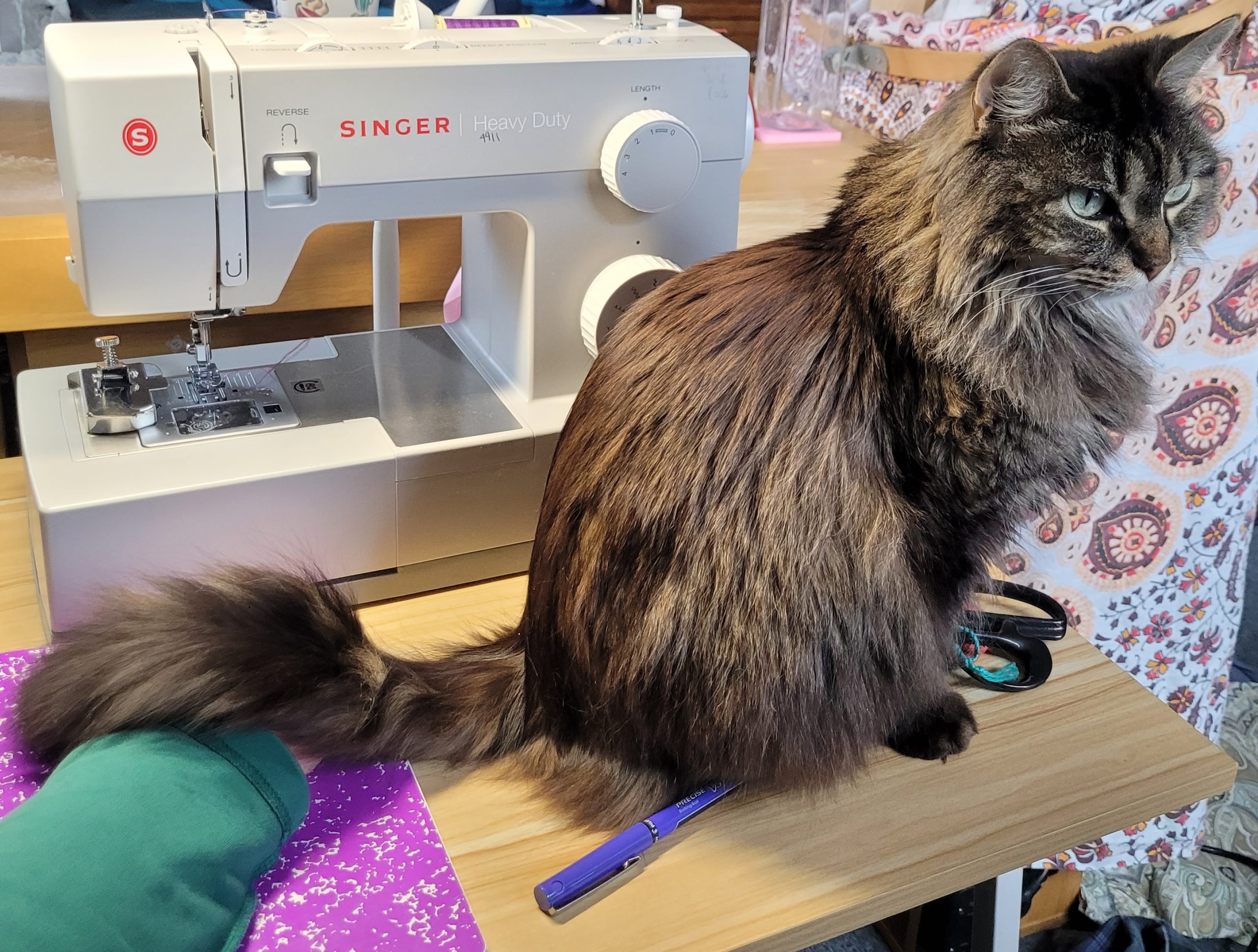
My cat blesses things by sitting on them. She thinks that’s perfectly appropriate, and doesn’t seem to care if there are other feelings on the subject.

She generates a fair bit of brain juice for me. That said, normally, having my center of attention occluded by a messy floof with gemlike eyes has not been high on my list of useful experiences.

Today, for a change, I worked around it. As soon as I really needed her out of the way, she moved off my notes and let me turn the page.

She must be feeling merciful.

Now she’s draping her tail over my notebook. I think this is the equivalent of a benediction.

I think cats are here to teach us to communicate. She has been communicating blessings & benedictions all this time, and I thought she was just getting in the way.

Like a missionistic preacher, she doesn’t always realize that her blessings and benedictions might be poorly timed, or even unwelcome.

She’s working on her timing. There is no power in heaven or earth that can persuade her she’s ever unwelcome.

I’m OK with that.

Super quickie: Wrecury must be in Gatorade

In the past 7 weeks, Facebook has security’d me out of my account and I’ve got 1 more final thing to try before giving up on it; my phone has been having the fantods about web surfing, and requires restarting every couple of days just to clear out whatever is jamming up the data signal; and it turns out that this very web-site has missing or broken widgets (like the subscribe button) and I’d have to go further into WP care & feeding than I dare to. I’m normally fearless about tech stuff, but there is soooo much work stored here I don’t know how to un-clench enough to do the maintenance. I’ll figure it out, or work out who to ask.

I’m partly laughing at myself and whining just a little, while explaining why it’s not exactly feature-rich at the moment!

Quickie: Snorgie sick

OMG I have a head cold. WTH???

My last few illnesses have been of the “when do I go to the ER” sort.

This is just… snorgies. Not fun, but so trivial in the scheme of things.

So far. No promises, ofc.

I’m teaching my lovely housemate how to make my snorgie tea, which will have to do until I can stand up safely long enough to breathe steam — the sure-fire way to wipe out a snorge (sinus issue) in my family.

Snorgie tea, for me at least, is roughly this:

  • 1/3 cup/80 ml dried nettle herb (fabulous antihistamine & source of useful minerals)
  • 1/8 teaspoon/~.6 ml powdered ginger (clears things)
  • 1/8 teaspoon/~.6 ml ground clove (intense antioxidant)
  • 1/4 teaspoon/~1.2 ml cinnamon (sweetener)
  • 1/4 teaspoon/~1.2 ml ground pink peppercorns (supports everything else & I like the Asian zing of it; substitute black pepper if you want to & can)

I put it in my reusable linen teabag (you can use whatever you want, or use nothing & let it steep until everything settles). Pour freshly-boiled water over it, letting the bulk of the nettle & seed/bark-ness of everything else handle the heat.

That makes ~24 oz/700 ml, more or less, depending on how you like your herbal brews.

I add local honey because passive immunity works for me, and our local honey is delicious.

There are many lovely anti-snorge teas around. Many come pre-made! Whatever you use, may it be pleasant and helpful.

Communication: How showers can suck

We get a lot of disbelief from normos who can’t imagine why we don’t spend more time in the shower. This is what you show them, to reduce the explanation time and shorten the period of disbelief. We have really good reasons, a whole variety of them. (Mom, this explains why I always look for a bathtub to use instead, but you can  give it a miss.)

I’ve talked over The Shower Issue with many people.

Keep in mind that I remember when showers felt wholesome and refreshing. I know what people mean when they say, “Have a Nice Shower — you’ll feel better.”

I have to make Nice Shower a proper noun to distinguish it from other showers. Nice Shower abandoned me long ago. We hardly ever meet each other now… maybe once a year or so.

They’re still dead wrong. I don’t get Nice Showers, though I sometimes get bearable ones.

Some people find each moment of preparation, ambulation, ablution, and drying off to be exhausting beyond belief. Taking a shower consumes most of the day.

Some people have ferocious blood-pooling and dysautonomia from their reaction to standing upright while being covered in water that’s running down — like their battery. Bloodpooling feels awful, and the stubborn dizziness can be nauseating.

Some people can’t articulate why it’s so awful because the English language is not good at describing unpleasant states or experiences. If it’s not bleeding, breaking, crushing, or falling, our language runs out.

For me, it’s several things, and it varies widely from time to time. Here are some of the options in play for me…

Every drop running down me might as well have a hook in its head and be pulling the life-force from me. That’s a real drag when it happens. Literally, ha ha.

The tactile experience of being jabbed, tapped, and scraped by a thousand little nails or pins (different sized shower sprays just mean different sized nasty objects) is, frankly, appalling. 0/10 do not recommend.

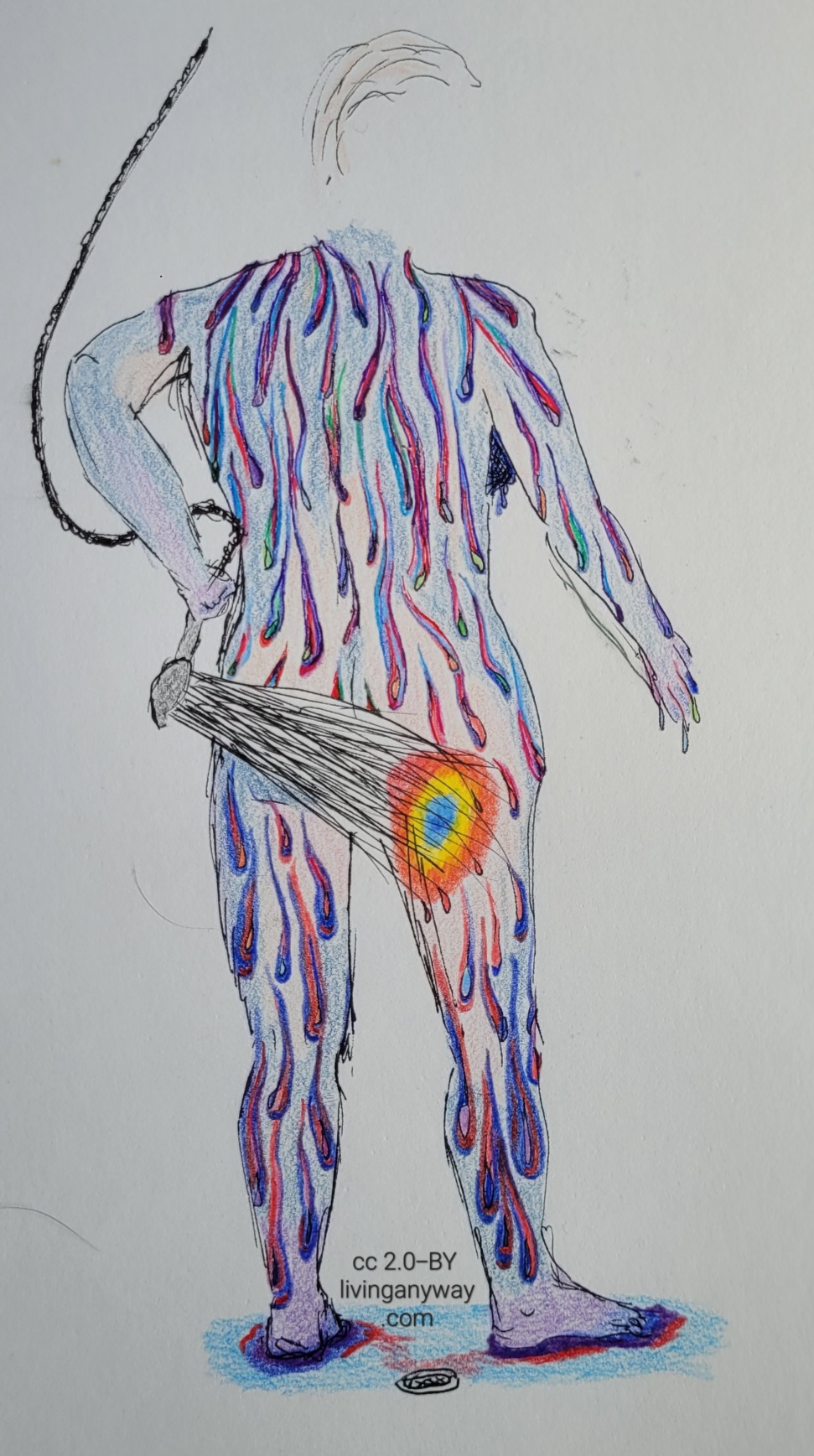
And then there’s the temperature issue. In me, CRPS hot-wires my perception of temperature on my skin far beyond what’s reasonable, including my perception of temperature changes. The micro-changes, on days like today, are no fun at all. Imagine something feeling like a stream of hot coals when it first lands, then like a band of ice next to it, repeating that pattern — until the next droplet. The water in the basin, regardless of its actual temperature, feels freezing, with a runnel of boiling-hot swirling through it. I came up with an image for it, which even shows the nicer temperatures, though not how quickly it all changes again.

It’s a bit oversimplified, scaled for Web-based use, but it gives an idea of what the temp-two-step is like:

Too bad it doesn’t actually show. That’d be awesome!

Anyway… when people say that showers are horrible, it’s fine to just believe them, even when your own experience is quite different.

Quickie: Managing expectations?

Today, I learned (or re-learned) how much louder clothing speaks than my expression or manner.

I went out in my “hippie” disguise — a change from my usual “preppie on her way to a parent-teacher conference” disguise.

I like turtlenecks in winter. Anyway.

Today, in my shaggy green sweater with the red-and-purple geometric designs, people are *smiling back* and giving me extra time when my fingers don’t work.

I love my neat, clean, long-lasting basic wardrobe. (A bit boring, but well-kempt, smart, and will stick around forever. Kind of like my ideal partner.) However, I feel Indian cotton and flowy accessories in my future. I need to be responded to, more than I need to be respected — and possibly slightly annoying…

Quickies, x5: How the doctor-patient situation is supposed to work

Chronic specialist care

Once upon a time, I asked my hot-shot pain specialist (I’ve had some real rock-stars) for something heavy-duty and intense (I forget what).

He told me that he wanted to stick with using current meds a little differently and upgrading my self-management skills, because I had a lot of years left and he wanted to keep something in reserve for when things got worse.

This doctor really understood long-term palliative care — palliative care meaning, you’re not expected to recover, so treatment means managing symptoms for as long as possible.

That’s not about dying comfortably, most of the time. It’s about living anyway. Being sick is not the end of life. It’s just a heck of a detour.

He was apologetic and sympathetic, hoping I wasn’t too dismayed and disappointed. I was delighted to realize this physician firmly intended for me to have a long and active life, and was asking me to step up to the plate to help to make it so. I don’t think he realized that, in that moment.

I said to my specialist, “My job is to figure out how to get through my days as gracefully as possible. Your job is to hold the long view for me, and figure out how to manage my care over time so I can get through the years as gracefully as possible.”

He looked at me in perfect stillness for a long moment. For someone who likes talking as much as he does (for good reason; interesting talker), that was weighty.

He asked, “Would you please come to my severe-pain support group and say that?”

Sadly, I really couldn’t drive safely that late and knew I couldn’t get a ride for it. (This was pre-pandemic, so, no remote possibilities.)

It’s possible that he was as frustrated and disappointed that I couldn’t come and say this to his patients as he had expected me to be about the medication. So, Dr. Saberski, this one’s for you!

Emergency visits

The purpose of the Emergency Department (or A&E/Casualty, for the other English-speaking countries) is to figure out if anything is going to kill or disable you in the next 24-48 hours. It’s a very specific remit.

Flare-ups of chronic conditions can creep into that remit, severe pain being very disabling in itself.

However, another condition of mine, gastroparesis, is not a great candidate. The heavy-duty pain meds in the ER are mostly narcotics, which rarely work for intestinal pain and, more importantly, make the intestinal paralysis worse. The anti-vomiting meds may not be better than what your doctor prescribes, although they may be different and worth trying for that reason alone.

ER nurses used to have an effective line in moving stubborn bowels. It seems this is no longer the case. It’s often considered a specialist task, not that specialists do it either. If in doubt, look up “soap-suds enema” and follow the instructions carefully. Stay near a toilet for the next 6 hours as your guts remember their job.

It’s vital to know that dehydration can be deadly or disabling, and the ER is exactly the place to go for treating that. So, if you can’t keep even sips of water down for a day or two, for any reason, and you’ve got the sunken eyes and play-dough skin (pull up a little fold on the back of your hand, and it stays there), the ER is the place to go.

Bodies can’t recover without water. Water really is life.

If your condition requires specialist knowledge to treat, but probably won’t kill you or further disable you in the next 24-48 hours, the ER can be bitterly frustrating, because thats not their brief and it feels unfair to ask them for it when they don’t have the training or funding.

However, it’s perfectly okay to phone them up and ask the triage nurse what to do. I’m an old triage nurse and I loved it when people were “on it” enough to call and ask. If they didn’t need to come in, I could tell them what to do and what to report if things changed. If they needed to come in, I knew they would do as well as possible and I could get them sorted and into appropriate care faster and with a rare smile on my face.

Being deliberately involved in your care is that powerful a message to send to your system. We can’t consciously control our systems, except in nudging things here & there, after specific training. We can deliver primal shoves with our basic approach, with how deliberate and mindful we are about our care.

Urgent care

Urgent Care is where you go if you’re pretty sure you aren’t going to die or be (further) disabled, but you do need same-day care.

Keep in mind that these providers do not have specialist training, but might be able to make a call to your specialist or be willing to discuss what you want from them. I said “might” — it depends on factors beyond your, or even their, control.

In the US, they usually can’t make referrals — except to the ER, if they find that you need further scans or a higher level of care.

It’s not fair to them to expect specialist care. That said, it’s not fair to you to have an inaccessible specialist. Lousy situation.

Primary (general) care

This person is supposed to be the ring-master who holds the ends of all the threads of your care. They’re supposed to take over your prescriptions (unless they’re actively in the “figuring out what works” stage) or you’ve got a specialist who wants to stay absolutely on top of things.

This is the person you usually call for coughs and colds, annual checkups, questions about whether you might need another specialist or different care, and when you want to talk over health care concerns, including confusion with how the system works.

They’ve still only got 5-10 minutes with you, but it’s time well spent if you’re confused or overwhelmed. As ever, note your issues and questions before going in, to make the best use of your time together.

One of the uses of those “talking” visits is for a medication review, one of the best uses of time there can be for us. See the Pharmacist section for more.

Pharmacist

These are the medication bosses. Their depth of knowledge of medications, interactions, side-effects, and alternatives is absolutely daunting. They’re the wizards of meds.

If you’re having symptoms that might be side-effects, this is who you ask about it. If you’re unsure about a new med or dont know what to expect, this is who you ask about it. If you’ve got genetic variants that might affect medication metabolism, this is who you ask about it.

Medication review

If you’re concerned at how many meds you take, talk to your pharmacist first. Then, with the notes from that conversation in hand, talk to your doctors.

This is called a “medication review” and everyone can do it annually, or more often if things are changing for you.

Pharmacists can’t prescribe, because the depth of knowledge about various bodies in sickness and health is the reason why physicians spend even longer in training than anyone else. Most of medical care is beyond medication. It’s why nutrition and self-care matter so much.

The body is its own unique thing and needs its inhabitant to be involved for best results.

In short

Medicine is really, seriously deep and complex. Each of these segments of the health care system is necessary, and none can substitute for the others.

It’s an imperfect system. It should be much better, but, heaven forfend, that might cut into enormous corporate profit margins. Patients, doctors, pharmacists, and every actual helping human has to work within the restraints of enormous corporate profit margins.

Hope this helps clear a few things up!

Quickies: The deliverance of deliberate delight

We grew up thinking happiness, joy, delight, etc., was spontaneous. It arose naturally from circumstances. If you had to go looking for it, or even put in the effort to crack open a door for it, it lost legitimacy. It wasn’t real.

Thank goodness that’s incorrect.

We know now that seeking the little joys has a cumulative effect that makes us stronger and more resilient. I’ve written about this before here 1 and here 2 (plus, it’s mentioned pretty often in passing), but it feels like time to mention it again.

There’s a social push, in some areas, to do like they do in zombie shows and batten down with All The Weapons and prepare to destroy all comers, because they will surely want to destroy you.

If that’s your jam, go ahead.

Social data and history shows that kindly communities generally weather hard times better. Everyone has different skills, and that only works well when skills are pooled in a varied group.

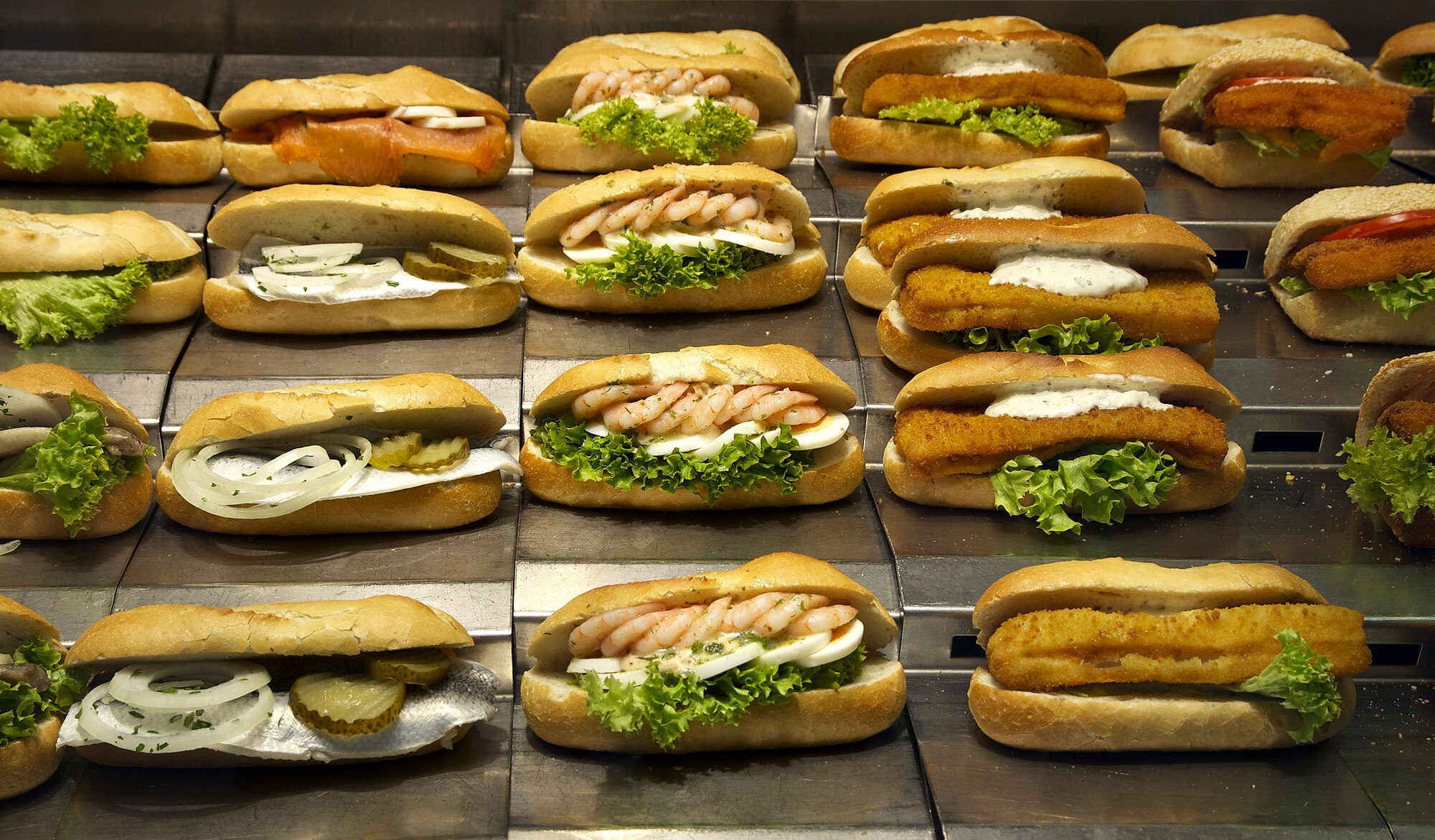
It’s like making sandwiches…

If everyone has peanut butter, you don’t have sandwiches, you have an impending plumbing problem once everyone has eaten it. That’s like everyone having the same set of skills or preferences — it’s just not going to work out well under stress.

If someone has peanut butter, someone else has white bread, another has whole wheat bread, another has slices of chicken, somebody shows up with pickles and mayo, another has lettuce and tuna, and an absolute star shows up with jelly and gluten-free options, then everyone gets a delicious sandwich.

Pooling resources is fun! And that’s how you get through hard times. Use your strengths and work with those who can do what you can’t. *

Scared of the zombies? One skill-set an amazing number of people around you have relates to tactics, strategy, combat, and martial arts. The US has been actively involved, as a major force, in wars around the world at least since the late 1980s, with only brief breaks before then. We’ve got lots of veterans, and they can build things, wire things, program things, bandage things, and cook, too. You’d be surprised.

Wait… How did we get here? I meant to write about how finding little beauties, stopping to soak up little joys, noticing and remembering what you like so you can go back to it — these all trigger “brain juice” in the form of neurotransmitters that help us regulate our minds and get closer to peace, poise, and sanity.

All of which is super handy when you’re picking teams to survive the zombie apocalypse. 🤣✨️

* Hot tip:

Disabled people tend to be overlooked. That’s absurd. Nobody is better at thinking around problems than disabled people, and we tend to have incredibly useful skills… because “disabled” is a misnomer. Most of us are highly able — we just have specific barriers, which we know all about. We can seek complementary skills and specify our necessary adaptations.

Come get us. You’ll be glad you did. A tiny bit of upfront effort, and then your whole project grows wings.