Morning exercise, redux

Flashback

Up until I got the injuries that precipitated CRPS, I used to run about 3.8 miles (about 6.1 km) up and down a redwood canyon most mornings. It was a highlight of the day: watching the light stain the tops of those glorious trees, waking the birds as it went, until the whole forest was filled with the noise of thousands of adorable featherbrains screaming their fool heads off, and the spiraling redwoods were soaked in molten gold.

I sprained my ankles a few times, leaving them with permanent puffy-pads. One time it was a bad sprain (I was pretty sure it was broken, given the huge swelling and rapid bruising) and I had to crawl and hop the last mile-and-a-bit, but I got there in the end because I’m just that kind of bonehead. I drove my stick-shift to the ER because, after all, the foot was still attached and all I had to do was push a little.

…Bonehead. (With, admittedly, an unusually high pain tolerance.)

Got poison oak a few times, until I went back to using poison-oak honey in my tea for the passive immunity.

I was kind of a sucker for a challenge, and I liked figuring things out.

I also liked the boards they had laid across a sandy furlong of the path to keep the sand from getting ploughed too far by the horses. The boards were just tall enough to make me hop them, and I liked pretending I was a horse trotting through a series of in-and-outs as I popped over them one after the other.

Great way to start the day.

And then what happened?

The repetitive stress injuries of long hours with keyboard and mouse, led to a series of wrist surgeries and complications in a couple of years. The CRPS diagnosis took longer.

What with all the roots and stones and the sun being in my eyes for the latter part of the run, I did stumble a lot. Having to catch myself went from being a diversion, to a nuisance, and rather suddenly to a terrifying possibility with crippling results. I dared not land on my wrists, because that could be the end of my career and my ability to support myself.

After recovering from surgery, cardiovascular exercise just caused too much swelling and inflammation — for years. I found that counterintuitive, which means illogical and, for me, extremely frustrating.

Fast forward 24 years

And now, it’s now. The ongoing heat wave (and flash floods) are making my usual afternoon walks impossible. My body refuses to stay vertical when the temp is a stunningly humid 84 degrees F (28.8 C). This body-system and wet-bulb temps just don’t get along.

Meanwhile, my thyroid supplement is starting to take hold. This means that, while I’m not up to normal energy by a long way, I crave exercise like a junkie with healthy tastes.

The only time I can be outside is before 8 am.

It usually takes me until then just to get out of bed, because of dysautonomia.

It’s hard to describe the sensation of challenging your dysautonomia, but if you turn on a powerful electric milk-frother and throw that down your stomach, while putting your head inside a vice and trying to breathe through a sodden sock, as flesh-eating termites devour your limbs… well, you still won’t know what it feels like, but you’ll at least be in the right ballpark.

I have an agreement with my body where it will let me get up early for Really Important Things, like fasting lab draws and airplane trips; I just have to pay for it the rest of the day.

I decided that it’s time to move exercise back into that category and hope it adapts appropriately. This is going to be rough, but the skills I’ve learned might make it work.

The skills

First thing is, No Surprises. I think about getting up and out early, as I’m getting ready for bed the night before. I think about the early hush and the freshness of morning air. I wonder what birds I’ll hear. I look forward to it sincerely.

Next thing is, Lower Barriers & Eliminate Excuses. Water is at my bedside and clothes & shoes get picked out the night before. I don’t want to have to think about doing it, I just want to grease the slide out the door.

Third thing is, Wake And Ground Deliberately. Once my eyes are willing to open, I drink at least half my pint of water and then organize my spine (a series of moves and physical therapy stretches that make my spine feel properly engaged), and then get all the way inside my skin (tapping down the top of my left arm, up the bottom of the left arm, down my side and front, down the front of my left leg, grab my foot until I can really feel it top and bottom, tap up the back of my leg, over my kiester and up my back and side; then, do exactly the same thing on my right side; then, tap up my neck — tapping on alternate sides — and use my fingertips over my face; rub through my scalp to get all the scalp muscles awake and ready to encase my skull today; and nice big sigh to turn over the air in my lungs.)

It sounds rough for CRPS, but I’ve been doing this for a long time and my brain knows what to expect. That’s important.

It also works to apply pain cream instead of tapping. It’s fine to skip over bits that don’t let you touch them. It’s fine to use a very soft touch, or stroke with something soft like a bit of plushy fabric or a feather.

It’s about input for the skin that helps the brain remember and rehearse where your body is in space. This is an important tool for pushing back on CRPS. It literally recaptures parts of your brain that have been turned into pain-sensation, and makes them remember how to do body-sensation instead. Worth pursuing and persisting with.

After this, I check in and, if body says it’s willing to try, I swing my feet onto the floor. I finish my water there, sitting on my bed.

I Check In as I Sit Up, nicely hydrated and with no surprises. If all is well, I get up and check in with my legs. If they’re OK holding me up and flexing, then I climb into clothes and shoes, and head out for my walk.

I planned my walk the night before (“no surprises” really helps the autonomic system to cope!) so there’s nothing to figure out as I grab my phone and keys and head out.

I adjust the distance I’ll go depending on how I feel when Im out. Today, I got wildly nauseous when I was about at half my intended distance. Vomiting tears open my saggital seam, that tough band that forms the middle crease in a 6-pack. (I vomit very hard.) So, I sat down and smoothed down the texture of my thoughts until the nausea passed.

Then I did some t’ai chi and qi gong, focusing on moves that stabilize the autonomic nervous system and ending with a “microcosmic orbit” series I always enjoy. (Let me know if you’d like video of any of that.)

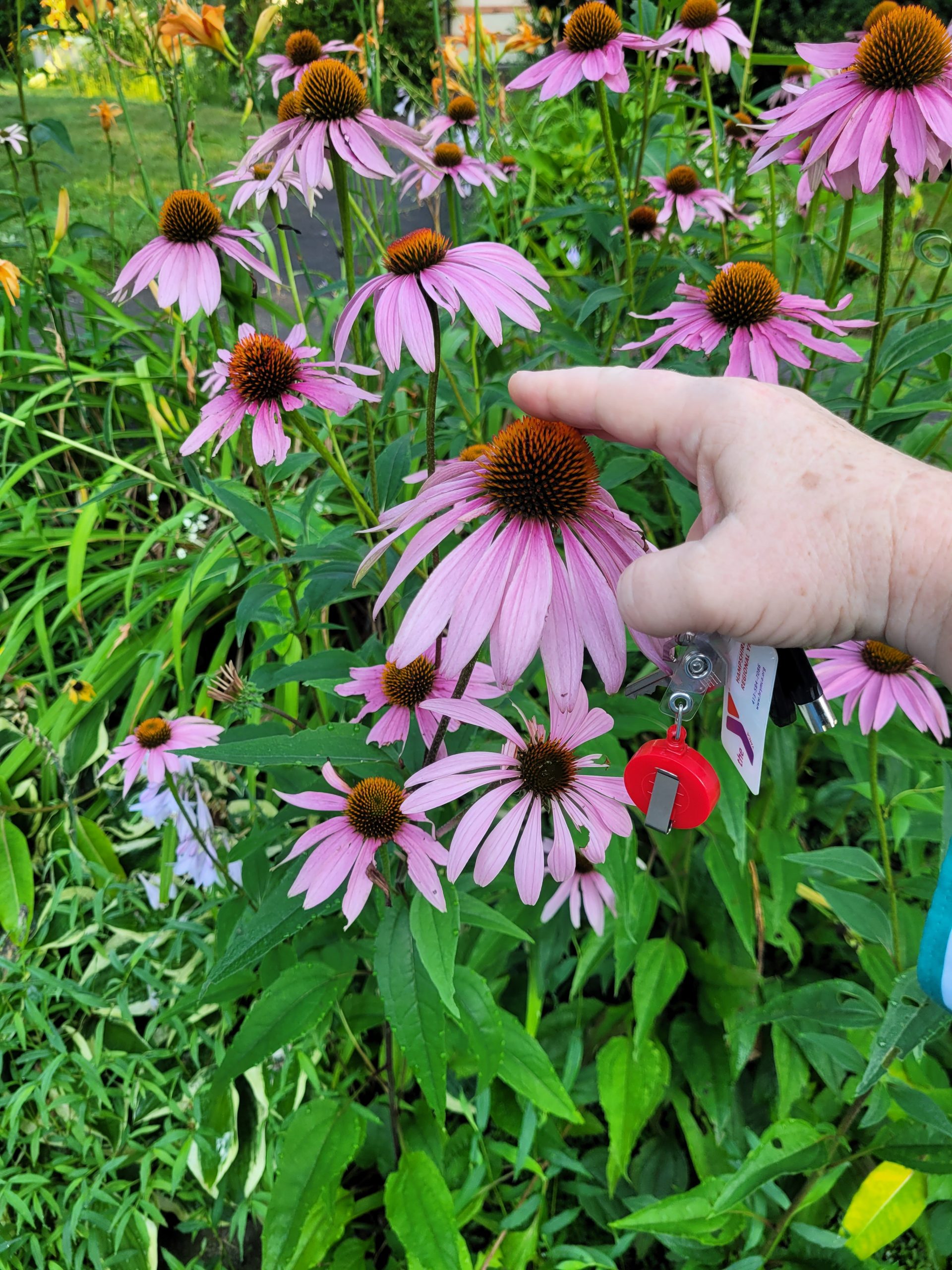
Once my internal system was going better, I bowed out and returned, snapping pretty pictures on the way.
Summary & Conclusions

I’ve gone about the same distance both days, though yesterday’s walk took less time — I didn’t have to sit down. Today’s walk was more up & down. I think I’ll stay on level ground the rest of this week and see how that goes.

I’m now fighting the urge to go to sleep. I fell asleep at 8:30 am yesterday, after getting in from my walk, and slept until 1:30 pm. Waste of a day, IMHO.

Maintaining a diurnal cycle (regular sleep/wake and eating times) is very important for taking care of yourself with dysautonomia. So, now that my thyroid is not completely in the toilet, I’m going back to fighting to keep hold of the day. I want some life back.

To be perfectly frank, I’ve spent most of the last 9 or 10 months just waiting for each day to pass in the hope that another day will be better, and if not, at least I’ll be closer to the right treatment.

Enough is enough.

It’s hard work, but so is life: I’m starting to take back my days. That starts with regular activity, because nothing re-regulates a dysregulated system like regular activity.

And I do love the morning!
My job as a complex chronic patient

My first nursing job was on an HIV unit in 1991. We were in the 2nd wave of the med mixes, so there were some treatment options. We knew which precautions were necessary, and when.

Those precautions had been newly dubbed, “universal precautions”. HIV was the last global pandemic that had a powerful effect on ordinary patient care, legislation, daily activities, travel, everything. The lessons we learned were rolled so thoroughly into our lives that we no longer think about it.

Anecdote from the front lines..

At that time, it was all rather new. Old nurses were afraid to go near any patients on our unit. We had about 80% novice nurses, an unheard-of proportion on a specialty ward in a nationally-ranked hospital in a major city! We had to pay attention, and we had to learn fast.

Because we weren’t abandoned enough already…

Our rather young nursing preceptor had bone cancer in her knee. She went in for surgery as soon as the last of us (me + 1 other) got signed off on training.

But wait, there’s more: as soon as she came out of surgery, she wrote a message insisting they pull the plug on the machines and let her die. Husband supported that, in tears.

Considering how close to hysterical she’d gotten 3 days earlier, when I tried to dig in my heels and tell her I was not ready to practice autonomously and might need more training after her op; and how strenuously this woman — who’d done little but put me down for weeks and express frustration at how slow I was — now insisted I was ready, really ready; and considering how improbable that post-op scenario is, in so many ways… I think she had planned it well in advance. Most expensive euthanasia ever.

Her 2nd-to-last words to me were: “Change your socks. They should be white. Bright colors are not professionally appropriate.” And gave me a fierce look. She came back for a nice goodbye, telling us we were all “good nurses” despite our occasional touches of color (a laugh and a nudge for the main transgressors, me & a fabulous fellow), before she turned and left the unit for the last time.

She’d been working on me about the sock thing for weeks. Slouchy cotton socks in gem-bright colors were still fashionable; drove her crazy.

She was the only one who hated them. The patients, the other nurses, and my immediate supervisor thought my gaudy ankles were delightful. I was referred to as “the one with the socks” and everyone knew. (I also introduced the fanny pack to nursing life. Nobody had heard of it before I showed up with a white, wipe-clean, bleachable one. You’re welcome.)

It’s possible that I got a packet of white socks, as a gesture of respect to that tough young woman… which quickly got grubby-looking, as white socks always do on me, and thus were eliminated from my wardrobe as not being professionally appropriate.

… That was largely irrelevant, but I’ve stopped suppressing my storytelling urge. There are just too many; they leak.

Back to the job of being a complex chronic patient.

It’s surprisingly logical — it just takes a long time to figure it out. I hope this will shorten that course for whoever reads this! There are 3 key principles to follow, and 3 sets of jobs, one for each kind of person involved in each case.

Three key principles

My patients on that ward taught me a lot about how to navigate hard, complex, intransigent illness. There are 3 key principles:

  1. Grandma was right” kinds of things: fresh air, activity, nutrition, sincere friends, learning all you can — they make a huge difference.
  2. Find the light, or life, in the cracks. Doing #1 makes that a lot easier.
  3. Communicate with others in the way they need to be communicated with.

That can be a tricky one, but I’ve got a lot of material on it. Some of it is here on this blog. And one day I’m going to complete and organize that collection of communication tools. (Any day now…)

Three different sets of jobs

It’s important to remember that you can’t do everything. I learned that (and keep re-learning it) the hard way.

There are specific realms of responsibilities which the important people in this situation have:

  • My job.
  • Significant other’s job.
  • Provider’s job.

They’re perfectly straightforward.

My (the patient’s) job

A note on terminology: some object to the word “patient” as dehumanizing. I’ll let you mull over what it means to think of someone who needs care as less than human. I don’t.

I’m sticking with the word “patient” here, because it describes a person who has specific, unavoidable experiences with alterations in their bodies, care providers, and whatever health-care system they have access to.

Complex chronic patients have a depth and breadth of experience with these things that most people simply can’t imagine — and nor should they. We wouldn’t wish this on anyone.

So, as a patient, my job boils down to this…

Take care of myself; take care of my responsibilities; take care of my relationships. All this includes having fun and seizing little joys!

  • Manage my illness. This includes: meds, nutrition, activity, learning about the disease and how to manage it, self-care (whatever that turns out to include, but it always includes pacing: alternating activity and rest.)
  • Track important signs, symptoms, and changes, and document them meaningfully.
  • Share this info with providers and significant others when it makes sense to.
  • Find useful ways to communicate with significant others & care providers about changing needs and abilities.
  • Make all my appointments on time, every time.
  • Contact my Dr for anything I need their support with: changes, meds, treatments, info.
  • Get through the days one at a time. (Thinking of the whole span of my existence is not my job. One day at a time is plenty.)
  • Find life in the cracks: notice the little beauties, regularly do something I enjoy, stop and smell the flowers.
  • Make time for fun and happiness. It makes me so much stronger!
  • Be good to my loved ones, whatever that means and within my limits.
  • Know that I’m the subject matter expert on my body, and hold myself responsible for managing it accordingly.

Significant other’s job

shows images suggesting love, friendship, and work

These two principles can be used by people at work, at home, on the playground, wherever. Very simply, “believe me” and “avoid making this harder, whenever possible”.

Believe me

Nobody — trust me, nobody — can make this stuff up, and there are far too many expensively-educated people working on this for it to be imaginary.

  • If you can’t believe it, then try pretending you do for awhile, just to test the concept, and see how that works.
  • Learn about the disease. There’s good info out there and I, or my doctor, can help you find it.
  • If you’re really important to me, come to an office visit with me and ask the doctor your own questions.

Avoid making this harder

Communicate with me about changing levels of activity and needs. I hate to keep saying how broken I am, so let’s come up with a code to pinpoint the different levels of broken that I could be.

Then, I don’t have to talk about how close I am to puking or crying or passing out, you can know anyway, and we can get on with things appropriately.

That’s what I really want — to be as productive as possible for all the time that I can; to be as good a partner/employee/friend/family member as I can.

Provider’s job

Another note on terminology: I’m old enough to remember when physicians, who were relieved that good schools for PAs, NPs, and APNs were starting to flourish, advocated for the term “provider” as a collective noun, encompassing themselves and the advanced-practice professionals who potentiated their work and multiplied their efforts.

That worm has turned, and now it’s not so popular with physicians.

Please allow this old nurse to use the term with all the respect it originally included, in memory of the brilliant and capable physicians who taught me to use it as the inclusive term of choice.

The provider’s job (as of course you know) is threefold: keeping the larger view, providing appropriate care (of course), and providing info and guidance.

This is sometimes easier said than done, because every time I see you is a rough day. You hold more than the power of life or death over me — you hold the power of tolerability or pure Hell. Thus, it’s natural for me to be a little fragile, possibly overwhelmed, in our conversations.

I do my best to be prepared and “keep it together”. I want to make the best use of our time.

Due to the additional insults of pain and CNS dysfunction, I can be subtly or even grossly impaired when I most need to be responsive, intelligent, and clear.

Given all this, please know that your kindness makes a great difference in my life.

Here is what I hope for, from my providers:

  • Consider context. Notice where I fall in the statistical ranges and how might this affect my care; help me distinguish between reasonable vs. unreasonable efforts, as well as watchable vs. reportable signs/symptoms; steer me through that intersection created by my medical & physiological peculiarities in one axis, and the statistical probabilities generated by reams of studies and years of clinical practice on the axis which crosses it.
  • Prescribe appropriate tests, ancillary care (physical therapy, occupational therapy, speech therapy, and so on), and medications.
  • Respond sensibly and kindly to concerns about meds, therapies, and changes in my illness. (Fragile egg here.)
  • Let me know what I really need to know about my condition, meds, or treatment, before I leave the room (virtual or 3-D), so I neither ignore something important nor over-study and confuse myself. My responsibility to learn benefits from yours to inform me. Also, it helps me to know the right keywords.
  • Be the subject matter expert on the scientific and clinical knowledge-base for the illness I see you for, and be willing to figure out relevant context that my other conditions create.

See this article about just how fabulous an experience it is to have a physician who does all that. It’s such a relief and such a joy. Thank you from the bottom of my vital signs for doing what you do.

All 3 working together = best possible situation

When complex chronic patients can monitor and communicate effectively, prioritizing our care while keeping life in center stage most of the time; when our loved ones can coordinate around our limits, allowing us to be at our best, considering; and when doctors apply their staggering breadth of knowledge to our particular situations with attention; we have a fabulous chance of doing as well as possible.

I like doing as well as possible. I have a lot to give and I want to be able to give it — that said, my care comes first, last, and always; it’s the only way!

Thanks to significant help and support, good friends and loving family, and some real rock-stars on my medical team, I’m well set right now. I’m almost afraid to admit it, because I don’t want to rock the boat…

And here we are

There you have it: the 3 key principles and the 3 main jobs of living/working with complex chronic illness.

I know they are that fundamental, because I’ve had a few providers almost plead with me to come and participate in their patient support groups, specifically so I could talk about it with other patients.

Well, here we are, sharing this information all over the world! Send this article wherever you see fit. I’d love to know what your support groups think about it.

Patients, caregivers, loved ones of complex chronic patients, doctors, P.A.s, A.P.N.s and N.P.s… feel free to comment. This is about all of us, after all.