Quickies: How the doctor-patient situation is supposed to work

Chronic specialist care

Once upon a time, I asked my hot-shot pain specialist (I’ve had some real rock-stars) for something heavy-duty and intense (I forget what).

He told me that he wanted to stick with using current meds a little differently and upgrading my self-management skills, because I had a lot of years left and he wanted to keep something in reserve for when things got worse.

This doctor really understood long-term palliative care — palliative care meaning, you’re not expected to recover, so treatment means managing symptoms for as long as possible.

That’s not about dying comfortably, most of the time. It’s about living anyway. Being sick is not the end of life. It’s just a heck of a detour.

He was apologetic and sympathetic, hoping I wasn’t too dismayed and disappointed. I was delighted to realize this physician firmly intended for me to have a long and active life, and was asking me to step up to the plate to help to make it so. I don’t think he realized that, in that moment.

I said to my specialist, “My job is to figure out how to get through my days as gracefully as possible. Your job is to hold the long view for me, and figure out how to manage my care over time so I can get through the years as gracefully as possible.”

He looked at me in perfect stillness for a long moment. For someone who likes talking as much as he does (for good reason; interesting talker), that was weighty.

He asked, “Would you please come to my severe-pain support group and say that?”

Sadly, I really couldn’t drive safely that late and knew I couldn’t get a ride for it. (This was pre-pandemic, so, no remote possibilities.)

It’s possible that he was as frustrated and disappointed that I couldn’t come and say this to his patients as he had expected me to be about the medication. So, Dr. Saberski, this one’s for you!

Emergency visits

The purpose of the Emergency Department (or A&E/Casualty, for the other English-speaking countries) is to figure out if anything is going to kill or disable you in the next 24-48 hours. It’s a very specific remit.

Flare-ups of chronic conditions can creep into that remit, severe pain being very disabling in itself.

However, another condition of mine, gastroparesis, is not a great candidate. The heavy-duty pain meds in the ER are mostly narcotics, which rarely work for intestinal pain and, more importantly, make the intestinal paralysis worse. The anti-vomiting meds may not be better than what your doctor prescribes, although they may be different and worth trying for that reason alone.

ER nurses used to have an effective line in moving stubborn bowels. It seems this is no longer the case. It’s often considered a specialist task, not that specialists do it either. If in doubt, look up “soap-suds enema” and follow the instructions carefully. Stay near a toilet for the next 6 hours as your guts remember their job.

It’s vital to know that dehydration can be deadly or disabling, and the ER is exactly the place to go for treating that. So, if you can’t keep even sips of water down for a day or two, for any reason, and you’ve got the sunken eyes and play-dough skin (pull up a little fold on the back of your hand, and it stays there), the ER is the place to go.

Bodies can’t recover without water. Water really is life.

If your condition requires specialist knowledge to treat, but probably won’t kill you or further disable you in the next 24-48 hours, the ER can be bitterly frustrating, because thats not their brief and it feels unfair to ask them for it when they don’t have the training or funding.

However, it’s perfectly okay to phone them up and ask the triage nurse what to do. I’m an old triage nurse and I loved it when people were “on it” enough to call and ask. If they didn’t need to come in, I could tell them what to do and what to report if things changed. If they needed to come in, I knew they would do as well as possible and I could get them sorted and into appropriate care faster and with a rare smile on my face.

Being deliberately involved in your care is that powerful a message to send to your system. We can’t consciously control our systems, except in nudging things here & there, after specific training. We can deliver primal shoves with our basic approach, with how deliberate and mindful we are about our care.

Urgent care

Urgent Care is where you go if you’re pretty sure you aren’t going to die or be (further) disabled, but you do need same-day care.

Keep in mind that these providers do not have specialist training, but might be able to make a call to your specialist or be willing to discuss what you want from them. I said “might” — it depends on factors beyond your, or even their, control.

In the US, they usually can’t make referrals — except to the ER, if they find that you need further scans or a higher level of care.

It’s not fair to them to expect specialist care. That said, it’s not fair to you to have an inaccessible specialist. Lousy situation.

Primary (general) care

This person is supposed to be the ring-master who holds the ends of all the threads of your care. They’re supposed to take over your prescriptions (unless they’re actively in the “figuring out what works” stage) or you’ve got a specialist who wants to stay absolutely on top of things.

This is the person you usually call for coughs and colds, annual checkups, questions about whether you might need another specialist or different care, and when you want to talk over health care concerns, including confusion with how the system works.

They’ve still only got 5-10 minutes with you, but it’s time well spent if you’re confused or overwhelmed. As ever, note your issues and questions before going in, to make the best use of your time together.

One of the uses of those “talking” visits is for a medication review, one of the best uses of time there can be for us. See the Pharmacist section for more.

Pharmacist

These are the medication bosses. Their depth of knowledge of medications, interactions, side-effects, and alternatives is absolutely daunting. They’re the wizards of meds.

If you’re having symptoms that might be side-effects, this is who you ask about it. If you’re unsure about a new med or dont know what to expect, this is who you ask about it. If you’ve got genetic variants that might affect medication metabolism, this is who you ask about it.

Medication review

If you’re concerned at how many meds you take, talk to your pharmacist first. Then, with the notes from that conversation in hand, talk to your doctors.

This is called a “medication review” and everyone can do it annually, or more often if things are changing for you.

Pharmacists can’t prescribe, because the depth of knowledge about various bodies in sickness and health is the reason why physicians spend even longer in training than anyone else. Most of medical care is beyond medication. It’s why nutrition and self-care matter so much.

The body is its own unique thing and needs its inhabitant to be involved for best results.

In short

Medicine is really, seriously deep and complex. Each of these segments of the health care system is necessary, and none can substitute for the others.

It’s an imperfect system. It should be much better, but, heaven forfend, that might cut into enormous corporate profit margins. Patients, doctors, pharmacists, and every actual helping human has to work within the restraints of enormous corporate profit margins.

Hope this helps clear a few things up!

Quickies: The deliverance of deliberate delight

We grew up thinking happiness, joy, delight, etc., was spontaneous. It arose naturally from circumstances. If you had to go looking for it, or even put in the effort to crack open a door for it, it lost legitimacy. It wasn’t real.

Thank goodness that’s incorrect.

We know now that seeking the little joys has a cumulative effect that makes us stronger and more resilient. I’ve written about this before here 1 and here 2 (plus, it’s mentioned pretty often in passing), but it feels like time to mention it again.

There’s a social push, in some areas, to do like they do in zombie shows and batten down with All The Weapons and prepare to destroy all comers, because they will surely want to destroy you.

If that’s your jam, go ahead.

Social data and history shows that kindly communities generally weather hard times better. Everyone has different skills, and that only works well when skills are pooled in a varied group.

It’s like making sandwiches…

If everyone has peanut butter, you don’t have sandwiches, you have an impending plumbing problem once everyone has eaten it. That’s like everyone having the same set of skills or preferences — it’s just not going to work out well under stress.

If someone has peanut butter, someone else has white bread, another has whole wheat bread, another has slices of chicken, somebody shows up with pickles and mayo, another has lettuce and tuna, and an absolute star shows up with jelly and gluten-free options, then everyone gets a delicious sandwich.

Pooling resources is fun! And that’s how you get through hard times. Use your strengths and work with those who can do what you can’t. *

Scared of the zombies? One skill-set an amazing number of people around you have relates to tactics, strategy, combat, and martial arts. The US has been actively involved, as a major force, in wars around the world at least since the late 1980s, with only brief breaks before then. We’ve got lots of veterans, and they can build things, wire things, program things, bandage things, and cook, too. You’d be surprised.

Wait… How did we get here? I meant to write about how finding little beauties, stopping to soak up little joys, noticing and remembering what you like so you can go back to it — these all trigger “brain juice” in the form of neurotransmitters that help us regulate our minds and get closer to peace, poise, and sanity.

All of which is super handy when you’re picking teams to survive the zombie apocalypse. 🤣✨️

* Hot tip:

Disabled people tend to be overlooked. That’s absurd. Nobody is better at thinking around problems than disabled people, and we tend to have incredibly useful skills… because “disabled” is a misnomer. Most of us are highly able — we just have specific barriers, which we know all about. We can seek complementary skills and specify our necessary adaptations.

Come get us. You’ll be glad you did. A tiny bit of upfront effort, and then your whole project grows wings.

Quickies: Stubborn CRPS sores? TCM burn cream

New series: Quickies. Short, practical notes, mostly about things to try for problems with CRPS, dysautonomia, mast cell & histamine disorders, etc.

Problem

I get what my grandmother would have called chilblains: cracks in the calluses around my feet and sometimes on my fingers. Nasty, uncomfortable, and — because they’re surrounded with thick walls — hard to heal.

Option

I’m an old nurse. I know a lot about healing wounds of all kinds. Nothing worked, at all …until I tried Ching Wan Hung, in the copper-colored packaging.

Ching Wan Hung:
Different manufacturers but similar copper packaging

It’s a traditional herbal product with Chinese cinnamon, which smells a whole lot different from the tropical stuff we eat. It also has menthol, which I can’t tolerate normally, but is no problem for me here. I can scarcely smell it, so maybe it’s a dosing or production issue. Most herbal salves bring on menthol like a battering ram.

Usage

I squish it right into the cracks and holes of the sores, rub it in well, then put a dark sock over it for an hour. (It stains light colors.) Then I get on with my nap, or my task, or whatever. I put it on twice a day, before getting out of bed and at bedtime. I should probably use it more often for faster results, but I’m not very good at that.

It doesn’t work for everyone, just as everything else I tried, that did work for other CRPSers, didn’t work for me. It’s another option.

Sourcing

I’ve found it online at the usual places and at my local Asian/ international market, usually in little copper-colored tubes, which is more hygeinic than the larger tub you have to stick fingers into. It’s cheap for what it is, too.

You can ask for “Chinese burn cream” if you can’t remember the name.


Caveats

Use common sense (all my readers are extremely sensible, so of course you will).

If it brings up a rash or makes you wheeze, wash it off well and never use it again. Not for wounds that bleed readily or might be infected. Never use on bites, because mouths are utterly filthy and bite wounds need different care. If you can’t feel the tissues where your chilblains or non-healing sores are, see a doctor about them and follow their advice over mine. And so on.

Disability & commensurate effort

“Why do you do that to yourself?”

Why would I not? That’s the more pointed question.

I remember being lazy. I was fit, well, and always a little dissatisfied. …This might be the human condition.

I loved to work (still do) but I also valued my downtime, time in the wild, beach time, workout time, hang time with friends. Something like work-life balance, I guess. In retrospect it seems lazy, but my perspective is a little distorted. It’s been decades since I had a real vacation from my current work.

Current work situation

My current work is living anyway, in spite of this suite of deficits and dysfunctions. It doesn’t give me time off. It’s frankly a bit tiresome.

Why, yes, that was a supremely wry understatement. Cackle freely!

If I stuck to doing only the things that hurt the least, stress my system the least, and otherwise rock this boat as little as possible, what would happen?

Would I be more comfortable? Actually… no, not beyond the time that rest is necessary and productive.

Would I get any better? Decidedly not. “Use it or lose it” beats in my mind like a metronome when I’m down too long. If I don’t stay active, right up to current limits, my exertional malaise gets worse. (It’s a real thing: exercise tears the body down, where it would build a normal person’s up.)

Survival of the fittest

“Then, let’s be honest here, do you deserve to survive?”

Most (not all) people ask that more subtly, but it’s a question I’ve faced often. Brutal it may be, but it’s natural.

First, let’s check the wording. The phrase “survival of the fittest” was coined by the economic theorist & philospher Herbert Spencer (who clearly didn’t let clarity stand in the way of a good bumper-sticker slogan.)

Darwin later adopted it, possibly assuming that his accompanying thoughts would be kept in mind. Now we have to specify them: strength, speed, intelligence, etc., are all subordinate to being able and willing to adapt to change.

The point he was making all along is that they key to survival is adapting to change. Not being in shape.

Finches aren’t humans

Darwin famously studied tiny birds on tiny islands to arrive at his insights. They had tiny life spans and tiny jobs. For them, fitness was biological: who got to breed and have their offspring get to breed, and so on ad infinitum? Breeding and brooding are simple markers.

Humans have big, tangled societies with big, tangled networks and big, tangled obligations. It’s not just breeding and brooding, although that can be part of it. It’s work, school, friends, parents, neighbors, politics & policy, insurance premiums, mutual aid, prepping for a blizzard or another record-breaking hurricane. This time of epochal shifts in weather, science, and economics creates a relentless roar of things we need to cope with and adapt to, and a life where breeding & brooding cannot ensure survival, because, for many, the money and assurance of a tolerable future just aren’t there any more. Only appropriate adaptation to change can aid survival.

We’re (almost) all forced to manage so much more than the finches ever could conceive of.

Stating the obvious

What group of people is the best at adapting?

Take a minute. I’m not going anywhere.

Who else but your people with handicaps and disabilities.

Watch what they do, how they manage in the face of an intransigent world and variable limits, how they keep going. It looks like an art form, if life itself were art.

Just the cost of doing business

I’m still absorbing an incident ~12 years ago when a chair-riding friend with paraplegia was driving us in his van, and we had to stop and get gas. I unbuckled my seatbelt and was going to go pump. He waved me down. “Nah, I got it.”

He opened the sliding door behind him, flicked his wheelchair out of the minivan and half-open in one complicated motion, levered himself and the chair into conjunction, and went on about the business of pumping gas from his chair. Then he reversed the process (more or less) to get back in.

I told him that was impressive. Didn’t he mind the effort?

He shrugged. “It’s just the cost of doing business.”

I let that sink in.

Everybody has to do tedious things to get to the next thing they want. It’s the cost of doing business, of getting through life.

Everybody’s cost is a bit different.

Everybody should have the right to choose what’s worth the cost.

“Life, liberty, and the pursuit of happiness” was originally written in bloody-handed hypocrisy, but it’s right and wise to make it true.

Challenging yourself can be fun

With all that said, my insistence on pushing my limits — as long as I can generally expect safe air, food, water, shelter, and adequate rest — might make more sense. Or maybe it doesn’t. It’s not likely to change, especially since I decided last year that life was too short to settle for survival — I was going to chase fun, and see where I found it!

Documentation: logs and tracking

Cards on the table: I like to write. Maybe a little too much.

It’s inconvenient to have crapped-out wrists that limit typing severely and a voice just weird enough in accent & vocal fry to make dictation software stare back at me, blinking blankly, instead of capturing the marvelous flow of inspiration…

Yeah. To heck with that. I have to make it simpler.

I have a bunch of self-documentation templates and techniques which I’ve been meaning to write about, because we know how important providing evidence of your own experience can be and because… I like to write.

Sigh.

I’m not trying to make them pretty and I’m certainly not taking the time to make them generic or pare out the details of what I’ve tried and used over the years. I like doing that, but wanting to do that is what has kept from getting this stuff up… for years.

I’m just going to throw them at you instead. You’re all smart enough to take what you like and leave the rest. Have fun!

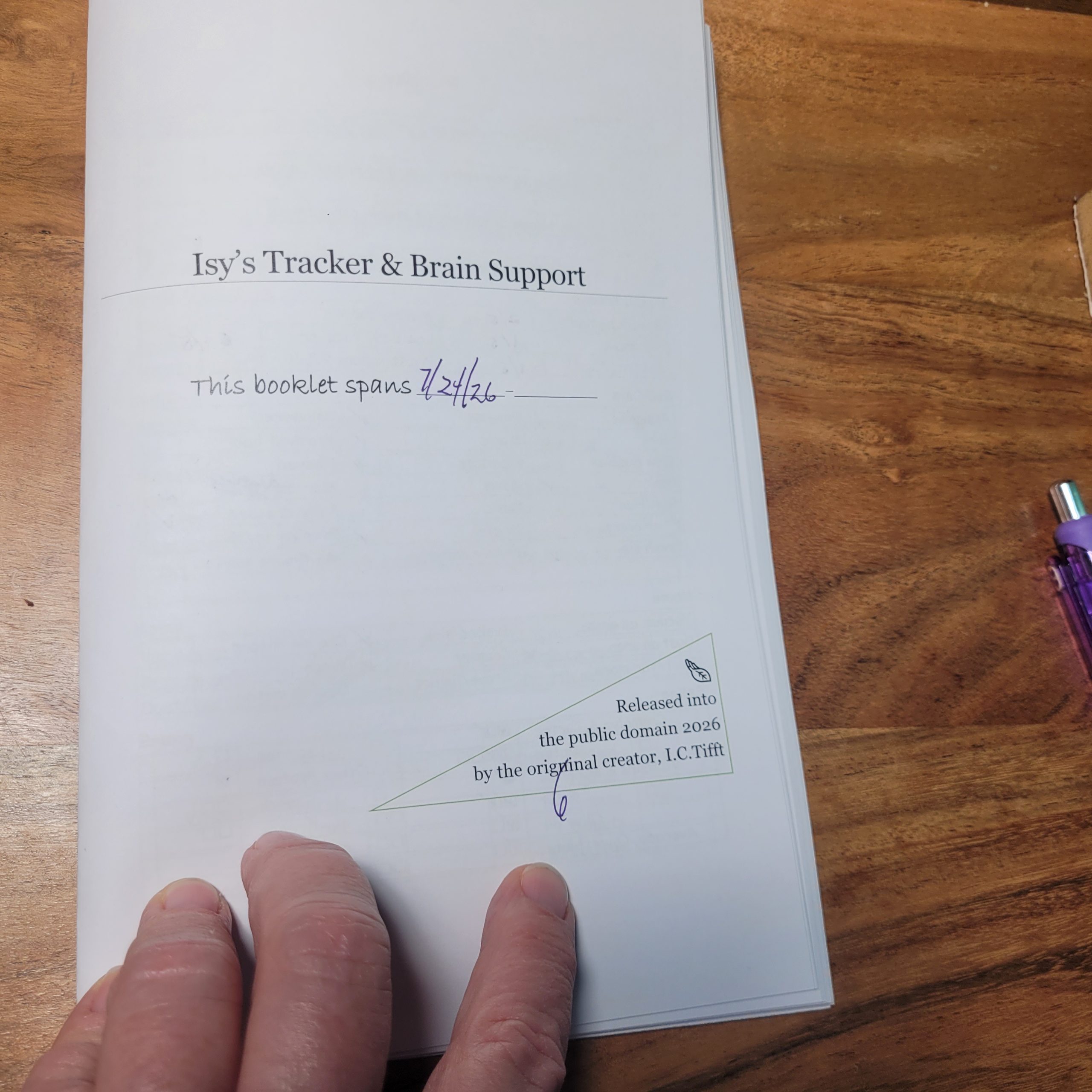
Note: All of my Self-Documentation by LivingAnyway.com is marked CC0 1.0. To view a copy of this mark, visit https://creativecommons.org/publicdomain/zero/1.0/

TL;DR – it’s a formal way of making this work Public Domain. Go wild. It’s yours now.

Pro Tip: There are good health tracker apps now, and one or two are very good. If they work for you, that’s good enough!

If, like me, screens hurt your eyes and tapping hurts your hands, you might want to consider the ol’ pen-and-paper method here.

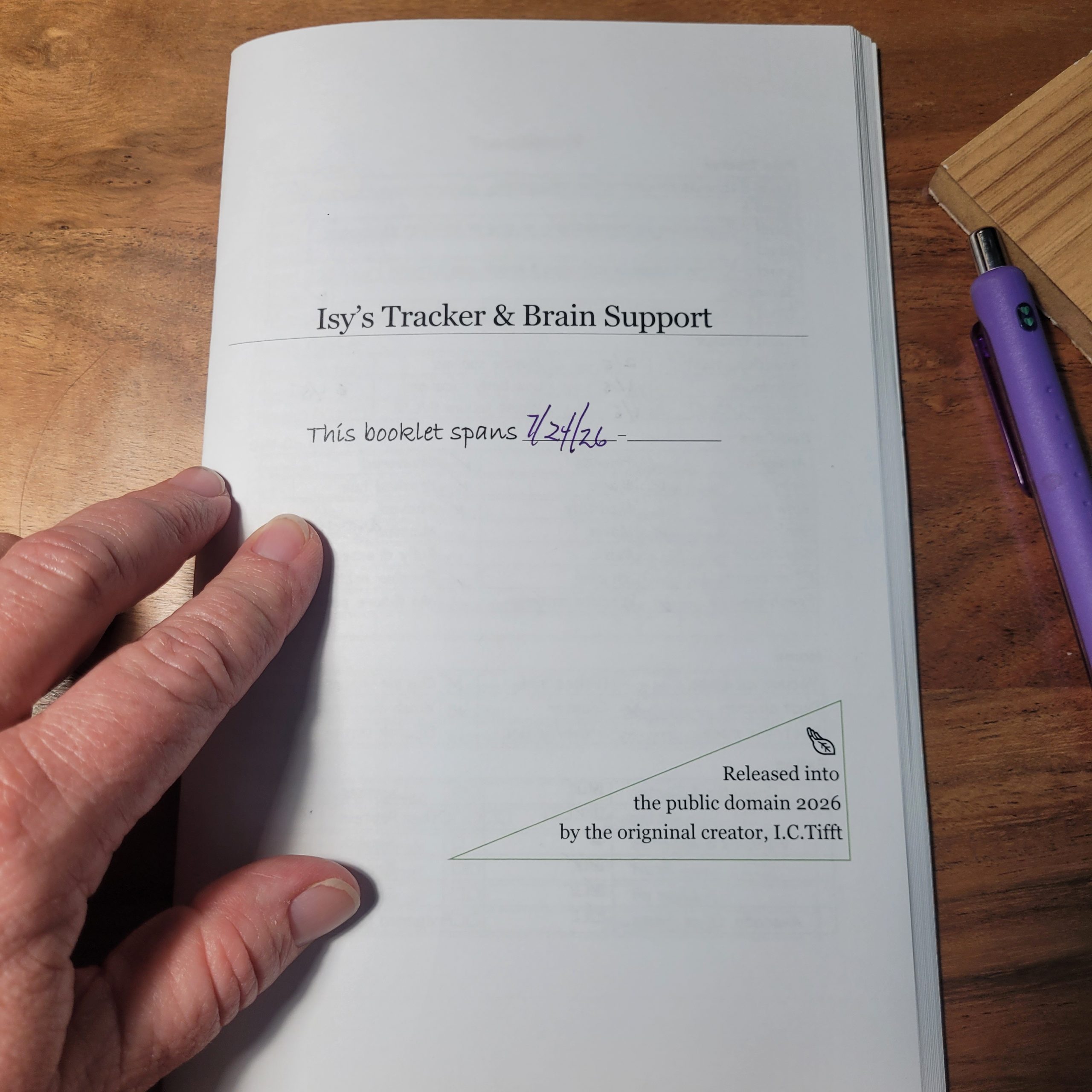
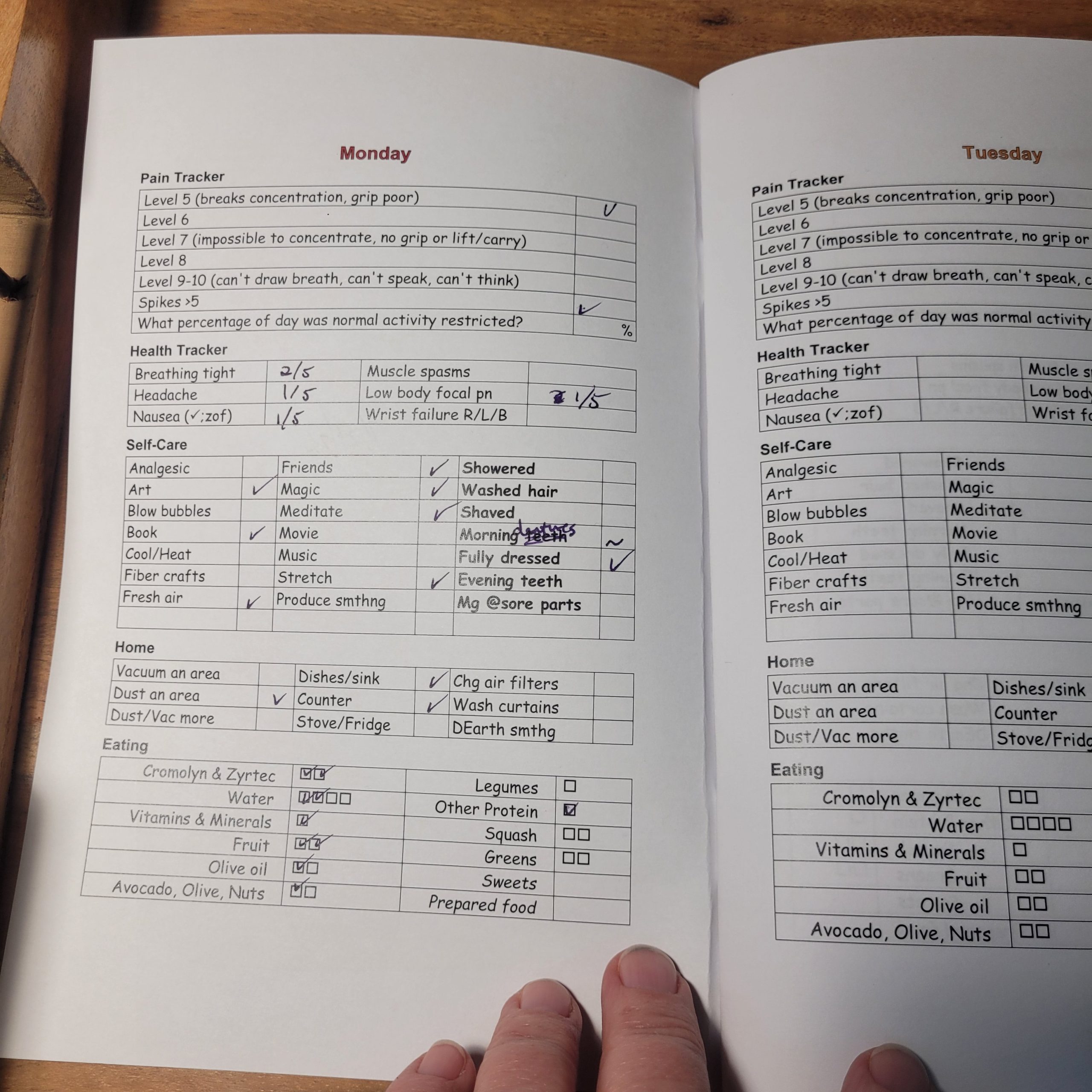
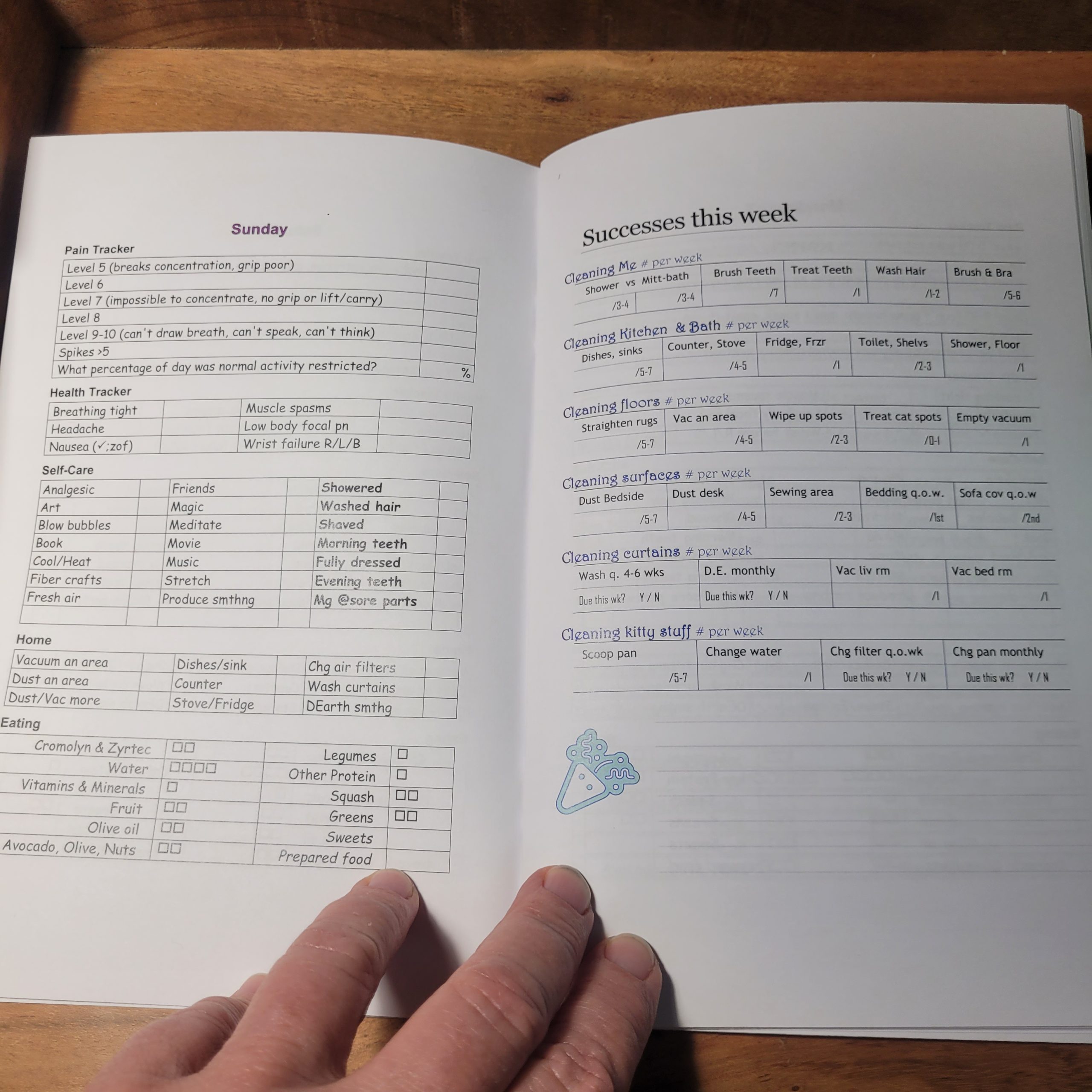
We’ve got logs in color. We’ve got ’em in black and white. We’ve got half sheets, whole sheets. We’ve got tables, checkboxes, body maps… anything I could think of to make using these a low-cognition task:

You can see how my tracking changed depending on just how sick I was vs. how much activity I could (or, more often, wanted to) expect from myself. They show how my priorities and needs shifted, what worked for me well enough to track, and so on. Don’t worry that it seems rather personal – it’s all information; information is a good thing; good things should be shared. You might find a relevant format to start your own tracker from.

They’re in PDF format, for technical reasons. Conversion tools and PDF editing tools are available, some of them for free. Have fun, and come back here to re-download if you mess something up. This is a no-shame zone.


Halcyon insomnia

I’m having an episode of rock-hard insomnia. I’ve been having unpleasant dreams about an obnoxious person I used to know. I wondered if there was some concealed message in these recurring distasteful dreams, but, on reflection, I’ve concluded that my brain is just being an asshat. Sometimes it just is.

Having unpleasant dreams does cause insomnia for me; it seems I don’t want to go to dreamland when dreamland sucks. That seems fair!

So, I’ve dabbed lavender oil on my pillow, which calms my central nervous system and wards off nightmares. I’ve taken hydroxyzine, but didn’t even notice the window of opportunity, so that’s no good. I have one of my favorite books read by one of my favorite readers playing, but it’s just noise tonight.

Nope. Nothing.

I’m more relaxed, sure. Just nowhere near sleepy-bye.

What occupies my mind most of all, though, is how this period in my life, personally, is a halcyon time. Hard as it is in the shared realities of politics and funding, my personal life is filled with kindness, care, and love, more than it’s been in… oh lordy, let’s not go there. Years.

I adopted a young friend and they have brought their partner and siblings and pets into my life. Every time a new member of this clan meets me, my soon-to-be kid-in-law watches the exchange, nods, and says, “Everyone in this family falls in love with Isy,” as if it were the most natural thing and completely to be expected.

It’s an odd way to double your family size. I realize that. It won’t always feel so easy, because that’s life and being human. It’s simply that, after decades of grinding through this really bloody hard work of being alive with CRPS and all its atrocious friends & companions (dysautonomia and disability to start with and spiraling down from there), working through every challenge essentially alone for most of that time… this? This is different.

One of the kids is staying over to do my housework and help with shopping and cooking. They commented, insightfully, how glad they were that I experimented more with food when they were around.

I said that it’s easier because if I choose wrong and my fingers turn into sausages, I can still eat safely and recover without losing ground, because they’re there to take care of things. Also, my allergies are much better because of their work.

I said, “It’s safer when you’re here.”

I had one of those echoey moments when a bone-shaking realization hits you and you can either weep for the dreadful risks and hardships of the past or take a breath and be grateful for the present.

I took a breath.

So, although I need to sleep and I don’t want any more nightmares, I’m enjoying being awake because I can just wallow in this feeling that — after so long and so much — I find myself recognizing, with a rare purity, that these are halcyon days for me. Right now. I didn’t know I’d get such a wonderful time again, but I hoped for it, for many, many years.

I’ve had good times, don’t get me wrong! I’m good at finding joy and making the most of moments of connection and delight. I have friends and relatives I adore and can rely on. My life has loads of good.

It’s not the same as this feeling of bedrock beauty undergirding my daily experience. Does that make sense? It’s not just beautiful moments with loved ones making gorgeous spots among the daily crap. It’s a wholeness of greater safety and loving peace. The lovely moments string together until the brightness takes over.

As my adoptive grandchild sleeps in the next room, I find that I don’t have nearly enough fingers and toes to count all my blessings. I don’t mind being awake tonight. It’s a halcyon insomnia!

SMIB!

Word for the day while riding whirlwinds

“Coherent” is a good word.

In one sense, it means making sense; that is, speaking & writing in a way that’s both rational and relevant to our shared reality. It’s not messy, shouty, or rude.

It also means being complete in itself in that moment. It’s when all the pieces that make up an idea, feeling, or statement hold together. It’s the opposite of fractured or flailing.

It can seem like a high bar, especially in a country where the system of education has been under siege for half a century, the economy is teetering, and the leader is sending soldiers into cities to attack people that he thinks disagree with him. (If they agreed with him before, as many did — Southern California used to be deep red, despite Hollywood’s reputation — now, probably not so much.)

The opposite of coherent is incoherent.

So, as I lay here waiting for my body to come online and hope we get to be vertical in the next hour or two… and as I watched my mind flicker and flash among the upheaval, anguish, and uncertainty in my country, my loved ones, and my own future… I realized today’s word had to be “coherent”.

As I mulled it, I felt my mind coalescing into sanity again. I found myself reflexively doing the stretches that keep my legs working. I found my sense of what’s my stuff and what’s others’ stuff re-establishing itself. I found myself feeling fortunate again, which I am, because I’m safe and housed (and safely housed) and I live in a charming place where I can get my needs met.

The whirlwinds keep whirling. It’s their job. I think of being in a bright, bouyant column of air filled with those of us who hold each other up. The energy here holds us together instead of tearing others apart.

In the midst of the storm of chaos, I hold myself to the word “coherent”, and coalesce into myself. The winds may throw me around, but they don’t pull me apart any more.


Word for the day

Spoonies, you know how we sometimes drift through the day? If we don’t have an external demand shaping our efforts — kids, work, methodical spouse or housemate — then, for some of us, getting through the day can be a matter of bumping or lurching from one need to the next (use toilet, refill water, rustle up food, manage an appointment, negotiate for a ride, do the self-care things that require that up-front energy to make them happen, organize recovery periods from each of those activities…)

Yeah.

An old friend of mine reminded me that there can be a thread running through the day, in addition to the usual “what’s the next task for survival and coping?” —which, let’s face it, gets a bit grim.

We can suggest to ourselves what that day’s thread might be.

This can line our attention up on it, and make the day less annoying and, in some ways, more fruitful. It also comforts the brain & spine with a sense of supportive purpose.

That’s worth a lot.

I mull it over the night before and find myself with a short list. Next morning, I pick one or two.

This also gives my brain/mind the supportive sense of being cared for at the beginning and end of each day.

I picked two this morning, but I can only remember one: calm. Picking “calm” as the thread for today is particularly good, because there’s a lot to do before I get a molar cut & chiseled out of my head with hopelessly inadequate pain control this afternoon, and thinking about that is not calming, but it’s going to happen and it needs to happen. I get to figure out how to mitigate the horror and so forth, and stay in my skin (so to speak) while I prepare for a testing few days of hard recovery.

Because I chose “calm” for today, I’m taking the time to write this, instead of trying to cook soft food, drag out the vacuum, shower, and make tea & take my pills, all at the same time. And doing all of them badly, if at all.

This word for today is providing a good anchor to hang onto as anxiety and the foreshadowing of so much more pain tries to wreck my mind.

It’s not that things are going to be anything other than what they are. It’s just that it’s not actually the end of the world, the wound will heal, and I can weather that process. I remember that when I reach for the word and idea of “calm”.

This is the 4th day and the 4th word since that conversation. It has improved my ability to get things done that are time sensitive, and it’s helping a lot with getting through this testing day.

I used to do this years ago. It’s amazing what we forget.

I’ve already vacuumed and breakfasted,  and did them well enough (my vacuuming kit is in the picture below. Check out the padded suede gloves to cut the vibration from the handle!)

This image shows a woman wearing heavy duty ear defenders, with heavy-duty padded leather gloves within reach.

Now for tea, pills, quick washup. This is do-able.

Calm. Calm is good.

Today I Learned.. about how cashier’s checks work

If you’re chronically ill to the point of being disabled, you’re probably the sort of person that things happen to. This is something that insurance companies used to have data for, so nobody can tell me this category doesn’t exist. Besides, I think I am one!

Long story short…

Cashier’s checks can disappear into the void, but — if you know a little terminology — it’s possible to get them out again.

Note: this is based on the US system. The concepts broadly apply, but tend to be implemented differently elsewhere.

Lingo and key points are in bold.

When you get a cashier’s check, the money is taken out of your account and put into the bank’s GL, or General Ledger.

The GL is a kind of “sandbox” that they can use to move money through in a way that protects the cashflow, regardless of what else happens in your account. It’s strictly temporary and has to be zero’d out at the end of each day.

Whatever else you do, check 2 things on that cashier’s check:

  1. Who it’s made out to (get them to read it to you if necessary).
  2. How much it’s for.

If either is wrong, push it back across the counter and make them redo it immediately.

The cashier’s check is drawn on the bank’s own account. This is why the account number on the check is not one of yours. It’s also why they’re considered more usable than personal checks: banks are guaranteed to have that money in hand.

If you take that check to another bank to deposit it, hopefully it’ll be credited directly to your account.

If not, here are some clues to follow.

I’ve spoken to 8 or 10 bankers in the past 2 weeks, 4 of them managers/assistant managers. (I don’t know exactly how many people were in a couple of those rooms.) Only one of them could explain this to me. So, might want to take notes or print this out.

If a cashier’s check is negotiated (in this case, that means “marked up and legally received”) by a bank, and subsequently denied for any reason, it goes into a magical 3rd space that few people even know exists. This is where things get interesting.

If anyone tells you — as people have told me — that a problematic cashier’s check simply vanishes and you lose that money, they’re wrong. Don’t put up with that.

1. If the check was negotiated by the receiving (2nd) bank before being denied (this is rare, and requires at least three people to be asleep at the time!), then call the issuing (1st) bank and ask if it shows up in their system as having been cleared.

But wait! There’s more.

2. If it has been cleared, then next, the bankers need to look for what’s called a Fed adjustment. Naturally, the Feds keep a hand on the tiller of bank transactions. When a balance sheet is not right, they make a Fed adjustment — which does not show up in the usual account information, as seen by the front-line staff! — and gets parked in the 1st bank’s own accounts somewhere else.

PRO TIP: Try to get a trace number, or else (like someone sitting in my seat right now), you might wind up waiting still more days to track that money down definitively.

Information about a Fed adjustment is not available to the usual banking staff. Access to that info is available only to specialists, and it’s often contracted to a specialist 3rd party.

The bank’s Accounting department might have access if they know they’re looking for a Fed adjustment. The Operations department (if they have one) will have access, because they have to handle policies and procedures and stay legal & proper.

The 2nd bank’s 3rd party specialists can access that info and tell you where it is. The 1st bank’s specialists may not see it without a trace number.

It exists and it’s their job to find it.

Once you’ve established whether the check has been cleared by the 1st bank, and you have found the right person who can look up Fed adjustments, then you’ll know where the money exists: either in the 1st bank (most likely) or possibly in the 2nd bank. But now you know.

Remember.. It won’t be in any of your accounts, it’ll be in the bank’s own area. They have to look for it differently.

4. Next step is to notify the bank/branch manager where the money is, and ask them to credit that money back to your account.

If that doesn’t go well, play Duelling Bank Managers: go to the bank that doesn’t have the money and, from the manager’s office, call up the one that does; the manager you’re with can ask them sweetly & precisely how to find it and get the money back to you.

This is one of the things that speakerphone was made for. Wonderful way to clear the path.

5. This is the worst part: the Fed adjustment may not land back in your bank (let alone your account) for 30 days. Then you can do whatever you like with it.

My 1st bank, now that they know where the money is and are sure of receiving it in time, are giving me a free loan on that basis, so the money is in my account now and I can go get it at last.

I’m gasping. Absolutely breathless.

Warning: verbatim quote — “the squeaky wheel gets the grease”… so if you’re working with a bank that isn’t culturally meticulous, be prepared to do a lot of squeaking.

I’m hoping the car dealerships will take cash, because I have jumped through enough hoops in the past 2 weeks, and I do need my own transportation.

Pulling the masks off in pieces

Having crashed and burned in a (for me) spectacular manner, I’m being (ahem) encouraged by many of my nearest and dearest to stop pretending I’m so much healthier and stronger and more multi-systemically resilient than I am.

My underlying state of health is not good, and I hate discussing it. It’s tiresome and depressing. That said, ignoring it obviously doesn’t work for long. Need a 3rd way.

I’m pushing 60. Time to stop pretending I’m 34… which was my last year of what I still reflexively consider my normal health & athleticism, and it was also when this pain syndrome was laying down its first tracks. Between multiple bereavements, recurring respiratory infections, and repeated courses of megadeath antibiotics, my nervous system was primed for disruption.

As one friend said, “We habitually present a version of our pre-CRPS selves” and, outside my 4 walls and the privacy within, I don’t seem to have anyone else to be yet. How can I exist without coming off as hardy and buoyant? I don’t know what that could even look like.

I go out and do things in public view, then crawl home (nope still no car, yes it’s been all of 2025, yes I’m struggling more all the time, don’t ask) to recover in private. Those are my 2 gears. I’ve recently developed a half-gear of being in my garden plot, but that now requires a lift because the bus is too brutal – although I love that it’s currently free!

It feels like I’m waiting for the world to allow me to heal. If that sounds self-pitying, you’re probably right. I’m new to un-masking, and it’ll take practice to get the tone right – un-self-pitying, but fully honest for a change.

Showing showering

I’ve been drawing cartoons of lives like mine for years. I was waiting to put them into a book, but they’re doing no good in my folio and some have been there for way too long. I’ve also drawn communication tools. It didn’t seem time to share them before, but it sure does now.

First up…

Taking a shower on a bad day:

When I’m rash enough to shower on a bad day, it feels kinda like this.

This picture isn’t finished, but it’s good enough. You can enlarge it to see the way the (to my senses) appalling changes of temperature wrap around every individual drop’s path all the way into the drain.

I couldn’t find a way to draw the way each drop feels like there’s a hook in its head, physically latching onto and dragging energy out of my body. That doesn’t hurt (unlike the hot/cold nonsense) but boy, is it exhausting!

So, when you can tell (pew!) that I haven’t had a proper shower or even gotten wet recently, you’ll be able to surmise that the pain has been higher than my ability to cope with the intensity of the experience.

For the record – I gritted my teeth and showered & washed my hair yesterday morning! I’m taking a bow, frankly. I had a familiar audiobook to listen to, which sometimes can keep my attention off those hot/cold and dragging sensations.

Keep in mind that everyone’s pain is their own. CRPSers don’t all have the same experience in the shower, because, for some, it’s awful in some other way. Not all days are this bad, even 24 years in. Nuance is key. Also, boundaries.

My pain isn’t yours, and nor should it be.

The idea here is to give you a chance to look on, without looking for anything more than your witness. That right there is a powerful thing: just being seen.

Don’t take it on.  Just adjust your expectations, maybe, as I’m learning to do myself.

If you’re a bio-nerd, read up on how humans go from mad mitosis to having skin and organs. It is absolutely fascinating – and explains a lot about neurological variations!

Communication tool: moods & self-care

I’ve also got a delightful communication tool to share.

As we all now know, my mood may not reflect the outward, apparent situation. There can be stuff burbling away that affects me in ways I might not realize, but others can.

I came up with a rough drawing of a rating scale for my housemates to use (when I had some) and it was a huge help to get that objective feedback – without anyone being defensive! I’d sometimes find the magnet moved to a different number, then go away and take care of myself until I was pretty sure it could move back up. Usually, though, they felt free to call me over and show me where my behavior was, and I loved their honesty. Did me a lot of good.

Click here for the full-sized PDF: Irritability Scale

I particularly like how it indicates when a level of irritation is appropriate. That was a mind- blower for me, as I’d been telling myself that it was always bad to be unpleasant. Nope! Sometimes it’s perfectly appropriate!

I think, and hope, that sharing these images and tools will:

A. Be useful, and

B. Get it right through the concrete (taps own head) that I need to come up with ways to live and engage with the world that are congruent with this reality.

My inner Cleopatra, queen of de Nile, needs to get back to Egypt.

Cheers and virtual hugs are most welcome! I’m daunted by this job. I mean… I value honesty enormously… just not about my weaknesses and disabilities 🤣