Reading science (and surviving) 101

I wrote the start of this for a fellow spoonie today and realized it’s a good starting point for a subject most people find overwhelming: reading medical science when you’re starting off as a non-scientist.

The article I cite first is a good example to start with, because it’s written well and has passages of clear English to work with. So…

sketch of excessively happy doctor running with a hypodermic needle
“Here we go!”

Here’s a science article which describes immunoglobulin E pretty thoroughly: https://www.ncbi.nlm.nih.gov/books/NBK541058/

I suggest reading the abstract and introduction. After that, just skim the first sentence of each paragraph, since (in science writing) that tells you what the paragraph is about.

If the first sentence makes no sense, skip that paragraph.

If you can figure out the first sentence, glance at the rest of the paragraph to see if there’s any more to glean. If not, move on..

It’s a skill

Reading science is a skill, and skills take time to master. That’s expected! Share what you glean with your doctor and ask them to help you understand it better.

Honestly — this isn’t to puff myself up, it’s just the nature of patients to dis themselves, so hear me out — if you can read my stuff and make out half of it, you are plenty smart and literate enough to start reading science. It’s just work and time, and the time will pass whatever we do, and the work will get easier with time. We just have to take care of ourselves and pick our time, when we’re chronically ill.

Using the right amount of honey

Doctors might give you attitude about comparing your Google search to their medical degree, but that’s not what you’re doing: you’re studying up on your condition, which is wise, and you’re expanding your info base on this thing that has imposed on your life, which is survival.

So, feel free to correct them sweetly, and don’t be afraid to pour some admiration on them if it helps them to re-focus on your information-gap.

The point is not who knows more overall. That’s not in question. When you talk to your doctor, you’re talking to someone who had to memorize, for instance, the Krebs cycle (here’s a partial explanation: https://www.medschoolcoach.com/the-krebs-cycle-mcat-biochemistry/) — so, yes, they have a depth and nuance of knowledge that’s nearly impossible to replicate without going to medical school.

They like having that acknowledged, because they take a lot of painful flak for not knowing everything about everybody’s illnesses all the time, and they need to know that you know what an effort they made to be able to work as a doctor.

So, it’s good to acknowledge that enormous effort.

Then they are usually able to hear you when you clarify that you’re not arguing with them, you’re trying to improve your understanding of this thing that affects you so profoundly. You trust them to help because of their knowledge.

Trust. Help. Knowledge.

These are keywords because they are core professional values for most doctors.

They’re important to acknowledge, and great to invoke and rely on.

That said… if you can’t rely on these characteristics in your doctor, even after you tell them that that’s what you need, then it might be time to find another doctor if you can. These core values are far more important than whether a doctor has good social skills or a good handshake.

When all is said and done, guess who has to live (or not) with the outcomes? It’s you. While the doctor is the subject-matter expert on the medical info around your condition, you are the subject-matter expert on being in your body and dealing with the fallout. There’s a degree of respect that should go both ways, though modern practice makes that hard.

What you need most from your doctor is:

Trustworthiness (intellectual trustworthiness, specifically).

Urge to help.

Knowledge.

Those are the keys to good care.

Mental skills for the non-scientist to start with

The key to reading science is realizing — or at least, going ahead as if — you’re perfectly capable, and just need to practice. Science is written by humans, and you’re a human too.

1. You are a perfectly sensible person. If you’re reading this, you know how to read (or access translations from) English; also, you have access to a whole world of dictionaries. MedlinePlus is especially helpful in explaining concepts and helping us learn to read medical stuff.

2. Not all scientists can write well in English, and none of them write in English all the time. That’s okay. They went to school for a long time to get extra vocabulary and learn to do what they do; good for them. They’re still people, and they have to write in English at least some of the time. That’s where you can come in.

3. You can read the English just fine. Trust yourself and take time. With practice, you can learn more lingo over time, and get better at reading more science.

Just work from what you can understand now, and let that grow over time. You’ve got this.

Choosing credible sources

While you’re learning to read science, start where you can and work from there. As you get more confident and your understanding grows, you’ll learn to be choosier.

The gold standard for science info

When learning how to assess science, you’ll hear a lot about placebo-controlled, double-blind studies and that method is often important. This method of science gives us more reliable statistical probabilities about whether something will work in a certain situation. The statistical probabilities become reliable when several thousand people (“subjects”) have been tested, probably over many different studies.

With rare diseases, this is obviously pretty unlikely, so we have to work with less scientific certainty. C’est la vie.

Statistical probabilities have more limited value for patients than doctors, because we’re individuals, not pooled data. There used to be a phrase used in medical school: “Statistics mean nothing in the case of the individual.” This has gone by the wayside a bit, but it’s still true.

We may have to cast our nets further afield, because we’re looking for clues that might help us, personally. Be aware when you’re doing that, and put those science reports in your mental “hmm, maybe” folder.

I showed a case study that had a marvelous impact to one of my best doctors. He said to me, “If I could put that effect in a bottle, I would. It worked for that person, and we have no idea why. We do know that it doesn’t work for all these other people. Everybody’s different. Figuring out how to apply one thing to help a lot of people is our holy grail!” Lloyd Saberski, MD.

And that’s why doctors rely on the pooled data gathered from the scientific method. They want to help as many people as possible with each thing they try. Otherwise they fear they’ll spend too much time chasing rainbows.

We patients have to find our own rainbows, just as we have to count on our doctors to keep an eye on what’s statistically worth trying. It really is teamwork, and we both need to do our jobs.

What’s peer review?

Before you give a study to your doctor, it’s worth checking if it’s from a peer-reviewed journal. Don’t expect them to put too much stock in it otherwise.

Peer review means that other people in related fields have checked it over for sanity and validity. This is important for us patients, as well as the doctors who rely on the information.

You can Google whether the journal your article was first published in is a peer-reviewed journal. JAMA, BMJ, and the Lancet are all reliably peer-reviewed.

The value of literature reviews

Then, after a fair amount of studies have been done on a topic, there’s usually a literature review. This is when a qualified scientist takes a close look at all the studies, throws out the ones that were badly designed or poorly run (because bad technique creates bad data. “Garbage in, garbage out”) and writes an overview of what the current good science says.

They also discuss the strengths and weaknesses in the data, and suggest where future science funding could go, in light of the science so far.

Literature reviews are wonderful places to improve your knowledge of your disease/condition, expand your vocabulary, and get a lot better at understanding what goes into the science on your condition in the first place.

For instance, it used to be widely believed that most people with Complex Regional Pain Syndrome had had traumatic childhoods. (“Blame the parents” LOL.) There was a literature review done on about 30 years’ worth of studies, and it turned out that almost all of them were so badly-designed, poorly run, and calculated with so much bias, that nearly all of the studies had to be thrown out!

This taught me very important lessons:

– Just because most people say it, doesn’t mean it’s right, even if they should know better. This is an excellent attitude to have while reading science.

– Methods matter. You’ll learn over time how to sense whether the methods used are appropriate to the topic studied. The wrong method can lead to truly bogus results. The method has to fit the material.

– People lose their minds when they think about pain, as well as when they think about childhood trauma. In practical terms, this means I have to approach all normal (non-CRPS) people’s reasoning about my condition (which is characterized by relentless agony which a non-CRPS’d brain cannot even conceive of) with compassionate criticism. They do not know what it’s like, nor how to live with that pain and still think rationally. They’re not able to know. I don’t want them in a position where they do know, because that’ll mean their lives are as battered as mine is.

Therefore, every word they say has to be filtered through my awareness of how their minds get lit up by unreason, when they think about my pain. This, believe it or not, is perfectly natural. (Look up “amygdala hijack” for background on this mechanism.)

I survive because I’ve learned to substantially displace or ignore one of the most powerful primitive signals in the human body. That isn’t natural, and nor should it be.

These scientists mean well, without question. However, their logic is necessarily fractured when thinking about this, because they lack my tools for facing it. I need to dig into their data and methods before I can buy into their conclusions.

That’s good to know!

The conclusion of that literature review? CRPSers are likely (not guaranteed) to have had relatively eventful lives. Whether the events were traumatic or wonderful wasn’t relevant to our probability of developing CRPS.

In other words, we live in interesting times!

Where to find science to read

Google pubmed, and you’ll find the National Library of Medicine (NLM) division of the National Institutes of Health (NIH). This is a searchable science library which hosts articles from all around the world, in whatever language they were published in plus English. You can search any valid medical term — for instance, use the full name of your disease rather than its initials, for better results:
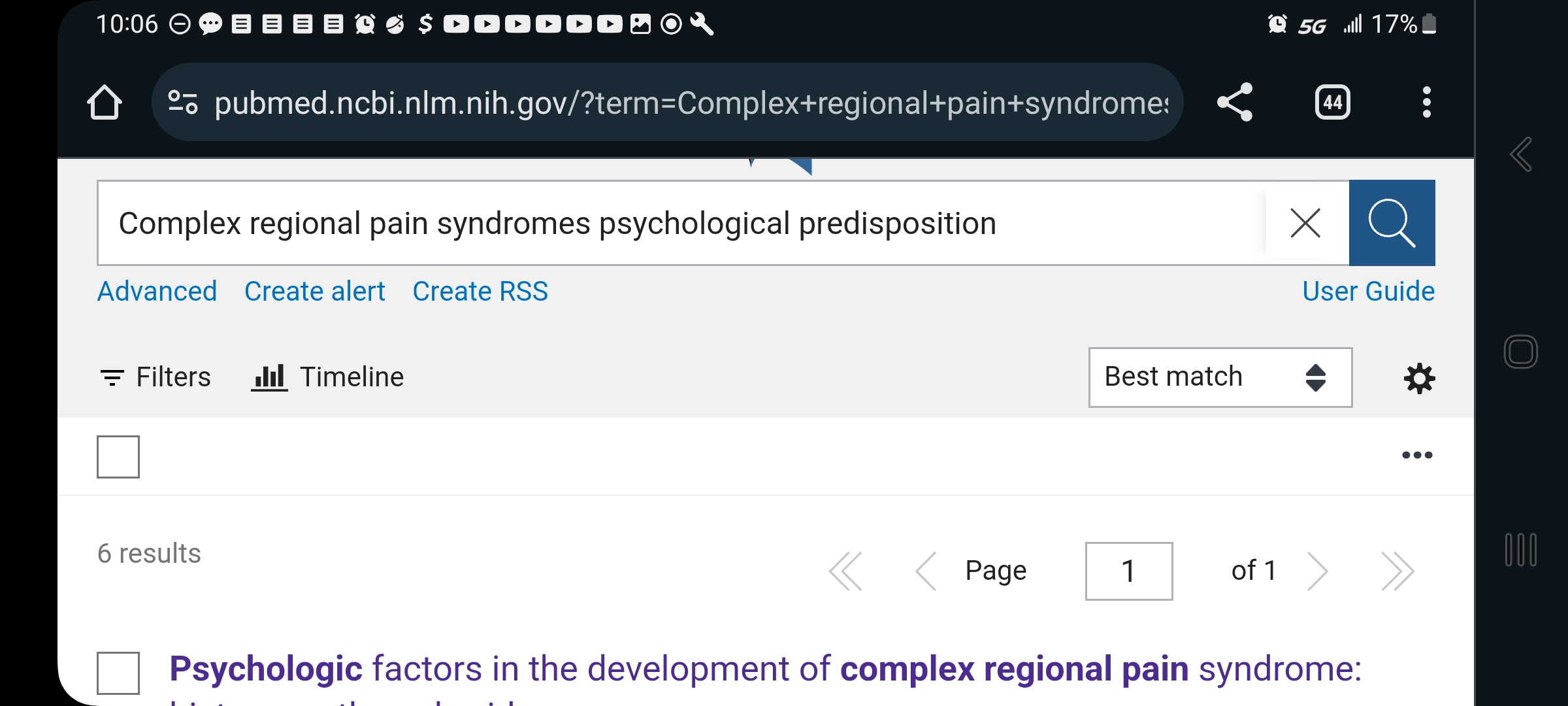
Here, you can see that I typed out “complex regional pain syndromes” instead of CRPS.

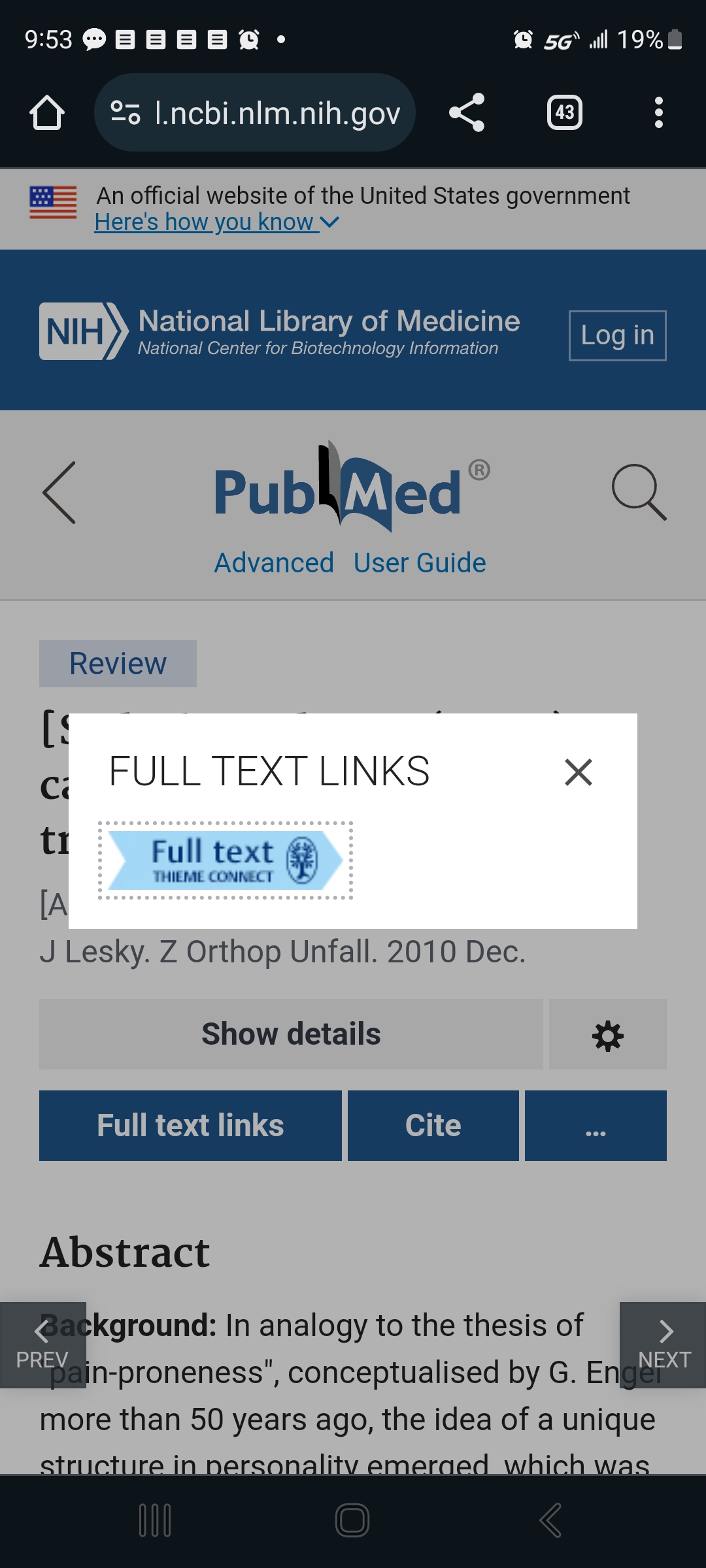
Some of them have full articles that are free to read (look for “Full Text Link”) …
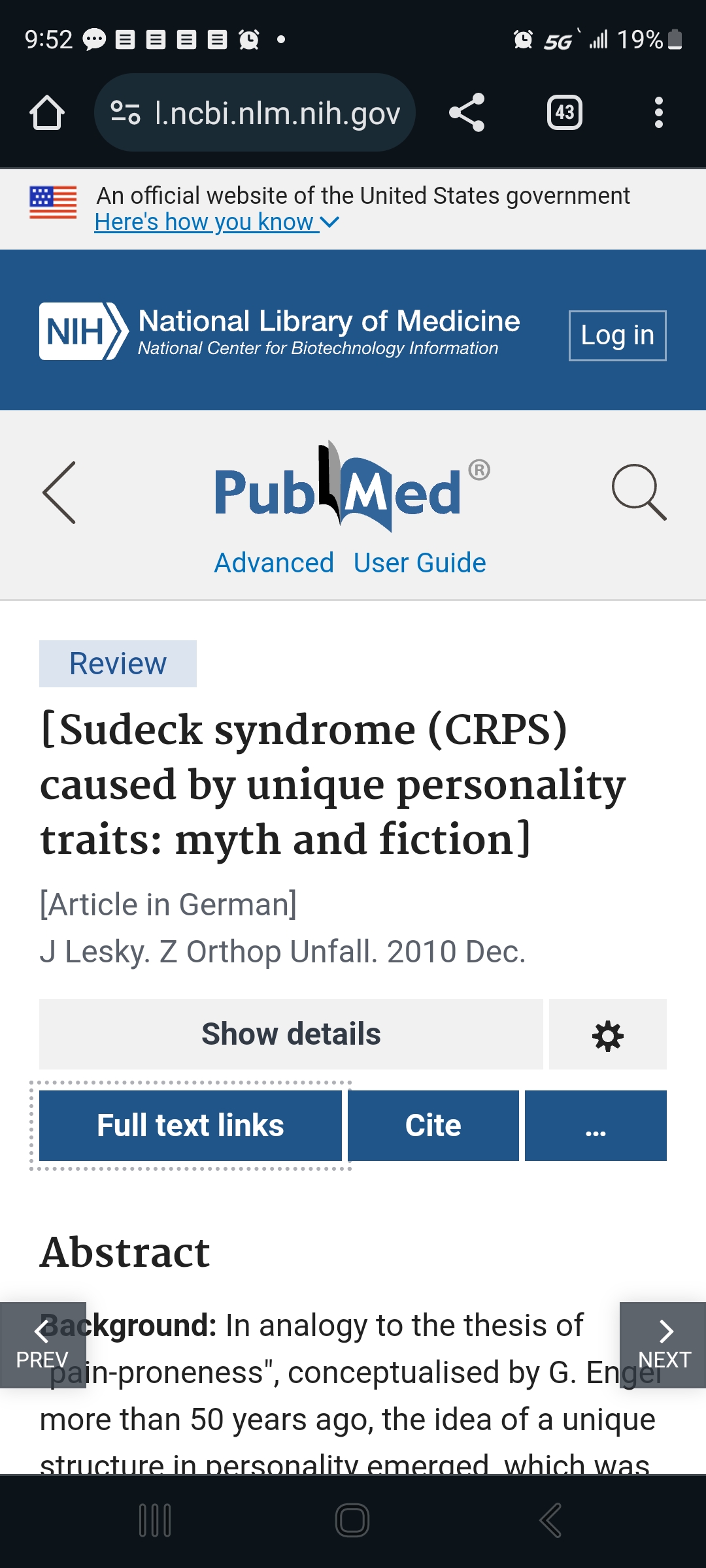
The square brackets around the title tell you it originated in another language. The note under the title tells you which one. Good science is done all over the world. I’m glad we can access so much of it!
This image shows what pops up when you touch the Full Text Link button.
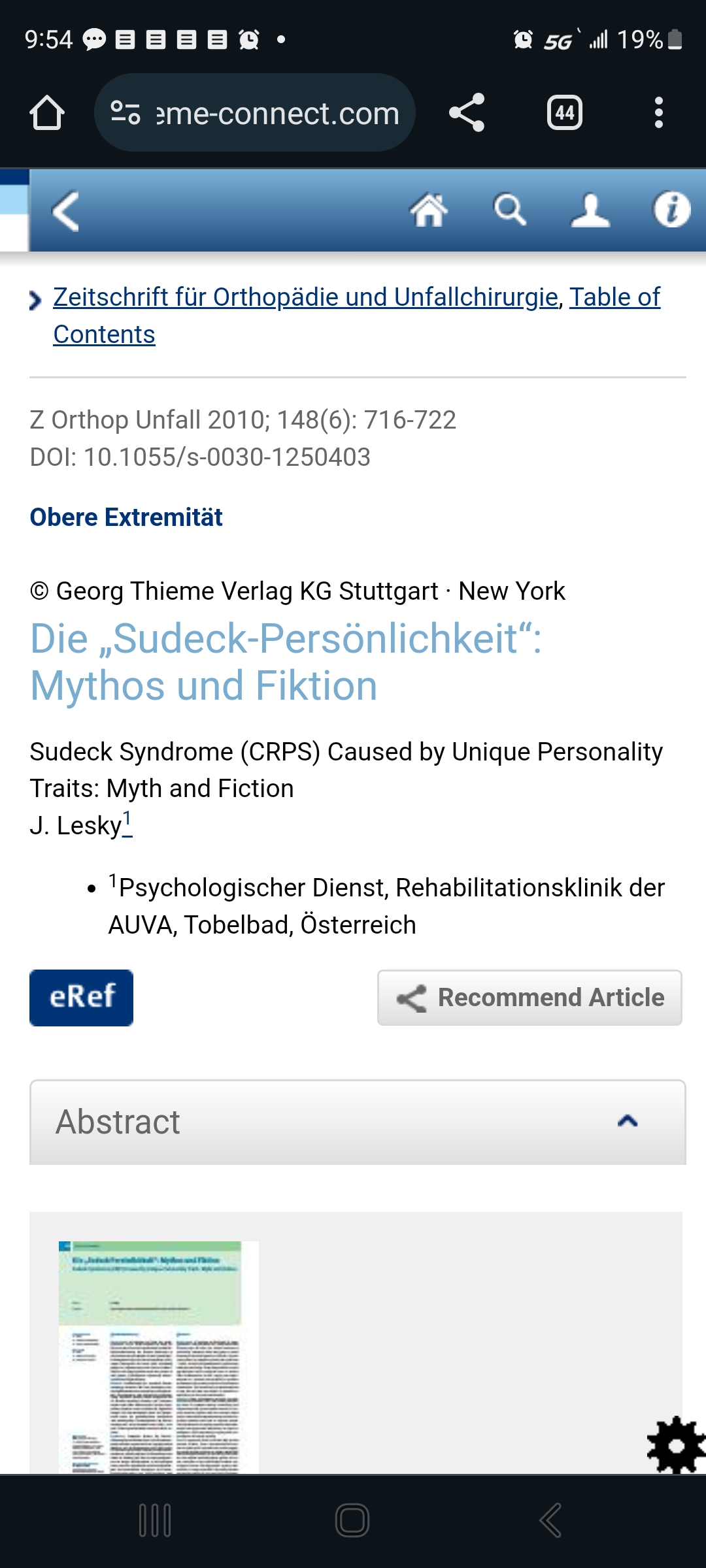
This is the original site that published this paper. As you can see, it’s in German here, but an English translation is also printed below the German version. For better or worse, English is the world language for science and medicine. I feel lucky being born into an English-speaking family, because it’s tough to learn. All those synonyms… and the crazy spelling!

…But most will show only the abstract, that is, the high-level overview of what the study is about. For our purposes, that’s the most important thing, so it gives you something useful to work with.

The interface gives you options for saving, sending, and citing the articles.
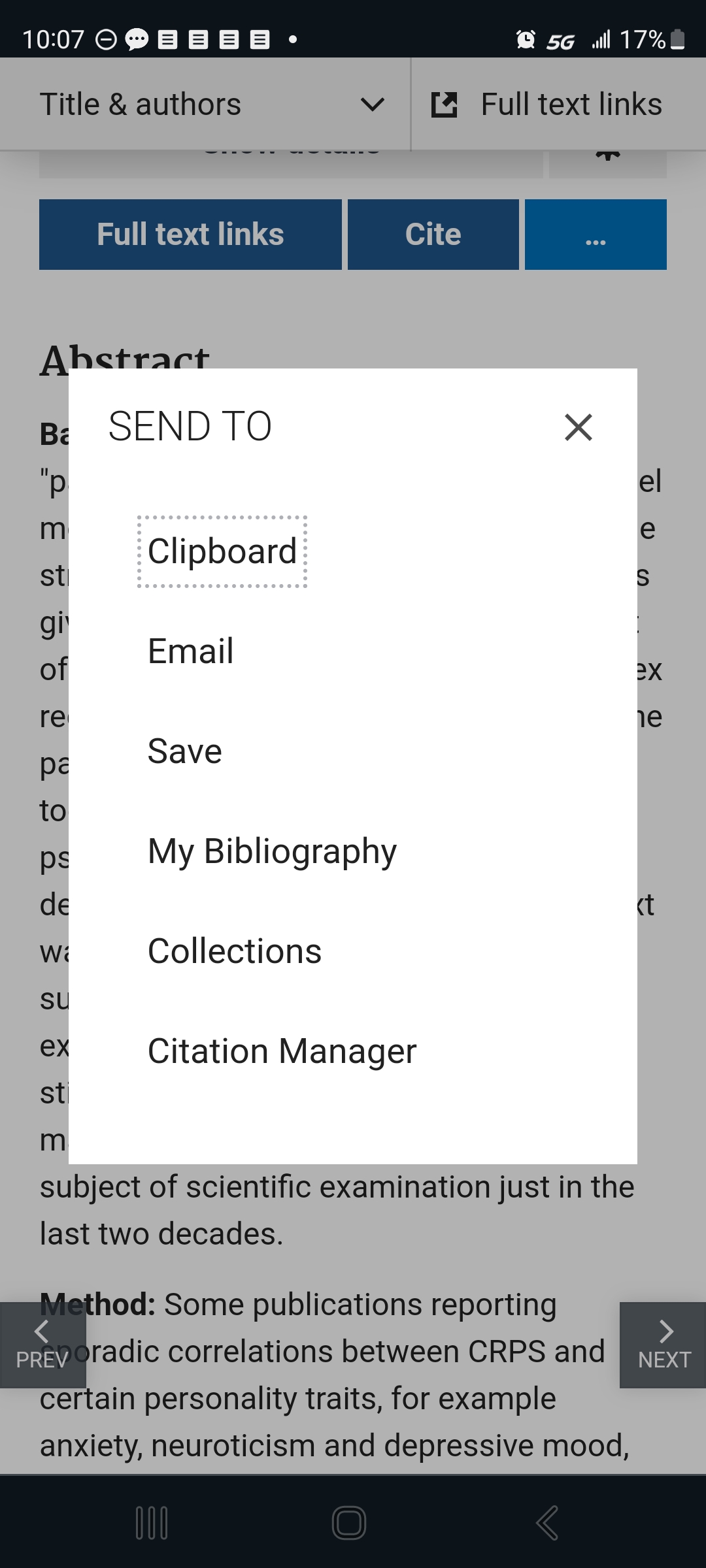
Touch the “…” button to get this helpful menu. If you get a free account with the NLM, you can use these to help you keep your studies organized and accessible.

To use these, just touch or click the one you want. They do exactly what they say they will.

If you touch one of the menu options that requires them to store the info on their side — like “Collections”, “Bibiography”, or “Citation Manager”– it will give you what you need to sign in (if you already have an account) and, at the very bottom, the option to “Sign up”:

The site is very helpful; just slow down and let yourself look at one thing at a time.

Once you feel more self-assured, try out Google Scholar. It’s smaller in some fields and generally less selective, but that can be good. I suggest saving it for later only because it’s got fewer guard-rails. We’re all different, though, and you might find that easier.

These two libraries aren’t identical. They do overlap.

A word about MeSH terms

MeSH stands for Medical Subject Heading. It’s a curated list of specific terms used in the National Institutes of Health materials. This kind of consistency is necessary when organizing a stupendous medical database like the National Library of Medicine.

MeSH terms are listed at the bottom of each article. If that article was useful, you can click the MeSH terms to have them saved to your PubMed search history:

I’ve circled the heading “MeSH Terms”, where it appears below other back-matter after the article.

Here’s a tip: when using their Search tool, don’t worry about capitalization, but be very particular about spaces and punctuation. Copy them exactly.

Using MeSH terms will improve your future searches, because it makes the most of the databases self-referencing mechanisms.

Trust your eyebrows

Best tool in your mental toolbox: when you’re reading sentences you know you do understand and, yet, you feel your eyebrows moving around on your forehead… that logic is not right.

The scientist might be misinformed, biased, pulling a fast one, or just plain wrong, but it doesn’t really matter which — that logic is not right. The underlying pattern-matching part of your brain can tell. That’s a primitive part of the brain and, when you’re paying attention to it, it’s extremely hard to fool!

Trust your eyebrows. If you want to, save the article and come back to it when you know more, so you can figure out where the problem is. I assure you, there is one. Your eyebrows don’t lie.

Feed your brain

Reading science is hard work and brains are big hungry things at the best of times. Feeding it right can be a huge help.

Meds & caffeine

If you’ve got attention problems, adjust your meds and caffeine to give you some extra focus when you’re reading science. It’s a lot more fun that way!

Smart produce

Green, blue, and purple foods are absolutely marvelous for brains — and pain. They feed the nerves, literally. I know you needed an excuse to eat more blackberries, blueberries, collard greens, and rocket salad, aw shucks.

I also know it’s not the cheapest stuff in the market. Explore your local options for farmer’s markets, roadside stands, produce sales, and organized assistance like EBT/food stamps and healthy-living programs giving more access to produce in the state, like they have in Massachusetts and California and other places.

This is a great opportunity to learn more about your condition and to bring what you’ve learned into your life (more on that later), and the upfront effort pays off so much in the end.

Body-safe phenylalanine

Obviously, if you’re prone to phenylketonuria, skip this part! IYK,YK.

Also, keep in mind that this can have an effect on some meds — sometimes giving them a boost, sometimes making things worse. Be sensible, do your due diligence, and study it up for yourself if you’re interested. Also, use your self-documentation skills: note what you do and what it does to you, change what needs to change, and take responsibility for the results of your choices. We are our own best caregivers.

I’m discussing the physiological activity of this thing with the weird name, and what I’ve found in my life and those closest to me. This isn’t any kind of assurance that it’ll do good for anyone else. Put it no further than “hmm, maybe” in your mental filing system and do your own further research to validate what I say and get an idea how it might work for you, yourself.

Basically, phenylalanine is a precursor to the “up” side of the neurotransmitter suite, dopamine and norepinephrine and even epinephrine (they all transform into each other as needed). These neurotransmitters carry messages among the parts of the brain involved in learning and memory. Taking in phenylalanine can have a truly astonishing effect on attention and memory WHEN you’ve got fundamental deficits, as do people with central and longstanding pain and some other conditions.

TL;DR — If it doesn’t make an obvious difference in less than an hour, you don’t need it.

I’ve trialed using aspartame, which went well for me. (Discussing my results with my doctor paved the way to including SNRIs in my med regime, to my considerable benefit.)

Food sources of phenylalanine

This is where hard cheese and smoked or processed meat shine. They’re rich natural sources of phenylalanine. They also have saturated fats which, in moderate doses, seem to help with pain and brain symptoms.

As a moderate part of a well-balanced diet, folks.

This hasn’t been well-studied; it’s one of those things you pick up after being involved with self-managed patients for over 30 years.

It doesn’t take much. I found that 2 or 3 bites of aged cheddar would absolutely light up my brain for 45 min to an hour and a half, depending on my deficit.

One pal of mine keeps meat jerky sticks on hand for study sessions. Aged cheese works better for me; jerky works better for them.

Now, unfortunately, mast cell activation problems have moved cheese and smoked meat out of my diet. When I need a brain boost, and it feels like cheese might help, I have to use a supplement instead.

Supplementing phenylalanine

It’s more measurable to use a supplement called DLPA, or d,l phenylalanine. It’s a blend of natural and manufactured forms of phenylalanine. One works better for pain and another for depression, but the blend seems well-tolerated and helps both. Phenylalanine suppresses certain inflammatory kinases and may help suppress pain at the spinal root (that is, right where the base of the peripheral nerve path comes out of the spine) as well as helping with mentation and cognition. (Sarcastic Sister notes: The recent science about it magically disappeared in the wake of the “war on pain meds” and I won’t pretend to understand why.)

There is a maximum recommended dose before it gets toxic, but if you’re seriously thinking about that, you’ll want to do your own studying, and might want to talk to your doctor about SNRI meds as a possibility. (The N is for norepinephrine,  which phenylalanine supports.)

Why bother with learning how to read science?

Knowledge and understanding are the most powerful tools you can have for dealing with complex chronic health problems. It may or may not change what you have to deal with, but it certainly gives you more and wiser options about how to deal with it.

Even if you aren’t ready to start now, you can circle back around to this whenever you want. It’s attainable; you can do it. It’ll always be there (although individual articles and topics may come and go.)

The patients who learn the most and put that to work in their own lives, are the patients who most consistently beat the odds and have the best quality of life over time.

Therefore, better information leads to better living with complex chronic illness. My HIV patients taught me that 32 years ago at my first nursing job, and it’s truer than ever now.

Note: Nobody here says it’s easy. That said, our complex chronically ill  lives are never easy.

Pretending that getting through the day is not, itself, almost a superhuman task is a disservice to our strength, so let’s just start off by recognizing that everything we do is really hard work.

Knowing that, I have found that the effort of learning and applying what we learn pays off a whole lot more than passively waiting to be saved and feeling rotten all the while — and still being wrecked & exhausted.

I can whole-heartedly recommend learning and figuring things out. It’s a winner.

Felix the Cat with bag of tricks and scientist


First aid kit – homeopathic side

I’d like to eschew certain arguments altogether. This is not about dissing or justifying one approach over others. Every one of us has to figure out what works for our own individual selves. Anybody who feels they have the right or duty to argue otherwise, please read the last 3 paragraphs first. Thank you!

My homeopathic first aid kit

I used to keep just Arnica montana and Symphytum officinale around. As an old trauma nurse & athletic over-doer, dealing with sprains, bruises, and occasional bone bruises & minor fractures was the main point, and these two remedies are outstanding.

Then Zicam became over-the-counter shortly after Oscillococcinum hit the market during flu season, followed a year or two later by the blend Cold Calm, and winters got a lot less snurgee. So that was another win. It was interesting to finally care whether a virus came on fast or slow, because until then, it didn’t matter, because I was in for 10 to 14 days of aching yukiness either way. (Generally speaking, if it hits fast, it’s flu; if it comes on over a day or three, it’s a cold.)

It was good to be young! And healthier! XD

The current cabinet

Now I’ve got a lot more to deal with, including lower and fewer possibilities for meds, herbs, and food. Homeopathics are taking up more of my “treatment options” space as other things fall away and conventional therapeutics have less to do for me.

Here’s my current lineup:

Pain

Body pain: Arnica, 6c or 30c, or both starting with 30c and going down.

Bone pain*: still evolving this solution. Currently isolating effects of Symphytum o.(absolutely brilliant for previous fractures and bone aches in early CRPS) vs. Bryonia (commonly used for my type of bone pain) vs. Calcarea flourica (helped with aching bones 15 years ago, on occasions when Symphytum wasn’t helpful.)

Muscle cramps and spasms: Magnesium phosphorica, known as Mag phos by its many fans, 6c for pre-spasm tension or sudden onset, 30c for deeper or more persistent cramping.

Labeled as a remedy for menstrual cramps, I have found it to be outstanding for my skeletal muscles and intestinal muscles as well — as long as:

  • My serum magnesium is ok (I supplement with chelated magnesium twice a week, since my body plows through this electrolyte at a consistent rate);
  • My other electrolytes are ok, including calcium, and my vitamin D is high enough to regulate the calcium properly;
  • My hydration is adequate. If I can’t experience thirst normally, I blink and feel for discomfort in my eyelids, or pinch up the skin on the back of my hand and give it 1/10 of a second to return to flat. (I need to stay in the upper level of hydration for the sale of my brain & spine — as well as my kidneys, which work hard to deal with my meds.)

Note of caution: Muscle spasms are not necessarily a simple fix. Start with the simple thing and work out what your underlying tendencies are: dehydration is usually easy to sort out, and you’ll know if it helps within a day; magnesium/calcium/electrolyte levels need a simple blood test to discover; once you’ve got good info to work from, you’ll know if your next step is supplementation, medication, homeopathy, or a call to your doctor.

So, please, start with getting good objective info so you know what your particular system is likely to need when your muscles cramp. There is definitely such a thing as too much dietary magnesium, so throwing magnesium chelates at spasms can make things considerably worse if that’s not the underlying problem!

G.I.

Colic & abdominal cramps: Mag phos for the win! See above.

Constipation: As I’ve recently been reminded… first, call your pharmacist, and ask about your med side effects. Sigh, so easy to do, so hard to remember to do.

Homeopathically, Sepia and Alumina took turns being helpful, but didn’t complete the turnaround I needed.

In the end, getting off a key med, while also minimizing histamine release in my gut, while also supporting digestion with a prescribed suite of digestive enzymes and some Chinese herbs, while also eating tapioca with nothing in it but a bit of coconut sugar nearly every darned day for 6 weeks… turned that intransigent problem right around. Plus, Mag phos for the abdominal cramps.

This is a 5-star example of a multi-front approach: med revision, diet revision, toxicity reduction, and a combination of supportive measures: prescription, dietary, herbal, and homeopathic.

Life, at this end, isn’t simple. Simple solutions often aren’t enough. That’s why I value the “multi-factor” approach: nothing works that well in isolation, so I often wind up getting everything possible to head in the desired direction.

Brain

“Heated” brain feeling & stormy sensory sensitivity: still best with herbal concentrated lemon balm, which is effective & reasonable. Good homeopathic fallbacks (for me) are Silicea or Kali phosphorica, depending on accompanying feeling of irritability (Silicea) or dullness (Kali phos.).

*Bone pain treatment note: The bone pain started up as Savella cleared my system. My bowels got back into gear over the same span of time. This week, I trialled a small dose (12.5 mg twice daily) of Savella to see what it did; in 2 days, the bone pain decreased by ~80% — and my bowels shut down at the same time, leaving me with the poor sleep, delayed recovery, body pain, and joint pain that comes with the inflammatory bloom that produces.

I might give it one more shot, but honestly, there was no other change involved and I hate torturing myself.

I’ve learned what it’s like to survive without a working gut,  and it’s too hard. The knock-on effects of pain, fog, and allergic activity is brutal.

So, my current personal project is to figure out another way to manage bone pain. It’s just awful, but a stalled gut is still worse.

Diet and nutrition has brought me a very long way forward, but at the moment, there’s not much more it can do. I’ve had a squeaky clean diet for years, but now it’s so carefully tuned it could probably hit high C. This may change, and if I have to do something else, I’ll figure it out when the time comes.

Pharmaceuticals have come a long, long way, especially these amazing mixed-SNRI neurotransmitter supporters. However, between my genetic tweaks affecting med assimilation and the natural effects of biochemistry, there isn’t an obvious way forward here, now that Savella has washed out for me.

Herbs are so built into my life that it’s a specific mental effort to think what else I could try here. Given that herbs A. Require frequent dosing and B. Do have side effects and I’m exhausted with side effects right now, that currently there’s nothing herbal I know of that I’m willing to try.

Homeopathics have a history of being more predictable, consistent, reliable, and safer for me than herbs and pharmaceuticals (though I owe my life to pharmaceuticals and am not dissing them, just facing another tough reality). There are several possibilities to explore, so that’s where the next step leads me.

Onward!

Felix the Cat with bag of tricks and scientist

Last 3 paragraphs

My own approach is absolutely comprehensive — pharmaceutical, nutritional, dietetic, physical, psychological, mental, herbal, artistic, behavioral, and energetic techniques all play a part, and there’s peer-reviewed science behind over 90% of what I do. Every single intervention gets tested on me — and assessed for benefit and drawbacks — before being incorporated, and gets retested at least yearly.

I’m a diligent empiricist; as I’m responsible for exactly 1 clinical case, that is the most rational approach. Empirical science is the only method of scientific inquiry which consistently considers the individual case.

Sarcastic Sister adds:

Anyone who sincerely & totally refutes the value of homeopathic remedies is welcome to borrow my body for a week or two & see what works for themselves; I’d be happy to borrow theirs while they figure it out.

Getting re-humanized by phenylalanine

After breaking my own heart just before the holidays, and then lots of traveling and the sheer delight of swimming in the ocean of love I felt with my kin (lucky me!), and then coming back in once piece, and then a bumpy recovery period… my dopamine was pooped.

How do I know that? Simple. I lost touch with the usually easy-flowing sense of love for my nearest and dearest. I was not quite as interested in grabbing good moments to have some fun; I was drawn to sitting around, disaffected and lethargic. My mind was a bit fuzzy. It was pretty much impossible to control my impulses to buy things I didn’t need, but felt a need for right at the moment.

Dopamine (among other things) is used to make decisions, control impulses, get interested in things, be motivated, and feel the pull of love or other desires.

I experimented years ago with precursors to neurotransmitters, because I was having a hard time convincing doctors that addressing the neurochemical impact of the disease might lessen the neurological effects of the disease.

Line drawing of brain, including medulla, sliced near the middle so the lacunae are visible.


I know, crazy stuff. Such a weirdo.

mirror_neuron

I’m taking an SNRI which mostly does a good job, but I’ve been doing this long enough that I don’t want to crank up the meds as my first line of action. Meds are problematic, especially for me, so I keep them as a second or third line option, starting with less toxic options first.

I’ve learned that the meds need something to work on. Selective reuptake inhibitors basically affect the molecules that already exist; they can’t make new molecules of serotonin, or norepinephrine, or whatever; they can only push the ones that already exist to work harder.

I like to make sure my reuptake inhibitors have something to work on, rather than just squeezing the last of the juice out of what few molecules are there. I still trust my body to make the neurotransmitters if they have the raw materials, so I listen to my cravings and supplement accordingly, giving them the raw materials to make more neurotransmitters.

Craving starch and fat and sugar is a good indicator that I need more serotonin, so I add 5-HTP to give myself a solid, measured dose of serotonin precursor. Craving sugar and having protein quench the urge, is usually a good hint that I need more dopamine, so I take some nice clean d,l phenylalanine.

Wide-eyed kitten staring at a roast chicken on table in front of its face

(Your mileage may vary, of course, but it turned out there was good, straightforward science behind these two simple self-checks.)

These are only two out of dozens of neurotransmitters, but they interrelate and often morph into each other sooner or later. So far, I’ve had good results with focusing on these two as the lynchpins of my neurochemical management.

Here’s a metaphor that parallels the relationship between neurotransmitter meds and neurotransmitter precursors. You can crank up the volume all you want, but if there’s nothing in the CD/MP3 player, most of what you’ll get is just noise. Precursors are the music media. Meds can be the volume control.

I stopped taking d,l phenylalanine a couple months ago because I was doing great and really wanted to reduce the number of capsules I have to choke down. For awhile, I thought things were fine, but I’m not sure they actually were… I made some very silly decisions.

Phenylalanine, found in processed (smoked or dried) meats and well-aged cheese, as well as in certain artificially-sweetened drinks, is a key precursor for the dopamine/norepinephrine set of neurotransmitters. It has been found to suppress pain at the spinal root, too. It’s used by some vets to help advanced arthritic pain in dogs.

Line drawing of spine in a human frame.
The spinal root comes out between the vertebrae. Most pain nerves in the body lead to a spinal root, and the spinal root goes into the spinal cord. The spinal cord is part of your central nervous system and goes straight to your brain. This explains a lot about CRPS, and other things.

My early experiments, when my neuro situation was getting bad, showed that 4 packets a day of that phenylalanine-rich artificial sweetener helped my mood and my pain noticeably. This persuaded my (slightly bemused) doctor to try me on SNRIs. Once I got onto the right SNRI, I’m happy to say I could get off the crazy chemical-sweetener version of the molecule. Suddenly the artificial sweetener stopped tasting good!

Anyway, to make a long story short (“Too late!”), I keep d,l phenylalanine on hand in case I need it for pain or brain. I started taking it a few days ago, in the morning, and I’m finally starting — starting! — to feel more human again. I started at a low-moderate dose, and gave it a few days to work its way in before reassessing.

I understand that many people shy away from these precursor supplements because medical conservatives don’t trust their patients to pay attention and notice what makes things better or what makes things worse. That’s often reasonable… when I was working as a nurse, 90% of my patients probably couldn’t tell if their feet were on fire without looking first. Most people are really dissociated from our bodies.

Moreover, pain patients have every reason to be! When you spend most of your time in some degree of agony, it takes nerve, practice, and stubbornness to check in on yourself and make note of what you find, in order to screen out or screen in things that might be harming and helping. I have to say, I have found it well worth the effort, overall.

Also, surprisingly, it makes the pain less oppressive to look it straight in the eye once in awhile and say, “I see you. I see exactly what, and where, you are. You don’t fool me. You are not my life. You are not my body or brain. You’re just something that gets in the way, and I can usually work around you to some degree.”

Now, here is the “caveat” part.

It is possible to over-crank your meds by cranking up the precursors; it is possible to generate too much serotonin or too much dopamine by taking too much in the way of purified precursors, and your meds will keep squeezing the most out of that excess. So yes, you need to be careful and pay attention if you’re going to try this. Don’t jump in blindly. Take some time to study up.

This is where your own research and self-awareness becomes pivotal. What will that look like? How will you handle it?

My first experience of serotonin syndrome came from an iatrogenic overdose of an SSRI. That was bad. But hey, I sure know what it feels like now! I back off on the precursor or med when I feel the slightest drift that way.

Personally, I normally cut back on the meds first, because they contribute more to the fogginess and confusion that makes life so sucky sometimes. This is how I handle it, because I am comfortable doing things like filing or nipping a bit off my pills to cut the dose down, and I know my body well enough to notice the effects.

Using these supplements appropriately — with all this awareness and empirical experiments on myself and so forth — has reduced the side effects from my meds while giving me much better pain control and a much pleasanter quality of life. That’s a huge benefit. Huge. Definitely worth the effort.

If you’re interested in doing this… be sure to research the possibilities; understand what the sources, benefits, and drawbacks can be; and learn to track your symptoms. When you feel comfortable trusting your mind to your knowledge and record-keeping skills, then experiment carefully to see what works for you.

I’m not going to patronize my readers by telling them not to take responsibility for their bodies and their knowledge base, but I’ll gladly remind you — as I’ve recently reminded myself — to keep paying attention. Whatever mistakes you make are as much yours to deal with, as your successes are yours to celebrate. I wish you all success.

Naturally, it’s a good idea to start small and work up until you notice an effect. These things rarely work instantly, so give it a few days in your system until you bump the dose up.

Just as with meds, go with M.E.D.: Minimum Effective Dose.

If you don’t know your body pretty well, it can be hard to figure out what deficiency or excess you’re dealing with. Most online definitions of these syndromes or toxicities discuss the extreme and life-threatening levels of toxicity, which are not helpful to those of us who are working out our supplementation and medication levels.

When I had serotonin syndrome, I simply didn’t care if I had anything to eat or if my laundry — or my body — got washed. Nothing mattered. The peace was outstanding, but the situation was not compatible with long-term survival. I didn’t have tachycardia, myoclonus, or tremors, and I only noticed my reactions were twitchy when my doctor did the knee-hammer thing.

This non-disastrous level of reaction matters, because this is where we have the chance to tune our levels and make our lives better instead of worse.

I took years to get to know my body’s reactions, knowing the time would pass anyway and I might as well be wiser for it. So I learned to be mindful and careful, pay attention to myself and my body’s signals, and do my homework on the foods and nutritional supplements I wanted to try. Everything has to make sense to me before I try it.

I don’t much care if a bunch of overpaid idiots agree. I care what works for me.

Currently, I’m on 500 mg a day and am noticing an improvement, although it’s a rather slow one. I now have a theory that my body can cache something in the chain between phenylalanine and dopamine, and the important thing to do is not to let that cache get too depleted. Once I’m back up to par, I may not need it all the time, but I need it often enough to keep my “backstock” up to par. Progress!

I’m going to go from once daily to twice daily on this phenylalanine, and once I get back to a tolerable baseline, go back down to once daily and stick to that at least through the winter. Then I’ll reassess, yet again, as I normally do every 6 months or so, and consider going down to every other day or so.

One thing you’ll discover in your research is why I use the d,l form of phenylalanine. Go on, check it out 🙂

Re-assessing meds and supplements a couple of times a year is just part of life now. Things change and I want to keep up! I can usually find an intelligent pharmacist to talk things over with, and those decades of tracking what happens to my body and mind serve me well when it’s time to fiddle my supplements, so I can take as little as possible for the best effect.

It would be all too easy to take dozens of supplements, because this set of diseases wears so hard on the body’s systems, from the intracellular organelles to the organs themselves — not to mention the nerves and circulation connecting it all. But that has its own pitfalls, in addition to the staggering expense. I stick to what works for me, and try to stay current on the theory of other things so I can give meaningful suggestions when people ask. Other people’s bodies are different from mine, and what works for one may be no good to another; we all have to be our own, not mad scientists, but sane ones… an interesting challenge at the best of times.

Wishing you the best of the new year. I hope it’s good to you.