Seeing, as in looking at, stars

I saw a whole lot of stars last night. Good for the soul, that.

I’ve been taking this opportunity to be in the experience of life without having to explain it, or articulate reasons to anyone outside my own skin. I had almost forgotten what that’s like. With very bright and articulate people in my life, it’s hard to get that in my personal life. Their need to understand is borne of pure love — they worry, because they’ve seen me through some rough times, and in order not to worry too much, they need to understand in their own minds what’s going on in this mind over here, which is in a completely different person. (Mom, you’re in good company with my lot! <3)

I’m in a lot of “thin end of the bell curve” categories, so this can take some doing: INFP (about 2-4% of the population, last I heard), serendipitously rather than linearly accomplishing (about 20%), and ADHD female (goodness knows, but the proportion seems to be growing as the markers are better understood), in addition to the weird requirements of all these illnesses — pretty much guarantee that anything normal won’t work, no matter how carefully I plan and execute.

This is the second summer in a row where things have not gone according to plan, so much so that a new term somewhere between “not according to plan” and “WTF just happened” needs to be coined to express it. I’m beginning to think I should just take this as a new life pattern, since the switchbacks tend to heal the dribbling wounds of layers & layers of PTSD. (Well-managed PTSD is not the same as resolved PTSD, although the most dramatic difference is on the inside.)

My friend and honorary BIL Ron wound up with massively metastatic liver cancer because 2 years of pandemic disruption and lousy treatment from LA’s indigent support system (which is a criminally bad system, worse than war-escaping migrant camps and most internment camps, according to the UN) left his early, localized, treatable cancer as an undiagnosed blurch on a CT scan which he had a few months before the pandemic was identified.

His care was denied because there weren’t enough staff or open beds. He was killed because of, but not from, Covid. When you think about maskless people and Covid deniers, think about treatable, localized cancer turning into a deadly and agonizing bloodbath for people like Ronnie.

Yeah… I’m not bitter… much!

Folks, this is not a drill. It’s not imaginary. It’s a fast-evolving pandemic in its early days. Read up on the Black Death for a little perspective.

A couple months ago, as people told themselves the pandemic was “settling down” right before the peak of record-setting waves of contagion and death (check the data, not the ideology) Ronnie bent down to pick something up, passed out, and woke up in hospital getting the third of eight units of blood. Then he found out over half his liver was lost to cancer and that treatment would only buy him a matter of months.

He opted to skip treatment and make the best of his remaining time.

He wanted to go fishing, so he set his mind to get strong enough for one last boat trip. His family proposed bringing him home to Northern California, where there’s glorious fishing in all sorts of waters.

Long story short, the appalling facility he was in was so good at losing contact information, that his hospice social worker didn’t realize he even had family until I had the option of including a gift card with a care package I sent from Amazon, and I included four names and numbers. Then things started happening.

If you’ve got someone in a facility, send them a card! It’s documentation that people care, and nothing happens in health care without documentation!

I never thought of it as anything other than a nice gesture, but turns out it’s a whole lot more: It’s evidence that they’re worth saving. ÷O

Put your number on it if they’re in bad shape, so the facility has someone to call. Atrocious that this should be needful, but hey, welcome to modern America! o_O

OK… maybe a *little* bitter.

Since I was about ready to have him kidnapped to get out of that stupid facility, we had contingency plans up the wazoo to get him out of there and home.

Even longer story short, it turned out that the only feasible option was to drive him home, which was a 2 person job and only one person in that elderly and health-challenged family could do that, so I changed my own plans (plan is a 4-letter word anyway) and got the soonest ticket I could.

As he listened to this planning conversation, Ronnie smiled from ear to ear with tears streaming down his face. He could take in how much he was loved and wanted, and he was going home to a slice of paradise to be surrounded and supported by the care of those who loved him.

Important note here: he already had this information, but he also had his own layers of damage which made it hard to let the information in. That resistance was there for a reason. You can say something to someone all you want, but if they aren’t equipped to accept it, it won’t go much further. There has to be a big enough change in themselves and their circumstances for those scars to shift, so the info can flow.

Ron was able to put aside everything that kept him from being able to accept that information, and he had, as the wise social worker said, “a moment of pure happiness.”

The following day, his condition deteriorated. We updated our plans to go visit and hope for the best.

The morning I was supposed to fly out, he was gone.

I did my quiet-inner-voice thing, and it said “go anyway.” So I did.

Bodhisattva oath

I’ve been contemplating the distinction between working the Bodhisattva vow and being a doormat (or codependent, as we call it now), off and on, ever since I discovered the concept when I was 12 or 13. It’s been an important part of my work of dealing with the last couple decades of harrowing illness, poverty, and systematized abuse as a patient. It’s become a regular topic recently in my meditation class. This is a big deal and an important point to consider.

The difference, it seems, is about self-care and responsible boundaries. These are particularly key for people who are women, healers, and in a vulnerable situation; it may not have escaped your notice that the wording which defines these terms was developed by men who had quite a bit of support in their work, and such people need a lot less protecting.

It’s healthful for people in habitual authority/access/power over others to embrace a practice of profound and selfless compassion. It gives them more insight and calm.

Those of us whose ground state is based on acute awareness of others require a more nuanced approach.

There are techniques which allow a diligent practitioner to pursue the Bodhisattva vow over the rim of what appears as boundaried behavior without psychological damage, but they only come after many years of serious training and discipline with qualified supervision. So, people like me have to be pretty darned careful how we proceed.

In short, I was in two minds about my own reasons for coming, but I yielded to the quiet tidal bore of my inner voice and took that flight.

Serendipity

I’ve landed in a beautifully imperfect place among people who wear their glorious sweetness and relentless flaws in flowing symmetry. From Ronnie’s kin, I’d expect nothing less.

Above all, I realize it’s not my bathtub to soak in and not a set of problems for me to fix. I’m just here as a welcomed guest and loved part of this extended & protracted family system.

This is a big deal.

There’s a lot of work for me to do (administrative nonsense, since death and life are both business matters; my trip will be paid for) and that’s healthy, because it’s easy for me and a real boon to the family. Healthy boundary there.

There is a lot of soft, verdant ground for me to walk on; a ton of stars spilling across the sky overhead; a cornucopia of Isy-friendly food pouring out of the greenery on this well-kept land; and my allergies have backed off considerably. My ex has put my health needs absolutely first in every consideration and the rest of the family is happy to support that. Definitely healthy.

And me? I’m not over-explaining! It’s amazing :D! I just quietly take care of my needs and appreciate everything that I *can* partake of. Good boundaries there, too.

I’m learning, carefully, again, how to be present. How to unlock from anxiety without letting go of my real needs. My phone is nearby and in signal, but usually off. That’s healthy too, right now. It’s a kind of technology break, which my battered and hyperactive brain is probably long overdue for.

I’m also bereaved in the presence of others who are also old hands at bereavement. It’s a peaceful thing. It feels curiously wholesome, even as grief and mortality are shredding sorts of events. Ronnie and all our late loved ones are very present in their very absence.

I could natter on about the wheel of life and possibly even spout some Buddhist wisdom about interconnectedness and emptiness, but to put it in words is to miss the point. It’s an experience. All you can really do with an experience is to be in it and allow it to be part of you.

So that’s what I’m doing. And there’s real healing in it.

For some things, no explanation is needed because, at root, none is… oh I don’t know… possible?

Anyway, I’m OK. I’m doing the things and being the me and accepting the limits (including transport) while appreciating the strengths (like interconnectedness) and feeling very secure and centered and remarkably peaceful withal. This is good. And if my phone is off, be assured it would be on if I needed it. Right now, the stars and the green and the peace are healing me, and I’m simply letting them. <3
Angel wings & tactical things

This morning, I woke up feeling like a butcher knife was lodged in my heart, the memory of barking and snarling voices ringing in my ears. No surprise there; it’s to be expected.

My first coherent thought was, “This needs to be better.” I think that about a lot of things, but this one is mine to deal with.

I pulled one of my tools out of my mental toolkit, and flicked my eyes from ceiling to floor, ceiling to floor. (I’m a side-sleeper.) When I felt an urge to close my eyes, I did. When I opened them again, the butcher knife had shrunk to the size of a stiletto, maybe a medium-sized knitting-needle.

This magic technique is one way of using “bilateral stimulation.” Bilateral stimulation is a way of using neuro-anatomy to manage neuro-chemistry, using your brain signals to heal your mind. There’s loads of material on it in the field of trauma psychology.

Basically, the way our brain processes “sidedness” (the fact that we have a left, a right, a front, and a back) is even deeper than the way it processes strong, primitive emotions, like fight-or-flight-or-freeze. Those emotions tend to disrupt the brain’s normal processing of memory, thought, and decision-making, which can be useful when mastodons are stomping over your village — what you need to do is move faster than you’ve ever done in your life, and not camp on their migratory route in the future.

Most decisions we have to make are not on that order. Even when we live with a brain that keeps wanting to go there, it’s still rarely useful. So, it’s wise to have a few tools that can keep it in check when it’s working “after hours”, so to speak.

One way to do that, which works for most ordinary stressors, is meditation. It gives me practice in creating a still space inside, where I can survey my surroundings, assess things, and choose the best way forward, from this non-triggered space. The “success” of individual meditation sessions is irrelevant to this skill, because it comes naturally as a result of persistently going back to meditation and working on it over and over. Like with many things regarding central nervous system care, persistence is key.

When my skills are toppled over by what goes on around me (cf. my last post! A perfect example of losing it and coming back again), these other tools come out of my “bag of tricks.”

Glancing from one side to another is easy, portable, and requires only some vision and muscular control of your eyes. Pick a spot about 45-60 degrees ahead of you on your left, and a corresponding spot on your right. Flick your glance from one to the other, and back again, not too fast, not too slow. The right speed varies from person to person and time to time. Feel out the point where your system naturally drops to a median, attentive level. It doesn’t feel dramatic or unnatural; I experience it as a sort of a natural pause, as if it’s waiting calmly for something reasonable. Getting someone properly trained in EMDR to teach you what this feels like is really helpful, but you might be able to find it yourself.

There’s a bit more to it: real EMDR training starts with finding, and programming into that deep layer, a “safe place” to go to in your mind; establishing a certain connection with what some call “your wise self”, so you can re-assess your situation and re-evaluate your responses without the triggering; and learning what happens to you, in particular, during the process, so you can self-treat with fewer problems and more success.

Other techniques of bilateral stimulation include the “butterfly hug.” Cross your arms so your hands rest on your opposite collarbones, and tap one side, then the other side. This feels very comforting. It’s not my go-to, because the nerves going through my elbows don’t like bending up that much.

Thigh tapping is widely taught in disaster- and war-related trauma recovery. It can be done sitting, standing, or lying down. Simply tap your legs, first one side, then the other, with the hand on that side. Left hand left leg, Right hhand right leg, back adn forth. The signal demands attention from the brain, which pulls itelf off of panic duty and gets back to processing information and sorting memories in a healthier way.

My physical therapist recently taught me the cross-body crawl. I can do this standing, sitting, or lying down on my back. Reach over with one hand and bring up the opposite knee, then switch sides, back and forth.

This does several things: it provides bilateral stimulation, which calms the panicky system down. It tones the core muscles, especially done while walking! It reminds the brain where the limbs are, which is kind of a huge deal with CRPS, which tends to muddle our brain’s map of our bodies. The cross-body crawl tops my current list of things I wish I wouldn’t do in public, because people look at me funny, but I’m going to do it anyway, because it’s so helpful to me.

I’m also able to focus on nutrition, physically the biggest player in the healing game. I made a green soup last night — Not Chik’n brand bouillon with all the green things I could find in the store that weren’t cabbage relatives (because they push down on my thyroid), and yesterday that was parsley, leeks, mature spinach, celery, and dandelion greens, plus carrots to smooth it all out. I cooked the rather harsh-smelling leeks in butter until the smell sweetened, then dumped everything but the spinach in and simmered for awhile, letting the minerals leach out into the broth. Then I cooked the spinach on top more briefly (so it wouldn’t get bitter) and threw it all in the blender.

As my friend said, “It’s like a chlorophyll bath.”

Meanwhile, as long as I persist in my meditative practice, the work on finding a home charges ahead. It’s a lasting puzzle to the linear part of my mind why an hour spent on meditation makes the other 3-4 functional hours I can squeeze out of the day ten times more effective. I’m gaspingly glad that it does, because it’s a heck of a job to find a safe place for this body.

This cascade of events has carved into my very bones the understanding that it’s meditation that will save me in the end. It’s the axis of my mundi, strange as that may seem to those who’ve witnessed any of my eventful life.

I feel the wings of angels stirring my hair now, and I can’t worry, only take the leap and trust that I’ll fly, rather than fall.

Floating again

I’ve removed two posts:

  1. “Departure & apology” is moot, completely overtaken by events.
  2. “Outrageous fortune” has the seeds of a good tutorial for navigating intensely difficult, but very predictably-patterned, situations which painies are very likely to find themselves in sooner or later, especially in relation to other painies. (Currently, it’s mostly “bleeding on the page,” which is not very useful.) With a top-flight professional in the field as a cowriter, I think we can turn that into a useful tool which could help limit damage in other situations and provide good tactics and strategies for self-extrication and perspective.


To provide some sort of segue between two very different periods of life, I’m including the end of the second piece here. It seems like a pretty good transition marker.

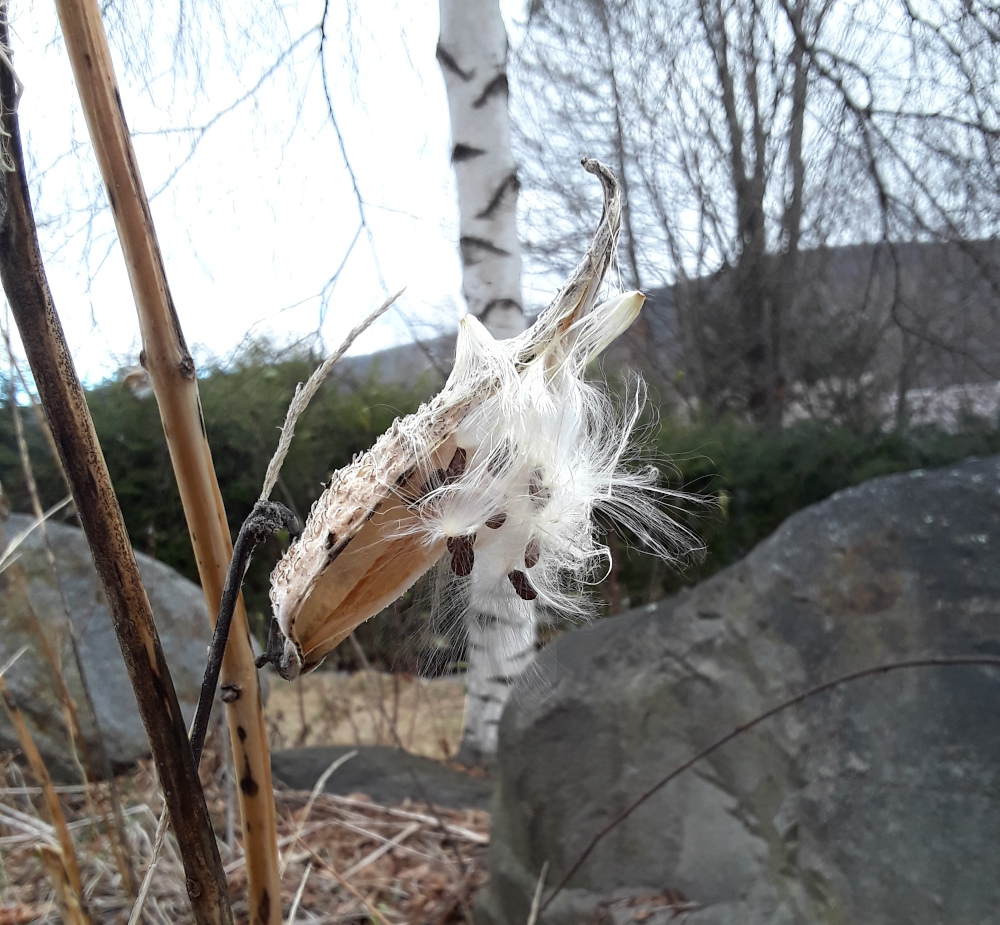
bursting milkweed pod hanging between rock, birch, and sky

So now… I spend alternately painful and peaceful hours in meditation. I walk in the fresh air whether it’s warm enough or not. I drink another glass of water every time I pass the sink. This will pass. This will pass. I still live, so I must breathe and keep on. This will pass.

It’s now a week … and already the formless future is beginning to gain a bit of shape. It’s nothing like what I’d imagined before. I imagine nothing now. I wait to see what emerges. So far, my family of origin is leaping onto their shining steeds; high school friends are posse-ing up with an offhand, “That’s Buxton; we look out for each other”; and a meditation center that works for me and a glowing kindred spirit have popped out of the fog, pointing out a way before me.

Meanwhile, the milkweed is bursting its pods — a glorious, silken, dizzyingly delicate reminder of the peaceful beauty of letting go…

Outrageous fortune is starting to come from a different direction now. I will feel whole again someday; I feel it in the wind.

Hours before leaving the city after all that horror, my driver’s-side wing mirror got creamed. The rest of that side is fine, hardly a scratch, but… no wing mirror.

As metaphors go, it’s probably good advice:

Stop Looking Back.

3-4 solid tools for tough times

(If you’re looking for my housing-search info, go here for the latest with all the tables, and here for the one before that 🙂 )
I’ve often remarked that one of the really SPECIAL things about CRPS is the way it essentially “re-traumatizes” the brain: in many ways, it duplicates what happens to the brain when horrific things happen — car accidents, war, etc.
That’s so not right.
This is why we tend to be a leeeeeetle intense at times, and why those of us who survive it long-term become Jedi masters about managing how we appear to feel and how we manage how we really feel.
A key component, as many of you are well aware, is helping yourself find and develop the tools that let your brain process the endless hurt, integrate useful lessons, and release the bitterness, day by day by day. 
 
This is where a regular inner practice comes in handy. I’m sure there’s something most of y’all have got going, possibly related to CBT or DBT or mindfulness, for anxiety, grounding and self-calming; these are great tools. To strengthen yourself further and create more resiliency, try taking that to the next level in some way.
Here are some tools from my life and from survivor workshops and so forth. Individually, they’re amazing. Together, they’re mutually reinforcing and geometrically powerful. They are:
  • Free writing
  • Journaling (not the same thing at all)
  • Disciplined movement
  • Some kind of meditation
 

A. Free Writing:

1. Set a timer or page-count. If possible, use paper and pen rather than keyboard.
2. Once you start, just keep the pen moving forward, no crossings out or edits, just keep the pen moving forward. 
3. When the timer/page count is done, stop right there. It’s okay to finish the sentence, but stop.
> This does something important, which we don’t really have language for but which is absolutely primitive-brain-supportive, that helps de-sting one’s thoughts and experiences.
> Start as short or long as you think it would be successful to do, and go from there. Time spent doing free-writing is never wasted, but running around and art are good too.
> Walk away and do something physical or practical afterwards.
>> Take at least 2 hours before coming back for another round. The brain needs the integration-rest-time, for this to work.
> If you leave out any of these points, then you’re journalling, which is also great, but it’s a totally different strategy as far as the brain/mind/emotional landscape is concerned.
This technique is particularly useful after school, after a big incident when the feelings have calmed down but the mind is still recovering, or before starting a big project.
 

B. Journaling:

1. Put it outside the head and onto a physical medium.
That’s it.
> Journaling can be written, drawn, painted, danced (if filmed), sculpted, photographed, montaged, whatever. Out of the head and onto/into a physical medium.
> We journal for ourselves alone. The writing, pictures, even the dance footage, are not for showing. They might be shown later, after the period of life has passed, but that’s not the point. More commonly, they lay the groundwork for exponentially better art that’s made later.
> Keep them close, where they can be consulted by the one who did them. Nobody else is involved.
> Journaling exteriorizes and preserves our thoughts/feelings/subjectivity so they get less “gluey” and less scatty and become easier to handle.
> Looking over a period of life’s journals can be a great way to shine a Klieg Light of God on things, and free you up to make great changes quickly.
> It’s compost. Don’t expect it to be sweet or glorious, just let it compost. It pays off over time.
 

C. Disciplined movement

Of any sort: dance (Traditional, hip hop, jazz, modern, square, anything), t’ai chi, yoga, playing drums, gymnastics, long-distance running, group sports (plenty of opportunities for seeing both useful and silly ways to handle conflict), canoeing, sailing, etc.

Big grinning woman in spectacular Hawaiian ceremonial dress dancing with her arms
Photo: Joanna Poe in Honolulu
> This literally helps organize the brain, especially a growing brain, most especially that of an intelligent child.
> It also helps regulate neurotransmitters to a healthier balance.
> The body working under specific direction of the brain is enormously neuro-protective and re-balancing. Nothing else works half as well for the brain, the mind, the feelings, and the immune and digestive systems, as disciplined movement. Its value simply can’t be overstated.

D. Meditation

Of any of several kinds.
It seems most useful to have a couple of different kinds of meditation, so if you’re not up to one, you can do the other, and the benefits are mutually reinforcing.
1. “Still” meditation is mostly based on breathing with attention, and once that gets more natural, there are progressive layers of using attention & breathing to strengthen, stabilize, and regulate inner life and responses to outer events in life.
2. “Standing” and “Moving” meditations are often easier than still meditation when it’s harder to focus. The posture and/or movement provides a way into the meditative state.  Also, it qualifies as “disciplined movement.” Two-fer!
> Different methods of “still” meditation only become interesting once you’re generally pretty comfortable with sitting and breathing, and being able to put your attention on some place in your breathing path and just rest it there. (Feeling the air come in at the tip of your nose. Feel it come down to 2″ above your navel. Or rest your attention on any place in between. I love the feeling of it moving in my lungs, so that’s where I focus. My mom focuses on the tip of her nose. Just pick one and learn to rest your attention there — with a naturally-upwelling calm delight, yum! — while breathing.)
> Set a timer, and respect it — just like with Free Writing. For that period of time, all you have to do is the meditation, of whatever kind. It’s okay if it’s boring. It’s okay if it’s frightening — you’re actually safe and okay, and it’s okay to breathe through the feelings and let the time pass. The timer is your safety net. Remember that it takes about 5 minutes before and after meditating to transition, and that’s okay too.
> “Standing” and “Moving” meditations come in millions of styles and schools. These include yoga (hot, cold, slow, fast, many schools!), t’ai chi, qi gong (thousands of schools), judo (those who engage in judo are referred to as “playing” rather than “fighting” judo — it was my first martial art; surprised?), aikido, Shaolin — in fact, any martial art with a great teacher… and of course these come in styles relevant to the countries in which each particular school originated — Japan, Okinawa (my Dad’s karate style), China, Tibet, India, even France (savate) and Brazil (capoeira)… lots to choose from.
 
I’ve found that most more-detailed techniques of managing and clarifying thoughts, feelings, and decisions are basically variations or elaborations of these 4 core strategies. Play around and find what works for you.
 
I copied this from a comment I wrote on social media. So many of us need reminding, especially me. I’m so frightened and overwhelmed myself, I want to put this info where I can grab it quick.
Off to set a timer and do some t’ai chi.

Interim choices

After my head exploded last month, it took awhile to recover. It wasn’t happening while I was up to my eyeballs in what I can’t do and can’t change, even with daily Epsom baths and extra antioxidants. So, I visited Mom for a bit, soaked myself in her hugs and books and art and homey-exotic collections of interior dec from my upbringing and her subsequent travels, had lunch with my cousin (who did an outstanding job of mental chiropracty on my crippled thinking), and came home almost ready to face my current world.

Which looks something like this:

  • Approaching the hard deadline for leaving my rented home.
  • Lump of expensive metal sitting in my driveway, not driveable.
  • Housemate & ex-fiance (who asked me to marry him for 5 years, until I said yes, then refused to set a date) who really truly simply can’t choose a life-ward path but is increasingly obsessed with orchestrating his end… with frustratingly irrational obliviousness that that’s what it is. I could write a book about this — it’d make a fascinating novel — but confidentiality forbids.
  • Understanding that, after 7 eventful years together during which we’ve saved each other’s lives more than once, that’s not the choice I make every day I rise up against my own pain etc,, but HIS path is not MY choice to make.

Okay, bluntly, that’s:

  • No safe-enough home.
  • No working car.
  • Newly “divorced.”
  • Expecting to be imminently widowed.
  • Helpless in the face of most of this.

And this is where I tune into the meditative practices, because there’s a way I’ve learned to breathe that lifts my heart and brings me into life, no matter what. Helps me let go of the need to care FOR someone as much as I care ABOUT them. Releases him and his future to the care of the cosmos, which is a lot bigger than me, and has a different perspective on life.

I have to get back to writing perky posts! I have to live with this heavy stuff, but it doesn’t usually set the tone of my being. I can’t allow despair more than a look-in, so I’ve learned what it takes not to.

…Breeeeeathe…

It’s probably needless to say that I prefer to stay on the kindest terms possible. Keeping my connections pleasant is hugely important in managing the underlying chaos of my system, so my nerves have less to be jangled by. One of my personal mantras is: Someone else’s bad behavior is not an excuse for mine. Sounds rigid, but it works well in the service of my larger strategy of keeping my system on a more even keel.

Here’s where I huff on my nails and buff them on my nonexistent lapel: I stopped 4 efforts to start an argument in 20 minutes yesterday, and I only pulled one of my old habits of “managing” his tortured thinking 3 times throughout the day. Just letting it all go. He is his, warts and all. Only he (I think) will have to face his consequences.

I also found a couple of possibly-soft-enough-ride cars I should be able to afford, with a bank loan. Just need to arrange the ride to check them out.

Here’s a little cherry on top of the hopefully-expanding sundae of possibilities: the ugly and ill-considered business choices made by the dealership who sold me that expensive hunk of metal, can be addressed by filing online (no car trip! No need to collect and print my documentation & evidence ahead of time! No repeat visits!) with the state’s Consumer Protection department. PHEW! I’m happy to let the authorities tackle this while I deal with my present needs.

Life is short; keep it kind. Be good to each other.

3rd panel of triptych: The action of deciding

This is the third panel of the triptych. It took awhile to write. You’ll see why soon.

First panel: my pre-CRPS decision mechanism broke, but look! There’s a hack for that! Using remaining fragments, bubble gum & baling-wire, and lots of patience, I can still stagger through even fairly complex decisions.

Second panel: Speaking of complex decisions, I’m looking for a home that meets my physical needs and my financial limitations. Turns out, there is no such thing… Yet. Crossing every available digit and getting really creative.

Now: I’ve been mulling the origin of the act of deciding. When does that happen? It goes by so fast sometimes, I find myself dancing on a spinning log of results before being aware of stepping onto it.

It’s my nature to leap to a decision and be told I’m going off half-cocked, but what I’m doing is processing huge amounts of information very quickly at a largely subconscious or pre-conscious level. I can haul out all the arguments pro and con on no notice, if anyone wants to hear them.

At least, I used to. It’s CRPS’s nature to pour a whole lot of crude-oil over everything between my ears, so things just don’t happen that fast in there any more, and the gears are more likely to slip and chatter. So, I go through a more iterative process and take much more time. If I could adjust my expectations of myself accordingly, I’d be all set…

At the moment, I’m viewing the action of choice with great intensity. I’m convinced that decisions are especially difficult, especially fraught, and especially crucial, for people with CRPS. (Not that this is a competition. If what you read fits, just circle it and write, “me too.”)

Layers of decision-ing:
Conscious vs. Unconscious

So much happens at the unconscious level before we even are aware of having a choice, that it’s impossible to discuss a mental action like choosing without acknowledging some of the most important barriers to thinking clearly in the first place. These are factors that many spoonies (and all CRPSers) have to live with and figure out how to handle, or decide not to handle and just be driven by them instead. (The enormous initiative required to deal with them is overwhelming, so I gently suggest being tolerant of those who don’t, or feel that they can’t, circumvent the circus acts desribed below.)

  • PAIN: Acts on the most primitive brain, and the primitive brain can’t think past the moment. Not its job.
    • Takes a good set of pain-management tips and tools to nudge the primitive brain to the back of the car, so reason can drive.
  • FEAR: Fear hijacks the amygdala and activates the fight-or-flight syndrome. Hijacked amygdalas distort the brain’s function even further, and the fight-or-flight response further destabilizes the already-wobbly central nervous system.
    • This is a one-two punch for CRPSers. It takes a lot of training and practice to work around that, but it usually can be done.
  • The MONSTER: know thy (current) self. Those of us with horrifying illnesses sometimes feel and seem like we’re taken over by some horrible, biting, unpleasant person who looks and sounds a lot like us, but doesn’t act like we normally intend to. This is tough all around. I find myself being emotionally hijacked — say, by a food allergy response, or a surprise pain flare — and, as I’m sitting there with tears of rage and fear pouring down my face and snarling, inside I’m going, “What the hell is going on? Why can’t I stop this??” It’s The Monster, and it’s off the leash.
    • Because I self-monitor so much, I can usually catch The Monster before things go too far, and I sequester myself (that is, I hide) and do distraction/self-care/Epsom baths/whatever until I’m back in charge as (& of) myself.

Bases for decisions: Information — & Certainty

When is the info in hand enough — both in quantity and quality — to base a decision on? (This is where I really miss those old rapid-processing days.) More fundamentally, how can I tell? Because determining and sorting the value of info is yet another, even higher-order level of processing than collecting it!

Having to make choices based on inadequate, unreliable, or unknown-quality info is a far more common task post-CRPS than pre-CRPS. Stumbling around in the dark and guessing, hoping for the best or maybe for the kindness of strangers, is not yet a default, but it sure is more common.

At some level — probably that mile-high view that my “wise self” hangs onto, whether or not it’s talking to me at the moment — it’s funny to see a super-clever type A whizz kid with delusions of promotion, like I used to be, stumbling around in the dark here. There’s a poetic justice to that, um, adjustment that even I can see. My darker side, perhaps, which I usually inflict only on myself.

“There’s always an afterwards”:
Sequelae & Consequences

Reality doesn’t care what drives my decisions; the “afterwards” I face is going to be what it’s going to be, and derive largely from the choices I make — not the ones I wanted to make, or was unable to make, or wished I could have made. They stem directly from the choice I did make, consciously or not, emotionally or not, rationally or not, wisely or not. It takes, again, a lot of practice and some basic training to keep in mind that there will be an afterwards, and force myself to make the decision that results in a better afterwards — even if it’s less satisfying at the time.

The increasing intransigence of reality is really annoying! Can’t it work with me a little more? Sigh.

The older, poorer, and sicker I get, the less flexible the world around me gets. Being young and perky was all kinds of help — I had no idea!

everyone over 50

I distinguish sequelae (|suh-quell’-eye|) from consequences like this:

  • Sequelae are natural results of something. They may or may not be a problem, may or may not need managing, but they’re just what happens as a result of factors we don’t necessarily control.
  • Consequences are results that must be dealt with somehow. Assessing consequences is part of rational decision-making. Who could be hurt? What might it cost? What kind of damage, or benefit, could happen? They’re predictable, if we stop and think things through properly. So, there’s a level of responsibility involved.

We RISK possible sequelae. We FACE possible consequences.

Too much decision-ing:
What About Control Issues?

In the category of bottomless dopamine sinks…

Trying to control too much of my environment is a total waste of effort. It soaks up decision-making chemistry, burns through my attention like a bonfire, and creates a lot more anxiety for absolutely zero net benefit.

People who knew (or dated) me in my 20’s quirk up one corner of the mouth a lot these days. I’m happy to let anyone decide anything for me — as long as it doesn’t do any further harm. My emotional investment in things like where to meet or what to eat, interior decor, stylistic choices, what others should do — pretty much nil.

My emotional investment in being in control is tightly centered on protecting my immune and nervous systems. That’s about it. Anything that meets those (admittedly, enormous & far-reaching) criteria and then looks for something more from me gets a big, airy, sky-bright “whatever!”

I realized that control issues were really a type of anxiety. I have my past traumas, like most, and loads of current problems which are terrifying to contemplate, so it’s reasonable to be anxious. Not helpful, though. Anxiety stalls my brain out completely.

This ratfink disease forces me to choose consciously — and learn to enforce skillfully — what to let myself worry about. It’s one of the great lessons of learning to live with this disease. Speaking as someone who started out being mildly thrilled by emergencies and wound up, at my nadir, being unable to get out of my home and onto a bus because of long-legged terror looming and lunging at me, I’m the first to say that managing anxiety is a journey, a process, any of those things that won’t be completed in my life because it now is part of my life.

This is why I now meditate twice a day. I was mulling, about a month ago, how much harder it was to keep my temper or keep my brain ticking over at a functional rate. The Dalai Lama’s dictum came to mind: “Meditate for half an hour every day. Oh, you don’t have time to meditate for half an hour every day? Meditate for an HOUR every day!”

I’d gotten to the point where an hour before bedtime was not cutting it any more. Figuring the Dalai Lama has never steered me wrong so far, I added another hour (or so) of meditation, after my morning pills go down.

I retest that now and then, but sure enough, if I don’t have time to meditate for the morning hour, everything takes longer and everything gets worse. If I do take that extra hour, I’m a lot clearer and my rate of being able to get things done — and to know, moment by moment, what I’m most able to do as my “glasses” change — surges up to a new normal. I’d like to get used to that — but never take it for granted!

Counter-intuitive, to say the least, but I care more about what works than about what I understand or believe.

Now, back to wrestling with reality to create possibilities that don’t currently exist… No hurry, though — doing the impossible usually takes more effort; might as well do it right the first time.

Dropping the ball… and kicking it along for a bit

To cut a long story short, I wound up with insufficient medication before my next pain doc appointment, and had to cobble together my full dose by using 3 smaller-dose tablets. Periodically over the last month, I’ve been peering quizzically into my bottle and wondering if all those little pills were going to last long enough.

Late last week, I finally had few enough that I could count them. (Due to perceptual issues, looking at a lot of little identical objects makes my eyes swivel, and I can’t keep track of them, even if I pull them out a few at a time. They appear to dance and swim without any help.)

Well, I had a problem. I couldn’t parse what to do about it because I didn’t know who to ask. My pain doc had been a bit more high-handed than usual at my last appointment, so I didn’t expect sympathy there, especially as it implied his math was wrong. I knew my GP would feel understandably uncomfortable prescribing a med he didn’t know well and didn’t normally use, which was normally prescribed by a high-flying specialist in a narrow discipline. That’s a lousy position to put a GP in.

I froze.

Stylized image of woman asleep with enormous red and black dress billowing around and supporting her. White snow falls from a deep blue sky

So, regardless of the record heat and shocking floods elsewhere, New England has been cooler than usual, perpetually cloudy, with the Spring rain pattern (3 days and nights of constant rain, one and a half days of sun, a day or two of mostly clouds, 3 days and nights of constant rain, rinse and repeat.) This does tie in — really.

The reason it ties in is because summer gives me my recovery time, which involves sun and warmth and outdoor activity. 3 months of sun, warmth, and outdoor activity is what makes me strong enough to endure a New England winter.

It was so gloomy and chilly this summer, we dug up the money to go to California to recharge our bodies’ batteries. That didn’t go according to plan at all. As some of you know, I had viral meningitis from the day after we landed to 2 days before we left.

So, not much recovery, just a whole heaping helping of extra damage to recover from!

Then, of course, I had a relapse 10 days later, just in case I was getting too perky.

This summer has left me with a brain that’s just not up to par. So, rather than doing my usual thing of targeting the issue and parsing its components and figuring out what solution solves most of the elements, I … froze.

Stylized image of woman asleep with enormous red and black dress billowing around and supporting her. White snow falls from a deep blue sky

I started cutting the third of the 3 little pills in half, and taking two and a half, so I could buy a little time to think. Since that works out to my normal summertime dose, I didn’t question it much. It occurred to me, just as I’m writing this, that it has really crippled my ability to think, so that was not my usual problem-solving level of skill. Sigh.

I honestly can’t remember how I wound up on the phone with my doctor’s office on Friday. Wait, after 5 minutes’ cogitation, I do: I hadn’t heard from referrals my primary doc was supposed to have written 2 weeks before. Usually right on top of things, he had documented that he intended to make the referrals, but forgotten to enter the orders to do so.

The compassionate office lady asked how I was, and it wasn’t until then that I said, “Actually, I’m kind of in a bind,” and explained about the meds. To my complete lack of surprise, given how things have been going, it turns out my primary doc is on vacation this coming week. She left a note for whoever’s covering for him.

Since then, of course, I’ve been trying to work out whether I should call during the weekend, when coverage is even weirder and less accountable, or wait until Tuesday and the first day of business this week, and try to coherently answer the question of why I didn’t call sooner, and hope and plead to get my meds from someone who doesn’t know me and is working too hard to feel for one more sad case.

So … I’m froze.

Stylized image of woman asleep with enormous red and black dress billowing around and supporting her. White snow falls from a deep blue sky

Meanwhile, my feelings and my disease-driven propensity to worry paralyzingly, are all honed to a ridiculous edge. Once my pills get past the cannon-ball feeling in my stomach (almost past the half hour mark; 15 minutes to go) I’m going to do an hour of meditation, which I expect to roughly track the pattern of the meditation I did during the meningitis episode: 20 minutes of pure inward flail, breathing quietly while my mind and emotions just went off like a carton of firecrackers spilled on a brush fire; then, once that calmed down, my thoughts chased each other like frantic squirrels for another 20, not slowing appreciably until the last 2 or 3 minutes; then 10 minutes of one or two issues or ideas holding fairly still, allowing me to turn it over until it’s transformed into something peaceful by the pure attention; and then the rest, finally, gradually, moving into a pure and floating calm.

They say that one should meditate for an hour every day. If you don’t have the time for that, make it two hours. I hold this as a constant goal. Sadly for me, I can normally only push myself to sit down and shut up like that when things are so bad all I can think to do otherwise is scream.

I need to work on that.

This was going to be the year I learned to meditate and do t’ai chi pretty much daily, no matter what level of peace and calm there was in my life. I’m embarrassed that, even at my age, I still seem to need some chaos to let me bring enough pressure to bear on myself that I’ll do these key self-care activities at all.

Something to mull over in the contemplation stage of some meditation!

Fixing the brakes

Interesting week here.

A dear friend is embroiled in one of those ghastly legal tangles where the vultures are rigged to win. I’m the key defense witness. This comes up later.

This whole winter, I’ve been basking — simply basking! — in the sheer delight of being safe, sheltered, warm, loved, and with as little chaos as anyone with a recent move, a complex illness, and widely scattered relationships can get. Occasionally, I’ve wondered if I’m allowed to be in such a situation, and strained my ears for the sound of the other shoe dropping… Then I do a reality check, tune in with my lovely partner and my lovely housemate/hostess, and it appears that no, it’s okay, things are right, and this is what’s right now.

My nod to the fairly relentless self-management that got me through the past decade has been an occasional effort at meditiation, a minute or three of qi gong, a few moves of t’ai chi now and then, or the occasional mood-check.

In short, diddly-squat.

In December, I lost it with a dear friend.[LINK] I did more mood-checks for awhile, a bit more meditation, maybe ten whole minutes of t’ai chi every other day for a couple weeks.

Diddly-squat doubleplusgood.

I was heartbroken at the mess I’d contributed to, but couldn’t dig up the motivation to really “do the Do”, to restart my hard-won disciplines.

Dear heavens, it was soooooo good to rest, just relax for a change, enjoy the sensation of not looking over my shoulder and not being constantly *forced* to calm sometimes-legitimate terror or possibly-reasonable panic.

It was winter. I was safe. I let my disciplines sleep.

Meanwhile, the brakes on my car[LINK] were acting up, or rather, occasionally failing to. $2,000 later, that was supposed to be fixed.

Gradually, I noticed that J was telling me, more and more often, to lower my voice: “I’m right here!” Huh. I didn’t think I was talking that loudly…

As I relaxed, other humans became more interesting and I started striking up conversations with strangers, as I used to do. They didn’t respond as well as they used to. Odd…

On social media, I found myself being snippy where I used to be sweetly witty or wryly amusing to make the same point. I backed off of my online time, because if I can’t manage myself well, I’d better not interact with anybody else who might be feeling frail. “Do no further harm” has been wired into me from way back. It’s the most basic courtesy.

I took the car back for a second brake job a few weeks ago, only $150 this time, and that seems to have taken care of the problem. So my cynicism about car dealerships remains unimpaired, thank you.

Meanwhile, there were some tellingly unpleasant procedures[LINK] which illuminated a fact I’m still failing to accept: CRPS has moved into my viscera — it has leaped out of the musculoskeletal bounds and gotten right into my core. I used to say my case was “all-body”, but that was because of the gastroparesis and subtle endocrine weirdness, which I figured was simply faulty autonomic signaling. It has definitely become much more.

I could feel every line of my intestines and the springy squashiness of my organs as the ultrasound tech noodled around on my abdomen, and the less said about the gynecological exam the better. It’s real. It’s a bed of coals in there. This finally sank right through my skull over the past few days.

Damn damn damn damn damn damn damn damn damn damn damn damn damn damn damn. With extra damn.

So, now we’re up to this week.

I spoke with the lawyer involved with the vulture case mentioned above. I went off on a tear about the duplicity and injustice involved. He finally broke through by howling my name in exactly the tone my mother used when I was getting out of hand. Once I was quiet (and abashed), he said very sweetly, “If you’re going to go on like that, you might as well hit your friend over the head with a two by four.”

Two things happened. I realized that my self-regulation was much worse than I had ever imagined; and I spent the day in a state of total exhaustion and emotional fragility, the classic signs of a massive adrenal-dump.

SIMPLY GETTING WOUND UP IS BAD FOR ME. The mere state of emotional excitement is poison to my system.

I used to know that.

I used to know when the emotional excitement was coming, and could head it off.

Nope. Caught me completely by surprise.

So, I’ve been processing all this for a few days to a few weeks now. I’m coming to some conclusions, and have a few remaining questions.

I’m pretty sure the spread into my viscera had a lot to do with the merry-go-round of the past few years.

The spread in my brain may be related, in fact it must be; however, I’m pretty sure that re-incorporating my habits of self-care and diligence can get back quite a lot of the gentle precision, sweet tact, and pleasant diplomacy I was once capable of.

So, in keeping with this revelation, I’m going to acknowledge that I’ve completed my alotted time for being on the computer and get up to go do some morning activity. Then I’ll put my feet up for a bit and lunch on brain-supporting food. After a digestion break of an hour or two, I’ll do something physical in the afternoon, including 20 minutes of t’ai chi or qi gong. After that, an hour of work, which today will consist of loading my classical collection onto my tablet. This evening, I’ll spend an hour listening to classical music, then meditate, then apply my lotions for pain and muscle spasms before bed.

There are no bloody shortcuts. None. It’s just work, and it doesn’t stop.

I’m still supremely glad to be safe and warm and loved. I just have to wrap my thick head around the fact that it doesn’t mean I’m off the hook for taking care of myself.