A friend I’ll call A died of suicide last night. It’s easy to say of people that they are rare and radiant souls once they’re gone, but A is the sort of person who was generally agreed to be a rare and radiant soul even when she was alive. Pretty angelic, really.
Suicide is a tough gig for all concerned, but being suicidal is living hell. I’m going to try to present some information in an accessible way, but this is an emotional time (it’s also deathiversary season for some of the biggest losses in my life, and there have been more deaths than usual this winter) … I’m very upset and very angry. It’s liable to show. Anyway, here goes…
Most of the time (not all the time), the deed that causes self-death is impulsive, which is the point of the 3-day hold in psychiatric hospitals: get them over that bump, then their coping skills come back, and then they find a way forward.
In cases like A’s, some survivors want to know why our loved one didn’t reach out, didn’t let us know ahead of time. Some want to know why this person “didn’t love us enough to stay.”
That’s a common feeling after suicide. These are all very common responses. Thing is, they miss the causative point.
Reality check
Here’s the thing:
Stop being so selfish!
It’s NOT ABOUT YOU. This is a tough one to swallow because you’re the one left alive and hurting, but it’s something to be faced in order to understand how this could happen.
It’s about being in so much pain that continuing is intolerable and there is no way this person can find to make it stop. Can you even imagine that? If not, then who are you to judge? If you can, then why are you blaming the victim?
Do you think she didn’t try hard enough, or know enough to battle this more effectively?
Actually, that’s a fair question. Some people don’t know enough, and need the chance to breathe, reboot, and find another way forward. (Most people who attempt suicide fall into this category.) It’s not an unreasonable thing to ask, so let’s look into that.
Some things can’t be fixed
My lovely friend A was a sophisticated, educated, well-informed consumer of, and professional in, the health care industry and effective alternative therapies. She really knew her way around.
I have a pain disease that, if I have to be truthful, hurts more every year. I’ve had over 15 years to ramp up to my present level of unthinkable, brain-blistering agony — and to find ways to manage it along the way. I can kid my mind most of the time that the pain is hardly there. I’m not likely to kill myself any time this year, though I might get flattened by a bus in a fit of absent-mindedness due to masking too much pain… you never know. (I’ll keep wearing bright colors and getting assistance around town, so don’t worry unduly, Mom!)
My friend A had a painful condition evolve recently that wouldn’t budge despite much work, and a surgery with… interesting characteristics. I sure don’t need to spell that out for those of you who’ve had, cared for, or performed surgeries. One of her main nerve branches was involved, which tells you the rest. It was risky, tough, and fraught. She knew that. Surgery was the only way to avoid the dreadful situation she faced if she didn’t have it.
By the time she made her last tragic decision, A could easily have been in a level of pain comparable to what I live with, but she did not have 15 years to ramp up. Most of that mountain of agony landed on her inside of a few weeks.
She knew what was going on in her body and worked for years to correct it without surgery.
She knew what the surgery might result in and she tried it anyway.
She knew her options.
She knew what to do to mitigate risk and optimize healing.
It’s likely that she did everything that could possibly be done.
It’s likely that there was too much pain and no way to escape it.
Sometimes, some things can’t be fixed.
I respect her choice. I hate it, it makes me miserable, but given the circumstances, I respect her choice as I respect her right to make it.
I don’t blame A. I wish that things had been different for her.
Please remember the compassion that was at the core of her spiritual and professional life, and return it to her as well as you can. She may need your compassion more than ever, because the end of her life was so awful, and she worked and fought so hard to make it.
She loved you. She loved us all, in her endless outpouring of loving-kindness and intelligence and determination. Please, try to give some of that back to her, now when it’s no longer easy.
Step Up
Of course you’re angry to lose wonderful people to suicide. Want to do something about that?
Vote for universal health care, so people like A can get timely care and prevent minor issues from becoming major ones and then becoming deadly nightmares. Because this should not have happened in the first place.
Lobby for universal housing and emergency accommodations in every state, so people like my brilliant friend Cross don’t have to choose between being murdered by a caregiver or taking their own lives, because NO OTHER OPTIONS EXIST.
Get your elected representatives to re-fund, and stop de-funding, mental health services and social safety nets, so my gifted friend Ethan didn’t have to shoot himself in the head to make the PTSD nightmares stop. Every dollar spent on these programs saves between 10 and 800 dollars in the costs of cleaning up the failures resulting from their absence. Our economy cannot afford that kind of constant, suppurating loss.
YOUR VOTING RECORD AFFECTS THE SURVIVAL OF THOSE YOU LOVE.
Don’t step into the voting box in the hope of choosing your next drinking buddy; the POTUS will never drop in at your neighborhood dive. Try to remember you’re voting for your next Chief Executive. This needs to be someone who’s smart enough and wise enough to do the job of leading a huge country that’s in serious trouble.
If you feel that, against reason and compassion, against economics and decency, you really have to vote against these policies or vote in those who oppose them, then don’t EVER complain to me about losing people you love to suicide, or maltreated illness, or poverty, or homelessness. These deaths are optional 99.9% of the time, and I have absolutely had enough of them!
This worm has turned
I used to be vigorously opposed to suicide. I spent too many hours coding people who had no choice about whether they lived or died, so that the occasional attempted suicides I treated in the ER just made the bile rise in my throat. Those idiots were bloody well going to live whether they liked it or not, and if they reached consciousness, they were getting a short and fiery talking-to from a short and fiery RN.
One day, I confided my thoughts to a longtime trauma counselor. She stopped me dead when she said, with great pain and exquisite kindness, “They do that because they can’t think of any other way to stop the pain.”
I tried to imagine so much pain and so much trapped-ness… and I couldn’t hate them any more.
And then, years later, I developed CRPS… then fibromyalgia… then dysautonomia… and, this week, I’m getting screened for a couple of cancers.
Those of you who follow this blog know that I spent a few years clinging to life by a thread. The pain, disability, and relentless, pounding losses and brutality of the world on the suddenly-disabled, on top of an ongoing roster of bereavements around me, very nearly finished me.
I was suicidal for some of that, only I was not going to screw it up; if I did it, I was going to do it properly. So there were no attempts, there was a thorough exploration of the idea. (At the very bottom of my personal root under the final level of Hell, I found … curiosity. I could not rest until I found out how this story went. Not only would I miss my funeral by several days, I’d never find out if we got a cure in my natural lifetime, if I ever figured out how to blog, what exactly CRPS is, who I had yet to meet, or anything. That was more unbearable than pain for me: unsatisfied narrative curiosity. I can’t explain it, I can only report it. I’m still working out how to crash my funeral.)
The point is, I’m pretty familiar with the landscape of endless pain.
I understand, with diamond-sharp clarity, that there is a point where a person simply shouldn’t have to put up with any more.
I know, as I never did in the innocence of my ER days, that there is such a thing as No More Options.
The word “unbearable” is no longer just an adjective; it has real meaning. Some things should not be borne, and that’s bad enough, but some things really cannot be borne. What then? Do we turn our backs and shrug, feeling we’ve done our jobs?
Those who’ve survived the suicide of someone you loved, you have my absolutely heartfelt sympathy. It’s awful, peculiarly and specially awful. There’s nothing like it.
If you’re really outraged, turn your anger onto a suitable target: the systemic failure that made that cherished person’s life unlivable.
That would honor them, in a remarkably constructive way.
I’m off to make sure I’m registered to vote tomorrow. I don’t want to sit this one out. I’m torn up and miserable, and I want to honor the memory of A and all my dear departed angels.
In CRPS and dysautonomia, several parts of the brain get under- or over-enthusiastic (or both, unpredictably.) It’s easy to oversimplify, but even more confusing; each part of the brain has many jobs, so I can’t say that the anterolateral cortex does one thing and the cingulate cortex another.
I can boil it down by the effects that these remappings have, though. That’s relatively simple!
So, in me, this is what happens as a result of these scrambled brain bits.
1. Obviously, pain signals don’t know when to pack it in. That’s obvious. They just keep going and going and going and going and…
2. Coordination gets impaired. I used to be freakishly well coordinated, so I don’t normally get much sympathy, but this is a bit unfair.
I had 38 years of knowing exactly where my body was in space, of being able to move without triple-checking myself, from the time I first learned to walk. Or, rather, the time I first learned to climb out of my crib. … Several months before I was steady enough on my feet to toddle, I’d do a layback (a climbing maneuver where you grab one edge of a gap with your hands and then walk your feet up the opposing surface) to get up the side of my crib…
Feet push, hands pull, and you go upwards. Photo JMiall on Wikimedia Commons.
…then rappel down the rails and crawl down the hall to my parent’s room to let them know that it was almost dawn and I was ready to play.
I also learned to jimmy the rails so they came down altogether, but that took a little longer. More engineering and upper-body strength involved, you know. (I got a bed well before I was two. They figured it was safer.)
I’m not used to living in a world where my body isn’t exactly where I think it is. I probably take more damage than someone who’s been this poorly coordinated all their lives, because there’s this huge layer of bewilderment and surprise. Not to mention lack of preparedness.
I don’t compensate for it unconsciously — I have to be very conscious about being careful bending over, walking not running down stairs, always wearing de-skids when I go outside in the snow. This requires a bit more bandwidth than just doing things as you normally would.
3. The third and most annoying thing is, my brain just LOVES to go to anxiety.
Anxiety is a bit of a circus. It pushes up my blood pressure and makes my heart beat fast, which is worrisome in itself. It makes my vision go whitish, like everything is covered in fog. All this makes it rather hard to think, to reason out whether I really have cause to be anxious.
Then my stomach starts nudging the back of my throat, which is never pleasant. I keep ginger near all the time, because Tums just make it worse and I can’t stand Rolaids or any of the others.
Then my waste systems get into a tizzy and I feel like I have to go wether I do or not. If I don’t need to go now, then I will in half an hour, because (as I’m sure you remember from anatomy class!) the adrenals sit right on the kidneys and when your adrenaline goes up, so does your kidney activity.
So, on an eventually related subject, I recently got worked up for endocrine and allergy issues. The tests are still rolling in. A couple of blood tests were funky, so I need to get screened for gynecological cancer, and I need to get checked for pancreatitis — which, with my squeaky-clean life, would be decidely, wildly, completely idiopathic — if it isn’t cancer.
Naturally, part of my brain is throwing up images of a midsection riddled with malignancies. I’ve seen a few of those, so it’s not a big stretch.
That’s it, I’m doomed.
Blood pressure.
Heart rate.
White fog.
Stomach… wait, the stomach goes with the pancreatitis.
What notion of reality am I in now? The cancer one or the anxiety one? Because I can ignore the anxiety one — OMG I might have metastatic cancer! Everything’s turning white! My heart’s going too fast! AAAUUUGHHHH —
And this is where my head starts spinning around and the pea soup comes out at projectile velocity.
Not really. It just feels like being in a horror movie sometimes.
I’m lucky. I have a sense of humor. I just think about horror tropes when this circus starts, and I snort and calm down a little bit.
I have to jump on that first lowering of tension or it spins right back up. This is the dysautonomic brain at work — getting right back to panic is the easiest thing for it to do.
If mentally reaching out for my anxiety dials and trying to turn them down doesn’t help, then the very next thing to do is yawn.
It’s an incredible tool — no bad side effects, many uses. Plus, you can do it in company.
Let me explain.
Yawning starts with pulling air into the deepest part of my lungs. I can imagine it going all the way down my spine and filling the bowl of my pelvis. My ribs reach out and stretch nicely. This deep breathing is the first key.
The second key is that my jaws open up wide, releasing that clenched set of muscles there. It’s impossible to grit teeth while yawning.
I may find myself in a yawning cycle — yawn after yawn, for a good five minutes. I figure I need it. All that oxygen, all that jaw-releasing… hard to beat.
Now that my torso, shoulders, neck, and jaws are unclenched, now that I have enough oxygen circulating to let color come back into the world … now I can begin to cope.
The first thing I do, before getting up, is check my breathing. I’ve gone back to breathing from my belly, drawing air down to where it needs to go. Good.
The next thing I check is my head and neck. My jaw muscles feel softer and my neck is flexible; I give it a stretch or two each way to check. This is good.
This is a functional situation now.
Okay, I’ve done all I can. I’ve pulled myself out of the anxiety tailspin. I’ve made the next round of appointments.
As I keep telling others, don’t borrow trouble; all I can do is get on with my life while I wait for those appointments and their results. I’ll take it from there.
It doesn’t help matters that I’m worried about friends and acquaintances who are facing verified life-threatening situations. The background anxiety makes my own triggers harder to handle. But I’ve done all I can there, too. I have to accept my limits and hope for the best for them.
Editorial note…
It’s hard to see good people being treated like disposable objects. There’s something very wrong with that.
As a historian, I know that human societies go through these cycles where the empires get bigger, the oligarchs get out of hand, and then a lot of people die as the system falls over and much is lost, and then eventually a set of new systems arise from the rubble. Eventually some of them flourish, a few emerge as empires, and the whole cycle goes around again.
I hate being in a falling-over period of history. There is so much we could be doing that does not involve ripping people and nations apart to see how much money can be made from the minions before everyone dies.
Sadly, I don’t get to make that decision. I’m not an oligarch.
I have loads of advice for surgery and invasive procedures, so I might as well park it in one place. I used to be an RN and I’ve had this monster for over 15 years so I’ll share the key things I know, and others can add more about what they’ve tried or heard about 🙂
NUTRITION
One leg of my Holy Trinity of Healing: Nutrition, Activity, Rest.
ANTIOXIDANTS
With nerve or mitochondrial diseases, antioxidant support is absolutely critical and vitamin C is the cheapest, most bio-available antioxidant. It’s very straightforward — it basically works by refreshing and rebooting the others. The vitamin C protocols for surgeries and procedures with CRPS are simple:
500 MG per dose (more than that, and especially a fragile system will get overwhelmed and throw the whole lot away)
2 to 3 doses per day (2 doses for upper limbs, 3 doses for trunk and lower limbs)
Start up to 2 weeks before surgery
Continue for 3 months (12 weeks) after surgery
Have you had your D3 levels checked? If you’re chronically ill, do so. It’s becoming clear (finally) how crucial this is and how much of it our bodies need in chronic conditions.
D3 is critical for healing, especially joint and bone healing, as well as helping our calcium stay in bones and teeth, helping our skin, and maintaining soft tissue integrity. Get that checked when you can, but if you aren’t already taking it, get started. Something is better than nothing. Raise your dose until your serum vitamin D3 is well within normal range. This is important. The test is relatively cheap and easy to get.
FURTHER NUTRITION
Speaking from decades of clinical and personal experience, I’d add that this is the time to invest in a good, food-based multivitamin and take it with breakfast and lunch every day from now to at least 3 months after your procedure. After years of home care and being a patient myself, I have found nothing — absolutely nothing! — that speeds healing and reduces complications like really good vitamins. It’s like magic. Also, some science is beginning to emerge about the value of nutrition in handling CRPS.
I get my vitamins from vitacost.com, which has wholesale prices and lightning fast shipping, or luckyvitamin.com which has one week delivery. Amazon can sometimes meet those prices, and of course they make it very easy to give them your money.
The brands I can recommend are the capsule (not tablet) forms of:
RAW Vitamin Code (what I use), a Garden of Life line
Irwin Naturals
Garden of Life “My Kind” may be good; it’s new and I haven’t tried it, but its sister line is great.
NOW is normally ok, but it’s not something I’d recommend around a procedure. They’re great for the price, but not top tier. Their multis are tablets which are noticeably harder for fussy systems to handle.
For targeted supplements (Calcium, 5-HTP, DL phenylalanine, magnesium chelates, etc.) I use and recommend (as of 5/2017) these brands:
Jarrow
Pure Formulas
Doctor’s Best
Ester-C
Several other food-based vitamins used to be great but they got bought and really dropped in quality as the parent company squeezed their profits.
Several very famous brands, which I’m not lawyered-up enough to mention, are an absolute waste of money — go to the library and check out the issue of Consumer Reports where they investigated those.
Basically… don’t buy anything you can get in a major pharmacy. When it comes to meds, I always suggest discussing meds with your pharmacist, but when it comes to vitamins, the brands available to them are frauds with great advertising budgets, and they aren’t allowed to say so even if they know it.
Talk this over with a chronically ill person who is a vitamin geek, if you want more recommendations. Some health food stores have good vitamin geeks on staff. Ask around.
RECOVERY
This is based on the 12-week period that covers most procedures and most traumatic injury-healing. This is not for everyone, it’s not comprehensive, it’s just a generic brain-dump from one former RN and current chronic patient. If you’re planning to use this as a guideline, PLEASE take this into your doctor and highlight the bits that matter to you, so you can get a sanity check from the person who’s actually aware of your particular case and is guiding your care.
If your doctor expects less than 12 weeks, smile politely, bless their optimism, and plan for 12 weeks of intensive self-care as the better part of wisdom.
If your doctor expects more than 12 weeks, BELIEVE YOUR DOCTOR. If they tell you to stay in bed for a year, then the survival path and the wise thing to do is to stay in bed for a year. They simply don’t want you horizontal for any longer than strictly necessary, so take them seriously and don’t finesse it. Just don’t even go there. They’ll get you up the very minute it’s even vaguely safe.
Since spoonies are more likely than normal people to have a longer healing period, plan accordingly and mentally prepare a Plan B that includes yet another 25-50% of rehabilitation and recovery time. For each day in bed, figure it will take 1-3 days of activity to recover afterwards, depending on your basic fitness and cardiovascular tone.
It’s okay, don’t let the numbers scare you. I just button on my pig-headedness so it faces the right way, and make myself do the long, slow slog of building back up again. It’s hard work, but the time will pass anyway, and I want to be better at the end of it.
You are not a normal patient, if you already have something like CRPS. Don’t panic; there are lots of abnormal patients out there! You’re not alone. Just plan wisely.
EARLY RECOVERY PERIOD
Early recovery is a bear, but it doesn’t last long. Some things we just have to white-knuckle our way through, one breath at a time. Early recovery may be one of them. It will pass.
At this point, a certain amount of swelling is good and helpful, because it keeps the area flushed with nourishment and growth cells.
Keep your affected body part ABOVE HEART LEVEL if at all possible, to allow the “used” fluid to drain out. Your heart should be able to push the blood up that slope (dysautonomiacs and those with existing circulatory issues, watch this closely), but your body needs a gravity-assist to help it come back down. It also helps keep the pain down. Letting a healing limb hang below heart level will usually immediately increase your pain.
This is where you corral all the pillows you can get your hands on so that, during recovery, you can park that puppy up there and put your head down to lower the bar even further.
Work out a pain management policy in advance with your doctor, so you have a Plan A, B, and C for managing different levels of pain after surgery.
If you’ve had to go to the ER for pain crises before, then ask your doctor to contact the ER and arrange a patient-specific set of interventions for you in case you have an after-hours crisis after surgery. This should ideally:
Be time-limited to the post-surgical period,
Cover both pain and infection and whatever other surgery-specific complications are most likely, and
Indicate when/whether they should call your doctor/surgeon.)
This will save a whole lot of time and fuss, and would make me feel a lot safer about the post surgical period.
Not all ERs make it easy to do that, but you’d be amazed how much silliness a bit of surgeon’s bluster can cut through. The ER will find a way to capture and recall that information all right. They just need a little push sometimes.
Speaking as an old ER nurse, I felt a lot better about treating a chronic patient in crisis according to their specialist’s or surgeon’s requirements, than us having to figure out something so fraught on our own.
Pain crisis and post-surgical emergency protocols tailored to the chronically ill patient are a huge benefit to everyone involved.
There should also be a limit on how many ER visits before your surgeon gets called in, because if you need more than one (maybe 2 on the weekend) then you really need to be seen again by the surgeon on an emergency basis, since something may be wrong with the surgery.
Bones and joints
Those of you with bone and joint trauma or surgery, please be aware that the number 1 cause of non-healing bones is… using the darn things! Here’s the lowdown on fracture (and ligament) recovery:
For the first ~3-5 days, the “callus” is forming. This is the foundation of all the healing that happens after. There is no substitute. This is when there is the most swelling, and there needs to be: there isn’t much blood flow inside bones or connective tissue, so this is the best substitute. Extra hydration (to keep things moving through my tissues) and basic nourishment, featuring vitamins, antioxidants, and digestible protein, is my appropriate dietary focus.
For the next couple weeks, “knitting” is happening. The fractured ends are reaching across the nourished gap and, strand by strand, are pulling together. There’s no hurrying this process, but it’s easy enough to disrupt it, so keep staying off it. Supplementation with bio-available calcium (food-based sources are usually the easiest for the body to get hold of and integrate) with vitamin D, magnesium, and (according to some studies) boron and strontium, can be a real help with rebuilding the bone. I take phosphorus in the middle of the day, because it should not be released into my gut at the same time as calcium, because it’ll block it from being taken in. I take calcium, D, and the other bone-building supplements morning and night.
For the rest of the healing time, the bone break is turning that knitted lattice into solid bone which you will eventually be able to use normally again. I keep up the vitamin and mineral supplementation above, and, trust me, I did absolutely whatever it took to STAY OFF THAT FRACTURE until the bone had gone through its full healing cycle.
After that, it’s just rehab. That takes patience, pacing, and diligence, plus more pain that before, but normally, with the antioxidants and hydration and pacing, it does pass and the bone and muscle are all right at the end of it.
Ligaments take time. They don’t naturally have much blood supply, so they don’t heal quickly. However, with time, nutrition, diligence, and with moving enough to provide as much blood flow to surrounding tissues as your condition permits, these will normally come back in time too. Remember to go easy on that joint’s over-flexion and strain for a couple of years, because it won’t have the old elastic strength for some time.
Organ surgery and trauma
Abdominal surgery usually requires a coughing pillow, to protect healing and allow you to cough and clear your lungs without hurting yourself. (See the part on scar management.) The nurses should set you up with one, but any small, very firm pillow — or a bathtowel folded and taped into shape — will do the job.
Post surgical care for abdominal surgery boils down to:
Keeping your lungs working well. If you can’t breathe well, then you can’t do well. Simple as that.
Keeping your drains — natural and surgical — as clear as possible. (Tips: farts are good! Poop is great! Urine is the key to life!)
Keep moving in small, frequent bursts, so you heal faster — and to help with the previous bullet point.
And, for us painiacs, we add:
Managing pain, so the other stuff (breathing, excreting, moving) is more manageable in turn, and we don’t come out of it worse than when we went in.
You will be discharged with specific instructions about food, fluid, medications, antibiotics, wound care, and so on. FOLLOW THEM.
I know — antibiotics suck and it takes weeks of probiotics and soluble fiber and maybe Senakot to get our guts back in shape. However, the pathogens that can grow in there are far, far worse; finish your antibiotics and kill them dead.Then take the time to rebuild your gut.
I’d love to be able to say otherwise, but that’s the way it is these days; we as a society have to stop creating resistant organisms, and that starts with the ones we, as patients, treat in ourselves.
FIRST 6 WEEKS
The first 6 weeks is the “knitting” part, or, in joint replacement, the part where the bones bind onto the joint insert and make it part of your body.
Keep a close eye on your surgical area for signs of infection or rejection. Be sure your surgeon discusses this in advance so you’re prepared to take the right meds (might be as simple as Benadryl and Advil) at THE FIRST sign of trouble.
For these 6 weeks, the bone care and the skin/nerve care diverge.
Bones
With bone fractures or bone surgeries, NO STRAINING OR BEARING WEIGHT on that part. Do your prescribed physiotherapy if you have any, but don’t go *one ounce* over the line. Pushing it now is the surest way to screw up your healing and have a much bigger and longer-lasting problem.
Just stay completely off the darn thing, ok? Doesn’t matter what it takes.
I’m speaking as someone who crawled to the bathroom on 3 CRPSy limbs (think walking on hands and knees over live coals with hot electric wires sticking out of them, no kidding), 5-6 times a day, for this entire length of time, due to a broken foot. It sucked, but I did it. It was a nightmare and I’d rather shoot myself in the head than go through it again, but I did it, because that’s what it takes to get the bone to knit.
STAY OFF IT. Seriously. Just STAY OFF IT. Figure out how to make that happen, for 6 (in some cases, 8) whole weeks. The time will pass whatever you do, but you’d rather have one less major problem at the end of it, right?
Soft Tissue and Scarring
I scar quickly. This used to be a good thing.
Most scar tissue is laid down in the first 12 weeks, and 50% of that is laid down in the first … I forget.. 2 weeks, or 4? Like I said, my healing rate is odd, so I’m not sure what the usual numbers are.
The first stage of scarring needs to happen as undisturbed as possible, so your tissues can be closed up and the integrity of skin and organs and so forth can be maintained. However, after the first stage (which is when the surgical splints come off), it’s time to start managing the scarring, so that the tissue comes back as close to normal as possible.
Scar tissue is more brittle than regular tissue, especially if left to its own devices. If scar tissue is managed correctly, 3 things will happen:
There will be minimal brittle scar tissue, with minimal risk of subsequent tearing and re-injury.
Regular tissue will grow in and restore normal function, circulation, and flexibility, leaving only a little brittle scar tissue.
Underlying structures, like nerves,vessels, and ligaments, will not be trapped in the scar tissue, so they can continue to function normally.
If scar tissue gets out of hand, those good things don’t happen. And then you have more problems: tearing and re-injury, stiffness and limitations, reduced function in that body part, or, as in my case, nerves and other structures getting completely tied up and trapped in scar tissue (in record time.) Any of these is a whole new set of problems with added complications waiting to pile on.
Some Occupational and Physical Therapists specialize in scar management. Stretching, gentle massage, deeper massage after a certain length of time, silicon pads, heat therapy, bead therapy — they have tons of good tricks up their sleeves.
Case study: Me
I had come out of the post-surgical splint with 4 degrees of motion in my wrist. (That’s not a typo. Check that on a protractor.) Because I was still in the acute-healing phase, the scar tissue was being laid down faster than we could manage it, and if we didn’t have substantial improvement by Week 8 after surgery, I was looking at painful splints and possibly more surgery to loosen up my wrist/forearm so I could use it again.
A warm pack and pain meds, followed in half an hour by diligent massage and stretching for 10 to 20 minutes, three to five times a day, with a silicone pad on it otherwise, was my routine for over a month. I watched a lot of movies to distract from the horrible pain and keep going, because I couldn’t take narcotics — they had hospitalized me with life-threatening side effects.
That’s probably what sealed my fate with CRPS: ineffective and even toxic post-surgical pain control followed by months of brutal rehab with continuing ineffective pain control. We didn’t have a Vitamin C Protocol for hand surgery then, so I didn’t know to take additional antioxidants, the one thing shown to reduce post-surgical CRPS.
Sure wish I’d known that then! It’s so simple, so cheap, so effective!
My wrist has never totally regained all its flexibility, but it used to be freakishly flexible, so it’s technically all right now.
The caution and care you take in these first six weeks will pay off HUGELY. Put your natural stubbornness and self-sufficiency (which most spoonies have a LOT of) in the service of your healing for a month and a half, ok? 🙂
SECOND 6 WEEKS
Now, if things have callused well and knitted properly, the second half of the “12-week healing circus” gets more interesting. This is when you gently and persistently put that part of your body back in service, and remind the nerves there that their job is not to be hysterical and overly dramatic, but to report only/exactly what’s really there. Seriously. It’s a bit like self hypnosis. One great technique is in the “Mental Rehearsal” heading.
Another is a dry version of the Epsom baths described here. Keep in mind that you can use a washcloth or soft cloth dunked in Epsom solution instead of taking a bath, in order to benefit from the de-programming and re-programming you can do on your body in this way.
This period is crucial because that’s when 80-90% of the healing is completed. So, this is why the vitamin protocols, physiotherapy, and medical care really focus on that period. Problems are best found early in this period, so they can be fixed, mitigated, or worked around.
It’s not short, but it is finite!
PHYSIOTHERAPY AND REHABILITATION
Do what you can to get the best rehab possible, and be as communicative and involved as you can. Remember, whether you like your rehab professionals personally is not the point; it’s simply a question of whether you can communicate with them and get the care that you need. If you can’t communicate with them despite your best efforts, change therapists. There has to be 2-way feedback — especially with the tricky cases that we always are — or else it’s not a therapeutic situation.
Retrain the Pain
There are several ways to manage how the CRPS brain mis-handles the new pain information. These are different ways of hacking into the ways that the disease grabs the part of your brain that corresponds to the part of your body that CRPS wants to climb into.
Naturally, there are no guarantees, but mental-plasticity techniques can be hugely helpful.
Mental Rehearsal
When you are using that limb in the rehab stage, mentally practice the motion first, playing it out painlessly in your mind. Imagine the whole motion going perfectly comfortably. Then do the motion. If this doesn’t go well, work with your physical therapist on details of the technique (there are several ways to conduct the imaginary and real movements) and figure out what works best for you. Persistence is key in rehab.
The point is to make the movement you mentally practice as realistic as possible, as much like the real motion as possible, and have it be painless and comfortable in your mind when you practice it. Keep doing the mental rehearsal before the movement, and refine the mental rehearsal until you can predict the shape of your movements fairly exactly. This was one of the best tricks I ever learned for de-programming my body’s pain responses and getting back a TON of function.
If done wrong, it can have pretty much the opposite effect, so go carefully and find good guidance if it’s not easy for you.
Brushing
This is kind of like acting out a metaphor, and that metaphor communicates with the body-mapping parts of the brain in a way it’s hard for them to ignore.
I find it makes a big difference if I approach all this with an attitude of parental authority toward my own body. I can’t control my body completely, just as a parent can’t completely control a child, who really is a separate entity; but a parent can exert a great deal of influence, when they do so with tones of loving, generous, insistent declaration.
“This is best for you, and I know that, and what happens to you matters, so do this and we’ll go from there.”
For paraesthesias — the garbage-can term meaning “weird skin sensations”, including numbness, tingling, or allodynia — I simply stroke from a non-weird area into the weird area.
I pay attention while I’m doing that, mentally pushing the non-weirdness into the weird area, and telling the weird area to pay attention because this is what “normal” feels like and “normal” is the appropriate way to feel. Kindly persistence is key.
Every now and then, I hear Jim Carrey’s character talking to his dog Milo. This clip isn’t in English, but somehow the meaning comes through in the first minute: “Come here, Milo… Come on, there’s a good boy… You can do it… PUT SOME EFFORT INTO IT!”
PAIN REHABILITATION can take longer than 12 weeks! Keep at it
Be patient. Be diligent. Above all, don’t give up. It just takes time (months or years in some cases) but it can usually be done, and the time will pass either way so you might as well have something to show for it.
Keep working on it. Mental rehearsal, brushing, self-hypnosis, calming meditation, Epsom baths, vitamins, etc. It all helps. Keep at it.
If you don’t already have a good pain psychologist, this is the time to get that referral. Pain psychologists have special training around understanding how pain impacts the brain, and how this, in turn, affects our feelings and behavior, and what we can do about that. Most importantly, they have special training about how to use the characteristics of the brain to better our frames of mind under varying stresses. It’s pretty brilliant.
There is a ton of good science on how we can learn to use our minds to improve our lives, and pain psychologists are the ones trained in how to identify our strengths and struggles and train us as individuals in using the tools that can benefit us the best.
NUTS-AND-BOLTS PREPARATION FOR PROCEDURES AND SURGERIES
Basic activities of life have to go on… So, plan ahead, clear the decks for action, and prepare some things ahead of time so that you have less to flail about when the time comes.
FOOD
You need to be able to get a meal with minimum effort for a couple of weeks. Before surgery, stock up on easy food. For me at my surgeries, that was apples and nut butter, nitrate-free cold cuts and veggie chips, romaine lettuce and Cabot Extra Sharp cheddar — which I slice and bag up ahead of time. Trader Joe’s and good grocery stores often have pre-made wraps, soups & salads, and good frozen meals. For normal people with fewer allergies, it’s probably instant soups and microwaveable food. Whatever works for you. As long as you’re taking your vitamins, packaged food may be a reasonable compromise within your limits.
Say it with me: “Do what works for you.”
Clean clothes and sheets
Also, catch up on laundry and get rid of any “stupid problems” around the house — a door that makes you fight with it, a sink stopper that doesn’t work, a rug that always catches your foot. Fix the door, pull out the broken stopper and replace it with one from the dollar store, and get rid of the rug. I hate those kinds of rugs. (Old trauma nurse, remember.)
Making a “day nest”
If you don’t already have one, set up a “day nest” at home. It’s absolutely essential to get out of bed every day if possible, because it’s much better for your brain, but for awhile you won’t be up to much more. Make a comfortable place to lounge and watch tv, with your body-part up, some kind of toileting you can get to, and your comfort kit handy (books, comics, hot water bottle, meds, snacks, etc.) for hours at a time.
Personal hygeine (sigh)
You’ll need to waterproof that body part for bathing and showering. You may need back scrubbers and other reaching aids to get clean, too. At certain times, a wet washcloth may be the best you can do, so make it easy to reach the washcloth, soap, and a manageable towel.
Try to work this out ahead of time. Give yourself slack for different levels of ability: washcloth while sitting on the toilet, soaking in the bath with the body part perched on the rim, showering in a chair or stool, or standing under the running water. Remember to figure out how to clean and manage your hair.
Having this mapped out ahead of time simplifies the hygeine. For another, it’s powerfully healing to know that you’re taking good care of yourself.
The first few days are… special
I find that the first 2-3 days are too bewildering and painful to handle alone. After that, I’d begun to learn how to change position, dress, and wipe myself adequately (hey, that’s important!) and the IV site had healed.
If you’re on your own normally, try to find a helpful friend to stay with (or ask them to stay with you) for the first 2-3 days. All you need is someone to remind you that there’s life outside this, to pass your meds and a tissue, and, if necessary, call an ambulance to get you to the ER. Simple enough.
Final Notes
If you’re facing surgery or invasive procedures or a major injury, you’ve got a tough gig ahead of you, but you can manage it. I’d be wetting myself with anxiety if I had to face that again, but I’d do all this stuff anyway because I know it works.
Now, having said that, this is the part where I have to insert the reminder that I am not a doctor, I have not examined my readers, and I have no business making diagnoses or conducting treatments on them.
Since I’m a pretty straightforward old cuss, I’ll add that it’s your own body anyway and you have to do your own homework, follow your own inner promptings, and take responsibility for the choices you make accordingly.
May all things go well for you, especially recovery.
I was holding off on blogging consistently until my brain was more consistently reliable — until I had enough improvement in my mental faculties. Reason intervened, and it got through the concrete that, longstanding CRPS being what it is, that could be a very long wait. Those of you looking for solid whacks of brilliance or coherence or good judgment, consider yourselves warned. This is real life, and, whatever is left of it, it’s time to live it anyway.
And, with that said, 2015 is left in the dust.
Waiting for perfection is obviously absurd. Anything with a pulse is still imperfect. Waiting for “enough improvement” is the mental sucker-punch that hides in perfection’s shadow. It cajoles me by not being perfect, but … define “enough improvement.” — See what I mean? Mental sucker-punch!
My tea, like me, is a work in progress at the moment. I sit here letting it steep, with my patches of exposed skin singing “zippity do dah!” every time something touches them, the silver and white day rising gently through my window, my insides solidly blocking the thought of food or pills for the foreseeable future (we’ll have to negotiate that later), J coming over to hug me against his side and give a pleased giggle that we’re reallly here and really together and we made it this far, and I find a perfect moment in it.
Living anyway. That’s the point. Well done, Isy.
Happy New Year.
May your hardships be balanced by your blessings.
May your love drown your pain.
For the many of us who live unbearable lives, may you have all the courage and wit and calm to bear it and find your moments of freedom.
Whatever you’ve got to live with, live anyway, and find the peace and joy there is even in the event horizon.
My heart is with you.
There are no shortcuts with grief. There’s no trick to it. It just is. It’s just one part of life, different from joy or ecstasy or delight, but still one part of life, and as such, its real purpose is to be experienced.
I thought there was something more, and that I must be doing something wrong in the way I dealt with it. I don’t think so, though. I think it just is.
I was in deep meditation when an image came to me. A dear and excellent friend I meet in my dream-times was standing by me while I burned. He is a profoundly spiritual person, wise beyond reckoning, and always calm.
He was not calm this time. He looked at me in agony as I went up like a torch. There was nothing he could do. I burned away until my flesh was gone, then my skeleton tumbled, still burning, and soon there was nothing but ash.
He fell to his knees among my cooling remains, frantically sifting through the ashes for anything left of me, sobbing great wracking sobs that tore through him like bombs.
He found a strand of pearls, and from them made me a backbone. He and a great bird worked together to build me anew.
I asked him why he had cried. He said, “I didn’t know if we were going to get you back. I knew I might lose you.”
This most enlightened being, according to my subconscious, was torn up and bereft by his young friend’s death. The fact that he subsequently brought me back was not the point. At that time, he was bereaved, and it hurt like hell.
On reflection, I find that freeing. I thought there was something I should be doing differently about bereavement, but it turns out, what I have to do is simply feel it, and then get on with the work.
My beloved Uncle Peter died last weekend. He died painlessly, a stroke knocking him down and out between one breath and the next. Naturally, I keep wanting to call him, and running headlong into his absence. He had a terrible illness all his life, and to combat it, he created a personal life-structure of great simplicity, absolute rigidity, and total decency. He was the most forgiving, truly charitable person I ever met.
He lived in a poky little flat on the cheap side of town, lived on emergency rations and diner food, slept in a sleeping bag on an unwrapped mattress, and gave half of his respectable middle-class income, before taxes, to charities. His correspondence was filled with replies from his letters to legislators and the White House, doubtless written on half-sheets in his very shaky old-man’s cursive, since he was consistent in his habits, and that was how he wrote to me. He would probably see no appreciable difference between the importance of writing heartfelt encouragement to his niece or well-informed thoughts to the White House. To him, we are all under Heaven.
Uncle Peter was an exceptionally good and self-disciplined character, notwithstanding his twinkling share of the family sass. His humility and sincerity always were there, but I never really knew how humble and sincere he really was until after he died and the proof turned up. I can’t emulate him, but I can aim to be better in my own way because I know now how extraordinarily good it really is possible to be, and still live and breathe in this world.
He’ll always outshine me, morally, but I think of him as a Klieg light, illuminating the extent of what is possible. It’s much further than I thought.
I could talk to him about anything, the most humiliating and terrible events of this… interesting life, and his reaction was always the same, utterly sincere every time: “You deserve a lot of credit, you really do. You deserve a lot of credit for dealing with all this and still plugging along.”
I can hear his soft, husky baritone humming the words to me again, as I sit here with a break in my foot and a break in my heart.
Bereavement is agony. I am in agony (and not just because of the broken foot.) But it’s okay. It’s right and natural. There’s no trick to it, and I’m not handling it wrong. I love Uncle Peter and I can weep for my selfish loss, and when each storm of tears passes, I can get on with the work.
I know he’d approve. He’d say, with perfect sincerity, “You deserve a lot of credit for dealing with all this and still just plugging along.” And he’d go on plugging along himself … shrugging off the most astonishing insults from life with steady calm, advising the silliest and the wisest with equal sincerity, supporting himself in hermetic simplicity, and going on giving.
The first thing our bodies do when we get a burst of pain or other shock is, clench. Hard to breathe effectively when clenched and, oddly, it’s hard to do anything else — except let the anxiety-mad sympathetic nervous system run riot.
For normal people, the exercise I’m about to describe is a calming exercise, but for the chronically ill and chronically hurting, it’s more like an elementary coping exercise.
That feeling of being frozen? It’s shock. It’s normal to go there, but don’t dwell in it.
Ways to help yourself through it are largely little physical shifts that send a message back up to your brain that it’s time to process now.
Notice where your shoulders are. Just notice. Notice how your neck feels. No judgment or “I should”s, just notice. Notice how you’re sitting or standing. Notice how your hips are rotated in relation to your posture. Just observe these things.
Now exhale all the way. Not to the point of straining or coughing, just comfortably emptied out. Let your lungs spring open naturally and — this is key — open your teeth as you inhale.
Now, when you breathe out, purse your lips softly, as if puffing out a match. That does two things: keeps your jaw unlocked and nudges a little extra oxygen into your lungs.
When you breathe in, after that first open-mouth inhale, breathe in through your nostrils if you can. If you can’t, put your tongue tip on the roof of your mouth and breathe around your tongue. Either way, it opens the back of your throat slightly so you can…
Imagine the breath sliding down your spine and into the bowl of your pelvis. This helps your body do an end-run around the clenched-torso breathing we get into when we freeze. Just let the good air wash into your spine and slosh into the bowl of your pelvis.
Then let it out through gently pursed lips, and in through opened throat, then down, and back out, and so on.
Do ten cycles. It’ll be a different and better world after. Notice how your shoulders and neck soften, and your hips unwind. Colors are a little brighter. Feelings are closer, but less overwhelming.
You can do this. I have faith in you. You are life warriors and we handle it. It’s our gift to be this strong and still be this alive.
Ted Mancuso is famous for his enthusiastic Renaissance mind and the kinds of explanations it leads to. If that kind of thing doesn’t drive you up a tree, it’s enormously rewarding, because it can pay off for years.
It may not be immediately obvious how Chinese calligraphy, the evolution of the yin/yang symbol, James Joyce’s “The Dubliners”, a great general who died 2 thousand years ago, and the spinal root of a nerve, all relate to each other — let alone to the logic of a single move in t’ai chi.
For him, they do.
Moreover, when he explains it, it makes perfect sense.
Compared to his ferally free discursiveness, my mind is almost tame. It helps me relax into training, because I don’t have to struggle with my own lateral-mindedness and force it into literal-mindedness — I can just say what I think and get instant yes/no/kinda, from a teacher who gets it. As I said to his wife once, “I LOVE that man.”
There’s a lot to think about in t’ai chi chuan, the way it’s taught at Ted’s academy. For that reason — and here I apologize to my fellow ADD-ers — this is a long piece, because I have to circle through a few related ideas to get to the point in a meaningful way.
One thing that’s becoming very clear to me is that, ideally, there is no such thing as an inattentive moment or an inactive body part. Even a part that’s held still, is still alive, still alert, still awake to the world and present in the mind.
Ideally.
Introducing Peng (however you spell it)
The concept of “peng” leads us closer to understanding this. If your native language is a Chinese language or French, your pronunciation is fine or nearly fine. If it’s not, you’re in trouble.
The word is pronounced with a very hard P and an English A that clearly came from the upper crust in the south of England. Its pronunciation is closest to “bong” in English, but, as a resident of a medical-marijuana state, I can’t write “bong” without inviting confusion, and as a longtime pain patient, I can’t write “pang” for much the same reason.
So, hard P, haughty A, and in here I’ll spell it pæng.
Pæng is often explained as a defensive or guarding force, but that’s an oversimplification. Ideally, pæng never leaves, except when displaced by a more specifically directed action.
Pæng makes directed action a lot faster, too, because of the way it creates potential space in any direction, which is then easy for you to fill. Much more efficient than the usual wind-up we usually find ourselves doing before initiating a directed action.
(This Marx Brothers compilation is hypnotic, to the point of being kinda creepy. If you’re triggered by casual violence, skip it.)
Pæng is the force you use to define the space you inhabit. Since you’re always in your own space, it makes sense to maintain pæng. Pæng is the ground state of each limb “at rest” (a relative term.)
Ideally.
This is what we work towards, anyway.
A relevant discussion of expertise
I’ve noticed, for much of my life, how the true experts in any movement (martial arts, dancing, rock climbing, surgery) don’t get in their own way. This is a lot easier said than done.
There’s a reason why true excellence is generally pegged at 10 years of experience. I figure it takes a couple of years to learn what’s supposed to happen, and then it takes most of the rest of the time to unlearn the reflexes that get in the way of achieving that. That’s my theory. Unlearning is that hard.
We lack faith in ourselves, at a subtle level, and it creates the interferences of hesitation, fidgets, and engaging the wrong efforts, then having to disengage them and reassess, then go forward again, in a sort of ongoing, half-unconscious dance towards accomplishing the goal.
Ted says that people come to his classes hoping to come in as they are and go straight on to excellence, and have to come to terms with the need to back up to roughly when they learned to walk/run really well and go on from there.
It’s part of his particular genius that he doesn’t try to get each person to unlearn their ways, he simply creates what he calls a shadow posture, and I call a parallel posture (though we mean the same thing), so that class time and practice time are spent in this new and evolving structure that creates the foundation for excellence to be built on. It’s up to you whether you go into that space the rest of the time, but it’s pretty hard to resist, because it’s delightful.
That very delightfulness is unnerving. I’ve had to integrate a lot to be able to accept something so alien to my experience of the last 14… no, actually, 40-odd years. It’s just so foreign, so antipathetic to what I have known for so long. Fortunately, I have ways of dealing with that…
My style of learning something profound goes like this:
I charge in for a bit, throwing myself at it like spaghetti at the wall.
Then, when my body-mind has reached a saturation point of new information and everything inside is sitting up and screaming, “WTH??”, I sit back for awhile to rethink and mull the new ideas involved in these skills.
I feel and learn how they filter down and across and through every applicable aspect of life, and I have to semi-consciously work to let those old assumptions shift, evolve, and change.
Then, when my mind has reached a saturation point of digested information, I can move back into activity, usually with a significant bump up to a new level.
Winter is a good time to digest, and with the waxing days I’m getting impatient and ready to bump up. I’m thorough, and I give full credit to my subconscious processes and the importance of mental digestion. When it comes to my learning style, I’m fairly relaxed…
We’re not relaxed in our tasks until we’re expert. I wonder if we can accelerate towards expertness by learning to relax in our tasks. There’s an empowering thought.
Expert surgeons have far better outcomes, partly because their lack of irrelevant motion means that they leave less trauma behind. Their scalpels don’t make any pointless cuts, their hands don’t jostle any irrelevant flesh, there simply isn’t anything done under the skin that isn’t directed towards the goal. There is not a wasted motion, and not a wasted moment.
They don’t dither; they do, and they do it decisively and cleanly. If something turns out a bit different from what they expect, they go with it — no holding back, no denial, just accept, redirect, and move on. They don’t interfere with themselves, and thus they don’t interfere with the work.
The truly expert surgeon, a few of which I’ve been privileged to see, is a breathing artwork of purposeful action and focused intent.
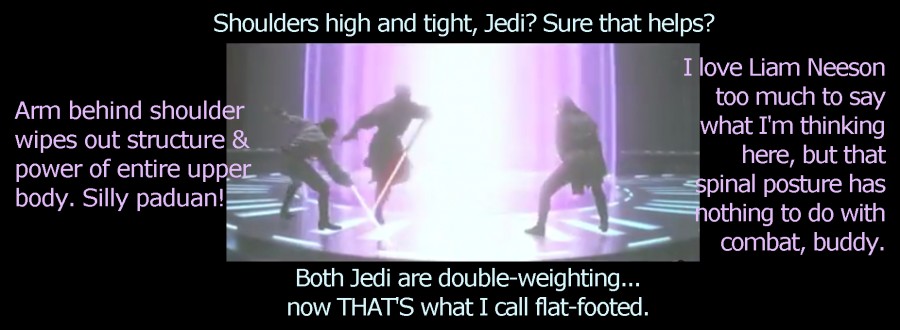
Martial arts is a bit more accessible to most people, so let me show you a popular and priceless example of an expert martial artist next to a couple of wonderful actors who can’t help getting in their own way. Here is the famous fight scene between Darth Maul and the two heroic Jedi, Qui Gon and a young Obi-Wan Kenobi:
All rights to this film belong to 20th Century Fox, in case someone forgets.
I included the whole fight scene. (You’re welcome, Marie P. and Steven R.) If you’re impatient, skip to the last 2 minutes. You’ll notice that the only reason the bad guy lost was a moment of inattention. He moves with effortless elegance, decisiveness, and power, while the Jedi are fighting their own bodies with every move, hulking their shoulders and flexing like mad. It looks exhausting! It took a lot of Lucasfilm to spin the contest out past the first minute, the imbalance of skill is so great.
Darth Maul is relaxed. It makes him effective. Qui Gon and Obi-Wan are not. They’re braced and clunky, utterly without pæng.
All right, given that this force (as it were) of pæng both protects space and creates space, what the heck is it, exactly?
Very simple. Not easy, but simple.
Pæng is the yielding resistance of a tree branch or a length of spring steel, or, for that matter, of a good dancer’s arms.
You push one part of the branch, and the whole bough may sway, but its balance is undisturbed. You push your good dance partner’s hand, but that doesn’t just move her hand — her whole frame absorbs and responds to your push with a graceful springy motion and she rotates, balanced over her own feet, as far as your push goes (backwards and in high heels, most likely. Be impressed.)
That is the force called pæng.
Let’s return to the tree branch for a moment. It allows us to extend the analogy without special training.
Take a good look at an oak, maple, or a eucalyptus tree. Look at a branch from its tip to the root of the tree. You can always follow a single, sinuous line from tip to root.
It’s the same tree, mirrored across. The lines are drawn in on the right-hand image.
That tree holds the branch up from root to tip, without any muscles at all. It lifts it from underneath its feet, up its trunk, and floats it out into space from there. This is how the force flows. Not muscular at all, but very, very strong. It’s pure physics.
The tree also holds the branch outward with curves that act as support structures (like the curvilinear welts in plastic packaging, to keep the package from being flattened), in order to make the most of the space.
Mmm… I wonder if they’re gluten free?
Bounce a branch lightly. Observe the change in the movement. It bounces more near the point of impact, and as the springiness absorbs the motion, it moves less the closer it gets to the spine. I mean trunk. Did I say spine? I meant trunk. Of the tree. In this case.
This calm-but-alive springiness, this resistance without strain, lifting up from the root through the trunk, opening without pushing, pressing without squeezing, all at the same time, is pæng: the whole branch, from trunk to leaftip, is awake all the time, ready to play with the wind all the time, ready to soak up the raindrops all the time, connected through the trunk or stem to its root all the time. Every touch on the way is received and understood, and responded to naturally. It is always alive with this springy yet relaxed, rooted yet responsive energy.
In humans, pæng can be modulated. This is part of the martial aspect of t’ai chi: intensify pæng to ward off an attack or prepare for one, shift pæng to draw the opponent, release pæng to snap into an attack, but always, always have pæng as your ground state. It gives you a safe, structured space to work from.
Ideally. That’w what we work towards.
Now that we’ve mulled the nature of pæng, we’re a bit closer to understanding what Ted and the t’ai chi chuan classics mean when they use the word “relaxed.” In our extreme-adoring Northern/Western Hemisphere culture, “relaxed” is the opposite of “tensed”, or even “stressed.” A certain floppiness comes to mind, even a resistance to being vertical.
Tense:
   []
   |
   |
   |
   L
Relaxed (Western style):
8)________|
A “relaxed” body, in this sense, is not ready to move — far from it. It probably wants another drink!
The ancient Chinese traditions cultivate the middle way, not extremes.
As it happens, this is an excellent approach for many people with central nervous system dysfunctions, because our disrupted systems are hardwired to charge wildly between extremes. The more we strengthen our access to the middle ground, the more stable our central nervous systems become, and the better we can get.
Simple. Not easy.
With this in mind, we have to repurpose the word “relaxed” so it’s not a synonym for “floppy”, but a distinctly different term that describes the useful middle ground between “floppy” and “tense.”
It’s easy to see, even in these keyboard-figures, which level of energy makes it easiest to move in a useful way, doesn’t it?
How do you want your surgeon to be, heaven forbid you ever need one? How do you want to move when you dance?
Darth Maul seems quite a bit different now, doesn’t he? Actually, he does remind me of a couple of doctors I’ve worked with…
Shortly after I drafted this, Ted saw me struggling through a leg-intensive exercise. He said, with sympathy, “I see why you find these leg exercises so exhausting. Your leg muscles are fighting with each other in every direction.”
I went away and thought it over.
Well, of course they were fighting each other in every direction. This was the setup:
When I was 10, I got the silly idea that I should have an adult arch to my foot, so I began to supinate.
That led to my thigh muscles developing lopsidedly, and since I played varsity soccer in high school and ran in my 20’s, they developed lopsidedly a fair bit.
That led to my kneecaps tracking wrong, and me losing the cartilage under my kneecaps. (I used to think that hurt. Cute!) Ted steered me away from his t’ai chi class in the 1990’s because I was so nervous about my knee pain (really cute!)… so I took his shaolin kung fu class instead.
So, over 15 years later… I’m far too frail for serious kung fu and Ted has become a breathtakingly subtle teacher of t’ai chi; I’ve gone through several rounds of posture training (round 1, round 2, round 3); and, now that the pieces are finally coming together (big clue: if it bears weight, it affects your posture), I’ve been working like mad to rectify my knees.
They still pull to the outside, from the habits laid in by my childhood efforts to lift my arch, and my knees hurt like blazes when they bend. To manage that, I practiced pulling them to the inside, but not directly — kind of rolling my lower thigh muscles inside and upward at the same time… While my habitual muscle pattern pulls outward and up.
Weren’t we just watching Liam Neeson and Ewan Macgregor do something very similar (if a lot more cutely)? Muscles fighting each other in every direction, literally at every turn?
The fighting was simply wrong. …And I don’t mean in the movie.
That’s no way for a body to behave, fighting itself. I don’t want my body to fight itself.
I didn’t see that changing the fighting would work, because there would still be fighting.
Finally, I straightened up. I said to myself, in tones of firm parental authority, “Knee, do it right. I’m not having you fight about it. I’m going to relax — unwind every muscle and make them stand down and wait for orders. You’re going to do it right the first time, because nothing is interfering and nothing is asleep. It is … relaxed.” Pæng.
I lifted my leg and put my foot down. It felt different.
I bent my knee. It was fine, absolutely fine.
I tried the exercise. The thing was completely painless, and floatingly easy.
Buyer beware — it’s a process. For me, the issues are simple, although annoyingly tricky to work with:
My levels of tension and awareness, not to mention relaxation and attention (those are 4 completely different concepts, you’ll notice), change so much from day to day.
I still have nearly 40 years of walking habits that I’m building an alternative to.
I still have to take lip from my knees now and then, which slows me down for recovery, and I have to mentally go down there and tell everyone to stop arguing and let me mend.
It’s a process. However, it’s well begun. It’s all about relaxing, in this special sense of pæng.
Cats are masters of pæng 🙂
It’s like this stuff works … Who knew?
I used to be punctual, meaning, 3-10 minutes early. I used to be relentlessly diligent. I used to be cast-iron reliable. (I worked hard to acquire those skills, after drifting through my first couple of decades with my energy and attention set to “simmer.”)
These were so much a part of my identity that, after a memorable lunch with 12 engineers and one writer (me), they passed me the bill to calculate. I didn’t know whether to laugh or cry, but I scolded them and passed it back. CRPS had already set in and numbers tended to cartwheel in front of my eyes, but I didn’t tell them that.
My care providers know they have to call me to confirm the day before an appointment, because even with the calendar in my phone and on the wall, and now with a weekly dry-erase scheduler on the fridge, I need the added sensory input to make sure the other 3 are correct and, above all, to give my brain one more hook to the info.
Reliable, remember? I’ve still got a lot of identity tied up in being reliable, and it takes a LOT more work, but it’s important enough to me to do, and ask for a little practical assistance with.
Today, I looked at the clock when I woke up and thought, “Hour and a half to appointment time. OK.”
As I set up my tea, I thought, “I’ll let J sleep. He’d only have half an hour to get ready and I don’t want to spoil his morning.”
As I washed and dressed, I thought, “Excellent, time to read a little while I have my tea, fruit and morning pillage.” Can’t just call them pills. Definitely pillage. I hope to lay waste to CRPS as it tries to lay waste to me, so that could go either way.
En route to my appointment, I found a whopping case of vehicular atherosclerosis — a traffic jam, in a country stretch of highway. Very odd. The clock read 9:50, and I realized I was going to be late gor my appointment.
Diligently, I picked up my phone and made an illegal call to notify Dr. Resneck that I’d be late.
She said, in slightly worried tones, “But… your appointment isn’t until 11.”
Not missing a beat, I said, “Excellent! I’ll pull over and read for an hour. That’ll be nice!”
In response to the still-shocky silence, I added, “Well, an hour early is better than an hour late, isn’t it! See you soon!” And hung up.
I realized that my brain had simply done an ER-worthy triage — is anyone hurt? Anything made worse? No? Fine! — and moved straight on to a good Plan B. I’m reading Jodi Taylor, and St Mary’s is about to be incinerated and I’m dying to know what happens. And yes, I’ve read it before, though not for awhile.
If I were a clinician caring for me, I’d note this incident down and give a worried little sigh. It’s not good, just not very good.
But I have learned, in this brutal school of my life with this ratfink stinker of a disease, that I CAN’T WORRY ABOUT THESE THINGS. From the standpoint of the person doing this, I am really pleased with my handling of it.
Anyone hurt? Anything worse because of my mistake? No? Fine! Now let’s advance some other agenda I’ve got! Because as long as the first two questions come up negative, IT’S OKAY. I am not a failure, oddly enough. I’m just not. I get a free hour, and that’s pure bonus!
Off to read my book. Enjoy the rest of your day, and remember that blessings can come in heavy disguise.
A fellow martial arts teacher/competition judge once barked at Ted Mancuso, “None of your students move like you!”
Ted blinked, barked back “Good!” and walked away, shaking his head.
He refuses to model a move more than the essential minimum, and is no great fan of the mirror, either. However, he will coach the most clueless student with bottomless patience, week after week, as long as they don’t give up.
His model of teaching is based on the (all too rare) assumption that each of us should be the person most aware of, and most in charge of, our own bodies.
… I know, right?
If you follow the logic through, this implies that the correct structure for moving through, say, Fair/Jade Lady Weaves Shuttle (which is an upward block snappily followed by a nose break, which tells you something about those names)… as I was saying, the most effective and correct structure for that move is going to vary from one body to the next. The correct structure for HIS configuration of bones, ligaments, muscles, and chemistry is not going to be the most correct (or even passable) structure for MY configuration, or yours, or anyone else’s.
Ted doesn’t just say that, he bases his whole approach on it, from start to finish. His crogglingly refined sense of how to read that on others is probably another article, or rather book. Gifted pedagogue, yes.
In the long years of wrestling to take back control of my body from CRPS and all its ghastly little friends, I’ve taken PT for months, done intensive massage therapy ditto, and been overdosed on nearly every class of drug used to treat it — except the ones I flatly refused.
This inward/martial training with Ted is the first one that not only requires physical self-awareness, but actually helps me learn that awareness from the inside out, rather than passively requiring me to learn it from the outside in.
Once I gave permission for him to go to town on my structure, it would be tempting to say that he’s become merciless. That would be totally wrong, in both senses. He lives in an ocean consisting of equal proportions of mercy, humor, precision, and a degree of awareness of others that seems uncanny until you reflect that he’s been working on that since I could walk. So, yeah, he’s got that healer’s mercy that means he’ll do what’s right for you even if it sucks right now.
I’m now on the second round of fighting with my low back and hips for control of my spine, and it really sucks right now.
I am tired of trying to unlearn 40-odd years worth of faulty structure from the inside; it hurts, and more pain is tediously wearing.
So I found a massage therapist who suits my needs, and went to line up a series of sessions.
First available time?
3 weeks out.
… I know, right?
I came for a hot tub and chiropractic adjustment (which I believe is within spec for Ted’s style, given the intransigence of bony tissue and the ubiquity of hot water) and sat there letting my knotted thoughts and knotted muscles melt… until I smacked my forehead and started to laugh.
Why is my low spine putting up such a fight? Why has it kept falling back into the same darn reef-knots, despite the PT and massage and Round 1 of this struggle last year and so on?
Right.
It’s obvious, now that I think about it. There are no shortcuts! I have to learn how to identify, unravel, and rebuild those structures from the inside out. That’s the whole point. That’s why I undertook this training. This is exactly how it’s supposed to happen, aches and all.
This is me, having another laugh at my own expense, releasing one last sigh, and figuring out how to do this from the inside.
I love that teacher. I don’t exactly like him a lot right now, but that’s okay.
I was mulling a post called, “The Pulse,” about how my life tends to go in surges, and when I work with that, things go better, but when I try too hard to flatten life out to a steady level, everything goes badly. Some people try to flatten the ocean. That’s above my paygrade. I just try to ride the waves. Photo Brocken Inaglory/Wikipedia.
It’s about the pulse — push when I have the momentum to push, pause when the momentum fades, sink when even standing still feels like a sucking drain; push, pause, sink, push, pause, sink, and so forth.
If you’ve ever held a stethoscope to the sound of a beating heart, you have an idea what that sounds like.
It’s like pacing, a familiar concept to the chronically ill, but on a larger timescale.
Winter always involves some withdrawal, some sinking. This makes lots of sense to my acupuncturists and martial arts teachers. The traditional Chinese medical model assumes that we’re embedded in a larger reality, with weather and climate and timely changes, a key idea which conventional medicine doesn’t acknowledge very well.
I used to be able to push enough, even in winter, that the annual sinking wasn’t that obvious, given that most of those around me were in winter too. However, since my mid-30’s, a lot of people I’ve loved, liked, and depended on have died in the chilly armpit of the year. Deathiversaries, as I’ve noted, tend to have an effect on me, especially when they pile up like… well… bodies.
Perhaps I should move south of the equator. Then it’ll be warm at this time of year, at least for me, if not for my lovely ghosts. Photo in the public domain, with thanks to the photographer Nello Rolleri
Late last year, two honorary brothers, one of my dear CRPS friends and a young friend whose life I actually saved at one time, both died. Now, at least two of my honorary sisters are at the end of their lives, one of CRPS and the other who’s working on her 6th cancer.
I’m not whining. It’s not about me, it’s definitely about them. I’m not dying.
It’s just that it’s hard to remember that, sometimes.
Helpless as I am to hold back the grim reaper’s scythe, there are sometimes things I can do to soften the end of others’ lives. My first nursing job was on an HIV/AIDS unit in 1991, so this is a well-established idea for me.
This year, though, 24 years on, some invisible line has been crossed, or some invisible straw has landed on this camel’s back. I cannot move. (It’s kind of wild that I can write, finally.)
I am paralyzed, generally anesthetized, frozen. There is no pulse, no pause, no sinking, not a microgram of push. My mind currently looks something like this. Photo Chris Stubbs/Wikimedia.
Four days of work, pushing so hard it sucks my breath away, and I now have a psychotherapy appointment with a 30-year veteran of helping the chronically ill and deeply traumatized. Plus one blog post.
I can’t do a thing for anyone else until I can move and breathe again. This thought alone is like a blanket of razors, since the condition of my friends isn’t going to wait for me to get my act together, but still — it doesn’t break the ice.
There are some things that are too much to expect a reasonable person to bear, and anyone with a hellacious disease already has one of those things on their plate. Those who are in the last stage of life have another. Those who are bereaved … you get the idea.
I’m posting this, not to write my diary in public, but because I know I’m not alone. Those of you who can barely move enough to shift the cursor, be assured that I know you’re not alone, either. Somehow, we will get through this. We will melt the ice, with help if we can get it. There is always an afterwards.
There’s one thing that offers this frozen veteran of grief the kind of scathing consolation that’s all I can expect these days: when my time comes to shuffle off this mortal coil, then, if there’s anything left of me to notice or care (as I strongly suspect the more subtle yet intransigent laws of physics require), I will be in the very best company.