Reading science (and surviving) 101

I wrote the start of this for a fellow spoonie today and realized it’s a good starting point for a subject most people find overwhelming: reading medical science when you’re starting off as a non-scientist.

The article I cite first is a good example to start with, because it’s written well and has passages of clear English to work with. So…

sketch of excessively happy doctor running with a hypodermic needle
“Here we go!”

Here’s a science article which describes immunoglobulin E pretty thoroughly: https://www.ncbi.nlm.nih.gov/books/NBK541058/

I suggest reading the abstract and introduction. After that, just skim the first sentence of each paragraph, since (in science writing) that tells you what the paragraph is about.

If the first sentence makes no sense, skip that paragraph.

If you can figure out the first sentence, glance at the rest of the paragraph to see if there’s any more to glean. If not, move on..

It’s a skill

Reading science is a skill, and skills take time to master. That’s expected! Share what you glean with your doctor and ask them to help you understand it better.

Honestly — this isn’t to puff myself up, it’s just the nature of patients to dis themselves, so hear me out — if you can read my stuff and make out half of it, you are plenty smart and literate enough to start reading science. It’s just work and time, and the time will pass whatever we do, and the work will get easier with time. We just have to take care of ourselves and pick our time, when we’re chronically ill.

Using the right amount of honey

Doctors might give you attitude about comparing your Google search to their medical degree, but that’s not what you’re doing: you’re studying up on your condition, which is wise, and you’re expanding your info base on this thing that has imposed on your life, which is survival.

So, feel free to correct them sweetly, and don’t be afraid to pour some admiration on them if it helps them to re-focus on your information-gap.

The point is not who knows more overall. That’s not in question. When you talk to your doctor, you’re talking to someone who had to memorize, for instance, the Krebs cycle (here’s a partial explanation: https://www.medschoolcoach.com/the-krebs-cycle-mcat-biochemistry/) — so, yes, they have a depth and nuance of knowledge that’s nearly impossible to replicate without going to medical school.

They like having that acknowledged, because they take a lot of painful flak for not knowing everything about everybody’s illnesses all the time, and they need to know that you know what an effort they made to be able to work as a doctor.

So, it’s good to acknowledge that enormous effort.

Then they are usually able to hear you when you clarify that you’re not arguing with them, you’re trying to improve your understanding of this thing that affects you so profoundly. You trust them to help because of their knowledge.

Trust. Help. Knowledge.

These are keywords because they are core professional values for most doctors.

They’re important to acknowledge, and great to invoke and rely on.

That said… if you can’t rely on these characteristics in your doctor, even after you tell them that that’s what you need, then it might be time to find another doctor if you can. These core values are far more important than whether a doctor has good social skills or a good handshake.

When all is said and done, guess who has to live (or not) with the outcomes? It’s you. While the doctor is the subject-matter expert on the medical info around your condition, you are the subject-matter expert on being in your body and dealing with the fallout. There’s a degree of respect that should go both ways, though modern practice makes that hard.

What you need most from your doctor is:

Trustworthiness (intellectual trustworthiness, specifically).

Urge to help.

Knowledge.

Those are the keys to good care.

Mental skills for the non-scientist to start with

The key to reading science is realizing — or at least, going ahead as if — you’re perfectly capable, and just need to practice. Science is written by humans, and you’re a human too.

1. You are a perfectly sensible person. If you’re reading this, you know how to read (or access translations from) English; also, you have access to a whole world of dictionaries. MedlinePlus is especially helpful in explaining concepts and helping us learn to read medical stuff.

2. Not all scientists can write well in English, and none of them write in English all the time. That’s okay. They went to school for a long time to get extra vocabulary and learn to do what they do; good for them. They’re still people, and they have to write in English at least some of the time. That’s where you can come in.

3. You can read the English just fine. Trust yourself and take time. With practice, you can learn more lingo over time, and get better at reading more science.

Just work from what you can understand now, and let that grow over time. You’ve got this.

Choosing credible sources

While you’re learning to read science, start where you can and work from there. As you get more confident and your understanding grows, you’ll learn to be choosier.

The gold standard for science info

When learning how to assess science, you’ll hear a lot about placebo-controlled, double-blind studies and that method is often important. This method of science gives us more reliable statistical probabilities about whether something will work in a certain situation. The statistical probabilities become reliable when several thousand people (“subjects”) have been tested, probably over many different studies.

With rare diseases, this is obviously pretty unlikely, so we have to work with less scientific certainty. C’est la vie.

Statistical probabilities have more limited value for patients than doctors, because we’re individuals, not pooled data. There used to be a phrase used in medical school: “Statistics mean nothing in the case of the individual.” This has gone by the wayside a bit, but it’s still true.

We may have to cast our nets further afield, because we’re looking for clues that might help us, personally. Be aware when you’re doing that, and put those science reports in your mental “hmm, maybe” folder.

I showed a case study that had a marvelous impact to one of my best doctors. He said to me, “If I could put that effect in a bottle, I would. It worked for that person, and we have no idea why. We do know that it doesn’t work for all these other people. Everybody’s different. Figuring out how to apply one thing to help a lot of people is our holy grail!” Lloyd Saberski, MD.

And that’s why doctors rely on the pooled data gathered from the scientific method. They want to help as many people as possible with each thing they try. Otherwise they fear they’ll spend too much time chasing rainbows.

We patients have to find our own rainbows, just as we have to count on our doctors to keep an eye on what’s statistically worth trying. It really is teamwork, and we both need to do our jobs.

What’s peer review?

Before you give a study to your doctor, it’s worth checking if it’s from a peer-reviewed journal. Don’t expect them to put too much stock in it otherwise.

Peer review means that other people in related fields have checked it over for sanity and validity. This is important for us patients, as well as the doctors who rely on the information.

You can Google whether the journal your article was first published in is a peer-reviewed journal. JAMA, BMJ, and the Lancet are all reliably peer-reviewed.

The value of literature reviews

Then, after a fair amount of studies have been done on a topic, there’s usually a literature review. This is when a qualified scientist takes a close look at all the studies, throws out the ones that were badly designed or poorly run (because bad technique creates bad data. “Garbage in, garbage out”) and writes an overview of what the current good science says.

They also discuss the strengths and weaknesses in the data, and suggest where future science funding could go, in light of the science so far.

Literature reviews are wonderful places to improve your knowledge of your disease/condition, expand your vocabulary, and get a lot better at understanding what goes into the science on your condition in the first place.

For instance, it used to be widely believed that most people with Complex Regional Pain Syndrome had had traumatic childhoods. (“Blame the parents” LOL.) There was a literature review done on about 30 years’ worth of studies, and it turned out that almost all of them were so badly-designed, poorly run, and calculated with so much bias, that nearly all of the studies had to be thrown out!

This taught me very important lessons:

– Just because most people say it, doesn’t mean it’s right, even if they should know better. This is an excellent attitude to have while reading science.

– Methods matter. You’ll learn over time how to sense whether the methods used are appropriate to the topic studied. The wrong method can lead to truly bogus results. The method has to fit the material.

– People lose their minds when they think about pain, as well as when they think about childhood trauma. In practical terms, this means I have to approach all normal (non-CRPS) people’s reasoning about my condition (which is characterized by relentless agony which a non-CRPS’d brain cannot even conceive of) with compassionate criticism. They do not know what it’s like, nor how to live with that pain and still think rationally. They’re not able to know. I don’t want them in a position where they do know, because that’ll mean their lives are as battered as mine is.

Therefore, every word they say has to be filtered through my awareness of how their minds get lit up by unreason, when they think about my pain. This, believe it or not, is perfectly natural. (Look up “amygdala hijack” for background on this mechanism.)

I survive because I’ve learned to substantially displace or ignore one of the most powerful primitive signals in the human body. That isn’t natural, and nor should it be.

These scientists mean well, without question. However, their logic is necessarily fractured when thinking about this, because they lack my tools for facing it. I need to dig into their data and methods before I can buy into their conclusions.

That’s good to know!

The conclusion of that literature review? CRPSers are likely (not guaranteed) to have had relatively eventful lives. Whether the events were traumatic or wonderful wasn’t relevant to our probability of developing CRPS.

In other words, we live in interesting times!

Where to find science to read

Google pubmed, and you’ll find the National Library of Medicine (NLM) division of the National Institutes of Health (NIH). This is a searchable science library which hosts articles from all around the world, in whatever language they were published in plus English. You can search any valid medical term — for instance, use the full name of your disease rather than its initials, for better results:
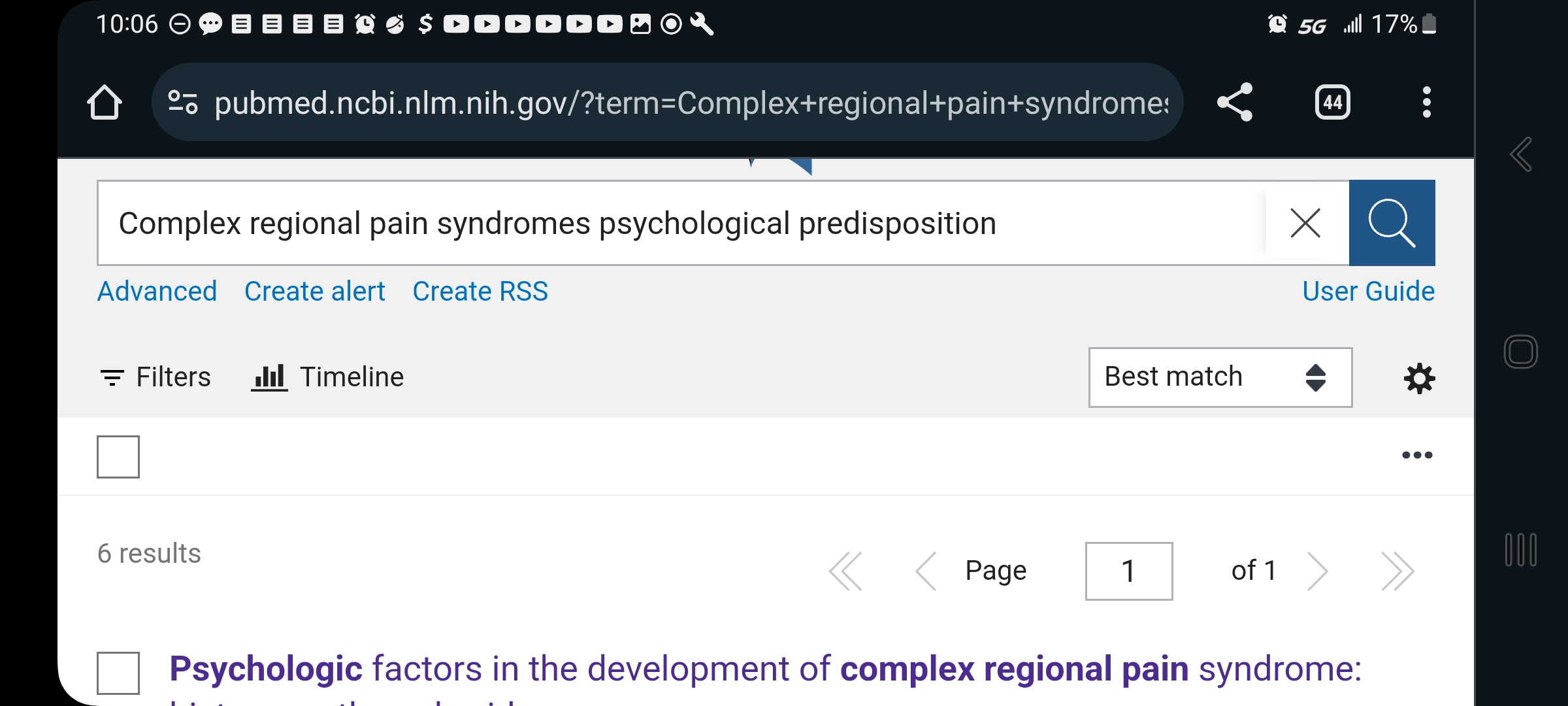
Here, you can see that I typed out “complex regional pain syndromes” instead of CRPS.

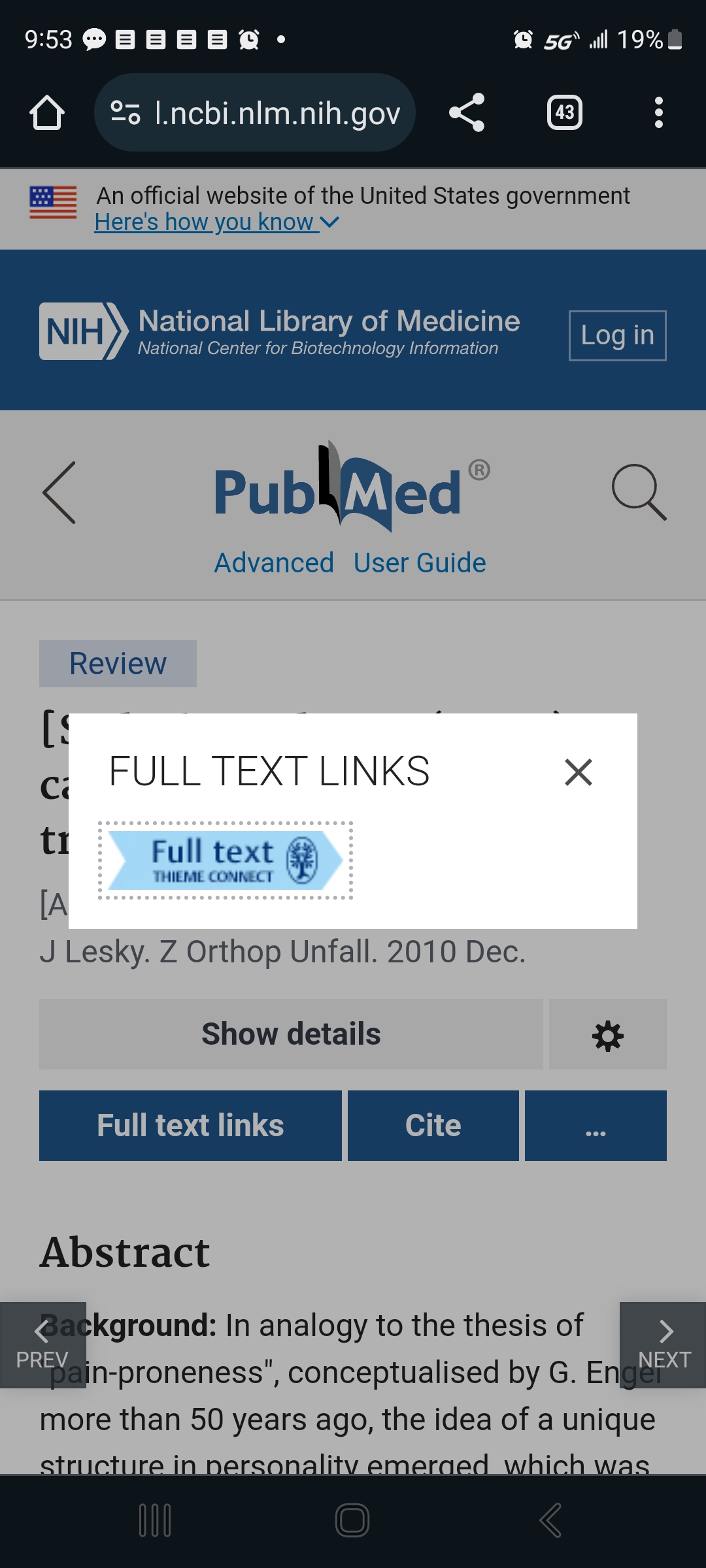
Some of them have full articles that are free to read (look for “Full Text Link”) …
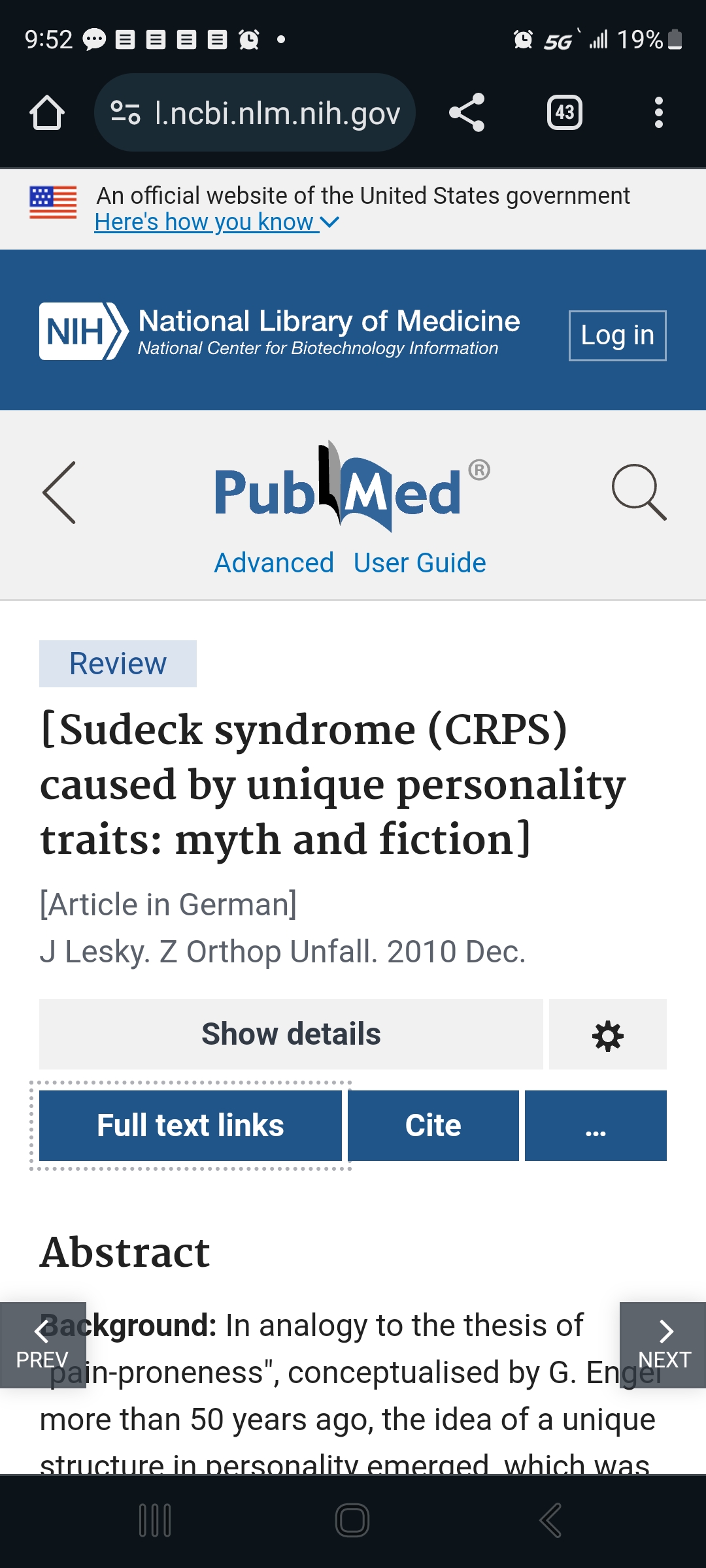
The square brackets around the title tell you it originated in another language. The note under the title tells you which one. Good science is done all over the world. I’m glad we can access so much of it!
This image shows what pops up when you touch the Full Text Link button.
This is the original site that published this paper. As you can see, it’s in German here, but an English translation is also printed below the German version. For better or worse, English is the world language for science and medicine. I feel lucky being born into an English-speaking family, because it’s tough to learn. All those synonyms… and the crazy spelling!

…But most will show only the abstract, that is, the high-level overview of what the study is about. For our purposes, that’s the most important thing, so it gives you something useful to work with.

The interface gives you options for saving, sending, and citing the articles.
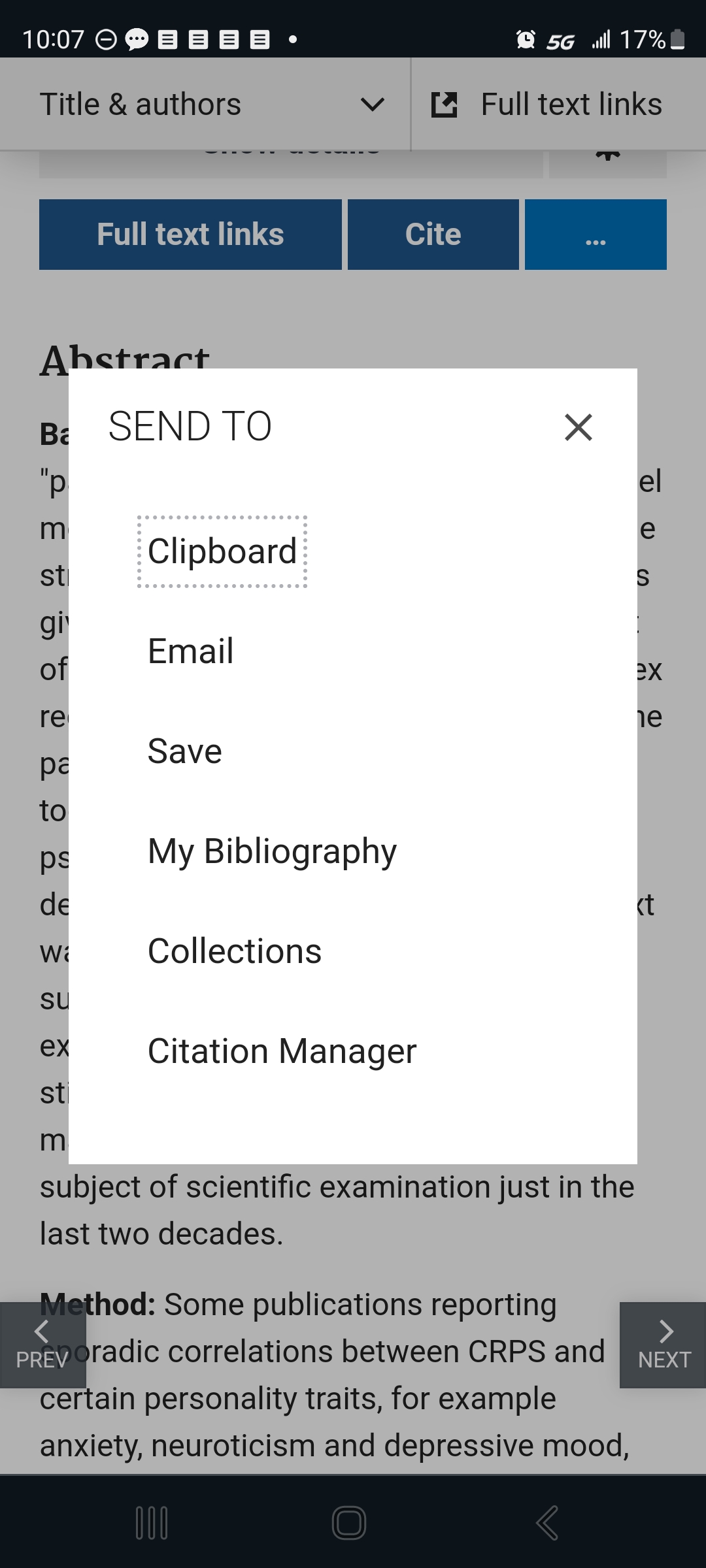
Touch the “…” button to get this helpful menu. If you get a free account with the NLM, you can use these to help you keep your studies organized and accessible.

To use these, just touch or click the one you want. They do exactly what they say they will.

If you touch one of the menu options that requires them to store the info on their side — like “Collections”, “Bibiography”, or “Citation Manager”– it will give you what you need to sign in (if you already have an account) and, at the very bottom, the option to “Sign up”:

The site is very helpful; just slow down and let yourself look at one thing at a time.

Once you feel more self-assured, try out Google Scholar. It’s smaller in some fields and generally less selective, but that can be good. I suggest saving it for later only because it’s got fewer guard-rails. We’re all different, though, and you might find that easier.

These two libraries aren’t identical. They do overlap.

A word about MeSH terms

MeSH stands for Medical Subject Heading. It’s a curated list of specific terms used in the National Institutes of Health materials. This kind of consistency is necessary when organizing a stupendous medical database like the National Library of Medicine.

MeSH terms are listed at the bottom of each article. If that article was useful, you can click the MeSH terms to have them saved to your PubMed search history:

I’ve circled the heading “MeSH Terms”, where it appears below other back-matter after the article.

Here’s a tip: when using their Search tool, don’t worry about capitalization, but be very particular about spaces and punctuation. Copy them exactly.

Using MeSH terms will improve your future searches, because it makes the most of the databases self-referencing mechanisms.

Trust your eyebrows

Best tool in your mental toolbox: when you’re reading sentences you know you do understand and, yet, you feel your eyebrows moving around on your forehead… that logic is not right.

The scientist might be misinformed, biased, pulling a fast one, or just plain wrong, but it doesn’t really matter which — that logic is not right. The underlying pattern-matching part of your brain can tell. That’s a primitive part of the brain and, when you’re paying attention to it, it’s extremely hard to fool!

Trust your eyebrows. If you want to, save the article and come back to it when you know more, so you can figure out where the problem is. I assure you, there is one. Your eyebrows don’t lie.

Feed your brain

Reading science is hard work and brains are big hungry things at the best of times. Feeding it right can be a huge help.

Meds & caffeine

If you’ve got attention problems, adjust your meds and caffeine to give you some extra focus when you’re reading science. It’s a lot more fun that way!

Smart produce

Green, blue, and purple foods are absolutely marvelous for brains — and pain. They feed the nerves, literally. I know you needed an excuse to eat more blackberries, blueberries, collard greens, and rocket salad, aw shucks.

I also know it’s not the cheapest stuff in the market. Explore your local options for farmer’s markets, roadside stands, produce sales, and organized assistance like EBT/food stamps and healthy-living programs giving more access to produce in the state, like they have in Massachusetts and California and other places.

This is a great opportunity to learn more about your condition and to bring what you’ve learned into your life (more on that later), and the upfront effort pays off so much in the end.

Body-safe phenylalanine

Obviously, if you’re prone to phenylketonuria, skip this part! IYK,YK.

Also, keep in mind that this can have an effect on some meds — sometimes giving them a boost, sometimes making things worse. Be sensible, do your due diligence, and study it up for yourself if you’re interested. Also, use your self-documentation skills: note what you do and what it does to you, change what needs to change, and take responsibility for the results of your choices. We are our own best caregivers.

I’m discussing the physiological activity of this thing with the weird name, and what I’ve found in my life and those closest to me. This isn’t any kind of assurance that it’ll do good for anyone else. Put it no further than “hmm, maybe” in your mental filing system and do your own further research to validate what I say and get an idea how it might work for you, yourself.

Basically, phenylalanine is a precursor to the “up” side of the neurotransmitter suite, dopamine and norepinephrine and even epinephrine (they all transform into each other as needed). These neurotransmitters carry messages among the parts of the brain involved in learning and memory. Taking in phenylalanine can have a truly astonishing effect on attention and memory WHEN you’ve got fundamental deficits, as do people with central and longstanding pain and some other conditions.

TL;DR — If it doesn’t make an obvious difference in less than an hour, you don’t need it.

I’ve trialed using aspartame, which went well for me. (Discussing my results with my doctor paved the way to including SNRIs in my med regime, to my considerable benefit.)

Food sources of phenylalanine

This is where hard cheese and smoked or processed meat shine. They’re rich natural sources of phenylalanine. They also have saturated fats which, in moderate doses, seem to help with pain and brain symptoms.

As a moderate part of a well-balanced diet, folks.

This hasn’t been well-studied; it’s one of those things you pick up after being involved with self-managed patients for over 30 years.

It doesn’t take much. I found that 2 or 3 bites of aged cheddar would absolutely light up my brain for 45 min to an hour and a half, depending on my deficit.

One pal of mine keeps meat jerky sticks on hand for study sessions. Aged cheese works better for me; jerky works better for them.

Now, unfortunately, mast cell activation problems have moved cheese and smoked meat out of my diet. When I need a brain boost, and it feels like cheese might help, I have to use a supplement instead.

Supplementing phenylalanine

It’s more measurable to use a supplement called DLPA, or d,l phenylalanine. It’s a blend of natural and manufactured forms of phenylalanine. One works better for pain and another for depression, but the blend seems well-tolerated and helps both. Phenylalanine suppresses certain inflammatory kinases and may help suppress pain at the spinal root (that is, right where the base of the peripheral nerve path comes out of the spine) as well as helping with mentation and cognition. (Sarcastic Sister notes: The recent science about it magically disappeared in the wake of the “war on pain meds” and I won’t pretend to understand why.)

There is a maximum recommended dose before it gets toxic, but if you’re seriously thinking about that, you’ll want to do your own studying, and might want to talk to your doctor about SNRI meds as a possibility. (The N is for norepinephrine,  which phenylalanine supports.)

Why bother with learning how to read science?

Knowledge and understanding are the most powerful tools you can have for dealing with complex chronic health problems. It may or may not change what you have to deal with, but it certainly gives you more and wiser options about how to deal with it.

Even if you aren’t ready to start now, you can circle back around to this whenever you want. It’s attainable; you can do it. It’ll always be there (although individual articles and topics may come and go.)

The patients who learn the most and put that to work in their own lives, are the patients who most consistently beat the odds and have the best quality of life over time.

Therefore, better information leads to better living with complex chronic illness. My HIV patients taught me that 32 years ago at my first nursing job, and it’s truer than ever now.

Note: Nobody here says it’s easy. That said, our complex chronically ill  lives are never easy.

Pretending that getting through the day is not, itself, almost a superhuman task is a disservice to our strength, so let’s just start off by recognizing that everything we do is really hard work.

Knowing that, I have found that the effort of learning and applying what we learn pays off a whole lot more than passively waiting to be saved and feeling rotten all the while — and still being wrecked & exhausted.

I can whole-heartedly recommend learning and figuring things out. It’s a winner.

Felix the Cat with bag of tricks and scientist


Excercise intolerance, the invisible vampire

I’ve been walking for 2 1/4 miles 6 out of 7 days per week for a few weeks, and it stopped kicking my butt, woohoo! I could come home and go straight into another task. This took awhile; at first, I had to lie down with my calves & feet up on a suitcase for a couple hours & stay down for hours except for bathroom breaks, then I just had to lie down for hours, then it went down to half an hour of horizontal time, and finally it was fine.

So I bumped it up — like a fairly well-informed patient– by no more than 10%, or a whisker under 2.5 miles. Today was the first day. I had to lie down for a couple hours, and moving at all is brutal. I move like a centenarian who’s been sucked dry.

Dazed looking fellow with fangs
This outstanding cartoon is by JNL and is freely available under a Copyleft free art license

So, after realizing that yes, even though I can walk more than 2 miles, I *still* have excercise intolerance… I decided to look it up and learn more about it.

Further inquiry

You know me: I like primary sources. Doesn’t mean I always understand them, but I can usually glean the right vocabulary from primary science and improve my searches from there.

What a 1 hour scroll through the National Library of Medicine turned up today is that excercise intolerance is usually related to specific kinds of heart failure (already ruled out), certain profound lung diseases (definitely not), certain complications of diabetes (nope, thank goodness), and mitochondrial illnesses usually due to genetic variations that leave them struggling (definitely something I’ll check again, in light of this new info. I’ve got those geneticgenie.org results somewhere…) It can also go with POTS, postural orthostatic tachycardia, which I have a variable case of.

So what is excercise intolerance?

As I understand it currently, excercise intolerance means that, instead of excercise building muscle and oxygen-carrying capacity, exercise chews up tissues and reduces oxygen-carrying capacity.

Much like what happens when the vampires have been at ya.

Edvard Munch’s colorful take on vampiric prey, massively stylish as ever.

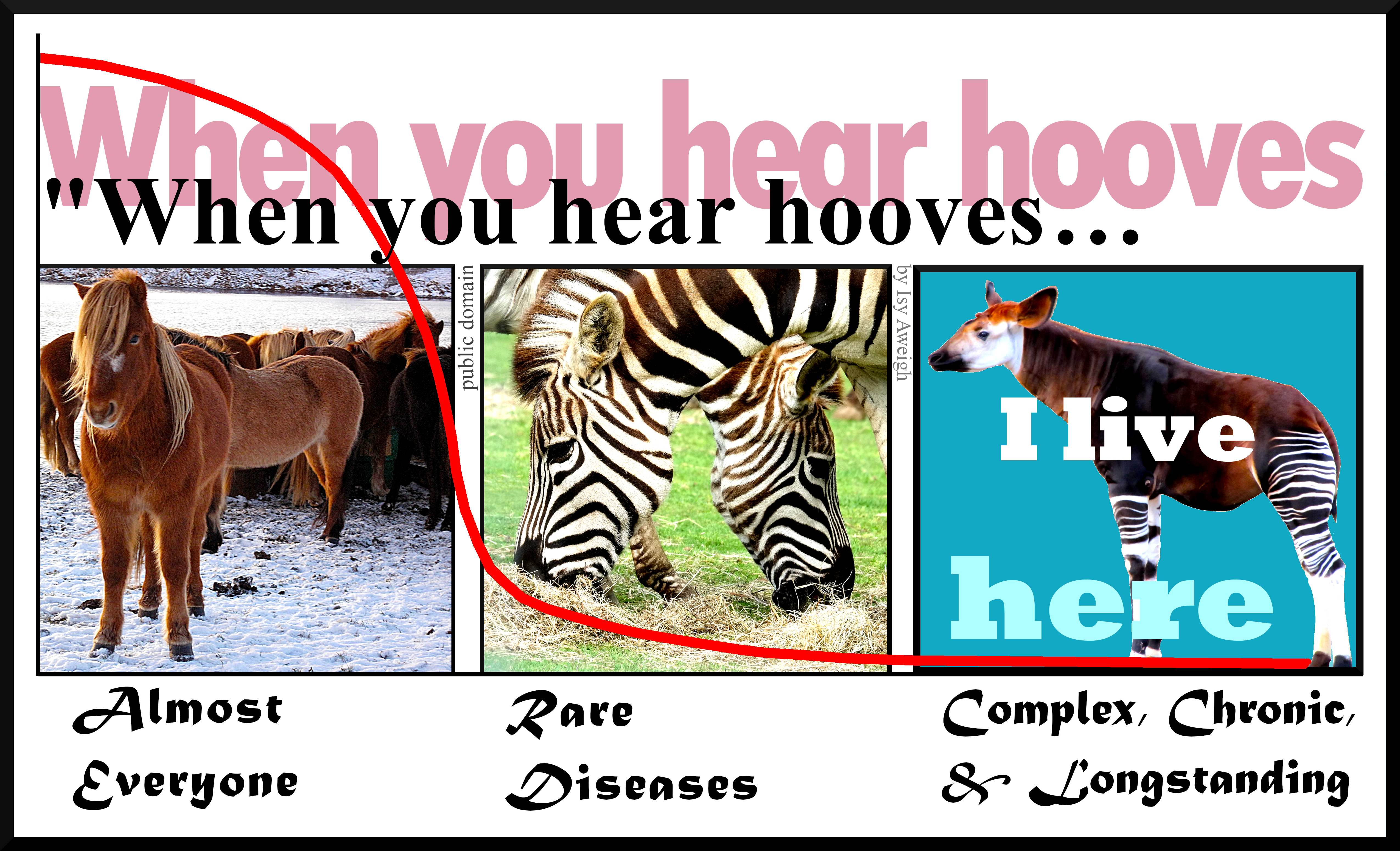
It’s very uncommon in the general population, and many people think they know better than to “believe in” it.

No wonder. It’s completely counterintuitive! How can excercise possibly make you weaker, sicker, and more broken-down?

Because some of us are just that lucky. Or something.

That which doesn’t kill me…

Makes me seem weirder and even harder to relate to.

It also generates inflammatory crap much faster than the impaired body can clean it out, which means more pain, more limited range of motion, and longer recovery time.

Yep, it’s fun to have! XD

It used to be that, once I broke the 2-mile mark, the only symptom I’d get after too much excercise was simply feeling like I’d had too much excercise, and a couple of Advil and a couple of good night’s sleep would take care of it. There *was* such a thing as “no more excercise intolerance”, and it was lovely.

I didn’t realize there were also such wide degrees of excercise intolerance. *This* doesn’t feel like I just did too much exercise and all I need is a little time. This feels like I’ve had an inflammatory surge, a mast cell activation episode, like my bones are charring gently, and like everything is about 10 times harder.

Now I know: Excercise intolerance can keep up! (Foul expletives mumbled under the breath.)

In the interests of data collection (and getting physician attention), I’ve pulled out my pulse oximeter and will check my oxygenation and pulse rate before, during, and after my walks.

Data! Yummy data! Nom nom nom nom. It’s not a cure, but it might help in the longer run. — Walk. The longer walk, haha.


Nerdy stuff: menstruation, hormones, pregnancy, and pain

This is a brain-dump and research-blurch I just did for a compatriot. These are issues that come up occasionally — every 28 days, for many — and always deserve good answers. Lots of links to scientific articles here.

Mouse brain neurons, two pairs, stained flame yellow against red background
Image by neurollero on flickr, CC share-alike attribution license.
There has been little research on women’s experiences of CRPS in terms of menstruation and pregnancy & breastfeeding. Gee, surprise surprise!
So I’m working to come at the issue sideways: looking for info on hormonal changes during menstruation & during pregnancy, and the effects that those hormones have on deep or central pain. Tedious, but possible. 
Also, I only have access to those articles which are publicly available. Many are kept under wraps because it’s one way that labs protect their intellectual property, sigh. 
PAIN & CHEMICAL-MESSENGER BASICS

Pain-related cytokines (this is old information, so these studies are old, but still informative):
“Recent findings on how proinflammatory cytokines cause pain”
https://www.sciencedirect.com/science/article/abs/pii/S0304394003013879
This article specifically cites 3 main culprits in neuropathic pain: IL-1beta (interleukin 1-beta), IL-6 (interluekin 6), and TNF-alpha (tumor necrosis factor alpha, which does a lot more than kill tumors!)

The publicly-available articles on cytokines’ role in pain are abundant from the early part of the millenium (1999-2010) but seem to disappear after 2013. I assume a lot of patentable activity is going on about it now, and given the usual lead-time on drug development, may not be available even for human trials for at least 5 more years.
Your pain specialist should be able to pull up more recent articles to share with your OB-GYN about that.

“Oxytocin – A Multifunctional Analgesic for Chronic Deep Tissue Pain” 2015
https://www.ingentaconnect.com/content/ben/cpd/2015/00000021/00000007/art00008

“Oxytocin and the modulation of pain experience: Implications for chronic pain management” 2015
https://www.sciencedirect.com/science/article/pii/S0149763415001177

MENSTRUAL CYCLE

Pain-related cytokine & hormonal changes around menstruation:
“Impact of Gender and Menstrual Cycle Phase on Plasma Cytokine Concentrations”
https://www.karger.com/Article/Abstract/107423
Women always have more pain cytokines than men, but they have more still during the luteal phase of the cycle, right after the egg is released (a.k.a. premenstrual phase) and leads to menses.

Since there’s so little science on menstruation in those with pain disorders, I include an article on menstruation & cytokines which explicitly draws a conclusion that *menstrual tissue itself* is the cytokine trigger (and endometriosis is basically an exaggeration of it), a conclusion which does support our experience of higher levels of CRPS pain with menses:
“Menstruation pulls the trigger for inflammation and pain in endometriosis”
https://www.sciencedirect.com/science/article/abs/pii/S0165614715000449

PREGNANCY & BREASTFEEDING

Breastfeeding confers protection against noxious brain chemistry:
“A new paradigm for depression in new mothers: the central role of inflammation and how breastfeeding and anti-inflammatory treatments protect maternal mental health”
https://internationalbreastfeedingjournal.biomedcentral.com/articles/10.1186/1746-4358-2-6
Has loads of references. It’s from 2007, but it’s so approachable I want you to have it anyway. Besides, the chemistry of our bodies hasn’t changed, only our understanding has increased.

Here’s an update by the same original author:
“The new paradigm for depression in new mothers: Current findings on maternal depression, breastfeeding and resiliency across the lifespan” 2015
https://search.informit.com.au/documentSummary;dn=283392990281695;res=IELHEA
It may be risky to include this, depending on your OB/GYN, because of the brutalizing confusion and ignorance around depression — widely seen as a character flaw and sign of weakness, when it’s just an overwhelming neurochemical state, and incidentally overlaps significantly with the overwhelming neurochemical state of neurogenic/central pain. In short, things that alleviate/mitigate depression also usually alleviate/mitigate central pain. It’s very simple.

GOOD TO KNOW

Let me give you two names to pass on to doctors willing to learn, for great info on CRPS: R.J. Schwartzmann, who retired in 2012 but whose work remains the most intelligent and articulate among CRPS researchers; and currently Breuhl and van Rijn are doing good work too.
More articles listed here by a trained 2dary researcher: https://elleandtheautognome.wordpress.com/crps-frequently-asked-questions-faq/

Of Mice, Medicine, and Malefactors

Older Brother and his wife, Aunt Krusty, sent me a fabulous little doohicky from a medieval town they visited. It’s a brooch of a common design element used in the Middle Ages: a tabby cat with two tails and fabulous eyebrows offering a mouse, with the legend, “visis mu” — “here’s the mouse.”

Pewter pin of tabby cat as described in text.
Close inspection shows both letter “s”s to be upside down. I’ve known a few artisans, and they like making people twist their heads around. Besides, that’s relevant. You’ll see why.

The enclosed card contains the usual wonderfully vague, semi-academic wording saying that animals with two tails (no mention of fabulous eyebrows) are signifiers of evil forces at work, but beyond that, nobody really knows what this means.

I thought some academics kept cats…?

My lovely polyglot friend Sylvie does. Sylvie is a CRPS compatriot who lost a frightening percentage of weight late last year, from which she’s still recovering. Her cat Nala has become a serial killer of the entire species Rodentia, bringing her grisly accomplishments to lay at Sylvie’s feet — or couch, or pillow — with startling frequency. Naturally, they aren’t always quite dead.

Pinto cat biting into white mouse on a lawn.
Not Nala, but a kindred spirit. Photo Tomasz Sienicki @ Wikimedia Commons.

Cats don’t have thumbs, so they don’t really get it about cooking and cupboards. All Nala knows is that Sylvie obviously needs to work on her hunting skills, but in the meantime, Nala can at least help her fatten up.

Also, cats tend to gatomorphize, just as those of us who are close to them tend to anthropomorphize. Nala has no idea that mice, gophers, shrews, and moles do Sylvie no good at all; that, on the contrary, they’re upsetting, messy, and potentially infectious. Nala thinks they’re good, and Nala cares for Sylvie, so they must be good for Sylvie.

She honestly believes that, with all her furry, loving little heart. “Visis mu! Have this great mouse!” So the slaughter continues.

Sylvie’s garden blooms, but her house is an abattoir at times. This is not a bad metaphor for explaining one of the more difficult aspects of being under a doctor’s care.

Most doctors really mean well. Becoming a physician takes an enormous amount of work, which requires great commitment to complete. It’s a hard job with ridiculous hours, especially for the first few years.

That doesn’t mean they’re all bright or gifted or even humane. It just means they believe in the value of medicine and surgery, enough to spend a decade or more learning to do it.

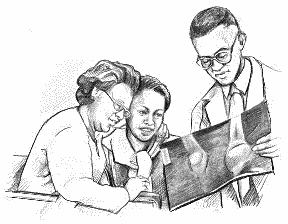
Line drawing of doctor going over an x-ray with patients.
There is much care and dedication among many doctors.

Doctors are intensely, let’s say, socialized to stay within the parameters of accepted practice. It keeps them out of trouble, although it may also keep them from true excellence at times.

Mostly, they love those parameters. They love having guidelines. They are truly, madly, deeply convinced of the value of the meds and procedures that they’re trained in. It doesn’t help that, if they put a foot wrong outside of those parameters and things don’t go well, they can lose everything. They are heavily incented, so to speak, to stay inside whatever they understand their parameters to be.

And, of course, the peer pressure is enormous.

Now, this is tough for CRPS patients. There is so much variation from one CRPSer to the next, that there are NO established treatment parameters that meet the medical gold standard of being consistent, repeatable and reliable over a majority of patients.

None. Nada. Zilch. There is not one thing that consistently works well for most of us — at least nothing that comes from a bottle or an operating room. Activity, rest, hydration and nutrition all seem to be key, but even their benefits are hugely variable, and you rarely hear about them from physicians.

For a while, it was thought that COX-2 inhibitors combined with membrane stabilizers, came close to being a semi-magical bullet. (Gabapentin/ Neurontin, pregabalin/Lyrica, and so on, are known to most patients as anti-seizure meds, but many healthcare providers call them membrane stabilizers.)

Then it turned out that the Dr. Scott Reuben, the physician who popularized that treatment, was making the numbers up (here, reported to his colleagues and here, reported to science fans.)

Old poster of a show called, "Pinocchio, the tale of a marionette"
He was so busy being a puppet of the drug companies paying him, that he forgot what it means to be real.

COX-2 inhibitors were given a general thumbs-down over cardiac effects (which many people with chronic CRPS have enough trouble with anyway) and, as peri-surgical meds, did not live up to Reuben’s promise that subsequent chronic pain would be less.

Ironically, it had already been established that 500 mg of vitamin C two or three times daily for 3 months after surgery does have significant demonstrated benefit, reducing the incidence of CRPS – the most intractable and severe form of chronic pain – by 35-80%, depending on the extremity, extent of injury, and probably the degree of compliance. Moreover, vitamin C is very cheap, as well as very effective. (See extensive links list below.)

The anti-seizure meds, unfortunately for pain patients, did not get removed from first-line treatment.

By then, unfortunately, whole nations (Great Britain and the Netherlands, take a bow) had adopted Reuben’s corrupt recommendations for first-line treatment. It takes a lot more effort to undo that level of adoption than it does to hoodwink an entire sub-economy of peer reviewers and medical specialists, apparently.

The arrogantly reputable journals that accepted his work, and subsequently published other work which was based unquestioningly on his false results, are still trying to live it down. What’s interesting is that other doctors couldn’t replicate his results, so he was the only one publishing these great data… yet journals and physicians continued to publish and follow his recommendations. I do hope the journals revised their “peer-review” process to include more actual, I don’t know, reviewing, perhaps by peers.

Old cartoon of Pinocchio sitting on a pile of books, with a book open on his lap.
It took a lot of people to permit and perpetuate Reuben’s false reports. They are not innocent.

It could take decades to undo much of his damage, and meanwhile, the advancement of treatment has been down the wrong track for years, while other more appropriate avenues of treatment have been ignored or even forgotten.

So, millions of CRPS patients are being first-lined with truly obnoxious meds with iffy benefits and ghastly side-effects, rather than being examined as individuals, and assessed as to whether:

  • neurotransmitter support, most provably with antidepressants, would be more appropriate, given disease-related onset of affective symptoms (antidepressants), sleep problems (tricyclics), or dysautonomia (SNRI);
  • a short, hard attack of narcotics and aggressive PT would answer in the case of a hardy, active, or young person;
  • a proprietary or tech-based treatment, like TCMI or Calmare, are indicated for those who show active neuroplasticity or respond well to electrical stim; or
  • this person is a good candidate for ketamine protocols of one kind or another, some of which are no more toxic than membrane stabilizers.
  • it might be reasonable to try a more experimental approach which has demonstrated significant promise, notably magnesium infusions, immune globulin therapy, or temporary immune suppression.

Oops… Doctors, as a group, forgot to look at the patients in their excitement to have a designated treatment protocol. “Visis mu! Take this mouse – it’s government approved!

If you've worked with government agencies, you know why they're laughing.
If you’ve worked with government agencies, you know why they’re laughing.

But the doctors doing the offering really think this is a great idea. That’s what the guidelines say, after all, and they are evidence-based – except that that evidence was cooked.

While anti-seizure meds do work very well for some, starting with them reflexively is not reasonable: the cost-benefit profile is worse than most of the other potential first-line alternatives, due to high rates of side effects and comparatively unimpressive rates of usefulness.

Using them as a first-line treatment delays more effective, lower-cost treatment for many people in horrific pain, and, between the delay and the cognitive and neurologic side effects of this class of drugs, causes greater impairment (with higher associated costs) in far too many. It should be a second or even third line treatment, if you go by the evidence that has remained credible – taking a back seat to less fraught (not perfect, but still less problematic) therapeutic agents and interventions.

But the docs who lean on it really think it’s great.

sketch of excessively happy doctor running with a hypodermic needle
“Visis mu! Visis mu! Look – it’s a great mouse!”

Reminds me of my previous pain doctor, a competent technician with a bedside manner directly related to the patient’s appearance. He has a good reputation in his area – which tells you what a lot of rubbishy practitioners there were in the area.

He wanted to shove into the neck of my spinal column a couple of widgets which were the size of Starbucks drinking straws – you know, those really fat ones that you could suck a steak through, if it’s tender enough. Two of those, jammed into a six-inch length of a space that didn’t have enough room for one, and which – as we now know – was already inflamed in much the same way that the spinal cord of someone with a spinal cord injury is inflamed.

He liked it because shoving surgical hardware into other people’s bodies is what he does best, and these widgets have embedded electrodes which could zap the pain signal at the spinal root of my arms and he thought it would work really well and I had the right psych profile for it and this was the greatest thing since sliced bread.

"Visis mu! Visis mu! This is a truly excellent mouse which I am shoving smugly up your spine!"
“Visis mu! Visis mu! This is a truly excellent mouse which I am shoving smugly up your spine!”

It was a nice idea, and, again, this particular thing works spectacularly well for some people. For me, not so much. In fact, it was a disaster. It was truly worse than the CRPS pain, which takes some doing. The equipment trial still gives me spasms due to the mere memory of the staggering physical trauma it entailed.

Truly, each of us is unique.

Once he realized that I couldn’t accept his mouse, his whole manner changed. Just like a sulky cat, nursing his disappointment seemed a lot more important to him than finding something that would help me.

How could I be so callow and blind that I couldn’t appreciate this great mouse he wanted to give me? There’s just no helping some people! His neglect and disaffection was so damaging I had to fire him and move on to the excellent Dr. Richeimer at USC Pain Center, 4 hours’ drive away and worth the two-night stay in the armpit of LA.

Another dear friend, the angelically kind M, has roughly 3 dozen anaphylactic reactions a year. She is so hyper-reactive to so many things that driving past a town with the wind in the wrong direction could be the death of her. 3 dozen anaphylactic reactions a year, and she’s in her fifties now. Yes, amazing.

She saw a young cardiologist, who did what young cardiologists do: he threw upon her a huge, bloody gopher, covered in prickles and gore. “Your heart is dicky! This could kill you in a year! Visis mu, I can save you! Isn’t this exciting?”

Sepia-toned photo of a very dead, gutted gopher.
I processed this image out of respect for X’s exquisite sensibilities.

Personally, I think the appropriate thing to do is to pick that gopher up and shove it down his throat, but when a patient does it, it’s assault and battery with a biohazardous weapon.

The cardiologist, naturally, is doing exactly what he was trained to do and is wildly excited to have such a thrilling case and such interesting news. She, who already faces death on a weekly basis, should clearly get wound up about this because it might kill her if she doesn’t.

Gopher poking head out of hole, looking grumpy, with long claws and nasty teeth.
“Visis mu! This is a glorious mou — er, gopher! Check out those charming teeth, those tiny claws, that helpful expression! Awesome!

A brickbat? A muzzle? What do you think? Words simply fail. All I can think of is applying to him the kind of cat that has nine tails. It’s not a good way to model compassion, let alone tact, however.

As for me, I have to pick a primary doc for myself. My old one retired from private practice, and I miss him, because I could just walk in and look at him and he’d know.

I’m just thrilled at the prospect of training someone new, who will be a generalist treating the peripheral issues of someone with an incredibly peripheral-intensive disease. There will to be many rounds of “visis mu”, as he comes up to speed. And, since it’s all well-intended, I have to find a way to accept one or two mice as graciously as possible. One can only recoil so often before they decide they can’t treat you.

"Visis mu! I care for you, so let me do this wildly inappropriate thing, because I’m too rushed to think things all the way through!"
“Visis mu! I care for you, so let me do this wildly inappropriate thing, because I’m too rushed to think things all the way through!”

They mean well. They really do.

I never have figured out what to do when a cat, with every evidence of caring attention, brings me a mouse. I try to be nice about it, and that’s the best I can do.

Obit
Sadly, Sylvie’s furry little caregiver, Nala, departed this earth for the Happy Hunting Grounds. By a series of flukes, Sylvie wound up with a rescue cat, Filou (meaning roughly “brat” or “mischief-maker”), who has taken over her care with great enthusiasm — and much less bloodshed.

Links

Grouped by subject.

Sylvie’s blog on “neuroalgodystrophie”, mostly French but some bilingual French/English: http://sylvieghyselscrpsdrc.wordpress.com/

I’m shielding my friend M for safety reasons, but I can point you to a blog on managing immune suppression and chronic pain with few drugs and much natural care: http://www.tamingthebeast.ca/

Scott Reuben’s villainy, as reported to colleagues in Anesthesiology News:
http://www.anesthesiologynews.com/ViewArticle.aspx?d_id=21&a_id=12868
And in Scientific American: http://www.scientificamerican.com/article/a-medical-madoff-anesthestesiologist-faked-data/

Vitamin C after surgery or trauma, value established before Reuben’s fall:
From 1999, in The Lancet: http://www.thelancet.com/journals/lancet/article/PIIS0140-6736(99)03059-7/abstract
From 2002, in Belgian orthopedic periodical: http://www.ncbi.nlm.nih.gov/pubmed/12584978
From 2007, in the Journal of Bone and Joint Surgery: http://jbjs.org/content/89/7/1424.long

CRPS at the top of the McGill Pain Index:
https://elleandtheautognome.wordpress.com/2012/09/05/mcgill-pain-index-crps-and-fibromyalgia/

UK treatment protocols for GPs treating CRPS: https://www.rcplondon.ac.uk/sites/default/files/documents/complex-regional-pain-full-guideline.pdf

Netherlands treatment protocols for treating CRPS: http://www.posttraumatischedystrofie.nl/pdf/CRPS_I_Guidelines_patient_version.pdf

Relatively useful treatments for CRPS:
Most suggestions are pulled from the current IASP recommendations for diagnosis and treatment of CRPS or the pivotal work of Dr. R. J. Schwartzman, Dr. van Rijn, and Dr. Breuhl (part of the team that developed the IASP guidelines), with updates from recent science available on PubMed.

Dr. Robert J. Schwartzman’s seminal works..
Outstanding primer on CRPS and what it can do in Systemic Complications of Complex Regional Pain Syndrome
Neuropsychological deficits associated with Complex Regional Pain Syndrome

Dr. van Rijn’s Spreading of complex regional pain syndrome: not a random process

IASP current recommendations: http://onlinelibrary.wiley.com/doi/10.1111/pme.12033/full#pme12033-sec-0023
Simplified diagnostic tool using IASP criteria: http://biowizardry.info/wp/2014/12/the-hidden-simplicity-of-diagnosing-complex-regional-pain-syndrome/

The authors have their blind spots and biases, of course, so researching any therapies that sound interesting is a good use of time.

The National Library of Medicine at the National Institutes of Health (U.S.) is an outstanding clearinghouse of articles from peer-reviewed scientific journals: http://www.ncbi.nlm.nih.gov/pubmed/?term=complex+regional+pain+syndrome
Just add the term of the treatment you’re interested in to the MeSH term, “complex regional pain syndrome”, to maximize useful hits.

Lovely note to start on

Pisses me off that almost all the studies done on CRPS insist on recruiting subjects (that is, patients) who have only one affected limb!  This specifically precludes a huge proportion of us. Unrealistic & stupid.

Happily (and never was the word less apt), RSDS.org is doing a 20-year study on the natural history of CRPS.  With luck, that might change the general focus to something more realistic. It only takes practice about, oh, 10-15 years to catch up with the data.

Frkn one-affected-limb-only.  Sheesh.  Bloody amateurs.

If I had a massive gift to endow, I’d create scholarships for people with CRPS to get all the support & equipment they need to complete medical school, medically-related advanced degrees, whatever it takes.