So that was the “overdoing on bad stuff” side of the question.
Because I don’t know when to quit, apparently, I did another experiment yesterday: allowed myself to run out of greens, and had a whole day without my Brain Food shakes. That was the “neglecting the good stuff” part, because of course //wide eyes// one must have both the yin and the yang.

Here’s how that went:
I was scheduled for a massage at one, but my massage therapist had (for once) forgotten to change it in his schedule, so he thought it was at noon. As I was leaving the house, I walked through a cell signal (few and far between here) and got the happy blurt that tells me I have a message. It was Ed, my massage therapist, calling to see if I was all right because it was 30 minutes into my session and I wasn’t there. (It’s not like me to be late.)
Here’s the fun part: I stood there, phone in hand, mentally cursing because now I had to go back in the house and look up his number.
While holding the cellphone he’d called me on.

I went back inside to where I keep my cell phone plugged in, looked at the empty space, realized my mistake, cursed inwardly, went back outside to make the call. Before I started dialing, I realized my vision was too bad to drive without my glasses. (It varies with my brain state.) Slightly panicked, I went back inside for my glasses. I didn’t want to forget and drive off without them, which I feared I might be capable of.
By the time I got there, I’d forgotten why I had gone inside, and was very annoyed with myself for wasting time. I stood there, staring into the blurry living room which I could not see across accurately, wondering what the hell I had come inside for and why it was important enough to keep me from driving off.
I went back outside, and was almost at the car…
when I realized, again, that I couldn’t possibly drive like that. Muttering, “Glasses, glasses, glasses,” so I wouldn’t forget again (which I was fully capable of), I went back inside and retrieved them.
I came back out, found my way to the phone zone, and made a slightly hysterical call to my massage therapist. I was now 15 min. late by my time, and an hour and a quarter by his. Bless his golden heart, he calmed me right down, and my day was considerably better soon after.
I’m preparing for a cross-country meander, meant to be conducted within my limits of capacity – mental, physical, and financial – which may be yet another fantasy, but at least it will be an interesting one.
I’ve taught myself 2 important lessons this week, though, and it’s good to be absolutely clear about them before I have so much else to think about:
1. Sugar in strictest moderation. It used to be a matter of avoiding pain, but this was a neurologic meltdown of a depth and duration best avoided in future.
2. Eat my damn Brain Food shake. I didn’t spend all these years figuring it out, just to dis my own discovery. Figuring out how to get them on the road just became the most important job of my life!
Is it just me? I sometimes wonder how many of us, who turn to sweets for comfort and let our distaste for kale exceed our longing to function (as I certainly did until very recently), could be doing so much better.
My pain levels rest very low, as long as I eat right and drink enough water. And my mental function — as, wow, I have reeeeeally demonstrated this week — is hugely affected by what I do, and don’t, get into my system.
- If I still ate wheat, I’d be so thoroughly impaired I’d be in need of daily care to make sure I showered and ate and — literally — didn’t wander into traffic.
- If I still ate corn regularly, I’d be so sore, cranky and ill-behaved that it would be impossible to find an aide to help me.
- If I still ate rice I’d regularly be in so much pain I couldn’t think of anything else.
- If I still ate grains in any amount (even of good quality, as I used to), I’d be nearly immobilized by the extra weight I’d be carrying, making that care even more necessary but even harder to get.
- If I ate sweets for comfort, I’d never really find it. But I’d keep trying, probably by eating more sweets! With insulin resistance, it’s a vicious cycle of longing with temporary and partial satisfaction overlaying a bottomless need.
How many undiagnosed food sensitivities and metabolic dysregulations are deepening the levels of Hell in which CRPSers live? Especially given that it’s a disease of the central nervous system, which most certainly does include the gut? It really makes me wonder.
The largest concentration of nerves outside the brain is in the gut, and there’s a breathtaking new field of science about that, called gastroneurology or neurogasteroenterology (it’s only been around for 20 years, so the name is not yet fixed).
Metabolically, I’m just not that weird, that so many core, neuro-immunologic issues that show up in me could be all that unusual. It makes me wonder if my brain is really all that broken, or if it’s just signalling really hard…
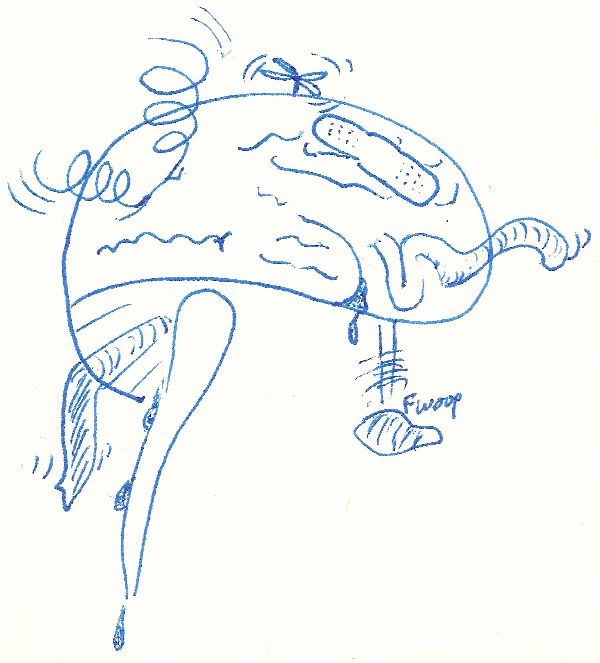
I know how desperately hard it is to change the way you eat, because it means changing the way you have to respond to your most primitive longings at your most vulnerable and achingly needy times. (I have an extremely high tolerance for uncertainty and an extremely low one for needless stupidity, especially in myself, and that has been a great help in working this out.)
It helps to have a structure worked out and some sort of support: hence the success of Weight Watchers and clinician-approved eating patterns like the Stone Age diet or the South Beach Diet.
These dramatically different strategies coexist because … drumroll please … we aren’t all the same! Some will work on some, others will work for others.
Personally, I’m intrigued by the immunological component of digestion and assimilation (another key characteristic of gastroneurology), best addressed by the Blood Type bouquet of diets. The Type O eating pattern (with added wheat) was what I did naturally when I was fit and well, and guess what, I’m type O.
 |
| mmmmm, lunch! |
But things have gotten weirder since then…
Now that I’ve finished my tea, it’s time for breakfast. Guess what that’ll be? 🙂
Links:
- Last week’s divine excess: Moderation… in moderation
- Ed Connor at The Healing Zone: The Healing Zone Therapeutic Massage
- My Brain Food shakes, Recipe: Kale Shake & the Sunshine Band
- The defining book of gastroneurology, The Second Brain, by Michael Gershon, MD
- Slate magazine article from 2007, Should You Trust a Gut Feeling
- NY Times article from 2011, The Other Brain Also Deals With Many Woes
- Fascinating but deeply geeky paper explaining this field, Fundamentals of Neurogastroenterology: Basic Science
- Weight Watchers official site: http://www.weightwatchers.com/
- Dr. Voegtlin’s original book on the Stone Age, or Paleolithic, Diet: The stone age diet: Based on in-depth studies of human ecology and the diet of man …plus a more recent reference: Wikipedia on the Paleolithic diet
- Dr. Agatston’s South Beach Diet book: South Beach Diet: The Delicious, Doctor-Designed, Foolproof Plan for Fast and Healthy Weight Loss
- Dr. D’Adamo’s page for Blood Type diets: Eat Right for Your Type