The arts are not trivial — why mythopoiesis matters

Almost 7 years ago, I was walking with a fellow writer, sharing our souls as good friends do. I was recently disabled with CRPS and, needing activity as I do, I was trying to think what to do with my life beyond struggling to stay alive and in manageable pain.  I complained about my internal blocks to any sort of publicity for my work.  (I had no blogs.  Nobody outside the Java software industry had ever heard of me.  Nearly all my output had been printed anonymously by the company I worked for.)  
She asked what I thought that was about.  I said I had been brought up with the very clear message that arts are fine for a hobby, but that making a living as a writer or actor was absolutely unthinkable.  It was irrational to take the arts seriously.
Her soft voice changed to ringing iron in the shape of a bell: “The arts are not trivial.”  
I stopped, right there on the sidewalk, shocked out of my self-pity. She turned and egged me on; we continued walking.  “What did you do after surgery?” she asked.
I mumbled, “Watched movies.”
“You watched movies. When you were a little better but couldn’t go back to work yet, what else did you do?”
“Read.”
“You read.  Writers and actors and producers and other artists got you through that time.  They got you through the last year, with the awful work and the layoff.  Survival is not trivial.  It’s significant.  The arts matter.”
Hard to argue with that.  I’d be dead, miserably dead, without the work of visionaries — especially the really  funny ones.
This came up again in the context of my own more recent absorption in the value of mythology as a ticket to survival in the face of horrible odds — a pressingly modern issue in these impossible times.  Then today, I learned that it was Professor Tolkien who created the word “Mythopoeia” — wrote a poem on it, in fact, to his increasingly rigid friend Reverend Lewis. 
While both men were theists, C. S. Lewis was much more interested in the structure and received wisdom of religion; J. R. R. Tolkien was a spiritual seeker more in the experiential, visionary, nature-loving, nearly shamanic mode of poets like Coleridge and Keats.  
 Here it is, with my annotations [in square brackets and italicized.]  Take your time and enjoy:

To one who said that myths were lies and therefore worthless, even though ‘breathed through silver’.

Philomythus to Misomythus

[“Loves Myths” to “Opposes Myths”]

You look at trees and label them just so,
(for trees are ‘trees’, and growing is ‘to grow’);

[I love this comment on the dry limits of literalism!]

you walk the earth and tread with solemn pace
one of the many minor globes of Space:
a star’s a star, some matter in a ball
compelled to courses mathematical
amid the regimented, cold, inane,
where destined atoms are each moment slain.

At bidding of a Will, to which we bend
(and must), but only dimly apprehend,
great processes march on, as Time unrolls
from dark beginnings to uncertain goals;

[he’s making the point that there’s more to all this than we can comprehend in our poorly-constructed, limited and ignorant theories of time, space, matter, and life.
He goes on to describe fiction, which at least doesn’t pretend to hold all facts:]

and as on page o’er-written without clue,
with script and limning packed of various hue,
an endless multitude of forms appear,
some grim, some frail, some beautiful, some queer,

[he used “queer” in the sense of “odd”, but as far as I’m concerned it’s all good]

each alien, except as kin from one
remote Origo, gnat, man, stone, and sun.
God made the petreous rocks, the arboreal trees,
tellurian earth, and stellar stars, and these
homuncular men, who walk upon the ground
with nerves that tingle touched by light and sound.

[by pairing these luscious words with the plain ones, he just destroyed the dry concept that “trees are ‘trees’, and growing is ‘to grow'” — making the point that there’s more to language and life than the rules we know.]

The movements of the sea, the wind in boughs,
green grass, the large slow oddity of cows,
thunder and lightning, birds that wheel and cry,
slime crawling up from mud to live and die,
these each are duly registered and print
the brain’s contortions with a separate dint.

[he’s pointing out (with beautiful imagery) that our brains are so rich and complex, and that life and experience are so rich and complex, that each rich experience makes unique patterns in a complex brain…]

Yet trees are not ‘trees’, until so named and seen
and never were so named, till those had been
who speech’s involuted breath unfurled,

[…and that even to come up with dry little words to describe them, is a feat of imagination in the first place]

faint echo and dim picture of the world,
but neither record nor a photograph,
being divination, judgement, and a laugh
response of those that felt astir within
by deep monition movements that were kin
to life and death of trees, of beasts, of stars:
free captives undermining shadowy bars,
digging the foreknown from experience
and panning the vein of spirit out of sense.

[remove the line-breaks and read that again: “but neither record nor a photograph, being divination, judgement, and a laugh response of those that felt astir within by deep monition movements that were kin to life and death of trees, of beasts, of stars: free captives undermining shadowy bars, digging the foreknown from experience and panning the vein of spirit out of sense.” 
In short, taking pictures and otherwise recording things is often a nervous tick, used by those who aren’t enough in touch with their feelings and experiences to find some richer way to convey them meaningfully — but convey them we do, however we can, in an effort to rescue our deeper selves…]

Great powers they slowly brought out of themselves
and looking backward they beheld the elves
that wrought on cunning forges in the mind,
and light and dark on secret looms entwined.

[…and from that effort we grow, and brilliant works come in time.]

He sees no stars who does not see them first
of living silver made that sudden burst
to flame like flowers beneath an ancient song,
whose very echo after-music long
has since pursued. There is no firmament,
only a void, unless a jewelled tent
myth-woven and elf-pattemed; and no earth,
unless the mother’s womb whence all have birth.

[in short, to see something, we must first be able to imagine it.  This idea of his has since been borne out by modern science: http://www.sciencedaily.com/releases/2008/07/080703145849.htm]

The heart of Man is not compound of lies,
but draws some wisdom from the only Wise,
and still recalls him.

[Tolkien’s religious background was Roman Catholic, which believes in God as the ultimate source of wisdom …]

               Though now long estranged,
Man is not wholly lost nor wholly changed.

[…and teaches the story of the Garden of Eden as the fall of man and expulsion from paradise.]

Dis-graced he may be, yet is not dethroned,
and keeps the rags of lordship once he owned,
his world-dominion by creative act:
not his to worship the great Artefact,
Man, Sub-creator, the refracted light
through whom is splintered from a single White
to many hues, and endlessly combined
in living shapes that move from mind to mind.

[Our minds may be separated from God’s (his belief, not mine) but they are still derived from it, and all our rich variety of unique perceptions create endless possibilities.]

Though all the crannies of the world we filled
with Elves and Goblins, though we dared to build
Gods and their houses out of dark and light,
and sowed the seed of dragons, ’twas our right
(used or misused). The right has not decayed.
We make still by the law in which we’re made.

[A triumphant assertion of the right to exercise creative will.  Go Tolkien!]

Yes! ‘wish-fulfilment dreams’ we spin to cheat
our timid hearts and ugly Fact defeat!
Whence came the wish, and whence the power to dream,
or some things fair and others ugly deem?

[yeah, so we make stuff up — and it makes us stronger. It’s holy.]

All wishes are not idle, nor in vain
fulfilment we devise — for pain is pain,
not for itself to be desired, but ill;
or else to strive or to subdue the will
alike were graceless; and of Evil this
alone is deadly certain: Evil is.

[now that’s pretty clear!]

Blessed are the timid hearts that evil hate
that quail in its shadow, and yet shut the gate;
that seek no parley, and in guarded room,
though small and bate, upon a clumsy loom
weave tissues gilded by the far-off day
hoped and believed in under Shadow’s sway.

[you don’t have to be a soldier to strive against evil. To make stories, or art of any kind, as a refuge and defense against evil, is to make room for a better future…]

Blessed are the men of Noah’s race that build
their little arks, though frail and poorly filled,
and steer through winds contrary towards a wraith,
a rumour of a harbour guessed by faith.

[… and the future itself starts out as something imaginary, a “rumor.. guessed by faith.”]

Blessed are the legend-makers with their rhyme
of things not found within recorded time.
It is not they that have forgot the Night,
or bid us flee to organized delight,
in lotus-isles of economic bliss
forswearing souls to gain a Circe-kiss
(and counterfeit at that, machine-produced,
bogus seduction of the twice-seduced).

[it’s been said that this sounds a bit like our own times]

Such isles they saw afar, and ones more fair,
and those that hear them yet may yet beware.
They have seen Death and ultimate defeat,
and yet they would not in despair retreat,
but oft to victory have tuned the lyre
and kindled hearts with legendary fire,
illuminating Now and dark Hath-been
with light of suns as yet by no man seen.

[artists and writers and musicians keep us going, reminding us of brighter times and a future worth having, even in the face of defeat]

I would that I might with the minstrels sing
and stir the unseen with a throbbing string.

[“I would” means “I wish” — it’s an older form, so an antiquarian like the Prof can use it with a straight face]

I would be with the mariners of the deep
that cut their slender planks on mountains steep
and voyage upon a vague and wandering quest,
for some have passed beyond the fabled West.
I would with the beleaguered fools be told,
that keep an inner fastness where their gold,
impure and scanty, yet they loyally bring
to mint in image blurred of distant king,
or in fantastic banners weave the sheen
heraldic emblems of a lord unseen.

[he doesn’t care how silly or crazy or poor he seems, he will keep his courage and share his vision whatever anyone says.  Man after my own heart]

I will not walk with your progressive apes,
erect and sapient.

[in his day, “progressive” meant “making more machines, funding more science without conscience,” “making bad things happen faster”; what was called “progress” in his day, we would call “unsustainable development,” “pollution,” “health crises,” “rising poverty,” “environmental destruction,” and all those associated events. This word’s meaning has swivelled about 180 degrees]

                Before them gapes
the dark abyss to which their progress tends
if by God’s mercy progress ever ends,
and does not ceaselessly revolve the same
unfruitful course with changing of a name.
I will not tread your dusty path and flat,
denoting this and that by this and that,
your world immutable wherein no part
the little maker has with maker’s art.
I bow not yet before the Iron Crown,
nor cast my own small golden sceptre down.

[another line that makes me rise and wave my fist in triumph. He will keep his little sovereignty over his own poor life and trivial work, rather than give himself up to the unfeeling machine of so-called “success” that’s based on anaesthetic values like logic without art, money without value, creation without creativity.]

In Paradise perchance the eye may stray
from gazing upon everlasting Day
to see the day illumined, and renew
from mirrored truth the likeness of the True.
Then looking on the Blessed Land ’twill see
that all is as it is, and yet made free:
Salvation changes not, nor yet destroys,
garden nor gardener, children nor their toys.

[when we are true to our best selves, we are heavenly and whole.  Simple as that]

Evil it will not see, for evil lies not in God’s picture but in crooked eyes,
not in the source but in malicious choice,
and not in sound but in the tuneless voice.

[evil is due to distorted perspective, vile actions and unfeeling motives — it’s not available to those who are sincere]

In Paradise they look no more awry;
and though they make anew, they make no lie.

[creativity is not a lie]

Be sure they still will make, not being dead,
and poets shall have flames upon their head,
and harps whereon their faultless fingers fall:
there each shall choose for ever from the All.

[when we’re dead, those of us with the nerve and integrity to create will be valued, have endless possibilities to choose from — and work directly with God!]

Sources:

It occurs to me I should check the copyright status of this poem. Obviously, I think of Professor Tolkien’s work as being for all people and for all time, but his executors’ views may differ from my implementation.  

Himalayan dreams

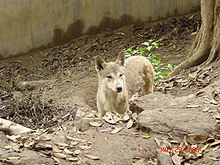
Had a dream of a remarkable wolf. It said it was from an extinct ancestral species. There were great mountains around us. I got curious and looked a few things up.

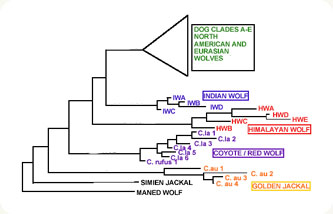
Timing couldn’t have been much better. In 2004, scientists examined mitochondrial DNA and cleared up a lot of questions about speciation and ancestry:

Here’s the Smithsonian’s article with that graphic: http://nationalzoo.si.edu/SCBI/SpotlightOnScience/fleischer2003108.cfm

Until this study, all canids except maned wolves (truly ancient) and coyotes were thought to be basically a type of grey wolf; Tibetan and Himalayan wolves were different flavors of the same breed. (The web being what it is, the old ideas of the much-loved grey wolf being the grand-daddy of them all still show up everywhere.)

Turns out the beautiful and sweet-faced Himalayan wolf is the ancestral canid from which Tibetan wolves, grey wolves, Mexican wolves, red wolves and modern dogs (from molossers to dachsunds) are all descended.

The adorable mutt I grew up with. The huge, terrifying sheepdogs of Turkey, where I was born. The overdressed show poodle that walks my marina. The chihuahua who helped fix my boat. All from the Himalayan wolf.

There are only 350 of this extraordinary species left, as of 2004.

http://news.bbc.co.uk/2/hi/south_asia/3804817.stm

The main problem? Human ignorance, voraciousness and violence.

Because 12 billion of us just isn’t enough, humans are expanding cultivable and buildable land every day to feed still more. I’m not sure why this is still seen as a better option than parental education and birth control, which are tragically underfunded worldwide.

Wolves are hunted for sport, because some people just have to prove they’re better than anything that doesn’t have ballistics and steel.

Wolves are hunted out of fear, because they are the bugaboos of Himalayan legend — since wolves have been made metaphors for the vilest traits of humanity in Europe and Asia alike. They aren’t like that, we just wish they were, so we wouldn’t realize we are looking in the mirror when we think of unrelenting evil.

They are hunted for killing livestock, which they do in the winter … But the ranchers who keep a couple donkeys with their herds, never lose animals to wolves. Donkeys have no fear of wolves and will kick the living snot out of anything that attacks their herd. Many ranchers don’t know this! Livestock predation is a stupid problem with an easy fix.

Rumor has it there’s a captive breeding program in India, but I haven’t been able to track it down online. I’d be happy to make a website for them with a big, persuasive “Donate” button.

Meanwhile, I’ll keep looking.

Addendum 1

Turns out that donations aren’t possible: http://wildlifesaviour.blogspot.com/2011/05/himalayan-wolf.html. HOW is that POSSIBLE? Further research needed, apparently.

I intend

I intend to die a hale and hearty old bitch,
rounding Cape Hatteras on a blowy day
in a boat far too light for the waters
but light enough for me;
or flying over fences on my blooded
or bloody-minded Arab mare,
a feisty brat after my own heart,
one fence too far.

Sudden and fierce it should be.
Nobody I’ve never met should profit
from my slow and tortured death,
acceding in misery
to what the doctor thinks is best.

Their training is not that good.

Pharma doesn’t train my best healers.
Only wind and waves and good rich earth
can give what I need, or take it at the end.

The Raven quoth … Something untranslatable

The ravens almost never come this far out on the water, but this morning two, then three of them, didn’t want to leave my ‘hood.

One perched on my mast; I shook it off with a nasty remark (their poop stains), and it flew around and around and around, too restless to settle elsewhere, too fixated to leave my bit of the sky.

(My unrepaired jib and the neighbor’s “corporate America” flags point to the rook’s erstwhile perch)

The restless raven rasped brusquely, then all three absconded at once.

As mythological moments go, that was a showstopper.

If I were writing a story, that would only happen right before all Hell broke loose. The thing is, Hell has a habit of breaking loose around here — in my life, in Oakland, on Earth generally these days. Why ravens now?

I’ll keep an eye on the sky (I always do, for the weather) and my nose to the grindstone. I’ll keep my hand on the plow and not sheathe the sword. And, of course, both feet planted firmly on the ground while grabbing the tiller.

What’s left of me will post updates.

Define stability

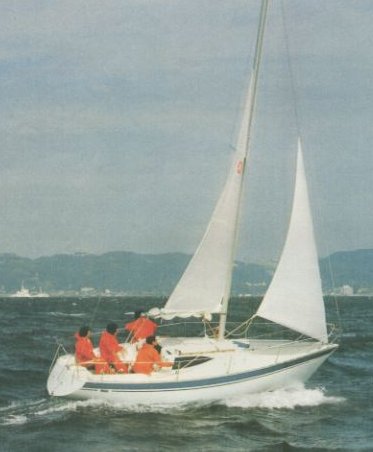
I live on a boat. Not a houseboat, a sailboat. It’s 29 feet long, 9’4″ at the widest point (outside measurement), and has overhead clearance of just barely 6′ in the main cabin.

Since I’m less than 9′ wide and 6′ tall, this works for me.

A small boat is an unstable surface, shifting with every step and wiggle. You keep your balance by toning your abdominal muscles – as soon as you tighten your midsection, the wobbly feeling disappears, and even if the boat’s surface is 30 degrees from horizontal, you can still keep your feet under you.

I have the strongest core of anyone I know who doesn’t either live on a small boat or teach Iyengar yoga, because that’s just how it works.

A friend of mine moved away and couldn’t get rid of his even smaller boat (25′ with rather less overhead clearance), so he sold it to me cheap. The main difference between his and mine is that the smaller boat has a larger engine and a thicker hull. It was designed to sail across the Pacific.

Now I have two boats. (That’s COMMODORE Idiot, thank you very much.)

For various reasons, it’s time to leave the Bay Area. I’ll be returning part-time to rural Massachusetts, but I can’t hack the cold season. It would be far cheaper and less painful to gnaw bits off me with a blunt and rusty saw. So I have to come up with some way to live and somewhere to be during the off-season.

Did I mention that I have a boat? … In fact, two?

I’m discussing a boat-partnership with a friend of mine who is capable of the work, but hasn’t found out if he really likes it yet. We’re going to work on the boats this winter, getting them ready to sell; in the fullness of time, we’ll know if we’re cashing them in for an upgrade to sail towards the Equator in, or flogging them and splitting the money then going our separate ways.

The second option is easy, sensible, and well within my expectations and experience of life. Our friendship could easily continue intact.

The first is not necessarily any of those things. But the long-term benefit of it is that it would probably give me a second home to go to, somewhere warmer, with the comfort of a friendly face to greet me.

Some think that coming away with a sack of cash is more like stability. Having money reassures me in a way known only to those who’ve done without. It feels solid.

But what’s the value of solidity? I’m used to ground that moves under my feet. Snug up your core, and it’s easy to handle. And there’s nothing like casting off and taking off, nothing over you but open sky, and your own home flying through the water with such poise that it makes even the cormorants faint with envy.

[IMG cormorant superflock on my birthday sail]

Stability might mean solidity. Or it could mean being able to balance different forces well. Which of these sounds more interesting? Even – or perhaps especially – when you aim to make each day as sparkly and intriguing as a handful of jewels?

[Just wait till I get the pictures up :)]

Considering the end: a new beginning

Mortality is tricky. We’re all going to go sometime, but we are hardwired to avoid the very thought of death. And so we should be.

However, when my loved ones die, my life (so far) continues – though significantly changed. Death has ripple effects on the living. This is why we have wills, wakes, and difficult conversations with the elderly and infirm.

My dad was a financial planner when he died. Here I am, 45, with a horrible condition and a little bit of property… As a financial planner’s daughter, I know perfectly well that the responsible thing to do is sit down and make a will, living will, and any other terminal documents I need. So I’ve started that process.

The old man would be proud!

Naturally, the first thing people ask is, in sweetly worried tones, “Are you okay?”

Having begun this process, I’m much better. It reassures me to know that certain important things will be said, certain horrible things will be avoided, and — though there’s no getting around the fact that bereavement sucks — there will be more love and comfort in those ripples than there would be otherwise.

It also makes me think in terms beyond myself. Legislation around CRPS is almost nonexistent, because people don’t think of it as terminal. However, as I remarked in my bio-blog, the diseases it causes most certainly are.

Sound familiar? Anyone here remember the health care terminology changes in the ’90s? (Read the bio-blog for more hints.)

I can do something very important with my death (hopefully many years off) -– I can make sure it’s properly attributed. No disease without a body count is ever taken seriously, and it’s time to start counting bodies with this horrible disease.

Personally, I have been struggling with a panicky fear of mortality because of this disease: each time I have a flareup, my body is never quite the same again; each time I have a lasting attack of the stupids, I have no idea if I will get my brain back; my heart is becoming more irregular. Barring a miracle or an accident, I’m facing a rotten time. With this disease, I look at the end, and all I can do is scream. I hope I have hidden it well!

However, the thought of this final gift — proper attribution, a ripple of awareness, the hope of better care for my compatriots — this tiny thing, this little spark, has had a tremendous effect: I feel the force of my life again.

It’s true: when you’re skirting paradox, you’re close to the naked truth.

Contemplating the end with wide-open eyes, returns my thoughts to getting more juice out of life. There’s a lot of it left, all things considered. My end will not be in vain, and with that in mind, the time until then seems much more promising.

Links:
Bioblog about myelin & attribution
“Nothing you do is in vain”

L.O.B.E.: Lung-Opening Buoyancy Exercise

I floated in the hot springs, like a wallowing marshmallow: inhale to come up, exhale to go down and sink beneath the surface. Lift chin, inhaling through fish lips to lift myself up, wobbling; exhale, slowly descend… to one side.

It had been a few years since I had done this, but something wasn’t right. I was rocking like a drunk.

Inhale, slopping over to the left; inhale further, watch my middle rise, then my belly. Exhale, and sink piecemeal, in chunks.

This was just weird.

I got up, reached for the brains I had left by the side of the pool, and dumped them back into my head.

Now lie back… breathe… whoa, definitely off-balance. Flopping over onto my left side, I grabbed the side of the pool as realization struck.

I was only using my lungs one lobe at a time.

Yeah, weird. I didn’t know it was possible.

Some of you know that the right bronchus is supposed to be more accessible, but it was the left lower lobe that inflated first. The right side inflated second, middle then bottom. Before the left upper lobe. My right upper lobe had simply forgotten how to expand, and took some prodding.

Inhale, slop, wobble; exhale, stagger, bump. The water let me know exactly how well — or not — I was doing.

It was a busy morning, relearning how to use my lungs, rocking like a sea serpent surfing for prey. I spent as little time as possible reflecting on how a once-athletic health nut who liked to meditate, could forget how to breathe.

In a hectic and pun-lathered conversation this afternoon, we decided that “lobing” was a good word to describe working on those skills you really should’ve mastered long ago, preferably with a built-in indicator that not even the terminally clueless could miss.

I’ll spare you the wordplay, except that I’m a little worried about the Loberlords.

Next, I’ll try to go for a walk… but that’s far more complicated.

Maybe I’ll just sit here and breathe.

Dopamine, poverty, and pain: the lighter side

Executive decisions are made in the forebrain. The information that goes into them comes from the sensory cortex (nearby) and the hypothalamus (back in the dark heart of the brain.) The execution of those decisions happens in the pituitary, among other places. In short, there’s a lot of nerve-impulse mileage laid down between the moment you feel the itch in your armpit, check your surroundings for privacy, scratch away, and give a happy little sigh of relief. Lots of neurotransmission there.

Dopamine is the neurotransmitter of executive decisions. It’s a daughter chemical of adrenaline, and your adrenal glands share blood supply with your kidneys; interestingly, Chinese medicine views the need to make too many decisions as being hard on the kidneys. Makes perfect sense to me. But that’s a red herring.

The key is, without dopamine, the decision can’t get from the frontal lobe to the action parts of the brain. Dopamine levels can be knocked back by pain, drugs (including the prescribed ones), depression, poor diet, and — of course — overuse.

People who have crippling pain have to make exponentially more decisions than those who don’t. Every action is measured against an internal set of standards that don’t exist for normos: how much pain will lifting that cost me? That car door — which way should I turn my hand to minimize damage when I pull it? How many function-dollars do I have left in my body’s account — enough to do laundry _and_ shower? Or should I do just one? If so, which one is more necessary?

Poor people have a similar ceaseless train of calculations running in their heads, but with different parameters. Can I get a little meat this week? What are my produce options, since there’s no good market in this area? Which neighborhood’s market has the best prices? Have I got the bus fare? Will I get into trouble over there? How do I blend in? Can I call in a favor to get some Tylenol too? These headaches are killing me.

As a poor person with pain, I figure I make easily 20 times as many decisions — on a slow day — as a normal person my age. When I was still overmedicated, I used to feel like a loser for not making 100% perfect decisions 100% of the time; in fact, I occasionally just goofed. And the trouble with living within such narrow parameters of function and finance is, the occasional goof can put you behindhand for a very long time.

It’s easy to sneer at those who make weird decisions like paying for a flat-screen TV instead of a semester of junior college. But try wringing out your dopamine every single blessed day, week after month after year, and see how well you do. These people don’t have decision-making disorders, so much as decision-making overload.

If you’re poor or in pain, take some credit for getting through the day. Cut yourself a little slack. Take a moment to rest and relax. See, it’s easier already.

Being hypercritical just uses up your dopamine faster. Why? Because criticism is the result of long strings of decisions. It’s very dopamine-expensive. (Ever wonder why hypercritical people don’t seem very happy? Now you know.)

Take a moment to be happy, to notice what’s good. Those moments rebuild your store of decision-making, anti-depressant dopamine. Each natural, happy little sigh is a shot of the stuff.

Sniff that flower one more time. Scratch where it itches (preferably in private.) Feel the sun warming your head. Laugh with your friends. There’s a reason why it feels so good. It really does make you stronger. It freely gives back what life makes you use. And it’s not too hard to find a reason to be happy.

Inspiration and vacation

I must remember to inhale. It’s too normal to go about with my whole core clenched. It’s very tiring, and I’m generally tired enough, thank you.

Here’s an interesting thought… If I feel chronically un-rested, it’s tempting to think that the solution is to rest, at some point, for long enough to recuperate completely. Nice thought, eh?

Doesn’t work. For one thing, I need to Do Something to keep the lymph flowing & neurotransmitters cycling, so absolute rest is beyond me. For another … Well, pursuing yet another extreme state probably misses the point.

So I come to the idea — by a very long route — that resting and recuperation are supposed to be as much a part of daily life as eating and breathing and sleeping. (Strange thought.)

It takes a certain amount of determination and persistence. It’s much easier, given my situation and habits, to churn on something that frustrates me or to brace for the next unexpected blow.

I’m practicing. Yesterday, I took a more scenic route home; don’t think it took much longer, but I got quite a bit of sun on my hair … And I remembered how to inhale.

I got only a couple hours’ sleep the prior night and worked hard that day, but at 5:04 pm I felt more rested than I can remember.

Today, I still feel that much better. Inhaling is still something I need to remember to do, but the part about digging the moment I’m in is already easier. Stretching is spa-time. A moment in the sun is a break. A beautiful glimpse of sparkling sea is a mini-vacation.

So something worked.