Frozen

I was mulling a post called, “The Pulse,” about how my life tends to go in surges, and when I work with that, things go better, but when I try too hard to flatten life out to a steady level, everything goes badly.

Some people try to flatten the ocean. That's above my paygrade. I just try to ride the waves. Photo Brocken Inaglory/Wikipedia.
Some people try to flatten the ocean. That’s above my paygrade. I just try to ride the waves. Photo Brocken Inaglory/Wikipedia.

It’s about the pulse — push when I have the momentum to push, pause when the momentum fades, sink when even standing still feels like a sucking drain; push, pause, sink, push, pause, sink, and so forth.

If you’ve ever held a stethoscope to the sound of a beating heart, you have an idea what that sounds like.

It’s like pacing, a familiar concept to the chronically ill, but on a larger timescale.

Winter always involves some withdrawal, some sinking. This makes lots of sense to my acupuncturists and martial arts teachers. The traditional Chinese medical model assumes that we’re embedded in a larger reality, with weather and climate and timely changes, a key idea which conventional medicine doesn’t acknowledge very well.

I used to be able to push enough, even in winter, that the annual sinking wasn’t that obvious, given that most of those around me were in winter too. However, since my mid-30’s, a lot of people I’ve loved, liked, and depended on have died in the chilly armpit of the year. Deathiversaries, as I’ve noted, tend to have an effect on me, especially when they pile up like… well… bodies.

Perhaps I should move south of the equator. Then it’ll be warm at this time of year, at least for me, if not for my lovely ghosts.

Photo in the public domain, with thanks to the photographer Nello Rolleri

Late last year, two honorary brothers, one of my dear CRPS friends and a young friend whose life I actually saved at one time, both died. Now, at least two of my honorary sisters are at the end of their lives, one of CRPS and the other who’s working on her 6th cancer.

I’m not whining. It’s not about me, it’s definitely about them. I’m not dying.

It’s just that it’s hard to remember that, sometimes.
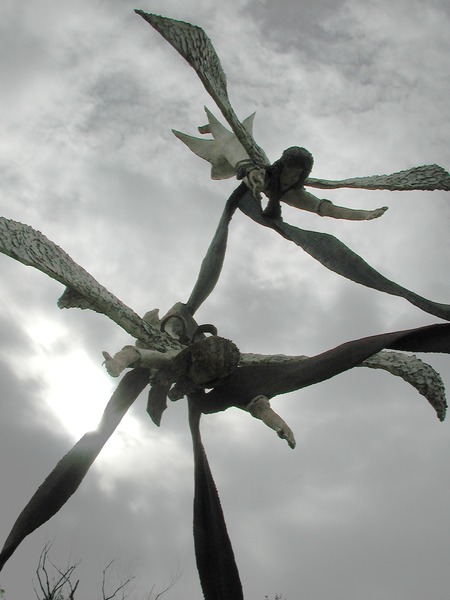
Angels_lossy_notsonice
Helpless as I am to hold back the grim reaper’s scythe, there are sometimes things I can do to soften the end of others’ lives. My first nursing job was on an HIV/AIDS unit in 1991, so this is a well-established idea for me.

This year, though, 24 years on, some invisible line has been crossed, or some invisible straw has landed on this camel’s back. I cannot move. (It’s kind of wild that I can write, finally.)

I am paralyzed, generally anesthetized, frozen. There is no pulse, no pause, no sinking, not a microgram of push.

My mind currently looks something like this.  Photo  Chris Stubbs/Wikimedia.
My mind currently looks something like this. Photo Chris Stubbs/Wikimedia.

Four days of work, pushing so hard it sucks my breath away, and I now have a psychotherapy appointment with a 30-year veteran of helping the chronically ill and deeply traumatized. Plus one blog post.

I can’t do a thing for anyone else until I can move and breathe again. This thought alone is like a blanket of razors, since the condition of my friends isn’t going to wait for me to get my act together, but still — it doesn’t break the ice.

There are some things that are too much to expect a reasonable person to bear, and anyone with a hellacious disease already has one of those things on their plate. Those who are in the last stage of life have another. Those who are bereaved … you get the idea.

I’m posting this, not to write my diary in public, but because I know I’m not alone. Those of you who can barely move enough to shift the cursor, be assured that I know you’re not alone, either. Somehow, we will get through this. We will melt the ice, with help if we can get it. There is always an afterwards.

There’s one thing that offers this frozen veteran of grief the kind of scathing consolation that’s all I can expect these days: when my time comes to shuffle off this mortal coil, then, if there’s anything left of me to notice or care (as I strongly suspect the more subtle yet intransigent laws of physics require), I will be in the very best company.

Ethan, in memoriam

I tried to find a song for Ethan, who did love music, but it wasn’t working. I’m not much of a poet, frankly, but it was the only thing I could do.

Here is Ethan’s poem from me.


We did the impossible quietly
Getting the boat into harbor
and keeping it safe through the night

Tight hugs abeam unstable piers
My little brother, so big

When I thought I'd die of weakness
You showed me my strength
And, smiling, would not accept less

Tight hugs killing off mortal fears
My little brother, so big

Long nights talking and talking
'til your gyroscope turned and you looked
at the first stains of dawn on the water

Tight hugs at the end of the tears
My little brother, so big

When you turned searching eyes upon me
For the integrity that rooted your heart
You had the grace to thank me

Tight hugs through difficult years
My little brother, so big

You were so impossibly larger than life
I wrote you into a comedy of death
And you were the best thing in it.

I miss your hugs, my dear.

It’s really too bad (a bit of staggering English understatement, there.) He had found the right life and the right wife, and I was beginning to think I’d eventually meet his children.

I hope he’s free of the demons that hounded him so mercilessly. Wherever he is, I expect he’s raising Hell — kicking righteous butt and making the world fall in love with him, and doing both with equal, unquenchable vigor.

Living without hope – tasks and aftereffects

I lived without hope for years. Years. It was weird to look around one day and realize I had no hope, and that I hadn’t had any for awhile. I didn’t think I was going to see another Christmas… for at least 5 Christmases.
ChristmasTree_NOT
When the few friends who were willing to be honest asked me what I hoped for or what I had ambitions for, I had to tell them that I had no hope and I had no dreams of the future.

They really had trouble with that.

Some just did that weird, head-shaking, “I didn’t just hear that” thing and changed the subject. A few asked if I was suicidal. I had been, and I drifted in and out of degrees of thinking about how to make it painless and permanent if I did kill myself, but I was… surviving.

Actually, I was working really hard on surviving. Hope had been sucking me dry, making me see things that weren’t there, putting my energy into some future I could only imagine, but couldn’t see a way to reach.

If I hadn’t been willing to drop everything, including hope, in order to just focus on the business of living with this horrific reality, I think I wouldn’t have survived. I had no extra energy, and hope was too demanding.

Line drawing of woman flat on floor, with woozles coming out of her head
Image mine. Creative Commons share-alike attribution license 🙂

When I came out of that time, very very slowly, it dawned on me that I had been fighting for so long for my own life that, for the first time in my entire conscious existence, I felt no need to apologize for the space I took up, the effort and attention I required from the world, or, in fact, for anything.

As I told my Mom at the time, “I’ve fought for others’ lives pretty often, and when you’re coding someone, they’re your whole world for the time that you’re coding them.
CPR
“If you fight for someone’s life over any length of time, you come to care about them as well as for them, even if you have nothing else in common. Well, I’ve spent years fighting for my own life, and it’s impossible to fight that long for someone without really coming to care about them. I really love myself, in a solid way, with no caveats, and nobody and nothing can shake that.”

So, I don’t associate hopelessness with futurelessness or lifelessness, as most people seem to do. I have every faith in our ability to face life without hope, because sometimes it’s just dead weight. Sometimes, it distracts us from what’s real.

I have faith in us, hope or no hope. I have absolute faith in our ability to move through the stages of this unbelievable circus we call life, and make them work for OURSELVES in the end.

Faith isn’t the same as hope, because it relies on something that’s present now, not on something that might be possible in the future. I have faith in our doughtiness, an old-fashioned word combining the meanings of nerve, grit, and determination. Boy, do CRPSers have all of that!

In the end, hope is a luxury we can’t always afford. Hoping and dreaming — putting our energy into things that don’t exist — can be a real sink. That is, maintaining hope and dreams can, themselves, take more energy than we can afford.

It sounds counterintuitive to someone who’s never been there, because most people think of hopes and dreams as what pulls us forward.

If hopes or dreams pull you forward, that’s good; if they don’t, reconsider, and maybe refocus.

Refocusing on the sheer present business of finding a way to survive with things as they are right now is not wasted time, it’s not suicidality, and it’s not even an act of despair. It’s profoundly rational, profoundly functional, and even when it’s profoundly difficult, it’s still profoundly worthwhile.

From my own experience, I have to say it’s a strange state of mind to live in, but it’s surprisingly worry-free. False worries fall away as fast as false comforts do. Once I accepted the state of life with no hope, there was no room for b.s., either in my world or in my relationships.

Life simplified itself; all I had to do was keep up — or rather, pare down. That was weird too, because I used to find stuff comforting.

In that utterly simple state, though, it wasn’t comforting. It was just stuff.

Having emotional energy invested in something so … stufflike … was absurd. Talk about false comfort!

So, before long, all I had was what I needed; nothing more, and not much less.
teapot-eaglehaslanded
In time, everything changes, even the amount of energy we can spare. I can tell you exactly when I rediscovered the luxury of hope, because I blogged about it here. It was nothing more than the first whisper, because that was all I could support, but it was unmistakeable.

Since then, I’ve also rediscovered flippancy, ambition, and even toilet humor. (My sense of irony never left, which makes me think it’s essential. H’mm…)

But a few things still remain, deep currents in the otherwise twinkly surface of my character:

  • stuff is good only if it’s useful and there’s room for it;
  • nobody, but nobody, decides when I die but me; and
  • I love myself. I may be grubby, nerdy, daffy, clever, ill-yet-unconquered — but I love myself absolutely, without vanity, and without caveats.

If it took living without hope, then I’m better for having done it.

Aphorism for the day: Don’t be afraid of what life brings you. You never know what’s on the other side. It’s just a matter of getting there.

me-fingers-peace

Un Crossed

Note – For legal reasons, this article is explicitly labeled an opinion piece. Quotes are used with prior permission of the author.

I’ve written of bereavement, suicide, the fact that CRPS is not imaginary (the whole point of this blog), and the true mortality rate of CRPS.

Now it has all come together.

Cross Y. was a friend of mine. He wore his heart on his sleeve — there was no deception about him, no malingering, no lying, no selfishness. Selfishness was something he needed more of, and tried to aspire to, because he forgot his own needs in the face of others’. His kind and loving heart poured forth upon his CRPS kindred and those he loved, often in scintillatingly original and muscular words.

He was injured at work. You’ve seen the news about corruption in New Jersey. Add to that the corruption of the Worker’s Comp system, and try to imagine for one minute what that might be like.

July 8, 2013
The truth will set me free,
Kill your dreams,
have nightmares for the rest of your days,
Welcome to New Jersey,
we stand our ground,
unite and become one sound,

The truth will set me free,
technology,
paper trial was the beginning,
soon the end,
your dark tunnel will remain,
Yes this once holy man,
once believed,
now a fucked up memory,
many joined,
happily crucified,
only one will remain,
your future is in vain,
your lies you cannot hide,
you may run,
change your name,
DNA will remain.

The truth will set me free,
Kill your dreams,
have nightmares for the rest of your days,
Welcome to New Jersey,
we stand our ground,
unite and become one sound.

Cross Y 7/6/13 1.21pm

He was a good-looking young Middle Eastern man, so of course, the New Jersey cops figured he was dirty from the get-go.
Cross solo
Then his brother, who didn’t believe he had this disease, became a cop, and things got worse still.

I watched his family dynamics transform as his marriage with a green-card seeker fell apart, then his beloved family started to fail him, and then he spent the best part of a year fighting to survive in an increasingly hostile and impossible hail of abuse, predation, invasion, and brutality.

The system failed him. His lawyer failed him. His family failed him. The original newspaper articles, based on interviews with his family, trivialize and brutalize still further the brightest mystic-poet I’ve ever known.

I’m grieved. More than that, I’m furious.

I had to watch as his extraordinary resilience was pushed and pushed and pushed until every strand of rubber broke.

I had to watch as his stumbling command of English prose was used to throw away the meaning behind his words. Judges and doctors alike could hardly be bothered to listen, and certainly couldn’t be bothered to believe him. Those of us who knew him had to watch as his posts wove between intelligent determination and raging despair, as time after time after time he was thrown back from what properly belonged to him.

His wife stole $30,000 of disability checks. His wife dumped him as soon as her immigration status was assured. His wife pushed him down off his weak leg.

Guess who went to jail? It wasn’t his wife. Try to imagine cold, sharp steel cuffs snapping tightly on CRPS wrists. You can’t. The world isn’t supposed to be large enough to hold that much pain.

August 6, 2013
The color of my eyes have become

the mountain I cannot climb,
the west brings the rainy days,
the east brings the heat,
So I wait,
I’ll give you my night,
I’ll give you my site,
I’ll give you my last breath,

The color of my eyes have become

the mountain I cannot climb,
Realities exist,
Unwinding occurs,
Petals unfolding,
Protecting what’s remaining,
Adapting each day,
Earth is distributing,
New sign,
New rhythm for humanity,
Being Bold,
Voice your feelings,

Full moon of greatness,
Hidden lights reflecting,
Fire resurrecting,
Slumbering beliefs,
Illusions of the underground,
Transformation of natural field,

The color of my eyes have become

the mountain I cannot climb.

9.42am 8/6/13 Lost soul

His brother’s police pals broke into his room (or were let in by his parents), stole his thumb drive, plowed through his poetry and his belongings, took his personal belongings, hacked his hard drive and his accounts. When he said he was going to install a spycam for evidence, his parents got him involuntarily committed to a public psychiatric hospital in New Jersey. They did not treat his CRPS, which was, after all, all in his head. They treated delusions that didn’t exist and a paranoia that was a perfectly rational response to his ghastly situation.

He got in line for emergency housing, but the wait list was at least 6 months long — for emergency housing. A combination of Governor Christie and Hurricane Sandy saw to that. The emergency housing and homeless shelters in New Jersey have been utterly gutted.

Three weeks ago, his father attacked and strangled him at a barbecue, in front of others. He posted a picture of himself afterward, with a bleeding bruise under one eye and big red welts around his neck, with the distinctive engorged look around the eye-bones (remember this is a former Emergency nurse writing this.)

His mother stood by and watched.

Someone called the police.

The partygoers disappeared.

His mother told the police that her husband had not attacked Cross, but that Cross had attacked her — with a knife.

Guess who got the handcuffs…

In private, she later apologized, and said she’d write a statement retracting the police report and her statements behind the psychiatric report.

She reneged.

He was living with people who were actively trying to destroy him. His work was being invaded and stolen. His life was in danger. Not even his dog’s life was safe.
Cross and his dog Leo
He had a sign posted in the rear window of his car: “We burn until there is a cure for RSD/CRPS.”

With perfect logic, he burned his car, before jumping to his death in the most beautiful part of the state. Of such indelibly poetic actions are myths made.

For him, there was no cure.

July 7, 2013
They Murdered me, I never

committed Suicide….

This disease is not imaginary. He was not crazy. He was perilously sane. He was a warm and loving soul with a shining gift of a mind, trapped in a fatally tightening spiral.

All he is now is a tragically truncated memory. What’s left is what we can scrape together of his work from our online conversations.

They keep saying he died of suicide. That’s not true. He died of torture: CRPS, institutional murder, and child abuse.

I. Am. Furious.

Cross, however, is finally at peace.

Reaching the Universe

Silence the past,
Silence the worries,
Silence the outside,
Silence the future,
Silence the self,
Silence the noise,
Silence the people,
Silence the voices,
Everything has left,
Faith in the now moment,
Faith that I am present to myself,
You are stripped,
You are Free,
You are Pure.
You are reaching the universe.

– Cross Y

Rest in peace, my darling, shining brother.

Humbling invitation

I’ve been invited to ride in the funeral cortége of the man I helped code last week. It’s a semi-public occasion, as he was a semi-public figure (which is why I’ve been cagey about details), so “yes” is not as simple as it sounds.

I seek public exposure the way other people seek whooping cough — every now and then, it hits, but fortunately, it’s rare, and generally causes no lasting damage.

I was silly enough to mention that I have a sub-par central nervous system to the extremely kindly person arranging the event — who was also my CPR partner at about this time last week. He nearly withdrew the offer on the spot, possibly raw over the possibility of another medical event.

It’s a bit strange to have someone else worrying more about my body’s reactions than I do. Kind of refreshing… but definitely strange. This disability has been so invisible for so long — a fact assisted by the sturdy stoicism so many of us live by — that I simply have no idea how to handle someone else’s concern.

To mitigate any need for worry on anyone’s part, I’m preparing for CNS stress on Monday. Here’s how…

I have found, absolutely consistently, that the key to preparing for extra events is all about berries and vegetables. All the vitamins in the world — which I think I’ve tried — can’t do quite as much good as half a bucketful of organic greens and half a basket of good berries per day. I just had a big farmer’s-market-fresh salad; I’ll have kale for dinner, and there’s steamed summer squash awaiting the next moment when I can handle a few bites. Wild blackberries are set for breakfast.

I’ll boost my multivitamins and antioxidants only slightly, since I already take about as much as my body can absorb. I’ll keep lemon balm (for pain flares and dysautonomia) and yerba santa (for nausea and nerviness) in my pockets.

I’ll do extra brain-training, which I’ll talk more about one day, but it’s basically about learning how to calm the central nervous system by sheer will. And t’ai chi. Lots of t’ai chi. Mental practice, if not much physical. I see a couple of Epsom baths in my future, stocking my system up on magnesium and sulphur to buffer this body a bit.

Funerals are for the living, though we think so hard about what the deceased would appreciate. I’m not sure why that works, but it does.

The peacocks left us a glorious side-feather.

peacock_sidefeather

It might come with me. It might not come back. I’ll see what it feels like the deceased would appreciate.

Define “invasive”

I was a Registered Nurse for 8 years — in one of the first HIV specialist units in the country, in the only public ER of one of the murder capitals of the US, in cardiac telemetry, in home care. It was a good, demanding, well-rounded career, if a bit short for my taste.

I’ve often wanted to re-educate my nursing self in light of my experience as a patient.
me-tongue-out
Here’s one of the most outstanding, outrageous lies we tell ourselves as clinicians: medications are not invasive.

That statement bears no resemblance to the reality of those being treated. It relates entirely and exclusively to the clinician’s experience. The clinician’s unstated assumption is, “I’m not hanging onto the thing that’s getting under your skin; therefore, what I’m doing is not invasive.”

News flash: Treatment is not about the clinician. It’s about the person being treated.
me_wrysmile
Medications get taken into the whole body, not just the ill part. Injections go right past the first barrier against infection and assault, the skin. Oral medications go through the mouth, descend into the stomach, and there meet the second barrier to infection and assault, the GI system… which they either aren’t bothered by, or can resist.

They’re then taken up by the blood, which goes everywhere.
circulation-allbody-Anna_Fischer-Dückelmann_1856–1917
They are all processed in the liver (it’s called “phosphorylation” and, privately, I suspect that’s why we tend to have trouble with phosphorus issues when we’re on lots of meds.) This is why too many meds for too long can lead, or contribute, to liver failure.

What goes through the liver goes through the spleen and kidneys, because that’s how it works. This is why some drugs can cause kidney damage.

What hangs out in the blood can, all too often, hang out in the brain. This is why some medications for organ issues or even a simple infection can cause deafness.

Blood circulation exchanges fluids with lymphatic circulation. Blood and lymph communicate with the central nervous system via the blood/brain barrier and the sheath around the spinal cord. The blood/brain barrier provides partial, rather temperamental protection, but it can be suborned by anything that makes the tissues fragile — fever, illness, injury… and some kinds of medication.

What is in the blood goes everywhere.
circulation-allbody-Anna_Fischer-Dückelmann_1856–1917
How is that not invasive?

I’m watching my partner fading with weakness after only a week on a couple of cardiac meds. I’m certain his heart has not gotten worse in a measly 7 days. The only thing that has changed is that he is seeing doctors and taking medication — for nearly the first time in his life. (“No side effects,” my left foot.)

How much of that weariness is stress, how much of it is the past couple of years catching up with him, how much of it is heart disease (actually, that part is pretty clear) and how much of it is medications? Each of these things has some part in it, there’s no question, but drawing the line between them is more than I can really do. I know the meds are part of it, but how much?

Medications are intimately, unavoidably invasive. There is no completely safe dose, and there is nothing that helps you for free.

Everything — meds, interventions, surgeries — EVERYTHING has side effects. There is no single thing you can do to your body, or allow others to do, that doesn’t affect every part of you in some way.

My years as a CRPSer, where the consequences of every change are so exaggerated, makes this pitilessly clear to me.

Given that there is no free ride, we have to look at the tradeoffs. Knowing that there are issues with absolutely everything, however “natural” or “close to our bodies’ own chemicals” it may be, we have to balance that against whatever benefits it may have.

Herbs are included, by the way. My increased sun sensitivity (which my disease causes a bit of anyway) and impairment of birth control (which I don’t take — what, mess with these chaotic hormones?) are side effects I shoulder with my eyes open, so that I can have the neurotransmitter support of the St. John’s wort herb I take twice a day.
St._Johns-wort_(Hypericum_tetrapetalum)_(6316227601)
I review all my medications twice a year at least, to see how I can tread the narrow path between optimum benefit and minimal confusion. Doing this from a chronically slightly confused state is, naturally, a whole different kind of fun. Working out which part of the daffiness is disease and which part is meds and supplements is really my most important task.

My partner has to choose between cautiously building back up some heart strength and circulation — and meanwhile have a life that is a small fraction of what he used to have for energy and activity, unless and until the medications and rehab really work; or risking the total loss of death by having a surgery which would leave him in pain and in rehab for awhile — but, afterwards, bring him back a lot closer to his normal, with many good years ahead.

Wait and see and work and hope, or take a leap and — if you live — work and probably win?

In a way, I envy him. If there were a procedure to do a bypass graft to eliminate CRPS, I’d be in the OR already. I’ve had enough of a twilit life, of exhaustion and fog. I want to get back into the full sun.

I miss running, too.

But it’s his heart, not mine. I do my best to explain things, listen carefully so as not to run over his real thoughts, and grab hold of my anxiety with both hands, so that any decision made is truly his. As it has to be.

Until then, he has to peer through the fog and work through the weariness of these “non-invasive” medications, to make his choices and his appointments. I’m just there to help — and to make sure he’s taken seriously, which is a real drawback to looking as fit as he does.
J-playing-on-treadmill
But that issue is another post…

Persistence, chronic illness, mortality, and other perky subjects

I’m recovering from packing and moving to my homestead. [I’m sorry to say that I don’t have internet yet, and the library’s uplink is slo-o-o-o-ow. Images will be filled in once that’s corrected. In the meantime, you get to see how I flag where the images will go.]
[img]
The cat is ecstatic. He’s getting muscular, too. He’s bigger than most of the cats I’ve ever had, and he’s only 8 or 9 months old. J is falling in love with his saucy sweetness — they’re a well-matched pair.

It took a week just to be able to think in a straight line again. I’m still very slow, but improving. Breakfast is my best meal, so I try to make it a good one — my stomach is not nearly as happy as the cat about all this.

Yesterday, as an aid to recovery, J and I went to the nearby hot springs for steaming and soaking.
[img]
We usually get nicely parboiled in a couple of hours, but I got horrifically dizzy going from the hot pool to the cold. Usually it feels terrific (one reason I keep going back) but I think I stayed in too long — 2 whole minutes… When I was able to see, I noticed that my skin was bright red; I touched it, and it was as hot as if I had a fever.

That’s the hyper-reactive response we get with a twitchy autonomic nervous system (ANS.) This is why we don’t ice our injuries with most forms of CRPS.

All my skin’s blood vessels spasmed with the cold, then the spasming set off an alarm in my wackadoodle ANS, and my ANS ordered all those peripheral vessels to open wa-a-a-y up.

What does that do? Sucks all the blood out of my brain and out into my skin, that’s what. Result: dizziness to a frightening degree. J helped me get out of the pool without drowning, and got me safely benched.
[img]
I realize I tend to overestimate my capacities, but that really was a first for me.

Periodically — and with increasing frequency — I get FED the heck UP with having these diseases — CRPS, FM, MCS, POTS, GERD … I’d have to be a British peer with medals and degrees to have that many letters after my name, in any other context.

These diseases are not recreational. They don’t just pop in, have a good time, and then take off.

They’ve moved in. They’re here for the long haul, or at least that’s what they seem to think. They take the concept of “persistence” to a whole new level.

It reminds me of something… H’mm. Oh yes.

In February 1999, I got a phone call at 4:10 am from my stepmother, telling me my father was dead. I still remember the way the word “no” kept echoing off the walls, until I realized it was me who had cried it out. I won’t describe the next few weeks, except that there was a lot to do (he had died in Egypt) and I learned a lot about the people in my family (interesting, not worrisome.)

After a few months, when the acute grieving was more or less behind me and I could drive safely and notice the birds and sunshine in a more normal way, I found myself unconsciously expecting him to be alive again. As if dying of a double heart attack face down in the water was like a curable cancer, horrific but eventually over. Then I’d catch myself, and that awful “no” would stab through me again.

There was a part of me that just could not get the permanence of death.

I haven’t spoken to anyone who has had this same experience. It may be so peculiarly daft that it could only happen to a wing-nut like me.

Death, take a holiday? Only in a Terry Pratchett novel.
[img]
Over the next couple of years, I had plenty of opportunity to come to terms with the persistence of death, as I was bereaved of friends and extended family about once every other month. None of them came back.

I don’t recommend it.

And this is where Walt and Pogo come stumbling in from the past:
[IMG: “don’t take life so serious, son, it ain’t nohow permanent.”]

It’s impossible to have a rotten, devastating condition and not face my own mortality once in awhile, if only because the blank spot that bereavement leaves in the world sometimes seems better than this mess. And it’s a persistent mess, too.

The real question is, is it just as persistent as death? Will there really be no end to this? The poetic injustice is, that question might not be answered until my ashes melt into the sea.

There are good times and strong times and, of course, I’m almost constantly panning for those nuggets of gold, so don’t worry.

It’s just that anyone vile enough to stick a gun in my ribs and say, “Your money or your life,” is going to have to hold me up with both arms, I’ll be laughing so hard.

Nice work, Clint, but I think me and my cohorts could top this delivery…

There’s always an afterwards

When I was a nurse, I could see when death was creeping up on someone. I saw gray fluttering around the person’s edges, especially around the head and upper body. As they recovered, the fluttering grew narrower and disappeared; as they lost ground, it grew wider, sometimes growing too wide to see.

Rear view of sturdy stone angel inside a lovel stone church

When that happened, I made sure I could find the code cart, because we were going to need it.

I worked and fought like hell to shrink that fluttering, to get each person closer to life.

Not every life can be saved. There’s a dislocating moment when, after working with several others to try to revive someone, it sinks in upon all of you – neaerly simultaneously – that it’s a lost cause, and then the doctor calls the code.

Everyone steps back for a moment, same expression on their faces: eyebrows up, eyes on the erstwhile patient, mouth slightly open, every brain running through the scenario and looking for something left undone (never has been, on my teams)… pausing in the shock of rebooting.

When I was coding someone, that person was the most important thing in my world, and all of my training and experience and physical capacity was tightly woven into my determination to get them back. When I had to stop coding them, all of that intense focus, activity, and energy had to come to a screeching halt, be re-assimilated back into my reserve, and clear the way for the next set of tasks. Not a trivial job.

Multiply  that by the number of professionals in the room, and you see why there’s always a breathless pause, even in the most practiced ER.

Then we get back to work, but it’s the work of cleaning up, restocking supplies and meds, prepping the body for the morgue/organ harvesting, and clearing the way for the next incident — a gunshot wound, a bloody nose, a beaten child, a drama queen or king; could be anything.

This explains a lot about ER staff: whatever happens, however we feel about it, we have to clear it away, clean up, restock, and be ready for the most trivial or the most harrowing issues to come in that door next — with little or no warning. Then deal with that, sometimes by brutal means (which you’d understand if you ever saw a chest tube placed or helped set bones for someone who’s been beaten.) Then go home, get food down and go to sleep, and be ready to  come in the next day and do it all over again. Day after day after week after year.

Imagine what that takes.

No wonder they often seem a bit detached, a bit harsh, a bit clueless about the human impact of what they do. They have to come back to that every working day, and try to stay above the madness.

Bosch_painting_of_Hell_(582x800)

The very day I realized I’d forgotten the human impact, was the day I knew I had to change careers. No wonder my immune system was failing. The effort to protect myself was killing me.

My dad’s death was unexpected, and happened overseas. It happened shortly after I knew I’d have to change careers, and shortly before I gave notice and surrendered my RN licensure.

I don’t think I’ll talk about it much, except to pass on the best advice I ever got about survival:

Take every opportunity to be happy, because it makes you stronger for the other times.

Less than a year later, one of my dearest friends died suddenly, back East… After that, I lost someone I loved every month or two, for just over a year… and somewhere in the middle of that, my relationship fell apart.

Hellish, tragic and harrowing as that period of time was, it turned out to be training wheels for being disabled with CRPS and all that comes with that.

It’s no wonder I have some of the symptoms of someone in an abusive relationship. I am; it’s called Life.

me-fingers-2up
And that’s what I say about it.

I’ve seen the grey fluttering around myself more often than I’d care to say. I’ve wrestled with the desperate temptation to end this brutal, chaotic nonsense for myself.

Angels_lossy_notsonice

My own intransigence saves me; no stupid disease gets to win. The very thought is intolerable. Not gonna let it happen.

US Navy: Marines of the embarked 15th Marine Expeditionary Unit practice hand-to-hand combat
I identify with both. They’re working their butts off and there’s no telling who’ll win… but neither one will cry uncle.

I’ve had to tell myself, sometimes every few seconds, “Keep breathing. This will pass. There is an afterwards. Just stay alive long enough to see it. There is an afterwards. Let’s find out what it’ll be like. Keep breathing. This will pass.”

Verbatim.

And, eventually, times like this morning come, which thaw those unspeakable memories on the warm stove of peace…

Gentle air from a misty morning caresses my mouth. Happy morning voices trickle in from the neighbors. My tea tastes just right. The birds are screaming their fool heads off in the greenery. My feline ray  of sunshine can’t stop moving for the sheer glee of being alive.

Ari-squirming

It’s simple, but it’s perfect.

I find myself glancing back at the shadows behind me, giving them a nod.

I was right. There is always an afterwards.

Marathon update

For weeks, I could hardly move outside without injury. It was maddening. I completely ran out of arnica pills, my best tool for keeping soft-tissue injuries from turning into flares or spreads of CRPS.

At the same time, I couldn’t make myself do the meditation exercises I’d been assigned, where I’m supposed to let some strange man tell me what to relax. Getting anything but my appointments done has been nearly impossible.

Today, I walked half a mile, half of it uphill, and most of that at around 15 degrees’ slope — really. And so far, I’m just fine. It seems  a bit miraculous, after the past few weeks.

For the past few days, I’ve also been wrestling with my dead… and at the risk of appearing to complain, I’d probably better explain that.

I’ve been interested in re-remapping my brain to a more useful cartography (so to speak) for years; that’s what holds the most promise of moving CRPS aside and leaving more room for life.

Sheer gall, determination and bloody-mindedness can only get me so far. Pretty damn far, but I think I’ve hit the limit. I need to move beyond, because frankly, life is barely worth it and I won’t stand for that.

To gain enough mastery over my brain that I can really push it into a different shape means getting my conscious mind and subconscious mind to play well together. Sooner or later, THAT means coming to terms with a few things I’ve shoved under the floorboards. Then I can put them in their proper place, and make a reliable path around them. It’s no good trying to build new paths in a brain that’s booby-trapped.

It’s impossible to discuss these losses and bereavements and horrors without sounding pathetic or whiny, so I won’t. Tell you what, though, I’ve stopped editing them out, when they’re relevant.

Something’s come loose. It’s true. It does seem to be working.

I’ve finally gotten myself scheduled into my meditation exercises, PT, and cleaning up… and I’ve walked half a mile today, much of it really steep… and I seem to be fine.

Every marathoner knows… you really run it from the inside.

Your normal is my catatonic

On top of my careful eating and constant self-policing… I’ve cut my online time to the bone, to conserve neurotransmitters and wear and tear on my telomeres.
 
I’m moving to a sunnier flat, to improve vitamin D uptake and exposure to beneficial UV bands.
 
I’ve gotten a cat, to lower my bp and help stabilize my diurnal cycle. (They get stirred up and worried when you stay up past your bedtime. It’s the cutest form of nagging ever.)
 
I’m doing my autogenic exercises as often as I can bear to, to bring my baseline level of overdrive down and begin to approach “normal”.
 
For better or worse, I’m getting more closely in touch with what a “normal” state of relaxation really feels like — and realizing how far from “normal” it is for me.
 
If I am as close to “normally” relaxed (or “normally” tense — its the same thing) as I can get, I’m nonfunctional.
 
All I can do is lie there, bathed in the peaceful antitoxins of adequate tissue perfusion and a still mind. Getting up requires dropping that calm, because there just isn’t enough energy there.
 
I’m far, far too tired to function as a normal person. My very cells are tired — I can feel it when I let down this chemical structure of overdrive and tension. Their very organelles are tired. The vacuoles, I bet, are tired.
 
Why? I mean, weariness is all very well,  but isn’t this a little ridiculous?
 
Ridiculous it may be, but not irrational or inappropriate. Here’s why, as far as I’ve thought it through.
 
– For one thing, pain is exhausting. An hour of pain is as wearying as an hour of running, but without the cardiovascular benefit or endorphins. Quite the opposite. And it never really stops.
 
– Moving the body with degraded muscles is hard work.
 
– Making decisions and doing the business of life (rent, bills, laundry, shopping) with a brain that flickers on and off… requires a lot of repeated trips and extra effort — also tiring.
 
– Remember that list of JCAHO-rated crises I mentioned on my last post? That was a sample from the latest in a series of years, each of which was about as harrowingly difficult, in different ways. Truly, I had no idea that so many ghastly things, most far too protracted for Hollywood to use in even their most grueling work, could grind through one measly life.
 
So maybe I should give my weariness some credit. Maybe I should stop bitching about how I just can’t get things done. Now that I’m trying to ratchet my ANS responses down from the stratosphere, maybe I shouldn’t wonder that it’s becoming hellishly difficult to get off the couch most of the time.
Maybe I should stop obsessing on my characteristic need to be productive.
 
Maybe it’s finally time to stop ignoring the fact that I’m really damn TIRED, and put my attention on getting more rest.
 
That might be the most productive thing I could do.