Morning exercise, redux

Flashback

Up until I got the injuries that precipitated CRPS, I used to run about 3.8 miles (about 6.1 km) up and down a redwood canyon most mornings. It was a highlight of the day: watching the light stain the tops of those glorious trees, waking the birds as it went, until the whole forest was filled with the noise of thousands of adorable featherbrains screaming their fool heads off, and the spiraling redwoods were soaked in molten gold.

I sprained my ankles a few times, leaving them with permanent puffy-pads. One time it was a bad sprain (I was pretty sure it was broken, given the huge swelling and rapid bruising) and I had to crawl and hop the last mile-and-a-bit, but I got there in the end because I’m just that kind of bonehead. I drove my stick-shift to the ER because, after all, the foot was still attached and all I had to do was push a little.

…Bonehead. (With, admittedly, an unusually high pain tolerance.)

Got poison oak a few times, until I went back to using poison-oak honey in my tea for the passive immunity.

I was kind of a sucker for a challenge, and I liked figuring things out.

I also liked the boards they had laid across a sandy furlong of the path to keep the sand from getting ploughed too far by the horses. The boards were just tall enough to make me hop them, and I liked pretending I was a horse trotting through a series of in-and-outs as I popped over them one after the other.

Great way to start the day.

And then what happened?

The repetitive stress injuries of long hours with keyboard and mouse, led to a series of wrist surgeries and complications in a couple of years. The CRPS diagnosis took longer.

What with all the roots and stones and the sun being in my eyes for the latter part of the run, I did stumble a lot. Having to catch myself went from being a diversion, to a nuisance, and rather suddenly to a terrifying possibility with crippling results. I dared not land on my wrists, because that could be the end of my career and my ability to support myself.

After recovering from surgery, cardiovascular exercise just caused too much swelling and inflammation — for years. I found that counterintuitive, which means illogical and, for me, extremely frustrating.

Fast forward 24 years

And now, it’s now. The ongoing heat wave (and flash floods) are making my usual afternoon walks impossible. My body refuses to stay vertical when the temp is a stunningly humid 84 degrees F (28.8 C). This body-system and wet-bulb temps just don’t get along.

Meanwhile, my thyroid supplement is starting to take hold. This means that, while I’m not up to normal energy by a long way, I crave exercise like a junkie with healthy tastes.

The only time I can be outside is before 8 am.

It usually takes me until then just to get out of bed, because of dysautonomia.

It’s hard to describe the sensation of challenging your dysautonomia, but if you turn on a powerful electric milk-frother and throw that down your stomach, while putting your head inside a vice and trying to breathe through a sodden sock, as flesh-eating termites devour your limbs… well, you still won’t know what it feels like, but you’ll at least be in the right ballpark.

I have an agreement with my body where it will let me get up early for Really Important Things, like fasting lab draws and airplane trips; I just have to pay for it the rest of the day.

I decided that it’s time to move exercise back into that category and hope it adapts appropriately. This is going to be rough, but the skills I’ve learned might make it work.

The skills

First thing is, No Surprises. I think about getting up and out early, as I’m getting ready for bed the night before. I think about the early hush and the freshness of morning air. I wonder what birds I’ll hear. I look forward to it sincerely.

Next thing is, Lower Barriers & Eliminate Excuses. Water is at my bedside and clothes & shoes get picked out the night before. I don’t want to have to think about doing it, I just want to grease the slide out the door.

Third thing is, Wake And Ground Deliberately. Once my eyes are willing to open, I drink at least half my pint of water and then organize my spine (a series of moves and physical therapy stretches that make my spine feel properly engaged), and then get all the way inside my skin (tapping down the top of my left arm, up the bottom of the left arm, down my side and front, down the front of my left leg, grab my foot until I can really feel it top and bottom, tap up the back of my leg, over my kiester and up my back and side; then, do exactly the same thing on my right side; then, tap up my neck — tapping on alternate sides — and use my fingertips over my face; rub through my scalp to get all the scalp muscles awake and ready to encase my skull today; and nice big sigh to turn over the air in my lungs.)

It sounds rough for CRPS, but I’ve been doing this for a long time and my brain knows what to expect. That’s important.

It also works to apply pain cream instead of tapping. It’s fine to skip over bits that don’t let you touch them. It’s fine to use a very soft touch, or stroke with something soft like a bit of plushy fabric or a feather.

It’s about input for the skin that helps the brain remember and rehearse where your body is in space. This is an important tool for pushing back on CRPS. It literally recaptures parts of your brain that have been turned into pain-sensation, and makes them remember how to do body-sensation instead. Worth pursuing and persisting with.

After this, I check in and, if body says it’s willing to try, I swing my feet onto the floor. I finish my water there, sitting on my bed.

I Check In as I Sit Up, nicely hydrated and with no surprises. If all is well, I get up and check in with my legs. If they’re OK holding me up and flexing, then I climb into clothes and shoes, and head out for my walk.

I planned my walk the night before (“no surprises” really helps the autonomic system to cope!) so there’s nothing to figure out as I grab my phone and keys and head out.

I adjust the distance I’ll go depending on how I feel when Im out. Today, I got wildly nauseous when I was about at half my intended distance. Vomiting tears open my saggital seam, that tough band that forms the middle crease in a 6-pack. (I vomit very hard.) So, I sat down and smoothed down the texture of my thoughts until the nausea passed.

Then I did some t’ai chi and qi gong, focusing on moves that stabilize the autonomic nervous system and ending with a “microcosmic orbit” series I always enjoy. (Let me know if you’d like video of any of that.)

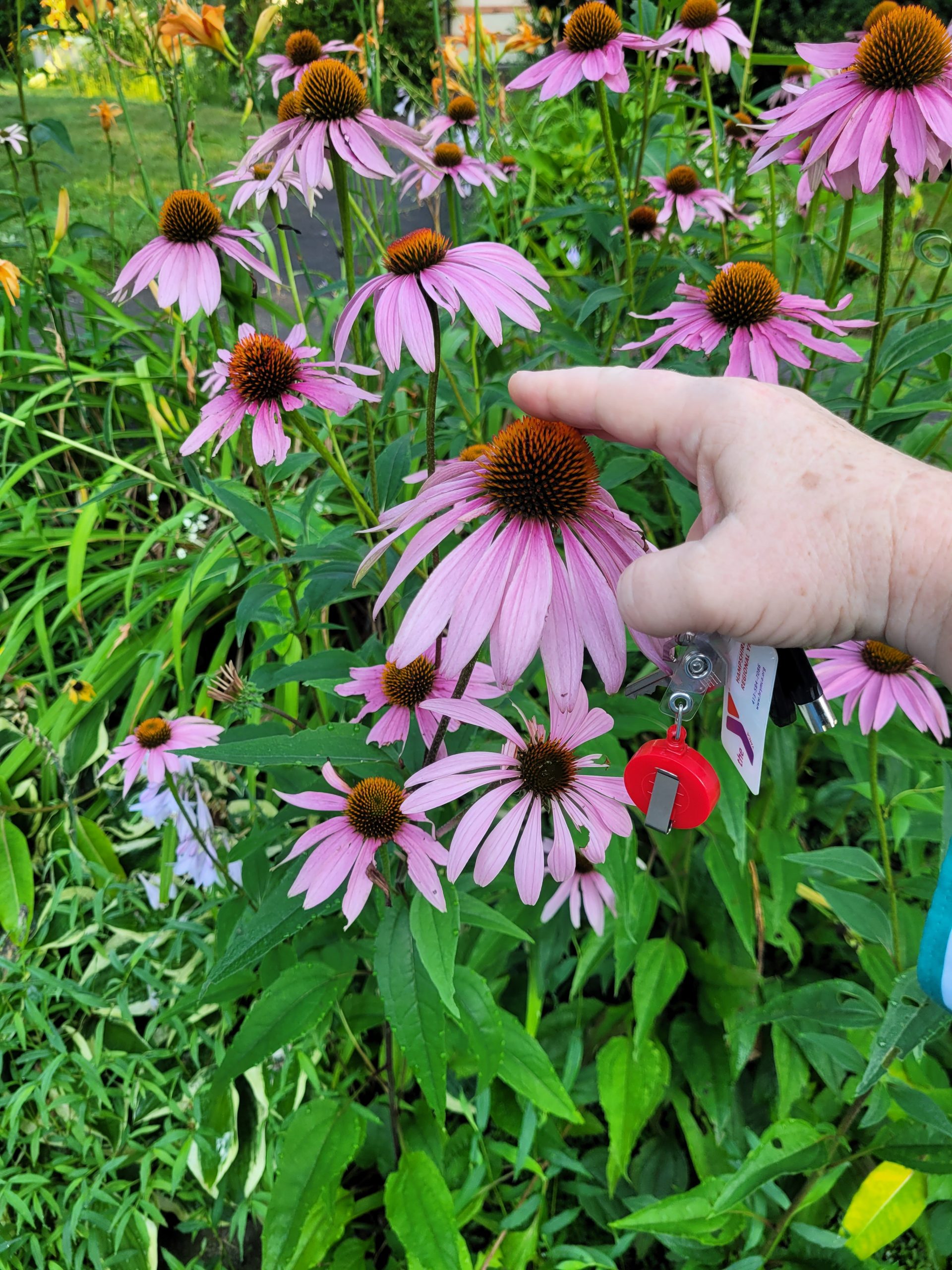
Once my internal system was going better, I bowed out and returned, snapping pretty pictures on the way.
Summary & Conclusions

I’ve gone about the same distance both days, though yesterday’s walk took less time — I didn’t have to sit down. Today’s walk was more up & down. I think I’ll stay on level ground the rest of this week and see how that goes.

I’m now fighting the urge to go to sleep. I fell asleep at 8:30 am yesterday, after getting in from my walk, and slept until 1:30 pm. Waste of a day, IMHO.

Maintaining a diurnal cycle (regular sleep/wake and eating times) is very important for taking care of yourself with dysautonomia. So, now that my thyroid is not completely in the toilet, I’m going back to fighting to keep hold of the day. I want some life back.

To be perfectly frank, I’ve spent most of the last 9 or 10 months just waiting for each day to pass in the hope that another day will be better, and if not, at least I’ll be closer to the right treatment.

Enough is enough.

It’s hard work, but so is life: I’m starting to take back my days. That starts with regular activity, because nothing re-regulates a dysregulated system like regular activity.

And I do love the morning!

Why Pride means life

On my 21st birthday, I went out with a bunch of women friends, including 2 couples. All of us health-care workers. Drunk jerk got thrown out of a car right behind is as we stood on the sidewalk deciding where to go next.

He decided that us being out without a man, and clearly happy in our own company, was a terrible transgression. Then he noticed the couple vibes. Then he called us “a bunch of” d-word. Then he tried to kill one of the women in a couple.

Someone else saw him draw a knife. He went to slash her throat. Someone else pulled her back, by her arms unfortunately.

I saw him raising a fist to a defenseless friend, her eyes huge, staring at the fist.

Somehow I levitated between 2 parked cars and a couple meters of pavement in the time it took his hand to move another foot.

I landed in front of him with my arms raised in a blocking stance my Dad taught me at 9 or 10 years old. He said, “I’m teaching you to block with both arms at once, so you don’t get confused in the heat.” That worked!

The attacker looked stunned. Took a step back. I stepped back. He took another, one more, then turned and ran.

I ran back to the bar we’d come out of, passing a couple of delightful young men, shouting a warning: “There’s a man, with a knife, back there.”

I had no idea my left side was covered in blood pouring out of my face.

Those two precious darlings ran. Found out later they ran *towards* the attack, followed my friends’ pointing fingers, and kept him blocked in at the train station, where he had just missed the last train out. Trust me, it takes balls to be a queen.

When the back door of the bar finally opened, the barkeep peeped out and said, “Sorry, we’re clo — oh, dear — somebody get me a towel with ice in it!” He clamped it to my face and that was the moment I realized my left shoe was squishing with the blood in it and I kinda lost my cool.

I hammered on the brick wall with my bare fists, screaming “Never again! Never again!”

I had already been a female for 21 years, which taught me a lot about uninvited violence; had learned about the Stonewall riots; knew the horrific statistics of how often non-heteronormative women are attacked “to teach them a lesson”; and had started getting involved in “let’s all treat each other like frkn human beings & not torture and kill each other like it’s a sport” types of activism.

So. All that was behind that “Never again”. It was too much in my life already, and I was barely an adult.

When the cops brought the attacker in the bulletproof squad car, so I could identify him, I couldn’t see at first because his hand was over his face. Cop went around to the side to ask him to lower his hand. He turned sideways, and I saw the profile that had gone to sink a knife into the throat of a defenseless woman.

It seemed logical at the time that I didn’t want to fight the cops, one on either side of the car. I decided to go through the windshield instead. It was only bulletproof glass; between fingernails and fury, I saw no reason (in my state at the time) not to get through it.

A minute later, with drunk dude stark white and frozen with terror, one of my friends (an ER nurse) pulled me off the hood by the slack of my best black jeans (this was the late 1980s) now smearing blood on the hood of the car.

She and the cop looked at each other and chorused, “I think that’s a positive ID.” ?

While this makes a great story, the memory of it also makes it very, very hard to speak up against microaggressive b.s. because you never know where it will lead. Name calling can go anywhere. Being in a group is some protection but not as much as you might think. If I’d tripped on my gods-assisted leap across that distance, my friend would be dead, and her partner would not have been even acknowledged as a widow, and all of us would have been stuck with that harrowing memory with no tolerable ending.

I now have long hair and am not nearly as fit, so I have the leverage of obvious straight privilege more than I ever did before. (Not that I’m personally wedded to gender or orientation. Binarism is a bit weird to me, but hey, you do you.) My actual sexuality has been all over the map and is currently parked in Neutral: don’t have it, don’t want it. But hey, you do you — that’s the bottom line.

That language changes all the time. When I was an activist, at first “queer” was an all-embracing term, but then the language started moving to an acronym. In the move to acknowledge all the variety, that acronym has gotten unwieldy. The English language being the adaptable thing that it is, another word-based term will emerge to act as the modern umbrella term; that’s still in process.

You don’t have to like LGBTQAI+. If you’d actually read, as I have, holy books in an intellectually responsible translation, you’d find that the major ones are OK with it. God is OK with it, but you do you: just keep your hands to yourself.

You don’t have to support LGBTQAI+ businesses or like having LGBTQAI+ employees. If you check the stats, you’ll find that businesses with strong LGBTQAI+-positive policies and culture get more and better work out of ALL of their employees. A tolerant environment is very freeing to everyone, not just the nominally unusual! But you do you; just keep your hostility to yourself. It’s not OK to be hateful or spiteful at work.

You don’t have to want a LGBTQAI+ family. If you check the records, you’ll find that kids raised in LGBTQAI+ homes are just as smart & just as competent (and generally somewhat more adaptable) as anyone else’s kids. You do you; just keep specific laws off those bodies, because it’s no more your business than your sex, your private parts, your children, and your home life belong in other voter’s hands.

You do you. Let others do them. That’s basic humanity.

It’s not just LGBTQAI+ people who suffer for it. It really is a disservice to everyone.

Let’s get this crapshow turned around, because we really need to get together on issues beyond the personal, if any of our descendants are going to have a bearable future.

Chaos theory

  1. As regular readers know, I’ve had an eventful life. The past 20 years, particularly, have been a circus of bizarre improbabilities, oxymoronic paradoxes, and irreconcilable conundrums. My life reads like a dystopian comedy, if your sense of humor is sufficiently twisted.

This is why I’ve got the category “imp-possible” going in this blog. It looks merely cute, but it has a lot of layers. Imps could be little devils, or little fairies, or little children. They emphasize the power of the small. It feels like the only power left. “Imp” also suggests the power of the unexpected.

As the current American president’s so-called “tax cut” comes home, the US Disability Income management agency, Social Security, has decided to trim costs in anticipation of their lost income: they’re cutting my pay, on the grounds that the Worker’s Compensation element of US health care paid me off for being hurt. Separately, they handed over a bunch of health insurance money so Medicare wouldn’t have to pay for my work-related treatment.

Social Security confused the two, and then added zeros to the left of the decimal, divided it by 12, multiplied that by the square root of Guatemala (I’m making this up, just like they did), slapped a bonus on it, and decided I make OVER $5,000 PER MONTH and they’re going to count 80% of that and dock my pay by ~$160 per month…

I’m allowed to make over $5,000/month? Where? How? Sign me up! But wait… huh?? You think I actually have $5,000/month???

Yeah, I’m confused too. (The payout was good, but not that good: I got a sturdy, 10-yr-old car and a year’s worth of rent in a clean, dry cottage out of it.)

That $160 is what allows me to keep my pain-cream-making gear & off-season clothes in storage *and* pay for my writing course at the 50% discount I negotiated with the teacher (I’m doing that course instead of buying books & music for a few months.) I’m not sure any of that counts as extra these days.

They said this would be (future conditional tense) reflected in my pay as of December 2019 (whaaaaat???)…

Either they’re as confused as the rest of us, they’re in even harder denial about which year this is, or they’re setting up to make the pay cut retroactive in case they decide that that’s in their best interests. Also, Social Security being who they are and the current US administration being who they are, this feels like the first move against our lifeline, not the only move.

… I’m sitting here speechless again. Happens every time I think about it.

This is on top of the brutal horrors of approaching winter (relentless agony, burning brain, incapacitating fog), no bathtub (CRPS’s disruptive surface effects creep up my legs and over my back and make my shoulders, hips, and right arm into bloated purple sausages wrapped in electrified barbed wire, with no way to push back), encroaching mold (which multiplies everything, including mast-cell hyperreactivity/disabling allergies, heart dysrhythmias, gut problems, and it adds respiratory diseases to the mix), and gastroparesis so bad that every other day I have to do a big ol’ — you don’t want to know. Trust me. Even I can’t make it funny.

My psychotherapist is savvy, sweet, and has that merciless faith in her client that the best of them wield like surgeon’s tools (yes, this is relevant, hang on through the curve)… I fell apart completely in our virtual visit and whispered in stricken tones, “I don’t know if I’ll make it this time.”

After acknowledging the depth and legitimacy of my feelings and recognizing my prior successes against staggering odds (she does know her job!) she encouraged me to see the breadth of creative possibility embedded behind, “I don’t know.”

I blinked, because that sounded pretty darned merciless, even for a top-flight psychotherapist. (Keep in mind that surgeon’s tools include, not just scalpels and silk, but electric saws and the sprung barbs known, deceptively, as towel clips.) She wouldn’t give up, though.

I agreed to accept that as a working hypothesis.

On reflection, that thought began to feel more like pre-2019 Isy, before my heart got ripped out and stomped on a little too hard by a few too many, and my system fell apart so badly in the storm of it. It began to feel more like the Isy who, 13 years ago at the start of the Hell Years, looked around at the absolute rubble & blasted mess of everything I thought defined my life, and realized someone was still there doing the looking, so there was still an “I” and I wasn’t done yet. It felt more like the Isy who made the term “imp-possible” a regular category. I didn’t know where that would lead me, but…

I didn’t know how to finish that sentence yet.

This morning, while listening to an audiobook that’s a romantic comedy about overthinky nerds (still relevant; hang on through one more curve), I used the toilet successfully for the first time in months, without having to resort to the apparatus hanging nearby for the thing I’ve had to do that I won’t tell you about. (It involves soap & warm water, nothing too ghastly.)

I use audiobooks to keep my brain from overheating. It gives me just enough to focus on that I don’t drive my thoughts off a cliff, and it’s not so intrusive or demanding that I can’t do ordinary tasks at the same time.

This one had gotten to a part where the author discusses basic chaos theory: chaotic systems (and I defy any biologist to come up with a more chaotic system than a dysautonomic human body with longstanding central pain syndromes) … where was I? Right. Chaotic systems tend to get more and more chaotic until a sort of tipping-point is reached and they reorganize at a higher level of criticality.

What the heck does that actually mean, anyway?? What do they mean by a higher level of criticality?

Partly, it means that a lower level of energy is required to maintain that state of chaos, even though it’s still a higher level of chaos.

And that (I thought, as I looked up at the equipment I was going without at last) meant that I could do more coping with less effort.

Once you’ve prioritized your needs hard enough and developed your adaptations effectively enough, it gets a whole lot harder to throw you off your game.

I can work with that.

The next level of chaos is here. I have no idea how it’ll unfold. That said, I’ve already reorganized at a higher level of criticality.

I’ll meet it somehow. I don’t know how. I’m still here doing the looking, so I’m not done yet.

In honor & memory of Ruth Bader Ginsberg.

3-4 solid tools for tough times

(If you’re looking for my housing-search info, go here for the latest with all the tables, and here for the one before that 🙂 )
I’ve often remarked that one of the really SPECIAL things about CRPS is the way it essentially “re-traumatizes” the brain: in many ways, it duplicates what happens to the brain when horrific things happen — car accidents, war, etc.
That’s so not right.
This is why we tend to be a leeeeeetle intense at times, and why those of us who survive it long-term become Jedi masters about managing how we appear to feel and how we manage how we really feel.
A key component, as many of you are well aware, is helping yourself find and develop the tools that let your brain process the endless hurt, integrate useful lessons, and release the bitterness, day by day by day. 
 
This is where a regular inner practice comes in handy. I’m sure there’s something most of y’all have got going, possibly related to CBT or DBT or mindfulness, for anxiety, grounding and self-calming; these are great tools. To strengthen yourself further and create more resiliency, try taking that to the next level in some way.
Here are some tools from my life and from survivor workshops and so forth. Individually, they’re amazing. Together, they’re mutually reinforcing and geometrically powerful. They are:
  • Free writing
  • Journaling (not the same thing at all)
  • Disciplined movement
  • Some kind of meditation
 

A. Free Writing:

1. Set a timer or page-count. If possible, use paper and pen rather than keyboard.
2. Once you start, just keep the pen moving forward, no crossings out or edits, just keep the pen moving forward. 
3. When the timer/page count is done, stop right there. It’s okay to finish the sentence, but stop.
> This does something important, which we don’t really have language for but which is absolutely primitive-brain-supportive, that helps de-sting one’s thoughts and experiences.
> Start as short or long as you think it would be successful to do, and go from there. Time spent doing free-writing is never wasted, but running around and art are good too.
> Walk away and do something physical or practical afterwards.
>> Take at least 2 hours before coming back for another round. The brain needs the integration-rest-time, for this to work.
> If you leave out any of these points, then you’re journalling, which is also great, but it’s a totally different strategy as far as the brain/mind/emotional landscape is concerned.
This technique is particularly useful after school, after a big incident when the feelings have calmed down but the mind is still recovering, or before starting a big project.
 

B. Journaling:

1. Put it outside the head and onto a physical medium.
That’s it.
> Journaling can be written, drawn, painted, danced (if filmed), sculpted, photographed, montaged, whatever. Out of the head and onto/into a physical medium.
> We journal for ourselves alone. The writing, pictures, even the dance footage, are not for showing. They might be shown later, after the period of life has passed, but that’s not the point. More commonly, they lay the groundwork for exponentially better art that’s made later.
> Keep them close, where they can be consulted by the one who did them. Nobody else is involved.
> Journaling exteriorizes and preserves our thoughts/feelings/subjectivity so they get less “gluey” and less scatty and become easier to handle.
> Looking over a period of life’s journals can be a great way to shine a Klieg Light of God on things, and free you up to make great changes quickly.
> It’s compost. Don’t expect it to be sweet or glorious, just let it compost. It pays off over time.
 

C. Disciplined movement

Of any sort: dance (Traditional, hip hop, jazz, modern, square, anything), t’ai chi, yoga, playing drums, gymnastics, long-distance running, group sports (plenty of opportunities for seeing both useful and silly ways to handle conflict), canoeing, sailing, etc.

Big grinning woman in spectacular Hawaiian ceremonial dress dancing with her arms
Photo: Joanna Poe in Honolulu
> This literally helps organize the brain, especially a growing brain, most especially that of an intelligent child.
> It also helps regulate neurotransmitters to a healthier balance.
> The body working under specific direction of the brain is enormously neuro-protective and re-balancing. Nothing else works half as well for the brain, the mind, the feelings, and the immune and digestive systems, as disciplined movement. Its value simply can’t be overstated.

D. Meditation

Of any of several kinds.
It seems most useful to have a couple of different kinds of meditation, so if you’re not up to one, you can do the other, and the benefits are mutually reinforcing.
1. “Still” meditation is mostly based on breathing with attention, and once that gets more natural, there are progressive layers of using attention & breathing to strengthen, stabilize, and regulate inner life and responses to outer events in life.
2. “Standing” and “Moving” meditations are often easier than still meditation when it’s harder to focus. The posture and/or movement provides a way into the meditative state.  Also, it qualifies as “disciplined movement.” Two-fer!
> Different methods of “still” meditation only become interesting once you’re generally pretty comfortable with sitting and breathing, and being able to put your attention on some place in your breathing path and just rest it there. (Feeling the air come in at the tip of your nose. Feel it come down to 2″ above your navel. Or rest your attention on any place in between. I love the feeling of it moving in my lungs, so that’s where I focus. My mom focuses on the tip of her nose. Just pick one and learn to rest your attention there — with a naturally-upwelling calm delight, yum! — while breathing.)
> Set a timer, and respect it — just like with Free Writing. For that period of time, all you have to do is the meditation, of whatever kind. It’s okay if it’s boring. It’s okay if it’s frightening — you’re actually safe and okay, and it’s okay to breathe through the feelings and let the time pass. The timer is your safety net. Remember that it takes about 5 minutes before and after meditating to transition, and that’s okay too.
> “Standing” and “Moving” meditations come in millions of styles and schools. These include yoga (hot, cold, slow, fast, many schools!), t’ai chi, qi gong (thousands of schools), judo (those who engage in judo are referred to as “playing” rather than “fighting” judo — it was my first martial art; surprised?), aikido, Shaolin — in fact, any martial art with a great teacher… and of course these come in styles relevant to the countries in which each particular school originated — Japan, Okinawa (my Dad’s karate style), China, Tibet, India, even France (savate) and Brazil (capoeira)… lots to choose from.
 
I’ve found that most more-detailed techniques of managing and clarifying thoughts, feelings, and decisions are basically variations or elaborations of these 4 core strategies. Play around and find what works for you.
 
I copied this from a comment I wrote on social media. So many of us need reminding, especially me. I’m so frightened and overwhelmed myself, I want to put this info where I can grab it quick.
Off to set a timer and do some t’ai chi.

A “bag of tricks” post: Care in Western NE, loads of info sources, and why long car trips hurt so much

felix-the-cat_n-bag-o-tricks
I’m now attending a weekly meeting of fellow pain patients in the area. It’s very good. A few things came up which I felt confident to share with the group and am now sharing with you, because the body of info is so useful… even if it’s only connected “under the hood.”
.

Pain care in the western New England region

Here are the local resources I can (to some degree) recommend. Those of you from other states and regions, please feel free to make recommendations in the comments! 🙂

.

Baystate Pain Management

There’s a Pain Management Center in Greenfield, MA, which I never knew about. It describes itself as “interventional”, meaning their focus is on procedures and injections and the like. (This means they aren’t currently doing much with the material mentioned in the Readings heading, but that may change in time.) They also provide PT and acupuncture, the latter only at the Springfield site. https://www.baystatehealth.org/services/pain-management-center

The Springfield site is the old home of a doctor I’ve mentioned before and don’t want to mention again. I noticed they don’t list staff on their current web page, but I do intend to follow up and learn a bit more about their current practitioners.


Real Pain Diagnosis

A New England pain practice focused tightly on accurate, validatable, useful diagnostic practice: http://www.ihurt.com/our-approach/
 .
My doc, Lloyd Saberski, is intellectually conservative, and will do nothing that has a fair chance of hurting the patient. (Since I tend to be more gung-ho, I consider his approach a necessary complement to mine.)
 .
There are a couple of other specialties (stem cell treatment and a weight-loss thingy) attached to the clinic, which is probably how they stay in business despite putting something as rare, time-intensive, & low-paying as advanced pain diagnosis at the center of the practice. I have never had the least hint of being nudged towards either of those; rather, Dr. Saberski specifically mentioned once that stem-cell treatment was still an immature modality with only a few conditions it was proven for, and that it would be totally unsuitable for me. Despite my poundage, he has never mentioned weight-loss, not even with a glance.
 .

Readings on brain plasticity, with guidance on pushing back

I consider this the best lowdown on trauma gets put in place into the brain & body (and why this shows that Worker’s Comp and the insurance industry are specifically trying to destroy us, so don’t buy their evil story about you): “The Body Keeps the Score” by Bessel van der Kolk
 .
It’s pretty science-y, so feel free to start with other authors like Pat Ogden or those listed below.
 felix-n-sciencenerd
Other authors I can recommend are…
  .

Norman Doidge

He’s a doc who developed central pain in himself, realized the current medicine on it was, um, let’s call it ill-informed, and eventually turned his extensive study on the subject into accessible material for the rest of us. He’s a good story-teller with an eye for the compelling detail that makes his point. He has two books out, both of them excellent, informative, and inspiring, avoiding all the usual pitfalls of physicians who like to write. He stays on topic, refers to the science, defers to the patient’s experience, and each side-trip turns out to be relevant and interesting.
I now mentally push my pain back up my spine and squish down on the pain regions in my brain every time I think of it 🙂 Week 2 — 4 more to go! Read more from him to understand what that’s about.
  .

Francine Shapiro

[Video list] [Book list] [CEUs and workshops — see links across top for more training]
Credited with developing one of the most-recognized techniques (called EMDR) for accessing the neurobiology of distress and reprogramming the mind/body response to it. Some of her work is very clinical, and some of it is designed for anyone to pick up and use for themselves. Be aware that EMDR techniques tend to be multi-stage processes, and the “at home” techniques involve a little advance work to set up your mental safety-net. (I did that during my designated meditation time, which I use for any solitary mental healing work.) With that done, you have a lot of options later for catching yourself and quickly restoring your ability to cope.
  .

Babette Rothschild

[Video list, most under 10 mins; 8 Keys series] [Book list] [Free articles]
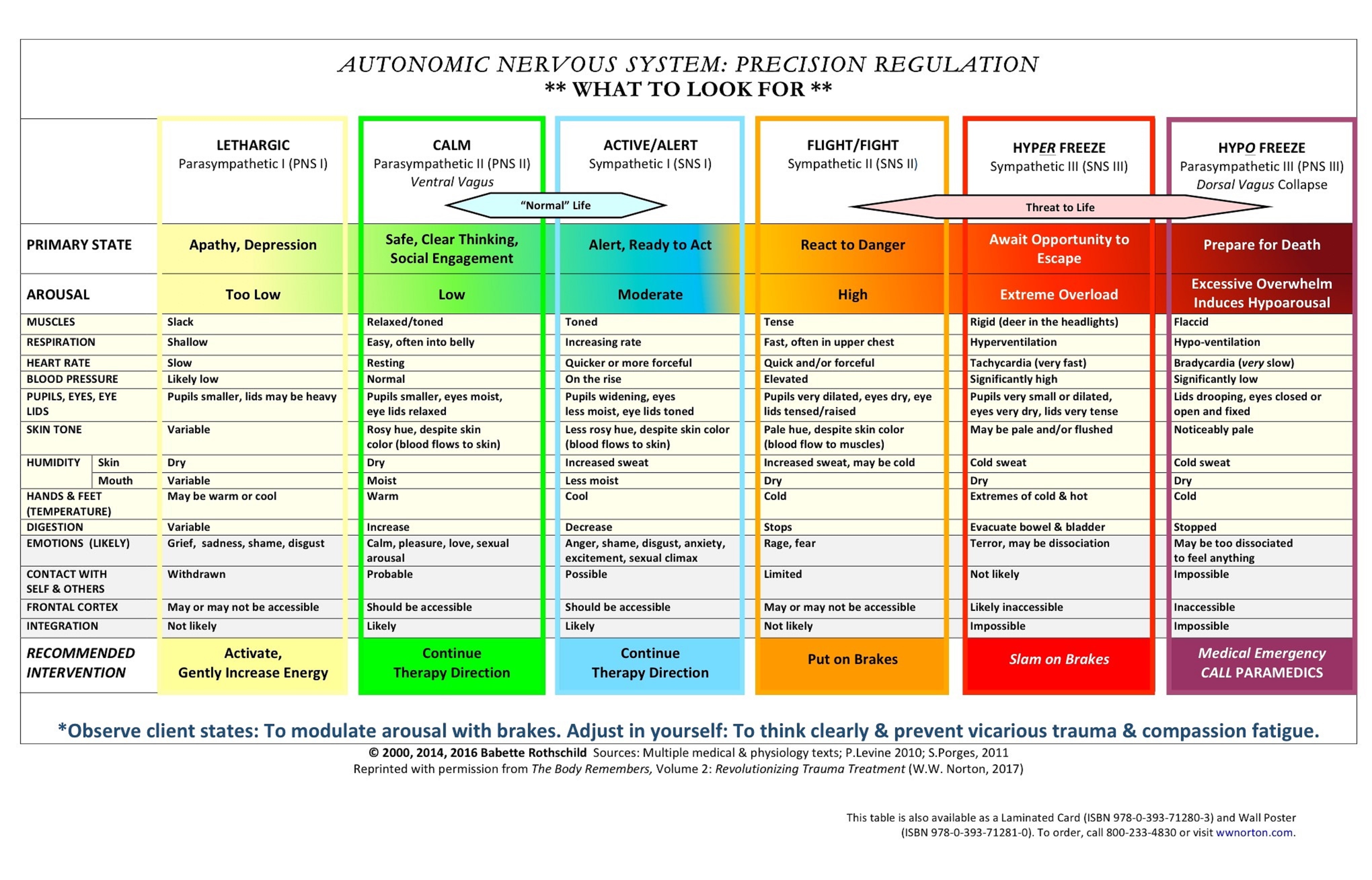
[Check out Dr. Rothschild’s brilliant chart on the autonomic nervous system’s activity levels!]
An outstandingly practical person with tremendous insight and depth, she is one of the founders & leaders in the field of understanding how ghastly experiences interact with the brain, and how the individual can get consciously involved and get back in control of these systems.
Note: These last two skillful practitioners produce, not only video clips and their defining books, but also accessible articles, textbooks, narratives, and workbooks for both professionals and patients. This provides many ways to get into their information, whatever your sensory learning mode and attention span, so you can see what works for you.
  .

Stephen Porges

[Books] [Articles] [Videos & podcasts, curated list] [YouTube]
A lucid speaker and explainer with many videos and a couple of books, especially (but not exclusively) for brain-science nerds. He co-authored several additional books that turn his theory into practical tools and techniques to use in real life. He focuses on hot issues for painiacs and those who love us: re-training our brains to identify and embrace the feeling of safety, developing healthy relationships in spite of twitchy brain responses, and re-developing our neurological coordination so we can get back in charge of ourselves.
  .

Multiple access-points to get to the same root issues of healing our neurobiology

felix-the-cat_magichat
These brilliant practitioners have come up with different ways to access and engage with our natural neurobiological wiring, in order to manage our own brain and body responses better. Many of them focus on trauma recovery rather than the ongoing disruption of central pain etc, but, where that’s the case, I mentally edit for ongoing “trauma” (which ongoing pain is, strictly speaking), and I find considerable insight and useful techniques there. Great stuff. Also, if you’ve had awful things happen in your life, you may find a useful healing approach in one or more of their works.
  .

Resources & info in this blog

I’ve been keeping a blog for ~9 years, though the earlier years got lost in a move. (Just as well; I was flailing.)  Questions I could probably bore you to tears answering in person…
.
Some of my blog posts on neurotransmitters & depression: https://livinganyway.com/wp/category/neurotransmitters/ 
There are 2 pages of links. The first in the series is a quick primer called “Dopamine, poverty, and pain: the lighter side
 .
Patient-generated documentation & record keeping: https://livinganyway.com/wp/category/documentation/ 
As I say elsewhere in this blog, it’s a bit of work to generate the first set of documents, but maintaining them is easy, and the payoff in personal poise and doctor response is tremendous.
  ..

Why is sitting in a moving car for hours so rotten?

Oh, boy, let me tell you what I’ve found about this! I think of it as 4 main issues, each of which I’ve developed ways to mitigate for my own case:
  • Skin
  • Surfaces
  • Stasis
  • Vibration

.

Skin

Our skin (where all those peripheral nerve sensors hang out) is hardly moving and half of it is pretty much unable to breathe, due to the mechanical pressure of our limbs against our bodies and the seat against our backs & thighs.

This means:

Hungry skin, with cellular & intestinal metabolic waste building up, no way to flush itself, with unhappy sensors, makes for serious discomfort.

Mitigation:

I find a good song and dance & gently gyrate in my seat :))
 .

Surfaces

Believe it or not, cars (especially American cars, sadly) are made of plastics that release molecules, which is called outgasing. Most plastics (including fabrics) outgas, meaning that molecules evaporate off the surface and escape into the atmosphere. These aren’t body-friendly molecules. Variously, they may interfere with  endocrine (hormones) and aprocrine (sweating) activity. Many are neurotoxic, capable (depending on individual factors) of reducing impulse control, spiking irritation, and triggering emotional and physical pain. (Many of the studies around this have disappeared from the web, which somehow doesn’t surprise me. Sigh.) This lessens as cars age, but doesn’t go away as long as there is plastic, car fabric, foam, treated leather, varnish, etc, in the car.

This means:

The vehicle itself compounds all the skin stuff, and adds a constant low-dose exposure to neurotoxins.

Mitigation:

Even in cold weather, I roll down all the windows every hour or so and purge the air in the car.
 .

Stasis

Our joints are not able to move much. The position, with the hips rotated slightly back, the shoulders reflexively rolled slightly forward to compensate, and not much room to do otherwise, is an unnatural position to be strapped into. It reduces ordinary motion, CSF/lymphatic flow, and nerve transmission, especially through the hips and spine. Our joints carry a lot of sensors, including those for blood pressure and balance; having them stuck in one position (while we’re breathing outgas, of course) makes the sensors unhappy, contributing to that general sense of yucky unpleasantness.

This means:

Unhealthy stasis in the joints, spine, and circulating body fluids, including CSF, lymph, and blood. This contributes to a central (brain & spine based) body-unhappiness.

Mitigation:

When I’m driving alone, I stop every hour and, at least, stretch and move until I feel okay, or do t’ai chi/qi gong/yoga if I feel safe enough. When I’m being driven, we stop every 1-1/2 to 1-3/4 of an hour. We usually stop for 20-30 minutes, unless we’re in a real hurry, in which case it’s 15. I don’t tolerate less.
Mitigation bonus: stopping this often means I can get potty breaks, making it easier to stay hydrated and up on my electrolytes — which makes everything more bearable and significantly reduces recovery time.
 .

Vibration

For many of us, vibration is a problem. It certainly stimulates the nervous system, especially in the spine and feet, and wherever you’re touching the structure of the car.
Whether vibration itself is obnoxious or not, car vibration is irregularly irregular, having no consistent pattern whatsoever. This means my brain/body has no chance of anticipating or compensating for the rhythm of it, putting my body in a constant state of jolt. I find it exhausting, and it pushes up my dysautonomia as well as my pain.

This means:

Central stimulation in a relentlessly irregular vibrating pattern can be really harsh.

Mitigation:

I adapted the inside of my car to reduce my exposure to seat outgas, improve airflow to my skin, and cut steering wheel and seat vibration to manageable levels. I also chose my car carefully to get maximum smoothness & good shocks in the first place.

Here’s a link on how I adapted my car to mitigate these effects, written amidst a cross-country drive! https://livinganyway.com/wp/2012/11/09/re-learning-how-to-drive/

The category about how I finesse my objects is called “Adaptation”.
 .

Summary

Nothing, but nothing, stabilizes and improves brain chemistry like activity and good air. Having…
  • all this gradual build-up of normal cellular & metabolic toxins,
  • PLUS the special added loads from the car itself,
  • WITH inadequate activity to move things along,
  • AND this forced posture we’re strapped into allowing for even less movement,
…adds up to most of the reasons why long hours in the car are SO hard on those of us with over-challenged systems already.

Start with, “Never give up. Never surrender.”

“Never give up. Never surrender.”
-attributable to:
Leonidas of Sparta, Jael the wife of Heber, Alexander the Great, Queen Boudicca, Mary Magdalen, the Prophet Mohammed, Hildegaard of Bingen, Vlad the Impaler, Queen Isabel of Spain, Geronimo, Copernicus, Marie Curie, Winston Churchill, Aung Suun Kyi, Terry Pratchett, the 14th and Final Dalai Lama…

Rest and retreat, yes.

Pause for thought, please (unlike some of those listed above.)

Knowing when to acquire a sense of proportion, ideally (again, unlike some of those listed above.)

But… don’t give up. Don’t give your rightful self away.

It’s always been easy for me to be determined, but not easy to pick the right things to be determined about.

  • In my 20’s, I wanted to save the world.
  • In my 30’s, I was willing to work only on that part of it that wanted my saving.
  • In most of my 40’s, I was dying — sometimes by inches, sometimes by yards — and couldn’t quite save myself.
  • I’m 50; what a relief!

Given that trajectory, it’s no wonder that my priorities have shifted a little.

I figure that, as long as I have working pulse and respirations, I’ve got a job to do. (I suspect everyone does, but I could be wrong.) My particular job is to re-possess my physical self, and, given enough slack, help others to re-possess theirs.

me-fingers-peace

Our bodies are not just machines, despite the inherent dis-inheritance proposed by Descartes (considering the body a separate entity from awareness), and the even more extreme model funded and fomented by a slightly misguided Hearst (who fell in love with interventionism, and drove the mechanical-problem-to-be-fixed model of medicine over the shifting-dysfunction-to-right-function model of medicine.)

old_school_surgeon

Bodies are the media we experience life through, the means we have to respond with. Despite the relentlessly shallow concerns over appearance the media saturates our lives with, our fundamental experiences of life are not just seen. Life is an all-body experience.

Still looking for attribution info for this glorious image.

Bodies are marvelously self-aware organisms on an enduring quest to care for and maintain themselves by communicating as effectively as possible within themselves, and responding as usefully as possible at every level — within the cells, between the cells, from cells to organs and back again — with the marvelously alert circuitry of the nervous system and the dazzlingly subtle chemical dance of the endocrine system drawing the whole show together.

That’s a bit more complex than just meat-sacks wrapped in hide.

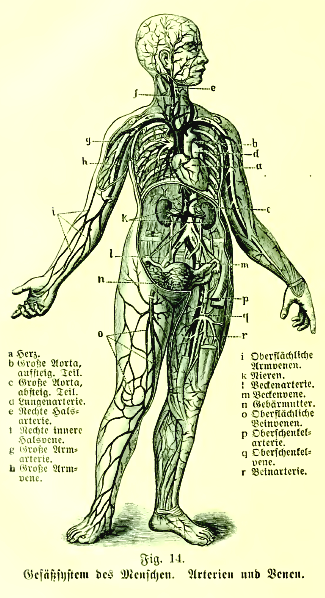
circulation-allbody-Anna_Fischer-Dückelmann_1856–1917

I’ve been mulling the twined facts that my body is an amazingly tough, brilliantly adaptable organism, and at the same time, is an organism constantly under sieges both subtle and overwhelming. Yet it never stops trying to find a useful set of responses, it never stops signaling and listening.

It never gives up. It has never surrendered.

I admire that.

More mantras

Just for grits and shins, here are a few other things that I mutter to myself over and over.

  • C’mon, you can do it.
  • Motion is lotion.
  • Use it or lose it.
  • Change or die.

That’s quite a set, when I look at it laid out like that.

Not all of them are cheerful. Sorry.

They’re all thoroughly grounded in my reality, though, and they all have had something to do with my getting this far. They are hammers and screwdrivers in my mental toolkit of radical presence, pushing back on neuroplasticity, and not settling for what this disease would leave me.

Naturally, I say these things to myself in tones of firm, loving parental authority, since it’s all about re-re-plasticizing my brain, and those are the tones it responds to.

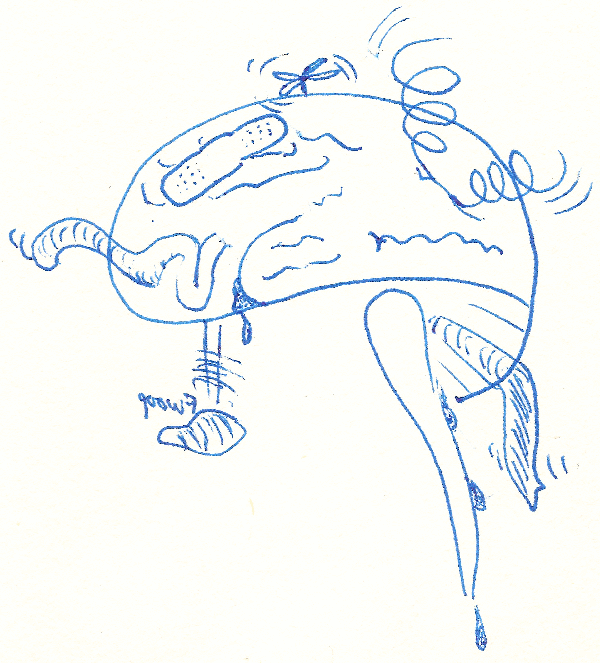
Sketch of brain, with bits falling off and popping out, and a bandaid over the worst

FTR, I’m sincerely glad it responds at all. When I was in nursing school, they told us adult brains were fixed for life. I doubted that from the start, and events eventually caught up with my skepticism. Brain plasticity FTW!

Battle for the Brain

It’s been a crazy winter, even for New England. Those of you with pain syndromes know what that means: changeful weather means unstable pain neurology which means more pain and less brain.

I’m so much more stable here in other ways that I found it frustrating to be soooooo daffy. I wanted to tuck that daffiness back behind the dam I can usually hide it behind, and use the creative and practical components of my mind to drive what I show in public.

I revised my supplements a few times, and finally found a routine that does seem to stabilize things a bit better, although it’s kind of hard to tell (it’s like inspecting a crystal with the lens inside, or possibly the other way around.) I’ve stopped fiddling, and will let the test of time tell me how this regime really does.

Also, we’ve had 2 or 3 strains of flu (so far) dancing through the household. The second one was nice, because the really awful part lasted about 5 days and it had an incubation period of about 6-7, and we got it one by one; as soon as 1 person got really sick there were 2 people to take care of him or her. In one case, this meant miso and ginger soup; in another, raw garlic in mashed potatoes; in a third, goldenseal and vitamin C; in all cases, loads of homemade chicken soup and buckets of fluids.

I’m not sick of homemade chicken soup, as every pot is different, but I am *so over* herbal tea, broth, diluted juice… everything. I had a big mug of plain hot water yesterday because at least I’m not sick of it.

I find that viruses affect my brain. They have for as long as I can remember. One of the first signs of viral illness, for me, is getting cranky and forgetful all of a sudden. With all these brain issues I have now, it just turns the volume of pain, reactivity, and goofiness up to 11.

Into this brew of brainlessness, add one more element of confusion: my most expensive brain prescription, Savella, looks exactly like my cheap antihistamine, generic Zyrtec; I take them both twice daily.

You can see this coming, can’t you…

I found out a week ago that I’ve been double-dosing on Savella and underdosing on Zyrtec. (No wonder my asthma has been acting up.) That, more than the virus and sinus activity, would explain the intense dizzy spells, disembodied feelings, uncharacteristic irritability, and eerie emotional detachment from my nearest and dearest. (No medication is harmless. Now you know what an overdose of SNRI does to me.) It was a relief to know what really caused all that, but it still sucked to go through it.

So, thanks to the daffy-dam getting burst by those bugs, I blew my brain out of the water (and also blew about $150!) AND set myself and my housemates up for a few weeks of needless unpleasantness. I’m still recovering, but well enough to think coherently about it, so that’s a huge improvement.

To my morning pre-pill routine of apple (malic acid) and sunflower butter (digestible folate, minerals and anti-inflammatory oil), I now have ~1/2 cup of defrosted Boreal blueberries (intense brain food with anthocyanins and antioxidants for recovery) topped with grated aged cheddar (intense brain food with dopamine precursors and saturated fats for those nerves) during and after pills. My pills go down better, and bit by bit the fog seems to be clearing.

Now that I might be able to think my way past a soggy Kleenex, it’s time to get that “activity” thing going again… if I can remember how. There is absolutely no substitute for activity, because it balances the autonomic system, improves neurochemical stores and their behavior, and can even reduce pain, with *no negative side effects* — as long as you don’t get hurt or over-do.

I had a dream last night of dealing with broken gym equipment, and of absolutely longing for good t’ai chi instruction. Until I find it, I’ll work with what I’ve got: my class notes and a couple DVDs from my old Academy. It’ll get me started, and then we shall see.

Fixing the brakes

Interesting week here.

A dear friend is embroiled in one of those ghastly legal tangles where the vultures are rigged to win. I’m the key defense witness. This comes up later.

This whole winter, I’ve been basking — simply basking! — in the sheer delight of being safe, sheltered, warm, loved, and with as little chaos as anyone with a recent move, a complex illness, and widely scattered relationships can get. Occasionally, I’ve wondered if I’m allowed to be in such a situation, and strained my ears for the sound of the other shoe dropping… Then I do a reality check, tune in with my lovely partner and my lovely housemate/hostess, and it appears that no, it’s okay, things are right, and this is what’s right now.

My nod to the fairly relentless self-management that got me through the past decade has been an occasional effort at meditiation, a minute or three of qi gong, a few moves of t’ai chi now and then, or the occasional mood-check.

In short, diddly-squat.

In December, I lost it with a dear friend.[LINK] I did more mood-checks for awhile, a bit more meditation, maybe ten whole minutes of t’ai chi every other day for a couple weeks.

Diddly-squat doubleplusgood.

I was heartbroken at the mess I’d contributed to, but couldn’t dig up the motivation to really “do the Do”, to restart my hard-won disciplines.

Dear heavens, it was soooooo good to rest, just relax for a change, enjoy the sensation of not looking over my shoulder and not being constantly *forced* to calm sometimes-legitimate terror or possibly-reasonable panic.

It was winter. I was safe. I let my disciplines sleep.

Meanwhile, the brakes on my car[LINK] were acting up, or rather, occasionally failing to. $2,000 later, that was supposed to be fixed.

Gradually, I noticed that J was telling me, more and more often, to lower my voice: “I’m right here!” Huh. I didn’t think I was talking that loudly…

As I relaxed, other humans became more interesting and I started striking up conversations with strangers, as I used to do. They didn’t respond as well as they used to. Odd…

On social media, I found myself being snippy where I used to be sweetly witty or wryly amusing to make the same point. I backed off of my online time, because if I can’t manage myself well, I’d better not interact with anybody else who might be feeling frail. “Do no further harm” has been wired into me from way back. It’s the most basic courtesy.

I took the car back for a second brake job a few weeks ago, only $150 this time, and that seems to have taken care of the problem. So my cynicism about car dealerships remains unimpaired, thank you.

Meanwhile, there were some tellingly unpleasant procedures[LINK] which illuminated a fact I’m still failing to accept: CRPS has moved into my viscera — it has leaped out of the musculoskeletal bounds and gotten right into my core. I used to say my case was “all-body”, but that was because of the gastroparesis and subtle endocrine weirdness, which I figured was simply faulty autonomic signaling. It has definitely become much more.

I could feel every line of my intestines and the springy squashiness of my organs as the ultrasound tech noodled around on my abdomen, and the less said about the gynecological exam the better. It’s real. It’s a bed of coals in there. This finally sank right through my skull over the past few days.

Damn damn damn damn damn damn damn damn damn damn damn damn damn damn damn. With extra damn.

So, now we’re up to this week.

I spoke with the lawyer involved with the vulture case mentioned above. I went off on a tear about the duplicity and injustice involved. He finally broke through by howling my name in exactly the tone my mother used when I was getting out of hand. Once I was quiet (and abashed), he said very sweetly, “If you’re going to go on like that, you might as well hit your friend over the head with a two by four.”

Two things happened. I realized that my self-regulation was much worse than I had ever imagined; and I spent the day in a state of total exhaustion and emotional fragility, the classic signs of a massive adrenal-dump.

SIMPLY GETTING WOUND UP IS BAD FOR ME. The mere state of emotional excitement is poison to my system.

I used to know that.

I used to know when the emotional excitement was coming, and could head it off.

Nope. Caught me completely by surprise.

So, I’ve been processing all this for a few days to a few weeks now. I’m coming to some conclusions, and have a few remaining questions.

I’m pretty sure the spread into my viscera had a lot to do with the merry-go-round of the past few years.

The spread in my brain may be related, in fact it must be; however, I’m pretty sure that re-incorporating my habits of self-care and diligence can get back quite a lot of the gentle precision, sweet tact, and pleasant diplomacy I was once capable of.

So, in keeping with this revelation, I’m going to acknowledge that I’ve completed my alotted time for being on the computer and get up to go do some morning activity. Then I’ll put my feet up for a bit and lunch on brain-supporting food. After a digestion break of an hour or two, I’ll do something physical in the afternoon, including 20 minutes of t’ai chi or qi gong. After that, an hour of work, which today will consist of loading my classical collection onto my tablet. This evening, I’ll spend an hour listening to classical music, then meditate, then apply my lotions for pain and muscle spasms before bed.

There are no bloody shortcuts. None. It’s just work, and it doesn’t stop.

I’m still supremely glad to be safe and warm and loved. I just have to wrap my thick head around the fact that it doesn’t mean I’m off the hook for taking care of myself.