My tiny handful of fellow “imps of the possible” are all for it, completely understanding the uncertainties and sidetracks and possible (even probable) different endings in store – and knowing that it’s the reach that’s important, that spreading
Frustration at the wall
 //
//
I have had less energy than I do now, but I have never had less motivation. Me? Unable to start something? This is so out of character that it’s a bit like seeing Mother Teresa bite a kitten — unfathomable.
Speaking of eating, I’ve been craving sugar so intensely I have truly felt like I’d lose my mind if I didn’t eat sweets. I haven’t had serious sugar cravings for almost a decade. That was one problem I never ever thought I’d be dealing with again. That’s finally lightening up, thank goodness — and thanks to some mental judo and nutritional first-aid. I can’t take on any more weight or the pain in my feet will become unbearable, and my hips are already giving me hell.
I have great blog ideas, but getting them into words isn’t happening. No… words… come… together. This is so strange I don’t even need to elaborate. This is the first thing I’ve been able to write in weeks and it’s not a blog, it’s a tirade. Excuse me while I scream.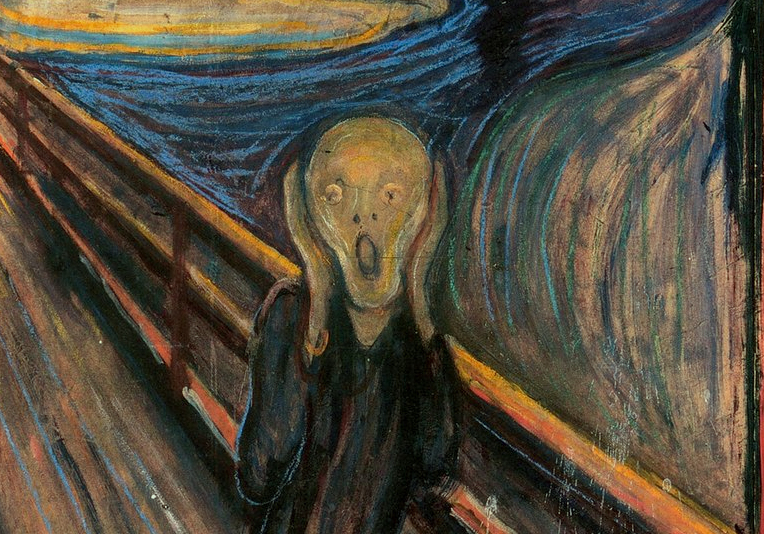
My muscles across my shoulders and upper back are so tightly knotted I can’t do my exercises or qi gong or even more than a stroke or two of tai chi without that weird warping sensation when the muscles pull my moves awry — and then the nerves pull back and howl. Some activity would be better than none, but low as that bar is, I just can’t make it over.
I got a break from my muscles last night when I loaded up on Flexeril (if you follow this blog, you know it’s almost unheard-of for me to hit the CNS-affecting meds) but the lethargy, brain fog and stupidity this caused, for 18 hours afterwards, is hideously limiting in itself.
After trying to do my most basic stretches just now, I took another dose. I will NOT let this twisty locked-up posture become the new normal.
And somehow, nevertheless, I will function tomorrow enough to get my pills and get my gear and get my food for the day and get my sorry ass over to OT and PT and hope something can break through this maddeningly comprehensive barricade.
Needless to say, this is not my usual pleasant, mindful, lemons-into-lemonade sort of post.
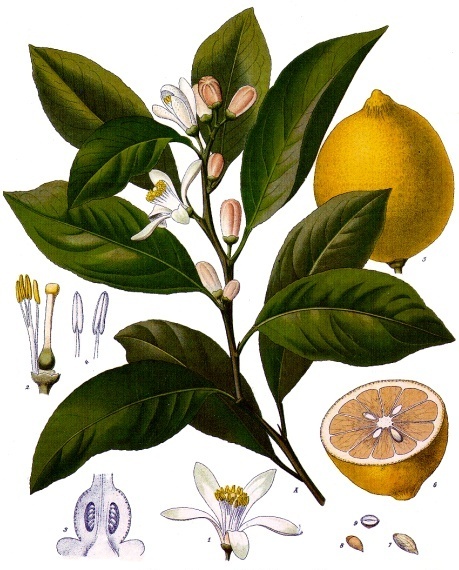
This is me grabbing the damn lemons and throwing them right back, hoping to hear a few screams as they connect.
In the fullness of time, I expect I’ll be able to find a trigger, or a clue, as to what exactly started this and how to avoid it in future. I can’t see it from here, and maybe this is the start of what I dread most: The Slide, the final descent into irresistible helplessness and incompetence.
But I think not. I’m too damn angry to give it that much room.
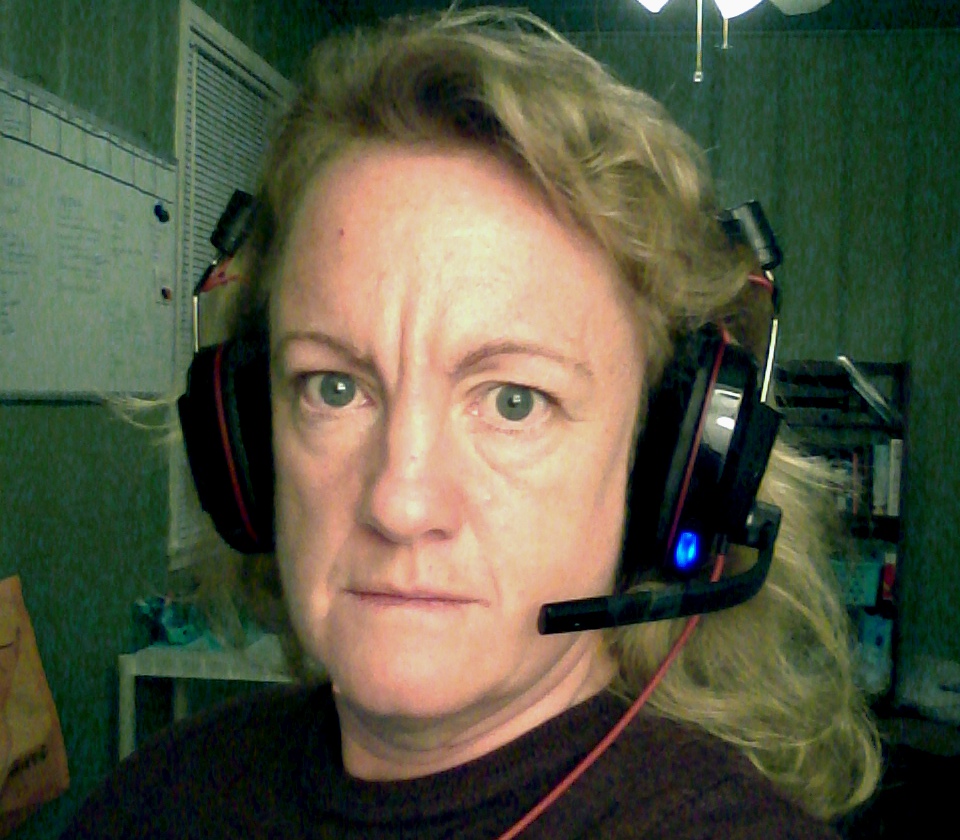
Let’s see what happens next. My money’s on the chunky blonde with the harsh mouth and crappy attitude.
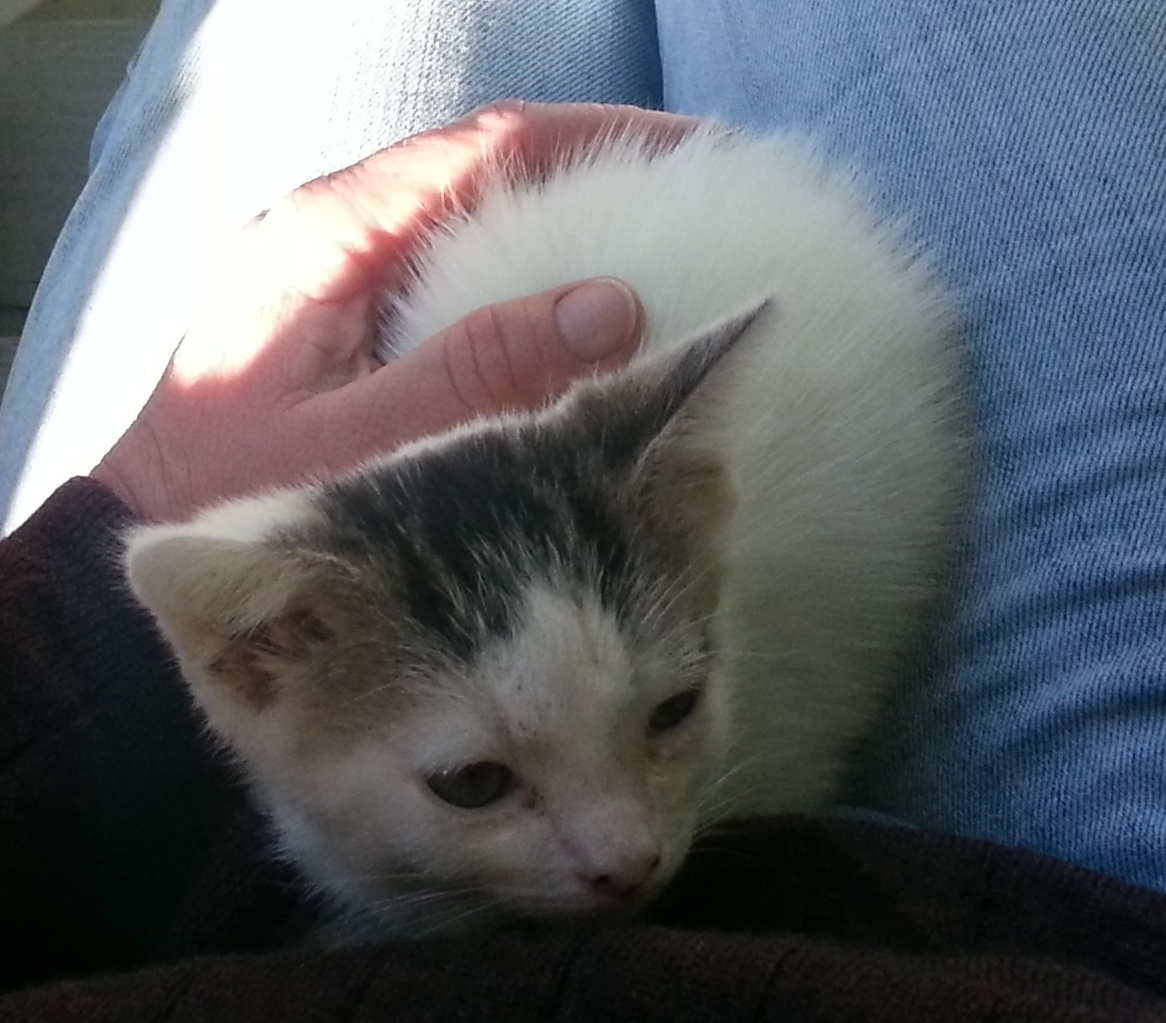
… And the new kitten…
Pushing back on neuroplasticity
//
-
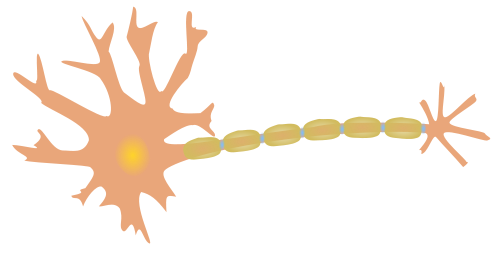
from the first refusal to cut pain signals off…
-
to the growth of the brain cortex area that monitors that body part, so it can handle more pain signals and provide less space for normal body areas…
-
to the deeper remapping and rewiring that alters cognition, disrupts memory formation, screws up autonomic signalling, knocks endocrine and digestive function out of whack…
-
and so forth.
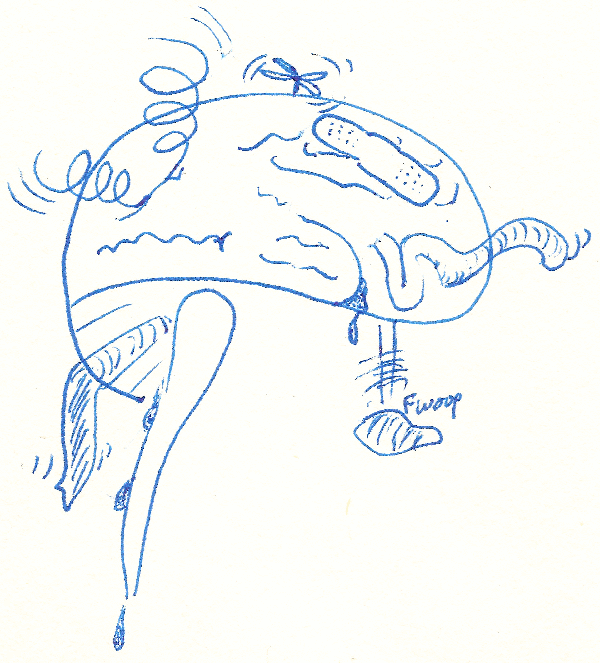
It’s important to stay on top of the brain, so to speak.
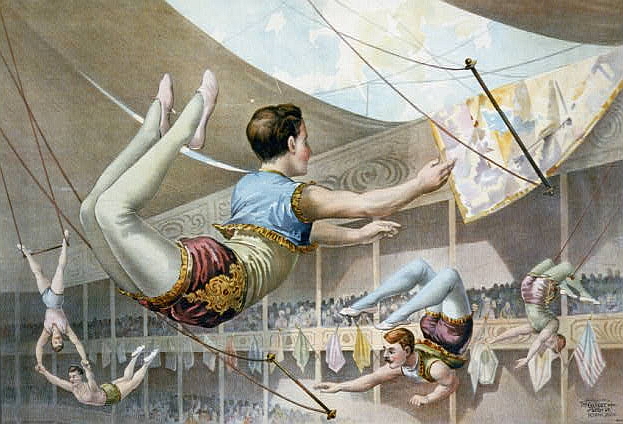
Having said that, it’s not completely reciprocal, nor is it ever under perfect control — unlike a good trapeze act.

- neurons hook up, and a connection (or association) is made;
- if the connection gets used (or the association is allowed to stand), more neurons hook up to make it stronger;
- once enough neurons have hooked up, the connection becomes like a good road;
- and the thing about good roads is, they get used, even if they’re used for something odd.


- Make sure the roads in your brain are useful to you.
- Do that by pruning the connections you don’t want.
- Prune those connections by letting the associations die.
- Let a connection die by deciding to think about, or do, something else, whenever it comes up.
Consistently. Persistently. Relentlessly. - And keep making that decision every time it comes up.
It works by a negative, which is not how we are taught to do things: turn away from the response, shut out the perception, ignore the link. That’s how you prune an unhealthy connection.
It takes time, but it works. The time will pass anyway, so your brain might as well be better off at the end of it…
 |
| Only constructive connections, please. |
 |
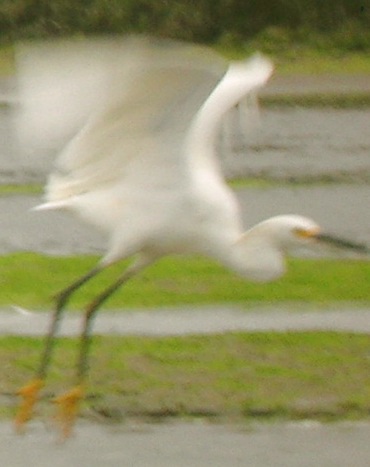
| Egrets make great distraction, especially in funny socks. |

Optimism has its place, but…
//Colorado Springs and the Paleolithic Point
//All of them. Directly. At us.
Not one fork moved.
I fiddled with my jacket zipper for a moment, dithering in the doorway, decidedly nonplussed.
JC took a look around, stepped around me, and sailed in as if he had just bought the place. He twinkled at the waitress, said something jovial to one of the guys at the endless table, chose a booth, and we had a wonderful meal.
He told me later that he cased the men over my shoulder and saw that the biggest of them was very much out of shape. With nothing to worry about, he defaults to playfulness and easy-going charm, which has the effect of drawing any remaining fangs.
I’m learning a lot from this guy.
Today
We noodled around Colorado Springs for a while. We were trying to find a museum which, he was told 20 years ago, would host an extraordinarily valuable archaeological find that he had made.
The museum had moved, with a great website but no address; and according to the website it had shifted its focus to post-World War I, while his find was Paleolithic.
We drove all over Fort Carson looking for the museum, called quite a few different phones with no clue, no answer, or an answering machine, and spoke to any number of very sweet people who had absolutely no idea that anything like a museum ever existed there… a museum that had been built less than 2 years ago — if it exists at all. I’m beginning to think the Mountain Post Historical Whatever exists only in print.
Sigh…
I have a couple of numbers to call, and if those don’t work out, I already have a plan C in place, which involves digging up the now-retired archaeologists in charge of the original excavation. Since his find saved their funding (and at least one doctoral thesis) after four fruitless years, I’m pretty sure somebody will remember.
I have a feeling there’s an interesting story that took place in the 20 years since that item was brought back to the light of day. It was very important to someone very important in his field, but it’s not important to the landlords who ostensibly own the right to it… And, at a market value of ~$10,000 at the time of its finding, that’s not a trivial issue.
It’s not unusual for great finds, like great works of art, to lie moldering in a museum basement because the present curator’s vision doesn’t include them. Even great curators have limits to their vision, and any curator who doesn’t dig Paleolithic craft is somewhat wanting, in my view.
But then, I am a bit of a throwback.
Speaking of being a throwback
We saw the Manitou cave dwellings. We were headed for the Manitou Springs, but I put the wrong thing into the Garmin. I first read about New World cave dwellers when I was five or six, and actually climbing around inside those wonderfully convoluted dwellings was a dream of 40 years’ standing. It was a totally unlooked-for gift.
JC kept saying, “there’s more…” And led me to further outdoor displays… the first floor of the gift shop… the second floor of the gift shop… the museum, with some stunning examples of work… and of course the bathrooms, which he knows I have to get to regularly.
We stopped in Trinidad for the night. The weather has been so odd – and so fraught – that the direct route over the Rockies, via Denver, was a little unnerving to me. Our route will bring us past more painted rock, and even some stunning canyon land. There’ll be a little bit of nostalgia for both of us, and there’s nothing to brighten a trip like telling each other stories.
Logistics
I’ve been doing a lot of thinking about how to conduct long trips. I’m checking some ideas against JC’s horse sense, and will refine them further with my CRPS: Art & Spirit core group.
And then we’ll deal with the reality of funding.
This trip has been immensely valuable from the standpoint of researching how to make this kind of traveling feasible. The answers look nothing like anything I’d envisioned at the beginning, so this was an extremely useful endeavor.
I’m awake now
//Thinking in terms of an early start. It was great. Then I tried to move.
So I spent a little over an hour on qi gong, stretching, and PT exercises. Much better.
I used my hot pot to make tea and my self-important Oster blender to make my shake, not with kale but frozen spinach, a soft mutzu apple and slushy blueberries.
It burned out the blender.
When I tried to take a picture of the really impressive clouds of smoke, my phone declared it needed updating. I took it as a cue to move forward rather than stand there gawping.
But I needed to get it off my chest. The scary negative crap can stop any time now.
"Invisible disability" gets an upgrade
//She said, “I hope I have my parking pass.”
He said, “Well, mine’s in my car, so if you don’t, we’re out of luck.”
I said, “What do you mean? I have one in my purse.”
She said, “Oh, yeah. You’re our Stealth Gimp.”
Best synonym for invisible disability EV-er.
Imp-possible
//Some things simply cannot be done: scaling Everest with flippers on your feet, for instance. Scaling Everest in a hot little bikini might be do-able, for all I know, although it hasn’t been done yet. I’ve met one or two people who seemed well suited (so to speak) for the job.
Many things that are widely considered impossible are simply heinously difficult, requiring extra time, diligence, and determination. They may be practically impossible, because most people are not willing to try that hard and can’t imagine that anyone else would be. I’ve met a few of those, too.
When facing the practically impossible, it helps to have a certain blithely F-U attitude, to be willing to flip a bird or two at the forces – or people – that seem to hold me from it. Not to hold resentment, but to detach from their limitations and clarify that they have no hold over me.
It helps to realize that those who tell me it’s impossible are really speaking for themselves, but that doesn’t mean they get to speak for me.
In short, it helps to have that inner steel spring that winds me up beyond any comfort zone and propels my willful butt over the heads of everyone who has failed before they began, and lets me look at them – not with contempt, because that has no place at this height – but with a cheerful bouyancy that holds the possibility that maybe there’s room for them up here, too.
This attitude is springy without being snappish, free-spirited without wasting time in rebellion, wild and fresh with only its own inner guidance for discipline.
It’s impish, in other words.
And this gives us a word we can use to describe things like scaling Everest in a skimpy swimsuit, or inviting cannibals to a linen-dressed tea, or curing CRPS:
Imp-possible.
I rather like that.
Curing CRPS is imp-possible. Excellent. Bring on the bikinis.
Mendo Acid Trip
//Case in point — my older brother’s riff on my county’s name might have a familiar feel, although only he could possibly have come up with this imagery:
‘I can’t decide if ‘mendocino’ sounds like an antacid (“Mendocino, now in new cherry flavour…”), or a garment of Mexican origin (“and now just add a chunky brown leather belt to offset the vibrant shade of your mendocino…”), and indeed maybe are old chinos with violent coloured patchwork on them….
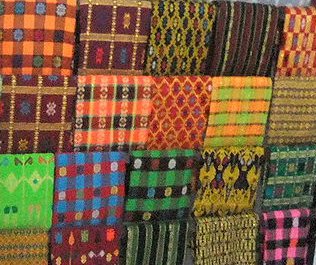
‘Why mendo-acid-vibrant coloured-cino?’
I had to read this through 3 times before I could keep my seat long enough to respond without falling off again.
The answer is far too prosaic to make a suitable reply, but frankly, that’s a tough act to follow…
So, why here?
Hills.
Trees.
Rocks.
Air.
Gives me whiplash to read this far.
Antacid-washed chinos might be more entertaining, but I had a deep need for a wooded granite ridge to park my frazzled bones upon, while preparing for the Healing Tour — whatever the heck that turns out to be.
My timing is good. Everything is bursting into bloom:
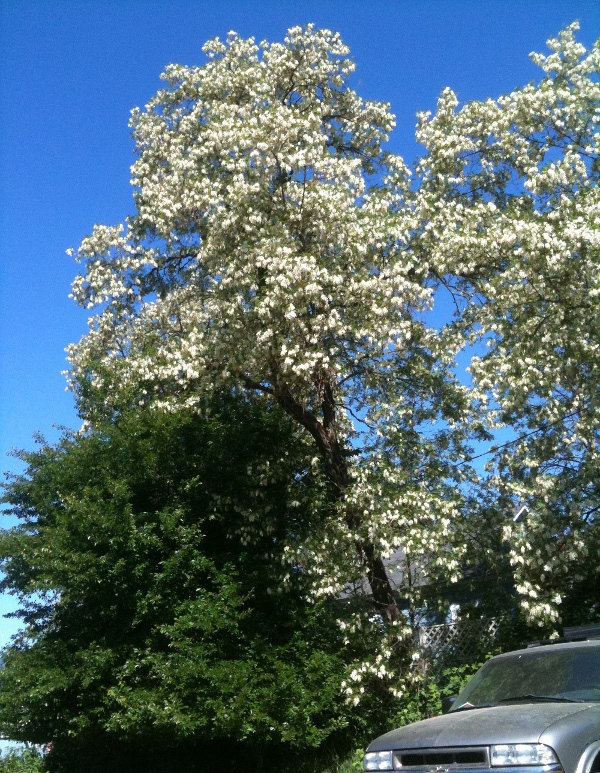
Cherry-flavored patchwork chinos would look pretty good sprawled under that tree. Mind you, anything would, including that dusty ol’ truck.
How we REALLY were made! :)
//There’s an old Greek story about the creation of humankind which sidesteps most of that. It goes something like this.
Young Kore (Persephone’s childhood name) was wandering by a river one day. As she forded her way across it, she was pleased by the clayey texture between her toes. She stopped on the opposite bank and scooped up some of that lovely mud.
She modeled it into a familiar bifurcated form, but it wouldn’t keep its shape. She worked some humus into the clay, to give it more body, and that helped. Bits of humus showed here and there, and the slightly fluffy look of it inspired her to give the dolly a nice topping of shreddy mould for hair.
Her father strolled up and asked what she was up to. She showed him her handiwork, as charmingly pleased with herself as only a kid can be.
Zeus admired it and said it was very nice, and what was she going to do with it?
She said she wasn’t sure. “But would you make it come alive, Papa? Please-please-pleeeeease?”
Zeus looked down at her wide, bright eyes and rosy cheeks, her face alight, and fidgeting in a pleased sort of way. Only one thing to do.
He turned on his endless vision and looked up to see who was near the Olympian Fire. One of his nephews was standing there, staring at it. Zeus turned on his bullhorn voice and bellowed up to Olympos, “Hey, Prometheus! Oy, Prometheus, I need you!”
Prometheus looked away from the Fire and said, “What’s up, Big Guy?”
Zeus hated it when people called him Big Guy (it lacked class), but he swallowed his irritation. “Toss me down some of that Fire, smartass, okay?”
Prometheus grinned good-naturedly, scooped up a handful of the divine flame, and lobbed it in an underhand toss.
Zeus caught it in midair, massaged it into shape, then carefully pressed it against the clay creature in his daughter’s hands. It baked the clay and filled it with life.
The little clay dolly twitched, gasped, and sat up. It rubbed its face and opened new eyes. It rubbed its head, now sporting a fluffy head of soft hair. It spoke: “Holy crap.” Pause. “Well, that was weird.”
Kore bounced up and down, causing the creature to splay its legs and hang on for dear life.
“I want lots of them! And I want to call them Kores, like me! Look how cute they are,” she declared ungrammatically, staring at the singular creature.
“They should be called Zeus-lets, kiddo. You’re hardly old enough to be naming dollies, let alone species! I gave it life and I’m the grownup. I’ll decide what happens to it. Understand?”
Gaia, who had had quite enough of her rotten grandson lately, made her presence known with a rumble. “Do you ever tire of being the biggest brat in the room, Zeus? I gave my flesh for the creature, so it should be named after me! Lots of little Gaia-citas running around. Should brighten things up considerably around here.”
Zeus found himself in a serious disagreement, where he had expected a minor battle of wills with a child.
It didn’t help that Prometheus and the rest of the Olympians had turned to watch, and were encouraging all sides indiscriminately: “Go, you kid!” “Give it to the Big Guy!” “Hey, Grandma rocks, she should have it!” Zeus personally saw Apollo, alone, change his vote three times. And he wasn’t the most changeable, either.
It was a floor show.
He caught Gaia’s eye. “Arbitrate?”
She lifted her chin. “If you can find an impartial arbiter.”
Zeus looked around and saw nearly every face animated with opinions. Even Hades had something to say. Naturally, he was rooting for the kid, just to spite Zeus.
Nearly every face. One face alone was still, and it was still behind bars. Zeus’s father, and former opponent, was just quietly watching.
He turned to Gaia. “How about Kronus?” (That’s the original name of Saturn, to you Latinites.)
Gaia was surprised. Also mighty pleased — she considered all her sons mentally weak, but Kronus was the best of the bunch and had taken her side when no one else would. If he was acceptable to his arch-enemy Zeus, he was certainly acceptable to her. “Kronus it is,” she said, and everyone turned with her to look at him.
Kronus’s eyes lifted. The ages of imprisonment had left his eyes deep and dark with shadows. It took some time for him to bring himself fully into the light again. His brother Iapetus gave him a surreptitious hand.
As he stepped into the center of the watching gods and took up the mantle of judgement, bright white light filled the space they were in. It chased away every shadow, prying into every nook. Nothing remained hidden.
He cleared his throat softly. “I can’t pretend I didn’t see and hear every bit of that. I’m a little surprised you asked me, so before I go further, I need one word from each if you.”
He paused and made sure he had their attention. Even the restless child was riveted by the lines and hollows on his great face, the aeons of thought marking his brow. “Swear before all Olympos that you’ll be bound by my decision. All of you. Because greater good or greater ill may come of this than any of you can now see.”
Surprised, but trusting him, Gaia nodded. “Of course.”
Enthralled, Kore whispered, “Yes.”
Boxed in and suddenly wishing he’d named anyone else, even Hades, Zeus grumbled, “Oh, Hell.” Beat. “All right.”
Kronus nodded, and shifted position. “Then this is how I rule.
“Zeus, you did a thorough job of giving this creature life, and therefore gave it a future and everything that goes with it: thoughts, wishes, actions, an ability to affect the world. That is a heavy burden to lay on something that didn’t ask for it. It will need a strong ally, a knowing guide, a wise governor. You will be all that and more, because, having given this thing life, you should help to make that life worth having.”
Zeus blinked and stepped back, as if punched in the gut. Not what he’d been thinking at all.
Kronus turned to Kore, who blanched and tried to shrink. He smiled at her as gently as he was able. “Kore, you made something beautiful, and it was intelligently and cleverly made. Well done.”
She tried to smile. She was certainly proud at his praise, but overwhelmed. Never had she been in the center of so much light; it hurt and frightened her, but she didn’t want to show it.
Kronus went on, “You asked that there be lots of them, and so there shall be. You will get your wish.”
Kore nodded with a big, shy motion of her head.
Kronus added, “You made it out of clay and in your hands it was lifeless. Do you remember?”
Kore nodded again.
Kronus said, “Then, in the fulness of time, you will be responsible for them in that state again. When they live out their spans and return to being lifeless, they will return to your hands.”
Kore’s eyes widened. So did Hades’, because a new shadow — distinctly like the shades of his realm — descended on Kore’s form and began to soften the light that nearly blinded her. Her mother Demeter, riveted by the shadow, was so tense you could string her in a bow, but there was nothing she could do.
Kronus turned last to Gaia. “You gave your flesh to make this flesh, so its flesh is your responsibility. Provide this species with food aplenty, and ensure its fertility so that it will perpetuate itself time out of mind.”
Gaia, hiding her relief, nodded. She didn’t know what she had been expecting, but hadn’t expected to get off so lightly for stooping to Zeus’s level in the first place.
Then Kronus stopped briefly and gave her a Look, and she felt she had just been privately chewed out for that very thing. She dropped her gaze and gave a little nod, accepting the silent rebuke.
Kronus looked upwards and scratched his chin. It made a scrunchy sound, since he hadn’t shaved. “As for what to call it,” he mused aloud, “I see no point in choosing one of your names over the others. It’s now a shared task and no one of you should have more credit — or more responsibility — than you already do.”
He looked at the little thing, sitting peacefully cross-legged and wondering what all the fuss was about.
Its mud was now good flesh, and the crisp, short fibers of humus peeking through were transformed into crisp, short hair. It saw Kronus peering at it, with his huge wise face alight with interest. It smiled brightly up at him and gave a big enthusiastic wave with both arms, exposing more crisp patches underneath.
Kronus smiled as inspiration dawned. He remarked, “It does look like it was made with humus. We’ll call it homo.”
And so it was.
The much shorter translation from Pseudo-Hyginus’s “220 Fables” is here:
http://www.theoi.com/Khthonios/Persephone.html
http://oxford-astrologer.blogspot.com/2011/08/how-i-made-friends-with-saturn.html?m=0
http://oxford-astrologer.blogspot.com/2011/08/kind-of-creepy-birth-of-venus.html?m=0