The Beast

One of the characteristics of CRPS and some other longstanding brain-driven pain conditions is the occasional personality transplants which, especially combined with memory-holes and perceptual shifts, can really do a number on relationships. This situation is called the Beast. Medically, it’s considered part of the territory.

I’ve been absolutely smug about my aability to stay away from the Beast. Since regular psychotherapy is part of the gold standard of treatment for CRPS, I’ve prioritized psych care — from professionals who have a good understanding of trauma and PTSD, since actual specialists in central pain are so rare, and trauma/PTSD is a good model to start from. That care hasn’t been possible for most of the past 5 months, and I’m taking stock of how much I’ve lost in that time, now that I’m back on the schedule.

I can count on 3 fingers (now 4) the times I’ve been the Beast in ~21 years. (I’m fuzzy on my first ~4 years of illness. It was a blur.) The most recent of those times was due to a neurotoxic exposure. One was when I lived in a mold infestation I hadn’t mitigated yet. One was during a particularly hectic trauma period. The current one was after I decided to make an extended, extravagant physical effort in not-very-safe air. I really thought I could pull it off, and just rest afterwards.

But these are reasons, not excuses. I hurt people who didn’t have it coming at all. I injured relationships I care about deeply and intend to protect. Today’s event cuts particularly deep.

“Why would you do that?” is an unanswerable question. If you don’t have this shit disease, it can’t be explained. All I know is that I felt myself being pulled under, not recognizing fractured memory and wacked perceptions. I grabbed for a rope. Didn’t think what it was attached to, because I thought I was drowning.

Mind you (adds that inveterate shit, Sarcastic Sister), my feelings are such that I’d rather be dead than hurt my loved ones. But this is not the time to say that, because it makes no sense from the outside, in light of what they just experienced from me.
Need a moment to process this.

So… diligent psychoemotional tune-ups, reasonable pacing of activity, and a safe environment are not at all optional. That rubric is my best insurance against the Beast. What I know from seeing my long-term survivor cohort is that there’s no guarantee I’ll be able to avoid the Beast forever. So, I’m wrestling with this reality and not really wanting to be here for my life. (“I’d rather be dead than feel this way” was a state my late BiL and I could bond over.) Many of my fellow CRPSers know the feeling, and it eases my soul ever so slightly to know it’s part of this disease experience, and not because I’ve actually become evil.

I’ve done what I can for now. I’m off home for meditation time, if I can, and a familiar show if I can’t. I have to remember how to rest and how to push myself no harder than is good for me. I have to take recuperation very seriously and basically expect nothing from myself for a week. I have to manage this terrible storm of feelings in the absence of a stable central nervous/ endocrine system. I hope to have the chance to rebuild a couple of relationships. We’ll see if that’s do-able. Fun times.

I’m looking for some more positive message to turn towards or even something to lighten this a little, since the point of this blog is “living anyway” in spite of what this craptastic disease does to people. The only thing I’ve got to offer right now is the passage of time and the hope of some recovery… within the context of this horror-show snowballing around me, around us all.

New times; new topics

For audio version (with extra fun stuff), touch this sentence.

I’m not going to mention current events in my country.

This is a series about traveling…

Traveling in interesting ways.

The ADHD is strong in this one:

If a thing is interesting, it is ever so much more bearable.

If I were to travel, I would like to bring my pet.

I hear some of you shouting, “Why, you insufferable loon? Don’t you have enough to deal with??” (Sorry, Mom.)

For one thing, I like her company; for another, she keeps me on schedule and is really good at “body-doubling”, or hanging around to help me focus on a task. She literally holds the yarn while I crochet, and tracks the loose bits of thread when I’m sewing. Cats are supposed to be interfering, but she’s genuinely helpful.

Also… Traveling with a pet definitely makes this more interesting.

Chapter 1: pet passport

I was going to start with the effort to find a vet to make her travel certification happen. I’m not up to that right now.

Chapter 2: Trip planning

I’ve been reading up on alllllllll the aspects of this trip for a long time. Years, really, but most recently for about 3 weeks. It takes some noodling around just to find out if it’s impossible or just kinda weird.

In case it isn’t obvious, I’m okay with weird. Impossible takes a little longer.

Aspects to understand for planning a trip like this:

– The only way to get to my target continent is by air.

– Some airlines are pet-friendly.

– Some airlines that are pet-friendly for domestic flights somehow refuse to carry animals at all on international flights.

– Some airlines that are willing to carry animals on international flights, don’t allow them in the cabin. From my experiences before, I absolutely, flatly refuse to send a cat in the hold, regardless of the airline’s reputation. Never again.

– Am I overthinking/ over-explaining? I think I am.

Point is, there are all these layers and layers of information to dig through. I had to keep on digging through possibilities, then peel back the incompatible options, until everything finally got very simple.

Cats are not supposed to be in a carrier for more than about 7.5 hours. So, all I really had to do was get her from my airport to an airport less than 8 hours away; 3 to choose from. Flights within that other continent are all within that time frame, so the crossing was all that mattered.

Still with me? Good.

Flying into one of these 3 cities puts me at the heart of the high-speed rail line, something I’ve been coveting a ride on since it was first mooted roughly half a century ago.

At the other end of that high-speed rail line is a ferry ride, a 16-hour journey over one of the most adorable seas in the world, to an island that entrances me.

The total cost of the train and ferry (even with the pet) comes out to less than half the cost of another darned multi-leg plane trip *without* the pet, eating bad food, too far up to enjoy the scenery, and breathing other peoples’ air.

In short, if I were to organize such a trip, we’d have 3 modes of transport over 40 hours, lungfuls of fresh air, and moonlight on the Mediterranean to welcome me home.

I might love it. I might hate it and never want to do any of that again. Doesn’t matter from here… because it’s interesting, it’s affordable, and I want to give it a shot.


The times, they are a-changing

Without descending into the morass of modern U. S. history and politics, let’s just say that I’d like the first months – up to half a year – of the new regime to happen with me being somewhere bearable, where good produce is a lot cheaper and the medical care both stable and affordable.

None of this is likely here, where my food prices rose about 30% during the harvest season and there is much loose talk and planned chaos around Medicare and the dole (which I depend on to stay alive) – not to mention the cost of everything rising by 15-60%.

The pundits and those who follow them tell me not to worry, because there are rules and procedures “they” have to follow.

Given the Mump track records regarding rules and procedures, all I can do is smile sweetly so as not to worry my loved ones, and let my mental gears turn more quietly.

Hot tip #1: a tariff is a tax. These get passed on to the consumers, not sucked up by the companies from countries exporting to us.

Hot tip #2: as we’ve seen so clearly over the past 5 years, industries don’t just raise costs in line with their own expenses, but jack them up to see just how much the market will bear. Given a captive market, this has gotten really ugly. Remember eggs last year? The sub-prime lending fiasco leading to the 2008-9 crash? Yeah, it’s an established pattern.

So anyway… here I am: if I stay in one place, I’ll be wrestling hard with un-meetable expenses (my dietary needs are simple, but not cheap) and a constantly-cycling urge to run away. That’s neither stable, healthy, nor fun. Been there, did that, threw away the t-shirt.

I didn’t grow up in one place, or even one country. I’m not mentally stuck here, and I don’t believe I have to put up with the scrambling anxiety or insufferable expenses to come as the Mump Regime and its trail of chaos gets itself through the initial reality-checks.

I’ve been toying with the idea that it’s healthful and good to be warm, stable, and happy. That takes adjusting to, because so much of what makes me feel anchored to the world is about work. I love to be productive. It makes me feel superbly grounded to be useful/helpful to others. This is very compelling… but as far as my daily choices go, doesn’t have a lot to do with being warm, stable, and happy.

It does have to do with abusing my eyes and attention with falling down back-lit rabbit-holes and trying to turn the swarms of information floating around in my brain into streams of relevant words, pertinent to the question I’ve just read.

But I’ve got serious limits and, as it turns out, I am much more useful and productive after I’ve been taking really good care of myself and playing and recreating and being happy outdoors – a lot.

This doesn’t sound like computer-gazing, which is how most of my work happens.

This focus on making myself happy is a weird concept, and I’m still working out a lot of the details. I mean, not even details – I haven’t settled on where to start; even my departure date is unfixed. Getting the right people in to keep my place clean & warm while I’m gone is kind of a big deal too. I’m not prepared to move and won’t sacrifice my sweet little home – not until I’ve got a much better offer in hand, anyway!

Anything could happen. I’m trying to keep breathing properly as I say that.

Maybe it’s time to take a sabbatical…

Tough gift, but a good one

American Thanksgiving is the 4th Thursday in November. I had a gift that day – a difficult one, but I’ve been unwrapping it and wondering ever since.

Wide-eyed kitten staring at a roast chicken on table in front of its face

My phone (which has my i.d. and my bank cards in it, and it provides my only internet access) disappeared on Wednesday evening.

While this is momentous for anyone these days, I have a disease-specific reason for being harrowed by it:

  • I listen to audiobooks to drown out my brain’s ongoing response to the ongoing pain, wonky signaling, and that disconcerting imbalance between what I need and what I have or can get to keep my environment safer for my body. To me, it sounds like screaming; I’ve heard others describe it other ways, as crunchiness or a kind of rattling wobble or other experiences entirely. My sensory processing apparatus decided that it’s a constant, ongoing scream from someone too upset to be the least bit self-conscious. Audiobooks and internet rabbit-holes are fantastic ways to manage this, partly by drowning out the internally-generated sound by the external one that I want to hear, and partly with the power of distraction.
  • Pain, reasonable & irreconcilable anxiety about how I’m going to get through anything from this day to the next chapter in my life, and the occasional neurological crumping (when my cognition shuts down and my coordination goes to hell, so I can’t make ideas or hold things) … all of these are best addressed by comfort and distraction. For me, books and memes and contact with absent friends are all good for that.

For Thanksgiving – when everything is shut aaaaaaaall day – I had none of that.

I just need a moment to process this.

It was a sad day. I couldn’t make or receive any of the usual holiday calls with people I love. I couldn’t go out to eat, and the previous evening I’d had to put back all the holiday food I had in my cart and get only what I could pay for in the cash I had on hand.

I had the sweetest visit from 2 friends (I explained why I had nothing to feed them with) who made it their mission to check on me twice daily until I was en-phoned again, and that helped me get through several hours much better.

Apart from that, I had little to do but hear the screaming, and wonder what I would do next year in a country that has voted for unprecedented chaos that, on the showing so far, is liable to shatter a large part of what makes it possible for me to live. The litany starts off like this: “The level of daily chaos to come is unbearable to think about. Every time I read up on the latest plans or appointments, it gets worse.” Not good for dysautonomia, among other things.

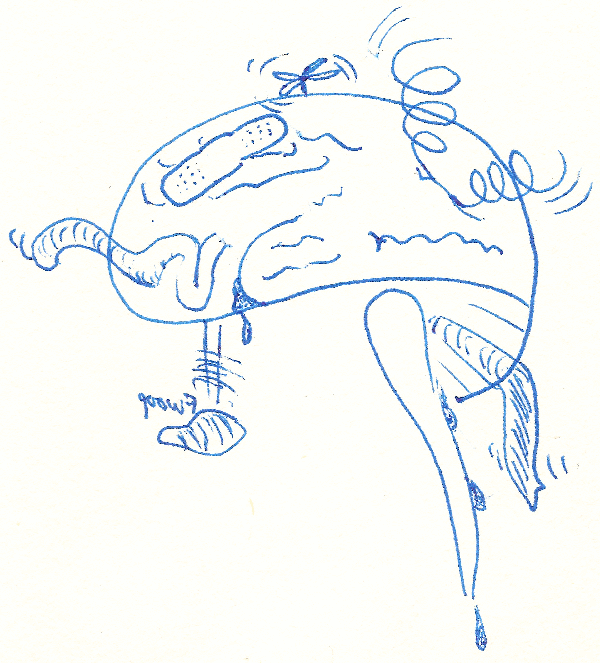
Sketch of brain, with bits falling off and popping out, and a bandaid over the worst

At the end of the day, I began to apply a bit of cognition to this experience (as you do) and realized something important…

The screaming was a whole lot quieter than it used to be; than it was, say, a year ago.

Last year, it was a lot quieter than when I first moved in here, right before the Pandemic. That was a tough time and the screaming was so loud I had to play the audiobooks and dvds at a fairly ridiculous volume to get the benefit. (The neighbor knocked on my wall a couple of times.) That volume might be partly why I now have ongoing tinnitus, a ringing in my ears that’s always at a different pitch and volume from the inward screaming. Clearly, my brain decided not to confuse the two.

Also, I noticed that my mind had actually recovered some ebb and flow!

There were times of day where it was natural to fix things, other times for doing something creative, times to sit and be quiet and times to move around and chat with the cats…

Natural texture and dimension in my mental activity, which the constant audiobooks had smoothed out and neutralized since they came back until that day of enforced quiet.

To the able-bodied and -minded, this is perfectly natural. It didn’t used to be for me. I had 10 or 12 alarms set throughout each day to tell me exactly when to do each kind of activity, because that mental texture had been quite, quite lost.

I got through 2 nights and a day without any alarms. I survived, and I also realized that alarms are jarring.

Who knew??

It turns out that my slowly-healing autonomic system has finally agreed with me that a stable diurnal schedule is a good thing to do, so I wake up within the same half-hour every day, without needing to be kicked awake by a series of 3-4 alarms.

The phone climbed out of its hiding place the next day. (Of course, I had already thoroughly checked there.) I canceled almost all of the alarms, except the one for feeding the cat.

I can make a short list for each day and get through it by riding those mental waves – and being kind if I can’t get them done at the very time that I wish to. It seems that being kind to myself knocks down a number of stress-related barriers.

Horse & woman laughing hysterically

I’m still digesting this new experience of the world. It’ll probably continue evolving over some time to come.

It’s not exactly normal to have such a significant level of recovery when you’re close to pushing 60 and sitting on 25 years of pain-related neurological disruption, including 20 years of dysautonomia.

So yeah, it was a sad day and not an easy one, but what a gift it turned out to contain!

I needed such a gift. My life is about to change drastically, and it’s up to me to work out which path to take through it. None of them are easy, but some could be more rewarding than others.

Can’t wait to see, not only how I’ll screw up, but what I’ll learn from it!

I’m going to try something new, as I navigate this tricky shift in life: asking for input and advice from people outside my head and its rabbit-warrens of associated ideas.

I know, wild idea… and for that reason alone, probably worth trying.


Defining my terms: burny brain

Current science states that there are no nerves that convey temperature or pain in the brain.

Well, not a normal brain.

Well… not as far as we know.

Since I’m terribly clear about the fact that my sensory experience of life has been extensively revised over the past quarter century of constant and increasingly centralized (that is, brain- and spine-driven) neurogenic pain, I’m going to sail sweetly right over that assumption and get on with today’s topic.

We live in the messy and extensive reality of the world outside of labs, scientific studies, and academic debates. Don’t worry about them – they’ll catch up eventually, usually in about 10-30 years.

Brain inflammation

Brain inflammation is one of those topics which patients and wholistic or ancillary professionals have been working with & evolving strategies for for years, but many clinical practitioners have trouble working out how it applies in real life, let alone how to work with it given current techniques.

Practical point:

This is not a dis of those practitioners, it reflects their environment of practice. Their training – and liability insurance coverage – focuses on what has been proven through multiple double-blind placebo-controlled studies, preferably on thousands of patients. Those take time, funding, lots of patients (which rare diseases don’t provide anyway), and a crucial position away from interfering with vested interests.

This is why clinical practice lags 10-30 years behind practical patient experience.

Where were we? Oh – brain inflammation.

One of my dear friends has been working specifically on chronic longstanding brain Inflammation, and it’s been validating as heck to see someone so smart, disciplined, and articulate work through that. Burny brain is, in my case, a sign of acute flare-ups, and talking the concepts over has helped me articulate my own situation.

And then there was Election Day and this lifelong historian & longtime spoonie saw my future get thrown on the flames.

NB: I don’t believe ideology or labeling, I believe that past performance is a good indicator of future behavior and, more importantly, that a written plan is a big fat clue about what to expect – and it’s not good for someone in my position.

After days of feeling staggered, my brain caught fire.

Inflamed brain, level 1

When a series of events, or one overwhelming and life-altering event, land in my life and awareness, my brain takes a few days to go into full bonfire mode. But it does:

Managing that

I depend on my well-established habits around self care and communication to mask my real state and continue to function, but it’s not reliable.

I crank up my vitamins, especially B complex, and do what it takes to get enough protein in. This is tricky, because eating is hard work and few things taste ok.

Keeping a stable schedule is important, to avoid feeding into the general autonomic instability.

Stabilize, stabilize, stabilize.

Since I lose track of time constantly in this state, I have to double-check whether I’ve taken my meds on time, and they’re one of the most important ways of stabilizing that there are.

If I had a bathtub, I’d take baths with vitamin C (20 min very warm; lie down on the C-powder as the bath fills) and then Epsom salt (20 min not so warm) then take naps – a fantastic 1-2-3 recovery technique that I really miss having access to. I recommend it highly.

Level 2

Once the flames get lower and my brain feels more like heavy coals, I know I’m making progress, although it doesn’t feel great:

This feeling of roaring combustion comes with big, fragile feelings. I limit contact and focus hard on noticing when & how I’m functioning, and grab tasks off the to-do list that relate to that.

So, laundry was a significant part of my weekend: no brain required, little physical effort, quick reward, and a huge improvement in my life. Now I’m  dressing off the clean laundry pile rather than my drawers & closet, because I can’t focus on folding & putting away, but that’s okay.

More veg today, partly because I was finally hungry for them, and also because protein was too difficult.

All the olive oil all the time.

Level 3

This is how my brain feels today, more or less:

Honestly, this still sucks beyond belief, but it is improvement and improvement is good. I could eat in portions larger than half-cups and palmfuls, finally.

Today, I wanted to make some calls about getting something fixed, but that wasn’t possible – I kept going blank and stumbling into furniture when I tried (burny brain comes with worse coordination).

Instead, I went and got a ball of yarn to finish a project, which felt good and freed up more focus; with that, I dropped in at the law library and learned how best to approach an issue and then did some online research with that in mind. Now, when I do make those calls that i couldnt make today, I’m actually going to be much better prepared. Still not possible, but it will be at some point.

I wanted to make progress on another administrative task (paperwork, urgh) but my friend has taught us that, even though the clock keeps ticking, when the inflamed brain says “no”, it’s useless to argue. Let it go and rest that brain.

So I put on a movie. Then a dear old friend called out of the blue and we enjoyed reconnecting. Very good for the brain!

Level 4

With any luck, tomorrow my brain will feel more like this, still raw and hot, but somewhat contained, and with more cool spots:

Unless something else happens to shake my foundations. You never know. But still, I hope for continued improvement!

If you’re having trouble understanding brain inflammation as a physiological thing, write a query in the comments and I’ll explain…

Later <grin>


Adaptation tools in use

As some of you know, CRPS & dysautonomia involve constant re-traumatizing of the brain & nervous system. Our brains have flows that can resemble that of people living with domestic violence, because the CRPS itself keeps waling on us physiologically, in the same way people who get abused are waled on physically and emotionally.
Old amber-screen lettering showing *TILT* like on old pinball machines
This is why psychotherapy is part of the gold standard of treatment for intense chronic pain generally, and CRPS particularly: it takes good, highly specialized training — and ongoing coaching — to keep re-claiming and re-training the brain, so it can climb out of the being-beat-up mode and stay in the this-is-what’s-going-on-right-now mode.

Since I take the view that “whatever it takes, I’ll do it” is the way to work with such an intransigent, mean-spirited illness… I’ve naturally been persistent about holding to the gold standard of treatment, and working hard to implement everything that works for me. (Let it be clear that, just because that’s such a nice pat sentence, it is a hard road and a lot of work. Sisyphus thought pushing the same rock up the same hill was a lot of work? He should try claiming & holding ground against pain-brain.)

I’ve had tremendously capable psychotherapeutic teachers & coaches, and my present providers are over the moon for me. I tell them, “Gee, it’s like this stuff works!”

***

It’s graduation season in this college-rich area, and there are a lot of transitions taking place. I had a glorious week of family visiting and more social time than I’ve had all year. It was lovely and absolutely wonderful… yet, for a dys-y system, it’s still a lot of work. Big emotions, even good ones, trigger big neurotransmitter flows and that takes managing.

Yesterday, I got set straight by a friend I’ll call V, which was terrifying (really don’t want to lose that one) but the relationship will be better for it.

Big emotions kick out dysautonomic systems, so I started up the brain-stabilizing routines. Cool.

Then, I found out that a friend I’ll call D had nearly bled out last week and was currently in the hospital with massively metastatic cancer. He was diagnosed with limited cancer right before the first Covid-19 lock down. You know what happened with hospitals after that.

So, because he couldn’t get any treatment when it was treatable, he’s now faced with pretty horrific options and chose to go for comfort care for a very short life rather than horrendous chemo with a poor outlook anyway. He was an extreme athlete and had a rough life as a wee wiry guy in the city, so pain is no stranger, but at his age, it starts looking stupid to chase more discomfort.

Because of wacky human stuff, we hadn’t spoken in quite awhile. I’m glad we couldn’t see each other during the call because I know I was crying from the first sentence he spoke, and I suspect he was too. He’s a live wire & a cheery sprite by nature, and he made me laugh before I made him laugh, so I’m happy to say he won that round. We sorted out some heavy material and he said very nice things that were good to hear.

After that conversation, my usual brain-care toolkit was useless.

The first thing I do is, “don’t rehearse, replay, or dwell on it.” This is because that’s how trauma-tracks get laid in.

The more it replays in the mind, the deeper the distress gets planted. So, whatever it takes to prevent another topic of PTSD from getting laid in, is what I do.

I do come back and evaluate the experience for lessons a little later, but first… got to let the flaring, blaring intensity wash off before it stains, so to speak!

When the anguish of 2 perilous-feeling conversations, atop a beleaguered and recently worn brain, keeps roaring back, my usual low-key books/ shows/ audio/ doodling distractions aren’t enough.

I sat back and reached for a thought I’d had recently. There’s nothing more stabilizing for those who can do it than… what was it again?

Activity. Bilateral activity.

In my case, taking a walk.
Walking cat,distorted with closeness while coming at the viewer
So, with my phone reading me an audio book at the same time (clever, right?), I pulled on appropriate garments and got my wobbling butt out the door, one foot after another.

Blaring replays started up often, but I’ve had practice with this technique, and I reminded myself that *now* I walk, breathe, and follow along with a silly story; processing events comes later, *not now.*

The blaring replays got quieter by the end of the walk, and by the time I was 2 blocks from home, I could just about bear to be in my skin again.

The combination of bilateral activity (walking, wheeling, and most forms of warming activity qualify) and the distraction of a plot to follow combined to get me through the first stage of harrowing. Yay!

I followed up on a task I’d committed to for V and meditated briefly on how to follow through on family notification for D, a task that couldn’t go further last night.

The first task wasn’t executed perfectly, but I saw the error almost immediately and rectified it.

The second task, the one for D, has yet to be tried: there’s no good way to tell someone their estranged, love-hate sibling is dying, but of course it must be done and it’s not my job to try to be perfect in an impossible situation, it’s my job to be an honest, kind, and diligent friend to both of them.

So, today, once my pills are down (i.e. in a couple of hours) I’m going to the Y for non-weight-bearing exercise (because there’s only so much walking my hips and legs will tolerate) and then do something involving lots of colors (either drawing or crochet) afterwards, while listening to another story… and waiting for D’s sibling to call, so I can relay the dreadful info.

Update:
D’s sibling called, took the news with love and tears, and we conferenced in D for an agonizingly beautiful conversation. Older Sibling being lovingly overbearing and Younger Sibling trying to keep one foot in what’s really do-able, with me occasionally calling time or translating across the gaps, felt very normal to me, even though it’s not my family.

Some things are just human.

So I’ll keep breathing. And drinking lots of water. And taking extra vitamins, because this kind of stuff sucks them right outta me. (Truth to tell, you’ve only heard half of it. It’s been quite a heckin’ week.)

I can see the point of fiddling as your own city burns. Wait, I mean, Nero was a hot mess and a dreadful person to have in charge, if the legends are true.

The point I’m striving (awkwardly) to make is that arty activity calms and settles the mind, so that even devastation is less all-consuming.

I think today is a colored pencils day, or possibly even crayons. Crochet takes more thought, and I don’t want to hold myself responsible for that yet. Besides, my arm tendons are acting up, so crochet isn’t wise.

Update, Part 2:
I think I’ll take some crayons to the gym. Is that allowed? XD

Feelings pass. It’s what they do.

New normals emerge, and we learn to live with what was once unthinkable.

Adaptation is a big job sometimes, but, well, here we go again.

Seat-shaped rock in a shallow stream.

The Place to Be

On a rock in a river

Clean quiet murbles and shushes

everything Not Me drawn gently off

So easy.


Skeeters drift on, slackjawed with peace.

Dogs huff and slosh in the shallows,

Just going by,

In furry certainty

That happy playtime is normal

And right.


White white aspen tickles

Blue blue sky

And the birds zip

& comment benignly

up there.


The wet scent

Of contentment

Soaks to my marrow

And I’m finally


Still.

Seat-shaped rock in a shallow stream.

A 3-point reality check in the armpit of winter

I’ve got a sweet, safe little spot all to myself now. I can’t talk about it much but the gratitude and relief is STUPENDOUS. It took over a month to begin to come home to the fact that I get to come home now.

Last week, I didn’t spend much time upright. Months of overdrafts on my body’s account were called in: colossal spoon-deficit.

If I’d had the energy to feel much, I would have been alarmed. I just couldn’t. I couldn’t anything: think, choose, feel, read, watch, be.

Pale mass of bubbles from underwater

Just drifted through the hours, mostly lying down, listening to audiobooks I’d read (or had read to me; thanks, Mom!) at least a dozen times before. Drifting in and out of the stories. Falling asleep early, waking late. Weird, spacey surges of energy got the kitchen cleaned a couple of times, and enough whole food cooked (can’t afford premade) to keep me fed for another 2 or 3 days.

The laundry pile and state of the floors don’t bear thinking about. I’ve started cleaning the floor, one square yard at a time, and so far that’s one square yard. Yay!

Last week, I was incredibly seduced by the idea of giving up the considerable ongoing effort of living. Oh, the peace, the comfort, the over-ness…

Eventually, I made an agreement with myself to simply wait until summer. That’s all. Anything else I did would be pure bonus. Even knowing I’ve got dreadfully important things to do, I had to be ready to put them aside to get this internal agreement to work.

Reasons

Of course, part of this is the wacky human version of hibernation, an unsatisfying slowdown without the restfulness or calm feelings that make it pleasant.

Cold dark winters are brutal. I never stop thinking about 2 things: deep warm baths and warm places to go in the winter. There’s no tub here and I’m not doing any more packing for awhile, though.

Compounded by longtime central pain, dysautonomia now with heart effects, bereavement, and recent protracted survival-stress, it’s really no darned wonder that letting this ride stop appealed to me!

I made promises which I take seriously, and there’s no question of my hurting myself. That’s just not going to happen.

I only wanted so badly to stop pushing back all the time, stop doing the relentless self-disciplines around every life activity — eating, sleeping, moving around, taking care of self and pet and home, making it to all those appointments, staying on top of my tasks, tracking the endless cyclogram* of signs & symptoms & exposures & feelings & barometric changes & solar weather & functional levels… you get the picture.

Stylized image of woman asleep with enormous red and black dress billowing around and supporting her. White snow falls from a deep blue sky

What chores await

I want the business from my failed homing efforts cleaned up and moved on as soon as possible, so I can stop paying rent on a useless space. Going back to it is a desperately nauseating thought. The place nearly killed me, I realize in retrospect.

At least one of my friends realized that at the time. Sigh.

Line drawing of woman flat on floor, with woozles coming out of her head
Image mine. Creative Commons share-alike attribution license, credit livinganyway.com.

I’m used to pushing past feelings, of course — “CRPS R US!” — but this stage of illness makes an issue out of being too dizzy or vomity to drive safely. (The vomiting is really intense and leaves me no control of my arms and legs… or anything, actually.)

I toy with the idea of a tree falling on the thing hard enough to trigger an insurance writeoff… happy thought! Well, actually, I’m not fussy; anything that totals it and doesn’t harm anyone would be fine with me.

Dreaming is free. Meanwhile, I’m working on healing as hard as I can. This is one of several weighty and important things to manage, and I know a few of you know how much that’s like trying to run with no legs.

But I’m getting better

This morning, I could actually taste the raw sugar in my tea. That’s kind of amazing. I didn’t realize I’d simply stopped being able to taste sweetness. It’s these little things that give me some rational hope.

This first day that I’ve been well enough to get out, I loaded up on blue fruit and low-FODMAP carbs.

Hubris, meet Reality-check

I’m sitting down to give these palpitations a chance to calm down before heading home. If I’m up to it, I’ll get some digestible protein; if not, I’ll go home and get back to horizontal.

Something about that statement seemed odd. H’mmm…

I know what to do when a statement seems odd: do a simple 3-step reality check!

Isy’s 3-step reality check**:
1. Review what I just said.
2. Take a moment to notice the totality of how my body feels, right now.
3. Think back over past 24 hours and look for other symptoms.

That took 5 seconds for the first 2 steps and another 6 for the third. It gets very efficient with practice.

I said to myself, “Self… Palpitations and breathlessness now, and seeing spots last night & this morning? You’re going home to lie the heck down, pal! No argument!” (The spots relate to blood flow, in my case, so heart symptoms have been acting up in a non-chest way.)

Can’t argue with that.

…Well, I could, but it’d be wilfully stupid and I disapprove of wilful stupidity — not just in politicians, but also in myself. So I’d better get stable enough to drive and then go home and lie down.

1 hr later…
I did.

Cats are masters of pa:ng 🙂

Footnotes
*A cyclogram is a way of charting multiple changing elements in a single system, using a circular graph. It can be useful for seeing overlaps, backtracks, correlations, and other patterns among the different elements. Whether it’s better than an oblong line-graph is a matter of taste, but I find the sense of spinning-ness very apt here!

**Step 1 keeps me on track. I had two professions where everything depended on my getting things right, but I’m not perfect (despite best efforts!) so I got into the habit, very early on, of mental review and double-checking myself.
Step 2 is nearly magical in its effect. I stole it from the stress- and uncontrolled-pain-management skillset. It’s key to getting on top of any mind-clouding moment. Try it out, it’s magnificent!
Noticing the body response is a tremendously powerful step to getting back in charge. Once we can notice the physical self in an overcharged state, we can learn to steer it to a better physical state — breathe better, stand or sit better, lift the neck, release the shoulders — and wow! Suddenly it’s not about being so overwhelmed, it’s about a single moment (in a whole life) which we’re managing and moving more gracefully through. Great tool. Gets better and better with practice.
Step 3 I add for health issues, because chronic conditions need more context so we can figure out what’s going on. I started doing that for patients 30 years ago, so there’s a special rolodex in my brain for recent symptoms. When that rolodex went missing during the Hell Years, I noted symptoms & signs in my journal, which lived by my berth on the boat, always in reach. Over time (time which was passing anyway) that ability gradually got rebuilt.
Tracking matters. It really matters.

Angel wings & tactical things

This morning, I woke up feeling like a butcher knife was lodged in my heart, the memory of barking and snarling voices ringing in my ears. No surprise there; it’s to be expected.

My first coherent thought was, “This needs to be better.” I think that about a lot of things, but this one is mine to deal with.

I pulled one of my tools out of my mental toolkit, and flicked my eyes from ceiling to floor, ceiling to floor. (I’m a side-sleeper.) When I felt an urge to close my eyes, I did. When I opened them again, the butcher knife had shrunk to the size of a stiletto, maybe a medium-sized knitting-needle.

This magic technique is one way of using “bilateral stimulation.” Bilateral stimulation is a way of using neuro-anatomy to manage neuro-chemistry, using your brain signals to heal your mind. There’s loads of material on it in the field of trauma psychology.

Basically, the way our brain processes “sidedness” (the fact that we have a left, a right, a front, and a back) is even deeper than the way it processes strong, primitive emotions, like fight-or-flight-or-freeze. Those emotions tend to disrupt the brain’s normal processing of memory, thought, and decision-making, which can be useful when mastodons are stomping over your village — what you need to do is move faster than you’ve ever done in your life, and not camp on their migratory route in the future.

Most decisions we have to make are not on that order. Even when we live with a brain that keeps wanting to go there, it’s still rarely useful. So, it’s wise to have a few tools that can keep it in check when it’s working “after hours”, so to speak.

One way to do that, which works for most ordinary stressors, is meditation. It gives me practice in creating a still space inside, where I can survey my surroundings, assess things, and choose the best way forward, from this non-triggered space. The “success” of individual meditation sessions is irrelevant to this skill, because it comes naturally as a result of persistently going back to meditation and working on it over and over. Like with many things regarding central nervous system care, persistence is key.

When my skills are toppled over by what goes on around me (cf. my last post! A perfect example of losing it and coming back again), these other tools come out of my “bag of tricks.”

Glancing from one side to another is easy, portable, and requires only some vision and muscular control of your eyes. Pick a spot about 45-60 degrees ahead of you on your left, and a corresponding spot on your right. Flick your glance from one to the other, and back again, not too fast, not too slow. The right speed varies from person to person and time to time. Feel out the point where your system naturally drops to a median, attentive level. It doesn’t feel dramatic or unnatural; I experience it as a sort of a natural pause, as if it’s waiting calmly for something reasonable. Getting someone properly trained in EMDR to teach you what this feels like is really helpful, but you might be able to find it yourself.

There’s a bit more to it: real EMDR training starts with finding, and programming into that deep layer, a “safe place” to go to in your mind; establishing a certain connection with what some call “your wise self”, so you can re-assess your situation and re-evaluate your responses without the triggering; and learning what happens to you, in particular, during the process, so you can self-treat with fewer problems and more success.

Other techniques of bilateral stimulation include the “butterfly hug.” Cross your arms so your hands rest on your opposite collarbones, and tap one side, then the other side. This feels very comforting. It’s not my go-to, because the nerves going through my elbows don’t like bending up that much.

Thigh tapping is widely taught in disaster- and war-related trauma recovery. It can be done sitting, standing, or lying down. Simply tap your legs, first one side, then the other, with the hand on that side. Left hand left leg, Right hhand right leg, back adn forth. The signal demands attention from the brain, which pulls itelf off of panic duty and gets back to processing information and sorting memories in a healthier way.

My physical therapist recently taught me the cross-body crawl. I can do this standing, sitting, or lying down on my back. Reach over with one hand and bring up the opposite knee, then switch sides, back and forth.

This does several things: it provides bilateral stimulation, which calms the panicky system down. It tones the core muscles, especially done while walking! It reminds the brain where the limbs are, which is kind of a huge deal with CRPS, which tends to muddle our brain’s map of our bodies. The cross-body crawl tops my current list of things I wish I wouldn’t do in public, because people look at me funny, but I’m going to do it anyway, because it’s so helpful to me.

I’m also able to focus on nutrition, physically the biggest player in the healing game. I made a green soup last night — Not Chik’n brand bouillon with all the green things I could find in the store that weren’t cabbage relatives (because they push down on my thyroid), and yesterday that was parsley, leeks, mature spinach, celery, and dandelion greens, plus carrots to smooth it all out. I cooked the rather harsh-smelling leeks in butter until the smell sweetened, then dumped everything but the spinach in and simmered for awhile, letting the minerals leach out into the broth. Then I cooked the spinach on top more briefly (so it wouldn’t get bitter) and threw it all in the blender.

As my friend said, “It’s like a chlorophyll bath.”

Meanwhile, as long as I persist in my meditative practice, the work on finding a home charges ahead. It’s a lasting puzzle to the linear part of my mind why an hour spent on meditation makes the other 3-4 functional hours I can squeeze out of the day ten times more effective. I’m gaspingly glad that it does, because it’s a heck of a job to find a safe place for this body.

This cascade of events has carved into my very bones the understanding that it’s meditation that will save me in the end. It’s the axis of my mundi, strange as that may seem to those who’ve witnessed any of my eventful life.

I feel the wings of angels stirring my hair now, and I can’t worry, only take the leap and trust that I’ll fly, rather than fall.